
Imagine walking through a lush Asian forest, reaching out to steady yourself on what appears to be a thin green branch, only to have it turn its head and fix you with an unblinking stare. This is the Asian Vine Snake, one of nature’s most masterful practitioners of camouflage and one of the most visually striking serpents on Earth. With their impossibly slender bodies, vibrant coloration, and almost alien-like facial features, these snakes represent evolution’s answer to life in the canopy. What makes the Asian Vine Snake truly fascinating isn’t just its appearance—it’s the suite of specialized adaptations that allow it to thrive in one of the most challenging environments on the planet: the tangled chaos of tropical and subtropical tree branches.
Facts
- Binocular Vision: Asian Vine Snakes possess horizontal, keyhole-shaped pupils and forward-facing eyes that give them binocular vision—a rarity among snakes that allows them to judge distances with remarkable precision when striking at prey.
- Camouflage Champions: Their body shape is so elongated and stick-like that they can sway in the breeze, mimicking vine movements to become virtually invisible to both predators and prey.
- Mild Venom: While possessing venom, Asian Vine Snakes are rear-fanged and pose minimal danger to humans; their venom is primarily adapted to immobilize small lizards and frogs.
- Tongue Color Variation: Some species display brightly colored inner mouths—orange, blue, or red—which they reveal as a warning display when threatened.
- Slow-Motion Hunters: These snakes often hunt by moving so slowly that their prey doesn’t register movement, freezing mid-stride for extended periods before the final strike.
- Geographic Diversity: Different species of Asian Vine Snakes inhabit regions from India to the Philippines, each adapted to their specific microhabitats.
- Arboreal Specialists: They spend nearly their entire lives in trees, with specially adapted scales on their bellies that help them grip branches and traverse even thin vegetation.
Species
Kingdom: Animalia
Phylum: Chordata
Class: Reptilia
Order: Squamata
Family: Colubridae
Genus: Ahaetulla
Species: Multiple species, with Ahaetulla nasuta (Long-nosed Vine Snake) being the most common
The genus Ahaetulla contains approximately eight to nine recognized species, though taxonomic classifications continue to evolve as genetic research reveals new distinctions. The most prominent species include Ahaetulla nasuta (the Long-nosed or Common Vine Snake), Ahaetulla prasina (the Oriental Whip Snake or Asian Vine Snake), and Ahaetulla pulverulenta (the Brown Vine Snake). Each species has evolved specific adaptations to their regional environments, though they share the characteristic elongated body form and arboreal lifestyle. Some species show remarkable color polymorphism, with individuals ranging from brilliant green to brown, yellow, or even gray depending on their specific habitat and individual variation.
Appearance
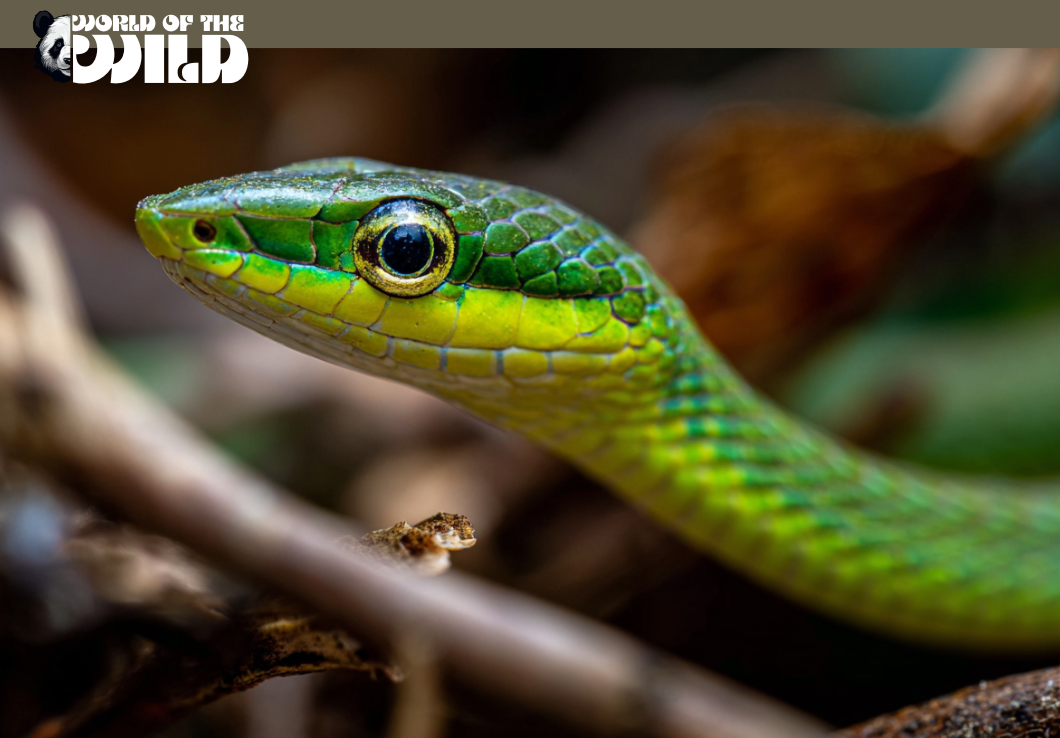
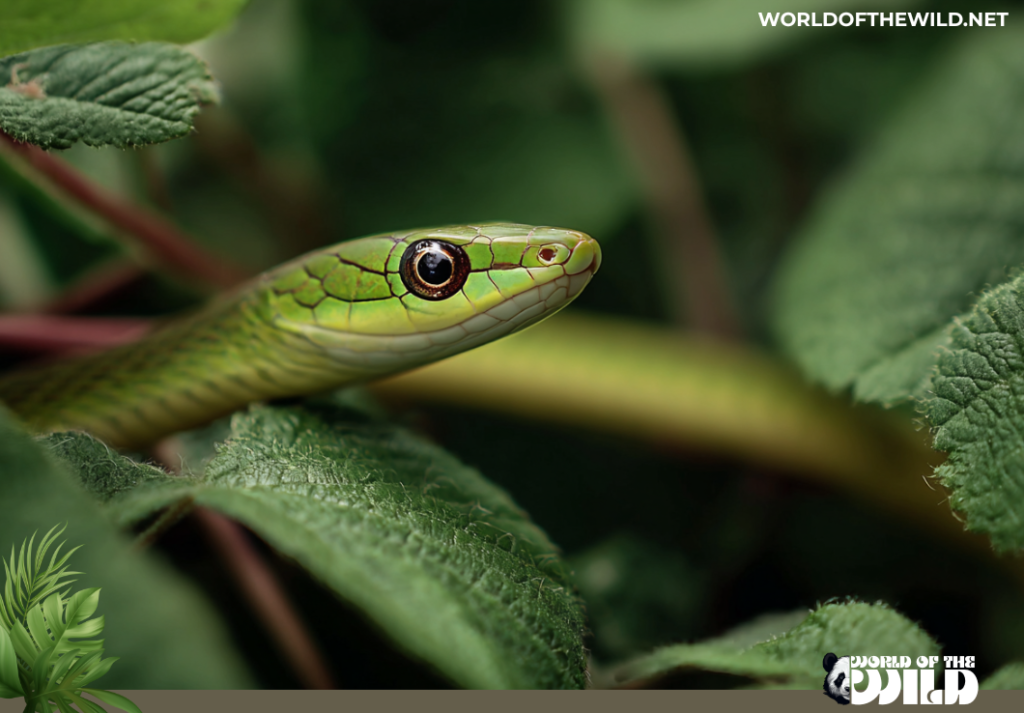
The Asian Vine Snake is instantly recognizable by its extraordinarily slender, elongated body that can reach lengths of 4 to 6 feet, though some specimens exceed this range. What truly sets them apart is their disproportionately thin profile—often no thicker than a human finger—making them appear almost two-dimensional when viewed from certain angles. Their heads are distinctly lance-shaped and elongated, with some species sporting an extended, pointed snout that gives them an almost comical appearance.
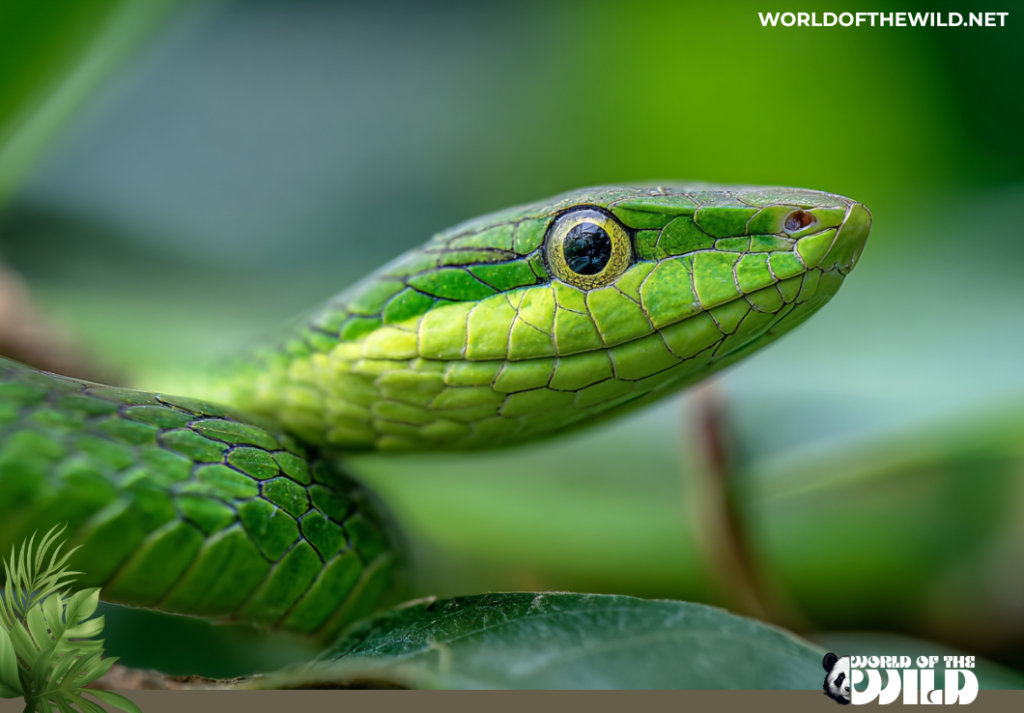
The coloration of Asian Vine Snakes is typically a vibrant leaf-green, providing exceptional camouflage among foliage, though brown and grayish variants exist, particularly in drier habitats. Many individuals display a subtle yellow or white stripe running along their sides, enhancing their resemblance to plant stems. Their scales are smooth and possess a slight iridescence that catches light like living leaves.
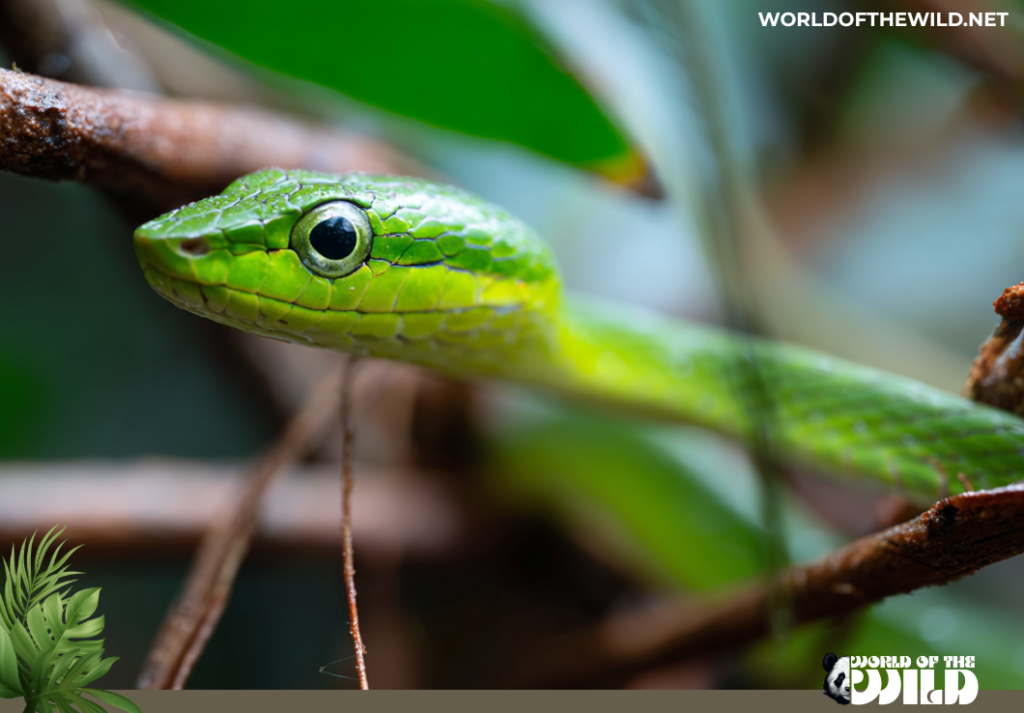
Perhaps most striking are their eyes—large, forward-facing, and equipped with horizontal, keyhole-shaped pupils that give them an almost intelligent, calculating expression. The eyes are often outlined in white or yellow, creating a mask-like appearance. Their tongue is typically dark, though the inside of their mouth may be brightly colored. Adult specimens rarely exceed 200 grams in weight, contributing to their ability to navigate even the thinnest branches without causing significant movement that might alert prey or predators.
Behavior
Asian Vine Snakes are primarily diurnal hunters, most active during daylight hours when their prey is also active. They are solitary creatures, only seeking out others of their kind during the breeding season. Their hunting strategy is a masterclass in patience and precision—they employ a technique called “periscoping,” where they extend the front third of their body horizontally from a branch, remaining perfectly still or swaying gently to mimic vegetation moved by wind.
When prey is spotted, the snake employs one of two strategies: either an agonizingly slow approach, moving so incrementally that motion-sensitive prey like lizards fail to detect the threat, or a lightning-fast strike that can cover a surprising distance thanks to their long, flexible bodies. Their binocular vision allows them to gauge distance with accuracy that would make most snakes envious.
When threatened, Asian Vine Snakes first rely on their camouflage, remaining motionless. If this fails, they may inflate their neck region to display colorful interstitial skin between their scales, creating a striped or banded pattern. Some species open their mouths wide to reveal brightly colored interiors—a startling warning display. Despite being venomous, they are reluctant to bite humans and will typically flee if given the opportunity.
These snakes demonstrate remarkable intelligence in navigating their three-dimensional arboreal environment, seemingly understanding complex spatial relationships as they plot routes through the canopy. They communicate primarily through body language and chemical signals, though little research has been conducted on their social behaviors beyond mating.
Evolution
The evolutionary history of the Asian Vine Snake traces back to the broader radiation of colubrid snakes, which began to diversify approximately 40-50 million years ago during the Eocene epoch. The Ahaetulla genus represents a specialized branch of this family that adapted specifically for arboreal life in tropical and subtropical forests of Asia.
The extreme body elongation seen in modern Asian Vine Snakes is an evolutionary response to the demands of arboreal locomotion. Fossil evidence of similar body plans in ancient tree-dwelling snakes suggests this adaptation evolved multiple times independently across different snake lineages—a classic example of convergent evolution. The development of binocular vision in these snakes represents a significant evolutionary innovation, as the standard snake eye configuration doesn’t favor depth perception. This likely evolved under strong selective pressure for accurate striking in a three-dimensional environment where misjudging distance could mean falling or missing prey.
The rear-fanged venom delivery system of Asian Vine Snakes represents an intermediate evolutionary stage between non-venomous snakes and the advanced front-fanged venomous species. Their venom composition appears optimized for immobilizing small ectothermic prey like lizards, suggesting a long co-evolutionary relationship with these food sources.
Recent molecular studies suggest that the Ahaetulla genus diverged from other Asian colubrids during the Miocene epoch, approximately 15-20 million years ago, coinciding with major changes in Asian forest ecosystems and the diversification of their primary prey species.
Habitat
Asian Vine Snakes inhabit a broad geographic range across South and Southeast Asia, extending from India, Sri Lanka, and Bangladesh through Myanmar, Thailand, Cambodia, Vietnam, Malaysia, Indonesia, and into the Philippines. Their distribution follows the availability of suitable forest habitats across this vast region.
These snakes are obligate arboreal dwellers, rarely descending to the ground except to cross between trees or during extreme circumstances. They show a strong preference for dense vegetation in tropical and subtropical forests, including rainforests, bamboo thickets, mangrove swamps, coastal scrublands, and even well-vegetated gardens and plantations. They thrive in areas with high humidity and temperatures ranging from 75-90°F.
Within their habitat, Asian Vine Snakes occupy the middle to upper canopy layers, typically residing 6 to 30 feet above the ground where foliage is dense enough to provide cover but open enough to allow movement. They favor areas near water sources, as these locations attract their preferred prey species. The specific vegetation structure is crucial—they require thin, flexible branches and abundant leaf cover that matches their body shape and color.
Interestingly, these snakes have shown remarkable adaptability to human-modified landscapes, successfully colonizing parks, gardens, and agricultural areas where sufficient vegetation remains, though they always maintain proximity to more substantial forest patches.
Diet
Asian Vine Snakes are strict carnivores with a diet heavily weighted toward small vertebrate prey. Lizards constitute the primary food source for most populations, with agamid lizards, geckos, and anoles being particularly favored targets. Tree frogs represent the second major component of their diet, especially during monsoon seasons when amphibian populations peak.
Occasionally, these snakes will consume small birds, bird eggs, and even other snakes, though such prey items are opportunistic rather than staple foods. Juvenile Asian Vine Snakes may also feed on large insects, particularly during their first months of life when they’re too small to tackle vertebrate prey effectively.
Their hunting methodology is specifically adapted to their diet. The slow-motion stalking technique works exceptionally well against lizards, which rely on motion detection to identify threats. Once within striking range—often less than a body length away—the snake launches forward with remarkable speed, seizing the prey in its jaws. The rear-positioned venom fangs then deliver a mild neurotoxic venom that quickly immobilizes the struggling animal.
The venom serves a dual purpose: subduing the prey and beginning the digestive process. Even after the initial bite, Asian Vine Snakes continue to work the prey backward in their mouth until it reaches the venom-delivering fangs, ensuring proper envenomation. Small prey items are often consumed alive and struggling, while larger items are held until the venom takes full effect.
Predators and Threats
Despite their effective camouflage, Asian Vine Snakes face predation from various sources. Arboreal predators pose the greatest natural threat, including larger snakes such as rat snakes and king cobras, which actively hunt other serpents. Raptors, particularly serpent eagles and hawk-eagles, have keen eyesight capable of detecting the vine snake’s form against vegetation. Tree-dwelling mammals like civets, mongooses, and certain primates will also opportunistically prey on these snakes when encountered.
Predation risk is highest for juveniles, which are more vulnerable and lack the size to defend themselves effectively. Eggs face threats from monitor lizards, rats, and ants that can decimate entire clutches if nests are discovered.
The most significant threats to Asian Vine Snake populations are anthropogenic. Habitat loss through deforestation for agriculture, urban development, and logging operations has severely fragmented their range across Southeast Asia. Unlike terrestrial snakes that can sometimes adapt to agricultural landscapes, Asian Vine Snakes require substantial tree cover and cannot survive in clear-cut areas.
Climate change poses an emerging threat by altering the distribution and abundance of their forest habitats and prey species. Changing rainfall patterns affect the availability of frogs and lizards, while temperature increases may push snakes toward higher elevations or latitudes where suitable habitat becomes increasingly limited.
Additional human threats include direct persecution—many people kill snakes indiscriminately out of fear, despite these species posing minimal danger to humans. The exotic pet trade also impacts wild populations in some regions, with collectors targeting the most vibrantly colored individuals. Road mortality is another concern in areas where forest patches are separated by roads that snakes must cross during dispersal.
Reproduction and Life Cycle
Asian Vine Snakes are oviparous, reproducing through egg-laying rather than live birth. The breeding season typically coincides with the onset of monsoon rains, which varies by region but generally occurs between April and July. During this period, males become more mobile, actively searching for receptive females using chemical cues detected through their forked tongues.
Courtship behavior involves the male pursuing the female through the branches, engaging in a complex dance where he aligns his body alongside hers, often jerking and quivering to stimulate her receptivity. Mating can last several hours, with the male securing his position by wrapping around the female’s body.
Following successful mating, females undergo a gestation period of approximately 2-3 months before laying eggs. Clutch sizes typically range from 3 to 12 eggs, depending on the female’s size and condition. The eggs are elongated, leathery, and white, measuring roughly 1-1.5 inches in length. Females select protected locations for egg deposition, often choosing tree hollows, dense vegetation clumps, or beneath bark.
Parental care ends after egg-laying, with no maternal protection of eggs or hatchlings. The incubation period lasts 60-80 days, with temperature playing a crucial role in development time. Hatchlings emerge at approximately 10-12 inches in length, already equipped with venom and hunting instincts. They are miniature replicas of adults, though often displaying more vibrant coloration.
Juvenile growth is relatively rapid in the first two years, with sexual maturity typically reached at 2-3 years of age. In the wild, Asian Vine Snakes can live 8-12 years, though captive specimens with optimal care have survived beyond 15 years. Mortality is highest in the first year of life, with estimates suggesting only 20-30% of hatchlings survive to breeding age.
Population
The conservation status of Asian Vine Snakes varies by species and region. Most species are currently listed as Least Concern by the International Union for Conservation of Nature (IUCN), indicating they are not immediately threatened with extinction. However, this classification masks concerning regional trends and the impacts of ongoing habitat loss.
Global population estimates for Asian Vine Snakes are difficult to establish due to their cryptic nature, arboreal lifestyle, and wide distribution across multiple countries with varying levels of scientific monitoring. Population density studies suggest healthy forest habitats may support 5-15 individuals per hectare, but these numbers fluctuate significantly based on prey availability and habitat quality.
Population trends show decline in areas experiencing rapid deforestation, particularly in Southeast Asian regions where agricultural expansion continues to accelerate. In contrast, populations appear stable in protected forest reserves and areas with slower rates of habitat modification. Some species, like Ahaetulla nasuta, maintain relatively robust populations across much of their range due to their adaptability to secondary forests and human-modified landscapes.
The lack of comprehensive population monitoring across their range represents a significant gap in conservation knowledge. These snakes’ arboreal habits make them far less likely to be encountered during standard herpetological surveys, which typically focus on ground-dwelling species. As a result, population declines may be occurring unnoticed in many regions.
Regional extinctions have likely occurred in areas where forests have been completely cleared, though documentation of such events is sparse. The species’ future largely depends on forest conservation efforts across South and Southeast Asia, with their fate tied to broader ecosystem health.
Conclusion
The Asian Vine Snake stands as a testament to evolution’s creative power, transforming a predator into a living branch that exemplifies the perfect marriage of form and function. From their binocular vision and patient hunting strategies to their impossible slenderness and vibrant camouflage, these snakes represent specialization at its finest. They are integral components of their forest ecosystems, controlling lizard and frog populations while serving as prey for larger predators.
Yet like so many specialized species, the Asian Vine Snake’s greatest strength—its perfect adaptation to arboreal life—has become its vulnerability in a rapidly changing world. As forests fall to development and agriculture, these snakes lose not just habitat but their entire way of life. Their survival depends on our collective commitment to preserving the complex forest ecosystems of South and Southeast Asia.
The next time you encounter images of these remarkable serpents, or if you’re fortunate enough to spot one during forest travels, remember that you’re witnessing millions of years of evolutionary refinement. Supporting conservation efforts, protecting forest habitats, and fostering appreciation for even the most overlooked creatures ensures that future generations can marvel at nature’s living branches swaying among the trees.
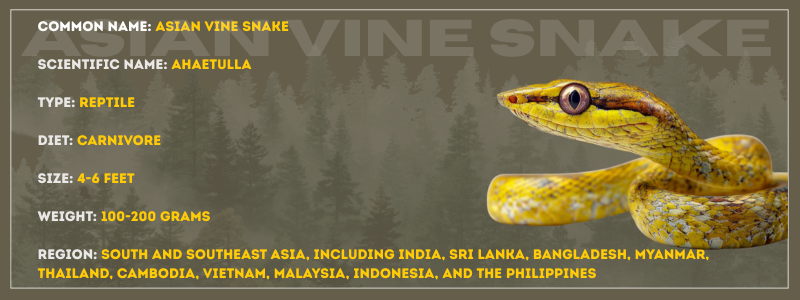
Scientific Name: Ahaetulla species (most commonly Ahaetulla nasuta and Ahaetulla prasina)
Diet Type: Carnivore
Size: 4-6 feet (1.2-1.8 meters) in length
Weight: 100-200 grams
Region Found: South and Southeast Asia, including India, Sri Lanka, Bangladesh, Myanmar, Thailand, Cambodia, Vietnam, Malaysia, Indonesia, and the Philippines