
In the shadowy forests and rocky outcrops of Central America, a small, exquisite creature emerges as darkness falls. The Central American Banded Gecko (Coleonyx mitratus) may be diminutive in size, but it’s a masterpiece of evolutionary design. With its delicate bands of color, cat-like eyes that lack eyelids, and soft, velvety skin, this nocturnal gecko represents a fascinating branch of the gecko family tree—one that has traded the famous sticky toe pads of its relatives for a different evolutionary path. These enigmatic lizards are living fossils of sorts, their lineage stretching back millions of years, and they continue to thrive in their specialized niche by being perfectly adapted to life in the dark. Understanding this remarkable species offers us a window into the incredible biodiversity of Central American ecosystems and the subtle beauty of creatures that most people will never encounter in the wild.
Facts
- Eyelid Advantage: Unlike most geckos, Central American Banded Geckos have movable eyelids and can blink, which is why they’re sometimes called “eyelid geckos.” This makes them stand out in a family where most members have fused, transparent eyelids.
- Vocal Communicators: These geckos produce soft squeaking sounds, particularly during territorial disputes or mating encounters, adding an auditory dimension to their otherwise silent nocturnal world.
- Temperature-Dependent Development: The sex of their offspring can be influenced by incubation temperature, with warmer temperatures typically producing more males.
- Tail Autonomy Masters: When threatened, they can drop their tails with remarkable ease, and the detached tail continues to wriggle vigorously for several minutes, distracting predators while the gecko escapes.
- Slow and Steady Hunters: Unlike the lightning-fast strikes of many lizards, these geckos stalk their prey methodically, moving in slow motion before executing a precise, calculated attack.
- Skin Shedding Ritual: They consume their shed skin after molting, recycling valuable nutrients and eliminating evidence that might attract predators.
- Long-Lived for Their Size: In captivity, these geckos can live 10-15 years, which is impressively long for such a small reptile.
Species
Classification:
- Kingdom: Animalia
- Phylum: Chordata
- Class: Reptilia
- Order: Squamata
- Family: Eublepharidae
- Genus: Coleonyx
- Species: Coleonyx mitratus
The Central American Banded Gecko belongs to the family Eublepharidae, commonly known as the eyelid geckos. This family is distinct from the more familiar Gekkonidae family, which includes the house geckos and tokay geckos with their adhesive toe pads. The genus Coleonyx contains several species distributed across the Americas, with the Central American Banded Gecko representing the southernmost extension of this genus.
Within Coleonyx mitratus, there are no officially recognized subspecies, though some geographic variation in coloration and pattern exists across its range. The species is closely related to other Coleonyx species found further north, including the Texas Banded Gecko (C. brevis), the Western Banded Gecko (C. variegatus), and the Barefoot Gecko (C. switaki). These species share similar morphological characteristics and ecological niches, representing an ancient lineage of geckos that have remained relatively unchanged for millions of years.
Appearance
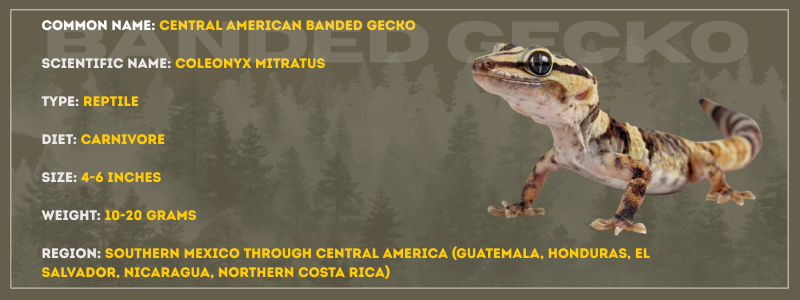
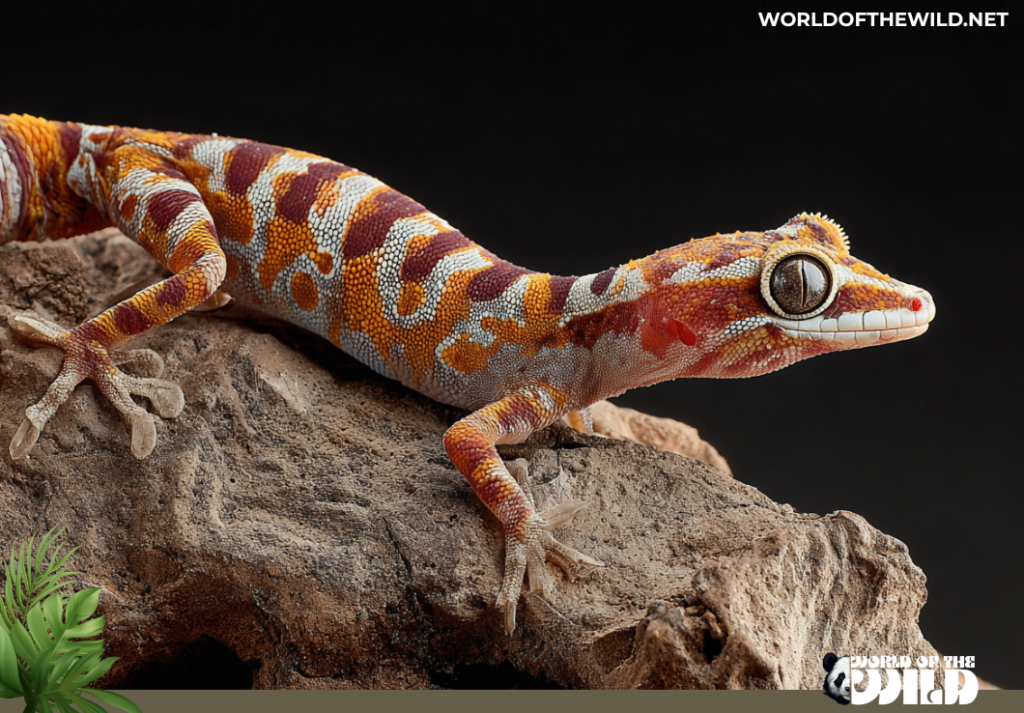
The Central American Banded Gecko is a study in delicate beauty. Adults typically measure between 4 to 6 inches in total length, with the tail accounting for roughly half of that length. They are slender and graceful, weighing a mere 10 to 20 grams—light enough to rest comfortably on a human finger.
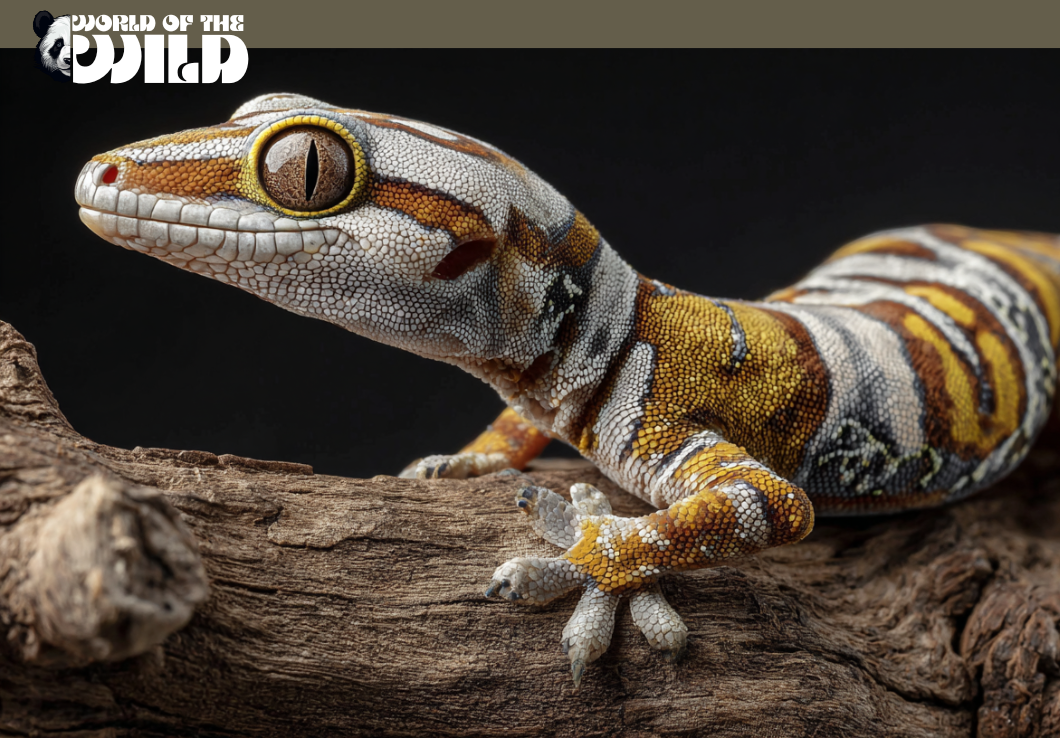
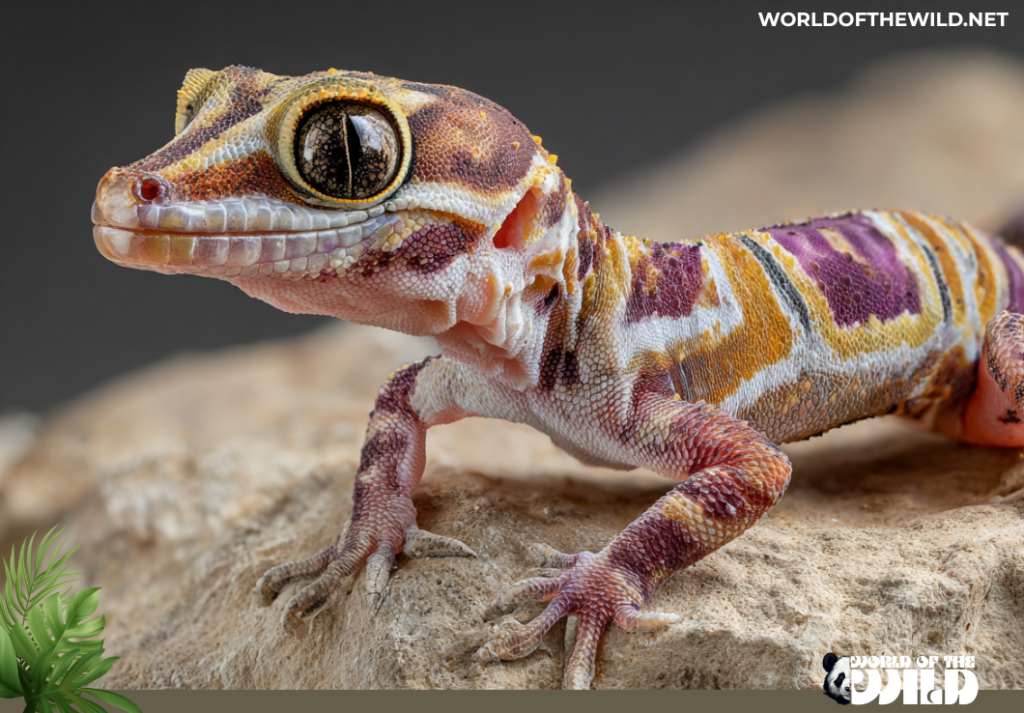
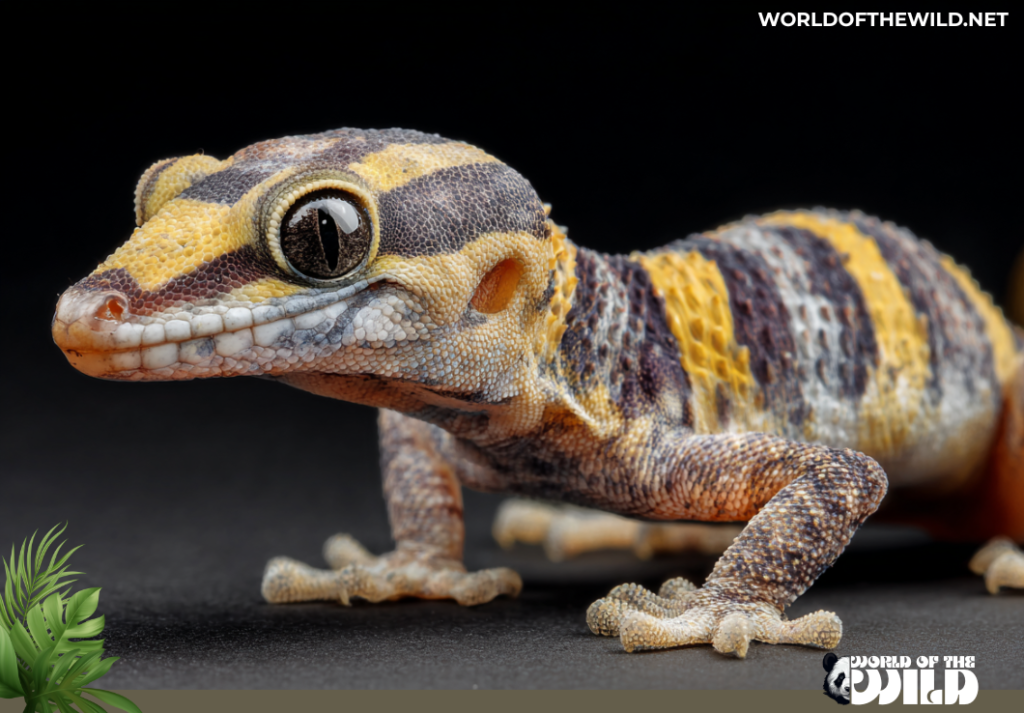
Their most distinctive feature is their striking banded pattern. The body is adorned with alternating bands of cream, yellow, or pale pink interspersed with darker bands of brown, chocolate, or deep purple-black. These bands are more pronounced in juveniles and may fade somewhat with age, creating a more mottled appearance in mature adults. The head is proportionally large with a gentle, almost sweet expression created by their prominent eyes.
Those eyes are truly remarkable—large, lidded, and featuring vertical pupils that dilate widely in darkness, much like a cat’s. The iris often displays a golden or amber hue that seems to glow in the right light. Unlike the adhesive-toed geckos, their toes are equipped with small claws rather than lamellae (the microscopic hair-like structures that enable wall-climbing), giving them a more traditional lizard-like appearance.
The skin has a soft, almost velvety texture, quite different from the bumpy, granular skin of many gecko species. The scales are small and smooth, contributing to their refined appearance. During the breeding season, males may develop more vibrant coloration, and the base of their tail becomes noticeably wider due to the hemipenes storage.
Behavior
Central American Banded Geckos are quintessentially nocturnal creatures, spending their days hidden beneath rocks, inside crevices, or buried in loose substrate. As the sun sets and temperatures cool, they emerge to begin their nightly activities. Unlike many gecko species, they are primarily terrestrial, preferring to hunt and explore on the ground rather than climbing vertical surfaces.
These geckos are generally solitary animals, with each individual maintaining a small territory that they defend against others of the same sex. During encounters, males engage in elaborate displays that include tail waving, body arching, and vocalizations—those characteristic squeaks that serve as warnings to rivals. Physical combat is rare, as most disputes are resolved through these ritualistic displays.
Their hunting strategy demonstrates remarkable patience and precision. They rely heavily on their excellent vision to detect movement, often remaining motionless for extended periods while watching potential prey. When they strike, the movement is swift but measured—a controlled lunge rather than an explosive attack. They use their tongue to assess chemical signals in their environment, supplementing their visual hunting with olfactory information.
Intelligence in geckos is difficult to assess by mammalian standards, but Central American Banded Geckos demonstrate problem-solving abilities and spatial memory. They can learn and remember the locations of productive hunting grounds and safe retreat sites. In captivity, individuals have been observed recognizing their keepers and associating human presence with feeding times.
One of their most fascinating behavioral adaptations is their response to threats. When cornered, they may emit their squeaking call, raise their tail and wave it back and forth as a distraction, or simply drop the tail entirely. The autotomized tail continues moving independently, creating a diversion while the gecko escapes. Though the tail will regenerate, it never quite matches the original in color or pattern.
Evolution
The evolutionary story of the Central American Banded Gecko reaches back to the Late Cretaceous period, roughly 100 million years ago, when the Eublepharidae family first diverged from other gecko lineages. This ancient split occurred before the evolution of adhesive toe pads, which explains why eyelid geckos lack this feature that has become synonymous with the gecko family.
The Coleonyx genus is believed to have originated in North America and gradually expanded its range southward. Fossil evidence of eublepharid geckos is scarce due to their small, delicate bones, but genetic studies suggest that the lineage has remained relatively conservative in its body plan and ecological niche. The genus represents what scientists call a “relict” group—survivors of an ancient radiation that once included more diversity but has since been reduced to a handful of species.
The Central American Banded Gecko’s ancestors likely migrated into Central America during periods of favorable climate and habitat connectivity, possibly during the Pliocene epoch (5.3 to 2.6 million years ago) when land bridges facilitated species exchange between North and South America. Over time, isolated populations evolved the specific color patterns and adaptations we see today.
Their retention of movable eyelids and clawed toes, rather than the fused spectacle and adhesive pads seen in most modern geckos, represents a more primitive condition. This doesn’t mean they are “less evolved,” but rather that they occupy a niche where these ancestral features remain advantageous. Their evolutionary success lies not in innovation but in perfecting an ancient formula for nocturnal, ground-dwelling predation.
Habitat
The Central American Banded Gecko inhabits a geographic range that extends from southern Mexico through Guatemala, Honduras, El Salvador, Nicaragua, and into northern Costa Rica. This distribution follows the mountainous spine of Central America, where their preferred habitats are most abundant.
These geckos thrive in dry to seasonally dry tropical forests, particularly areas with rocky outcroppings and sparse ground cover. They show a strong preference for limestone karst formations, volcanic rock fields, and boulder-strewn hillsides where crevices and caves provide abundant shelter. Elevation-wise, they typically occur between 300 and 1,500 meters above sea level, though they occasionally venture to lower or higher elevations where suitable microhabitats exist.
The ideal habitat features a mosaic of open areas for hunting and numerous hiding spots for daytime retreat. They favor locations with leaf litter and loose substrate where they can burrow if needed, but with enough bare ground or rock to facilitate movement and thermoregulation. During the dry season, they concentrate near areas that retain some moisture, such as rocky seeps or the bases of cliffs.
Temperature is a critical factor in their habitat selection. They require warm enough conditions to remain active but avoid extreme heat. The rocky habitats they prefer offer thermal diversity—sun-warmed surfaces for basking in the evening and cool crevices for escaping daytime heat. Humidity requirements are moderate; they need enough moisture to prevent dehydration but thrive in areas that would be considered semi-arid.
Human modification of the landscape has fragmented their once-continuous habitat, though they can persist in moderately disturbed areas if rocky refuges remain. Agricultural expansion, particularly in lowland areas, has pushed populations into increasingly isolated highland pockets.
Diet
The Central American Banded Gecko is a dedicated carnivore, specializing in small invertebrates that share its nocturnal activity pattern. Their diet primarily consists of insects, with a particular preference for soft-bodied prey such as crickets, moths, small beetles, termites, and caterpillars. They also consume spiders, centipedes, and other small arthropods, adjusting their prey selection based on seasonal availability.
Hunting is a deliberate, methodical process. These geckos don’t actively chase down prey; instead, they patrol their territory slowly, using their exceptional night vision to scan for movement. When potential prey is spotted, the gecko freezes, assessing the target. It then begins a careful stalk, moving with agonizing slowness to avoid detection. Once within striking distance—typically just a few centimeters—the gecko lunges forward, opening its mouth wide and snapping its jaws shut on the prey.
The capture technique is precise rather than powerful. Their jaws are designed to hold struggling insects rather than crush heavily armored prey, which is why they prefer softer targets. Once captured, prey is typically swallowed whole after some repositioning to ensure head-first consumption.
Their foraging strategy is opportunistic but selective. They ignore prey that is too large or well-defended (like large beetles with hard elytra) and focus on items that can be subdued quickly and swallowed easily. Juvenile geckos take smaller prey proportional to their size, often focusing on springtails, termites, and tiny spiders.
Water is obtained primarily through their prey, though they will drink droplets of dew or rain when available. In particularly dry periods, they may lick moisture from cave walls or humid rock surfaces.
Predators and Threats
Despite their nocturnal habits and cryptic coloration, Central American Banded Geckos face predation from various sources. Natural predators include snakes, particularly smaller species that hunt in rocky crevices such as night snakes and juvenile rat snakes. Nocturnal birds like owls and nightjars may opportunistically take geckos encountered on the ground. Mammalian predators include opossums, coatis, and various rodent species that might encounter geckos while foraging.
However, the most significant threats to this species come from human activities. Habitat destruction ranks as the primary concern, with deforestation for agriculture, cattle ranching, and urban development eliminating suitable rocky habitat across much of their range. The conversion of dry tropical forests—already a threatened ecosystem type—to agricultural land has been particularly devastating.
Climate change poses an emerging threat. Altered rainfall patterns affect the availability of insect prey and can shift the thermal environment beyond the geckos’ optimal range. More frequent and intense droughts may push populations in already marginal habitats to local extinction.
The pet trade represents another concern, though less significant than habitat loss. The attractive banding pattern and relatively easy captive care have made these geckos desirable in the exotic pet market. While captive breeding programs exist, wild collection still occurs in some areas, potentially depleting local populations.
Pesticide use in agricultural areas adjacent to gecko habitat can reduce insect populations, diminishing food availability and potentially poisoning geckos that consume contaminated prey. Road construction through their habitat creates barriers to gene flow and increases mortality from vehicle strikes.
Reproduction and Life Cycle
The reproductive cycle of Central American Banded Geckos is closely tied to seasonal patterns, with breeding typically occurring during the transition between dry and wet seasons. Males become more aggressive and territorial during this period, actively seeking females and defending prime habitat from rivals.
Courtship is a delicate affair. When a male encounters a receptive female, he approaches with a series of tail waving movements and gentle vibrations. If the female is receptive, she remains still, and the male grasps her neck gently with his jaws—a behavior called neck biting that occurs in many lizard species. Copulation is brief, lasting just a few minutes.
Female geckos typically lay two eggs per clutch, though occasionally only one egg is produced. These eggs are soft-shelled and relatively large compared to the female’s body size. She deposits them in moist substrate beneath rocks or in sheltered crevices where temperature and humidity remain relatively stable. Unlike some reptiles that guard their eggs, Central American Banded Geckos provide no parental care after egg-laying.
The incubation period ranges from 45 to 70 days depending on temperature. As mentioned earlier, incubation temperature can influence the sex ratio of hatchlings. The eggs must maintain adequate moisture without becoming waterlogged, making microhabitat selection critical for successful reproduction.
Hatchlings emerge measuring approximately 2 to 2.5 inches in total length. They are miniature replicas of adults but with more vivid banding and relatively larger heads and eyes. From their first moments, they are independent, immediately seeking shelter and beginning to hunt tiny invertebrates.
Sexual maturity is reached between 8 and 18 months of age, depending on food availability and growth rate. In the wild, these geckos typically live 5 to 8 years, though as mentioned earlier, captive individuals can reach 10 to 15 years with proper care. The relatively long lifespan for their size allows them to produce multiple clutches over their lifetime, though reproductive output tends to decline with age.
Population
The conservation status of the Central American Banded Gecko has not been comprehensively assessed by the International Union for Conservation of Nature (IUCN), and it currently does not appear on the IUCN Red List. This data deficiency is common for small, cryptic reptile species that are difficult to survey. However, based on habitat trends and local observations, herpetologists generally consider the species to be of moderate conservation concern.
Estimating global population numbers for this species is extraordinarily difficult due to their secretive nature, patchy distribution, and the challenging terrain of their habitats. No reliable population estimates exist, though the species is considered locally common in appropriate habitat where that habitat remains intact. In protected areas with suitable rocky terrain, such as certain national parks in Honduras and Guatemala, populations appear stable.
Population trends are likely negative overall due to ongoing habitat loss, particularly in lowland areas that have been heavily converted to agriculture. However, their presence in rocky, mountainous terrain that is less suitable for farming provides some buffer against complete habitat elimination. The species has proven somewhat resilient, persisting in modified landscapes where rocky refuges remain.
Regional variations in population health exist. In Mexico and northern Central America, where dry forests face intense pressure from development, populations are likely declining. In more remote mountainous areas of Honduras and Nicaragua, populations may be more stable. Costa Rica, with its stronger conservation infrastructure, may harbor some of the healthiest remaining populations.
The lack of comprehensive monitoring programs means that population trends are largely inferred from habitat assessments rather than direct counts. Establishing baseline population data and implementing long-term monitoring would be valuable for understanding the true conservation status of this species.
Conclusion
The Central American Banded Gecko exemplifies the hidden wonders that exist in our world—creatures that live their entire lives in the shadows, rarely seen but playing vital roles in their ecosystems. These elegant little predators help control insect populations, serve as prey for larger animals, and represent millions of years of evolutionary refinement. Their continued existence depends on the preservation of the increasingly threatened dry tropical forests and rocky habitats of Central America.
As we face mounting environmental challenges, species like the Central American Banded Gecko remind us that conservation isn’t just about charismatic megafauna. Every species, no matter how small or obscure, contributes to the intricate web of life that sustains our planet. The same habitat destruction that threatens these geckos also imperils countless other species, many not yet even described by science.
The future of the Central American Banded Gecko lies in our hands. By supporting habitat conservation, promoting sustainable land use in Central America, and raising awareness about the region’s incredible but vulnerable biodiversity, we can ensure that these nocturnal jewels continue to emerge from their rocky retreats for generations to come. Their silent presence in the night is a testament to nature’s creativity—a reminder that beauty and wonder exist in the most unexpected places, if only we take the time to look.
Scientific Name: Coleonyx mitratus
Diet Type: Carnivore (Insectivore)
Size: 4-6 inches (10-15 cm) total length
Weight: 10-20 grams
Region Found: Southern Mexico through Central America (Guatemala, Honduras, El Salvador, Nicaragua, northern Costa Rica)