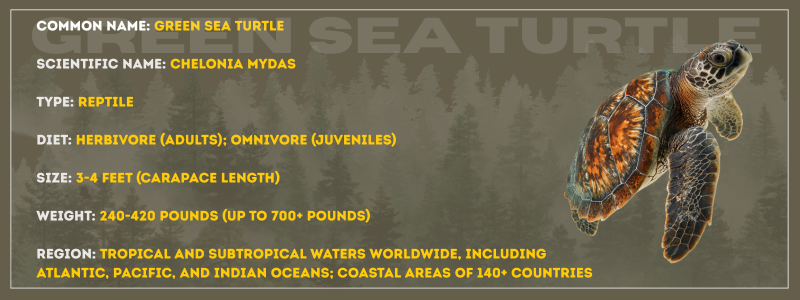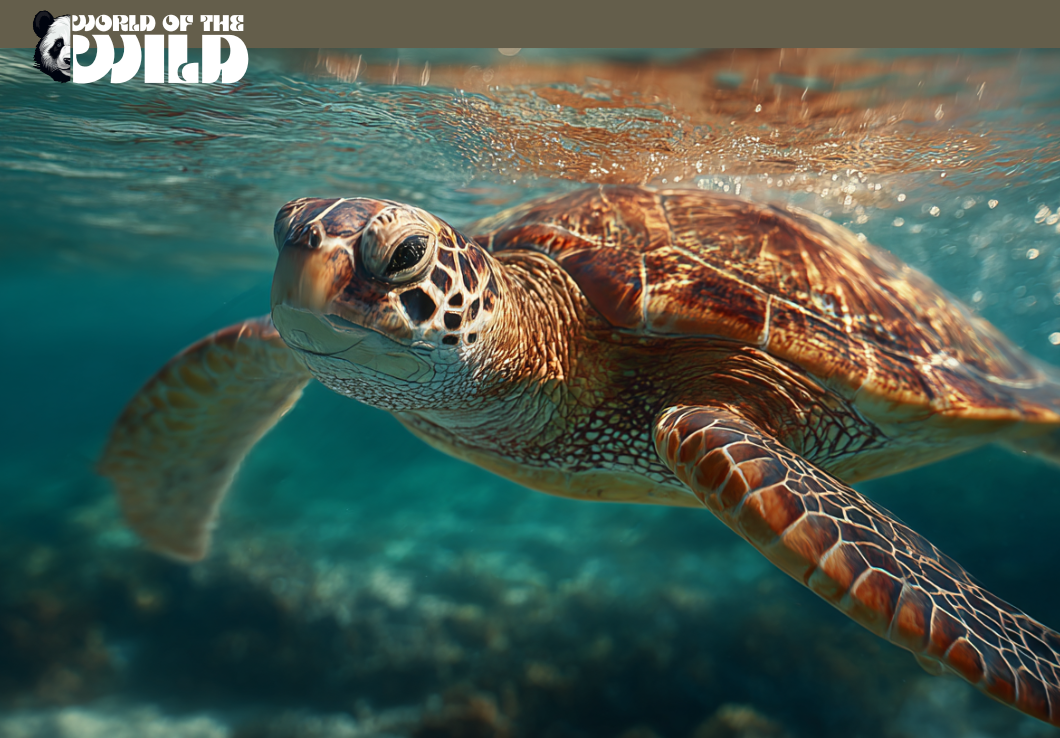

Gliding gracefully through azure tropical waters, the green sea turtle is a living testament to millions of years of evolution and survival. These magnificent reptiles have witnessed the rise and fall of countless species, navigated oceans since the age of dinosaurs, and continue to embark on extraordinary migrations that can span thousands of miles. Named not for their shells but for the greenish hue of their fat, these gentle giants play a crucial role in maintaining the health of marine ecosystems. Yet today, these ancient mariners face unprecedented challenges that threaten their continued existence, making their story one of both wonder and urgency.
Facts
- Green sea turtles can hold their breath for up to five hours while resting or sleeping underwater, with their heart rate dropping to conserve oxygen.
- They are among the few reptiles that cry, producing salty tears to excrete excess salt from seawater they drink, giving them a perpetually teary-eyed appearance.
- Green sea turtles undergo a dramatic dietary shift during their lives, starting as omnivorous hatchlings and juveniles before becoming strict herbivores as adults, making them the only herbivorous sea turtle species.
- Their powerful front flippers can propel them through water at speeds of up to 35 miles per hour in short bursts, though they typically cruise at a more leisurely 1-2 miles per hour.
- Female green sea turtles possess an extraordinary navigation system that allows them to return to the exact beach where they were born to lay their own eggs, sometimes after decades at sea.
- The temperature of the sand where eggs are buried determines the sex of hatchlings: warmer temperatures produce females, while cooler temperatures produce males.
- Green sea turtles can live for over 80 years in the wild, with some individuals potentially reaching 100 years or more.
Species
Kingdom: Animalia
Phylum: Chordata
Class: Reptilia
Order: Testudines
Family: Cheloniidae
Genus: Chelonia
Species: Chelonia mydas
The green sea turtle belongs to the family Cheloniidae, which includes six of the seven species of sea turtles. Within Chelonia mydas, scientists have identified several distinct populations that may represent subspecies, though taxonomic debate continues. The most recognized subspecies is the Eastern Pacific green turtle (Chelonia mydas agassizii), also called the black sea turtle, found along the Pacific coast of the Americas. This population exhibits darker coloration and a more domed carapace compared to Atlantic populations.
Green sea turtles are closely related to other Cheloniidae family members, including the hawksbill turtle (Eretmochelys imbricata), loggerhead turtle (Caretta caretta), and Kemp’s ridley turtle (Lepidochelys kempii). However, they are distinct in their dietary preferences and physical characteristics, occupying a unique ecological niche as the ocean’s primary large herbivore.
Appearance
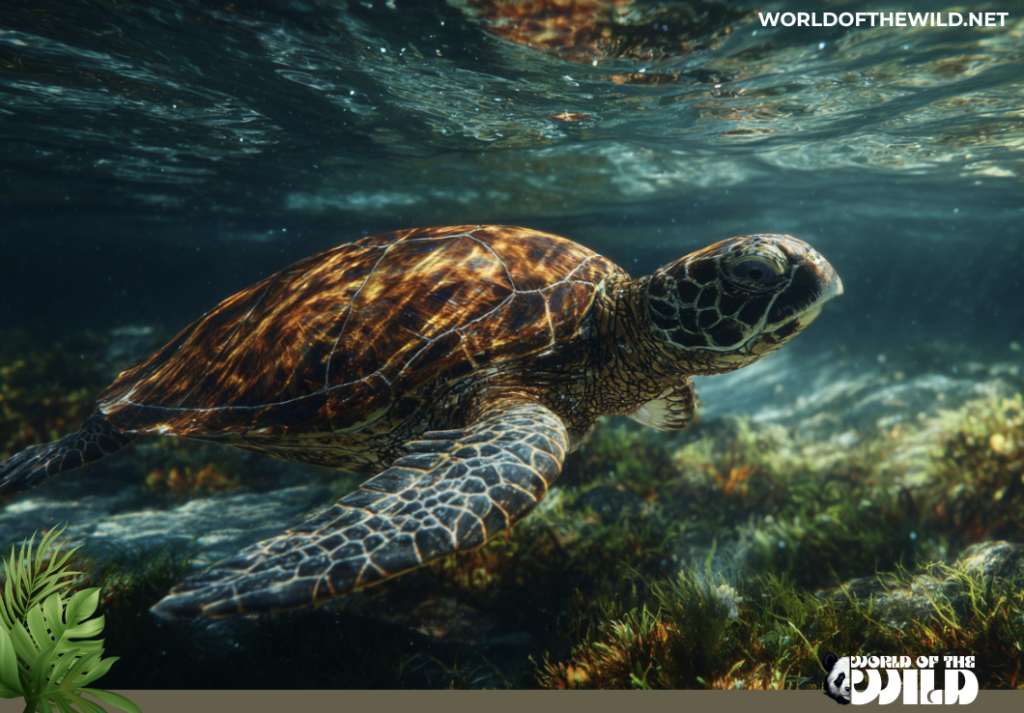
The green sea turtle is one of the largest sea turtle species, with adults typically measuring 3 to 4 feet in carapace length and weighing between 240 to 420 pounds, though exceptional individuals can exceed 700 pounds. The carapace, or upper shell, displays an elegant oval shape with a smooth, non-serrated edge, distinguishing it from other sea turtle species. The shell’s coloration varies from olive-brown to black with intricate patterns of radiating stripes, spots, or mottled designs that provide each turtle with a unique signature.
The turtle’s head is relatively small compared to its body, featuring a blunt, non-hooked beak perfectly adapted for grazing on seagrass and algae. A distinctive feature is the presence of a single pair of prefrontal scales between the eyes, whereas similar species have two pairs. The plastron, or underside of the shell, ranges from white to yellowish in color.
Their limbs have evolved into powerful, wing-like flippers that make them remarkably graceful swimmers but awkward on land. The front flippers are elongated and paddle-shaped, while the rear flippers are shorter and primarily used for steering. Adult males develop elongated, curved claws on their front flippers and possess a longer, thicker tail than females, extending well beyond the rear edge of the carapace.
The turtle’s skin varies from dark brown to olive, with patches of lighter coloring. Hatchlings emerge from their eggs with a striking appearance: dark-colored carapaces with white edges and undersides, measuring just 2 inches long and weighing approximately half an ounce.
Behavior
Green sea turtles are predominantly solitary creatures throughout most of their lives, coming together only during mating season. They exhibit distinct behavioral patterns that change as they mature and migrate between different habitats. These turtles are primarily diurnal, most active during daylight hours when they forage for food, though they may continue feeding at night in some locations.
Their daily routine typically involves long feeding sessions interspersed with periods of rest. Green sea turtles often return to the same resting spots, seeking shelter under ledges or in caves where they can sleep safely. During these rest periods, they can remain motionless for hours, entering a state of reduced metabolic activity that allows them to stay submerged for extended periods.
Communication among green sea turtles is subtle and not fully understood. Hatchlings produce sounds while still in their eggs, possibly to coordinate hatching. Adults may use body language and physical contact during mating rituals. Recent research suggests they may also use low-frequency sounds for communication, though their hearing is adapted primarily to low-frequency vibrations.
One of the most remarkable behaviors of green sea turtles is their navigational ability. They possess an internal magnetic compass that allows them to detect the Earth’s magnetic field, enabling precise navigation across vast ocean expanses. This geomagnetic sense is supplemented by their ability to use wave direction, sun position, and chemical cues to find their way.
Green sea turtles also engage in a fascinating behavior called “basking,” where they haul themselves onto beaches or float at the surface to warm their bodies. This is particularly common in Hawaii, where green turtles regularly sun themselves on beaches alongside human beachgoers. This thermoregulation behavior helps them maintain optimal body temperature and may also help eliminate parasites.
Intelligence studies have shown that green sea turtles possess strong spatial memory and learning capabilities. They can remember and return to productive feeding grounds year after year, and research suggests they may also learn from experience, adjusting their behavior based on past encounters.
Evolution
The evolutionary history of green sea turtles stretches back over 100 million years to the Cretaceous Period, when dinosaurs still roamed the Earth. Sea turtles as a group diverged from their terrestrial ancestors during the Late Jurassic, approximately 150 million years ago, when some turtle lineages ventured into marine environments and developed adaptations for oceanic life.
The earliest known sea turtle ancestor is Santanachelys gaffneyi, discovered in Brazil and dated to about 110 million years ago. This ancient turtle already possessed many characteristics of modern sea turtles, including flippers instead of feet and a streamlined shell adapted for swimming.
The family Cheloniidae, to which green sea turtles belong, emerged during the Late Cretaceous period, around 80-90 million years ago. Fossil evidence shows that Chelonia mydas as a distinct species has existed for at least 40-50 million years, having survived the mass extinction event that wiped out the dinosaurs 66 million years ago.
Throughout their evolutionary journey, green sea turtles developed numerous specialized adaptations. Their limbs transformed into powerful flippers, their shells became more hydrodynamic, and they lost the ability to retract their heads and limbs into their shells—a trade-off for improved swimming efficiency. Their respiratory system evolved to allow for extended breath-holding, and their salt glands developed to excrete excess salt from seawater.
Perhaps most remarkably, green sea turtles evolved to become herbivores as adults, a unique adaptation among sea turtles. This dietary shift likely occurred as populations discovered the abundant food source provided by seagrass beds, filling an ecological niche with relatively little competition. The evolution of their jaw structure and digestive system reflects this specialization, with a serrated beak for tearing vegetation and an elongated gut for processing plant material.
The green sea turtle’s evolutionary success is evidenced by their global distribution and their ability to survive dramatic climate changes, sea level fluctuations, and the emergence and extinction of countless other species. They have remained relatively unchanged for millions of years, a testament to the effectiveness of their body plan and adaptations.
Habitat
Green sea turtles inhabit tropical and subtropical waters around the globe, making them one of the most widely distributed sea turtle species. They are found throughout the Atlantic, Pacific, and Indian Oceans, with significant populations in the Caribbean Sea, Mediterranean Sea, and around numerous oceanic islands.
Their geographic range extends from approximately 40 degrees north to 40 degrees south latitude, encompassing coastal areas of more than 140 countries. Major nesting beaches are found in places like Tortuguero in Costa Rica, Raine Island in Australia, the Galápagos Islands, Florida’s east coast, and various locations throughout the Caribbean and Mexico.
Green sea turtles utilize different habitats throughout their life cycle. Hatchlings immediately enter the open ocean upon emerging from their nests, entering what is known as the “lost years”—a period of pelagic (open ocean) existence that can last 3-5 years. During this time, they drift with ocean currents, often associated with floating mats of Sargassum seaweed, which provide food, shelter, and camouflage.
As juveniles, green sea turtles transition to coastal habitats, seeking out shallow waters with abundant food sources. They show a strong preference for areas with healthy seagrass beds, coral reefs, and rocky areas with algae growth. These nearshore developmental habitats typically feature calm, protected waters at depths of less than 15 feet, though they may venture into deeper waters while traveling between feeding grounds.
Adult green sea turtles are most commonly found in shallow coastal waters, lagoons, bays, and estuaries where seagrass meadows flourish. They prefer areas with water temperatures above 68 degrees Fahrenheit, though they can tolerate cooler waters for short periods. In tropical regions, they may inhabit areas near coral reefs where they graze on algae growing on the reef structure.
The benthic (bottom-dwelling) lifestyle of adult green sea turtles means they spend much of their time in relatively shallow waters, typically less than 15-20 feet deep, though they are capable of diving to depths exceeding 300 feet. They establish home ranges within their feeding grounds, sometimes defending preferred grazing areas from other turtles.
Nesting beaches are characterized by specific features: sandy shores with appropriate sand composition for nest chamber construction, vegetation that stabilizes the dune system, and minimal human disturbance. These beaches must be accessible from the ocean with minimal obstacles and have temperature conditions suitable for egg incubation.
Diet
Green sea turtles are unique among sea turtle species for being primarily herbivorous as adults, earning them the distinction of being the ocean’s largest herbivore. However, their dietary preferences change dramatically throughout their life stages, a phenomenon known as ontogenetic dietary shift.
Hatchlings and young juveniles begin life as opportunistic omnivores, consuming a variety of items they encounter while drifting in the open ocean. Their diet during this pelagic stage includes jellyfish, Portuguese man-of-war, mollusks, crustaceans, fish eggs, sponges, and various floating invertebrates. They also consume algae and other plant material associated with Sargassum mats.
As green sea turtles mature and transition to coastal habitats at around 3-5 years of age, they gradually shift toward a more herbivorous diet. By the time they reach adulthood, they have become strict herbivores, feeding almost exclusively on seagrasses and algae. This dietary transformation is accompanied by changes in their digestive system, which becomes specialized for processing plant material.
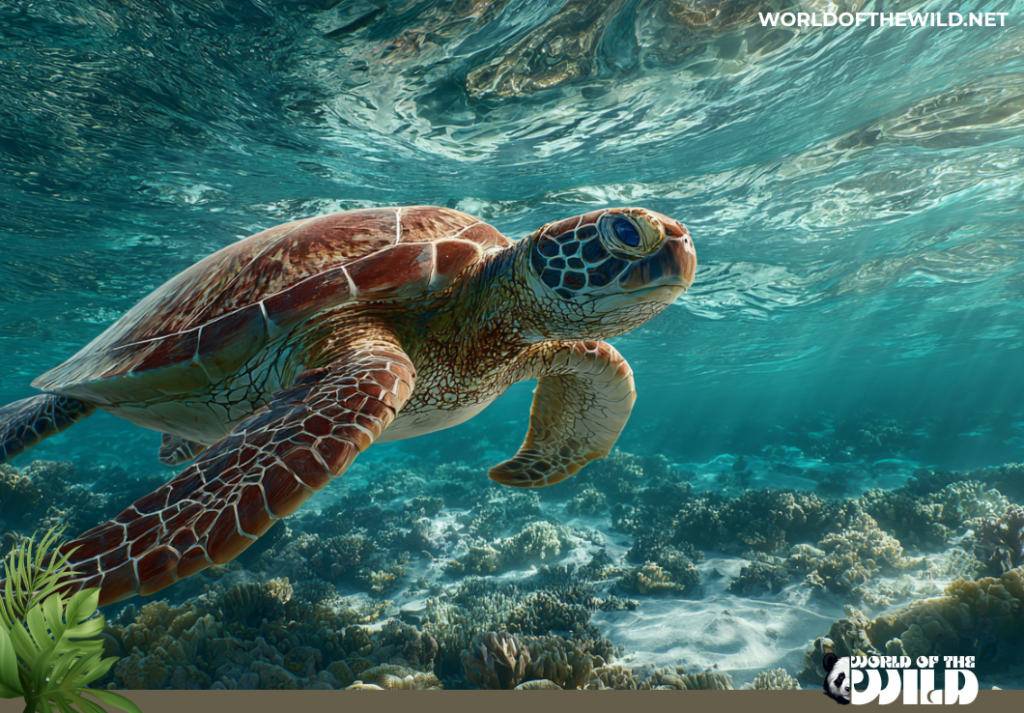
Adult green sea turtles are often referred to as “sea cows” due to their grazing behavior. Their primary food source is seagrass, particularly species like turtle grass, manatee grass, and shoal grass. They use their sharp, serrated beaks to tear vegetation, cropping seagrass blades much like a lawnmower. This grazing actually benefits seagrass ecosystems by preventing overgrowth and promoting the growth of younger, more nutritious blades.
In addition to seagrass, adult green sea turtles consume various species of algae, including green algae, red algae, and brown algae. They may also occasionally eat sponges, jellyfish, and other invertebrates, particularly in areas where preferred vegetation is scarce.
Green sea turtles are selective feeders, showing preferences for certain seagrass species and plant parts based on nutritional content. They typically choose younger, protein-rich shoots and leaves over older, fiber-rich material. Their feeding activity follows a daily pattern, with most intensive grazing occurring during morning and afternoon hours.
The digestive system of adult green sea turtles is specially adapted to break down cellulose and extract nutrients from plant material. Their gut contains beneficial bacteria that aid in fermenting and digesting tough plant fibers, similar to the digestive processes in herbivorous land mammals.
Predators and Threats
Throughout their lives, green sea turtles face predation from various natural predators, though the threat level varies dramatically depending on their life stage. The most vulnerable period is during the egg and hatchling stages, when mortality rates are extraordinarily high.
Turtle eggs face predation from a wide array of terrestrial predators including raccoons, foxes, coyotes, wild pigs, monitor lizards, snakes, and various species of crabs. Ants and flies may also attack eggs that have been exposed or are beginning to hatch. On some beaches, dogs and other introduced species pose significant threats to nests.
Newly hatched turtles running the gauntlet from nest to ocean face aerial predators like frigatebirds, herons, gulls, and crows. Once they enter the water, the dangers continue as various fish species, including snappers, groupers, and barracuda, prey upon the tiny hatchlings. Sharks, particularly tiger sharks and bull sharks, pose a threat to juveniles and adults, though healthy adult turtles are generally too large and well-protected for most predators.
Other natural predators include saltwater crocodiles in some regions, killer whales, and large octopi. However, natural predation on adult green sea turtles is relatively rare, as their size and hard shells provide considerable protection.
The far greater threat to green sea turtle populations comes from human activities. Historically, green sea turtles were hunted extensively for their meat, which was considered a delicacy, and for their cartilage used in turtle soup. While such hunting is now illegal in many countries, poaching continues in some regions, particularly for their eggs, which are consumed as food or used in traditional medicine.
Bycatch in commercial fishing operations represents one of the most significant threats. Green sea turtles become entangled in fishing nets, longlines, and trawling equipment, leading to drowning when they cannot surface to breathe. Thousands of turtles die annually from fishing gear interactions, despite regulations requiring turtle excluder devices in many fisheries.
Habitat destruction poses another critical threat. Coastal development destroys nesting beaches, while pollution from light sources disorients hatchlings, causing them to move inland rather than toward the ocean. Seagrass beds, their primary food source, are degraded by pollution, coastal development, and boat damage.
Marine debris, particularly plastic pollution, presents a growing danger. Green sea turtles often mistake plastic bags for jellyfish, ingesting them and suffering from intestinal blockages, malnutrition, and death. They may also become entangled in discarded fishing gear, nets, and other debris.
Boat strikes injure and kill numerous turtles each year, particularly in areas with heavy vessel traffic. The propeller injuries are often fatal or leave turtles unable to dive properly, affecting their ability to feed and escape predators.
Climate change represents an emerging existential threat. Rising sand temperatures on nesting beaches skew sex ratios toward females, threatening future breeding populations. Warming oceans affect food availability and may push turtles outside their normal ranges. Sea level rise threatens to inundate nesting beaches, while increased storm intensity destroys nests and damages critical habitats. Ocean acidification impacts coral reefs and may affect the availability of algae that forms part of their diet.
Disease outbreaks, particularly fibropapillomatosis, a tumor-causing disease linked to herpesvirus and potentially exacerbated by pollution and habitat degradation, affect green sea turtle populations worldwide. This disease causes debilitating tumors that can impair vision, movement, and feeding ability.
Reproduction and Life Cycle
The reproductive cycle of green sea turtles is a remarkable feat of endurance, navigation, and biological precision. Sexual maturity arrives late for these long-lived reptiles, typically between 20 and 50 years of age, depending on geographic location and food availability. Turtles in warmer waters with abundant food tend to mature faster than those in cooler regions.
Mating occurs in the waters adjacent to nesting beaches during the breeding season, which varies by location but generally occurs during warmer months. Male green sea turtles migrate to these mating grounds from their feeding areas, sometimes traveling hundreds or thousands of miles. Females undertake an even more remarkable journey, returning to the same beach where they themselves hatched decades earlier—a phenomenon called natal beach philopatry.
Courtship and mating can be vigorous affairs. Multiple males may pursue a single female, sometimes becoming aggressive with one another. The actual mating occurs in shallow water, with the male using his elongated front claws to grip the female’s shell and his long tail to achieve copulation. Females may mate with multiple males during a breeding season, storing sperm to fertilize multiple clutches of eggs.
After mating, female green sea turtles come ashore under cover of darkness, a behavior that helps them avoid predators and reduces heat stress. The nesting process is an exhausting ordeal that can take several hours. The female first scouts the beach, searching for suitable sand above the high tide line. Once satisfied, she uses her rear flippers to excavate a body pit and then carefully digs a deeper, flask-shaped egg chamber with her hind flippers.
A typical clutch contains 100-200 eggs, though the number can vary from 80 to 250. The eggs are spherical, about the size of ping-pong balls, with soft, leathery shells. The female deposits her eggs into the chamber in groups, entering a trance-like state during the process. After laying is complete, she carefully covers the nest, using her flippers to pack down the sand and disguise the location before returning to the sea.
Female green sea turtles typically nest multiple times during a breeding season, usually 2-6 times at approximately two-week intervals. After completing their nesting for the season, they return to their feeding grounds and will not nest again for 2-4 years, though some individuals may take even longer between breeding seasons.
The eggs incubate in the warm sand for approximately 50-70 days, depending on temperature. Warmer sand leads to faster development and produces female hatchlings, while cooler temperatures slow development and produce males. The pivotal temperature—which produces equal numbers of males and females—is approximately 82-84 degrees Fahrenheit. This temperature-dependent sex determination makes green sea turtles particularly vulnerable to climate change.
Hatching is a synchronized event, with most or all eggs in a nest hatching within a few hours of each other. The hatchlings use a temporary egg tooth to break through their shells, then work collectively to excavate themselves from the nest chamber. They typically emerge from the sand during the coolest parts of the day, usually at night, when the risk from predators and heat stress is lowest.
Hatchlings face immediate challenges as they scramble toward the ocean, using the brighter horizon over the water to orient themselves. This dash to the sea is fraught with danger from predators, and only an estimated 1 in 1,000 to 1 in 10,000 hatchlings survive to adulthood.
Once in the ocean, hatchlings enter their “lost years,” a poorly understood period of pelagic existence lasting 3-5 years. They eventually settle into coastal developmental habitats as juveniles, gradually growing and maturing over decades.
Green sea turtles are among the longest-lived reptiles. In the wild, they commonly live 60-80 years, with some individuals potentially exceeding 100 years. Their slow growth rate and late sexual maturity mean that population recovery is a slow process, making conservation efforts critical for their survival.
Population
The conservation status of green sea turtles varies by population, but globally, the species is listed as Endangered on the IUCN Red List. Some regional populations are classified as Threatened or Endangered under various national protections, including the U.S. Endangered Species Act, which lists all green sea turtle populations as either Threatened or Endangered.
Estimating global population numbers for sea turtles is challenging because they are highly migratory and spend most of their lives at sea. Population assessments typically rely on counting nesting females, which represents only a fraction of the total population. Scientists estimate that tens of thousands of nesting females exist worldwide, though this represents a dramatic decline from historical numbers.
Before widespread commercial exploitation, green sea turtle populations numbered in the millions. In the Caribbean alone, historical accounts describe fleets of dozens of ships dedicated solely to capturing turtles, with individual vessels sometimes taking thousands of turtles per voyage. By the mid-20th century, many populations had declined by 90-99% compared to historical abundance.
The good news is that many green sea turtle populations have shown signs of recovery in recent decades, thanks to intensive conservation efforts. Some populations have increased significantly since protections were implemented in the 1970s and 1980s. For example, nesting in Florida has increased dramatically, with some beaches seeing tenfold increases. Hawaiian populations have also shown strong recovery, as have some Australian populations.
However, population trends vary considerably by region. While some populations are recovering, others continue to decline or remain at critically low levels. The Mediterranean population remains severely depleted, with only a few thousand nesting females. Some Pacific populations face ongoing threats from poaching and habitat loss.
Major nesting populations include those in Tortuguero, Costa Rica, which hosts one of the largest Atlantic nesting populations with tens of thousands of nests annually; Raine Island in Australia, which supports the largest green sea turtle rookery in the world; and various sites throughout the Great Barrier Reef, Hawaii, Florida, Mexico, and scattered locations across the Pacific and Indian Oceans.
The success of conservation measures—including nesting beach protection, fishing gear modifications, hunting restrictions, and public awareness campaigns—demonstrates that green sea turtle populations can recover when given adequate protection. However, emerging threats like climate change, ocean pollution, and coastal development continue to pose significant challenges.
Population recovery is hampered by the species’ life history characteristics. With late sexual maturity and long generation times, population growth is necessarily slow. Even with perfect protection, it takes decades for conservation efforts to translate into increased numbers of reproductive adults.
Conclusion
The green sea turtle stands as both a symbol of the ocean’s ancient wonders and a stark reminder of humanity’s impact on marine ecosystems. These remarkable reptiles have survived millions of years of planetary change, outlasting dinosaurs and adapting to dramatic shifts in climate and ocean conditions. Yet in just a few centuries, human activities brought many populations to the brink of extinction.
Their story, however, is not one of inevitable decline but of hope and resilience. Where conservation efforts have been implemented seriously—protecting nesting beaches, reducing fishing bycatch, and prohibiting hunting—green sea turtle populations have demonstrated remarkable recovery. They remind us that with commitment and action, we can reverse the damage we have inflicted on the natural world.
As ocean gardeners maintaining seagrass beds, green sea turtles play an irreplaceable role in marine ecosystem health. Their loss would echo throughout coastal ecosystems, affecting countless other species. But beyond their ecological importance, these gentle giants connect us to deep time, carrying forward an evolutionary legacy that spans the age of dinosaurs.
The future of green sea turtles rests in our hands. Supporting marine protected areas, reducing plastic consumption, advocating for fishing regulations, and addressing climate change are all actions within our power. Every hatchling that makes it to the ocean represents not just an individual life, but the continuation of an ancient lineage and a small victory in the ongoing effort to preserve our planet’s biodiversity. The green sea turtle’s journey is our journey too—a test of whether we can coexist sustainably with the other magnificent creatures that share our world.
Scientific name: Chelonia mydas
Diet type: Herbivore (adults); Omnivore (juveniles)
Size: 3-4 feet (carapace length)
Weight: 240-420 pounds (up to 700+ pounds)
Region found: Tropical and subtropical waters worldwide, including Atlantic, Pacific, and Indian Oceans; coastal areas of 140+ countries