
TAXONOMIC CLASSIFICATION
Kingdom: Animalia
Phylum: Chordata
Class: Aves
Order: Piciformes
Family: Picidae
Genus: Melanerpes
Species: M. erythrocephalus
PHYSICAL SPECIFICATIONS
Total Length: 19-23 cm (7.5-9.1 inches)
Wingspan: 42-43 cm (16.5-17 inches)
Weight: 56-97 grams (2.0-3.4 ounces)
Body Type: Medium-sized woodpecker with bold, tricolored plumage
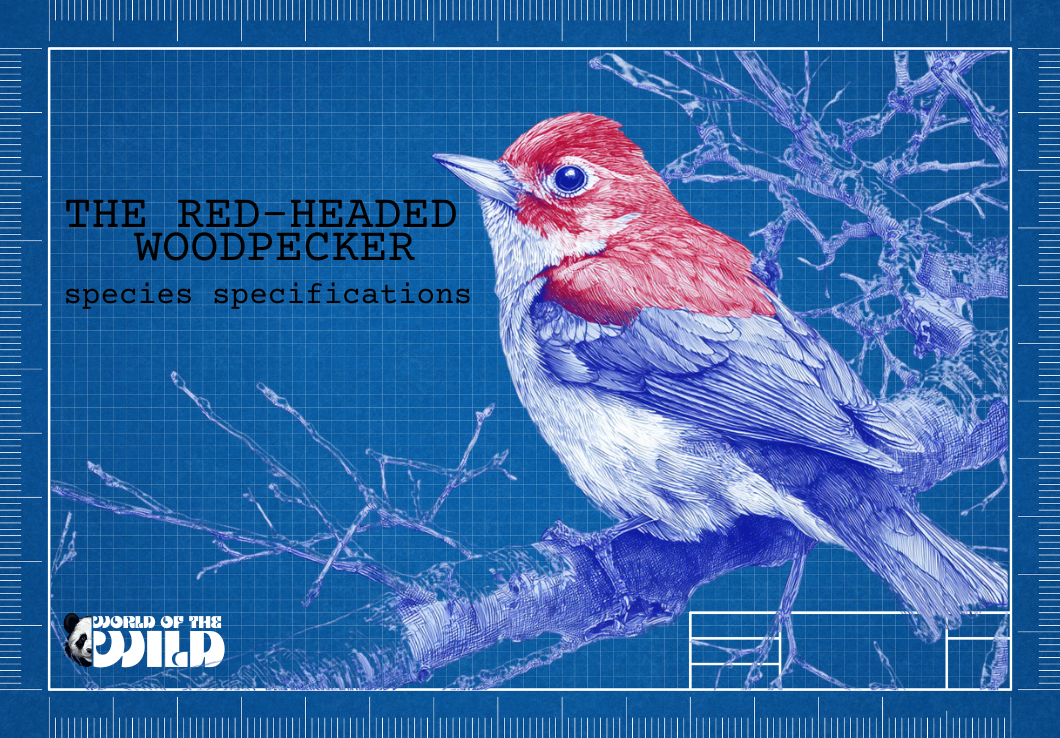
Plumage Description: The adult Red-headed Woodpecker displays one of the most distinctive color patterns among North American birds. The entire head, neck, and throat are covered in brilliant crimson-red feathers with no markings or variations. The back, wings, and tail are glossy blue-black, while the underparts, rump, and secondary wing feathers are bright white. This creates a striking contrast of three solid color blocks.
Sexual Dimorphism: Minimal. Males and females are virtually identical in appearance, making field identification of sex difficult without behavioral observation.
Juvenile Plumage: Immature birds display brownish-gray heads instead of red, with mottled brown and white back feathers. The distinctive adult plumage is acquired during the first fall molt.
Bill Specifications: Straight, chisel-like bill typical of woodpeckers, measuring 25-32 mm in length, colored dark gray to black.
HABITAT REQUIREMENTS
Primary Habitat: Open woodlands, forest edges, and parklands with scattered mature trees and snags (dead standing trees).
Preferred Ecosystem Types: Oak savannas, beech groves, bottomland forests, agricultural areas with tree rows, golf courses, and suburban parks.
Elevation Range: Sea level to approximately 2,000 meters, though most common at lower elevations.
Territory Size: Breeding pairs typically maintain territories of 2-8 hectares depending on habitat quality.
Critical Habitat Features: Requires dead trees or dead limbs on living trees for nesting cavity excavation, open areas for aerial foraging, and mast-producing trees (oak, beech) for food resources.
GEOGRAPHIC RANGE
Breeding Range: Eastern United States from the Great Plains to the Atlantic Coast, extending north into southern Canada (Ontario, Quebec) and south to the Gulf Coast.
Winter Range: Southern portions of breeding range, with northern populations migrating to central and southern United States.
Migration Pattern: Partially migratory. Northern populations typically migrate south in fall, while southern populations are year-round residents. Migration timing varies by latitude, generally occurring September through November (fall) and March through May (spring).
BEHAVIORAL CHARACTERISTICS
Foraging Method: Unlike most woodpeckers that primarily excavate for insects, the Red-headed Woodpecker employs diverse foraging strategies including flycatching (aerial pursuit of flying insects), gleaning from bark surfaces, and ground foraging. Capable of storing food items in tree crevices for later consumption.
Flight Pattern: Strong, direct flight with characteristic woodpecker undulation. Capable of agile aerial maneuvers when catching insects on the wing.
Vocalization: Produces a loud, harsh “kweer-kweer” or “queerp” call. Drumming pattern consists of single loud rap or short, rapid series of 15-20 beats per second.
Social Structure: Territorial during breeding season. May form loose flocks during migration and winter, particularly around abundant food sources.
Aggression Level: Highly territorial and aggressive, particularly during breeding season. Known to destroy eggs and nestlings of other cavity-nesting species and remove eggs from nesting boxes.
DIETARY SPECIFICATIONS
Food Categories (by season):
Spring/Summer – Approximately 50% insects, 50% plant matter
Fall/Winter – Approximately 30% insects, 70% plant matter
Animal Prey: Flying insects (beetles, grasshoppers, cicadas), spiders, earthworms, occasional small vertebrates (mice, bird eggs, nestlings).
Plant Material: Acorns, beechnuts, pecans, various fruits and berries, corn, cultivated grains.
Foraging Technique: Multi-modal approach including aerial hawking, bark gleaning, ground foraging, and food caching in tree crevices for winter storage.
REPRODUCTION SPECIFICATIONS
Sexual Maturity: Typically achieved at one year of age.
Breeding Season: April through July, with peak activity in May and June.
Nest Type: Cavity excavated in dead tree (snag) or dead limb of living tree. Both sexes participate in excavation, which takes 10-14 days.
Cavity Dimensions: Entrance diameter 5-6 cm, cavity depth 20-40 cm below entrance.
Clutch Size: 4-7 eggs (average 5).
Egg Specifications: White, glossy, elliptical shape, approximately 25 x 19 mm.
Incubation Period: 12-14 days, shared by both parents.
Nestling Period: 27-31 days from hatching to fledging.
Broods per Season: Typically one, occasionally two in southern portions of range.
Parental Care: Both parents feed nestlings. Young may remain with parents for several weeks after fledging.
LIFESPAN AND SURVIVAL
Maximum Recorded Lifespan: 9 years, 11 months (wild, banded bird).
Average Lifespan: Approximately 2-3 years in wild.
Primary Mortality Factors: Habitat loss, vehicle collisions, competition for nest cavities with European Starlings, predation by hawks, owls, and snakes.
CONSERVATION STATUS
IUCN Red List Status: Near Threatened (as of recent assessment).
Population Trend: Declining. North American Breeding Bird Survey indicates significant long-term population decreases across much of range.
Primary Threats: Loss of mature trees with dead snags due to forestry practices and land clearing, competition with introduced European Starlings for nesting cavities, mortality from vehicle strikes, decline in oak and beech mast production.
Conservation Priority: Species of moderate conservation concern. Included in Partners in Flight watchlist.
Management Recommendations: Preserve snags and dead trees in managed forests, install nest boxes in areas lacking natural cavities (though this may increase starling competition), maintain oak-savanna ecosystems, reduce pesticide use in foraging habitats.
FIELD IDENTIFICATION NOTES
Distinguishing Features: The only North American woodpecker with an entirely red head on an adult bird. The bold tricolor pattern is unmistakable.
Similar Species: Red-bellied Woodpecker has red only on crown and nape, not full head. Pileated Woodpecker is much larger with prominent crest.
Identification Confidence: Very high for adults; moderate for juveniles which may be confused with other woodpecker species.
Want to learn more about the amazing Red-Headed Woodpecker? Read the full article here.