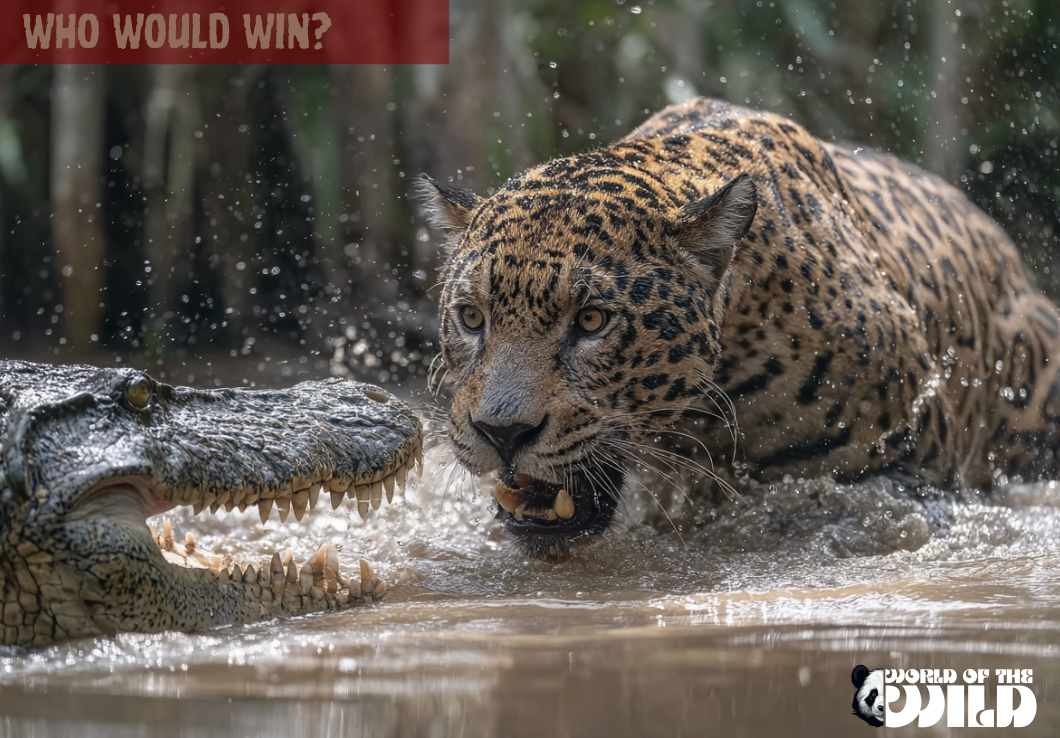

The Spotted Ghost of the Jungle Meets the Armored Assassin of the Deep
🐆 THE CONTENDERS
Ladies and gentlemen, welcome to the most dangerous stretch of riverbank on Earth — the flooded forests and muddy waterways of the Amazon and Pantanal, where two of nature’s most perfectly engineered killing machines share the same terrifyingly thin strip of territory.
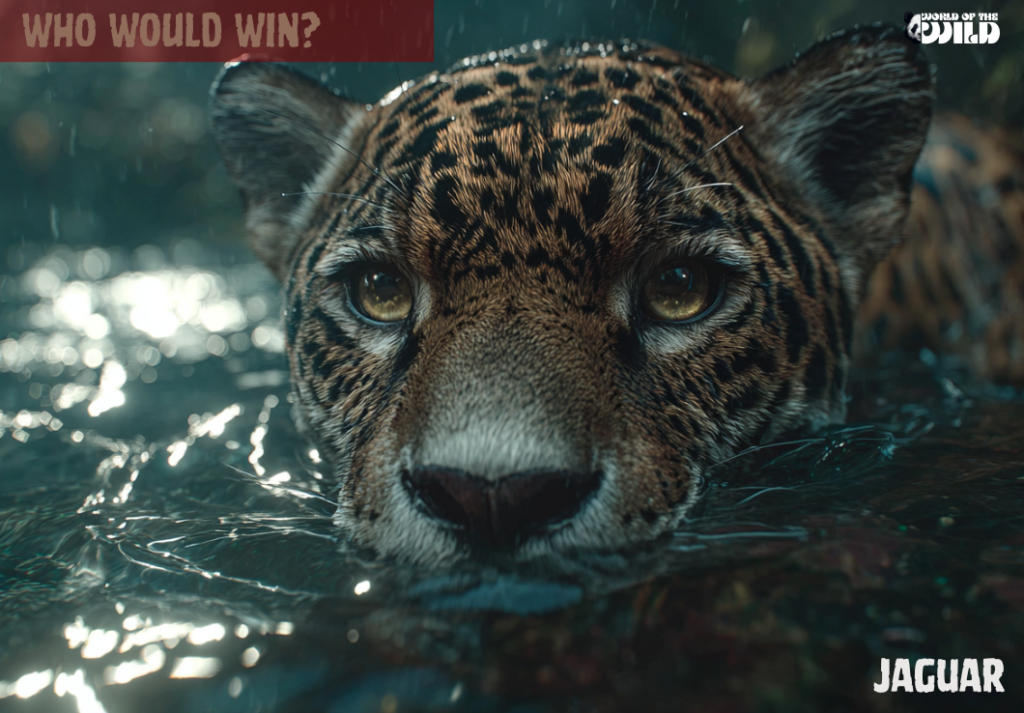
In one corner, we have the Jaguar — Panthera onca — the apex predator of the Americas. This isn’t your average big cat. The jaguar is a stocky, muscle-packed wrecking ball wrapped in spotted velvet, notorious for doing something no other cat on the planet routinely does: hunting and killing crocodilians for sport. It doesn’t avoid the water. It hunts there.
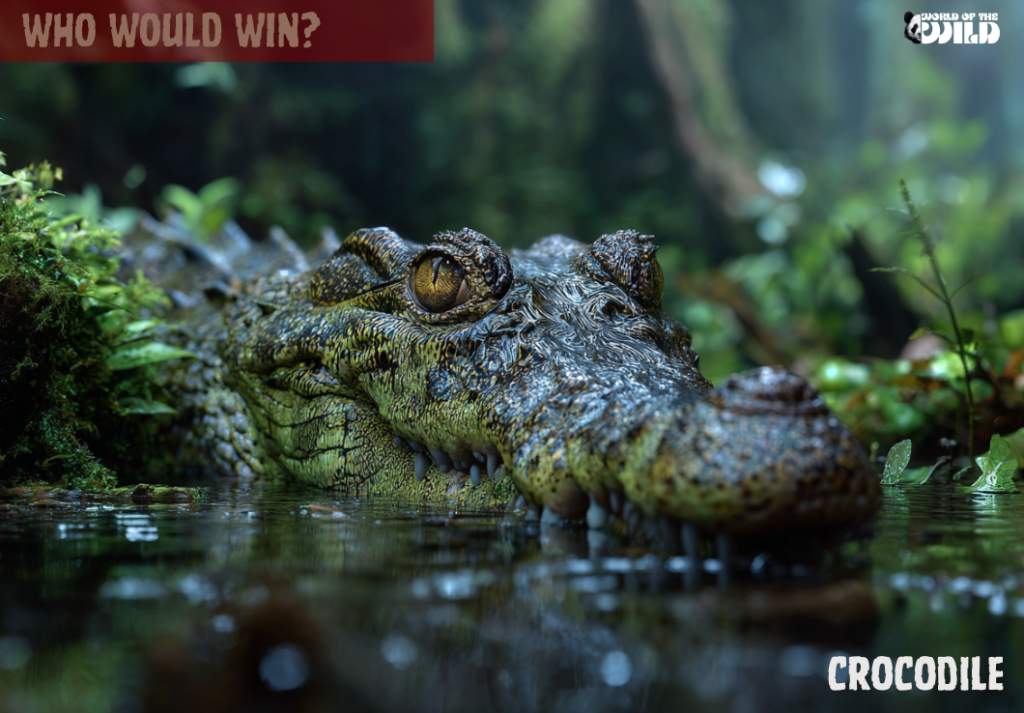
In the other corner, we have the Caiman — specifically the Black Caiman (Melanosuchus niger), the largest predator in the Amazon basin and the most formidable crocodilian in the jaguar’s range. Ancient, armored, and utterly ruthless, this reptile has barely changed its design in 80 million years. When something works that well, evolution leaves it alone.
This isn’t a hypothetical matchup pulled from thin air. This encounter happens in the wild — regularly — along the riverbanks of South America. So who walks away? Let’s break it down.
📊 TALE OF THE TAPE
| Category | Jaguar | Black Caiman |
|---|---|---|
| Size / Weight | 4–6 ft body length; 100–250 lbs | 8–14 ft total length; 400–880 lbs |
| Top Speed | ~50 mph on land; strong swimmer | ~20 mph burst in water; sluggish on land |
| Bite Force | ~1,500 PSI (strongest of any big cat) | ~2,000–2,500 PSI |
| Key Weaponry | Skull-piercing canines, razor claws, iron jaws | Bone-crushing jaw, armored scutes, death roll |
| Special Abilities | Ambush precision, cranial bite technique, stealth | Death roll, armored hide, ambush in water, jaw power |
| Habitat Advantage | Land & water (versatile) | Water (dominant), land (vulnerable) |
| Stamina | High (mammalian metabolism) | Low sustained effort (ectothermic) |
💪 PHYSICAL ADVANTAGES
The Jaguar’s Arsenal
The jaguar is built differently than every other big cat — and that’s not hyperbole. While lions and tigers kill with a throat bite that induces suffocation, the jaguar has developed a uniquely devastating technique: it drives its canines directly through the skull or spine of its prey, causing instant neurological death. Its bite force of roughly 1,500 PSI is disproportionately massive for its body size, and its skull is wide, short, and reinforced specifically to generate that crushing power.
Beyond the jaws, the jaguar’s body is a compact powerhouse. Short, thick legs anchor it to the ground with extraordinary leverage. Its forelimbs in particular are among the most muscular of any felid — capable of holding down thrashing, panicked prey several times its own size. It’s also a confident, powerful swimmer who actively patrols riverbanks and has been filmed on multiple occasions stalking, ambushing, and killing caimans in the wild. This isn’t accidental. It is deliberate, learned predatory behavior.
The Black Caiman’s Arsenal
If the jaguar is a precision weapon, the black caiman is a siege engine. Stretching up to 14 feet and weighing close to 900 pounds in large males, it outweighs the jaguar by a ratio of 4:1 or more. Its hide is reinforced with osteoderms — bony, calcified scutes embedded beneath the skin — that form a natural suit of armor capable of absorbing significant punishment. A swipe from even the jaguar’s devastating claws will largely skid off this surface.
The caiman’s jaws are a bone-crushing vice, and once they close on something, physics does the rest. Its signature move, the death roll, is one of nature’s most brutal finishing moves: the caiman locks its jaws on a limb or body part, then spins rapidly along its own axis, tearing flesh and disorienting prey in a matter of seconds. In open water, this move is almost impossible to escape. The caiman also benefits from extreme patience — as an ectotherm, it can wait motionlessly for hours, invisible just below the waterline, burning almost no energy.
⚔️ THE BATTLE SCENARIO
The dry season has tightened the river to a thin, brown ribbon threading through cracked earth. A large black caiman, perhaps ten feet long and pushing 600 pounds, lies motionless along the bank, half-submerged, as still as driftwood. From the tree line, a big male jaguar moves through the undergrowth with that signature low, liquid stride — shoulders rolling, eyes locked. He has done this before. He pauses at the water’s edge, reads the shape in the shallows, and begins to circle.
The jaguar’s attack is sudden and catastrophic. Rather than leaping onto the caiman’s armored back — a rookie mistake — he launches himself at the neck and skull region, the one anatomical vulnerability, driving his canines downward with the full kinetic force of his 220-pound body behind them. For a smaller caiman, this would be immediately fatal. But this is a large black caiman, and size matters enormously here. The caiman’s neck musculature is dense and the skull thick. The jaguar lands the bite but fails to achieve instant penetration. The caiman erupts — it thrashes violently, whipping its powerful tail and twisting its body with alarming speed. If even a fraction of that jaw clamps onto the jaguar’s limb, the death roll begins.
This is the critical moment. On dry land or shallow mud, the jaguar can use its extraordinary forelimb strength to resist the roll and maintain jaw position. But if the struggle drags them into deeper water, the equation flips entirely. The caiman becomes neutrally buoyant, effortlessly powerful, and the jaguar — however strong — is now fighting in the caiman’s medium. In the wild, the jaguars that successfully kill caimans do so quickly, on or near the bank, before the crocodilian can drag the encounter into the river. Speed and precision are everything.
🏆 THE VERDICT: CONDITIONAL — But Edge to the Jaguar on Land
Here’s the scientific reality: context determines the winner, but on land or shallow bank — the most common scenario — the jaguar holds a meaningful edge.
The evidence isn’t just theoretical. Wildlife cameras and researchers in the Pantanal have documented jaguars killing caimans with regularity. These cats have developed a specialized cultural knowledge of how to approach, target, and neutralize crocodilians — aiming specifically for the back of the skull and neck, bypassing the armor and overwhelming the nervous system. Against smaller caimans (under 6 feet), the jaguar wins almost categorically. Against a large adult black caiman of 8–10+ feet, the jaguar is taking a serious, potentially fatal risk — but experienced individuals still manage it.
In deep water? The caiman wins, full stop. Size, environment, and the death roll make it essentially unchallenged.
Final Score:
- 🐆 Jaguar wins — on land / shallow water (7/10 encounters)
- 🐊 Caiman wins — in deep water (9/10 encounters)
The jaguar earns the split decision victory because it is the one actively choosing to engage the crocodilian on its own terms — and pulling it off. In the animal kingdom, that kind of fearless, calculated aggression counts for a lot. The spotted ghost of the jungle doesn’t just survive alongside the armored assassin of the deep. It hunts it.
Want more wild matchups? Subscribe to WorldoftheWild.net for weekly deep-dives into the animal kingdom’s most epic rivalries.