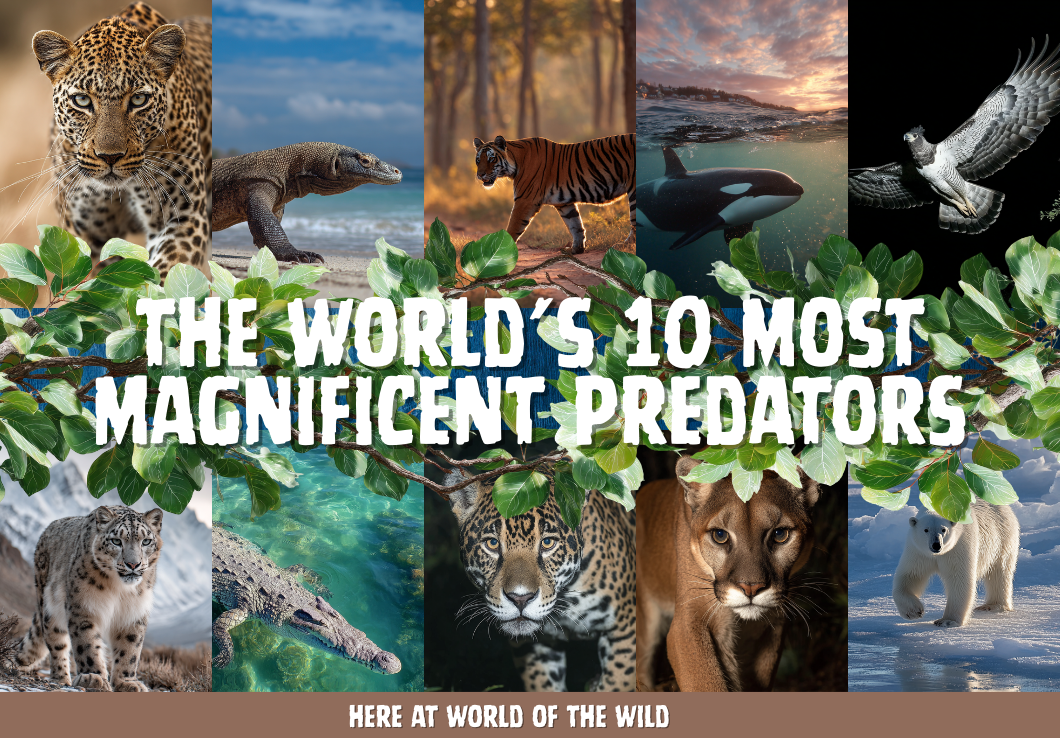

They sit at the top of their food chains — unchallenged, ancient, and awe-inspiring. These are the ten apex predators that define the wild places of our planet. To glimpse even one of them in the wild is a privilege that few ever earn.
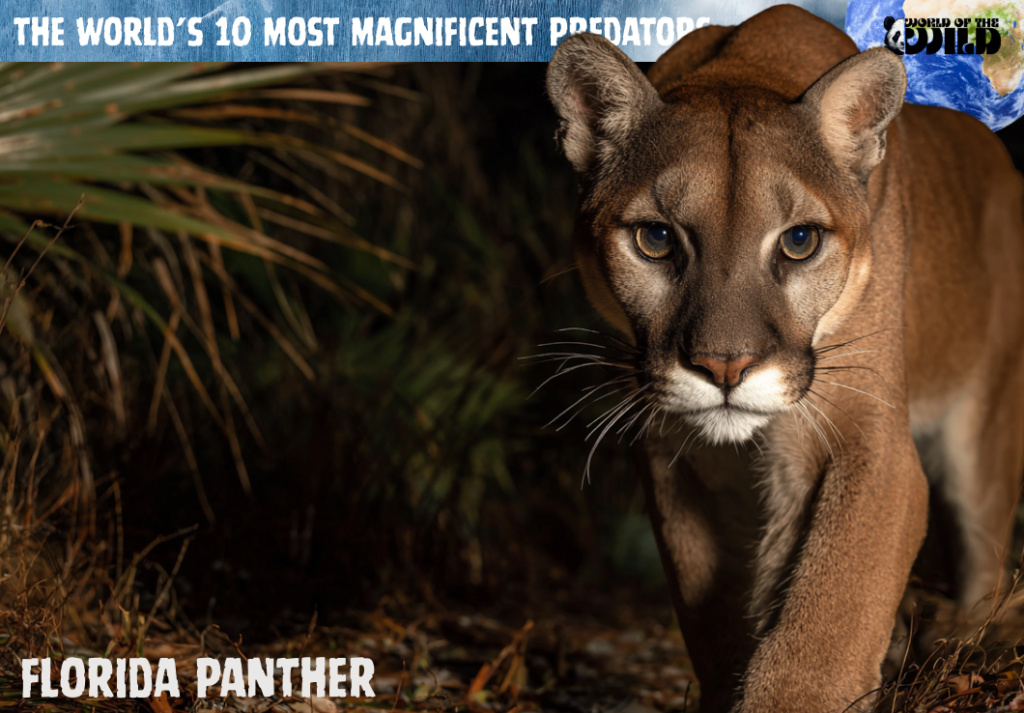
1. The Florida Panther — Ghost of the Everglades, USA
There are fewer than 200 Florida Panthers left on Earth. Let that number sink in.
Padding silently through the saw palmetto and cypress swamp of the Everglades, the Florida Panther (Puma concolor coryi) has earned its reputation as one of the most elusive creatures in North America. Trail cameras capture blurred shapes on moonless nights. Biologists spend years studying a single individual’s territory without ever laying eyes on the animal itself. This is not a predator that tolerates an audience.
The story of the Florida Panther is as much a conservation triumph as it is a wildlife one. By the 1990s, the population had crashed to just 20–30 individuals — plagued by inbreeding, habitat loss, and collisions with cars. A landmark genetic rescue program in 1995 introduced Texas Pumas into the Florida population, injecting critical diversity and pulling the subspecies back from the brink. Today, the Panther is a symbol of what is possible when science, policy, and public will align.
To stand in the quiet of Big Cypress at dusk, knowing that somewhere in the shadows a panther moves unseen, is a humbling and profound experience.
Learn more in-depth information about the amazing Florida Panther here at World of the Wild
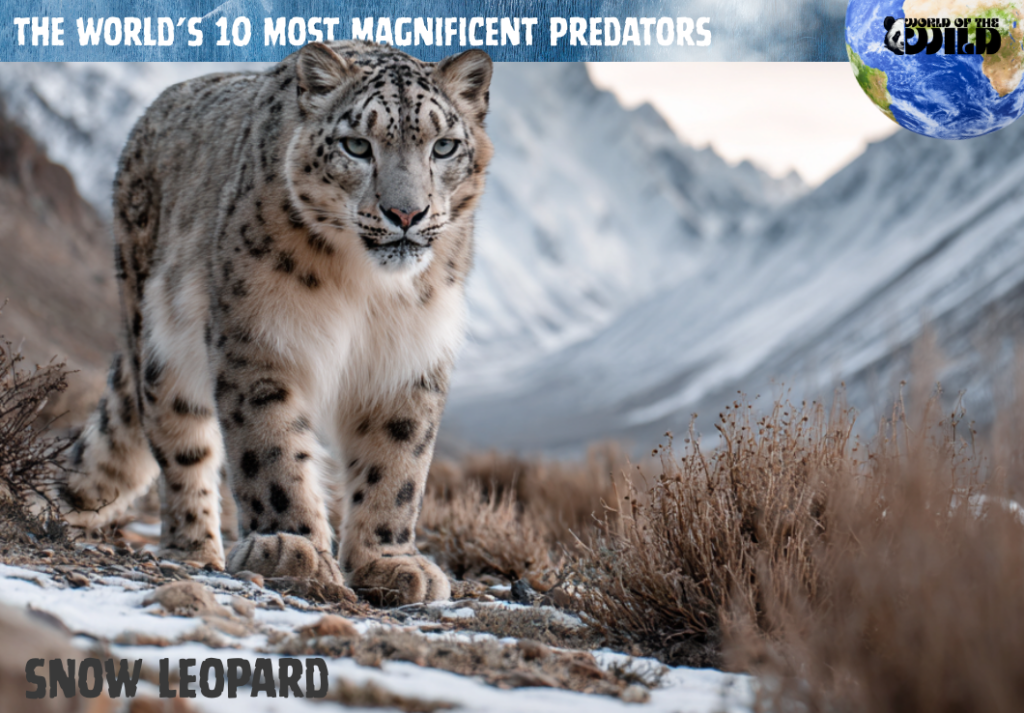
2. The Snow Leopard — The Grey Ghost of the Himalayas
At elevations where oxygen is thin and the wind cuts like a blade, the Snow Leopard (Panthera uncia) reigns supreme. It is a creature so perfectly adapted to its environment — so exquisitely camouflaged against the slate and frost of the high Himalayas — that even seasoned naturalists rarely spot one despite days of searching. Wildlife photographers have spent entire careers chasing a single clean frame.
The Snow Leopard’s smoke-grey coat, patterned with dark rosettes, dissolves into the rocky terrain of Central Asia as though the animal were made of the mountain itself. Their outsized, fur-padded paws act as natural snowshoes. Their extraordinarily long, thick tails — often nearly as long as their bodies — serve as both a balancing tool on rocky outcrops and a warm wrap against the brutal cold.
Fewer than 7,000 are estimated to survive across 12 countries. They are silent hunters, capable of taking prey three times their own weight, but it is their invisibility — not their ferocity — that defines them. The Grey Ghost gives nothing away.
Learn more in-depth information about the amazing Snow Leopard here at World of the Wild
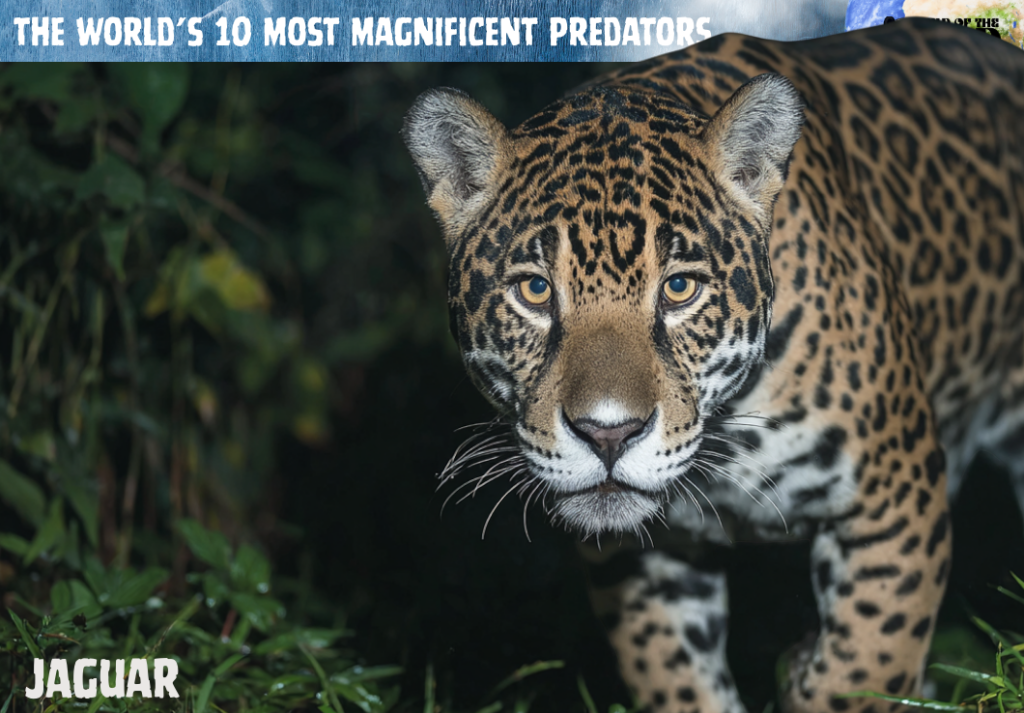
3. The Jaguar — River Hunter of the Pantanal, Brazil
Most large cats are predictable. The Jaguar (Panthera onca) is not.
In the Pantanal — the world’s largest tropical wetland, stretching across Brazil, Bolivia, and Paraguay — the Jaguar has done something no other big cat has mastered: it hunts in the water. While lions and leopards avoid aquatic confrontations, Jaguars actively patrol riverbanks for caiman, plunging into murky water to deliver their signature killing bite — a crushing skull-crack that bypasses the traditional throat-hold of other big cats. They have the most powerful bite of any cat relative to their size, capable of piercing the armored hide of a six-foot caiman with ease.
The Pantanal offers the best Jaguar viewing on the planet. Boat safaris along the Cuiabá River frequently encounter these spotted giants in broad daylight — resting on sandbanks, stalking capybara through flooded grassland, or staring back at observers with a confidence that makes it clear they have nothing to fear. The Jaguar does not run. It watches.
Learn more in-depth information about the amazing Jaguar here at World of the Wild
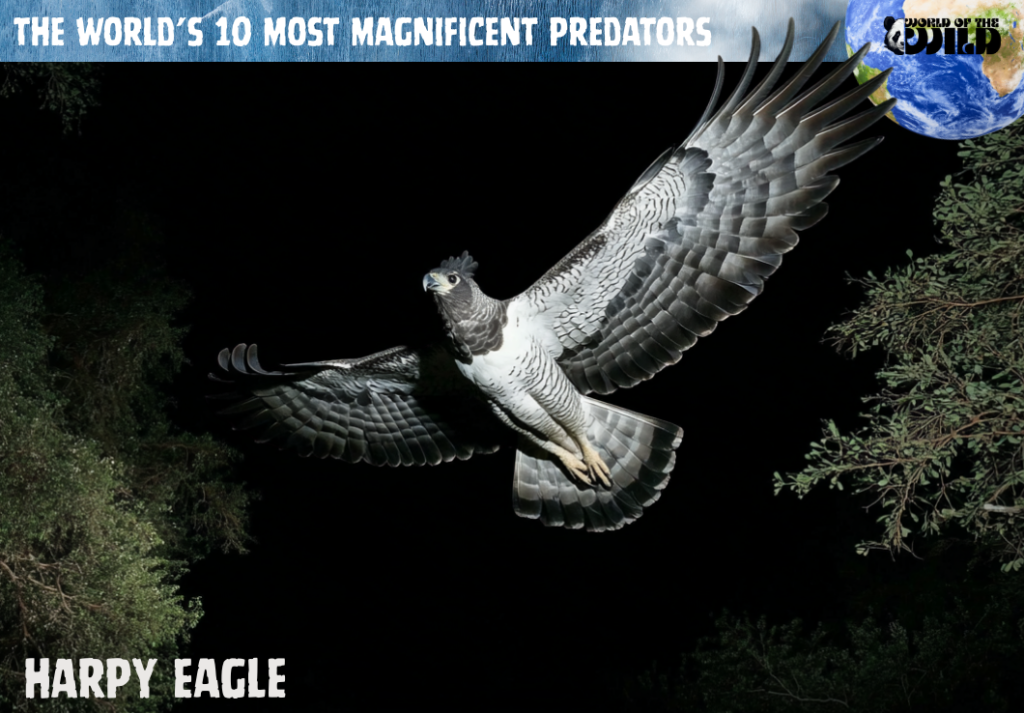
4. The Harpy Eagle — Terror of the Amazon Canopy
When ornithologists first described the Harpy Eagle (Harpia harpyja), they named it after the winged spirits of Greek mythology — and for good reason. This is not merely a large bird of prey. It is an airborne predator of almost mythological power, presiding over the Amazon rainforest canopy like a feathered apex monarch.
The numbers are staggering: a wingspan of up to seven feet, a body weight exceeding 20 pounds in females, and talons that rival the claws of a grizzly bear — thick, curved weapons up to four inches long. These talons do not merely grasp; they crush, exerting a grip pressure sufficient to snap the spine of a spider monkey or snatch a full-grown three-toed sloth from a branch.
Despite their size, Harpy Eagles are extraordinarily agile, navigating dense jungle at speed with sudden, devastating strikes. Their facial disc — a flat, owl-like ruff of feathers — funnels sound to their ears with radar-like precision. They are among the world’s most beautiful birds. They are also among the most terrifying things that can happen to a monkey.
Learn more in-depth information about the amazing Harpy Eagle here at World of the Wild
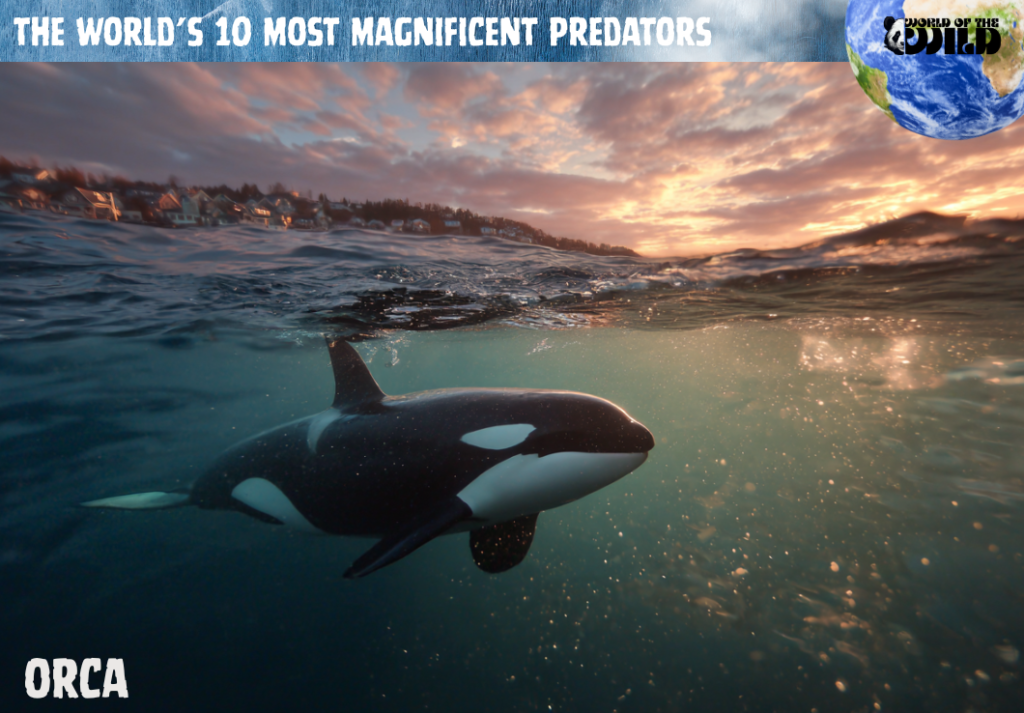
5. The Orca — The Fjord Strategist, Norwegian Coast
Intelligence changes everything in the hierarchy of predators. And no apex predator demonstrates intelligence quite like the Orca (Orcinus orca).
In the cold, deep fjords of northern Norway — particularly around the Lofoten Islands in winter — Orcas pursue vast schools of herring using a hunting technique so sophisticated it requires coordination, communication, and teaching across generations. It is called carousel feeding: multiple individuals work in concert to herd a tightly packed ball of herring toward the surface, taking turns slapping the school with their tail flukes to stun fish before consuming them. It is as much choreography as it is a hunt.
Orcas are not merely intelligent — they are culturally complex. Different pods maintain different dialects, different techniques, different prey preferences passed from mother to calf over decades. The Norwegian fjord Orcas are among the most studied populations on Earth, yet they continue to surprise researchers. They are social architects, strategic thinkers, and the undisputed apex predator of every ocean on the planet.
Learn more in-depth information about the amazing Orca here at World of the Wild
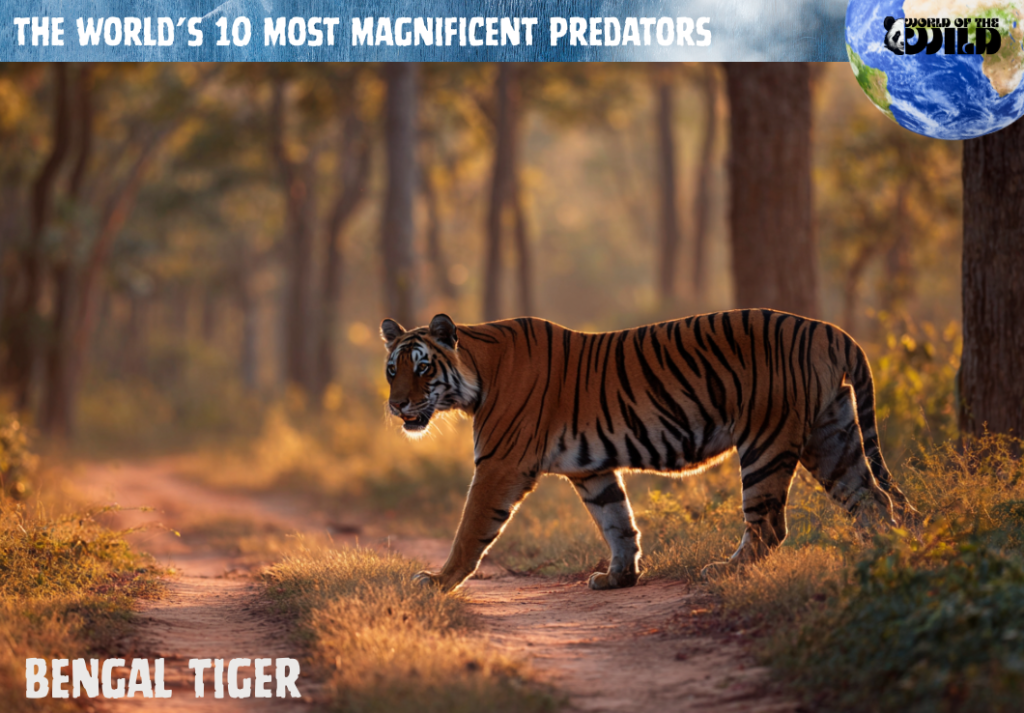
6. The Bengal Tiger — Flame in the Forest, Ranthambore, India
There is no prepared response for the first time you see a Bengal Tiger (Panthera tigris tigris) in the wild. The orange burns against the dry, tawny forest like a moving fire. The black stripes dissolve and re-emerge as the animal moves through dappled light and shadow with a fluid, boneless grace that seems impossible for something so massive.
Ranthambore National Park in Rajasthan is among the finest places on Earth to witness this. The tigers here are famously diurnal — hunting in daylight, drinking at open waterholes, and lounging near ancient Mughal ruins with an indifference to tourist vehicles that makes them feel simultaneously approachable and profoundly wild. These animals are as comfortable navigating history as they are the forest.
The Bengal Tiger remains critically endangered, with fewer than 3,000 individuals surviving in the wild. India’s Project Tiger — one of the most ambitious wildlife conservation programs ever undertaken — has helped arrest and reverse the population decline. Ranthambore stands as one of its crowning successes. Every sighting here is both a joy and a reminder of what nearly vanished from the world.
Learn more in-depth information about the amazing Bengal Tiger here at World of the Wild
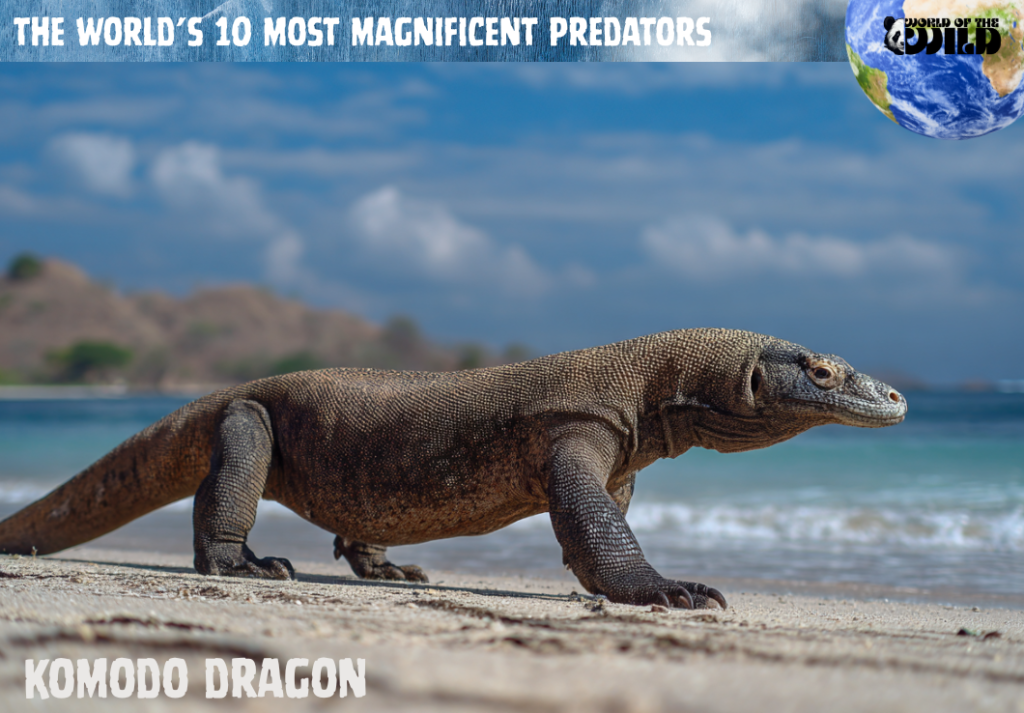
7. The Komodo Dragon — Island King of Indonesia
The Komodo Dragon (Varanus komodoensis) is a relic — a living window into the Cretaceous, a creature that should not, by modern ecological logic, exist. And yet on the islands of Komodo and Rinca in Indonesia, these prehistoric giants rule absolutely, growing to ten feet in length and patrolling their territory with the unhurried authority of an animal that has not needed to evolve in millions of years.
They are ambush hunters of extraordinary patience. A Komodo will lie motionless for hours beside a game trail, waiting for a deer or wild boar to wander into range before exploding in a short, violent burst of speed. Once a prey animal is bitten, the Dragon’s sophisticated saliva — laced with venom that inhibits blood clotting and contains dozens of bacteria strains — begins its slow work. Prey that escapes the initial attack rarely survives long.
The Dragon’s flickering, forked tongue samples the air constantly, a sensory system so precise it can detect carrion from miles away. In the world of Komodo Island, this animal does not compete for supremacy. It simply is supreme.
Learn more in-depth information about the amazing Komodo Dragon here at World of the Wild
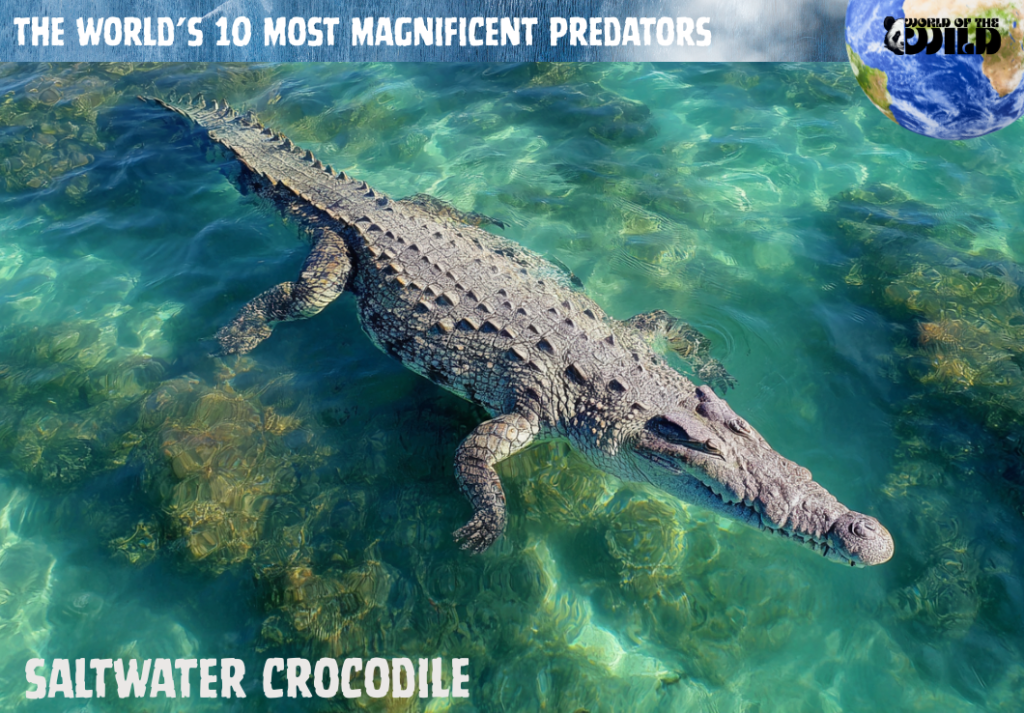
8. The Saltwater Crocodile — Living Fossil of Northern Australia
The Saltwater Crocodile (Crocodylus porosus) is the largest living reptile on Earth. A mature male can exceed 20 feet in length and weigh over 2,000 pounds — a mass of prehistoric armored muscle that has remained essentially unchanged for 200 million years. The dinosaurs came and went. The Saltwater Crocodile remained.
In Australia’s Northern Territory, along tidal rivers and mangrove estuaries from Kakadu to the Kimberley, Saltwater Crocodiles are not background wildlife — they are the dominant presence. They patrol river systems with territorial confidence, and their ambush technique — the slow, silent approach to the water’s edge, the explosive lunge — is the product of evolutionary perfection.
What is most unsettling about the Saltwater Crocodile is not its size or its speed but its intelligence. These animals learn individual human behavior patterns, return to the same ambush sites repeatedly, and adapt their hunting strategies based on experience. They are not mindless killers. They are patient, calculating predators — and in the waterways of northern Australia, they are always watching.
Learn more in-depth information about the amazing Saltwater Crocodile here at World of the Wild
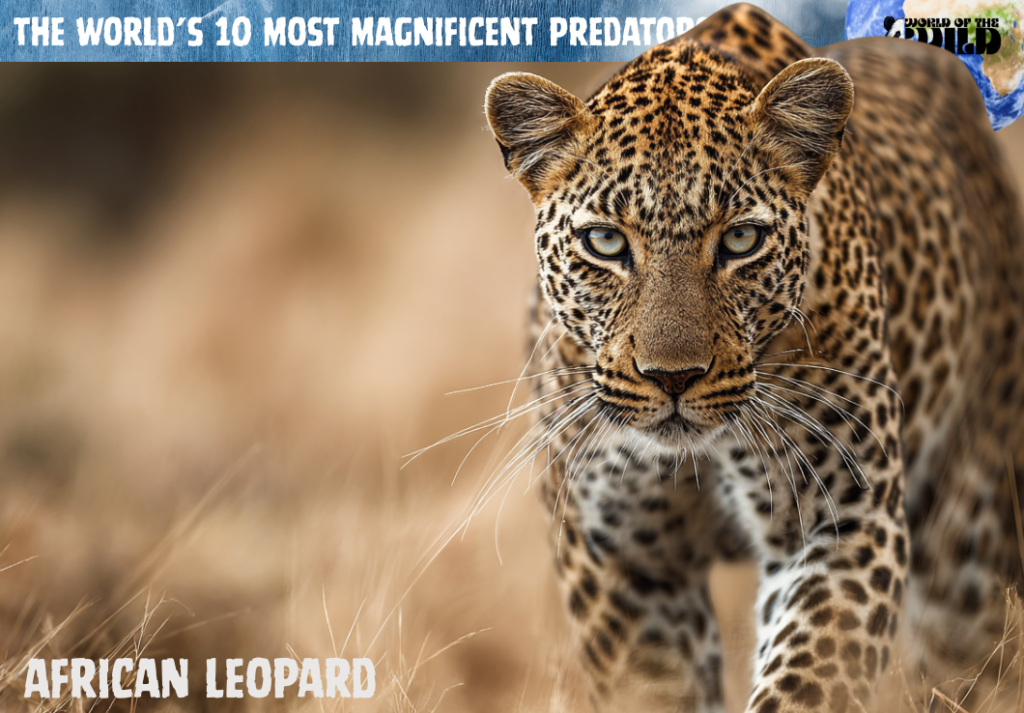
9. The African Leopard — The Invisible Artist of the Serengeti
Ask any experienced safari guide which of the Big Five is hardest to find, and the answer is almost always the same: the Leopard.
The African Leopard (Panthera pardus pardus) is a masterwork of concealment. Despite being one of the most widely distributed large cats in the world, it remains one of the most rarely seen — a testament to an instinct for invisibility so deeply embedded it borders on supernatural. In the Serengeti, your best chance of spotting one is by scanning the high branches of acacia trees for a dangling tail or the curve of a spotted flank. Leopards haul kills weighing twice their own body weight into the canopy, caching them away from lions and hyenas, then drape themselves across branches with an almost theatrical ease.
Their adaptability is unmatched among big cats. They hunt everything from dung beetles to waterbuck, thrive in habitats ranging from dense jungle to semi-desert, and have demonstrated the extraordinary ability to persist in proximity to human settlements that would have eliminated any other large predator. The Leopard endures because it is, simply, the most perfectly efficient predator on the African continent.
Learn more in-depth information about the amazing African Leopard here at World of the Wild
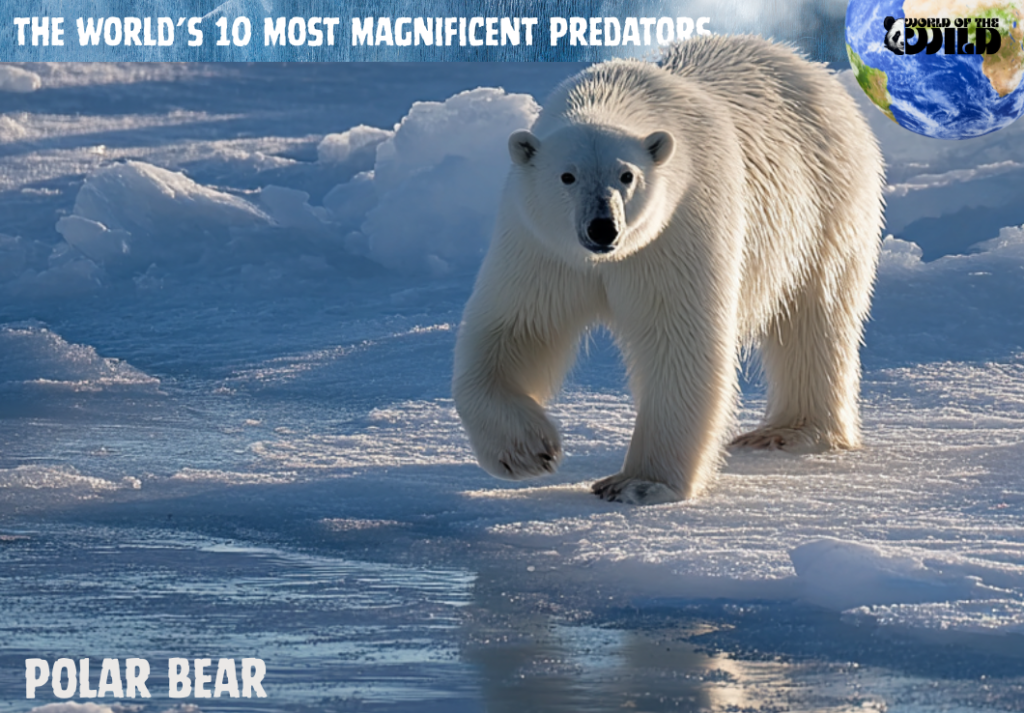
10. The Polar Bear — Arctic Sovereign, Svalbard, Norway
The Polar Bear (Ursus maritimus) is the largest land carnivore on Earth and the undisputed master of the High Arctic — a landscape of sea ice, howling gales, and months of perpetual darkness that would be lethal to almost every other creature on the planet.
On the Norwegian archipelago of Svalbard, Polar Bears can be observed in one of the most accessible wild settings in their range. They are engineered for the ice: hollow, translucent guard hairs that channel solar heat to their black skin; a four-inch layer of blubber beneath their hide; paws the size of dinner plates, perfectly designed for silent stalking across ice floes toward resting ringed seals. A single Polar Bear may roam a territory the size of a small nation.
But to visit Svalbard today is to understand that what you are witnessing exists under profound pressure. Arctic sea ice is declining at a rate of approximately 13% per decade. The hunting platform that Polar Bears have relied upon for 150,000 years is contracting beneath their feet. The urgency of a Polar Bear sighting in the 21st century carries a weight beyond wonder — it is a call to action, a reminder that the fate of the king of the Arctic remains very much in human hands.
Learn more in-depth information about the amazing Polar Bear here at World of the Wild
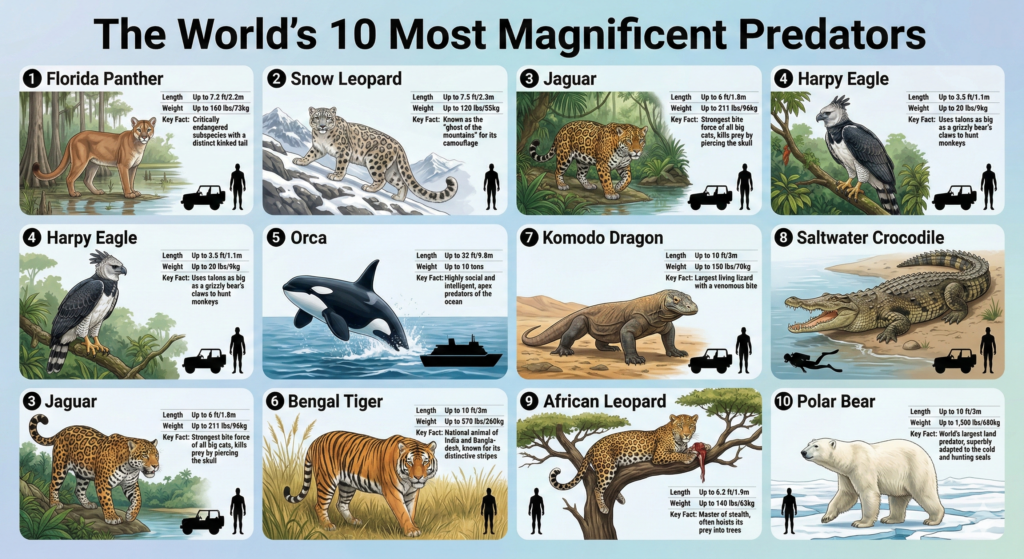
From the flooded forests of Brazil to the frozen seas of Norway, these ten predators represent the apex of evolutionary achievement — each one a product of millions of years of pressure, adaptation, and biological ingenuity. They are fragile and ferocious in equal measure. To protect them is to protect the very integrity of the wild world.