
Beneath the leaf litter of Europe’s ancient forests, an empire thrives. Mounds of pine needles and twigs rise like cathedrals from the forest floor, each one housing hundreds of thousands of workers carrying out tasks with the kind of precision and coordination that would make any city planner envious. These are the Wood Ants — and they are arguably among the most ecologically important, architecturally gifted, and evolutionarily remarkable insects on the planet.
What makes the Wood Ant truly extraordinary isn’t just the scale of their colonies or the complexity of their nests — it’s the sheer intelligence baked into their collective behavior. Wood Ants farm, fight, communicate through chemistry, and even practice a form of rudimentary medicine. They are engineers, soldiers, farmers, and pharmacists all rolled into a creature barely half an inch long. To walk past a Wood Ant mound without pausing to consider what lies within is to overlook one of nature’s greatest wonders right beneath your feet.
Facts
- Living thermostats: Wood Ant mounds are precision-engineered to regulate temperature. The outer layer of pine needles acts as insulation, while the ants themselves physically move the internal structure to maintain a near-constant internal temperature of around 25–30°C (77–86°F), even when outside temperatures drop near freezing.
- Chemical warfare experts: When threatened, Wood Ants can squirt formic acid from their abdomens with remarkable accuracy — spraying it up to several centimeters toward a perceived threat. A large colony under attack can release enough formic acid to produce a distinctly sharp, vinegar-like smell detectable by humans from several feet away.
- Supercolony builders: Some Wood Ant populations form “supercolonies” — networks of interconnected nests that share workers, queens, and resources. One famous supercolony in the Swiss Jura mountains contained an estimated 306 million workers across 1.2 million nesting mounds.
- Forest health guardians: A single large Wood Ant colony can collect and consume over 100,000 invertebrates per day, making them one of the most effective natural pest controllers in temperate forests. Foresters in Europe have long recognized their value and actively protect nest sites.
- Sun-worshipping navigators: Wood Ants use the position of the sun as a compass to navigate — a behavior known as sun-compass orientation. Even on cloudy days, they can detect polarized light to keep their bearings across vast foraging territories.
- They keep “livestock”: Wood Ants actively herd and protect aphids on plants near their nests. In return for protection from predators, the aphids produce a sugary excretion called honeydew, which the ants “milk” by stroking the aphids with their antennae — a remarkable form of insect agriculture.
- Medicinal foragers: Research has shown that Wood Ants deliberately collect and incorporate resin from conifer trees into their nest material. This resin has strong antimicrobial properties, effectively acting as a disinfectant throughout the colony — an early, instinctive form of colony-wide medicine.
Species
Wood Ants belong to the following taxonomic classification:
- Kingdom: Animalia
- Phylum: Arthropoda
- Class: Insecta
- Order: Hymenoptera
- Family: Formicidae
- Genus: Formica
- Species: Formica rufa (the Red Wood Ant, the most widely referenced species)
The genus Formica is large and diverse, containing over 170 recognized species globally, but the term “Wood Ant” most commonly refers to a cluster of closely related species within the Formica rufa group. The major species within this group include:
Formica rufa — The Red Wood Ant, the best-known and most studied species. Found widely across Europe, from Britain to Siberia. Characterized by its large mound nests and aggressive defensive behavior.
Formica polyctena — The European Wood Ant or Many-Queened Wood Ant. Similar to F. rufa but tends to form larger, multi-queen colonies. Common in continental Europe and particularly dominant in managed forests.
Formica lugubris — The Hairy Wood Ant. Found in upland and northern regions of Europe, including Scotland and Scandinavia. Distinguished by denser body hair and a preference for cooler, higher-altitude habitats.
Formica aquilonia — The Northern Wood Ant. Prevalent across Scotland and Scandinavia. Often found at higher latitudes and altitudes than other species, and frequently forms vast supercolonies.
Formica pratensis — The Meadow Ant. Though slightly divergent from the classic woodland habit of its relatives, it belongs to the same species group and shares many behavioral traits.
These species can hybridize in overlapping zones, and their taxonomy has been the subject of considerable scientific debate — underscoring just how complex and evolutionarily active this group remains.
Appearance
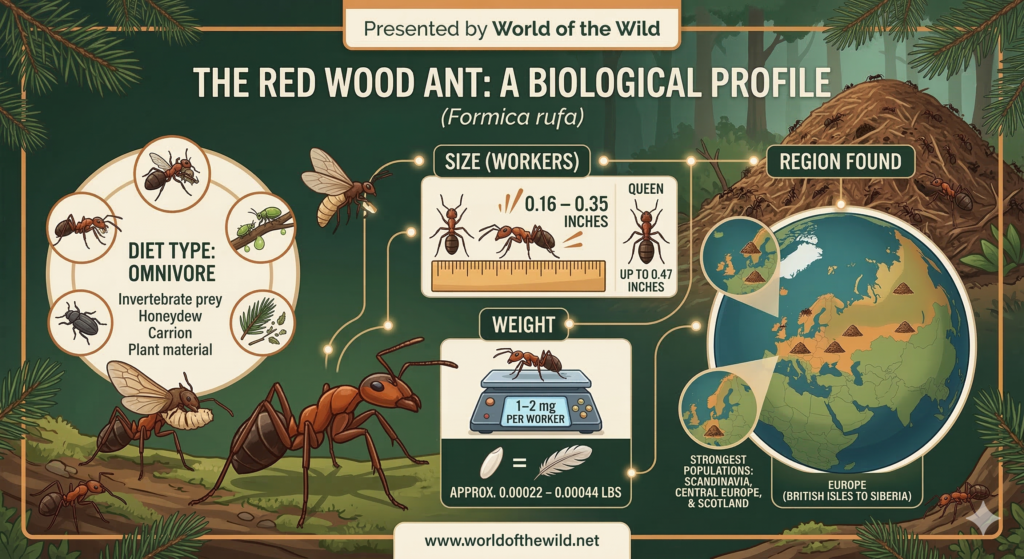
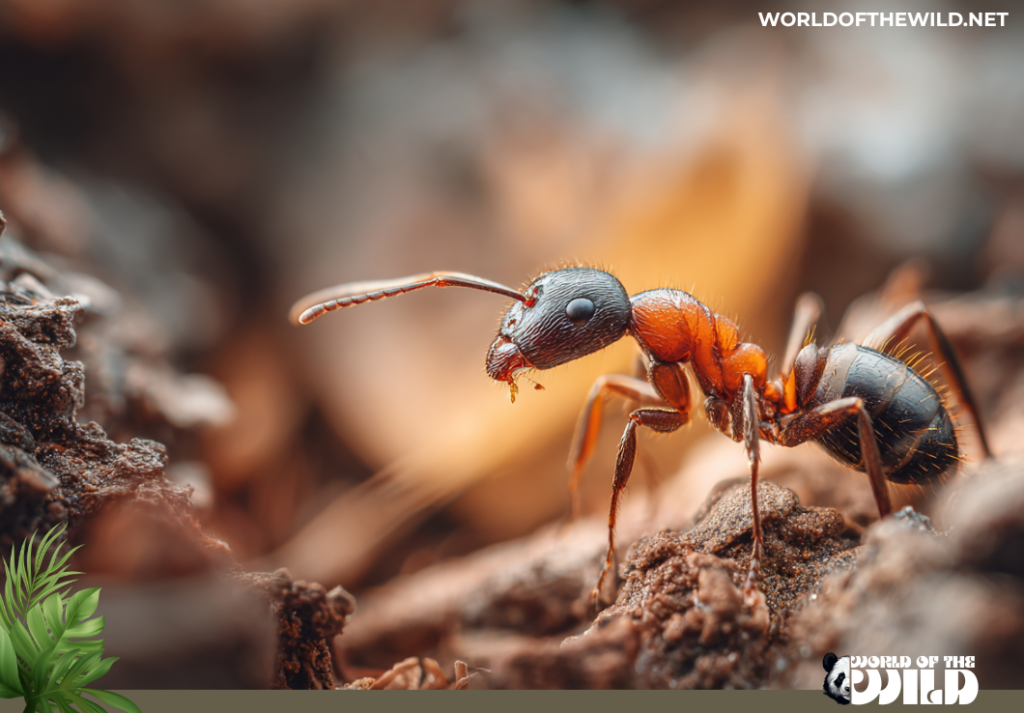
Wood Ants are medium-to-large ants by European standards, with a striking two-toned coloration that makes them relatively easy to identify in the field. Workers typically measure between 4 and 9 mm (0.16 to 0.35 inches) in body length, with queens considerably larger at up to 11–12 mm (roughly 0.45 inches). Males are smaller and more slender than workers.
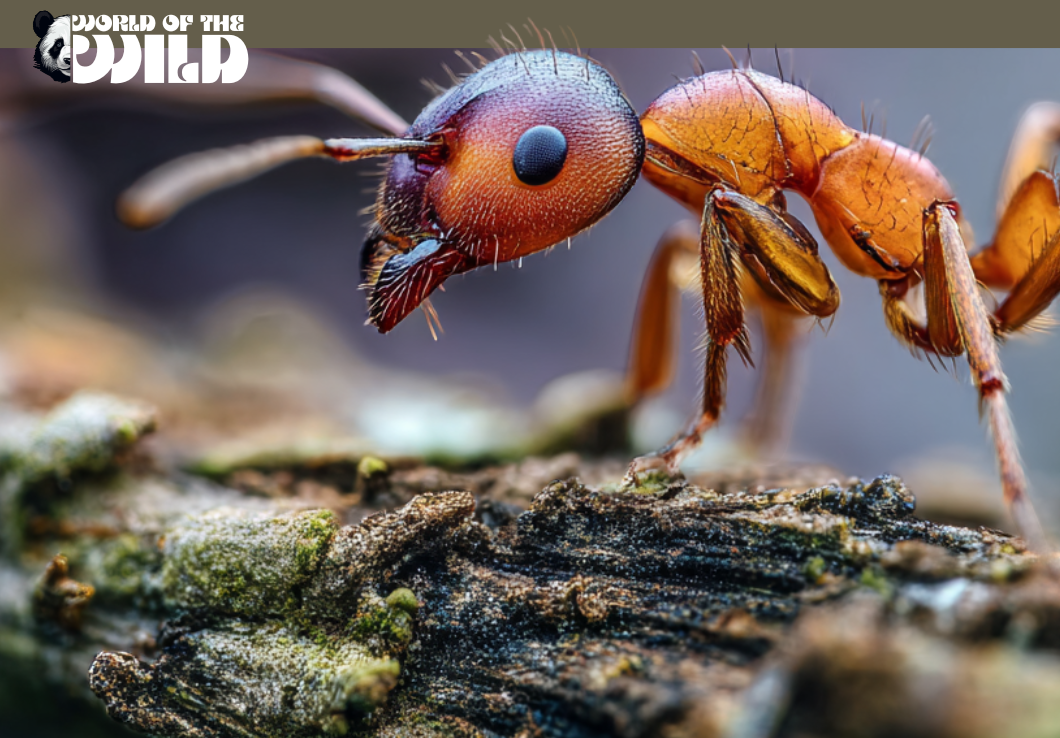
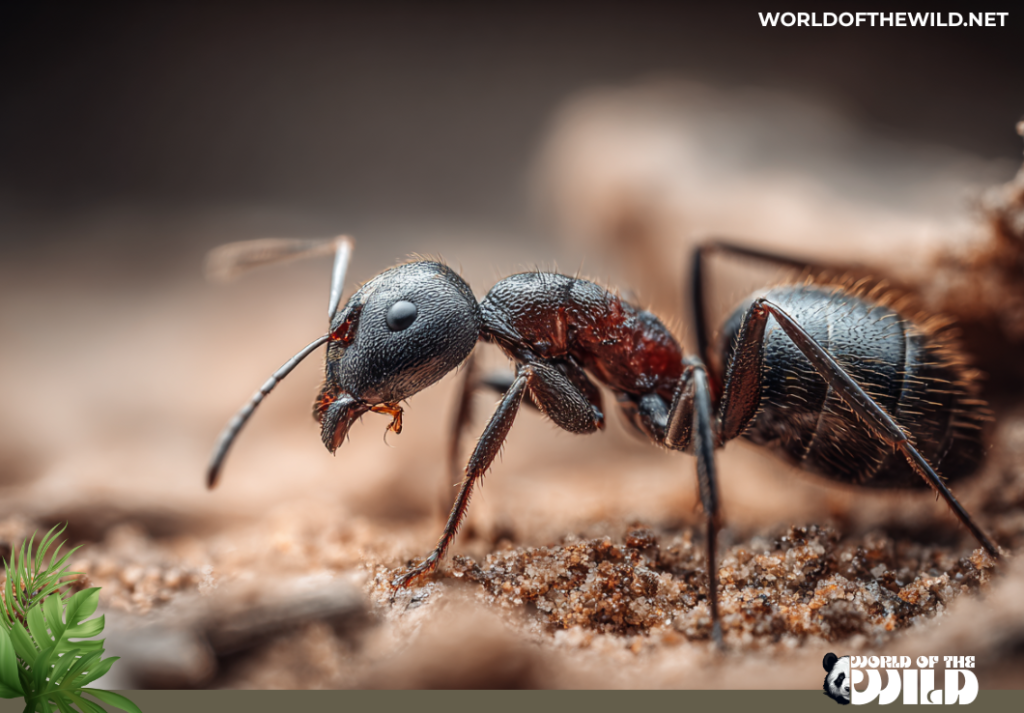
The body is divided into three distinct segments — head, thorax (mesosoma), and abdomen (gaster) — connected by a narrow waist called the petiole. The coloration of Formica rufa is one of its most recognizable features: the head and thorax are reddish-brown to orange, while the abdomen is largely dark brown to black, often with a slight sheen. The legs tend to match the reddish tones of the thorax.
Workers possess powerful, forward-facing mandibles well-suited for gripping, cutting, and carrying loads many times their own body weight. Unlike many ant species, Wood Ants lack a sting — their primary chemical defense instead comes from a specialized gland that ejects formic acid. Queens are visibly larger, with a more robust thorax that once bore wings (shed after mating), while males retain wings throughout their short adult lives.
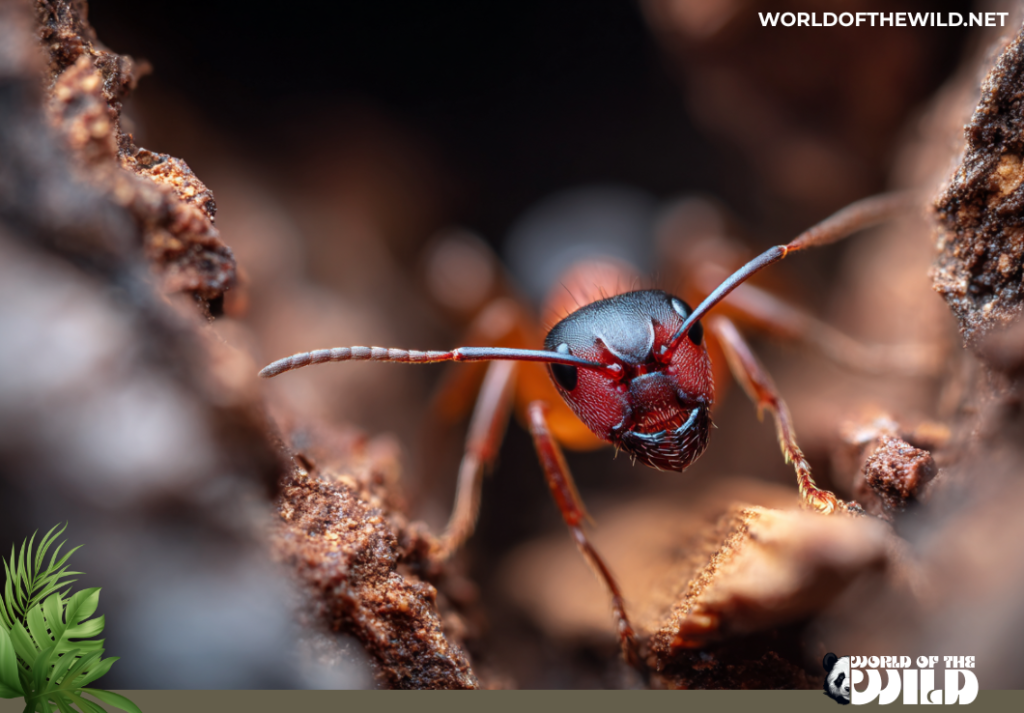
Under magnification, the body surface reveals a texture of fine hairs and sculptured cuticle. The compound eyes are well-developed, and the antennae — elbowed and 12-segmented — are in near-constant motion, sampling the chemical landscape of the environment. It is through these sensory organs that the colony’s richest communication takes place.
Behavior
Wood Ants are intensely social insects, and nearly every behavior they exhibit is shaped by the demands and needs of the colony as a whole. There are no solitary Wood Ants in the wild — every individual exists in service to the superorganism.
Division of Labor
A mature colony operates with a sophisticated caste system. The queen (or queens, in polygynic species) is dedicated almost entirely to egg-laying. Workers — all sterile females — are divided into roles that shift with age and colony need. Young workers typically serve as nurses deep within the nest, caring for eggs, larvae, and pupae. As they age, workers transition to foraging, nest maintenance, or defensive duties.
Foraging and Trail Networks
Foraging workers establish and maintain chemical trail networks that can extend 50–100 meters or more from the nest. These trails are reinforced with pheromone secretions, guiding thousands of workers simultaneously to productive food sources. The efficiency of these trails has been mathematically compared to optimized transport networks — Wood Ants essentially solve routing problems that engineers study formally.
Chemical Communication
Pheromones are the primary language of Wood Ant society. Workers use different chemical signals to mark trails, alert nestmates to danger, identify nest membership, and coordinate colony-wide responses. The complexity of this chemical vocabulary is remarkable — studies have identified dozens of distinct chemical compounds in Wood Ant communication, each conveying specific information.
Aggression and Defense
Wood Ants are fiercely territorial. Workers patrol the boundaries of their foraging territory and will aggressively confront and expel rival ants, often from the same or different species. When threatened, they adopt a characteristic defensive posture — abdomen curled forward — before releasing a spray of formic acid. Large colonies can overwhelm vertebrate animals many times their size through sheer numbers and chemical assault.
Aphid Farming
One of the most behaviorally sophisticated traits of Wood Ants is their mutualistic relationship with aphids. Workers herd aphid colonies on nearby shrubs and trees, protecting them from ladybirds and other predators. The ants “milk” the aphids by tapping them with their antennae to stimulate the release of honeydew. Some studies suggest Wood Ants may even suppress the aphids’ natural impulse to fly away, chemically manipulating their “livestock” to prevent escape.
Evolution
Ants as a group first appeared during the Cretaceous period, approximately 130–100 million years ago, having evolved from wasp-like ancestors within the order Hymenoptera. The earliest confirmed ant fossils date to around 99 million years ago, found preserved in amber. These ancient ants were already eusocial — meaning they lived in colonies with reproductive division of labor — suggesting that the social superorganism lifestyle evolved early and proved immediately successful.
The genus Formica is considered evolutionarily advanced within the ant family tree. It belongs to the subfamily Formicinae, one of the most species-rich subfamilies of ants, whose members are united in part by the presence of the formic acid gland rather than a functional sting. Formica species diversified significantly during the Eocene and Oligocene epochs (roughly 55–23 million years ago) as temperate forests expanded across the Northern Hemisphere following the end of the dinosaur age.
The evolution of the complex behaviors seen in Wood Ants — trail pheromones, aphid farming, nest thermoregulation, and resin use — did not arise simultaneously. These traits are thought to have evolved incrementally over millions of years, with each adaptation providing a competitive advantage that drove natural selection forward. Aphid tending, for instance, appears to have evolved multiple times independently across ant lineages, suggesting it is a highly adaptive strategy that ant evolution tends to converge upon.
The capacity to form supercolonies — with multiple interconnected nests and reduced aggression between members of different nests — is considered a relatively recent evolutionary development, possibly driven by environmental conditions that favored cooperation over competition at large spatial scales.
Habitat
Wood Ants are creatures of the forest. In Europe, their core habitat is mature deciduous and mixed woodland, though they are also strongly associated with coniferous forests, particularly pine and spruce plantations and ancient Caledonian pine forests. They thrive in areas where the forest structure provides a combination of open sunny glades (for warming the nest mound), dense canopy (for foraging), and an abundance of decaying wood and leaf litter (for nest material).
Geographically, the Formica rufa group ranges across much of the Palearctic region — from the British Isles and western Europe east through Russia and into Siberia, and from Scandinavia in the north down to the mountainous zones of central and southern Europe. In Britain, Wood Ants are most strongly associated with ancient woodlands in southern England and the Scottish Highlands, though their range has contracted significantly in recent centuries.
The nest mound itself is a habitat within a habitat. Rising sometimes to over a meter in height and spanning several meters in diameter, these structures can persist and grow for decades. The mound’s architecture is not random: the dome shape maximizes solar gain in the morning, warming the nest efficiently; tunnels within allow ventilation; and the layered structure of coarse and fine material maintains structural integrity even in wet conditions.
Wood Ants prefer forest edges, clearings, and areas with dappled sunlight over deep, uniform shade. They are strongly associated with “ancient woodland indicator” sites — places where forest cover has persisted for centuries — making them both inhabitants and indicators of ecologically valuable landscapes.
Diet
Wood Ants are omnivores with a varied and opportunistic diet, playing dual roles as both predators and scavengers within the forest ecosystem.
Animal Prey
The bulk of protein in a Wood Ant colony’s diet comes from invertebrate prey. Workers hunt and collect a wide range of insects — caterpillars, flies, beetles, springtails, and other small arthropods are all fair game. Larger prey items are dismembered at the site and carried back to the nest in pieces. Workers have been observed cooperating to subdue prey too large for a single individual, demonstrating a form of group hunting behavior.
Honeydew
Perhaps equally important to prey is honeydew — the sweet, sugar-rich excretion produced by sap-sucking insects such as aphids, scale insects, and treehoppers. Wood Ants are among the most dedicated honeydew collectors in the insect world, tending large aphid populations across their foraging territory and making multiple visits per day. Honeydew is a critical carbohydrate source, providing the energy that fuels the workers’ tireless activity.
Carrion and Scavenging
Wood Ants are efficient scavengers. They will readily collect and process dead invertebrates and occasionally small vertebrate carcasses found within their territory. This scavenging behavior means that almost nothing of nutritional value within a Wood Ant’s range goes to waste.
Plant Material
While Wood Ants do not heavily consume plant tissue directly, they occasionally collect plant sap, nectar from flowers, and seeds. The resin they collect from conifers, while primarily used for its antimicrobial properties, may also have a minor dietary function in some contexts.
Predators and Threats
Natural Predators
Despite their aggressive defenses, Wood Ants have many natural enemies. The Green Woodpecker (Picus viridis) is perhaps their most iconic predator — its long, sticky, barbed tongue is perfectly adapted for probing Wood Ant mounds. A single woodpecker can consume thousands of ants in a single visit, and mounds in woodpecker-rich areas often show characteristic excavation damage. Other birds, including Wrynecks and some thrushes, also prey on Wood Ants opportunistically.
Among mammals, badgers, bears (in continental Europe), and wild boar are known to raid nests — the latter rooting up mounds to access the protein-rich larvae and pupae within. Certain parasitic flies in the genus Phorid lay their eggs directly inside ant workers, and various beetle species have evolved remarkable chemical mimicry to infiltrate and exploit the colony from within.
Human-Caused Threats
The greatest threats to Wood Ant populations are those caused by human activity, primarily habitat modification. Ancient woodland clearance and the replacement of structurally diverse forests with dense, uniform monocultures removes the sunny glades and forest edge habitat that Wood Ants depend upon. Intensive forestry practices, including the removal of deadwood and the suppression of natural canopy gaps, degrades habitat quality even where woodland cover persists.
Pesticide use in surrounding agricultural and managed land can reduce the invertebrate prey base available to foraging workers. Increased recreational disturbance — particularly trampling of nest mounds — poses a localized but significant threat in accessible woodlands. In some parts of Europe, nest collection for fishing bait was historically practiced and caused local population declines.
Climate change presents a longer-term, systemic threat. Shifts in temperature and rainfall patterns are altering the composition of temperate forests, potentially reducing the availability of the coniferous and mixed woodland habitats that Wood Ants favor.
Reproduction and Life Cycle
Colony Foundation
A Wood Ant colony begins — or expands — through a mating flight, typically taking place on warm, sunny days in late spring or early summer. Winged males and virgin queens leave established nests en masse, often in synchronized eruptions that can involve thousands of individuals. These nuptial flights allow queens from different nests to mate with males from unrelated colonies, promoting genetic diversity.
After mating, males die within days, having fulfilled their sole biological purpose. Newly mated queens either attempt to found a new colony independently or, more commonly in Wood Ants, return to an existing nest or adopt a new nest through a process known as “budding” — where a queen and a cohort of workers split off from the parent colony to establish a satellite nest.
Egg Laying and Development
A mated queen begins laying eggs within the nest. Wood Ant development follows complete metamorphosis: egg → larva → pupa → adult. The larval stage is legless and grub-like, entirely dependent on workers for feeding and care. Pupae in Wood Ants are enclosed in silken cocoons, often mistaken for “ant eggs” when nests are disturbed. Development time from egg to adult varies with temperature but typically takes 6–8 weeks during the active summer season.
Colony Size and Lifespan
A mature Formica rufa colony may house between 100,000 and 500,000 workers, though particularly large or long-established nests can exceed this. Workers live for one to several years. Queens are exceptionally long-lived — individual queens in established colonies have been documented living for over 25 years, making Wood Ant queens among the longest-lived insects known. The colony itself, through queen replacement and reproduction, can persist on the same site for many decades.
Seasonal Cycle
Wood Ant colonies enter a semi-dormant state over winter, retreating deep into the mound where the compressed mass of thousands of bodies generates enough metabolic heat to survive freezing surface temperatures. Activity resumes in early spring, triggered by rising temperatures, and the colony builds rapidly through summer before preparing again for winter as temperatures fall.
Population
Conservation Status
The conservation status of Wood Ants varies by species and region. Formica rufa is currently listed as Least Concern on the IUCN Red List globally, reflecting its broad range and large overall population. However, this headline figure masks significant regional declines. In England, for example, Wood Ant populations have declined markedly over the past century and are now a priority species under the UK’s Biodiversity Action Plan.
Population Trends
Globally, Wood Ant populations remain substantial, particularly in the vast boreal and temperate forests of Scandinavia and Russia. In western Europe, however, populations are more fragmented. The loss and degradation of ancient woodland has isolated many colonies, preventing the natural dispersal and genetic exchange that sustains healthy populations over time.
Formica lugubris and Formica aquilonia — species associated with upland and northern habitats — face particular pressure from forestry practices in Scotland and montane Europe. Monitoring studies suggest a patchy but overall declining trajectory in managed landscapes where ancient woodland is scarce.
The ecological importance of Wood Ants as keystone species is increasingly recognized in conservation management. Their role as pest controllers, soil aerators, seed dispersers, and prey for specialist predators means that their decline has cascading effects on the wider forest ecosystem.
Conclusion
The Wood Ant is far more than a common forest insect. It is an ecosystem engineer, a chemical genius, a master architect, and a keystone species without which temperate forests would be measurably poorer. In the architecture of a single nest mound, in the invisible chemical highways that criss-cross the forest floor, and in the remarkable mutualism of ant and aphid, we see evolution at its most creative — life solving the challenges of survival with elegance and ingenuity.
Yet like so many of nature’s unsung heroes, the Wood Ant faces an uncertain future in many parts of its range. The ancient woodlands it calls home are among our most threatened habitats, and as those forests are fragmented and degraded, the empires within them quietly shrink.
The next time you walk through a forest and encounter a mound of pine needles teeming with industrious, rust-colored workers, take a moment to truly see it — not as an obstacle to step around, but as a civilization in miniature, one that has been perfecting its craft for tens of millions of years. Protecting the forests that shelter the Wood Ant is not a niche conservation concern; it is an investment in the ecological machinery that keeps our temperate landscapes alive and functioning. In defending the Wood Ant, we defend the forest itself.
Quick Reference
| Field | Details |
|---|---|
| Scientific Name | Formica rufa (Red Wood Ant) |
| Diet Type | Omnivore (invertebrate prey, honeydew, carrion, plant material) |
| Size (workers) | 0.16 – 0.35 inches (approx. 0.013 – 0.029 ft); queens up to 0.47 inches |
| Weight | Approx. 0.00022 – 0.00044 lbs (1–2 mg per worker) |
| Region Found | Europe (British Isles to Siberia); strongest populations in Scandinavia, central Europe, and Scotland |