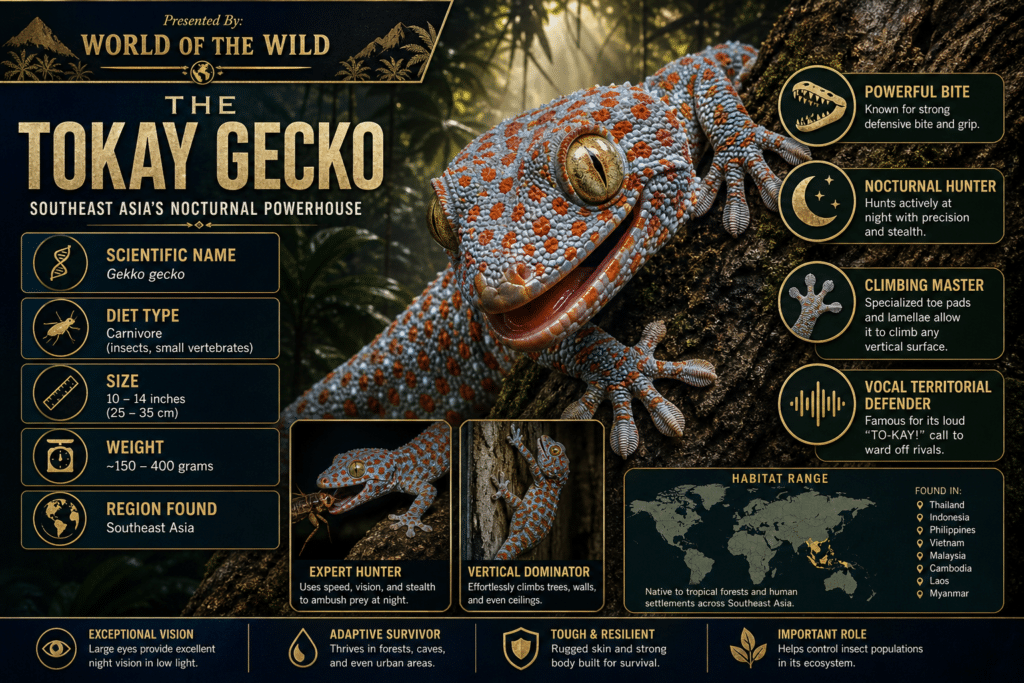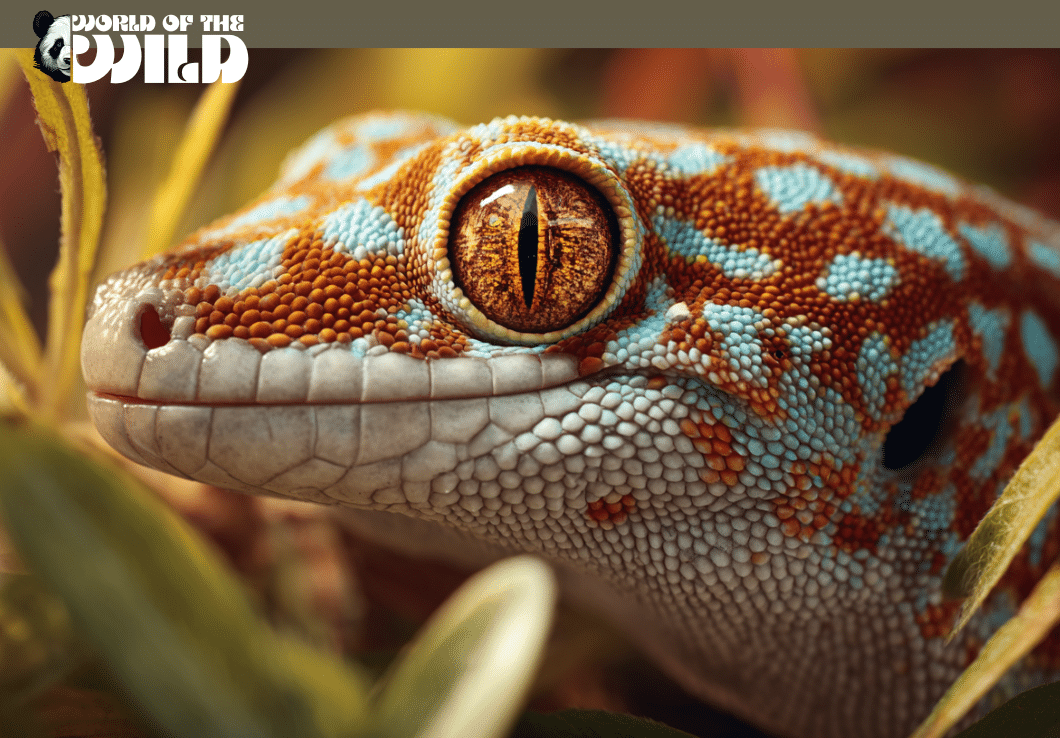

Picture this: it’s a humid tropical night somewhere in Southeast Asia. The air is thick with the sounds of insects and distant rain. Then, cutting through it all, comes a sound that seems almost cartoonishly loud for something that fits in the palm of your hand — “TO-KAY! TO-KAY!” You spin around, searching the wall of the building behind you, and there it is: a pair of luminous, amber eyes staring back at you from a creature that looks like it was designed by a fantasy novelist. Electric blue skin. Vivid orange spots. Pupils like vertical slits carved from obsidian.
The Tokay Gecko (Gekko gecko) is one of the most striking, vocal, and behaviorally complex lizards on Earth. It is the second-largest gecko species in the world, a creature of myth and medicine, a master of the night, and — despite being common across much of Asia — an animal that continues to surprise scientists and nature lovers alike. Whether you admire it for its almost supernatural grip, its brazen aggression, or the haunting call that gave it its name, the Tokay Gecko is impossible to ignore.
Facts
- Its name is onomatopoeic. The Tokay Gecko is literally named after the sound it makes. Its loud, two-syllable mating call — “to-kay” — is so distinctive and persistent that local cultures across Southeast Asia built the animal’s common name directly from it.
- It can detach and regrow its tail. Like many lizards, the Tokay Gecko practices autotomy — voluntarily shedding its tail when threatened. The detached tail continues to wriggle to distract predators while the gecko escapes. A new tail, often slightly different in color and texture, regenerates over several weeks.
- It has no eyelids. Tokay Geckos, like most geckos, lack movable eyelids. Instead, they have a transparent scale (a spectacle or brille) covering each eye, which they keep clean and moist by licking with their long, fleshy tongues.
- They are considered omens of good luck in many Asian cultures. In parts of Thailand, Laos, Vietnam, and the Philippines, having a Tokay Gecko living in your home is believed to bring fortune, fertility, and protection against evil spirits.
- Their feet are covered in millions of microscopic hairs. Each toe pad contains hundreds of lamellae — tiny hair-like structures called setae — that exploit van der Waals forces (weak molecular attractions) to let the gecko cling to virtually any surface, including glass, at nearly any angle.
- They are surprisingly long-lived for a small reptile. In the wild, Tokay Geckos can live 10 years or more. In well-maintained captivity, some individuals have lived beyond 18–20 years.
- Illegal wildlife trade has devastated wild populations. Tokay Geckos are harvested by the millions for use in traditional Asian medicine, with dried specimens and live animals commanding high prices on black markets — a crisis that has gone dangerously underreported.
Species
Full Taxonomic Classification:
| Rank | Classification |
|---|---|
| Kingdom | Animalia |
| Phylum | Chordata |
| Class | Reptilia |
| Order | Squamata |
| Family | Gekkonidae |
| Genus | Gekko |
| Species | Gekko gecko |
The Tokay Gecko belongs to the family Gekkonidae — the “true geckos” — one of the largest and most diverse lizard families in the world, comprising over 1,500 species. Within the genus Gekko, which contains roughly 60 recognized species, Gekko gecko stands out as the giant, both in terms of size and cultural significance.
Subspecies and Closely Related Species:
Two subspecies of Gekko gecko are widely recognized:
- Gekko gecko gecko — The nominate subspecies, found across mainland Southeast Asia and much of its native range. This is the “classic” Tokay Gecko most people are familiar with.
- Gekko gecko azhari — Found in parts of Bangladesh and northeastern India, this subspecies shows subtle morphological differences, particularly in scale counts and color patterning.
Among closely related species, the Kuhl’s Flying Gecko (Gekko kuhli) and the White-spotted Gecko (Gekko vittatus) are worth noting. While they share the same genus and a similar habitat range, neither matches the Tokay in size, vocalizations, or sheer attitude. The Common House Gecko (Hemidactylus frenatus), though not in the same genus, is frequently confused with juvenile Tokays in urban settings.
Appearance
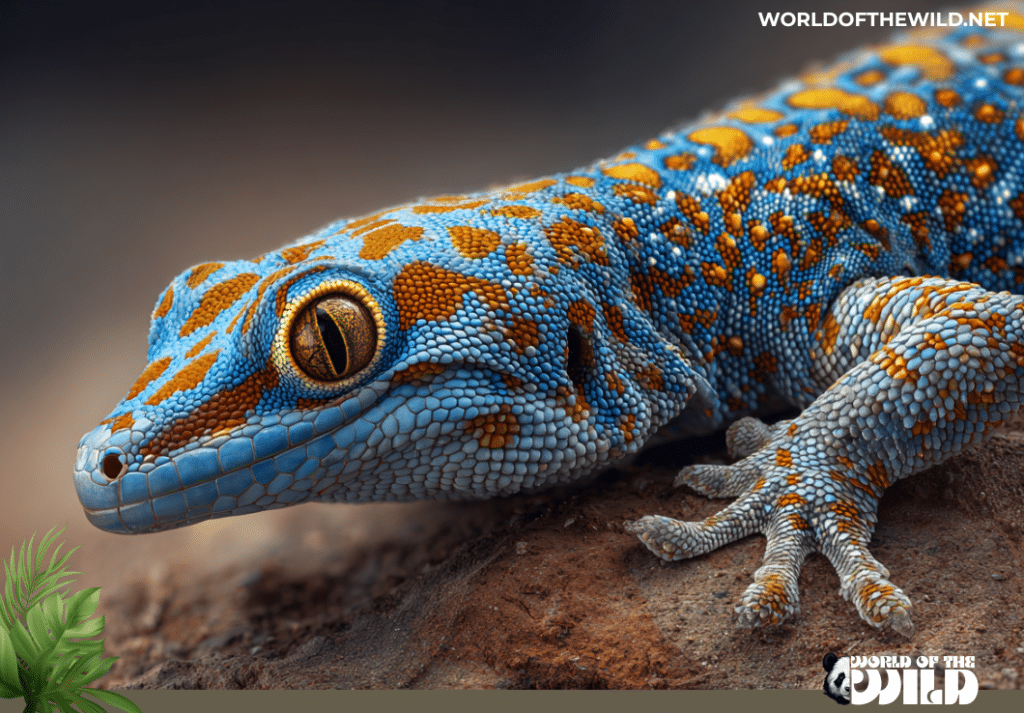
The Tokay Gecko is nothing short of spectacular in appearance — a living mosaic of color that seems almost artificially vivid against the bark of a tree or the plaster of a wall.
Size and Weight: Adult males typically measure between 11 and 15 inches (roughly 0.9 to 1.25 feet) in total length, including the tail, making them one of the heaviest-bodied geckos in existence. Females are somewhat smaller, generally reaching 8 to 12 inches. In terms of weight, adults typically fall between 5 and 10 ounces (approximately 0.3 to 0.6 pounds), though large males in optimal conditions can exceed this.
Color and Patterning: The base coloration is a striking blue-gray to grayish-purple, adorned with a scattering of bright orange, red, or white spots and speckles across the body and tail. These spots are not random — they form semi-regular patterns that vary between individuals, making each gecko subtly unique. Juveniles tend to be more boldly banded in black and white or gray, gradually developing their full adult coloration.
Notably, the Tokay can modulate the intensity of its coloration. During the day or when stressed, the colors may appear muted and pale. At night or during periods of excitement, the blue deepens and the orange spots seem to almost glow, giving the animal a remarkable otherworldly quality.
Distinctive Features:
- Eyes: Large and highly developed for nocturnal vision. The pupils are vertically elliptical, contracting to a series of tiny pinholes during bright daylight.
- Toe Pads: Wide, fan-like adhesive toe pads covered in microscopic setae, giving the feet a uniquely ribbed appearance.
- Body Build: Robust and somewhat flattened dorsoventrally, with a large, rounded head disproportionately large relative to the body — giving the animal a slightly bulldoggish profile.
- Skin Texture: Covered in small, granular scales interspersed with larger tubercles (raised bumps), lending the skin a rough, beaded texture.
- Tail: Thick at the base, tapering to a point, and banded — it serves as a fat reserve and a social signaling tool.
Behavior
If there is one word that encapsulates Tokay Gecko behavior, it is boldness. Unlike many lizards that flee at the slightest disturbance, Tokays are famously confrontational. Cornered individuals will gape widely, exposing a bright pink or blue-tinged mouth lining, hiss audibly, and bite with surprising force. Their jaws are powerful enough to draw blood from a human finger, and — in a particularly stubborn move — they often refuse to let go once they’ve latched on.
Daily Activity Pattern: Tokay Geckos are strictly nocturnal. During the day, they retreat into crevices, under bark, inside hollow trees, or within the walls and ceilings of human structures. As dusk falls, they emerge to hunt, socialize, and call.
Social Structure: Adults are largely territorial and semi-solitary. Males are aggressively territorial toward other males, engaging in loud vocal duels and, when necessary, physical confrontations. However, outside the breeding season, a dominant male may tolerate one or more females within his territory.
Vocalization: The Tokay Gecko is one of the most vocal of all gecko species. Beyond its signature “to-kay” mating call — which can carry remarkable distances in the humid night air — Tokays produce a variety of sounds including grunts, clicks, squeaks, and a distinctive rattling sound when extremely agitated. These vocalizations serve roles in territory defense, mate attraction, and general communication.
Adhesive Locomotion: One of the most behaviorally striking aspects of any gecko, and especially impressive in an animal this large, is the ability to walk across vertical and even inverted surfaces with ease. The Tokay can traverse a glass ceiling while carrying prey in its mouth — a feat that still inspires awe in materials scientists and engineers studying the principles behind gecko adhesion.
Intelligence and Adaptability: Tokay Geckos show considerable behavioral flexibility. They are remarkably quick learners in captivity, can recognize individual human handlers over time, and demonstrate a degree of spatial memory that allows them to navigate complex environments efficiently. They have also adapted exceptionally well to human-modified habitats, thriving in and around buildings across tropical Asia.

Evolution
The gecko lineage is ancient. The family Gekkonidae diverged from other lizards during the Cretaceous period, roughly 100 million years ago, making geckos contemporaries of the dinosaurs. Fossil evidence and molecular phylogenetic studies suggest that the ancestors of modern geckos likely originated on the ancient supercontinent Gondwana, dispersing across the globe over tens of millions of years through a combination of continental drift and active migration.
The genus Gekko itself is thought to have originated in South or Southeast Asia, with the Tokay Gecko representing one of the most morphologically and behaviorally derived members of its lineage — essentially a highly specialized, large-bodied nocturnal predator that has refined the core gecko body plan to near perfection for its ecological niche.
A key evolutionary milestone for Gekko gecko and its relatives was the development and refinement of the lamellar adhesive toe pad system. Though primitive setae appear in early gecko fossils, the complex hierarchical structure seen in modern tokays — with branching setae tipped by nanoscale spatulae — represents millions of years of evolutionary optimization. This system is so effective and energetically elegant that it has inspired an entire field of biomimetic engineering, with researchers attempting to replicate gecko-inspired adhesives for applications ranging from medical bandages to wall-climbing robots.
Another significant evolutionary trait is the development of sophisticated vocalization among members of the genus Gekko. While most reptiles are largely silent, the ancestors of geckos evolved functional voice boxes early in their history, and the Tokay has taken this to an extreme, producing one of the loudest calls of any lizard species relative to its body size.
Habitat
The Tokay Gecko’s native range spans a vast swath of tropical and subtropical Asia, from northeastern India and Bangladesh through Myanmar, Thailand, Laos, Vietnam, Cambodia, Malaysia, and across the Indonesian archipelago to the Philippines and beyond. It has also been introduced — largely through the pet trade and accidental transport — to parts of Florida, Hawaii, Belize, and several Caribbean islands, where it now has established feral populations.
Native Habitat Preferences:
In the wild, Tokay Geckos are primarily arboreal, living in:
- Tropical rainforests — clinging to the bark of large trees, sheltering under peeling bark, and hunting in the forest canopy.
- Rocky outcrops and limestone karst formations — using crevices and overhangs as refugia.
- Forest edges and disturbed secondary growth — taking advantage of the increased insect activity that comes with light gaps.
Perhaps more than any other factor, however, the Tokay Gecko is defined by its extraordinary success in human settlements. Across Southeast Asia, these geckos are permanent fixtures in villages, towns, and major cities alike. They inhabit the walls, ceilings, eaves, and attics of houses and commercial buildings, hunting the insects attracted to artificial lights. This synanthropic lifestyle — thriving in association with humans — has made the Tokay one of the most commonly encountered wild reptiles in urban tropical Asia.
The species requires warm, humid conditions throughout the year, with ambient temperatures ideally between 75°F and 90°F (24°C–32°C) and high relative humidity. It is largely absent from arid regions and high-altitude environments.
Diet
The Tokay Gecko is a carnivore — an opportunistic and voracious nocturnal predator that takes a remarkably wide variety of prey given its size.
Primary Food Sources:
- Insects — The dietary backbone. Crickets, cockroaches, beetles, moths, grasshoppers, and virtually any invertebrate of manageable size are consumed eagerly.
- Spiders and other arachnids — Taken readily when encountered.
- Small vertebrates — This is where the Tokay distinguishes itself from smaller gecko species. Adults are fully capable of — and regularly observed — consuming small mice and rats, smaller lizards (including other geckos), small frogs and toads, and even small birds and hatchling birds taken from nests.
Hunting Strategy:
The Tokay is a sit-and-wait predator, relying on stealth and explosive speed rather than active pursuit. It positions itself near a light source or a known insect pathway, remaining motionless for extended periods. When prey moves within striking range, the Tokay launches with startling speed, seizing prey in its powerful jaws. Larger prey items are subdued by repeated biting and shaking before being swallowed whole. The gecko’s strong grip and powerful bite — unusually forceful for its size — allow it to tackle prey items that would challenge much larger predators.
Water is obtained both from free-standing sources and by licking moisture from surfaces — a common behavior in humid tropical environments.
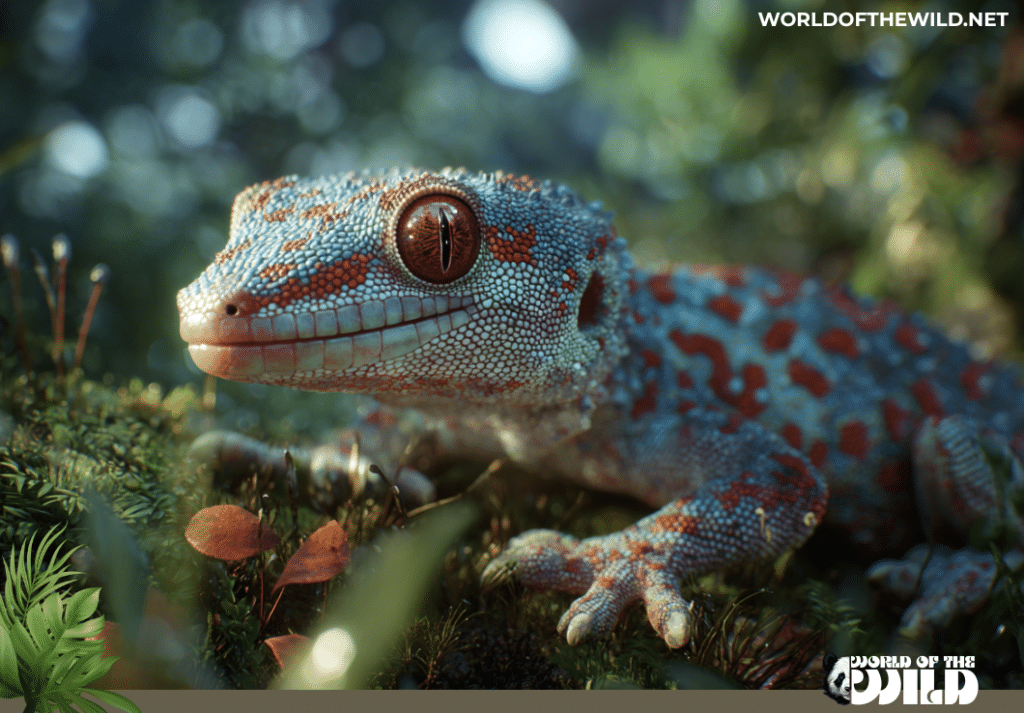
Predators and Threats
Natural Predators:
Despite their aggression and defensive arsenal, Tokay Geckos face a range of natural predators throughout their range:
- Snakes — Particularly arboreal species like rat snakes, vine snakes, and king cobras, which are among the most significant natural predators.
- Birds of prey — Owls, in particular, are well-adapted to picking off geckos in the dark.
- Large mammals — Civets, mongooses, and feral cats are documented predators in both wild and urban settings.
- Larger lizards — Monitor lizards (Varanus spp.) readily consume Tokay Geckos when the opportunity arises.
Human-Caused Threats:
The natural pressures on Tokay Geckos, while real, are far outweighed by the threats posed by human activities:
- Illegal Wildlife Trade: This is, by far, the most severe and immediate threat. Tokay Geckos are harvested in staggering numbers — estimates suggest tens of millions of individuals annually — for use in traditional Chinese and Southeast Asian medicine. Dried and live geckos are sold as supposed treatments for HIV/AIDS, cancer, asthma, skin disease, and sexual dysfunction. Despite no credible scientific evidence supporting these medicinal claims, demand remains high and enforcement of wildlife protection laws is inconsistent across much of the range.
- Habitat Loss: Deforestation across Southeast Asia continues at an alarming pace, eliminating the primary forest habitats that wild (non-synanthropic) populations depend on. Palm oil plantations, logging, and agricultural expansion are primary drivers.
- Pesticide Use: Urban and agricultural pesticide application reduces insect populations — the Tokay’s primary food source — and can cause direct poisoning when geckos consume contaminated prey.
- Pet Trade: Though legal trade is regulated in many countries, significant numbers of wild-caught Tokay Geckos enter the international pet market, particularly from Indonesia and the Philippines.
Reproduction and Life Cycle
Mating Behavior:
Breeding in Tokay Geckos is closely tied to the onset of warmer, wetter conditions and can occur throughout much of the year in equatorial regions, with peaks typically in spring and summer at higher latitudes within their range. Males advertise their fitness and territory through sustained, loud vocalizations — the iconic “to-kay” call — and engage in elaborate visual displays, including body posturing and tail undulation, when females are near.
Courtship involves the male approaching the female, licking and nuzzling her, and biting her gently along the neck and dorsum — a behavior common to many gecko species. If receptive, the female allows copulation, which can last several minutes.
Egg-Laying:
The Tokay Gecko is oviparous (egg-laying). Females typically produce 1 to 2 eggs per clutch, with multiple clutches possible throughout the breeding season — potentially producing 8 to 10 eggs per year in productive individuals. The eggs are adhesive and hard-shelled — a distinctive feature of the genus Gekko — and are typically glued to a concealed surface such as the underside of bark, inside a wall cavity, or within a rock crevice. This adhesive quality makes the eggs almost impossible to move once laid without damaging them.
Parental Care:
Unusually for reptiles, Tokay Geckos display a degree of parental investment. Both males and females have been observed guarding eggs against potential predators and interference, though the extent and consistency of this behavior vary. The eggs incubate for approximately 60 to 80 days depending on temperature and humidity.
Hatchlings and Development:
Hatchlings emerge fully formed and independent, measuring roughly 2 to 3 inches in length. They are immediately capable of hunting small prey and begin growing rapidly. Sexual maturity is typically reached at 1 to 2 years of age.
Lifespan:
In the wild, Tokay Geckos commonly live 10 to 15 years. In captivity with proper care, lifespans of 18 to 20 years have been recorded.
Population
IUCN Conservation Status: Least Concern (LC)
As of the most recent IUCN Red List assessment, the Tokay Gecko is classified as Least Concern, a designation that reflects its broad geographic range, adaptability to urban environments, and high reproductive output. However, this classification masks a deeply troubling reality: populations in many areas are declining sharply due to overexploitation for the traditional medicine trade, and the “Least Concern” status has been criticized by conservationists as failing to capture the urgency of the situation.
Global Population:
No precise global census exists for the Tokay Gecko. The species is considered abundant within its core range — particularly in urban and peri-urban environments across Southeast Asia — but forest-dwelling populations in regions heavily impacted by logging and the medicine trade appear to be contracting significantly. Countries such as the Philippines and parts of Indonesia have reported dramatic local declines, with some island populations showing signs of collapse under harvesting pressure.
Population Trends:
The trend is broadly assessed as decreasing, particularly in heavily exploited areas. The Philippines, recognizing the severity of the situation, has enacted domestic protections for the species. Indonesia imposed export quotas, though enforcement remains a persistent challenge. Introduced feral populations in Florida, Hawaii, and parts of the Caribbean are, ironically, stable or growing.
The gap between the species’ official “Least Concern” status and the on-the-ground reality of population declines in key areas underscores the need for more comprehensive, long-term monitoring programs.
Conclusion
The Tokay Gecko is many things at once: a biochemical marvel, a cultural icon, a nocturnal predator of surprising ambition, and a species caught in a painful collision between ancient tradition and modern conservation. Its adhesive feet have inspired technology. Its calls punctuate the nights of entire cities. Its vivid colors make it one of the most visually arresting animals you are ever likely to encounter in the wild — or on your hotel room ceiling in Thailand.
Yet for all its adaptability and resilience, the Tokay Gecko is not invulnerable. The insatiable demand of the illegal wildlife trade is extracting a toll that reproductive rates and urban success cannot indefinitely absorb. The “Least Concern” label should not lull us into complacency. Conservation attention, stronger trade enforcement, and — perhaps most importantly — public education campaigns that debunk the unfounded medicinal claims driving demand are urgently needed.
The next time you hear that unmistakable “to-kay” call rolling through a tropical night, take a moment to appreciate what you are listening to: 100 million years of evolutionary perfection, announcing itself to the world. It would be an incalculable loss to silence it.
Quick Reference
| Scientific Name | Gekko gecko |
| Diet Type | Carnivore |
| Size (inches) | 8–15 inches (0.67–1.25 feet) |
| Weight (pounds) | 0.31–0.62 lbs (approx. 5–10 oz) |
| Region Found | South & Southeast Asia (India, Bangladesh, Myanmar, Thailand, Vietnam, Cambodia, Laos, Malaysia, Indonesia, Philippines); introduced populations in Florida (USA), Hawaii, Belize, and Caribbean islands |