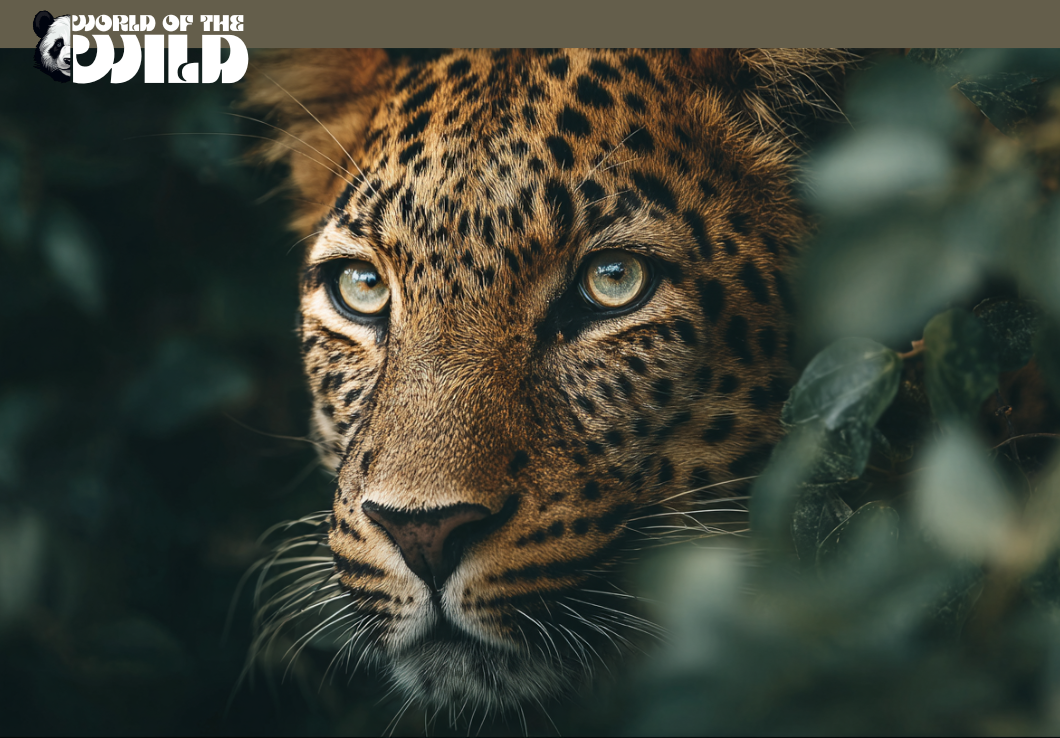

In the fading light of an African evening, a shadow moves through the acacia trees with impossible grace. The leopard—perhaps the most adaptable and enigmatic of all big cats—embodies the perfect synthesis of power and stealth. Found across a broader range than any other wild cat except the domestic species, this magnificent predator has captivated human imagination for millennia, appearing in ancient cave paintings, royal emblems, and modern conservation campaigns alike. What makes the leopard truly remarkable is not just its stunning rosette-patterned coat or its incredible strength, but its extraordinary ability to thrive in environments ranging from arid deserts to tropical rainforests, from sea level to mountain peaks exceeding 5,000 meters. In a world where habitat loss threatens countless species, understanding the leopard’s success—and its growing vulnerabilities—offers crucial insights into the delicate balance between wildlife and human expansion.
Facts
- Unmatched Strength: Leopards can drag prey weighing up to three times their own body weight vertically up a tree, a feat unmatched by any other big cat relative to size.
- Vocal Virtuosos: Despite their solitary nature, leopards produce a distinctive rasping cough called “sawing” that can be heard up to two kilometers away, serving as both territorial announcement and communication method.
- Black Panthers Are Leopards: The melanistic variant commonly called a “black panther” is simply a leopard with excess melanin pigmentation; in certain lighting, the characteristic rosettes remain visible beneath the dark coat.
- Swimming Cats: Unlike most felines, leopards are excellent swimmers and have been observed hunting fish and crabs in streams, demonstrating remarkable behavioral flexibility.
- Ancient Survivors: Leopards have one of the longest fossil records of any living cat species, with ancestors dating back approximately 2 million years.
- Nocturnal Vision: Their eyes contain a reflective layer called the tapetum lucidum that enhances night vision by up to six times that of humans, making them supremely effective twilight and nighttime hunters.
- Longest Canines: Relative to skull size, leopards possess proportionally longer canine teeth than lions or tigers, perfectly adapted for delivering precise killing bites to prey.
Sounds of the Leopard
Species
The leopard belongs to the animal kingdom’s elite predatory lineage:
Kingdom: Animalia
Phylum: Chordata
Class: Mammalia
Order: Carnivora
Family: Felidae
Genus: Panthera
Species: Panthera pardus
Within this species, taxonomists currently recognize nine distinct subspecies, though this classification continues to evolve with genetic research. The African leopard (P. p. pardus) roams sub-Saharan Africa and represents the most widespread and numerous population. The Indian leopard (P. p. fusca) inhabits the Indian subcontinent, displaying remarkable adaptability to human-modified landscapes. The critically endangered Amur leopard (P. p. orientalis) clings to survival in the temperate forests of Russia’s Far East and northeast China, with fewer than 100 individuals remaining in the wild.
Other subspecies include the Arabian leopard (P. p. nimr), perhaps the smallest subspecies and critically endangered throughout the Arabian Peninsula; the Persian leopard (P. p. tulliana), ranging across the Caucasus and Iran; the Indochinese leopard (P. p. delacouri) of mainland Southeast Asia; the Javan leopard (P. p. melas), confined to the Indonesian island of Java; the Sri Lankan leopard (P. p. kotiya), the island’s apex predator; and the North Chinese leopard (P. p. japonensis), surviving in fragmented populations across northern China.
Each subspecies exhibits subtle variations in size, coat coloration, and rosette patterning, reflecting adaptations to their specific environments and evolutionary pressures.
Appearance
The leopard’s appearance is the embodiment of functional beauty. Adults typically measure between 90 to 190 centimeters in body length, with tails adding another 60 to 110 centimeters—the tail serving as a crucial counterbalance during climbing and sharp turns while hunting. Males significantly outsize females, weighing between 37 to 90 kilograms, while females range from 28 to 60 kilograms. The largest individuals typically hail from the cooler climates of Asia and Africa’s mountainous regions, conforming to Bergmann’s rule that warm-blooded animals in colder climates tend toward larger body sizes.
The leopard’s coat showcases one of nature’s most exquisite patterns: golden-yellow fur adorned with dark rosettes—circular clusters of spots with tan centers. This pattern provides exceptional camouflage across diverse habitats, breaking up the animal’s outline whether moving through dappled forest light or golden savanna grasses. The chest, belly, and inner limbs display lighter, cream-colored fur, while the tail features distinctive spots that transition to rings near the tip.
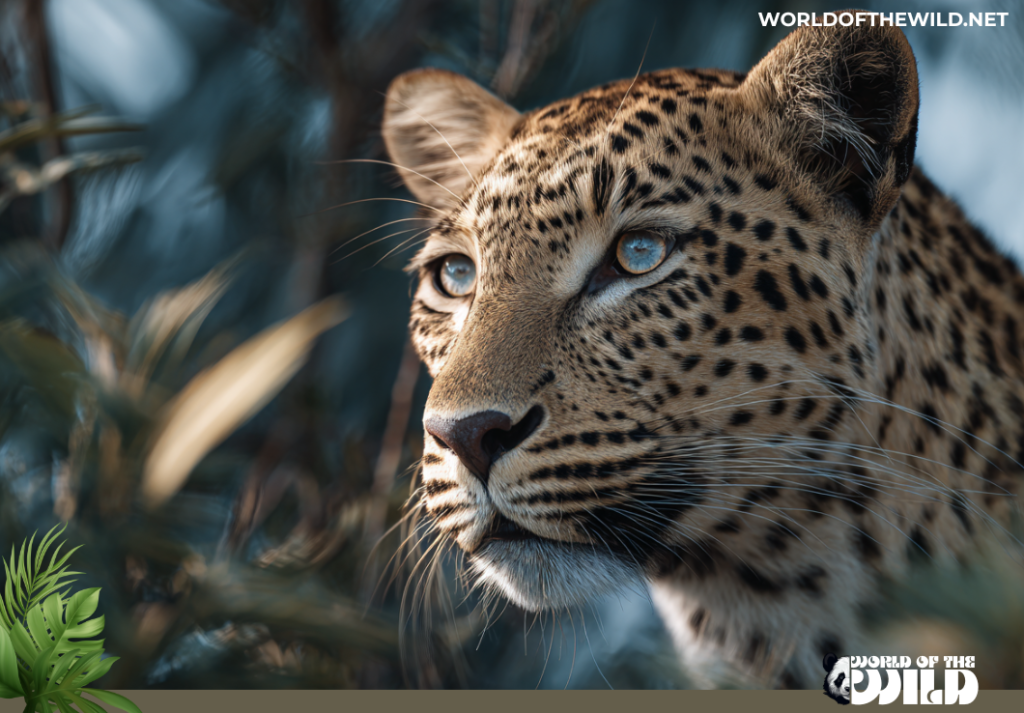
The skull is powerfully built yet elegantly proportioned, housing massive jaw muscles and those characteristic elongated canines. Small, rounded ears can rotate independently to pinpoint sounds with remarkable precision. The eyes, positioned forward for stereoscopic vision essential to judging distances when pouncing, range from pale green to golden yellow. Distinctive white markings on the backs of the ears and the tail’s tip may serve as visual signals to cubs following their mother through dense vegetation.
Leopards possess retractable claws that extend to approximately three centimeters, kept razor-sharp through regular stropping on tree bark and serving as both climbing hooks and lethal weapons. The broad paws distribute weight effectively, enabling silent stalking across various terrains.
Behavior
The leopard lives a predominantly solitary existence, with adults maintaining exclusive territories marked by scent scrapes, urine sprays, and claw marks on trees. Males occupy ranges of 30 to 78 square kilometers, while females claim smaller territories of 15 to 38 square kilometers that may overlap with one or more male ranges. This spacing system minimizes direct competition while facilitating breeding opportunities.
Predominantly crepuscular and nocturnal, leopards rest during daylight hours in dense vegetation, caves, or their signature location—sprawled along sturdy tree branches. This arboreal behavior serves multiple functions: avoiding detection by competing predators like lions and hyenas, escaping ground-level disturbances, and protecting cached prey from scavengers. Leopards display remarkable climbing ability, ascending vertical trunks with muscular grace and descending headfirst with perfect control.
Communication occurs through various vocalizations beyond the territorial “sawing.” Mothers and cubs exchange soft contact calls, while aggressive encounters prompt snarls, growls, and hisses. The leopard’s intelligence manifests in its hunting versatility and problem-solving abilities. Individuals learn their territory’s nuances intimately, memorizing game trails, water sources, and optimal ambush locations. They’ve been observed modifying hunting strategies based on prey behavior and learning from unsuccessful attempts.
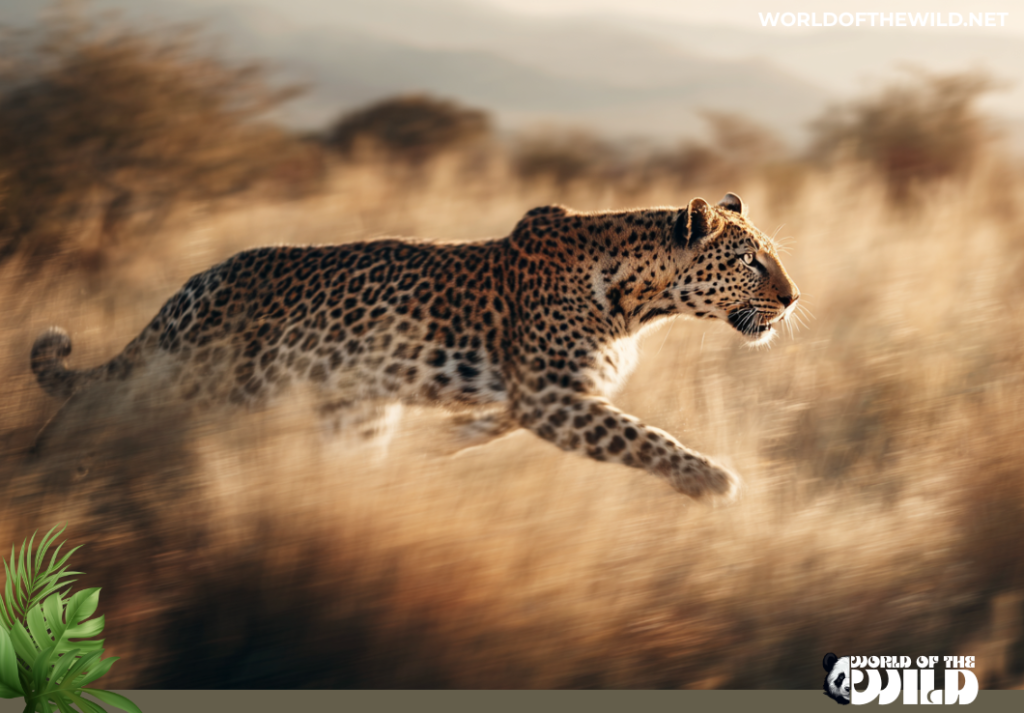
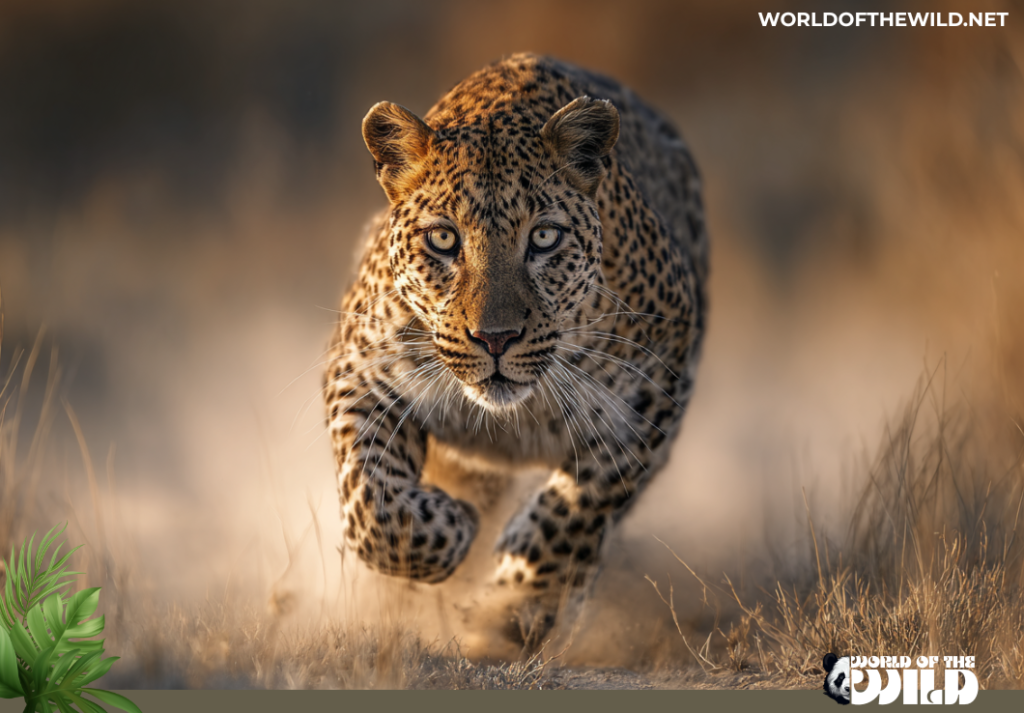
Unlike the cooperative social structures of lions, leopards hunt alone, employing stealth and explosive power rather than endurance. The typical hunt begins with patient observation, followed by a slow, crouching stalk that can last over an hour. When within striking distance—usually about five to ten meters—the leopard launches forward in a burst of speed reaching 58 kilometers per hour, attempting to close distance before prey can react. The killing technique varies by prey size: a suffocating throat bite for larger animals, a precise bite to the nape severing the spinal cord for smaller prey.
Evolution
The evolutionary journey of the leopard stretches back to the Pliocene epoch. The genus Panthera diverged from other felid lineages approximately 11 million years ago, with the leopard’s direct lineage emerging around 2 to 3 million years ago. Fossil evidence places early leopard ancestors across Africa and Eurasia, suggesting the species originated in Africa before expanding into Asia during the Pleistocene.
The leopard’s evolutionary success stems from its generalist strategy. While other big cats specialized for specific prey or habitats, leopards retained behavioral and physiological flexibility. This adaptability proved crucial during Pleistocene climate fluctuations that fragmented habitats and altered prey distributions. Genetic studies reveal that populations separated by geographic barriers evolved independently, leading to today’s subspecies variations.
The leopard shares its genus with lions, tigers, and jaguars, having diverged from their common ancestor approximately 6 million years ago. Interestingly, molecular evidence suggests leopards are more closely related to lions than to jaguars, despite superficial resemblance between leopard and jaguar coat patterns—a case of convergent evolution driven by similar ecological niches in forested environments.
The species survived multiple ice ages, human colonization waves, and competition with extinct megafauna like saber-toothed cats. This resilience reflects the leopard’s ability to exploit diverse food sources, occupy varied habitats, and avoid direct competition through behavioral flexibility—evolutionary traits that serve the species well in the modern era’s rapidly changing landscapes.
Habitat
The leopard’s geographic distribution is the most extensive of any wild cat species except the domestic cat, historically ranging across sub-Saharan Africa, North Africa, the Middle East, South and Southeast Asia, and eastern Russia to the Korean Peninsula. Today, while many populations have vanished or contracted, leopards still inhabit approximately 35 percent of their historical range.
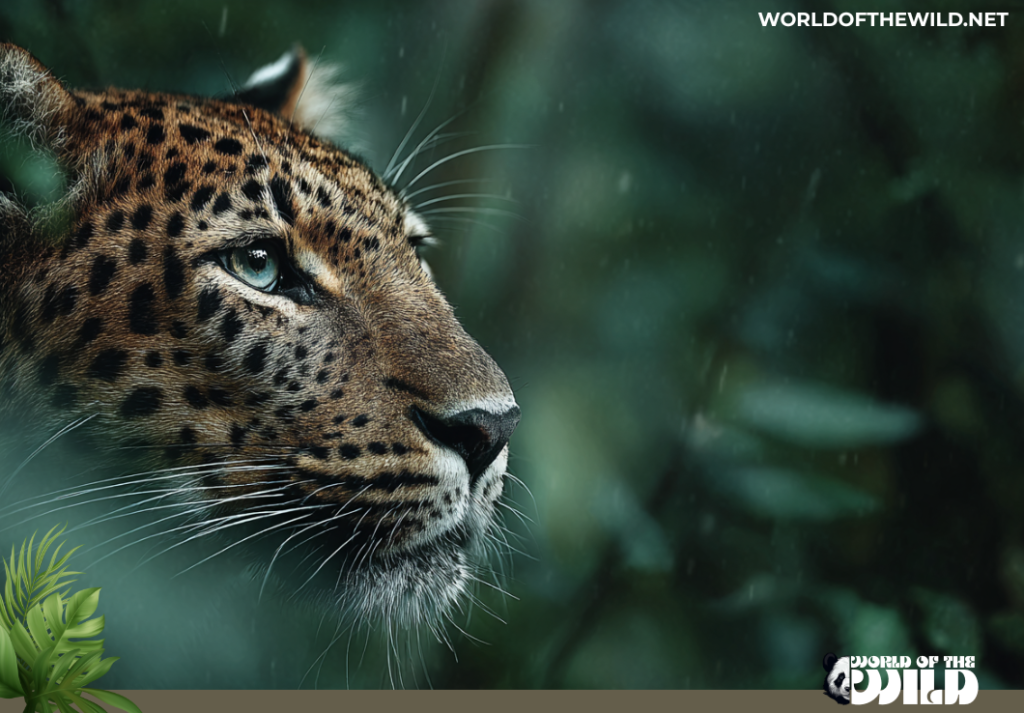
In Africa, leopards occupy virtually every habitat type except the Sahara’s hyper-arid core and the Congo Basin’s densest rainforest interior. They thrive in savannas dotted with acacia trees, rocky outcrops of kopjes, montane forests of the Ethiopian Highlands, coastal thickets, and even semi-desert scrublands. In Asia, their adaptability is equally impressive: tropical rainforests of India and Southeast Asia, temperate broadleaf forests of the Russian Far East, coniferous mountain forests of the Himalayas at elevations exceeding 5,000 meters, arid landscapes of the Arabian Peninsula, and agricultural mosaics surrounding human settlements.
This habitat versatility stems from several factors. Leopards require three essential elements: sufficient prey biomass, adequate cover for stalking and resting, and access to water. Beyond these basics, they demonstrate remarkable tolerance for habitat variation. The presence of trees or rocky terrain for caching prey and avoiding larger predators enhances habitat quality but isn’t absolutely necessary, as evidenced by populations surviving in relatively open landscapes.
Increasingly, leopards demonstrate remarkable ability to persist in human-modified landscapes—agricultural areas, plantation forests, and even urban peripheries—provided persecution remains low and sufficient natural prey exists. This adaptability, while impressive, also brings leopards into frequent conflict with human interests.
Diet
Leopards are obligate carnivores, opportunistic predators capable of exploiting an extraordinarily diverse prey base. Studies across their range document over 100 different prey species, making leopards among the most generalist of all large carnivores. This dietary flexibility is central to their evolutionary and ecological success.
Primary prey typically consists of medium-sized ungulates weighing 20 to 80 kilograms: impala, bushbuck, common duiker, chital, and muntjac feature prominently in different regions. However, leopards regularly hunt prey spanning an impressive size range—from beetles and lizards weighing mere grams to adult elands exceeding 300 kilograms, though such large prey is exceptional and typically involves weakened individuals.
The hunting technique reflects the leopard’s stalking specialization. After identifying potential prey, the leopard uses available cover—vegetation, terrain features, darkness—to approach undetected. The stalk requires extraordinary patience, with the leopard freezing motionless when prey looks up, then advancing during moments of inattention. The final rush covers the remaining distance in explosive bursts before prey can effectively escape.
Beyond ungulates, leopards consume primates including baboons and monkeys, birds from francolins to peacocks, reptiles, fish, arthropods, and even consume carrion opportunistically. In some regions, domestic livestock forms a significant portion of diet, creating human-wildlife conflict. Urban and suburban leopards have been documented hunting dogs and cats, adapting to available food sources.
Leopards typically consume 3 to 6 kilograms of meat daily, though they can gorge on up to 20 kilograms in a single session when a large kill is made. The famous caching behavior—hauling prey into trees—protects food from scavenging lions, hyenas, and vultures, allowing leopards to feed over several days from a single kill.
Predators and Threats
As apex predators, adult leopards face few natural enemies, though they exist within a competitive hierarchy. Lions pose the most significant natural threat, killing leopards whenever encounters occur, driven by interspecific competition for resources. Packs of spotted hyenas, African wild dogs, or dholes similarly kill leopards when opportunities arise. Tigers in Asia occupy the same competitive niche as lions in Africa, occasionally killing leopards in territorial disputes. Even crocodiles take leopards at water sources, and large pythons have been recorded killing and consuming adults.
Cubs face substantially higher predation risk. Beyond the threats to adults, leopard cubs fall victim to large raptors, other large carnivores, and even opportunistic predation by male leopards unrelated to them—a selective pressure driving females to be highly secretive about den locations.
However, anthropogenic threats dwarf natural predation as mortality sources. Habitat loss and fragmentation represent the primary threat across most of the leopard’s range. Agricultural expansion, logging, human settlement, and infrastructure development steadily erode and fragment leopard habitat, isolating populations and reducing prey availability. Increasingly, leopards survive in habitat islands surrounded by human-dominated landscapes.
Retaliatory killing following livestock predation or perceived threats to human safety eliminates many leopards annually, particularly in areas where traditional tolerance has eroded. Poaching for the illegal wildlife trade continues despite legal protections—leopard skins, bones, and body parts command high prices in traditional medicine markets and as luxury items. The bushmeat trade depletes prey populations in many regions, creating food shortages that force leopards into conflict with humans.
Road mortality, disease transmission from domestic animals, and climate change effects on prey distributions and habitat quality represent emerging threats. Some populations face genetic concerns from small population sizes and isolation, reducing adaptive potential.
Reproduction and Life Cycle
Leopards lack a defined breeding season in most regions, with mating occurring year-round as females reach estrus approximately every 46 days if not pregnant or rearing dependent cubs. When receptive, females advertise their condition through scent marking, increased vocalization, and movements within their range that increase encounter probability with resident males.
Courtship is brief and intense. Males and females who usually avoid direct contact temporarily tolerate proximity, engaging in mutual scenting, parallel walking, and vocal exchanges. Copulation occurs frequently over several days—sometimes dozens of times daily—ensuring fertilization. Following mating, the pair separates, with males providing no paternal care.
After a gestation period of 90 to 105 days, females seek secure den sites—caves, rock crevices, dense thickets, or hollow trees—and give birth to litters typically numbering two to three cubs, though ranges from one to six are documented. Cubs arrive blind and helpless, weighing approximately 500 grams, with fuzzy gray coats and faint spot patterns.
The mother remains extremely secretive during the cubs’ first weeks, leaving them hidden while she hunts and returning to nurse. Cubs’ eyes open around 10 days, and they begin venturing from the den at six to eight weeks. The mother moves cubs between multiple den sites during this period, reducing predation risk if one location is discovered.
Cubs are weaned around three months but continue learning essential hunting skills from their mother for 12 to 18 months. This extended dependency reflects the complex skills required for successful leopard hunting. Mothers demonstrate stalking techniques, make kills in the cubs’ presence, and eventually allow cubs to practice on restrained prey. Sibling play also contributes to skill development.
Young leopards reach independence at 12 to 24 months, with females sometimes establishing territories adjacent to their mothers while males disperse greater distances seeking vacant territories. Sexual maturity arrives at approximately 2.5 to 3 years for females and 2 to 2.5 years for males, though males often don’t successfully establish territories and breed until older due to competition.
In the wild, leopards live approximately 12 to 15 years on average, though individuals reaching 17 years are documented. Captive leopards regularly exceed 20 years, with the record approaching 27 years, highlighting the mortality pressures wild populations face.
Population
The leopard’s conservation status presents a complex picture varying dramatically by region. Globally, the species is listed as Vulnerable on the IUCN Red List, reflecting widespread population declines and range contractions despite the species remaining more numerous than other big cats. Several subspecies face far more dire circumstances—the Amur, Arabian, and Javan leopards are Critically Endangered, while others are Endangered.
Estimating global leopard populations proves challenging due to their secretive nature, nocturnal habits, and vast range across difficult terrain. Current estimates suggest approximately 250,000 to 350,000 adult leopards survive across Africa and Asia, though these figures carry substantial uncertainty. The African population appears healthier, with strongholds in eastern and southern African protected areas and populations persisting at relatively high densities in optimal habitats. The Indian subcontinent supports significant populations, with India alone estimated to host 12,000 to 14,000 individuals.
However, population trends reveal concerning patterns. Leopard populations have declined in approximately 50 to 75 percent of their historical range, with local extinctions documented across North Africa, the Middle East, and much of Central Asia. Many remaining populations are small, isolated, and facing ongoing pressures.
Several subspecies teeter on the brink. The Amur leopard—perhaps Earth’s rarest big cat—numbers fewer than 100 individuals despite recent conservation successes. The Arabian leopard survives in tiny populations scattered across the Arabian Peninsula, with perhaps 200 individuals remaining. The Javan leopard, confined to Indonesia’s most populous island, numbers perhaps 250 to 500 individuals facing intense pressure from habitat loss and human conflict.
Even relatively stable populations face threats. Human-wildlife conflict, retaliatory killing, poaching, and habitat degradation affect leopards throughout their range. Climate change models suggest substantial contractions in suitable habitat over coming decades, particularly in already-stressed populations at range margins.
Conservation successes do exist. Protected areas across Africa and Asia maintain viable populations. Anti-poaching efforts, community-based conservation programs, and livestock protection initiatives reduce conflicts in some regions. Captive breeding programs for critically endangered subspecies provide insurance populations and potential reintroduction sources. Growing ecotourism focused on leopard viewing generates economic incentives for conservation.
Conclusion
The leopard stands as a testament to evolutionary adaptability and resilience, a supreme predator whose rosette-patterned coat and solitary habits have allowed it to persist across Earth’s most varied landscapes. From tropical rainforests to semi-arid deserts, from sea level to mountain peaks, these magnificent cats demonstrate nature’s capacity for flexibility and survival. Yet their remarkable adaptability should not breed complacency—even the most versatile species cannot indefinitely withstand habitat destruction, persecution, and the cascade of pressures accompanying human expansion.
Understanding leopards means appreciating not just their power and grace, but their ecological role as apex predators regulating prey populations and structuring ecosystems. It means recognizing that their ability to live alongside humans in modified landscapes is both blessing and curse, enabling survival while increasing conflict. Most importantly, it means acknowledging our responsibility as the species whose actions will determine whether future generations inherit a world where leopards still stalk beneath the African sunset and patrol the Asian highlands.
The leopard’s story is unfinished, its final chapters yet unwritten. Through habitat protection, conflict mitigation, anti-poaching enforcement, and fostering coexistence between wild predators and human communities, we can ensure this evolutionary masterpiece continues to embody the wild’s enduring spirit. The choice, ultimately, rests not with the leopard’s adaptability, but with our commitment to sharing the planet with the extraordinary diversity of life that makes Earth precious.
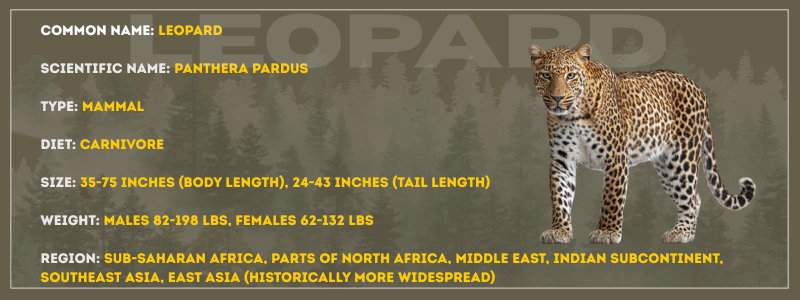
Scientific Name: Panthera pardus
Diet Type: Carnivore (Obligate)
Size: 90-190 cm (body length), 60-110 cm (tail length)
Weight: Males 37-90 kg, Females 28-60 kg
Region Found: Sub-Saharan Africa, parts of North Africa, Middle East, Indian subcontinent, Southeast Asia, East Asia (historically more widespread)
Hungry for More? The hunt doesn’t end here. Dive into our complete collection of Big Cat guides and articles.