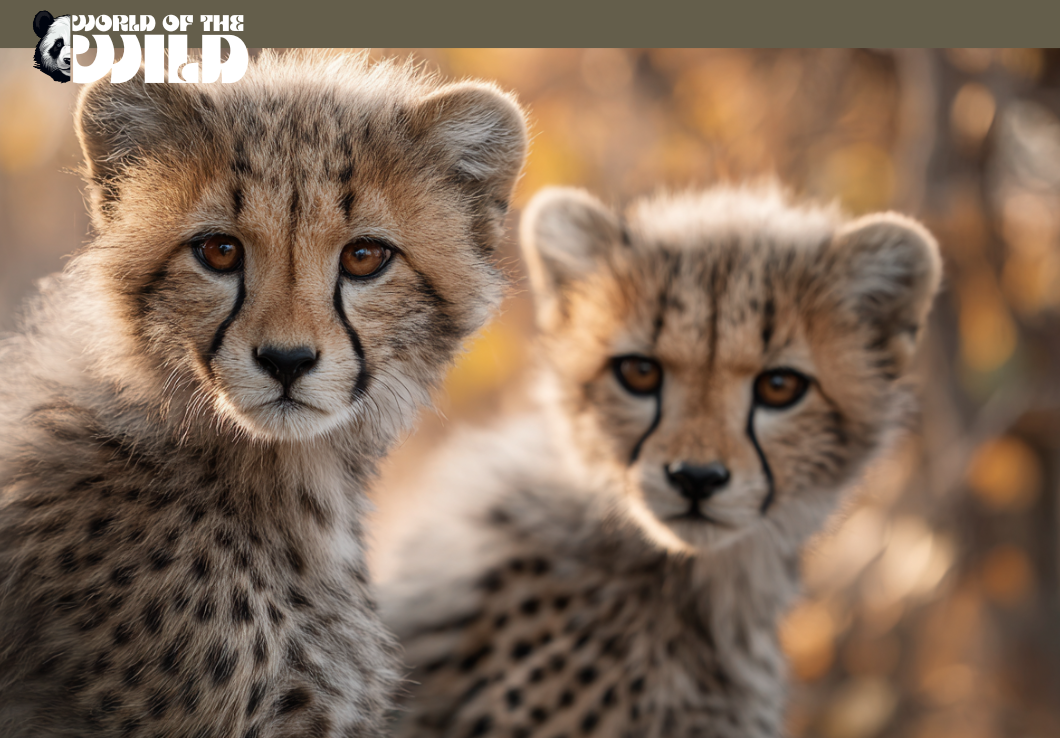

In the golden grasslands of Africa, a tiny ball of fluff emerges from a hidden den, its oversized paws and fluffy mane making it look more like a cuddly toy than the future world’s fastest land animal. Cheetah cubs represent one of nature’s most remarkable transformations—from vulnerable, defenseless infants to precision-engineered hunting machines capable of reaching speeds that would earn them a speeding ticket on most highways. These spotted bundles of energy face some of the most harrowing survival challenges in the animal kingdom, yet those that make it to adulthood become living testaments to evolutionary perfection. Understanding cheetah cubs offers us a window into the delicate balance between predation, survival, and the urgent need for conservation in our rapidly changing world.
Facts
Here are some fascinating facts about cheetah cubs that showcase just how extraordinary these young cats truly are:
Cheetah cubs are born with a distinctive silvery-gray “mantle” of long fur running down their backs and necks, which makes them resemble honey badgers—one of Africa’s most aggressive animals. This clever disguise is thought to deter predators during their most vulnerable months.
Unlike other big cats, cheetah cubs cannot retract their claws fully, even from birth. This adaptation provides superior traction when running at high speeds, essentially giving them permanent “running cleats” for their entire lives.
The mortality rate for cheetah cubs in the wild is staggeringly high, with approximately 70-90% not surviving to adulthood. This makes every successful cheetah more precious and highlights the species’ vulnerability.
Cheetah mothers move their cubs to new dens every few days during the first weeks of life, sometimes carrying them by the scruff just like domestic cats. This nomadic approach helps avoid predator detection.
Cubs begin making their first attempts at hunting as early as six months old, though they won’t be proficient hunters until around 18 months. Their early attempts are often comically unsuccessful but crucial for learning.
Young cheetahs have a unique play behavior where they practice their future hunting skills on anything that moves—including their siblings, small prey, and even their patient mother’s tail.
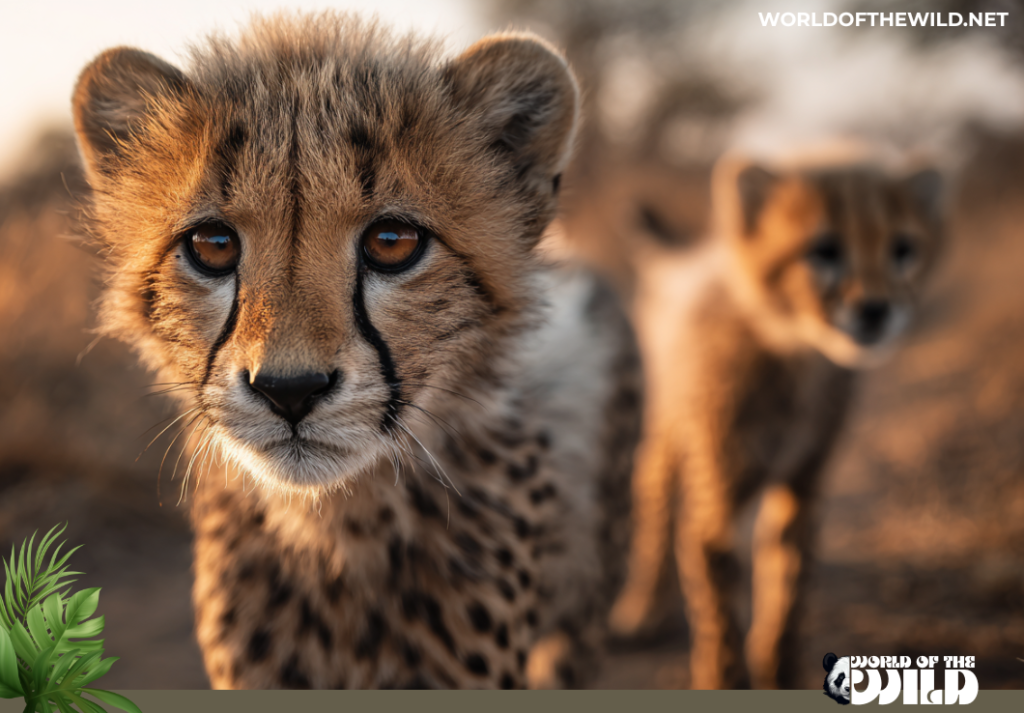
The distinctive tear marks on a cheetah’s face, running from the inner corner of each eye to the mouth, develop as cubs mature and serve to reduce sun glare during high-speed chases, functioning like an athlete’s eye black.
Species
Cheetahs belong to a fascinating taxonomic lineage that sets them apart from other big cats. Their full classification is:
Kingdom: Animalia
Phylum: Chordata
Class: Mammalia
Order: Carnivora
Family: Felidae
Genus: Acinonyx
Species: Acinonyx jubatus
The genus Acinonyx, which means “no-move-claw” in Greek, is particularly notable because the cheetah is the only surviving member of this genus, making it evolutionarily unique among modern cats.
While all cheetahs belong to the same species, taxonomists recognize several subspecies based on geographic distribution and subtle physical variations. The Southeast African cheetah (A. j. jubatus) is the most common and widespread subspecies. The Northeast African cheetah (A. j. soemmeringii) inhabits parts of East Africa. The Northwest African cheetah (A. j. hecki), also called the Saharan cheetah, is the palest in coloration and critically endangered, adapted to desert environments. The Asiatic cheetah (A. j. venaticus), once widespread across the Middle East and India, now survives only in Iran with fewer than 50 individuals remaining, making it one of the rarest cats on Earth.
There’s also ongoing debate about whether the larger East African populations represent distinct subspecies, though genetic studies suggest relatively low genetic diversity across all cheetah populations—a concerning indicator for the species’ long-term survival.
Appearance
Cheetah cubs undergo a dramatic physical transformation as they mature, making their appearance change significantly during their development. At birth, cubs weigh a mere 250-300 grams and are completely helpless, with their eyes closed and ears folded. They’re covered in short, grayish fur that provides little indication of their future golden coat.
The most distinctive feature of young cheetah cubs is their mantle—a thick mane of long, bluish-gray fur that runs from the top of the head down the back to the base of the tail. This mohawk-like crest can make the tiny cubs appear larger and is thought to mimic the appearance of the fierce honey badger, potentially deterring predators. This mantle gradually disappears as the cubs grow, typically fading by around three months of age.
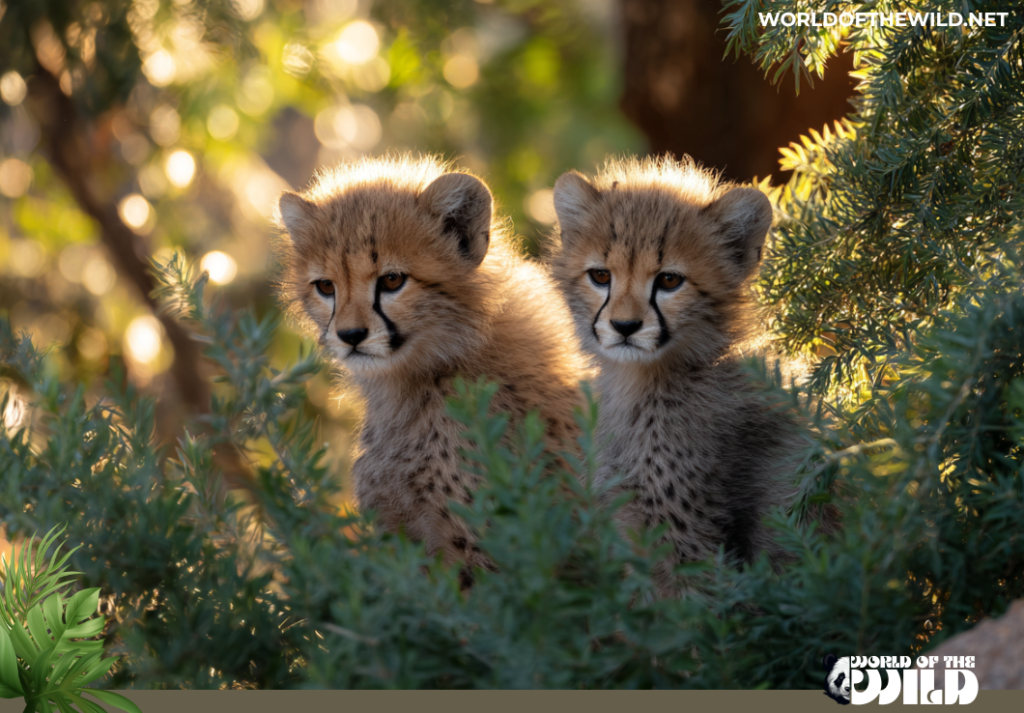
As they develop, the characteristic tawny or golden-yellow coat begins to emerge, covered with solid black spots approximately two to three centimeters in diameter. Unlike leopards or jaguars, cheetah spots are simple and evenly spaced, not forming rosettes. The iconic black “tear marks” become more pronounced as cubs mature, running from the inner corners of their eyes down to the sides of their mouths.
Adult cheetahs, which these cubs will become, are remarkably lean and built for speed. They stand 70-90 centimeters at the shoulder and measure 115-135 centimeters in body length, with their distinctive long tail adding another 65-85 centimeters. Males typically weigh 40-65 kilograms, while females are slightly smaller at 35-55 kilograms. Their bodies are characterized by a deep chest, narrow waist, long legs, and a small, rounded head—every aspect optimized for aerodynamic efficiency.
Cubs have disproportionately large paws that they’ll grow into, and their semi-retractable claws are already apparent from birth. Their eyes, initially blue-gray, transition to their adult amber or golden-brown color as they mature.
Behavior
Cheetah cubs display fascinating behavioral patterns that evolve dramatically as they grow from helpless infants to skilled predators. Understanding their behavior provides insight into their complex social structure and survival strategies.
For the first few weeks of life, cubs are entirely dependent on their mother and remain hidden in dense vegetation or rocky outcrops. Mother cheetahs are solitary hunters and exceptionally devoted parents, often going days without eating to stay close to their vulnerable offspring. During this period, cubs spend most of their time sleeping and nursing, only venturing short distances from the den.
Around three to six weeks, cubs begin to emerge more regularly and start following their mother on short excursions. This is when their playful nature becomes apparent. Cheetah cubs are extraordinarily playful, engaging in wrestling matches with siblings, pouncing on imaginary prey, and practicing their stalking techniques on anything that moves. This play is far from frivolous—it’s essential training for the hunting skills they’ll need to survive.
Communication among cheetah cubs and their mother involves a rich vocabulary of vocalizations. Cubs chirp, twitter, and make high-pitched yipping sounds to maintain contact with their mother and siblings. Unlike lions or tigers, cheetahs cannot roar. Instead, adults and older cubs produce a distinctive “chirrup” or bird-like chirping sound. They also purr loudly when content, churr when making social contact, and growl or hiss when threatened.
The learning phase is extensive and fascinating. At around six months, cubs begin accompanying their mother on hunts, observing her techniques carefully. She’ll often catch small prey and release it near the cubs, allowing them to practice their killing techniques in a controlled environment. This “schooling” is crucial—cubs that lose their mothers before learning to hunt effectively rarely survive.
Cheetah social structure differs significantly between males and females. Young males typically stay together after leaving their mother, forming coalitions that last for life—usually with their brothers, though unrelated males sometimes form bonds. These coalitions are more successful at establishing and defending territories than solitary males. Female cubs, conversely, become solitary adults, only associating with others when raising their own cubs or during brief mating encounters.
Cubs develop remarkable stamina and speed as they mature. While they won’t reach the adult cheetah’s breathtaking top speed of 100-120 kilometers per hour until fully grown, young cheetahs practice sprinting regularly, gradually building the explosive power and coordination required for high-speed pursuits.
Intelligence is another notable characteristic. Cheetahs must remember vast territories, locate prey, avoid larger predators, and in the case of mothers, protect and educate their young. Cubs learn to read their environment, recognize dangerous situations, and make split-second decisions that could mean the difference between eating and starving—or between life and death.
Evolution
The evolutionary history of cheetahs is a tale of specialization, adaptation, and survival against the odds. Cheetahs belong to an ancient lineage that diverged from other cats millions of years ago, taking a dramatically different evolutionary path.
The cheetah lineage split from other felids approximately 6.7 million years ago during the Late Miocene epoch. Fossil evidence suggests that cheetah-like cats once had a much broader distribution, with ancestors found in North America, Europe, Asia, and Africa. The American cheetah (Miracinonyx), which lived in North America until about 10,000 years ago, was likely a close relative that evolved convergently to fill a similar ecological niche as the modern African cheetah.
The modern cheetah genus, Acinonyx, emerged roughly 3-4 million years ago during the Pliocene epoch in Africa. These early cheetahs began developing the extreme specializations we see today—longer legs, a more flexible spine, enlarged nasal passages, and the semi-retractable claws that provide traction during high-speed chases.
One of the most intriguing aspects of cheetah evolution is that the species went through a severe population bottleneck approximately 10,000-12,000 years ago, coinciding with the end of the last Ice Age. During this period, cheetah populations crashed dramatically, possibly due to climate change, habitat loss, or competition with other predators. The genetic analysis of modern cheetahs reveals extremely low genetic diversity—all living cheetahs are as genetically similar to each other as highly inbred laboratory mice. This lack of diversity makes the species particularly vulnerable to diseases and environmental changes.
The evolutionary drive toward speed has resulted in numerous adaptations that distinguish cheetahs from all other felids. Their spine is exceptionally flexible, functioning like a spring to extend their stride length. Their enlarged heart, lungs, and adrenal glands support intense bursts of activity. Even their tail evolved to serve as a rudder during high-speed turns. These adaptations come at a cost, however—cheetahs are relatively lightweight and lack the strength and weaponry of other large cats, making them vulnerable to having their kills stolen and to predation by larger carnivores.
Interestingly, cheetah cubs’ mantle may be an evolutionary holdover or a more recent adaptation. Some researchers believe it could have evolved as protective mimicry, making cubs resemble honey badgers—animals that even lions tend to avoid. Others suggest it may simply provide camouflage in tall grass.
Habitat
Cheetah cubs are born into some of Africa’s and Asia’s most spectacular landscapes, though their historical range has dramatically contracted. Understanding their habitat is crucial to conservation efforts and appreciating the challenges these remarkable cats face.
Historically, cheetahs ranged across virtually all of Africa, the Middle East, and into India. Today, their distribution is primarily limited to sub-Saharan Africa, with small, fragmented populations scattered across the continent. The Asiatic cheetah, critically endangered, survives only in the arid desert regions of central Iran.
Cheetahs prefer open or semi-open habitats where their extraordinary speed provides a hunting advantage. The classic cheetah habitat is the East African savanna—vast grasslands dotted with acacia trees, characterized by seasonal rainfall and large populations of medium-sized ungulates. These areas include famous locations like the Serengeti-Mara ecosystem spanning Tanzania and Kenya, where cheetah populations remain relatively stable.
However, cheetahs are more adaptable than commonly believed. They inhabit a variety of environments including semi-desert regions, thick brush, woodlands, and mountainous terrain up to 4,000 meters elevation. The Northwest African (Saharan) cheetah has adapted to extremely arid desert conditions, ranging across the Sahara desert and Sahel regions, where they endure extreme temperatures and scarce water sources.
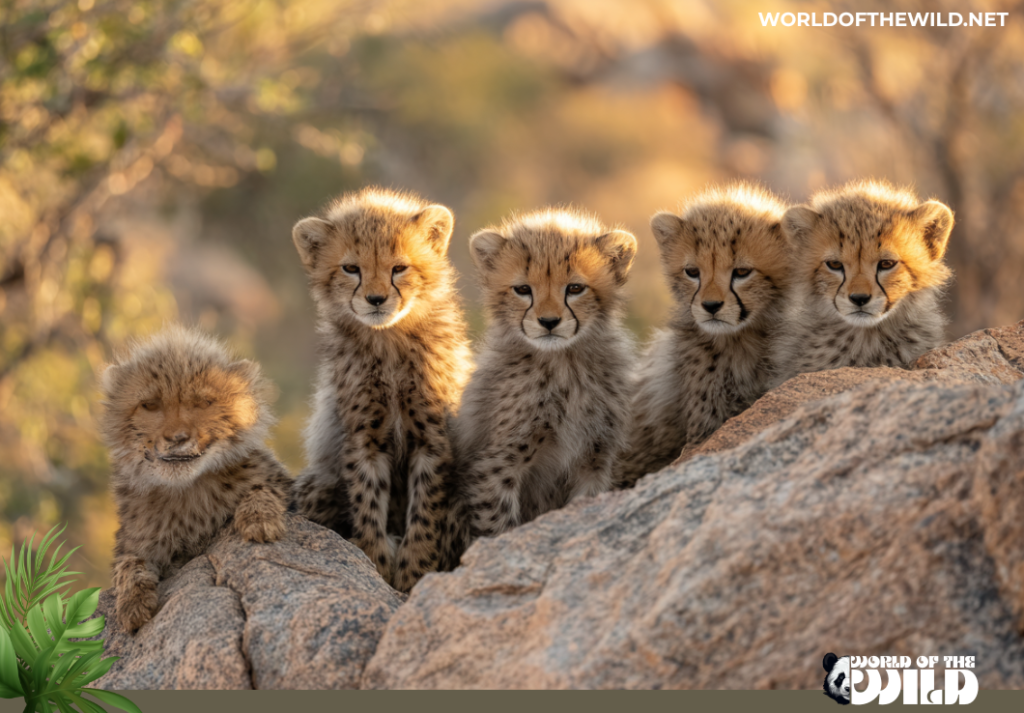
Cheetah mothers select den sites carefully when preparing to give birth. Ideal dens are located in areas with dense cover—thick vegetation, rocky outcrops, or even abandoned aardvark burrows—providing concealment from predators. These sites need to offer protection from the elements while being close enough to hunting grounds that the mother doesn’t have to travel far from her vulnerable cubs.
The specific features cheetahs require include visibility for hunting (they hunt by sight and need to spot prey from a distance), access to water sources, and sufficient prey populations. They avoid heavily forested areas where their speed advantage becomes useless and competition with ambush predators like leopards intensifies.
A critical aspect of cheetah habitat is the presence of other large predators. Lions, leopards, and hyenas all pose significant threats to cheetah cubs, so cheetah mothers tend to select areas with lower densities of these competitors. This often means utilizing the edges of territories or areas that other predators use less frequently.
The vast territories required by cheetahs—females may range over 800 square kilometers or more—bring them increasingly into conflict with human activities. Agricultural expansion, fencing, and development fragment the landscapes cheetahs need to thrive, making it harder for populations to remain connected and genetically viable.
Diet
Cheetah cubs begin their lives entirely dependent on their mother’s milk but gradually transition to becoming specialized carnivores optimized for hunting specific prey. Understanding their dietary needs and hunting strategies reveals the challenges of survival in competitive African ecosystems.
For the first three to four months, cubs rely exclusively on their mother’s milk, which is rich in nutrients necessary for their rapid growth. The mother must hunt frequently to maintain milk production while spending long periods with her cubs. This is one of the most challenging times for cheetah mothers, who must balance the need to hunt with the necessity of protecting their vulnerable offspring.
Around four months, cubs begin eating meat from their mother’s kills, though they continue nursing for several more months. Their first experiences with meat are tentative—they learn by watching their mother feed and gradually develop the jaw strength and teeth necessary to process raw flesh.
Cheetahs are obligate carnivores, meaning they eat exclusively meat. Unlike some big cats that can tackle prey several times their own weight, cheetahs specialize in small to medium-sized ungulates, typically ranging from 20 to 60 kilograms. Their primary prey species include Thomson’s gazelles, Grant’s gazelles, springbok, impala, and the young of larger species like wildebeest and zebra. They’ll also hunt hares, birds (particularly ground-dwelling species like bustards and guinea fowl), and occasionally small mammals like hyraxes.
The cheetah’s hunting strategy is unlike any other big cat. Rather than relying on ambush tactics from dense cover, cheetahs use a combination of stealth and incredible speed. A typical hunt begins with the cheetah scanning the landscape from a high vantage point, identifying potential prey. The cheetah then stalks as close as possible—usually within 50-100 meters—using available cover and moving when the prey isn’t looking.
The chase itself is breathtaking. Cheetahs accelerate from 0 to 100 kilometers per hour in just three seconds, reaching top speeds of 100-120 kilometers per hour for short bursts of 20-30 seconds. During the sprint, the cheetah may cover seven to eight meters in a single stride. The tail acts as a rudder, allowing for sharp turns as the prey attempts evasive maneuvers.
The kill is delivered with a suffocating bite to the throat. Unlike lions or leopards that deliver a crushing bite to the neck or skull, cheetahs lack the jaw strength for such techniques. Instead, they clamp down on the prey’s windpipe and hold until the animal suffocates—a process that can take several minutes and leaves the cheetah exhausted and vulnerable.
Cubs begin learning these techniques through observation and practice. Their mother will bring them along on hunts from around six months, allowing them to watch and learn. Later, she’ll catch small prey and release it near the cubs, giving them the opportunity to practice chasing and killing in a controlled environment. By 12-18 months, young cheetahs begin attempting their own hunts, though success rates remain low until they’ve gained more experience.
One significant challenge for cheetahs is that they must eat quickly. The exertion of a high-speed chase raises their body temperature dangerously high, and they need time to recover before they can eat. During this recovery period—and while eating—they’re vulnerable to having their kill stolen by larger, more aggressive predators like lions, hyenas, and leopards. Approximately 10-15% of cheetah kills are lost to kleptoparasitism, forcing cheetahs to hunt more frequently than they otherwise would need to.
For cubs still dependent on their mother, watching their meal disappear to a lion coalition represents more than just inconvenience—it could mean going hungry for days, impacting their growth and survival chances.
Predators and Threats
Cheetah cubs face a gauntlet of dangers that make them one of the most vulnerable young predators in Africa. The threats they encounter range from natural predators to human-caused challenges that increasingly endanger the entire species.
Natural predation is the primary cause of cub mortality in the wild. Lions are responsible for the majority of cheetah cub deaths, killing them opportunistically whenever they’re encountered. Lions don’t typically eat cheetah cubs but kill them to reduce future competition for resources. A single lion can kill an entire litter in minutes, and cheetah mothers, being lightweight and built for speed rather than combat, are powerless to defend against a determined lion.
Leopards pose another significant threat, especially in areas where territories overlap. Unlike lions, leopards sometimes hunt in the same dense vegetation where cheetah mothers try to hide their cubs, making detection more likely. Spotted hyenas, both as individuals and in clans, will kill cheetah cubs given the opportunity. Even jackals and martial eagles can take very young cubs if they’re found unprotected.
Adult cheetahs face fewer predation risks due to their speed, though lions and hyenas will kill adults when possible. However, for cheetahs less than 18 months old, still learning to hunt and lacking full speed capabilities, the predator threat remains severe.
Beyond natural threats, human activities pose the gravest long-term dangers to cheetah populations. Habitat loss and fragmentation top the list—as human populations expand, grasslands and savannas are converted to agriculture, settlements, and infrastructure. This not only reduces the space available for cheetahs but also fragments populations, preventing gene flow between isolated groups and exacerbating the species’ already critical lack of genetic diversity.
Human-wildlife conflict is particularly problematic in areas where cheetahs share space with livestock farmers. Cheetahs occasionally prey on domestic animals, especially calves, goats, and sheep, leading to retaliatory killings by farmers. In Namibia and other regions, conflict mitigation programs have had some success, but cheetahs continue to be killed, trapped, or poisoned in retaliation for real or perceived livestock losses.
The illegal wildlife trade represents another serious threat. Cheetah cubs are captured and sold as exotic pets, particularly in Middle Eastern countries where they’re sometimes kept as status symbols. This trade is devastating—not only are the captured cubs removed from wild populations, but their mothers are often killed during capture attempts. The mortality rate for cubs in the illegal pet trade is appallingly high, as they require specialized care that few private owners can provide.
Climate change is emerging as an additional threat. Shifts in rainfall patterns affect prey populations and vegetation, potentially reducing habitat quality. Extreme weather events can kill cubs directly, and changing conditions may alter the delicate balance between cheetahs and their more adaptable competitors.
Road mortality is increasing as roads cut through cheetah habitats, with both adults and cubs struck by vehicles. Disease poses a particular risk given cheetahs’ extremely low genetic diversity—a single epidemic could potentially devastate entire populations due to their lack of genetic resistance.
Finally, prey depletion through human hunting and habitat degradation makes it harder for cheetah mothers to find food, reducing cub survival rates. When mothers can’t hunt successfully, their milk production decreases, cubs grow more slowly, and their chances of survival plummet.
Reproduction and Life Cycle
The reproductive cycle of cheetahs is a fascinating journey from birth through maturation, marked by significant challenges and remarkable maternal dedication. Understanding this cycle is crucial for conservation efforts and appreciating the precarious nature of cheetah population dynamics.
Cheetahs don’t have a fixed breeding season and can reproduce year-round, though births may peak during periods when prey is most abundant. Female cheetahs reach sexual maturity at around 20-24 months, while males mature slightly later at 24-26 months. However, males often don’t successfully breed until they’ve established a territory or coalition, which may not occur until they’re three to four years old.
The mating process begins when a female enters estrus, a period lasting approximately three to 27 days. During this time, her behavior changes—she may urinate more frequently to mark territory, become more vocal, and show increased restlessness. Males detect receptive females through scent marking and may compete for mating rights, though actual physical combat is rare among cheetahs compared to other big cats.
Mating is brief and may occur multiple times over a few days. Unlike lions or leopards, cheetah pairs don’t maintain bonds beyond mating. Once breeding is complete, the male leaves, playing no role in raising the cubs. If a female mates with multiple males, a litter may have multiple fathers, though this is thought to be relatively uncommon.
The gestation period lasts approximately 90-95 days, roughly three months. As birth approaches, the pregnant female searches for a suitable den site—typically in tall grass, rocky outcrops, or dense bush that provides concealment from predators. She’ll avoid areas with high concentrations of other large predators, even if it means selecting less-than-ideal hunting grounds.
Litters typically consist of three to five cubs, though anywhere from one to eight is possible. The cubs are born helpless, weighing just 250-300 grams each, with their eyes closed and ears folded. Their distinctive mantle is already present, giving them a fuzzy, gray appearance quite different from their golden adult coat.
For the first few weeks, the mother rarely leaves her cubs except for necessary hunting trips. She nurses them frequently, and they grow rapidly on her rich milk. Their eyes open at four to 11 days, and they begin to walk shakily at around two to three weeks. The mother moves the cubs to new dens every few days during this period, carrying them by the scruff of the neck one at a time—a time-consuming and risky process that helps evade predator detection.
At around six weeks, cubs begin venturing out of the den more regularly and start following their mother on short excursions. Their mantle begins to fade around this time, and their permanent teeth start to emerge. By three to four months, they’re eating meat regularly alongside continued nursing, and the mother begins teaching them basic survival skills.
The weaning process is gradual, typically complete by six months, though some cubs may nurse occasionally for a few additional weeks. This is when cubs begin accompanying their mother on hunts, learning by observation the complex skills they’ll need to survive.
Between 12 and 18 months, cubs become increasingly independent, practicing their own hunts and successfully catching smaller prey. However, they remain with their mother, benefiting from her protection and continued instruction. Adolescent males within the same litter begin forming stronger bonds with each other during this period, preparing for their future coalition life.
Independence comes at around 18-24 months when the mother either enters estrus again (signaling her readiness to breed) or simply begins leaving her offspring for increasingly long periods. This transition can be gradual or relatively abrupt. Young females typically disperse and establish their own home ranges, becoming solitary except when raising their own cubs. Brothers, and occasionally unrelated young males, form coalitions that may last for life, helping each other establish and defend territories, which significantly increases their breeding success.
The mortality rate during cubhood is extremely high—estimates suggest 70-90% of cubs die before reaching independence. Predation accounts for most deaths, but starvation, disease, exposure, and abandonment also take their toll. Those cubs that survive face additional challenges as young adults—learning to hunt effectively, avoiding larger predators, and establishing themselves in a landscape already occupied by other cheetahs.
Female cheetahs that reach maturity may produce their first litter at around three years of age. They typically have litters every 18-24 months if their cubs survive, or sooner if a litter is lost to predation. Over a lifetime, a successful female might raise 10-20 cubs to independence, though many fewer will actually survive to reproduce themselves.
In the wild, cheetahs that survive to adulthood typically live 8-12 years, though some individuals reach 14-15 years. In captivity, where they face no predation and receive veterinary care, cheetahs may live 17-20 years. Males in coalitions may have shorter lifespans than solitary males due to more frequent aggressive encounters defending territories.
The reproductive challenges facing cheetahs—high cub mortality, low genetic diversity, and the demands of single parenting in a dangerous environment—make every surviving cub precious and highlight why conservation efforts focused on protecting breeding females and their cubs are so critical.
Population
The conservation status of cheetahs reflects the serious challenges this species faces across its remaining range. Understanding current population dynamics is essential for developing effective conservation strategies and ensuring the survival of these magnificent cats for future generations.
The cheetah is currently classified as “Vulnerable” on the International Union for Conservation of Nature (IUCN) Red List of Threatened Species. However, this classification masks significant variation between different populations—some regional populations are far more endangered than others, with the Asiatic cheetah classified as “Critically Endangered” with fewer than 50 individuals remaining.
Global cheetah populations have declined dramatically over the past century. Estimates suggest approximately 7,000-7,500 adult and adolescent cheetahs remain in the wild across Africa, though accurate census data is challenging to obtain due to their large ranges and relatively secretive nature in some areas. This represents a catastrophic decline from historical estimates—cheetahs once numbered over 100,000 across Africa, the Middle East, and into India.
The largest remaining population is found in Southern Africa, particularly in Namibia, Botswana, and South Africa, where an estimated 4,000-4,500 cheetahs roam. Namibia alone hosts the world’s largest population, with approximately 3,000 individuals, many living on private farmland outside protected areas. East Africa, including Kenya and Tanzania, hosts roughly 2,000-2,500 cheetahs, concentrated in protected areas like the Serengeti-Mara ecosystem, Tsavo, and Amboseli.
Population trends are concerning. Most cheetah populations are declining or stable at best, with very few showing signs of increase. The species has been extirpated (locally extinct) from approximately 90% of its historic range in Africa and has been virtually eliminated from Asia except for the tiny Iranian population. Countries that once hosted significant cheetah populations—including Egypt, Morocco, India, Saudi Arabia, and many others—no longer have wild cheetahs.
Several factors contribute to population decline beyond the threats already discussed. The species’ low genetic diversity makes them particularly vulnerable to disease outbreaks, inbreeding depression, and reduced adaptability to environmental changes. Their large home ranges mean that even seemingly large protected areas may support only small, isolated populations vulnerable to local extinction events.
In recent years, population assessments have revealed a troubling pattern: while cheetahs in well-protected, tourist-rich areas like the Masai Mara and Serengeti receive considerable attention and protection, the majority of cheetahs live outside protected areas on farmland and community lands, where they receive far less monitoring and protection. These unprotected populations face the highest levels of human-wildlife conflict, habitat loss, and persecution.
The breeding population is particularly concerning from a conservation perspective. Not all adult cheetahs breed successfully—only males that establish territories (either alone or in coalitions) and females that can successfully raise cubs contribute to the next generation. High cub mortality means that even breeding females must produce multiple litters to successfully raise just a few cubs to independence.
Some conservation initiatives show promise. Captive breeding programs maintain genetic diversity and provide insurance populations, though cheetahs born in captivity face challenges if ever reintroduced to the wild. Community-based conservation programs, particularly in Namibia, have successfully reduced human-cheetah conflict by implementing livestock protection measures and providing economic incentives for cheetah conservation.
The illegal pet trade continues to remove cubs from wild populations at an alarming rate. The Cheetah Conservation Fund estimates that approximately 300 cubs are illegally trafficked each year, primarily from the Horn of Africa to Middle Eastern countries. The mortality rate is devastating—an estimated 80% of these cubs die during capture, transport, or shortly after reaching their destination.
Climate change projections suggest additional challenges ahead. Changing rainfall patterns could alter prey distributions and habitat quality, potentially shrinking suitable cheetah habitat further. Models predict that some areas currently hosting cheetahs may become unsuitable within the next 50-100 years.
Despite these challenges, dedicated conservation organizations work tirelessly to protect cheetahs. These efforts include anti-poaching patrols, community education programs, livestock protection initiatives, habitat corridor development, and advocacy for policy changes that protect cheetahs and their habitats. Translocation programs have successfully established new populations in areas where cheetahs were previously extinct, providing hope that with concerted effort, the species can recover.
Conclusion
Cheetah cubs represent both incredible fragility and remarkable resilience in nature’s grand design. From their first moments as helpless, fuzzy newborns to their transformation into the world’s fastest land animals, these young cats embody the challenges facing wildlife in the modern world. Their journey from birth to independence is fraught with danger—predation, starvation, disease, and human impacts threaten them at every turn—yet those that survive become living masterpieces of evolution, perfectly adapted to life on the African savanna.
The plight of cheetah cubs reflects broader conservation challenges. With only 7,000-7,500 adults remaining and cub mortality rates reaching 90%, every surviving cub matters. The species’ low genetic diversity, shrinking habitat, human-wildlife conflict, and illegal wildlife trade paint a sobering picture, yet they also illuminate clear pathways for action.
These magnificent cats have survived for millions of years, adapting to changing climates, competing predators, and shifting landscapes. They’ve overcome a catastrophic population bottleneck and persisted through the end of the Ice Age. But they cannot overcome the unprecedented pace of human-driven habitat destruction and persecution without our help.
The conservation of cheetahs requires a multifaceted approach: protecting wild habitats, reducing human-wildlife conflict, ending the illegal pet trade, supporting community-based conservation, and maintaining genetic diversity through carefully managed breeding programs. It requires recognizing that cheetahs are not just charismatic animals worthy of protection for their beauty and speed, but essential components of healthy ecosystems that deserve our respect and stewardship.
Every cheetah cub that survives to adulthood and successfully raises cubs of its own represents a small victory in a much larger battle for wildlife conservation. As we watch these spotted youngsters tumble and play in the grasslands, learning the skills that will one day make them apex predators, we’re reminded that their future—and the future of countless other species—rests increasingly in our hands. The time to act is now, ensuring that future generations can marvel at cheetah cubs racing across the African plains, just as we do today.
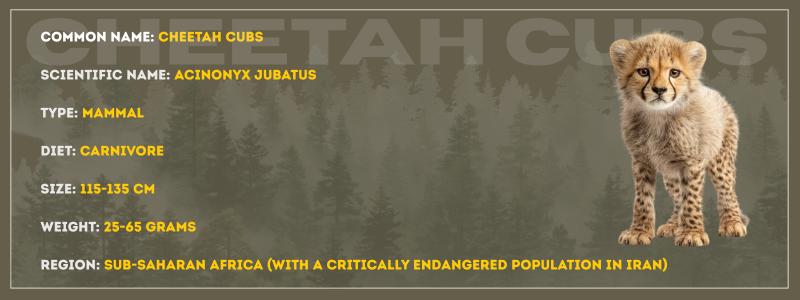
Scientific Name: Acinonyx jubatus
Diet Type: Carnivore (specializing in small to medium-sized ungulates)
Size: 115-135 cm body length (adults); cubs born at approximately 30 cm
Weight: 35-65 kg (adults); cubs born at 250-300 grams
Region Found: Sub-Saharan Africa (with a critically endangered population in Iran)