
Suspended upside down from a branch high in the rainforest canopy, moving so slowly that algae grows on its fur, the sloth defies nearly every rule of mammalian survival. In a world that celebrates speed, strength, and constant activity, this peculiar creature has thrived for millions of years by doing the exact opposite—moving as little as possible, sleeping up to 20 hours a day, and digesting a single meal for an entire month.
The sloth’s lifestyle seems impossibly lazy, yet this remarkable animal represents one of nature’s most successful evolutionary experiments. Far from being a biological failure, the sloth’s extreme slowness is a masterclass in energy efficiency that has allowed it to thrive in one of Earth’s most competitive ecosystems. Understanding the sloth means rethinking our assumptions about what it takes to survive and flourish in the natural world.
Facts
1. Sloths only defecate once a week, descending from their trees to do so, which is when they’re most vulnerable to predators. Scientists believe this risky behavior may help fertilize their favorite trees and facilitate moth reproduction in their fur.
2. Their fur grows in the opposite direction from most mammals—from belly to back—allowing rainwater to run off efficiently when they hang upside down.
3. Sloths are surprisingly strong swimmers and can move three times faster in water than on land, holding their breath for up to 40 minutes by slowing their heart rate.
4. A sloth’s stomach can comprise up to 30% of its body weight and contains multiple chambers like a cow’s, taking up to a month to fully digest a meal.
5. They have more neck vertebrae than almost any other mammal—three-toed sloths have nine neck bones compared to the seven found in most mammals, including giraffes, allowing them to rotate their heads 270 degrees.
6. Sloths maintain one of the lowest body temperatures of any mammal, ranging from 86-93°F (30-34°C), which fluctuates with the ambient temperature since they can’t regulate it well.
7. A sloth’s grip is so strong that they’ve been found still hanging from branches after death, their muscles locked in their characteristic hanging position.
Sounds of the Sloth
Species
Classification:
- Kingdom: Animalia
- Phylum: Chordata
- Class: Mammalia
- Order: Pilosa
- Family: Folivoridae (two-toed sloths: Megalonychidae; three-toed sloths: Bradypodidae)
- Genus: Bradypus (three-toed) and Choloepus (two-toed)
- Species: Six extant species
The sloth family is divided into two distinct groups that aren’t as closely related as once thought. The three-toed sloths (genus Bradypus) include the brown-throated sloth (B. variegatus), pale-throated sloth (B. tridactylus), maned sloth (B. torquatus), and pygmy three-toed sloth (B. pygmaeus). The two-toed sloths (genus Choloepus) consist of Hoffmann’s two-toed sloth (C. hoffmanni) and Linnaeus’s two-toed sloth (C. didactylus).
Despite their names, all sloths actually have three toes on their hind feet—the difference lies in the number of fingers on their front limbs. The two groups diverged evolutionarily around 30 million years ago, making them distant cousins rather than close relatives. Each species has adapted to slightly different ecological niches within Central and South American rainforests.
Appearance
Sloths possess one of nature’s most distinctive body plans, perfectly adapted for their arboreal lifestyle. Their bodies are covered in long, coarse fur that ranges from grayish-brown to beige, often with a greenish tinge from symbiotic algae that colonizes their coat. This algae provides excellent camouflage and may even serve as a supplemental nutrient source when sloths groom themselves.
Size varies considerably between species. Three-toed sloths are generally smaller, measuring 18-23 inches (45-60 cm) in length and weighing 5.5-14 pounds (2.5-6.4 kg). Two-toed sloths are notably larger, reaching 21-29 inches (54-74 cm) and weighing 9-19 pounds (4-8.5 kg). Their bodies are compact and rounded, with disproportionately long limbs ending in curved, hook-like claws that can reach 3-4 inches (7.6-10 cm) in length.
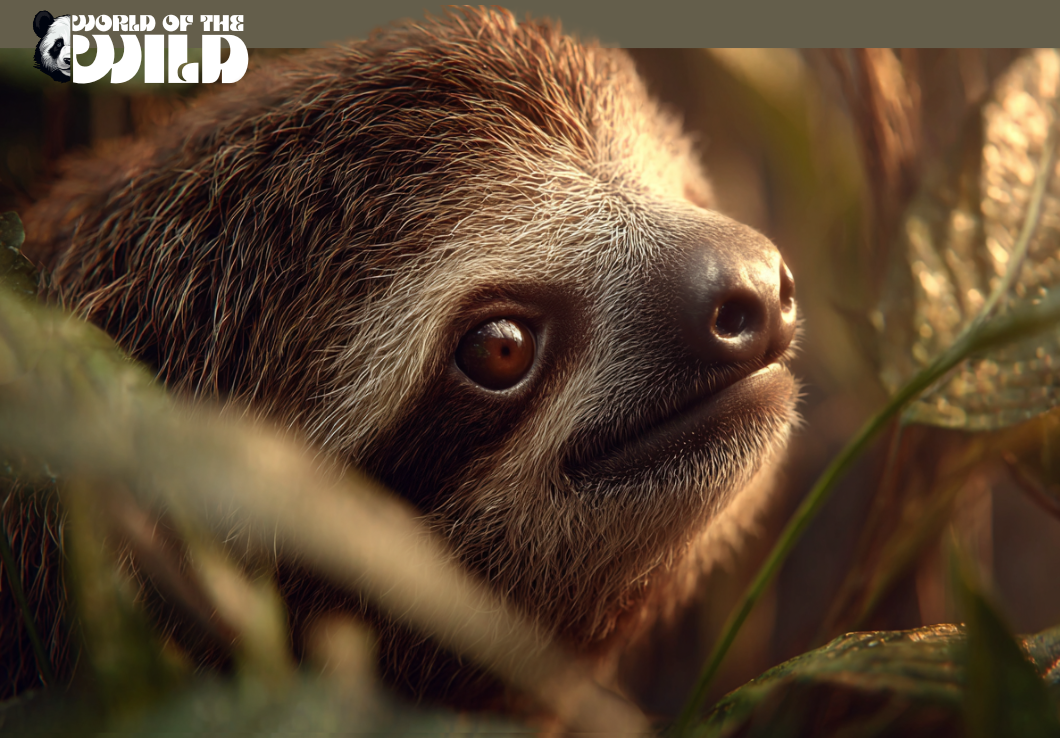
The sloth’s face appears permanently serene, with a small, flattened nose, tiny ears hidden beneath fur, and large, dark eyes positioned to see forward when hanging upside down. Three-toed sloths have a distinctive dark mask-like pattern around their eyes and often sport what appears to be a permanent smile. Their heads are small and round, sitting atop shoulders that can barely be distinguished from their torso. Perhaps most remarkably, their muscle mass is 30% less than that of similarly sized mammals, replaced with a digestive system that dominates their body cavity.

Behavior
Sloths have perfected the art of doing absolutely nothing. They sleep 15-20 hours daily and move so slowly that their top speed is a mere 13 feet (4 meters) per minute through the trees. This extreme lethargy isn’t laziness—it’s an elegant survival strategy built around minimizing energy expenditure in an environment where their leafy diet provides minimal calories.
Three-toed sloths are generally solitary creatures, though their home ranges overlap considerably without apparent conflict. They communicate primarily through high-pitched squeaks and hisses, though two-toed sloths are notably quieter. Females sometimes emit long, shrill calls during breeding season. Despite their solitary nature, sloths display remarkable site fidelity, often spending their entire lives within a few acres of forest.
Their cognitive abilities, long dismissed as primitive, have been reassessed in recent years. Sloths demonstrate spatial memory, learning which trees provide the best leaves at different times of year. They’re capable of surprisingly complex problem-solving when motivated, though “motivated” is relative—everything happens in slow motion.
The sloth’s most peculiar behavior is its weekly descent to the forest floor to defecate, always at the base of the same tree. During this vulnerable time, they perform a characteristic “poop dance,” wiggling their hindquarters to dig a small hole. This ritual may fertilize their preferred trees, help mark territory, and facilitate the life cycle of specialized moths that live in sloth fur and lay eggs in the dung. These moths, when they die, may decompose in the fur and provide nutrients for the algae gardens growing there, which in turn may supplement the sloth’s diet—a remarkable example of symbiotic complexity.
Evolution
The modern sloth is a shadow of its former glory. Today’s tree-dwelling species descend from the mighty ground sloths, some of which were as large as elephants. The evolutionary history of sloths stretches back approximately 60 million years to the Paleocene epoch, when the first members of the superorder Xenarthra appeared in South America.
The golden age of sloths was the Pleistocene epoch, when over 50 species of ground sloths roamed throughout the Americas, having crossed the Panamanian land bridge into North America around 3 million years ago. These terrestrial giants included Megatherium, which stood up to 20 feet tall and weighed 4 tons, and Eremotherium, which could rear up to reach high vegetation. Some ground sloths even adapted to semi-aquatic lifestyles.
The tree sloths we know today represent a separate evolutionary branch that adapted to arboreal life much earlier, likely in response to competition from other large herbivores and predation pressure. Their ancestors began moving into the trees around 20-30 million years ago, gradually evolving the specialized adaptations we see today: the hooked claws, slow metabolism, reduced muscle mass, and unique hanging lifestyle.
Most ground sloths disappeared around 10,000 years ago during the Quaternary extinction event, possibly due to climate change, habitat loss, and hunting pressure from newly arrived humans. The survival of tree sloths likely owes to their arboreal lifestyle and remote rainforest habitat, which protected them from human expansion. Remarkably, modern sloths have changed little in the past several million years—they found their niche and perfected it.
Habitat
Sloths are exclusively New World animals, found only in the tropical rainforests of Central and South America. Their range extends from Honduras in the north through Nicaragua, Costa Rica, Panama, Venezuela, Colombia, Ecuador, Peru, Brazil, and into northern Argentina. Each species occupies a specific geographic region within this broader range.
These mammals are obligate rainforest dwellers, requiring the continuous canopy of lowland and montane tropical forests. They inhabit elevations from sea level to approximately 8,200 feet (2,500 meters), though most species prefer lowland areas. The dense, humid rainforest provides everything sloths need: abundant foliage, stable temperatures, and the high humidity necessary to maintain their low body temperature.
Sloths are found almost exclusively in the forest canopy, rarely descending except for their weekly bathroom ritual. They prefer the middle to upper canopy layers where sunlight filters through, allowing them to thermoregulate by moving between sunny and shaded patches. The continuous canopy is essential—sloths are extremely vulnerable on the ground and in areas where they must traverse open spaces between trees.
Within their habitat, sloths show remarkable selectivity, feeding from specific trees and establishing defined home ranges of 12-15 acres, though they typically use a much smaller core area. They favor forest areas near rivers and streams, possibly because these areas support greater diversity and abundance of their preferred tree species. Sadly, habitat fragmentation has forced some sloths to cross dangerous ground gaps between forest patches, significantly increasing mortality rates.
Diet
Sloths are specialist folivores, meaning they eat primarily leaves—one of the least nutritious diets imaginable. Leaves are abundant but provide minimal calories and protein while containing compounds many animals find toxic. Sloths have evolved an extraordinary digestive system to extract nutrients from this challenging food source.
Three-toed sloths are more selective, feeding almost exclusively on leaves from trees in the families Cecropia and Ficus, along with occasional buds, tender twigs, and fruits. They may consume leaves from as few as 8-10 tree species. Two-toed sloths have a more varied diet, eating a wider range of leaves plus fruits, flowers, and occasionally small insects or bird eggs, making them technically omnivores rather than pure herbivores.
The sloth’s multi-chambered stomach houses a complex community of bacteria and protozoa that break down cellulose over weeks-long fermentation. This process is so slow that sloths have evolved a strategy of eating relatively small amounts—typically only 15-20 grams of leaves daily. Because fermentation produces heat, the full stomach helps maintain body temperature.
Sloths don’t drink water in the traditional sense. Instead, they obtain moisture from succulent leaves and by licking dew or rainwater from foliage. Their low metabolic rate means they require far less water than similarly sized mammals. When selecting leaves, sloths demonstrate sophisticated food choice, preferring young leaves with higher nutritional content and lower concentrations of defensive compounds. They can detect subtle chemical differences between leaves on the same tree, selecting only the most digestible options.

Predators and Threats
In the canopy, sloths face predation primarily from large raptors. The harpy eagle is their most formidable aerial predator, powerful enough to snatch an adult sloth from branches. Spectacled owls and other large owls also hunt sloths, particularly juveniles. The sloth’s camouflage, slow movement, and algae-covered fur make them difficult to spot from above, but once detected, their lack of speed makes escape nearly impossible.
On the ground, where sloths are most vulnerable during their weekly bathroom visits, they face threats from jaguars, ocelots, jaguarundis, and large snakes like anacondas and boa constrictors. Historical predators included now-extinct saber-toothed cats and giant ground predators, which may have driven the evolution of the tree-dwelling lifestyle.
Human-caused threats have become far more significant than natural predation. Deforestation is the primary danger, with vast areas of Central and South American rainforest cleared for agriculture, cattle ranching, and development. Sloths cannot survive in fragmented landscapes—they need continuous canopy to move between food sources. When forced to cross open ground, they’re hit by vehicles, attacked by domestic dogs, or die from stress.
Electrocution from power lines has emerged as a major mortality factor in areas where human development intersects sloth habitat. The animals’ instinct to cross between trees via any available route leads them onto power lines with fatal results. Climate change poses an emerging threat, as sloths’ limited thermoregulatory abilities make them vulnerable to temperature fluctuations. Additionally, the illegal pet trade captures wild sloths, particularly babies, removing them from breeding populations. “Sloth selfies” and roadside attractions have created demand that drives wildlife trafficking.
Reproduction and Life Cycle
Sloths have one of the slowest reproductive rates among mammals, reflecting their overall low-energy lifestyle. Sexual maturity arrives late—females reach breeding age between 3-5 years old, while males mature slightly earlier. Mating can occur year-round in some species, though others show seasonal patterns, typically breeding during the dry season.
Female three-toed sloths advertise receptivity through high-pitched screams that echo through the forest, attracting males from surrounding territories. Competition between males is subtle—rather than fighting, they may displace each other through persistence and proximity to the female. Two-toed sloths are more secretive, with quieter courtship rituals.
Gestation is lengthy for such a small mammal, lasting approximately six months for three-toed sloths and up to 11.5 months for two-toed sloths—nearly as long as a human pregnancy. Females give birth to a single offspring while hanging in the trees, with the baby immediately clinging to her fur. Twins are extremely rare.
Newborn sloths are remarkably well-developed, born with eyes open, full coats of fur, and strong claws. They spend the first 6-9 months clinging to their mother’s belly, nursing and learning which leaves are safe to eat. The bond between mother and offspring is the only strong social connection in a sloth’s life. Young sloths inherit their mother’s home range and feeding preferences, learning the specific trees that will sustain them for life.
Weaning occurs gradually, with young sloths beginning to sample leaves around one month but continuing to nurse for several months. After separation, young females often establish territories adjacent to their mothers, while males disperse farther. In the wild, sloths typically live 10-16 years for three-toed species and up to 20 years for two-toed species, though individuals in captivity have survived past 30 years. The slow pace continues to the end—even their cells divide more slowly than those of other mammals.

Population
The conservation status of sloths varies considerably by species. The brown-throated three-toed sloth and Hoffmann’s two-toed sloth are currently listed as Least Concern by the International Union for Conservation of Nature (IUCN), with relatively stable populations across their ranges. However, the maned sloth is classified as Vulnerable due to habitat loss in Brazil’s Atlantic Forest, where less than 10% of original forest remains.
The pygmy three-toed sloth, found only on Isla Escudo de Veraguas off Panama’s coast, holds the dubious distinction of being Critically Endangered. Its entire population may number fewer than 100 individuals confined to a tiny island, making it one of the world’s most endangered mammals. The pale-throated sloth is listed as Least Concern, though populations are decreasing.
Estimating total sloth populations is challenging due to their cryptic nature and canopy-dwelling habits. Scientists believe several hundred thousand sloths persist across all species, but precise numbers remain unknown. Three-toed sloths can reach densities of 8-10 individuals per hectare in prime habitat, while two-toed sloths are generally less abundant. Population trends vary by region—in protected areas with intact forest, numbers remain stable, but in regions experiencing rapid deforestation, local populations have plummeted.
What’s particularly concerning is that sloth population declines often go unnoticed until they’re severe. Their slow movement and solitary nature make population monitoring difficult, and by the time researchers recognize a problem, the situation may already be critical. Additionally, sloths require such large areas of continuous forest that protecting viable populations means preserving vast tracts of rainforest—a significant conservation challenge.
Conclusion
The sloth’s story is ultimately about redefining success. In a world obsessed with speed and productivity, these remarkable animals have survived for millions of years by moving slowly, eating little, and expending minimal energy. Their evolutionary strategy—so counterintuitive it seems impossible—has proven brilliantly effective in the specific context of the rainforest canopy.
Yet the same specializations that allowed sloths to thrive make them exceptionally vulnerable to the rapid environmental changes humans are causing. They cannot quickly adapt to habitat loss, cannot flee from danger at speed, and cannot survive outside their specialized niche. The sloth’s future depends entirely on our willingness to protect the rainforests they call home.
Every sloth hanging motionless in the canopy represents millions of years of evolutionary refinement and a unique solution to life’s challenges. Their survival is not inevitable—it requires active conservation efforts, protected corridors of forest, and a commitment to preserving biodiversity. In protecting sloths, we protect entire ecosystems and the countless other species that share their rainforest home. The question isn’t whether sloths deserve to survive, but whether we have the wisdom to ensure they do.
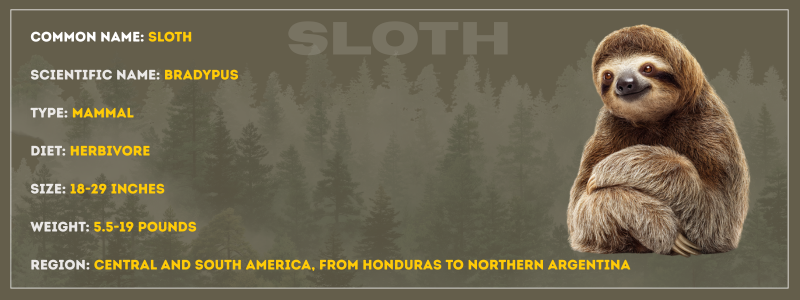
Scientific Name: Bradypus (three-toed sloths) and Choloepus (two-toed sloths)
Diet Type: Folivore (primarily herbivore; two-toed sloths are occasional omnivores)
Size: 18-29 inches (45-74 cm) in length
Weight: 5.5-19 pounds (2.5-8.5 kg)
Region Found: Central and South America, from Honduras to northern Argentina