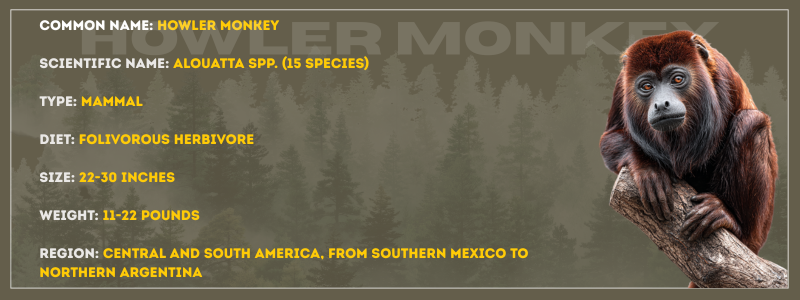

Deep in the emerald canopy of Central and South American rainforests, a sound erupts that can be heard up to three miles away—a guttural, booming roar that seems impossibly loud to emanate from an animal weighing no more than 20 pounds. This is the call of the howler monkey, one of the most vocally remarkable creatures on Earth. These fascinating primates have evolved a suite of extraordinary adaptations that allow them to produce calls louder than a lion’s roar, all while living a remarkably sedentary lifestyle high in the treetops. Beyond their sonic prowess, howler monkeys play a crucial role as seed dispersers in tropical ecosystems and offer scientists valuable insights into primate evolution, communication, and social behavior.
Facts
- Howler monkeys possess the loudest call of any land animal, reaching up to 140 decibels—comparable to the sound of a jet engine at takeoff and audible up to 3 miles (5 kilometers) through dense forest.
- Their remarkable vocal ability comes from an enlarged hyoid bone in their throat, which has evolved into a hollow resonating chamber roughly the size of a chicken egg, amplifying their vocalizations.
- Howlers are among the most sedentary primates, traveling only about 400 meters per day on average and spending up to 80% of their time resting or sleeping to conserve energy from their low-nutrition leaf diet.
- They have prehensile tails that function as a fifth limb, with a hairless pad on the underside that has fingerprint-like ridges for enhanced grip, allowing them to hang securely while feeding.
- Male mantled howler monkeys have been observed performing “hygienic behavior” unique among primates—they assist females during birth by catching infants and sometimes even eating the placenta.
- Howler monkeys have trichromatic color vision similar to humans, an adaptation that helps them identify the most nutritious young leaves among the forest canopy’s sea of green.
- The male’s distinctive red penis in some species is thought to play a role in visual communication and social signaling within troops.
Species
Classification:
- Kingdom: Animalia
- Phylum: Chordata
- Class: Mammalia
- Order: Primates
- Family: Atelidae
- Genus: Alouatta
- Species: 15 recognized species
Howler monkeys comprise the genus Alouatta, which contains 15 distinct species distributed across Central and South America. The most well-known species include:
Mantled Howler (Alouatta palliata) – Found from southern Mexico through Central America to Ecuador and Colombia, recognized by the golden fringe of hair on its flanks.
Black Howler (Alouatta caraya) – Inhabiting southeastern South America, this species shows striking sexual dimorphism with jet-black males and golden-brown females.
Red Howler (Alouatta seniculus) – The most widespread species, ranging across the Amazon Basin and northern South America, with reddish-brown fur.
Brown Howler (Alouatta guariba) – Native to the Atlantic Forest of southeastern Brazil and northeastern Argentina, considered endangered due to habitat loss.
Guatemalan Howler (Alouatta pigra) – Also known as the Yucatan black howler, found in Belize, Guatemala, and Mexico’s Yucatan Peninsula.
Each species has adapted to specific ecological niches within the broader tropical forest ecosystems, though they share the characteristic howling behavior and arboreal lifestyle.
Appearance
Howler monkeys are robust, medium-sized primates with a distinctive appearance that sets them apart from other New World monkeys. Adults typically measure 22 to 36 inches (56 to 92 centimeters) in body length, with males generally larger than females. Their powerful prehensile tail adds another 20 to 30 inches (50 to 75 centimeters), often exceeding their body length and serving as a crucial locomotion tool.
Weight varies by species and sex, with males typically ranging from 11 to 22 pounds (5 to 10 kilograms) and females from 7 to 18 pounds (3 to 8 kilograms). The black howler shows the most pronounced sexual dimorphism in both size and coloration, with males weighing nearly twice as much as females.
Their fur is typically long and thick, providing coloration that ranges from black to reddish-brown, golden, or dark brown, depending on the species. Some species, like the mantled howler, feature distinctive color patterns with lighter fur forming a “mantle” or fringe along their sides. The black howler presents a dramatic contrast between coal-black males and blonde to brown females.
The face is typically bare and dark, with a pronounced muzzle and wide-set eyes that provide good binocular vision. Their most distinctive anatomical feature is the enlarged throat, which houses the hyoid bone apparatus—this gives males in particular a prominent, swollen appearance in the neck area. Their hands and feet are adapted for arboreal life, with curved fingers and toes for gripping branches, while the underside of their prehensile tail features a sensitive, hairless pad with dermal ridges similar to fingerprints.

Behavior
Howler monkeys are highly social animals that live in troops typically numbering 6 to 15 individuals, though groups can occasionally swell to 20 or more. These troops usually consist of one to three adult males, multiple females, and their offspring, organized in a loose dominance hierarchy. Unlike many primates, howler monkey societies are relatively peaceful, with minimal aggression within troops.
The species is named for its signature behavior: the extraordinary dawn and dusk chorus performed primarily by adult males. These territorial howling sessions serve multiple purposes—advertising the troop’s location to prevent encounters with neighboring groups, maintaining troop cohesion, and asserting dominance. Males often howl in coordinated bouts, creating an intimidating wall of sound that reverberates through the forest. Females occasionally join in, though their vocalizations are quieter.
Howlers are predominantly arboreal and rarely descend to the ground. They move through the canopy using quadrupedal locomotion, walking along branches and using their prehensile tail as an anchor and fifth limb. Their movement style is deliberate and cautious rather than acrobatic, reflecting their energy-conserving lifestyle.
The daily routine of a howler troop is remarkably sedentary compared to other primates. They typically wake at dawn, feed for a few hours on young leaves and fruit, then settle into extended rest periods that can last throughout the midday heat. A second feeding period may occur in the late afternoon, followed by more rest before finding a sleeping site for the night. This low-activity lifestyle is a direct adaptation to their leaf-based diet, which provides relatively little energy and requires lengthy digestion periods.
Social grooming occurs but is less frequent than in many other primate species. Communication includes a variety of vocalizations beyond the famous howl, including grunts, barks, and chattering sounds. Body postures and facial expressions also play roles in social interactions, particularly during feeding competition or mating contexts.
Intelligence studies suggest howlers possess good spatial memory for locating food sources and demonstrate problem-solving abilities, though they’re generally considered less cognitively flexible than some other New World monkeys, possibly due to their specialized diet requiring less foraging innovation.
Evolution
Howler monkeys belong to the family Atelidae, which also includes spider monkeys, woolly monkeys, and muriquis. This family represents one of the five families of New World monkeys (platyrrhines), which diverged from Old World primates approximately 40 million years ago. The ancestors of modern New World monkeys likely reached South America from Africa via trans-Atlantic rafting on vegetation mats during the Eocene epoch, when the continents were closer together and ocean currents were favorable.
The Atelidae family is believed to have emerged around 16 to 20 million years ago during the Miocene epoch. Fossil evidence of howler monkeys specifically is limited but significant. The oldest confirmed howler monkey fossils, assigned to the extinct genus Protopithecus, date to approximately 1 million years ago from the Pleistocene of Brazil. These ancient relatives were considerably larger than modern howlers, with some species estimated to have weighed up to 55 pounds (25 kilograms).
More recent fossil discoveries have revealed the extinct species Alouatta mauroi from the Late Pleistocene of Argentina, demonstrating that howler monkeys once had a broader geographical range than they occupy today. DNA evidence suggests the modern genus Alouatta began diversifying into distinct species approximately 6.5 to 7 million years ago, with most speciation events occurring in the last 3 to 4 million years as populations became isolated by geographic barriers like rivers and mountain ranges.
The evolution of the howler’s enlarged hyoid bone represents one of the most fascinating examples of specialized adaptation in primates. This unique vocal apparatus evolved to facilitate long-distance communication in dense forest environments where visual contact between troops is impossible. Interestingly, research has revealed a trade-off in male howlers: species with larger hyoid bones and louder calls tend to have smaller testes relative to body size, suggesting an evolutionary compromise between investing in vocal competition versus sperm competition.
The development of trichromatic color vision in howlers and other catarrhine primates evolved independently from the trichromacy found in Old World primates, representing a remarkable case of convergent evolution driven by the need to identify nutritious young leaves and ripe fruits against a background of green foliage.
Habitat
Howler monkeys inhabit the tropical and subtropical forests of Central and South America, with a range extending from southern Mexico through the Amazon Basin and into northern Argentina. This distribution makes them one of the most geographically widespread primate genera in the New World.
Their geographic range spans diverse ecosystems, though all species require forested habitats. The mantled howler occupies lowland and montane forests from southern Mexico’s Veracruz and Oaxaca states southward through Guatemala, Belize, Honduras, Nicaragua, Costa Rica, and Panama, extending into western Colombia and Ecuador. The black howler is found in the gallery forests and seasonally flooded forests of southeastern Brazil, Paraguay, Bolivia, and northern Argentina. Red howlers dominate much of the Amazon Basin, ranging across Colombia, Venezuela, the Guianas, Brazil, Ecuador, Peru, and Bolivia.
Within these broad ranges, howlers occupy various forest types including primary rainforests, secondary forests, deciduous and semi-deciduous forests, gallery forests, mangroves, and even fragmented forest patches. They show remarkable adaptability to different forest structures and can survive in degraded habitats better than many other primate species, though they strongly prefer primary forest with continuous canopy cover.
Howler monkeys typically remain in the upper and middle canopy layers, rarely descending below 15 feet (5 meters) from the ground. They favor areas with dense vegetation that provides both food resources and protection from predators. The availability of water sources is important, as howlers obtain moisture primarily from their food but will drink from tree holes, bromeliads, and streams when available.
Different species show altitude preferences. While most howlers inhabit lowland forests below 1,500 feet (500 meters), some populations of mantled and red howlers can be found at elevations up to 8,200 feet (2,500 meters) in cloud forests and montane habitats. The brown howler is notable for inhabiting the temperate Atlantic Forest region, where it endures cooler temperatures than other species.
Forest edges, river corridors, and areas with high tree species diversity tend to support higher howler densities, as these zones offer varied food sources throughout the year. However, they maintain relatively small home ranges of 10 to 60 acres (4 to 24 hectares) depending on habitat quality and troop size, moving slowly through their territory and often using the same sleeping trees repeatedly.

Diet
Howler monkeys are primarily folivorous herbivores, meaning they subsist predominantly on leaves—an unusual dietary strategy among primates. Mature leaves constitute 40 to 70% of their diet depending on season and habitat, supplemented by fruits, flowers, buds, and occasionally nuts and seeds. This leaf-eating specialization sets them apart from most other New World monkeys, which tend to favor fruits and insects.
Their digestive system has evolved several adaptations for processing leaves, which are high in cellulose and often contain toxic secondary compounds that plants produce as defenses. Howlers possess an enlarged hindgut with specialized bacteria that help break down cellulose and neutralize plant toxins, similar to the fermentation chambers found in ruminants. This digestive process is slow and inefficient, which explains why howlers must rest extensively to conserve energy.
Howlers show strong selectivity in their feeding choices. They preferentially consume young leaves over mature ones because young foliage has higher protein content, less fiber, and lower concentrations of defensive chemicals. Their trichromatic color vision helps them identify the most nutritious reddish and yellowish young leaves against the background of mature green foliage.
Fruit becomes particularly important when available, sometimes comprising up to 50% of the diet during fruiting seasons. Howlers consume a wide variety of fruits but tend to prefer figs, which are both nutritious and available year-round in many tropical forests. They act as important seed dispersers, swallowing seeds whole and depositing them across their range in their feces.
Flowers and flower buds provide important protein sources and are eagerly consumed when available. Some populations have been observed eating bark, soil (geophagy—possibly to neutralize toxins or supplement minerals), and even occasionally insects, though these comprise minimal portions of the diet.
Foraging occurs primarily in the early morning and late afternoon. Howlers typically feed in small, scattered groups within the same trees, maintaining spacing to reduce competition. A single troop may use 50 to 100 different tree species throughout the year, requiring detailed knowledge of food source locations and seasonal availability. They can survive extended periods on a limited variety of food sources, demonstrating remarkable dietary flexibility compared to more specialized fruit-eaters.
Predators and Threats
In their natural habitat, howler monkeys face predation from several large carnivores. The primary natural predators include large felids, particularly jaguars and pumas, which hunt howlers both in the trees and on the rare occasions when they descend to the ground. Harpy eagles pose the most significant aerial threat, being powerful enough to snatch adult howlers from the canopy. These massive raptors can strike with devastating speed and are particularly dangerous to juveniles and smaller adults. Other birds of prey, including ornate hawk-eagles and crested eagles, also occasionally hunt howlers, primarily targeting younger individuals.
Large boas and anacondas opportunistically prey on howlers, especially near water sources or in the lower canopy. Ocelots and tayras may hunt juveniles or young adults when opportunities arise. Despite these natural predators, predation rates on healthy adult howlers in intact forests are relatively low due to their arboreal lifestyle, group vigilance, and the early warning provided by their loud vocalizations.
The most severe threats to howler monkey populations are anthropogenic. Habitat loss and fragmentation represent the primary danger across their range. Deforestation for agriculture, cattle ranching, logging, and urban development has dramatically reduced and fragmented howler habitat, particularly in Central America and Brazil’s Atlantic Forest. Howlers can persist in small forest fragments better than some primates, but isolated populations face genetic bottlenecks, increased mortality from falls (as they’re forced to cross gaps between trees), and higher predation rates.
Hunting and capture pose significant threats in some regions. Howlers are hunted for bushmeat in parts of their range, though they’re not preferred prey for most human hunters compared to larger species. Young howlers are sometimes captured for the illegal pet trade, though they make poor pets and rarely survive long in captivity when taken from the wild.
Climate change threatens howler populations through altered rainfall patterns, increased frequency of extreme weather events, and shifts in forest composition that affect food availability. Drought conditions can cause mass mortality events, as documented in several Central American populations where heat stress and dehydration killed hundreds of individuals.
Disease represents an emerging threat. Yellow fever outbreaks have devastated brown howler populations in Brazil, killing thousands of individuals in recent years. Howlers are highly susceptible to this mosquito-borne virus, and outbreaks continue to occur. They also face threats from habitat-related diseases and parasites that increase in disturbed environments.
Electrocution and road strikes kill howlers in fragmented landscapes where they must cross power lines or roads to move between forest patches. Domestic dog attacks also impact populations living near human settlements.
Reproduction and Life Cycle
Howler monkeys generally lack a strict breeding season, with reproduction occurring year-round in most populations, though some seasonal peaks in births have been observed corresponding to periods of food abundance. Female howlers reach sexual maturity between 3 to 5 years of age, while males mature slightly later, around 5 to 7 years, though they may not successfully breed until they’ve established dominance or joined a new troop.
Female howlers experience estrus cycles approximately every 16 to 20 days when not pregnant or nursing. Mating is typically polygynous, with dominant males securing most reproductive opportunities, though subordinate males may also mate, particularly in multi-male troops. Courtship involves vocalizations, including specialized calls from males, along with facial expressions and physical proximity. Copulation is brief, usually lasting less than a minute, and may occur multiple times over several days.
The gestation period lasts approximately 180 to 194 days (roughly 6 to 6.5 months). Females typically give birth to a single offspring, though twins are extremely rare. Birth usually occurs during the night or early morning hours. The newborn weighs around 10 to 14 ounces (300 to 400 grams) and clings immediately to its mother’s belly, with a coat color that may differ from adults—often lighter or golden even in species where adults are dark.
Maternal care is intensive during the first months of life. The infant remains constantly attached to the mother for the first few weeks, nursing frequently. After about one month, infants begin taking brief excursions away from their mothers but return quickly for security and nursing. Other troop members, particularly females, show interest in infants and may occasionally hold or groom them, though mothers remain the primary caregivers.
Weaning occurs gradually between 10 to 24 months, depending on the species and whether the mother becomes pregnant again. Even after weaning, youngsters remain closely associated with their mothers for several years. Young males typically disperse from their natal troop around 3 to 5 years of age, while females may remain in their birth group or transfer to neighboring troops.
The average lifespan in the wild is estimated at 15 to 20 years, though individuals can potentially live longer in protected environments with abundant resources. In captivity, howlers have survived into their mid-20s and occasionally into their early 30s, suggesting that predation and environmental stressors significantly impact wild longevity.
Reproductive rates are relatively slow compared to smaller primates, with females typically producing offspring every 18 to 24 months under favorable conditions. This slow reproduction, combined with lengthy maternal investment, makes howler populations particularly vulnerable to rapid population declines when faced with high mortality events.

Population
The conservation status of howler monkeys varies significantly by species, reflecting differing levels of habitat protection and human pressure across their ranges. The International Union for Conservation of Nature (IUCN) Red List assesses howler species across multiple categories:
Several species are classified as Least Concern, including the mantled howler and red howler, which benefit from relatively large geographic ranges and populations. However, this classification shouldn’t inspire complacency, as populations of even these species face localized declines and threats.
The brown howler (Alouatta guariba) is listed as Endangered, having suffered severe population declines due to Atlantic Forest habitat loss and recent yellow fever outbreaks that killed an estimated 80-90% of populations in some regions between 2016 and 2020. The Yucatan black howler (Alouatta pigra) is also classified as Endangered, with ongoing habitat loss threatening its restricted range.
Other species like the Bolivian red howler (Alouatta sara) and Coiba Island howler (Alouatta coibensis) are considered Vulnerable or Near Threatened.
Estimating global population numbers for howler monkeys is challenging due to their wide distribution and varied habitats. Conservative estimates suggest total howler monkey populations across all species may number in the hundreds of thousands, though precise counts are unavailable. The mantled howler, being widespread, likely numbers in the tens of thousands at minimum, while critically threatened species may have populations in the low thousands or even hundreds.
Population trends vary by region and species but generally show declining trajectories. Habitat loss continues at alarming rates, particularly in Central America and Brazil’s Atlantic Forest region. Some protected areas maintain stable or increasing howler populations, demonstrating that conservation efforts can be effective when properly implemented and funded.
Forest fragmentation creates isolated populations that face genetic risks and local extinction threats. However, howlers show resilience compared to some primates, adapting to secondary forests and even agricultural landscapes with sufficient tree cover, which offers hope for their persistence in human-modified environments.
Yellow fever represents an unpredictable threat capable of causing sudden, catastrophic population crashes, particularly in brown howler populations where outbreaks have become increasingly frequent and severe. Climate change may expand mosquito ranges and disease prevalence, potentially threatening previously unaffected populations.
Conservation initiatives including protected area establishment, biological corridors connecting forest fragments, reforestation projects, community education programs, and disease monitoring have been implemented across the howlers’ range, with varying success.
Conclusion
The howler monkey stands as one of nature’s most remarkable primates, having evolved extraordinary vocal abilities, specialized digestive adaptations, and a unique sedentary lifestyle that sets them apart in the tropical forests they call home. From their thunderous dawn chorus that echoes through the canopy to their crucial role as seed dispersers maintaining forest health, howlers demonstrate the intricate connections between species and ecosystems.
Yet these ancient vocalists face an uncertain future. While some species maintain healthy populations, others teeter on the edge, threatened by the relentless advance of deforestation, devastating disease outbreaks, and the accelerating impacts of climate change. The brown howler’s recent catastrophic declines from yellow fever serve as a stark warning that even seemingly stable populations can collapse rapidly when multiple threats converge.
The fate of howler monkeys ultimately rests in human hands. Supporting forest conservation, creating and maintaining biological corridors between fragmented habitats, funding disease surveillance and research, and addressing climate change are essential actions that will determine whether future generations can still hear the primordial roar of the howler echoing through Central and South American forests. These vocal masters have sung their ancient song for millions of years—it’s our responsibility to ensure their chorus doesn’t fall silent on our watch.
Scientific Name: Alouatta spp. (15 species)
Diet Type: Folivorous herbivore (primarily leaves, supplemented with fruit and flowers)
Size: 22-36 inches (56-92 cm) body length; tail 20-30 inches (50-75 cm)
Weight: Males 11-22 lbs (5-10 kg); Females 7-18 lbs (3-8 kg)
Region Found: Central and South America, from southern Mexico to northern Argentina