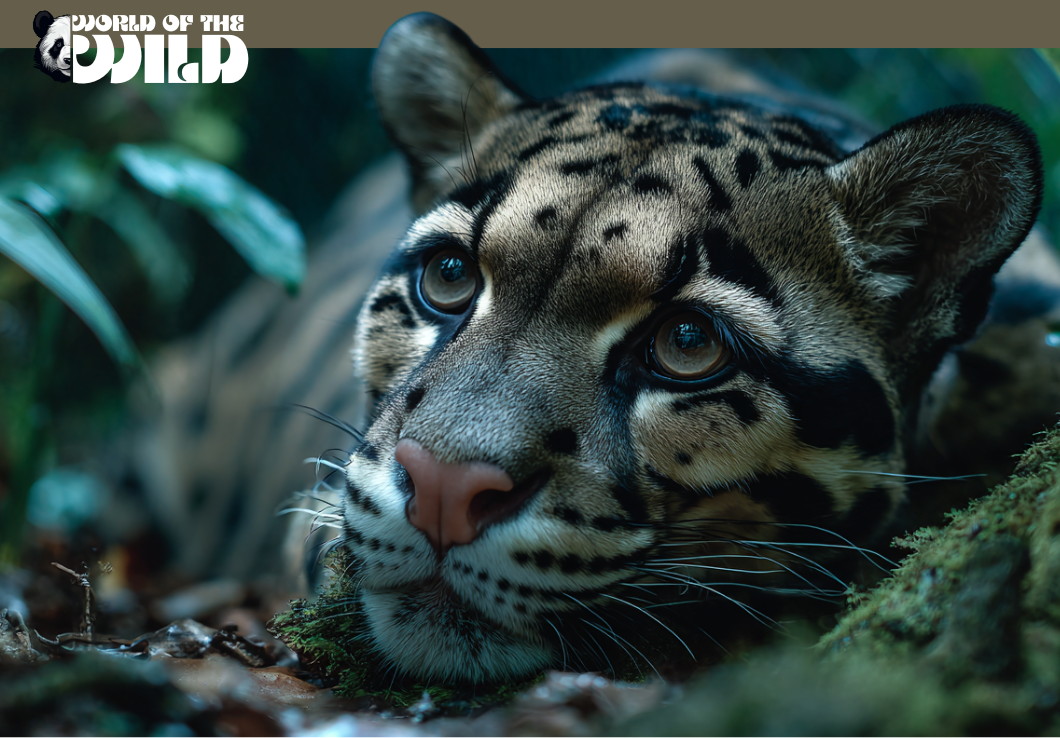

In the emerald canopy of Southeast Asia’s rainforests, a phantom stalks the branches. Moving with liquid grace along limbs that would challenge most ground-dwelling predators, the clouded leopard represents one of nature’s most exquisite evolutionary achievements—a cat that has truly mastered life in the trees. With its otherworldly coat pattern resembling clouds drifting across a twilight sky and adaptations that blur the line between terrestrial and arboreal hunter, this medium-sized felid stands as one of the least understood and most captivating predators on Earth. Neither truly “big” nor entirely “small,” the clouded leopard occupies a unique evolutionary position, serving as a living bridge between the great cats and their smaller cousins while facing an uncertain future in rapidly disappearing forests.
Facts
- Record-Breaking Canines: Clouded leopards possess the longest canine teeth relative to skull size of any living cat species, measuring up to 2 inches long—proportionally similar to those of extinct saber-toothed cats.
- Ankle Acrobats: They are the only cat species that can rotate their hind ankles backward, allowing them to descend trees headfirst and hang upside down from branches using only their hind feet.
- Taxonomic Mystery: Scientists didn’t confirm that clouded leopards comprised two distinct species until 2006, when genetic analysis revealed the Sunda clouded leopard as separate from its mainland cousin.
- Jaw Power Anomaly: Despite their moderate size, clouded leopards can open their jaws wider than any other cat—nearly 90 degrees—enabling them to deliver devastating bites to prey.
- Tail Counterbalance: Their extraordinarily long tail—often as long as their entire body—serves as a counterbalance for their aerial acrobatics, much like a tightrope walker’s pole.
- Vocalization Enigma: Unlike most cats, clouded leopards cannot roar but produce a distinctive prusten sound (a friendly chuffing) and emit low moans, hisses, and growls.
- Solitary Shadows: So elusive are these cats that some indigenous communities believed them to be supernatural beings, and even modern camera trap surveys often fail to capture them despite months of monitoring.
Species
Taxonomic Classification:
- Kingdom: Animalia
- Phylum: Chordata
- Class: Mammalia
- Order: Carnivora
- Family: Felidae
- Subfamily: Pantherinae
- Genus: Neofelis
- Species: Neofelis nebulosa (Mainland Clouded Leopard) and Neofelis diardi (Sunda Clouded Leopard)
The genus Neofelis contains two recognized species that were long considered a single taxon. The mainland clouded leopard (Neofelis nebulosa) inhabits the Himalayan foothills, mainland Southeast Asia, and southern China, while the Sunda clouded leopard (Neofelis diardi) is endemic to Borneo and Sumatra. Genetic studies revealed these populations diverged approximately 1.4 million years ago, developing distinct differences in coat patterns, skull morphology, and coloration. The Sunda species tends to have smaller cloud markings and generally darker fur.
Within Neofelis nebulosa, some researchers recognize several subspecies based on geographic distribution, though this classification remains debated. These potentially include the Himalayan clouded leopard, the Indochinese clouded leopard, and the South Chinese clouded leopard, though further genetic research is needed to confirm these distinctions.
Appearance
The clouded leopard’s appearance is nothing short of spectacular, embodying the aesthetic perfection of evolutionary adaptation. Adults typically measure 60 to 110 centimeters in body length, with males significantly larger than females. Their weight ranges from 11 to 23 kilograms, with males averaging around 20 kilograms and females closer to 12 kilograms. However, their long, thick tail adds another 60 to 90 centimeters to their total length, creating a remarkably elongated profile.
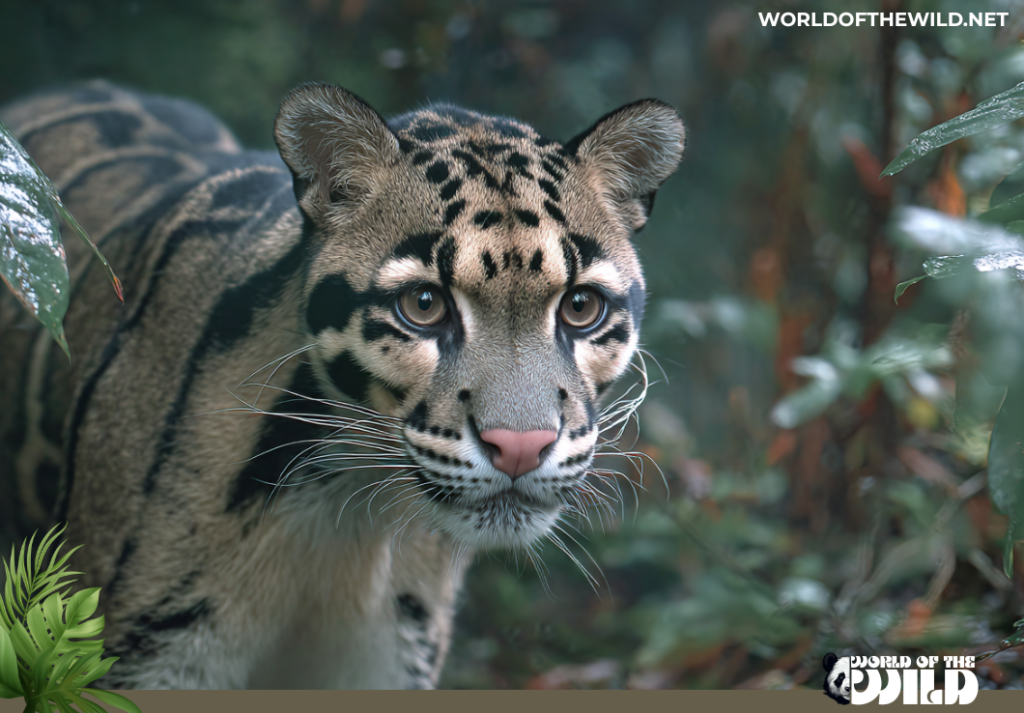
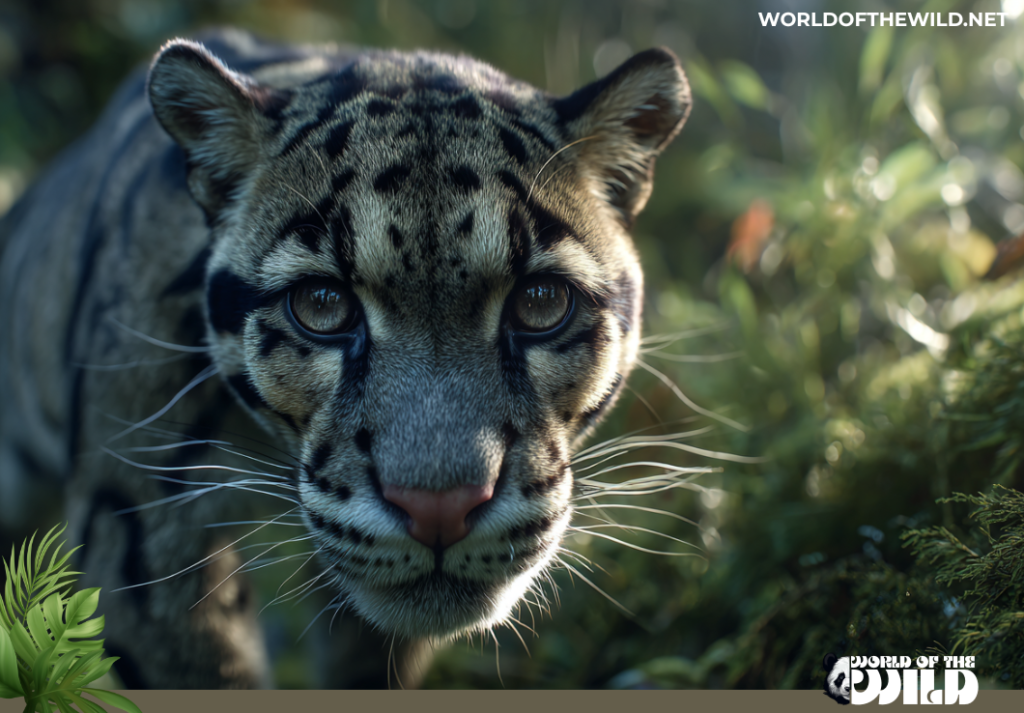
Their coat is an artist’s masterpiece—a tawny or gray base overlaid with distinctive elliptical blotches and irregular cloud-shaped markings edged in black. These “clouds” are actually partially filled irregular ovals, creating a pattern unique to each individual, much like human fingerprints. The rosettes on their flanks are larger and more irregular than those of leopards, giving them their evocative common name. Their underside features a cream or pale tan coloration with dark spots.
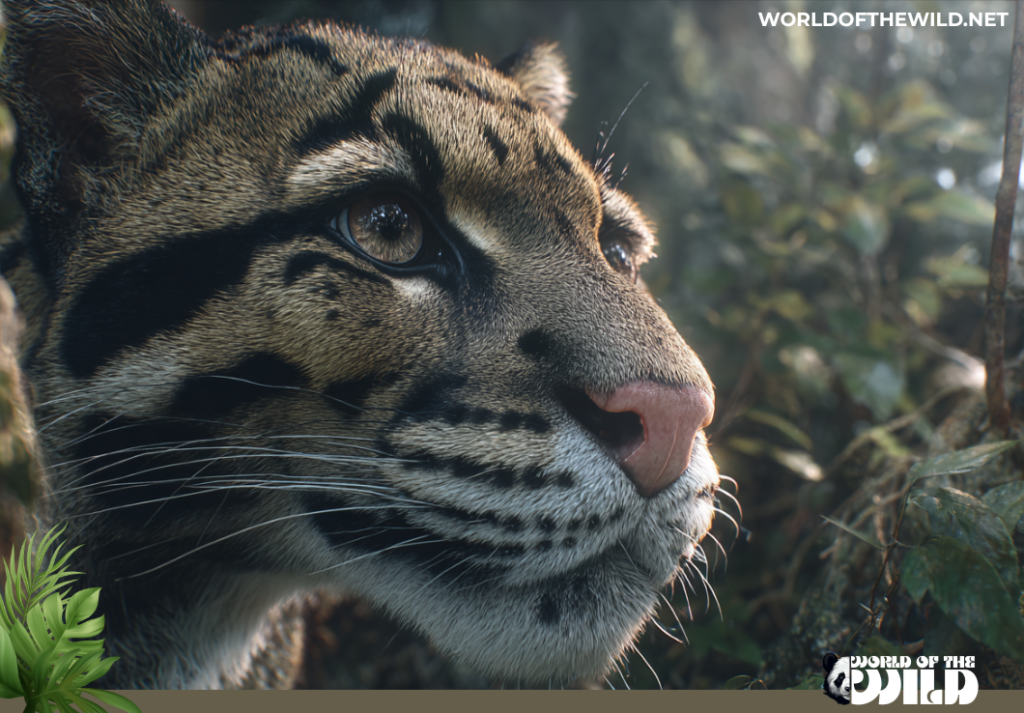
Beyond their iconic coat, clouded leopards possess several remarkable physical features. Their skull is elongated with an arched forehead, and their canine teeth are disproportionately long and sharp. Their legs are relatively short and stocky, with broad paws equipped with sharp, retractable claws. Their paws are exceptionally large relative to body size, providing superior grip on tree bark and branches. The eyes are striking—amber or greenish-gray with vertical pupils that dilate widely for enhanced night vision. Perhaps most notably, their exceptionally flexible spine and shoulder joints allow them to perform gymnastic feats impossible for most terrestrial carnivores.
Behavior
Clouded leopards are predominantly solitary creatures, with adults typically interacting only during brief mating periods. They are primarily nocturnal and crepuscular, becoming most active during dawn and dusk when they hunt with stealth precision through the forest canopy. Their behavior represents a fascinating blend of terrestrial and arboreal habits—they are equally comfortable hunting on the ground as they are navigating the complex three-dimensional space of the rainforest canopy.
In the trees, clouded leopards demonstrate behaviors that seem to defy the laws of physics. They can run down vertical tree trunks headfirst, leap backwards from branch to branch, and hang from limbs using only their hind feet while manipulating prey with their front paws. They rest in tree forks during the day, often draping themselves along branches with their legs dangling on either side—a position that provides both camouflage and quick escape routes.
Communication among clouded leopards remains incompletely understood due to their secretive nature, but they employ scent marking through urine spraying, feces deposition, and cheek rubbing. They also use scratching to mark territory on tree trunks. Vocalizations include prusten (chuffing), moaning, hissing, growling, and meowing, though they lack the ability to roar like true big cats. Some researchers have noted “wah-wah” vocalizations and purr-like sounds, particularly between mothers and cubs.
Their intelligence manifests in their problem-solving abilities and adaptability. Captive studies have revealed they can learn to manipulate complex mechanisms, suggesting cognitive flexibility. They appear to have excellent spatial memory, likely necessary for navigating complex canopy routes. Their hunting strategy demonstrates sophisticated ambush techniques, suggesting they can predict prey movement patterns and select optimal striking positions.
Evolution
The evolutionary history of clouded leopards traces back to the early divergence of the Pantherinae subfamily, making them a crucial link in understanding felid evolution. Molecular phylogenetic studies suggest that the clouded leopard lineage split from the common ancestor of all other big cats approximately 6 to 10 million years ago during the Late Miocene epoch. This makes Neofelis the sister group to all other pantherines, including lions, tigers, leopards, and jaguars.
The fossil record for clouded leopards is frustratingly sparse, but related extinct species provide clues to their evolutionary pathway. The genus Neofelis likely evolved in Southeast Asia, adapting to the dense tropical forests that characterized the region during the Pliocene and Pleistocene epochs. Their ancestors likely developed arboreal specializations as competition with larger ground-dwelling predators intensified.
The split between the two modern Neofelis species occurred roughly 1.4 million years ago during the Pleistocene, when sea level fluctuations periodically isolated Borneo and Sumatra from the Asian mainland. Populations on these Sunda Shelf islands evolved in isolation, developing the distinctive characteristics that now define Neofelis diardi. This speciation event demonstrates how geographic barriers and island biogeography can drive evolutionary divergence.
Interestingly, clouded leopards retain several primitive features compared to other pantherines, including their inability to roar (despite belonging to the roaring cat subfamily), their proportionally enormous canines reminiscent of saber-toothed cats, and certain skull characteristics. These features suggest they represent a basal lineage that branched off before some of the derived characteristics of modern big cats evolved.
Habitat
Clouded leopards inhabit the dense tropical and subtropical forests of Southeast Asia, occupying one of the most biodiverse regions on Earth. Their range extends from the Himalayan foothills of Nepal and Bhutan through northeastern India, Bangladesh, Myanmar, southern China, Thailand, Laos, Cambodia, Vietnam, and peninsular Malaysia. The Sunda clouded leopard is restricted to the islands of Borneo and Sumatra.
These cats show a strong preference for primary evergreen tropical rainforest, though they also occupy secondary forests, logged areas, and mangrove forests when necessary. They range from sea level up to elevations of approximately 3,000 meters in the Himalayas, though they are most commonly found at mid-elevations between 400 and 2,000 meters. They thrive in areas with high canopy cover, where their arboreal adaptations provide the greatest advantages.
Their habitat requirements include dense vegetation for cover, sufficient prey populations, and crucially, healthy forest canopy structure. They favor areas with large trees featuring horizontal branches suitable for resting and hunting platforms. While they can persist in selectively logged forests, heavy logging that removes the canopy layer renders habitat unsuitable. They also utilize transitional zones between forest types, including the edges of grasslands where forest cover remains nearby.
Clouded leopards demonstrate remarkable habitat versatility within forested ecosystems, occupying lowland dipterocarp forests, montane forests, cloud forests at higher elevations, and even coastal forests. However, they rarely venture far from forest cover, unlike leopards which can adapt to more open habitats. This forest dependency makes them particularly vulnerable to deforestation and habitat fragmentation.
Diet
Clouded leopards are obligate carnivores with a diverse prey base reflecting their unique hunting capabilities. Their diet primarily consists of medium-sized mammals, birds, and occasionally reptiles. Primary prey species include various deer species (particularly barking deer and young sambar deer), wild pigs, porcupines, monkeys and gibbons, civets, squirrels, and various rodents. In some areas, they also hunt slow lorises, pangolins, and birds including pheasants and other ground-dwelling species.
Their hunting strategy capitalizes on both terrestrial and arboreal opportunities. On the ground, they employ classic felid ambush techniques—stalking silently through underbrush before delivering a powerful pounce and killing bite. Their exceptionally long canines allow them to penetrate deeply into prey, delivering fatal wounds to the neck or skull. The ability to open their jaws extremely wide enables them to achieve optimal bite placement on prey.
In the trees, clouded leopards execute a hunting style unique among cats. They can stalk along branches, dropping onto unsuspecting prey below, or pursue arboreal prey like monkeys and squirrels through the canopy. Their retractable claws and rotating ankle joints allow them to maintain pursuit even on the smallest branches where other predators would fall. Some reports suggest they may drag prey up into trees to consume it away from ground-dwelling scavengers, though this behavior requires further documentation.
Individual hunting success depends on factors including prey availability, habitat structure, and individual skill. They typically hunt alone, covering territories of varying sizes in search of prey. Analysis of scat samples and camera trap footage suggests they may adjust their diet seasonally based on prey abundance, demonstrating behavioral flexibility in their foraging ecology.
Predators and Threats
As medium-sized carnivores, clouded leopards face predation pressure from larger predators, though confirmed cases are rare due to their arboreal escape abilities and secretive nature. Tigers, leopards, and dholes (Asian wild dogs) represent potential predators, particularly of juveniles or sub-adults. Large pythons may also pose a threat to young clouded leopards. However, their primary refuge in trees and nocturnal habits likely minimize encounters with most terrestrial predators.
The gravest threats to clouded leopards are anthropogenic. Habitat loss and fragmentation represent the most significant danger, with Southeast Asian forests disappearing at alarming rates due to logging, agricultural expansion, palm oil plantations, and human settlement. Between 2000 and 2020, the region lost millions of hectares of primary forest, directly eliminating clouded leopard habitat and fragmenting populations into isolated patches unable to maintain genetic diversity.
Poaching constitutes another severe threat. Clouded leopards are hunted for their spectacular pelts, which command high prices in illegal wildlife trade markets. Their bones and body parts are used in traditional medicine, and their large canine teeth are sold as decorative items or talismans. Despite legal protection throughout their range, enforcement remains inadequate in many areas. Camera trap and market surveys suggest poaching pressure remains intense, particularly near international borders.
Additional threats include prey depletion from overhunting, road mortality in areas where highways fragment habitat, persecution by farmers protecting livestock, and climate change impacts on forest ecosystems. The species’ naturally low population densities and slow reproductive rate make recovery from population declines particularly challenging.
Reproduction and Life Cycle
Clouded leopard reproduction remains incompletely understood due to their elusive nature, with much of our knowledge derived from captive populations. Females reach sexual maturity between 20 and 30 months of age, while males mature slightly later at around 24 to 30 months. Unlike many temperate felids with seasonal breeding, clouded leopards can breed year-round in the wild, though some populations may show breeding peaks coinciding with prey abundance.
The estrous cycle lasts approximately 30 days, with the female receptive for 5 to 6 days. Mating involves the male gripping the female’s neck during copulation, a behavior common among cats. Following successful mating, the gestation period extends 85 to 95 days—relatively short compared to larger felids. Females seek out secure denning sites, often in hollow trees, rock crevices, or dense vegetation tangles, where they give birth to litters typically containing one to five cubs, though two to three is most common.
Cubs are born blind and helpless, weighing approximately 140 to 280 grams. Their eyes open at around 10 days, and they are covered with dark, solid spots rather than the cloud patterns that will develop later. The mother provides intensive parental care, nursing the cubs exclusively for the first few weeks before beginning to introduce solid food at 10 to 12 weeks. Weaning occurs between 3 and 5 months of age.
Young clouded leopards develop slowly compared to some smaller cat species. They begin exploring outside the den at around 5 weeks and start following their mother on hunts at approximately 9 months, learning crucial stalking and killing techniques. Independence occurs at around 10 months to one year, though some individuals may remain with their mother longer. In the wild, clouded leopards likely live 10 to 13 years, while captive individuals have reached 17 years.
Population
The clouded leopard is currently classified as Vulnerable on the IUCN Red List of Threatened Species, indicating it faces a high risk of extinction in the wild. The Sunda clouded leopard is also listed as Vulnerable, with some conservation biologists arguing it merits Endangered status due to habitat loss on Borneo and Sumatra.
Accurate population estimates remain frustratingly elusive due to the species’ secretive nature and the difficulty of surveying dense forest habitats. Current estimates suggest fewer than 10,000 mature individuals survive across the entire range of Neofelis nebulosa, with population density estimates ranging from 1 to 5 individuals per 100 square kilometers in optimal habitat. Some protected areas may support higher densities, but vast areas of their historical range now harbor few or no clouded leopards.
The Sunda clouded leopard population is believed to be even smaller, potentially numbering only a few thousand individuals across Borneo and Sumatra combined. Population trends are decidedly negative across all range states, with populations declining by an estimated 10% per decade. Some regional populations have likely already been extirpated, particularly in areas experiencing rapid deforestation or intensive poaching pressure.
Genetic studies reveal concerning patterns of population fragmentation and reduced genetic diversity, suggesting many populations are becoming isolated and losing evolutionary resilience. Small, isolated populations face increased risks of inbreeding depression and local extinction from stochastic events. Conservation efforts have established clouded leopards in numerous protected areas, but many of these reserves are too small to support viable long-term populations, and corridor connectivity between protected areas remains inadequate.
Conclusion
The clouded leopard stands as a testament to evolution’s creative genius—a cat superbly adapted to life in the forest canopy, bearing the proportional fangs of ancient saber-tooths while navigating trees with the agility of a primate. Yet this evolutionary masterpiece now teeters on the precipice, its forests vanishing, its pelts coveted, its future uncertain. Understanding these enigmatic cats requires acknowledging that we still know remarkably little about their ecology, behavior, and true conservation needs. What we do know, however, is that time is running short.
The fate of clouded leopards is inextricably linked to the fate of Southeast Asia’s forests—ecosystems that harbor unparalleled biodiversity while facing unprecedented threats. Protecting these cats means protecting entire forest ecosystems and the countless species that depend on them. It requires strengthening anti-poaching enforcement, establishing and maintaining habitat corridors, supporting indigenous communities who share their forests with clouded leopards, and fundamentally rethinking our relationship with the natural world.
As these phantom cats continue their silent patrols through diminishing forests, they pose a question to humanity: Will we act with the urgency required to ensure that future generations can still glimpse clouds drifting through the canopy—not the meteorological kind, but the furred, fanged, magnificent kind that evolution spent millions of years perfecting? The answer lies not in the forest, but in our choices.
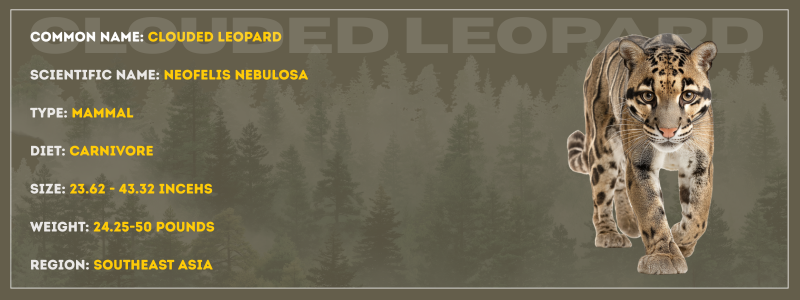
Scientific Name: Neofelis nebulosa (Mainland Clouded Leopard), Neofelis diardi (Sunda Clouded Leopard)
Diet Type: Carnivore
Size: 60-110 cm body length (tail adds 60-90 cm)
Weight: 11-23 kg (males larger, averaging ~20 kg; females ~12 kg)
Region Found: Southeast Asia (Himalayan foothills through Nepal, Bhutan, India, Bangladesh, Myanmar, southern China, Thailand, Laos, Cambodia, Vietnam, Malaysia, Borneo, and Sumatra)