
Imagine an animal that looks like a pinecone decided to grow legs and climb a tree. Covered head-to-tail in interlocking scales of hardened keratin, moving with a slow, deliberate grace through the forest canopy under the veil of night — the Tree Pangolin is one of the most surreal, otherworldly creatures that evolution has ever produced. It is part mammal, part reptile in appearance, entirely unique in reality.
Found deep in the rainforests of Central and West Africa, the Tree Pangolin (Phataginus tricuspis) is the world’s most trafficked wild mammal — a title that speaks not to its abundance, but to its tragedy. Despite being hunted relentlessly for its scales and meat, this shy, nocturnal creature remains poorly understood, seldom seen, and rarely photographed in the wild. Yet the more scientists learn about it, the more astonishing it becomes.
The Tree Pangolin challenges our assumptions about what a mammal can be. It has no teeth. It has a tongue longer than its own body. It can curl into an armored ball so tight that even a lion cannot pry it open. It is a master of chemical defense, solitary wandering, and silent survival. In a world that too often overlooks the quietly extraordinary, the Tree Pangolin demands our attention — and our protection.
Facts
Here are some of the most surprising and lesser-known facts about the Tree Pangolin:
- Its scales are made of the same material as your fingernails. Pangolin scales are composed of keratin — the same protein that forms human nails and hair. Despite resembling armor plating, they are not bone.
- Its tongue can exceed the length of its entire body. When fully extended, a Tree Pangolin’s sticky tongue can stretch longer than its head and body combined, reaching deep into ant and termite galleries that no other animal could access.
- It has no stomach acid in the traditional sense — it uses swallowed stones instead. The Tree Pangolin has a muscular, gizzard-like stomach that uses small stones and sand it ingests to mechanically grind up insects, compensating for its complete lack of teeth.
- It can close its ears and nostrils voluntarily. When raiding an insect colony, the Tree Pangolin seals its ears and nose shut to prevent biting insects from entering, and its thick eyelids protect its eyes.
- Newborns already have soft, functional scales. A pangolin pup is born with scales that harden within days of birth, providing early protection even before the young animal can defend itself.
- It secretes a foul-smelling fluid when threatened — much like a skunk. Glands near the base of its tail produce a pungent chemical secretion used for defense and territory marking.
- It has been on Earth in roughly its current form for over 80 million years. Pangolins are among the most ancient of placental mammals, having survived mass extinctions, continental drift, and ice ages — making their potential extinction in our lifetime all the more unconscionable.
Species
Classification of the Tree Pangolin:
| Rank | Classification |
|---|---|
| Kingdom | Animalia |
| Phylum | Chordata |
| Class | Mammalia |
| Order | Pholidota |
| Family | Manidae |
| Genus | Phataginus |
| Species | Phataginus tricuspis |
The Tree Pangolin belongs to the order Pholidota, a name derived from the Greek word for “scaled animal.” This is one of the smallest mammalian orders, containing only one family — Manidae — and eight living species spread across Africa and Asia.
The eight pangolin species are divided into three genera. The four African species include the Tree Pangolin (Phataginus tricuspis), the Long-tailed Pangolin (Phataginus tetradactyla), the Giant Ground Pangolin (Smutsia gigantea), and the Temminck’s Ground Pangolin (Smutsia temminckii). The four Asian species — the Indian Pangolin, the Philippine Pangolin, the Sunda Pangolin, and the Chinese Pangolin — all belong to the genus Manis and face similarly dire conservation pressures.
Among its African relatives, the Tree Pangolin is the most arboreal and arguably the most studied. The Long-tailed Pangolin shares its preference for trees and forest canopy life, while the two ground pangolins are considerably larger and spend most of their time on the forest floor or in open savanna environments. No recognized subspecies of the Tree Pangolin currently exist, though genetic variation across its geographic range continues to be studied.
Appearance
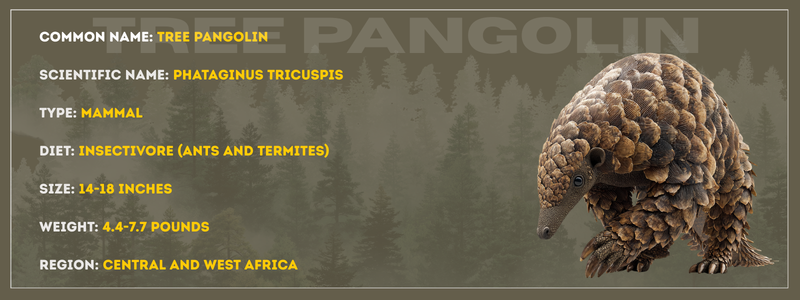
The Tree Pangolin is a medium-sized pangolin, with adults typically measuring between 14 and 18 inches in body length, plus a muscular prehensile tail that adds another 14 to 22 inches. Most adults weigh between 4.4 and 7.7 pounds, with females generally being lighter than males.
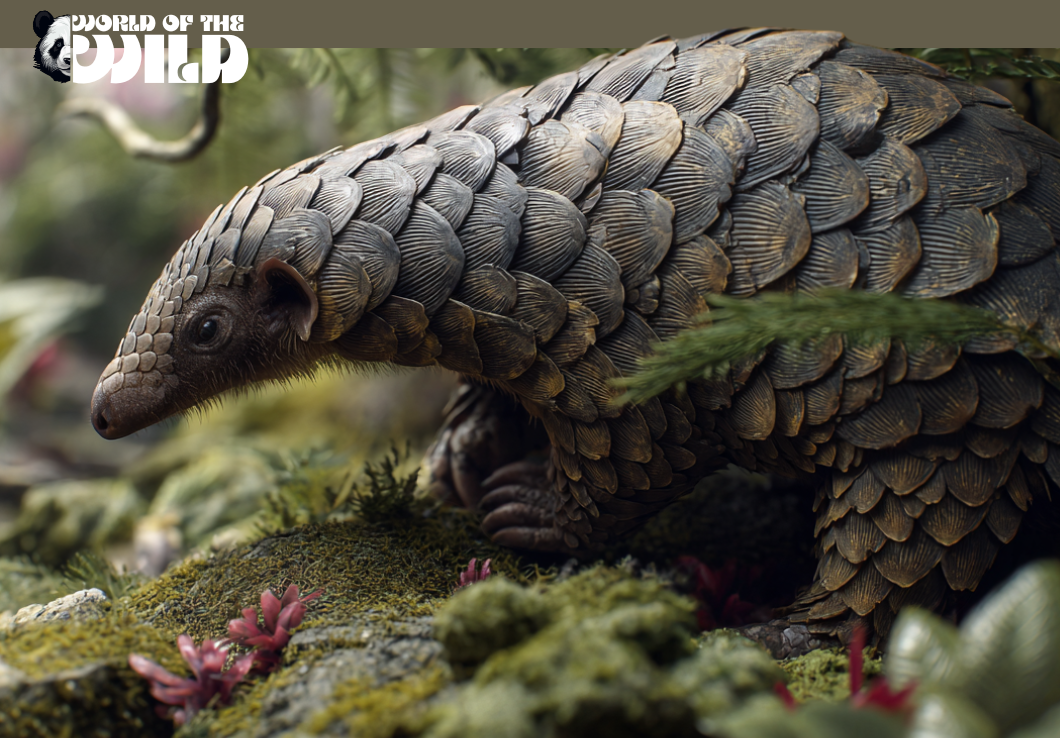
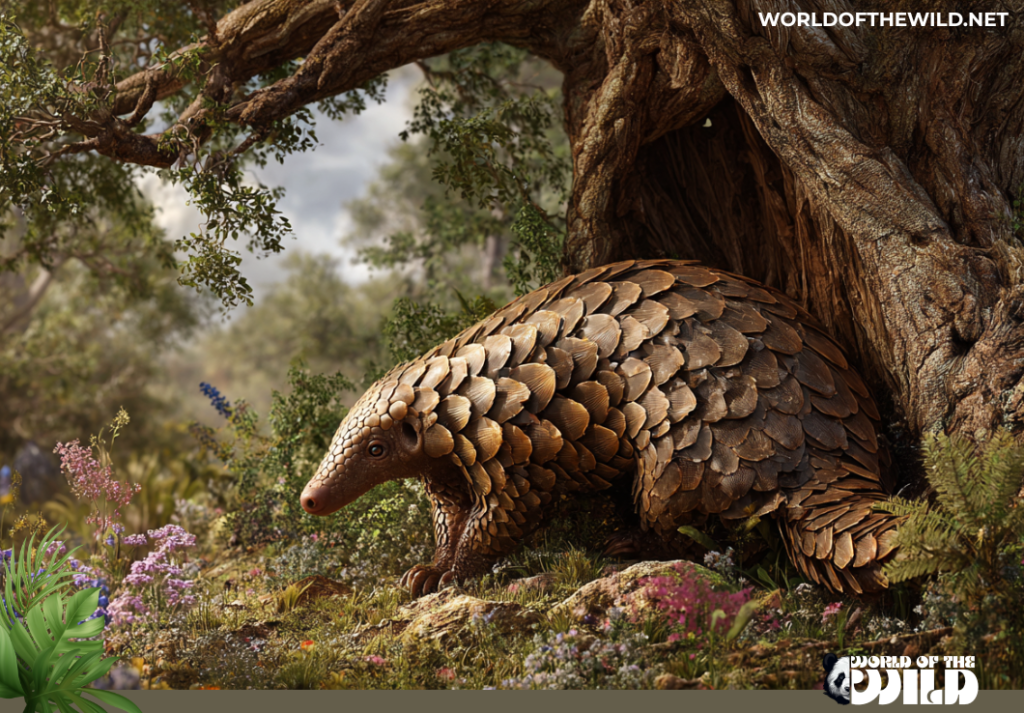
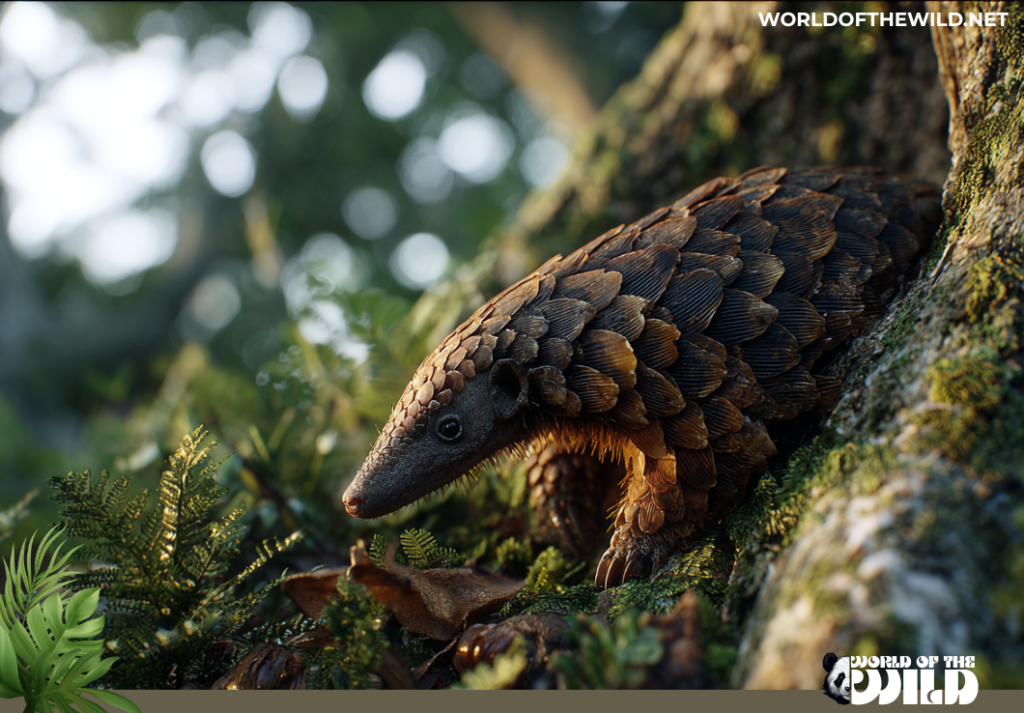
The most immediately striking feature is the pangolin’s armor. Overlapping rows of large, brownish-tan scales cover nearly every part of the animal’s body — the back, sides, top of the head, tail, and outer surfaces of the limbs. Each scale is roughly triangular and features three points along its lower edge, a characteristic reflected in the species name tricuspis, meaning “three-cusped.” The belly, inner legs, and face are covered not in scales but in sparse, coarse, pale hair that offers a striking contrast to the otherwise armored surface.
The head is small and tapered to a narrow, rounded snout, giving the pangolin an almost anteater-like profile. The eyes are small and dark, adapted for low-light vision, and protected by thick, reinforced eyelids. The nostrils are prominent and capable of being sealed shut. The legs are short and stocky, ending in powerful, curved claws — three on the front feet and five on the rear — that are ideal for gripping bark and ripping open insect nests.
The tail is perhaps the Tree Pangolin’s most distinctive structural adaptation among the pangolin family. It is fully prehensile, capable of wrapping tightly around branches to support the animal’s weight as it forages, and it acts as a counterbalance and anchor during vertical climbing. The underside of the tail tip is bare of scales, providing extra grip against smooth bark.
Behavior
The Tree Pangolin is a solitary, nocturnal animal. During the day, it rests curled in tree hollows, dense foliage, or occasionally in the forks of large branches. As darkness falls, it becomes active, moving methodically through the canopy and along the ground in search of ant and termite colonies.
Its movement on the ground is slow and distinctive. It walks on its knuckles with its front claws curled inward to protect them, a form of locomotion that gives it a rolling, almost awkward gait. In the trees, however, it is surprisingly capable, using its prehensile tail and strong claws to maneuver along branches with quiet confidence.
When threatened, the Tree Pangolin’s primary defense is to curl into a tight ball, tucking its vulnerable belly inward and presenting nothing but overlapping scales to a predator. This defense is so effective that lions, leopards, and hyenas have been observed giving up after failing to uncurl them. A secondary defense is the release of its pungent secretion from the anal glands, which deters most predators through smell alone.
The Tree Pangolin communicates through chemical signals more than any other sensory channel. Scent markings from the anal glands are left on trees, logs, and rocks to mark territories and convey reproductive status. Adults are generally silent, though young pangolins are known to emit soft, high-pitched calls when distressed. The species is not considered particularly intelligent in the cognitive sense compared to primates or corvids, but it demonstrates remarkable behavioral specialization — its entire sensory apparatus and physical toolkit are honed to a single purpose: finding and consuming social insects without getting stung, bitten, or detected.
Evolution
Pangolins represent one of the most ancient lineages of living placental mammals. Molecular clock studies suggest that their evolutionary lineage diverged from other mammals roughly 80 to 90 million years ago, during the late Cretaceous period — while dinosaurs were still walking the Earth.
For much of the 20th century, pangolins were grouped with anteaters, armadillos, and aardvarks based on their superficial resemblance — all are scale- or armor-bearing, toothless, and insect-eating. This grouping, called Edentata or Xenarthra, is now understood to be a classic case of convergent evolution, where unrelated animals independently evolved similar traits in response to similar ecological pressures. Modern genetic analysis firmly places pangolins in the superorder Laurasiatheria, making them distant relatives of carnivores such as cats, dogs, and seals — a relationship that would be impossible to guess from looking at them
The earliest definitive pangolin fossils, belonging to the extinct genus Eomanis, were discovered in Messel, Germany, and date to approximately 47 million years ago. These early pangolins were already strikingly similar to their modern descendants, suggesting that the pangolin body plan was highly successful and experienced relatively little change over tens of millions of years — a phenomenon known as evolutionary stasis or “living fossil” status.
The split between African and Asian pangolin lineages is estimated to have occurred between 30 and 40 million years ago, as the continents shifted and climates changed. The arboreal African species, including the Tree Pangolin, likely evolved their climbing specializations as the great equatorial rainforests of Africa expanded and diversified, offering a rich and relatively inaccessible food source in the forest canopy.
Habitat
The Tree Pangolin’s range spans a broad equatorial belt across sub-Saharan Africa, from Senegal and Gambia in the west, through the Congo Basin, and east to Uganda and western Kenya. Countries with significant Tree Pangolin populations include Cameroon, the Democratic Republic of the Congo, Gabon, Côte d’Ivoire, Ghana, Nigeria, and the Central African Republic.
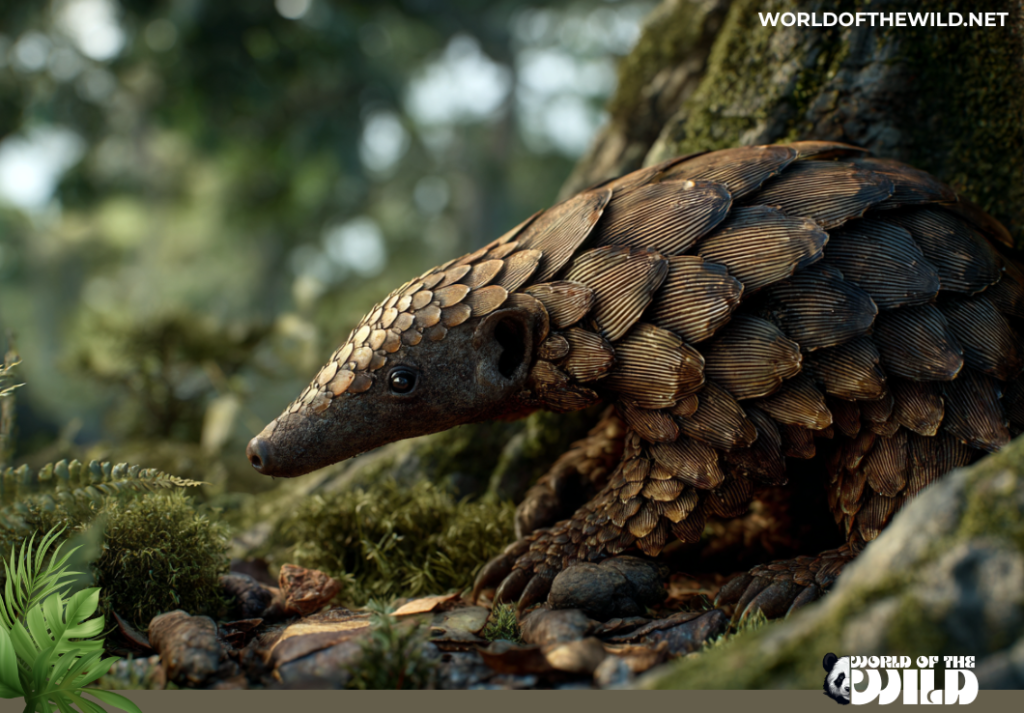
True to its name, the Tree Pangolin is fundamentally a forest animal. It is most strongly associated with lowland tropical rainforest — dense, humid, multi-layered forest characterized by a high closed canopy, abundant epiphytes, and a continuous supply of wood-nesting and ground-nesting ant and termite species. It is also found in riverine gallery forests, secondary growth forests that have been partially cleared and are regenerating, and forest-savanna mosaic zones where patches of woodland meet open grassland.
Altitude plays a role in its distribution as well. The Tree Pangolin is primarily a lowland species, most abundant below 3,300 feet in elevation, though it has been recorded at somewhat higher altitudes in suitable forest habitat. It appears to favor areas with older, larger trees that provide both roosting sites in natural hollows and a greater density of insect colonies in decaying wood and root systems.
Within its forest environment, the Tree Pangolin uses vertical space more extensively than most African mammals. It is as comfortable 30 feet up in the canopy as it is foraging along the forest floor, moving fluidly between layers depending on where insects are most abundant. Home range sizes are difficult to measure given the species’ nocturnal habits, but studies using radio telemetry suggest individual ranges of roughly 40 to 100 acres, with some overlap between individuals.
Diet
The Tree Pangolin is an insectivore with a diet that consists almost exclusively of ants and termites — two of the most abundant and nutritious insects on the African forest floor and canopy.
It locates prey primarily through its extraordinary sense of smell, which can detect the chemical signatures of active insect colonies through soil, bark, and rotting wood. Once a colony is found, the pangolin uses its powerful front claws to tear open the nest structure — whether a termite mound, a rotting log, a tree cavity, or an underground gallery system. The long, muscular, worm-like tongue is then extended repeatedly into the nest, withdrawing coated in a thick, sticky saliva to which hundreds of insects adhere with each pass.
A single feeding session can last anywhere from a few minutes to over an hour, and a Tree Pangolin may visit dozens of separate insect colonies in a single night. Estimates suggest that an adult pangolin consumes upwards of 70 million insects per year, making it one of the most ecologically significant insectivores in the African rainforest ecosystem.
Because it consumes such vast quantities of ants and termites, the Tree Pangolin plays a meaningful role in regulating insect populations and aerating soil through its digging activity. Some ecologists describe pangolins as the “ecosystem engineers” of their forest habitat, though this designation is rarely discussed in popular accounts of the species.
The pangolin does not drink water directly in the way most mammals do; it appears to derive sufficient moisture from the bodies of the insects it consumes, though it may occasionally lap up water from puddles or plant surfaces in particularly dry periods.
Predators and Threats
In its natural forest environment, the Tree Pangolin faces relatively few predators capable of overcoming its armored defenses. Large pythons, leopards, and lions are the most commonly cited natural predators, and even these formidable hunters typically find a curled pangolin impossible to attack effectively. Martial eagles and other large raptors may take young or small individuals caught in the open. For the most part, the Tree Pangolin’s scales and defensive curl make it largely predator-proof in a natural context.
The gravest threats facing the Tree Pangolin today are entirely human in origin, and they are severe enough that the species is classified as Vulnerable on the IUCN Red List, with populations declining sharply.
Poaching for the illegal wildlife trade is by far the most acute threat. Pangolin scales are in enormous demand in parts of Asia — particularly China and Vietnam — where they are used in traditional medicine, believed (without scientific evidence) to treat conditions ranging from skin disorders to lactation problems. Pangolin meat is also considered a delicacy and a status symbol in some regions. The global demand is so vast that all eight pangolin species are now listed under CITES Appendix I, providing the highest level of international trade protection, yet trafficking continues at alarming levels. Tens of thousands of pangolins are seized by authorities each year — representing only a fraction of the true number taken.
Habitat loss compounds the problem significantly. Across the Tree Pangolin’s range, rainforests are being cleared for agriculture, logging, charcoal production, and human settlement at an accelerating rate. As forest fragments, pangolin populations become isolated, reducing genetic diversity and making individuals easier to locate and trap. Bushmeat hunting, while secondary to the international trade in scale, remains a pressure in many parts of Central and West Africa where pangolin meat has been a traditional food source for centuries.
Reproduction and Life Cycle
Reproductive biology in the Tree Pangolin is still incompletely understood due to the difficulty of studying a nocturnal, solitary, forest-canopy animal. What is known comes from a combination of field observations, radio-telemetry studies, and records from animals held in rescue and rehabilitation centers.
Tree Pangolins do not appear to have a defined breeding season, and mating can occur at various times throughout the year. Males are thought to locate females through scent marking, following chemical trails left on bark and branches until they find a receptive female. Courtship is brief and relatively undramatic — the two animals interact for a short period before mating, after which the male and female separate and return to their solitary lives.
The gestation period is approximately 130 to 150 days, after which the female gives birth to a single offspring, called a pangopup. Twins are exceptionally rare. The pangopup is born with soft, pliable scales that begin hardening within its first few days of life. It weighs only a few ounces at birth and is completely dependent on its mother for warmth, transport, and protection.
The mother carries the young pangolin on the base of her tail, where the infant clings with its front claws. If the mother senses danger, she curls tightly around the pup, encasing it in her armored body and shielding it completely. The young pangolin nurses for approximately three to four months, though it begins sampling insects under its mother’s guidance well before weaning is complete.
Juveniles remain with their mother for several months after weaning, gradually learning foraging routes and techniques before dispersing to establish their own home ranges. Sexual maturity is reached at roughly two years of age. In the wild, Tree Pangolins are estimated to live between 10 and 20 years under optimal conditions, though many do not survive to their full potential lifespan due to poaching and habitat pressures.
Population
The Tree Pangolin is currently listed as Vulnerable on the IUCN Red List of Threatened Species, with a population trend assessed as decreasing. It is one of the more common pangolin species within its range, which partially explains why it is also one of the most heavily targeted — it is simply encountered more often than its rarer relatives.
Reliable global population estimates for the Tree Pangolin do not exist. The species’ nocturnal habits, dense forest habitat, and secretive behavior make census work extraordinarily difficult. What wildlife surveys do indicate is that populations have declined significantly across much of the western portion of the range, particularly in West Africa, where deforestation and hunting pressure are most intense. Central African populations — particularly in the Congo Basin — are thought to be relatively more intact, though they too face mounting pressure.
In countries where wildlife enforcement is strong and forest cover remains relatively high, local populations can still be reasonably healthy. Gabon, with its low human population density and large protected forest areas, is considered one of the most important strongholds for Tree Pangolins in Africa. By contrast, populations in Nigeria, Ghana, and Côte d’Ivoire have declined dramatically over the past few decades.
International attention to the pangolin’s plight has grown considerably since the 2010s, with NGOs, governments, and researchers dedicating increasing resources to anti-poaching efforts, community education, and captive care research. The Tree Pangolin remains a deeply challenging animal to keep in captivity, which limits the potential for captive breeding programs as a conservation backstop — making the protection of wild populations and their forest habitats the only truly viable path forward.
Conclusion
The Tree Pangolin is, in every sense, a marvel of natural history. It carries within its ancient body a lineage that stretches back to the age of dinosaurs, a suite of adaptations so refined they border on the extraordinary, and a quiet ecological role that keeps the forests of Central Africa in balance. It is armored like a knight, armed with a tongue like a fishing line, and has survived every extinction event the Earth has thrown at it — until now.
What it cannot survive, it seems, is us.
The story of the Tree Pangolin is ultimately a story about the cost of indifference — the cost of allowing a black market to consume a species into oblivion for the sake of a traditional medicine with no scientific basis, or a luxury meal that could be replaced by anything else on the menu. Every pangolin scale seized at a port, every forest cleared for a palm oil plantation, every night a poacher moves unchallenged through the canopy — these are choices, and they have consequences.
The Tree Pangolin has endured 80 million years on this planet. Whether it endures the next 80 years depends entirely on the choices we make now. Support organizations working to end the illegal wildlife trade. Advocate for the protection of Central African rainforests. Spread the word about this improbable, irreplaceable creature. The pangolin has survived everything nature has thrown at it — it deserves the chance to survive us, too.
Quick Reference
| Detail | Information |
|---|---|
| Scientific Name | Phataginus tricuspis |
| Diet Type | Insectivore (ants and termites) |
| Body Length | 14–18 inches (plus 14–22 inch tail) |
| Weight | 4.4–7.7 pounds |
| Region Found | Central and West Africa (Senegal to Uganda and western Kenya) |