
Picture this: the African savanna at dusk. The last embers of sunlight dissolve into the horizon, and from somewhere in the tall grass comes a sound that raises the hairs on the back of your neck — a rising, echoing whoop, followed by something disturbingly close to laughter. Most people feel a primal unease at the noise. They shouldn’t. What they’re hearing is one of nature’s most sophisticated, resilient, and frankly remarkable creatures: the Spotted Hyena.
For centuries, the spotted hyena has been saddled with a reputation it doesn’t deserve. Villainized in folklore, dismissed as a cowardly scavenger, and cast as the snarling villain in popular culture, this extraordinary animal is in reality one of Africa’s most successful and ecologically vital predators. It is more intelligent than a chimpanzee in certain cognitive tests, more socially complex than a wolf pack, and a more effective hunter than a lion. It is time to set the record straight.
The spotted hyena is not simply interesting — it is astonishing. From its bizarre and unique reproductive biology to its ability to digest bone, antlers, and hooves that would defeat any other mammal’s stomach, the spotted hyena represents one of evolution’s most finely tuned experiments in survival. Understanding this animal means understanding something fundamental about life on Earth: that adaptation, not elegance, is what endures.
Facts
Here are seven surprising facts about the spotted hyena that challenge everything you think you know:
- They are more closely related to cats than dogs. Despite looking and behaving superficially like canids, hyenas belong to the suborder Feliformia — making them closer kin to cats, mongooses, and civets than to wolves or wild dogs.
- Females are bigger, stronger, and socially dominant. In hyena society, females outrank every male. A low-ranking female is still dominant over the highest-ranking male, and female cubs inherit rank just below their mother’s from the moment they are born.
- Their stomach acid is so potent it can dissolve bone. Spotted hyenas consume — and fully digest — bones, horns, hooves, and even teeth. Their highly acidic digestive systems extract nutrients other predators leave behind, making them extraordinarily efficient feeders.
- They are accomplished hunters, not just scavengers. Studies conducted in the Serengeti showed that spotted hyenas kill up to 95% of the food they eat themselves. The scavenger label is largely a myth born from daytime observations; hyenas do most of their hunting under cover of darkness.
- Their “laugh” is a complex communication signal. The iconic giggle of a spotted hyena is not an expression of joy — it conveys information about the hyena’s age, social rank, and current emotional state. Scientists have identified at least eleven distinct vocalizations in their repertoire.
- Female spotted hyenas give birth through a pseudo-penis. Females possess an enlarged, elongated clitoris — nearly indistinguishable from a male’s penis — through which they urinate, mate, and give birth. This anatomy is unique among mammals and makes childbirth extraordinarily dangerous.
- They outperform primates on certain intelligence tests. Research comparing spotted hyenas to chimpanzees on cooperative problem-solving tasks found that hyenas solved the puzzles more quickly and with greater social coordination, without the trial-and-error aggression chimps often displayed.
Species
The spotted hyena belongs to the following taxonomic classification:
- Kingdom: Animalia
- Phylum: Chordata
- Class: Mammalia
- Order: Carnivora
- Family: Hyaenidae
- Genus: Crocuta
- Species: Crocuta crocuta
The spotted hyena is the sole living member of the genus Crocuta, making it a genuinely unique animal with no close living relative at the genus level. However, it shares the family Hyaenidae with three other surviving species, each occupying a very different ecological and behavioral niche.
The Striped Hyena (Hyaena hyaena) is a smaller, more solitary species found across North Africa, the Middle East, and South Asia. It is predominantly a scavenger and lacks the complex social structure of its spotted cousin. The Brown Hyena (Parahyaena brunnea), found in southern Africa, is another shy, largely solitary species with a shaggy, dark coat that is adapted to arid environments. Finally, the Aardwolf (Proteles cristata) is perhaps the family’s greatest surprise — a delicate, insectivorous hyena that feeds almost exclusively on termites and could not look or behave less like what most people imagine when they hear the word “hyena.”
Among spotted hyenas themselves, some researchers have historically recognized regional subspecies, including East African and West African populations that show subtle morphological differences. However, most current taxonomic authorities treat Crocuta crocuta as a single species without formally recognized subspecies.
Appearance
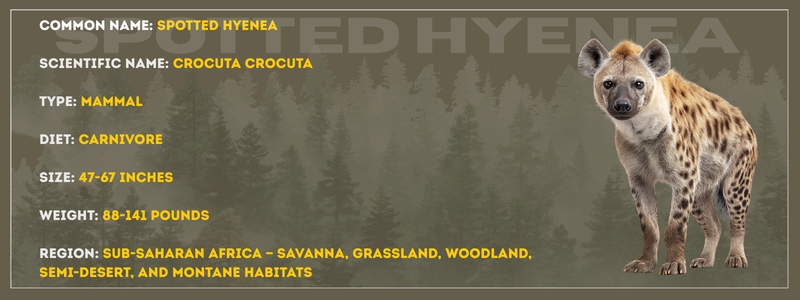
The spotted hyena is a powerfully built animal whose physical form is a masterclass in functional design. Adults typically measure between 47 and 67 inches in body length, not including the tail, with a shoulder height of around 28 to 35 inches. Females, due to the species’ pronounced reverse sexual dimorphism, are notably larger than males, weighing between 110 and 141 pounds compared to males at 88 to 121 pounds.
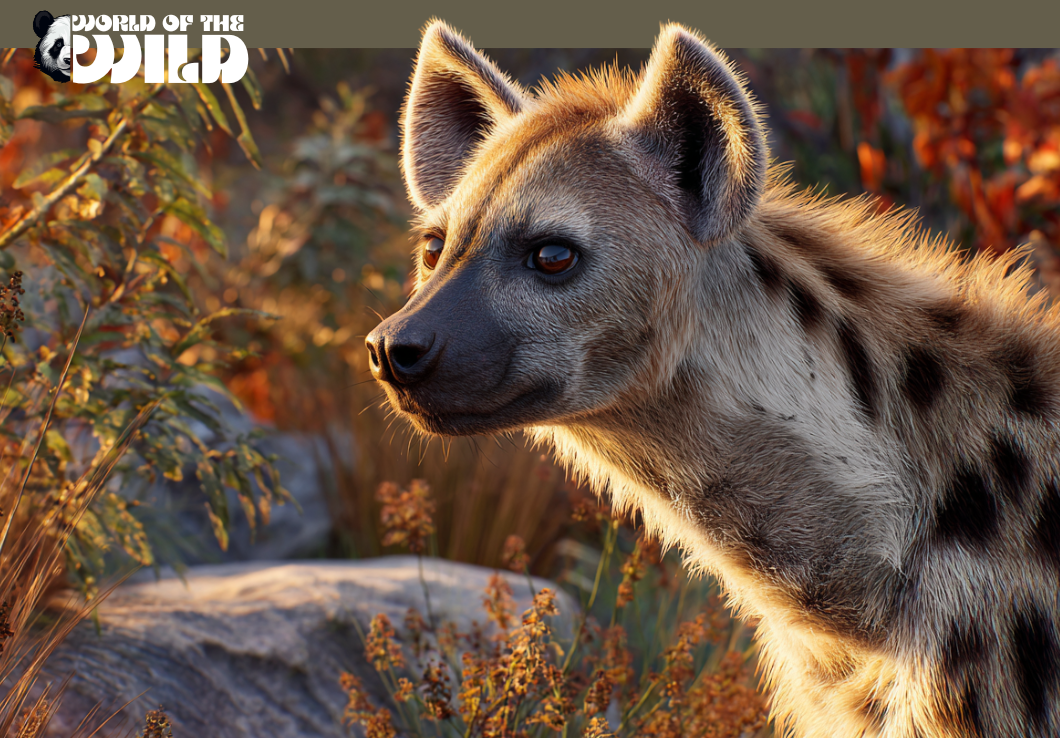
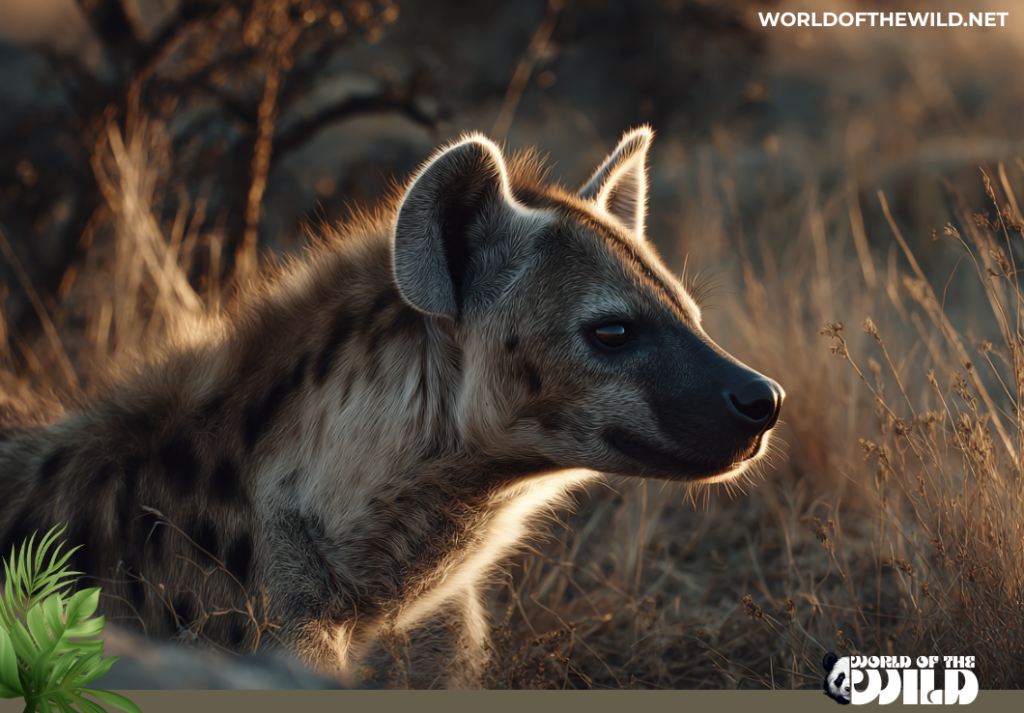
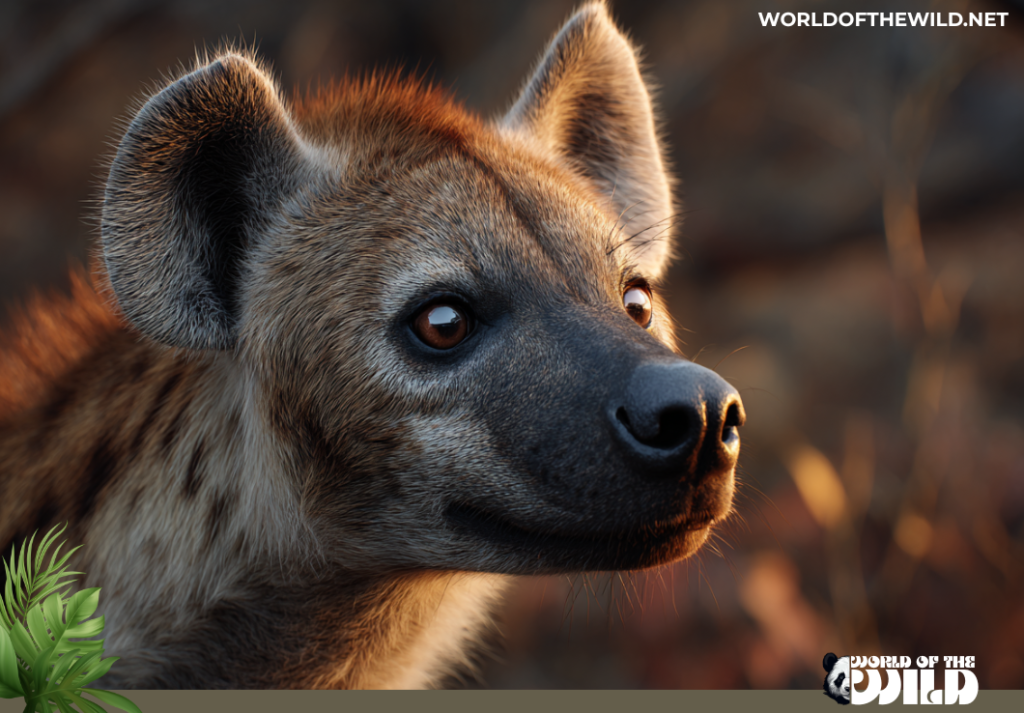
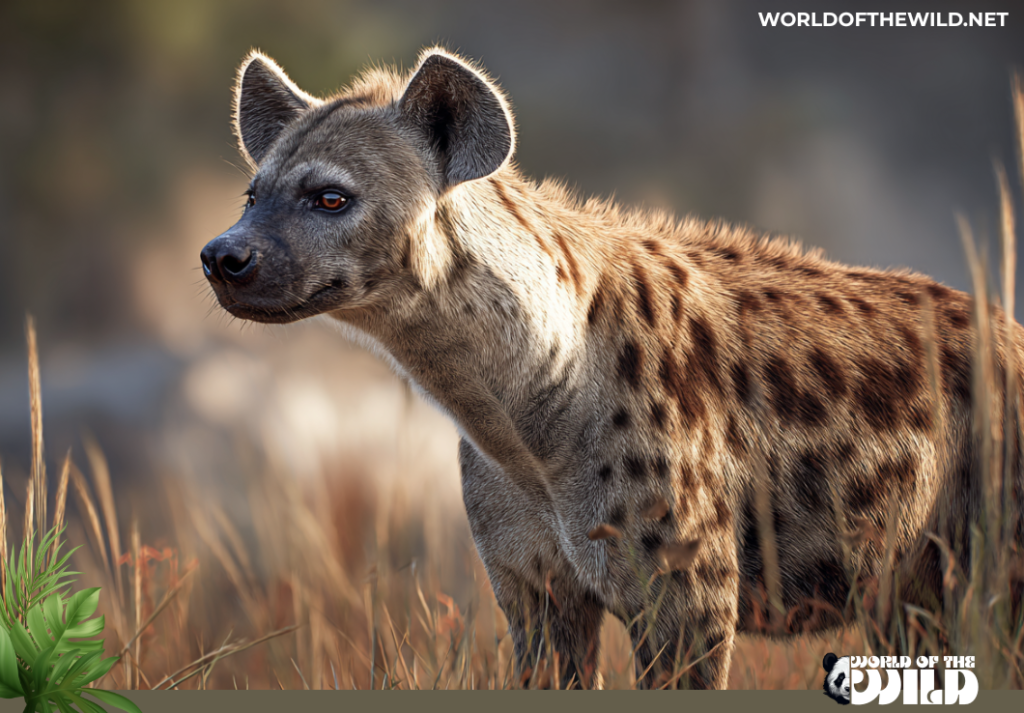
The coat is short and coarse, varying in color from sandy buff to pale yellowish-gray or tawny brown, covered with irregularly shaped dark brown or black spots scattered across the body and upper limbs. The spots tend to become less distinct with age, and older individuals may appear quite faded. The muzzle is broad, blunt, and powerfully muscled — built for gripping and crushing rather than speed or precision.
One of the spotted hyena’s most immediately recognizable features is its silhouette. The front legs are noticeably longer than the rear legs, giving the animal a characteristic sloping back that slopes steeply downward toward the hindquarters — a posture that is instantly recognizable even at great distance. The neck is thick and heavily muscled, capable of lifting and carrying carcasses far heavier than the hyena itself.
The ears are rounded rather than pointed, which distinguishes the spotted hyena from its striped relative, and the tail is relatively short with a bushy black tip. Around the neck and shoulders, the fur is slightly longer and can be raised into a rough mane when the animal is excited or threatened, adding to its imposing appearance.
Behavior
Spotted hyenas are highly social animals that live in structured groups called clans, which can range in size from a handful of individuals to as many as 80 members in prey-rich areas. These clans are organized around a strict, linear dominance hierarchy headed by a dominant female — the matriarch — and her offspring. Social rank is everything in hyena society; it determines feeding priority, access to mates, reproductive success, and even survival during lean times.
Despite their reputation for aggression, hyenas invest heavily in social bonds. Clan members greet one another with elaborate rituals involving sniffing, mutual inspection of the genital area (the famous “greeting ceremony”), and vocalizations. These interactions reinforce relationships, establish hierarchy, and reduce tension within the group. Hyenas that share stronger social bonds cooperate more effectively during hunts and territorial disputes.
Communication in spotted hyenas is extraordinarily rich. Their repertoire spans at least eleven distinct vocalizations, including the famous “whoop” — a long-distance contact call that carries for miles across open terrain — as well as growls, grunts, yells, groans, and the “giggle” that gave rise to their nickname, the laughing hyena. The giggle is typically heard when an animal is under stress or being chased and communicates submission or frustration rather than amusement.
Spotted hyenas are predominantly nocturnal but are not exclusively so, and they are frequently active during cooler hours at dawn and dusk. During the heat of the day, they rest in shallow pools, beneath shade trees, or in dens. Their dens — often old aardvark burrows or natural rock crevices — serve as social hubs where cubs are raised communally.
Cognitively, spotted hyenas are among the most impressive non-primate mammals on the planet. They track the individual identities, social relationships, and recent behavioral history of every member of their clan. They demonstrate flexible problem-solving, can use social information to update their understanding of a situation, and outperform many primates on cooperative tasks that require inhibiting individual impulses in favor of coordinated group action.
Evolution
The hyena family has a rich and ancient evolutionary history that stretches back approximately 26 million years to the late Oligocene and early Miocene epochs of Europe and Asia. The earliest hyenids were small, civet-like, forest-dwelling carnivores that bore little resemblance to the animals we know today. Over millions of years, the lineage diversified dramatically.
During the Miocene, a diverse array of hyena species populated Europe, Asia, and Africa. Some were dog-like runners; others were bone-crushing specialists. The famous “bone-crushing” ecological role — which today’s spotted hyena occupies so effectively — was actually pioneered by the genus Pachycrocuta, particularly the massive Pachycrocuta brevirostris, sometimes called the Giant Hyena, which was roughly the size of a modern lion and lived across Eurasia and Africa from about 3 million to 500,000 years ago.
The genus Crocuta itself appears in the fossil record during the Pliocene. Intriguingly, spotted hyenas once had a vastly larger range than they do today. During the Pleistocene, Crocuta crocuta — or its immediate ancestors — roamed across Europe, Asia, and the Arctic, coexisting with cave bears, woolly mammoths, and early humans. Cave hyenas left their marks — gnawed bones and hyena den fossils — across Europe as far north as Britain.
The retreat of spotted hyenas to sub-Saharan Africa appears to have been driven by a combination of climate change at the end of the last ice age, competition with other predators, and possibly pressure from expanding human populations. The modern spotted hyena is thus the survivor of a once-global lineage, now confined to a fraction of its former range.
Habitat
The spotted hyena is one of Africa’s most geographically widespread and ecologically flexible large carnivores. Its range spans sub-Saharan Africa from Senegal and Mauritania in the west across to Ethiopia and Somalia in the east, and down through East Africa to South Africa, though its distribution is increasingly fragmented due to human encroachment.
Unlike many large predators that are tightly tied to specific biomes, spotted hyenas are habitat generalists with impressive adaptability. They thrive in open and semi-open environments, and they are found across a broad range of ecosystems including savanna grasslands, open woodland, scrubland, thornbush, rocky semi-desert, and montane habitats up to altitudes of 13,000 feet in the Ethiopian highlands.
Within these environments, hyenas rely on a combination of availability of prey, access to water (though they can survive in surprisingly arid conditions), and the presence of suitable denning sites. The classic spotted hyena habitat is the East African savanna — vast, prey-rich plains like the Serengeti and Masai Mara — where large migratory herds of wildebeest and zebra provide abundant food year-round. However, hyenas are equally at home in the Kalahari scrubland, the highlands of Ethiopia, and the mopane woodlands of southern Africa.
Territories vary enormously in size depending on prey density. In productive savannas, a clan’s territory may cover only 15 to 40 square miles, while in arid environments with sparse prey, the same clan might patrol a territory ten times that size.
Diet
Spotted hyenas are carnivores and among the most versatile and effective hunters on the African continent. While popular culture has long painted them as skulking scavengers that steal the hard-won kills of lions, the reality is far more impressive. Research across multiple study sites consistently shows that spotted hyenas are active, highly skilled hunters that kill the majority of their own food.
Their primary prey consists of large and medium-sized ungulates — wildebeest, zebra, Thomson’s gazelle, topi, and various antelope species. Hunting strategies vary. Solo hyenas typically target smaller prey; clan groups coordinate powerful pursuit hunts that can bring down adult wildebeest, young buffalo, and even adult zebra. Their endurance is formidable — they can maintain a chase at speeds of up to 37 miles per hour for several miles, outlasting prey through sheer persistence.
What truly sets spotted hyenas apart in the predator guild is what happens after the kill. Unlike lions or leopards, which leave behind substantial portions of a carcass, spotted hyenas consume virtually everything — meat, skin, viscera, and bone. Their extraordinarily strong jaws (among the most powerful relative to body size of any land mammal) and highly acidic digestive systems allow them to process and extract nutrition from bone that other predators cannot, including the nutrient-rich marrow inside. The characteristic white, chalky appearance of hyena droppings is calcium phosphate residue from digested bone.
They are also opportunistic, and when prey is scarce or easily available carrion presents itself, spotted hyenas will absolutely scavenge. This flexibility — not laziness or cowardice — is the true source of their enduring success.
Predators and Threats
Natural Predators
Adult spotted hyenas are powerful, dangerous animals with few natural predators. The primary threat from other species comes from lions (Panthera leo), with whom hyenas share habitat across much of their range and maintain one of the most well-documented and intense interspecies rivalries in the animal kingdom. Lions kill hyenas opportunistically, particularly when hyenas are alone or caught vulnerable near a carcass. Spotted hyenas reciprocate, mobbing and harassing lions and occasionally killing cubs. This relationship is not simply predator and prey — it is a dynamic, ongoing competition for food, territory, and dominance that has shaped the behavior of both species over evolutionary time.
Nile crocodiles and African rock pythons occasionally take hyenas that venture too close to water, and young cubs are vulnerable to a wider range of threats including leopards, wild dogs, martial eagles, and even adult male lions. However, the clan’s cooperative defense system and the ferocity of female hyenas in defense of their cubs reduce cub mortality significantly under normal conditions.
Human-Caused Threats
The most significant threats to spotted hyenas today are entirely human-made, and they are severe. Habitat loss and fragmentation driven by agricultural expansion, human settlement, and infrastructure development has reduced and broken up the vast wilderness areas hyenas need to support viable populations. As their habitat shrinks, hyenas increasingly come into contact with human communities and livestock.
Human-wildlife conflict is perhaps the most acute immediate threat. Spotted hyenas do occasionally prey on livestock, and across Africa they are widely and intensely persecuted by farmers and pastoralists in response. They are shot, poisoned, snared, and trapped in enormous numbers. In some regions, cultural beliefs and superstitions about hyenas contribute to targeted killing.
Trophy hunting and bushmeat trade affect hyena populations in some areas, as do road collisions in landscapes increasingly bisected by roads and highways. Spotted hyenas are also susceptible to canine distemper and rabies, diseases that can sweep through entire clans, and these may be exacerbated by contact with domestic dogs at the margins of human settlements.
Reproduction and Life Cycle
Reproduction in spotted hyenas is unlike that of virtually any other mammal on Earth, largely because of the female’s extraordinary anatomy. Females possess a pseudo-penis — a fully elongated clitoris up to seven inches in length that is nearly identical in external appearance to the male’s organ. There is no external vaginal opening; urine is excreted, copulation occurs, and birth takes place through this single structure.
Mating in spotted hyenas is a logistically challenging affair that requires the full cooperation of the female. Given her anatomy and social dominance, females exert complete control over reproduction and can — and do — refuse any male they choose. Dominant females tend to mate with immigrant males from outside the clan, potentially as a mechanism to avoid inbreeding.
Gestation lasts approximately 110 days. Litters consist of one to three cubs, though two is most common. Cubs are born remarkably precocial — unlike most carnivores, spotted hyena cubs emerge with their eyes open and their milk teeth fully erupted. Litters born with two or more same-sex cubs face an immediate and often lethal challenge: sibling rivalry. Dominant cubs may kill subordinate siblings within days of birth, a practice driven by competition for access to the mother’s milk. This behavior is particularly pronounced in female-female twin pairs.
Cubs are raised in communal dens, often in large groups called “cub crèches.” Mothers are the sole providers of care — male hyenas play no paternal role in cub rearing. Nursing continues for a remarkably long period of up to 18 months, one of the longest lactation periods of any carnivore, reflecting the difficulty of the birth process and the investment already made. Cubs begin joining hunts and eating meat at around one year but remain with their natal clan for several years before females establish their adult rank and males typically disperse to seek acceptance in a new clan.
In the wild, spotted hyenas live for approximately 12 years on average, though individuals in protected areas have been documented surviving to 22 years or more. In captivity, lifespans of 25 years have been recorded.
Population
The spotted hyena is currently classified as Least Concern on the IUCN Red List of Threatened Species, a status that reflects its relative abundance compared to many other large African carnivores. Global population estimates place the total number of wild spotted hyenas at approximately 27,000 to 47,000 individuals, making it the most numerous large carnivore in Africa.
However, the “Least Concern” classification should not inspire complacency. Population trends are declining across much of the species’ range, and the distribution of spotted hyenas has contracted significantly from its historical extent. Populations outside formally protected areas — national parks, game reserves, and wildlife conservancies — are under serious pressure from habitat loss and persecution. In West Africa in particular, spotted hyena populations have become severely fragmented and depleted.
Inside major protected areas such as the Serengeti, Kruger, Masai Mara, and Hwange, spotted hyena populations remain relatively stable and healthy, underscoring the critical importance of protected area networks for the species’ long-term viability. The picture outside these refuges is considerably less reassuring.
Conclusion
The spotted hyena is, in every measurable sense, one of Africa’s most extraordinary animals. It is a devoted mother who nurses her young for longer than almost any other carnivore. It is a cognitive powerhouse that solves problems lions cannot. It is an ecological engineer whose bone-crushing ability recycles nutrients back into the soil and whose population dynamics shape the behavior of every large predator it shares its landscape with. And it does all of this while carrying the weight of one of the most unfair reputations in the animal kingdom.
Every time a spotted hyena is poisoned over a livestock kill, every time its habitat is carved up for a new settlement, and every time it is dismissed as a cowardly scavenger rather than the remarkable predator it truly is, we lose something we may not fully appreciate until it is gone. Africa without the laughing hyena would be a quieter, impoverished continent — ecologically poorer and experientially diminished.
The spotted hyena’s future depends on the same thing its present depends on: space to roam, prey to hunt, and the grudging respect of the most powerful predator it has ever had to compete with — us. Learning to see this animal clearly, without the distorting lens of myth and mischaracterization, is not just an act of intellectual honesty. It is the first step toward making the right choices for its survival.
Listen carefully the next time the whooping call carries across the African night. That is not the sound of something menacing. That is the sound of something ancient, intelligent, and magnificent — asking, in its way, to be left alone to thrive.
Quick Reference
| Attribute | Details |
|---|---|
| Scientific Name | Crocuta crocuta |
| Diet Type | Carnivore (active hunter and opportunistic scavenger) |
| Body Length | 47 – 67 inches |
| Shoulder Height | 28 – 35 inches |
| Weight | 88 – 141 pounds (females larger than males) |
| Region Found | Sub-Saharan Africa — savanna, grassland, woodland, semi-desert, and montane habitats |