
There is a moment — familiar to anyone who has spent time wading through Florida’s cypress swamps or picking their way along a blackwater creek — when the water seems to shift. A thick, dark shape glides along the surface with an almost preternatural stillness, head held just above the waterline, body barely disturbing the tea-colored water. Then it stops. And it opens its mouth.
That flash of brilliant white is not a threat. It is a warning — and one of the most iconic displays in all of North American wildlife. The Florida Cottonmouth (Agkistrodon conanti) is a snake that has earned its fearsome reputation, but beneath the mythology and the mistaken identities lies one of the most ecologically vital, behaviorally fascinating, and evolutionarily remarkable animals in the American Southeast. It is a creature simultaneously dreaded and misunderstood, persecuted by the uninformed and celebrated by herpetologists and naturalists alike. To truly know the Florida Cottonmouth is to appreciate the raw elegance of a perfectly adapted predator — one that has patrolled the wetlands of the Sunshine State for millions of years and shaped the ecosystems it inhabits in ways most people never consider.
Facts
- The name “cottonmouth” comes directly from the snake’s defensive display: when threatened, it coils, vibrates its tail, and gapes its mouth wide open to reveal the brilliant white interior — a behavior known as open-mouth gaping or threat yawning.
- Unlike most snakes, Florida Cottonmouths are capable swimmers and will actively pursue prey underwater, holding their breath and ambushing fish and frogs beneath the surface.
- Cottonmouths are one of the only venomous snakes in the world that are semiaquatic, spending substantial portions of their lives both in and out of water.
- They possess heat-sensing pit organs located between the eye and nostril on each side of the head — specialized nerve-filled cavities that detect infrared radiation, allowing them to locate warm-blooded prey in complete darkness.
- Florida Cottonmouths have been documented eating other venomous snakes, including Eastern Copperheads and even smaller cottonmouths, making them broadly opportunistic — and occasionally cannibalistic — hunters.
- Their venom contains hemotoxic and cytotoxic compounds that destroy red blood cells and tissue, but fatalities from cottonmouth bites in humans are extremely rare; the vast majority of bites occur when people accidentally step on the snake or attempt to handle it.
- Cottonmouths are viviparous — they give birth to live young rather than laying eggs — and neonates are born fully venomous and independent from their first breath.
Species
The Florida Cottonmouth belongs to the following taxonomic hierarchy:
- Kingdom: Animalia
- Phylum: Chordata
- Class: Reptilia
- Order: Squamata
- Family: Viperidae
- Genus: Agkistrodon
- Species: Agkistrodon conanti
For much of the 20th century, the Florida Cottonmouth was considered a subspecies of the Water Moccasin (Agkistrodon piscivorus), and was designated Agkistrodon piscivorus conanti in honor of herpetologist Roger Conant. However, genetic and morphological studies conducted in the early 2010s led to its elevation as a distinct species: Agkistrodon conanti.
The genus Agkistrodon contains several closely related North American pit vipers. The Eastern Copperhead (Agkistrodon contortrix) and the Broad-banded Copperhead (Agkistrodon laticinctus) are the Florida Cottonmouth’s closest relatives, sharing similar venom chemistry, pit organ anatomy, and viviparous reproduction. The Northern Water Moccasin (Agkistrodon piscivorus) — with which the Florida Cottonmouth was long synonymized — overlaps in range in northern Florida and the panhandle, and the two species may hybridize in narrow contact zones. The Florida Cottonmouth’s range is entirely within the Florida peninsula and surrounding coastal regions, making it one of the most geographically circumscribed venomous snakes in the United States.
Appearance
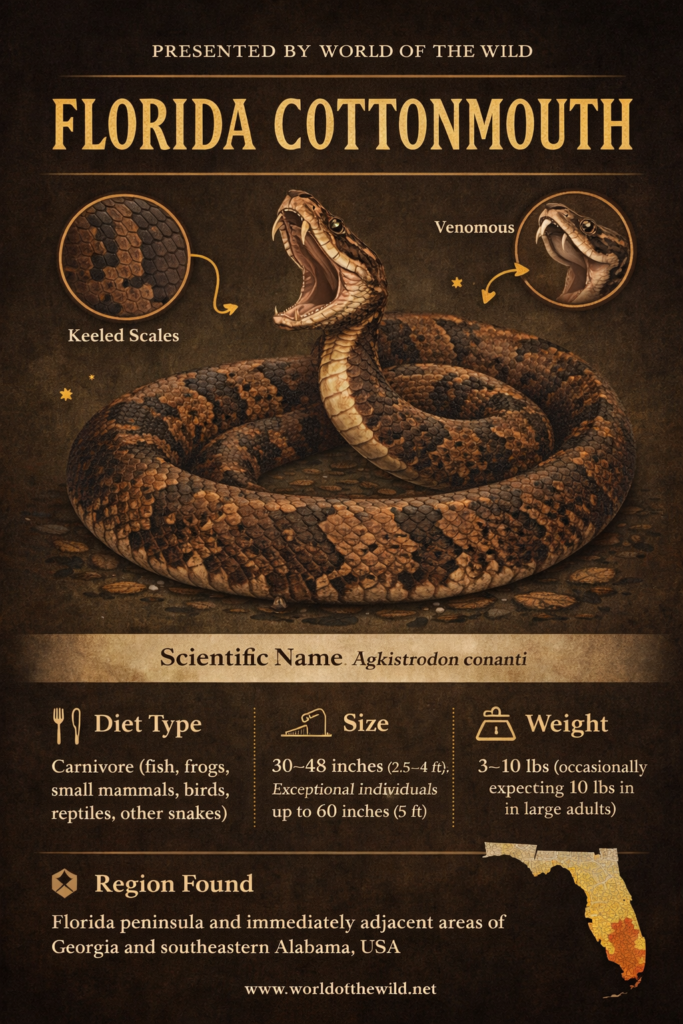
The Florida Cottonmouth is a powerfully built, heavy-bodied snake that commands attention. Adults typically range from 30 to 48 inches in total length, though exceptional individuals can exceed 60 inches (5 feet). Females tend to be slightly smaller than males on average, though large females are common. In terms of body mass, adults typically weigh between 3 and 10 pounds, with the largest individuals occasionally exceeding that range.
Coloration in the Florida Cottonmouth varies considerably with age. Juveniles are strikingly patterned — boldly banded with reddish-brown or chestnut crossbands on a lighter tan or brownish-gray background, with a bright yellow tail tip that they use as a lure to attract prey, a behavior known as caudal luring. As the snake matures, this patterning gradually darkens and obscures. Adult Florida Cottonmouths are often uniformly dark — nearly black or dark brown — with the juvenile banding becoming increasingly faint or invisible, particularly in older, larger individuals.
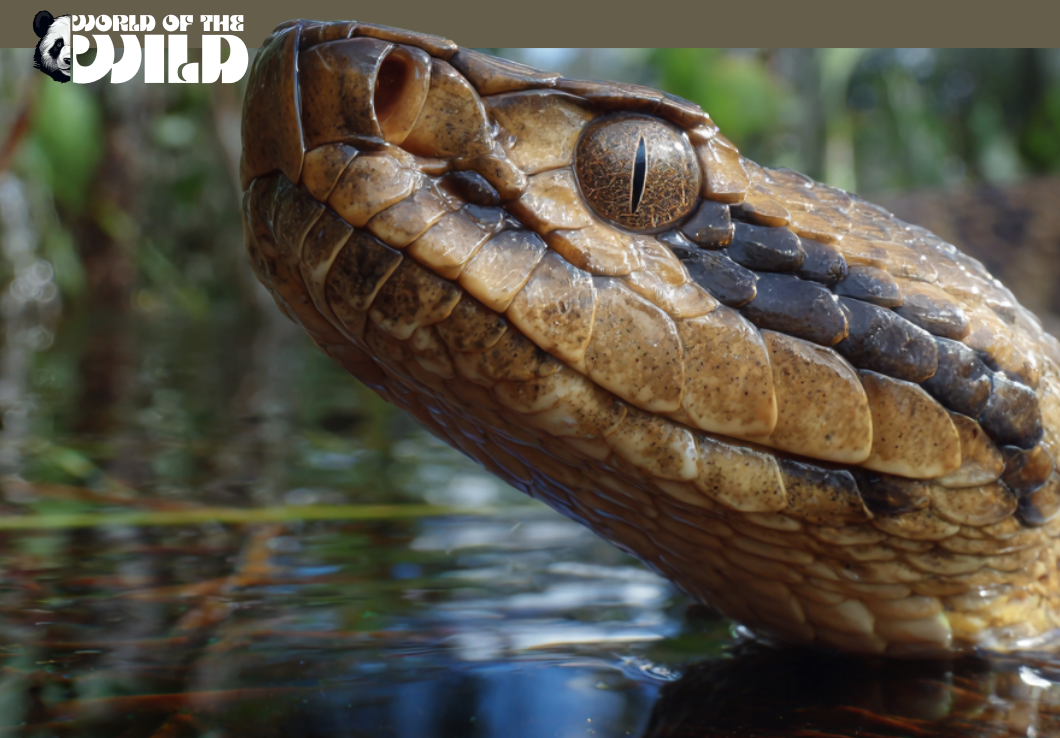
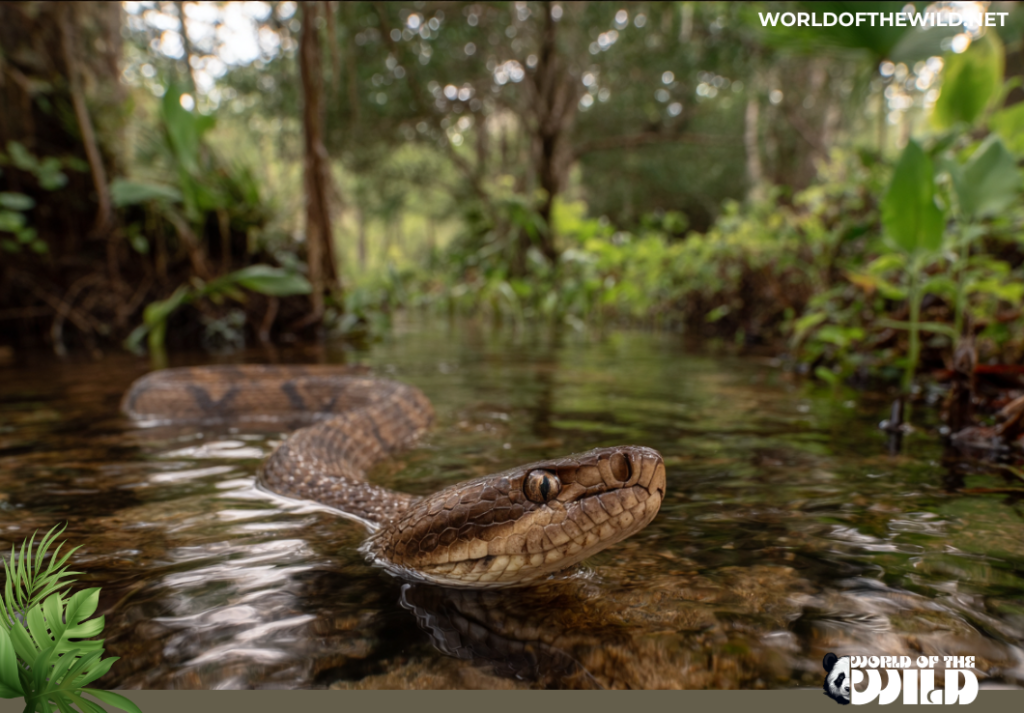
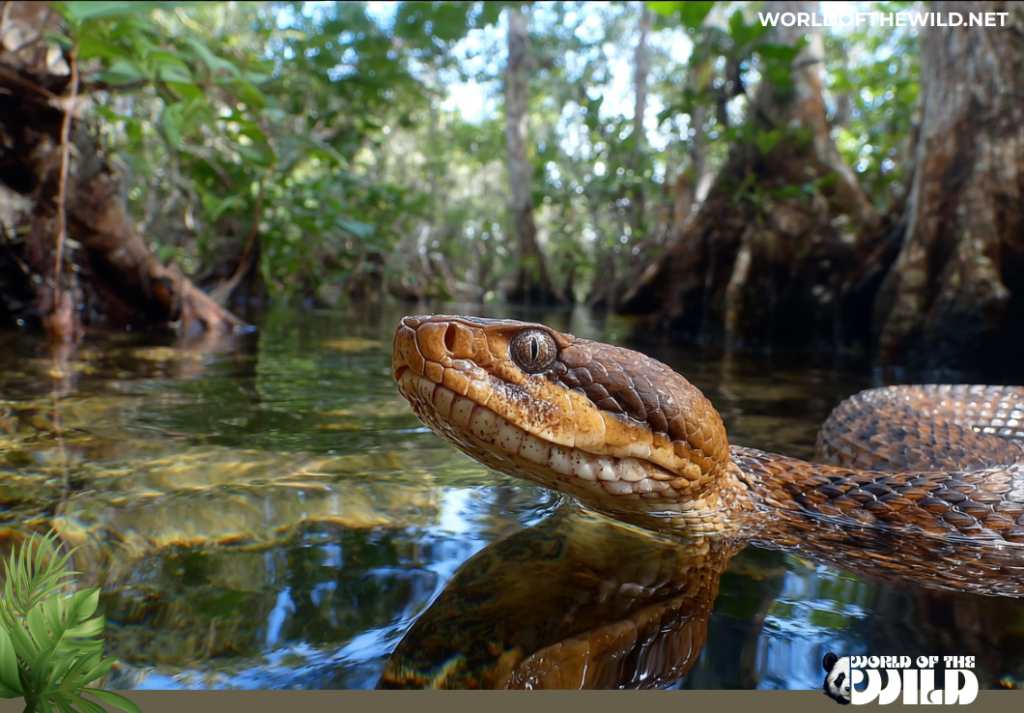
Several physical features immediately distinguish the cottonmouth from the many harmless water snakes with which it is frequently confused. The head is broad, triangular, and distinctly wider than the neck, a characteristic of most viperids. The pupils are elliptical (cat-like), rather than the round pupils of non-venomous species. The face features the signature heat-sensing pit organs between eye and nostril, and the jowls are notably thick and muscular from the large venom glands housed within. The body is keeled — each scale has a central ridge — giving the skin a rough, matte texture rather than a glossy sheen. When swimming, cottonmouths hold their entire body near the surface, with much of the body riding above the waterline — a behavior that distinguishes them from non-venomous water snakes, which tend to swim with only their head above water.
Behavior
The Florida Cottonmouth is primarily a solitary, ambush predator, spending much of its time motionless at the water’s edge, among vegetation, or partially submerged, waiting for prey to come within striking distance. Despite a reputation for aggression, cottonmouths are fundamentally defensive animals. The overwhelming majority of threatening encounters are the result of the snake feeling cornered, stepped on, or directly approached.
Their most iconic behavior is the defensive gape display — coiling the body, vibrating the tail, and holding the mouth wide open to expose the white oral lining. This display is a last resort before striking, giving potential threats every opportunity to back away. Many cottonmouths, when given space, will simply slide into the water and disappear.
Cottonmouths are primarily nocturnal during the hot summer months, becoming most active after dusk when temperatures moderate. During cooler seasons in northern Florida, they shift to more diurnal activity, basking on logs, cypress knees, and emergent vegetation to thermoregulate. They are one of the few North American snakes that remain active year-round in the southernmost parts of their range, though they enter periods of reduced activity during cold snaps.
Remarkably, cottonmouths have been observed communally basking in the same area and even tolerating other individuals during feeding aggregations near productive water sources — a degree of social tolerance uncommon among snakes. They communicate primarily through chemical signals (chemosensory communication) using the vomeronasal (Jacobson’s) organ, flicking their tongue to pick up scent particles from the environment and “read” information about prey, predators, and potential mates.
A fascinating and seldom-discussed behavior is their use of caudal luring as juveniles. The bright yellow tail tip is slowly undulated to mimic a worm or small invertebrate, luring curious frogs and small lizards within striking range — a technique that has been documented across multiple pit viper species.
Evolution
The family Viperidae — which includes all vipers and pit vipers — diverged from other snake lineages approximately 50 to 60 million years ago, during the Eocene epoch. The pit vipers (subfamily Crotalinae), to which cottonmouths belong, are a more recent radiation, with fossil evidence suggesting the group diversified substantially during the Miocene and Pliocene epochs, roughly 5 to 25 million years ago.
The genus Agkistrodon has a fossil record in North America extending back at least 5 million years, with ancestral forms documented from Pliocene deposits in the southeastern United States. The semiaquatic habits of cottonmouths likely evolved as an adaptation to the vast, low-lying wetland ecosystems that have characterized the Gulf Coastal Plain and the Florida peninsula since the Miocene, when rising sea levels and warm, humid conditions created the ideal ecological context for an aquatic viper lineage to flourish.
The development of the loreal pit organ — the heat-sensing structure shared by all pit vipers — represents one of the most extraordinary evolutionary innovations in vertebrate sensory biology. This structure can detect temperature differences as small as 0.003 degrees Celsius, effectively giving cottonmouths a form of infrared vision that complements their already acute chemical and visual senses. The cottonmouth’s venom system is itself an evolutionary masterpiece — a highly modified salivary gland connected to hollow, hinged fangs that fold against the roof of the mouth when not in use and rotate forward to inject venom during a strike.
The recognition of Agkistrodon conanti as a distinct species from A. piscivorus reflects the ongoing refinement of our understanding of pit viper evolution in the southeastern United States, and molecular clock analyses suggest the two lineages diverged somewhere in the range of 1 to 3 million years ago, likely as the Florida peninsula became geographically and ecologically distinct from the rest of the Gulf Coastal Plain.
Habitat
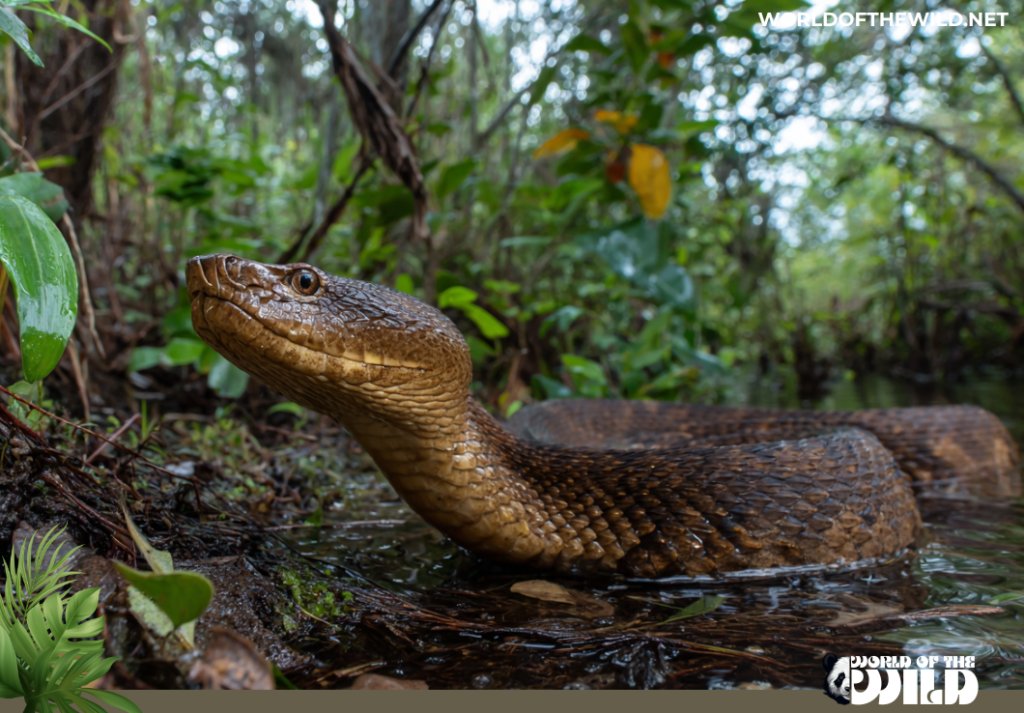
The Florida Cottonmouth is, above all else, a creature of water. It is most commonly associated with the full spectrum of freshwater and brackish aquatic habitats found across the Florida peninsula and surrounding coastal regions: cypress swamps, freshwater marshes, river floodplains, lake margins, slow-moving streams, drainage ditches, tidal creeks, and mangrove-fringed estuaries.
The species is endemic to Florida and immediately adjacent portions of Georgia and extreme southeastern Alabama, with its core range centered on the Florida peninsula. It is found from sea level to very modest elevations and is notably tolerant of brackish and even marginally saline environments, which has allowed it to colonize barrier islands and coastal habitats inaccessible to most strictly freshwater snakes.
Within its aquatic habitat, the cottonmouth is closely associated with specific microhabitat features: the bases of large cypress trees, emergent logs and stumps, dense mats of floating vegetation such as water hyacinth and duck potato, and the tangled root systems of riparian shrubs. These features provide both thermal refuges for basking and concealed ambush positions at the water’s edge.
Cottonmouths also venture onto terrestrial habitats more than their reputation as water snakes suggests. They regularly move through upland pine flatwoods, scrubby margins, and even suburban landscapes that border aquatic habitats, particularly during the breeding season when males undertake extended overland movements in search of mates. This terrestrial mobility increases their likelihood of encountering humans, contributing to their notoriety in Florida neighborhoods bordered by wetlands and retention ponds.
Diet
The Florida Cottonmouth is an opportunistic carnivore with a remarkably broad diet — one of the most ecologically generalist diets of any North American pit viper. Its primary prey includes fish, frogs, salamanders, sirens (aquatic salamanders), small turtles, small alligators, birds, small mammals, lizards, and other snakes, including venomous species.
Fish and frogs constitute the bulk of the diet for most individuals across most of the year, and the cottonmouth’s semiaquatic lifestyle positions it perfectly to exploit both. Unlike purely terrestrial vipers that must wait for prey to come to them, cottonmouths have been documented actively pursuing fish underwater, using their lateral body undulations to corner prey against submerged vegetation or shallow banks.
The hunting strategy varies with prey type. For warm-blooded prey such as mice and birds, the cottonmouth typically employs a strike-and-release method — delivering a rapid envenomation and then releasing the prey, tracking it by scent as the venom takes effect, before consuming it headfirst. For ectothermic prey such as fish and frogs, cottonmouths more commonly hold the prey in their jaws after striking, relying on the combined mechanical grip and venom action to subdue it before swallowing.
The hemotoxic and cytotoxic venom is well-suited to this ecological role, breaking down tissue and beginning the digestive process even before the prey is swallowed. This is not incidental — snake venom is fundamentally a highly modified digestive secretion that has been co-opted for prey immobilization over the course of evolution. Juvenile cottonmouths augment their ambush diet with the caudal luring behavior described above, preferentially targeting frogs and small lizards during the first years of life.
Predators and Threats
Despite its venom and formidable reputation, the Florida Cottonmouth is prey to several animals. American Alligators are among the most significant predators of cottonmouths in Florida, regularly consuming snakes encountered along waterways. Kingsnakes — particularly the Eastern Kingsnake (Lampropeltis getula) — are ophiophagous (snake-eating) predators that are immune to pit viper venom and will actively pursue and overpower cottonmouths. Large wading birds such as Great Blue Herons and Sandhill Cranes have been documented killing and consuming cottonmouths, as have Red-tailed Hawks, Ospreys, and Snapping Turtles. Raccoons and Otters occasionally prey on smaller individuals.
However, the most significant threats to the Florida Cottonmouth are human-caused. Deliberate killing by humans who encounter cottonmouths — or who misidentify harmless watersnakes as cottonmouths — represents a persistent and widespread cause of mortality. The cultural stigma surrounding venomous snakes in general, and cottonmouths in particular, has resulted in centuries of targeted persecution.
Habitat loss and degradation pose perhaps the most systemic long-term threat. Florida’s wetlands have been dramatically reduced and fragmented by drainage for agriculture and urban development, channelization of waterways, and the introduction of invasive plant species that alter the structure and water chemistry of wetland habitats. The Florida Cottonmouth’s dependence on high-quality aquatic habitat makes it acutely sensitive to these changes.
Road mortality is a significant and often underappreciated threat, particularly as cottonmouths make terrestrial movements during the breeding season across landscapes increasingly fragmented by roads and development. Invasive species — particularly the Burmese Python in South Florida — represent an emerging and potentially devastating threat, as pythons actively predate native snakes including cottonmouths throughout the Everglades and surrounding regions. Climate change poses additional long-term risks through alteration of hydrological cycles, sea level rise threatening coastal habitats, and increased frequency of extreme weather events disrupting thermal and reproductive cycles.
Reproduction and Life Cycle
The Florida Cottonmouth reaches sexual maturity at approximately 2 to 3 years of age, though this varies with environmental conditions and prey availability. Mating occurs twice a year in Florida — in spring (March through May) and again in fall (September through October) — a pattern facilitated by the state’s relatively mild winters.
Male combat is a notable feature of cottonmouth reproductive behavior. During the breeding season, males engage in ritualized wrestling bouts — intertwining their bodies and attempting to pin each other’s head to the ground — in competition for access to females. These contests are non-venomous and rarely injurious, serving primarily as a display of size and strength.
Females are viviparous, meaning they carry developing embryos internally rather than laying eggs. The gestation period lasts approximately 3 to 4 months, following which the female gives birth to live young, typically between 1 and 16 neonates per litter, with average litters of 6 to 8. Females do not breed every year; in many cases, particularly in cooler or resource-limited environments, females reproduce on a biennial or triennial cycle, investing significant energy reserves into each pregnancy.
Neonates are immediately independent — the mother provides no post-birth parental care. However, newborn cottonmouths are born with a functional venom apparatus and are capable of delivering a medically significant bite from their first moments of life. They are born averaging around 8 to 10 inches in length, boldly patterned, and equipped with the yellow tail tip used for caudal luring.
Lifespan in the wild is estimated at 10 to 15 years under favorable conditions, though captive individuals have been documented living beyond 20 years. Growth is rapid in the first few years of life and slows significantly at maturity.
Population
The Florida Cottonmouth is currently listed as a species of Least Concern on the IUCN Red List, reflecting that its populations, while locally impacted by habitat loss and human persecution, remain broadly stable across much of its range. It is not listed as threatened or endangered under the U.S. Endangered Species Act, and in many parts of Florida it remains a locally common species within suitable wetland habitats.
Precise global population estimates are difficult to establish for secretive, cryptic species like cottonmouths, and no comprehensive census has been conducted. However, population densities can be surprisingly high in prime habitat — studies at productive wetland sites have documented cottonmouths at densities of several individuals per acre in areas with abundant prey and suitable basking and refugia structure.
Locally, population trends reflect the broader trajectory of Florida’s wetland ecosystems. In areas where wetland habitat has been preserved or restored, cottonmouth populations appear stable. In highly urbanized or agriculturally converted landscapes, populations are reduced or absent. The continued expansion of the Burmese Python in South Florida represents a localized but serious threat, with studies documenting dramatic declines in native snake populations across the Everglades ecosystem — a trend that almost certainly includes cottonmouths in the affected region.
The species’ relative abundance and broad ecological tolerance provide a degree of resilience, but the cumulative pressures of habitat fragmentation, direct persecution, and invasive predators underscore the importance of continued monitoring and wetland conservation efforts.
Conclusion
The Florida Cottonmouth is not the mindless, aggressive man-killer of popular legend. It is a sophisticated, ecologically essential predator — one that has spent millions of years evolving in lock-step with the wetland ecosystems of the Florida peninsula, and one that plays a crucial role in regulating prey populations, cycling nutrients, and maintaining the balance of some of North America’s most biodiverse habitats. Every frog, fish, and small mammal that the cottonmouth consumes represents a thread in the vast ecological web of Florida’s wetlands.
The fear and misidentification that lead to the killing of cottonmouths — and the countless harmless watersnakes killed in their name — represent not just a conservation problem but a failure of understanding. Florida’s wetlands are not diminished by the presence of venomous snakes. They are enriched by them.
To protect the Florida Cottonmouth is to protect the swamps, the cypress strands, the blackwater rivers, and the coastal marshes that define Florida’s wild character. It is to acknowledge that sharing a landscape with wild, dangerous, magnificent things is not a burden but a privilege — and that the white flash of an open cottonmouth mouth, glimpsed at the edge of a dark Florida swamp, is not a reason to reach for a shovel. It is a reason to step back, pay attention, and feel the full weight of how extraordinary this living world truly is.
Quick Reference
| Scientific Name | Agkistrodon conanti |
| Diet Type | Carnivore (fish, frogs, small mammals, birds, reptiles, other snakes) |
| Size | 30–48 inches (2.5–4 ft); exceptional individuals up to 60 inches (5 ft) |
| Weight | 3–10 lbs (occasionally exceeding 10 lbs in large adults) |
| Region Found | Florida peninsula and immediately adjacent areas of Georgia and southeastern Alabama, USA |