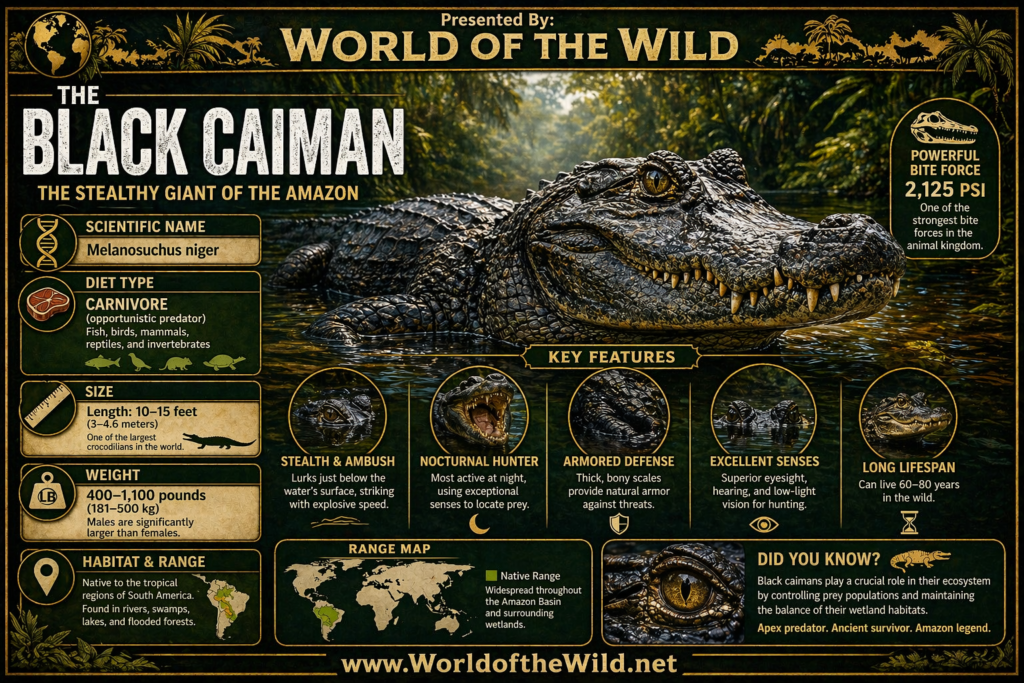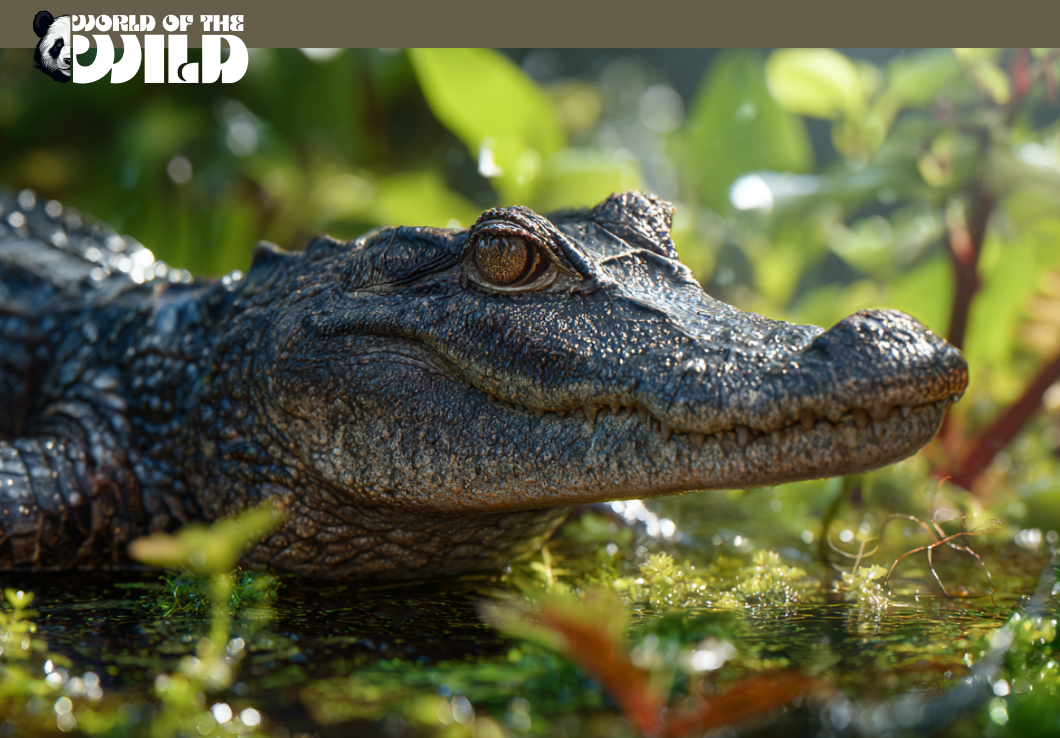

In the murky, shadow-draped waterways of the Amazon Basin, something ancient stirs beneath the surface. A pair of amber eyes breaks the water’s stillness, barely visible in the fading light — and then, silence. For millions of years, the Black Caiman (Melanosuchus niger) has ruled these rivers and floodplains as one of nature’s most formidable ambush predators. Larger than any crocodilian in the Americas and nearly as massive as the Nile crocodile, this obsidian-scaled giant is far more than just a big reptile. It is a keystone species, an evolutionary marvel, and a haunting symbol of the Amazon’s untamed wildness. Once hunted to the edge of extinction for its prized hide, the Black Caiman has made a remarkable comeback — yet its story is far from over. Sit back, because you’re about to meet the Amazon’s most magnificent and misunderstood apex predator.
Facts
- They can grow longer than a pickup truck. Large males regularly exceed 13 feet, with some exceptional individuals reportedly reaching 16–20 feet in length — making them the largest predator in the entire Amazon ecosystem.
- Their eyes glow red in the dark. Unlike most crocodilians whose eyes reflect orange-yellow in torchlight, Black Caiman eyes produce a distinctive reddish glow, which has contributed to their fearsome, almost mythological reputation among Amazonian communities.
- They were nearly wiped out in the 20th century. Commercial hunting between the 1940s and 1970s decimated their populations across South America, with millions killed for their smooth, dark belly scales used in luxury leather goods.
- They are ecosystem engineers. By keeping fish, capybara, and large mammal populations in check, Black Caimans regulate the food web of Amazonian wetlands, directly influencing the biodiversity of habitats far beyond the water’s edge.
- Mothers are remarkably devoted. Female Black Caimans guard their nest mounds for months and carry their hatchlings gently in their massive jaws — a level of parental care that challenges the popular image of reptiles as cold and indifferent parents.
- Their dark coloration is more than cosmetic. The jet-black scales absorb solar heat exceptionally well, helping them thermoregulate rapidly in the cool Amazonian mornings — a critical advantage for an ectothermic predator needing to reach peak activity quickly.
- Indigenous tribes consider them spiritual guardians. Several Amazonian peoples regard the Black Caiman as a powerful spirit animal, weaving it into mythology and ritual, which has historically created a complex cultural relationship between human communities and the species.
Species
The Black Caiman belongs to the family Alligatoridae — making it a relative of the American alligator rather than the “true crocodiles” of the family Crocodylidae. Its full taxonomic classification is as follows:
- Kingdom: Animalia
- Phylum: Chordata
- Class: Reptilia
- Order: Crocodilia
- Family: Alligatoridae
- Genus: Melanosuchus
- Species: Melanosuchus niger
Melanosuchus is a monotypic genus, meaning the Black Caiman is the sole living representative of its lineage — an evolutionary loner with no living sister species. It is, however, the largest member of the family Alligatoridae and its closest living relatives within the broader clade are the caimans of the genus Caiman, which includes the Spectacled Caiman (Caiman crocodilus), the Broad-snouted Caiman (Caiman latirostris), and the Yacare Caiman (Caiman yacare). The Dwarf Caimans of the genus Paleosuchus — the Cuvier’s Dwarf Caiman and the Smooth-fronted Caiman — are also part of the Alligatoridae family but represent a much more distantly related branch.
While no recognized subspecies of Melanosuchus niger are currently accepted by the scientific community, there is documented variation in body size and coloration across its geographic range. Populations in the western Amazon — particularly in Ecuador and Peru — tend to be studied more extensively, while those in Bolivia and Brazil’s interior floodplains show some morphological differences that researchers continue to investigate.
Appearance
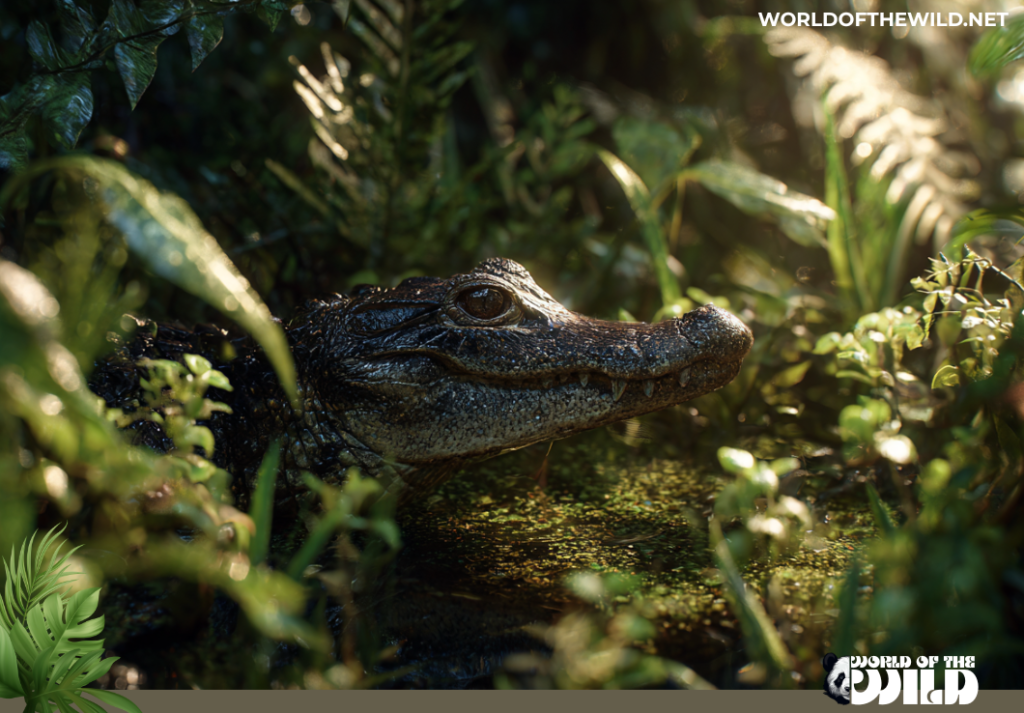
The Black Caiman is a creature of striking, almost austere beauty. True to its name, adults are covered in dark, blackish-grey scales that absorb light rather than reflect it, giving the animal an almost matte, shadow-like appearance when viewed from above. The dorsal scales are heavily ossified — reinforced with bone — forming a kind of natural armor plating along the back and tail. The flanks and belly tend to be somewhat lighter, ranging from grey to yellowish-white, and juveniles display vivid white or pale yellow banding and spots on their sides, which gradually fade as they mature into their darker adult coloration.
The skull is notably wide and robust compared to other caimans, more closely resembling the broad, powerful head of an alligator than the narrow snout of some crocodilians. This wide jaw architecture is no accident — it accommodates the powerful jaw muscles required to capture and subdue large prey. The eyes are proportionally large and set high on the skull, equipped with a tapetum lucidum (a reflective layer behind the retina) that enhances vision in low-light conditions. The irises carry a striking brown or amber hue.
In terms of size, adult males typically range from 9 to 14 feet (roughly 2.7 to 4.3 meters) in total length and weigh between 440 and 880 pounds (200 to 400 kilograms). Females are considerably smaller, usually measuring 6 to 10 feet. Historically, there are credible accounts of truly massive individuals approaching 16 to 20 feet, though such giants are exceptionally rare today. The tail accounts for roughly half of the total body length and is laterally compressed — a powerful, sculpted rudder that drives the animal through water with deceptive speed.
Behavior
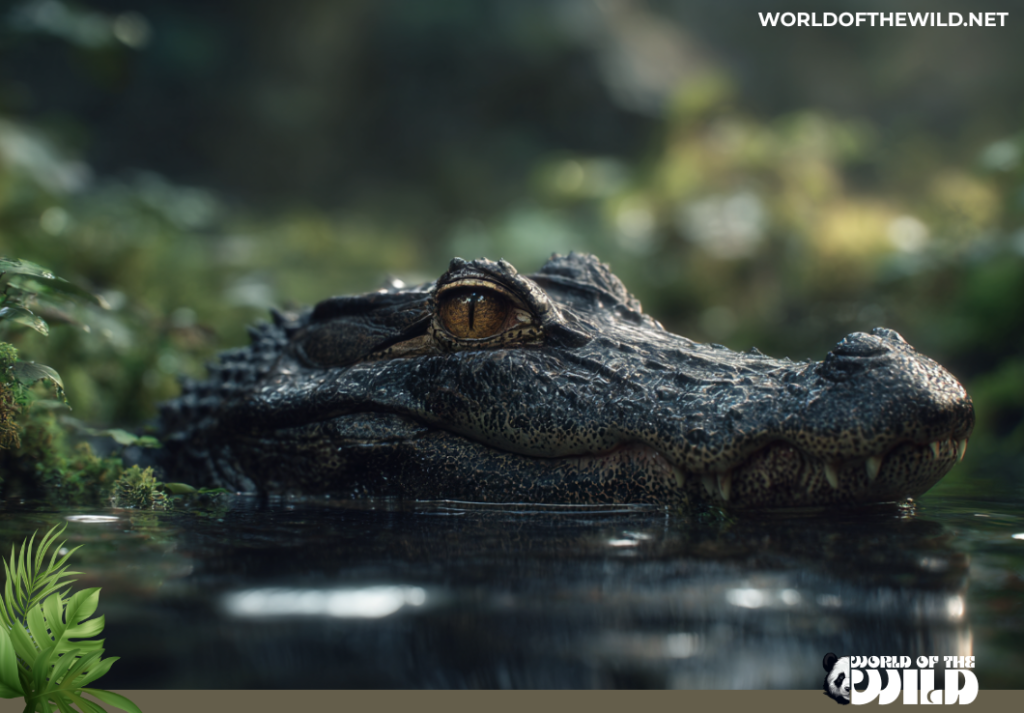
The Black Caiman is primarily a nocturnal hunter, spending the heat of the day basking on riverbanks or floating motionlessly at the water’s surface — a behavior known as “high floating” — to thermoregulate. As dusk falls, the animal transforms into one of the Amazon’s most efficient predators. It moves through water in near-total silence using a sinuous, full-body undulation, leaving barely a ripple as it approaches prey.
As with most crocodilians, Black Caimans are largely solitary, though they will tolerate one another’s presence at prime basking or feeding sites, particularly during dry seasons when prey concentrates around shrinking water bodies. Dominance hierarchies exist, with larger males claiming the best territories, and confrontations — while not always violent — involve distinctive head-slapping, jaw-popping, and body posturing displays.
Communication in Black Caimans is multi-modal. Infrasonic bellows and guttural roars are used during the mating season, and hatchlings produce a distinctive high-pitched chirping call to alert their mother. Tactile communication, particularly during courtship, involves snout rubbing and body contact.
One of the most remarkable behavioral traits of the Black Caiman is what herpetologists call “tool use” — a behavior documented in crocodilians broadly. During nesting season, caimans and crocodiles have been observed carrying sticks and branches on their snouts near active bird rookeries, effectively baiting birds that come to collect nesting material. Whether Black Caimans engage in this behavior is still under active study, but it highlights the surprising cognitive complexity of crocodilians in general.
On land, Black Caimans are capable of surprisingly fast movement in short bursts, using both a sprawling and a semi-erect gallop gait, though they prefer to avoid prolonged terrestrial activity.
Evolution
The crocodilian lineage is ancient beyond easy comprehension. Crocodilians first appeared in the Late Triassic period, roughly 230–240 million years ago, surviving the catastrophic mass extinction event that wiped out the non-avian dinosaurs 66 million years ago. In a very real sense, the Black Caiman is a living relic of the Mesozoic Era, little changed in fundamental design from its ancient ancestors.
The family Alligatoridae, to which the Black Caiman belongs, diverged from the crocodile lineage sometime in the Late Cretaceous or early Paleogene, with the split between alligatorid groups likely occurring in the Eocene epoch, around 50–40 million years ago. The genus Melanosuchus itself appears to be a relatively younger lineage within the alligatorid family, with its evolutionary roots traced to the diversification of South American crocodilians following the long period when South America was an isolated continent, separated from North America until roughly 3 million years ago.
Fossil relatives of the Black Caiman include the giant Purussaurus, a terrifying Miocene-era caiman that prowled the ancient Pebas mega-wetland — a vast inland sea that once covered much of western Amazonia. Purussaurus is estimated to have reached lengths of 30–40 feet, making it one of the largest crocodilians ever to exist. While the Black Caiman is not a direct descendant, it is a product of the same extraordinary evolutionary theater that shaped the Amazon Basin’s aquatic predators over tens of millions of years.
Habitat
The Black Caiman is strictly a South American species, with its range centered on the Amazon Basin — the largest tropical rainforest and river system on Earth. Its geographic distribution spans Brazil, Bolivia, Colombia, Ecuador, French Guiana, Guyana, Peru, Suriname, and Venezuela, though populations are absent from many areas where they were historically extirpated by hunting.
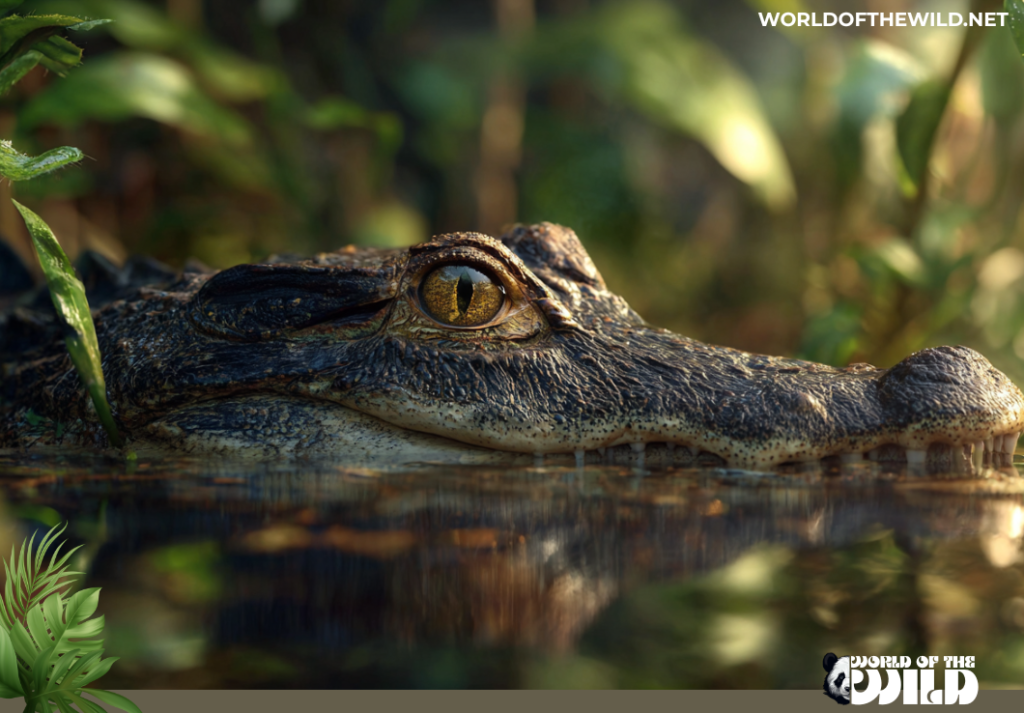
Within this vast range, the Black Caiman shows a strong preference for slow-moving or still freshwater environments. It is most commonly found in the flooded savannas known as the Llanos and Pantanal margins, lake edges, oxbow lakes (locally called cochas), large rivers and their tributaries, seasonally flooded forests (várzea and igapó), and wetland margins adjacent to gallery forests.
The species is highly sensitive to water quality and habitat integrity. Unlike the more adaptable Spectacled Caiman, which can survive in degraded and even semi-urban water bodies, the Black Caiman requires large, undisturbed wetland systems with abundant prey and adequate nesting habitat. During the Amazon’s dramatic wet season, when water levels rise by as much as 30 feet and forests flood for hundreds of miles, caimans disperse into newly inundated areas to take advantage of the expanded feeding opportunities. During the dry season, they concentrate along permanent water bodies.
Diet
The Black Caiman is an apex carnivore — a generalist predator whose diet shifts significantly across its life stages. Juveniles begin by feeding on invertebrates, insects, crustaceans, and small fish. As they grow, their prey expands rapidly to include larger fish (particularly piranha, catfish, and arapaima), amphibians, reptiles, and waterfowl. Adult Black Caimans, with their massive body size and powerful jaws, are capable of taking virtually any animal that approaches the water’s edge.
Large adults regularly prey on capybara (the world’s largest rodent), giant river otters, tapirs, deer, anacondas, domesticated livestock, and in rare but documented cases, even jaguars. The caiman is an ambush predator par excellence. It drifts toward prey with almost imperceptible movement, using the water’s surface as concealment. The strike is explosive — a sudden, lunging snap that delivers one of the most powerful bite forces recorded in any living animal. The prey is typically drowned or killed by the force of impact before being consumed whole or in large, torn pieces.
During periods of fish abundance, Black Caimans have been observed engaging in cooperative or at least concurrent group feeding, where multiple individuals gather near fish schools or at constricted waterways during the dry season — exploiting the same resource without active coordination, but nonetheless demonstrating behavioral flexibility.
Predators and Threats
As an apex predator, the adult Black Caiman has essentially no natural predators. However, eggs and hatchlings face significant predation pressure from large constrictors such as the green anaconda, tegus and other large lizards, feral pigs, and various bird species including large herons and the Jabiru stork. Juvenile caimans are also vulnerable to larger adult caimans — cannibalism is not uncommon during periods of food scarcity.
The most significant threats to the Black Caiman are, without question, human in origin. Commercial hunting for the caiman’s distinctive, smooth belly hide devastated populations across the entire Amazon Basin throughout the mid-20th century. While international protections largely curtailed the legal hide trade, illegal poaching continues in some areas today.
Habitat destruction poses an equally urgent and accelerating threat. Deforestation driven by cattle ranching, soy farming, logging, and mining operations eliminates the forested floodplains and wetland margins that Black Caimans require for nesting and feeding. Dam construction on Amazonian rivers alters hydrology, disrupting the seasonal flood cycles that the species depends upon. Mercury contamination from illegal gold mining operations (garimpo) poisons aquatic food chains and accumulates in the tissues of apex predators like the Black Caiman.
Climate change presents a longer-term but increasingly serious threat, altering the Amazon’s precipitation patterns, intensifying droughts, and potentially shifting the vegetation structure of wetland habitats. Additionally, retaliatory killing by livestock farmers remains a persistent pressure, as large caimans occasionally prey on cattle or domestic animals.
Reproduction and Life Cycle
The Black Caiman’s reproductive cycle is tightly linked to the Amazon’s seasonal rhythms. Mating typically occurs between April and June, during the dry season when water levels are at their lowest and caimans are most concentrated. Courtship involves extended periods of close physical contact between male and female — snout rubbing, vocalizations, and synchronized swimming — often over the course of several days.
Females construct large nest mounds from vegetation, soil, and organic debris, typically located on elevated ground near the water’s edge, or on floating mats of vegetation. A typical clutch contains between 30 and 65 eggs, which are incubated by the heat of decomposing vegetation within the mound rather than by direct body heat. Incubation lasts approximately 6 to 8 weeks, and the sex of the hatchlings is determined by nest temperature — a phenomenon known as Temperature-Dependent Sex Determination (TSD), common across crocodilians.
As the hatchlings begin to vocalize from within their eggs, the mother excavates the nest and may assist hatchlings in breaking free from their shells. She then gently carries them to the water in her jaws — a behavior observed in crocodilians across the world and one that never ceases to astonish observers who expect cold indifference from a massive, armored predator. The female guards her young for up to a year, aggressively defending them against predators.
Sexual maturity is reached at approximately 4–8 years of age, when males measure around 6 feet and females around 4 feet. In the wild, Black Caimans are estimated to live between 40 and 80 years, though precise data on maximum longevity in wild populations remains difficult to obtain.
Population
The Black Caiman is currently classified as Least Concern on the IUCN Red List — a classification that reflects a significant recovery from its historically perilous status, but one that should not breed complacency. Prior to commercial hunting protections in the 1970s and 1980s, the species had been eliminated from large portions of its natural range, and some estimates suggested populations had declined by as much as 99% in certain areas.
Following international trade protections under CITES (Convention on International Trade in Endangered Species) and national-level legal protections enacted by Brazil, Peru, and other range countries, Black Caiman populations have recovered substantially in areas like the Pacaya-Samiria National Reserve in Peru and the Mamirauá Sustainable Development Reserve in Brazil. These protected wetlands have become critical population strongholds.
Global population estimates are difficult to pin down with precision due to the species’ remote range, but most assessments suggest several hundred thousand individuals now exist across the Amazon Basin. Population trends are generally considered stable to increasing within protected areas, though continued habitat loss and illegal hunting in unprotected regions remain sources of ongoing concern. The overall population trajectory is positive, but the species remains vulnerable to the accelerating pace of Amazon deforestation — which claimed record areas of forest in recent years.
Conclusion
The Black Caiman is, in every sense, a triumph of nature. It is a species that survived the death of the dinosaurs, outlasted Ice Ages, and endured a human-caused population collapse — and it is still here, still gliding silently through the Amazon’s dark waters, still fulfilling its ancient role as the river’s supreme predator. Its recovery stands as one of conservation’s quieter success stories, a testament to what is possible when meaningful legal protections meet genuine political will.
But the Amazon is under unprecedented pressure. The forests are burning, the rivers are being dammed, and the wetlands are shrinking. The Black Caiman’s fate is inseparable from the fate of the Amazon itself — and the Amazon’s fate is, in many ways, inseparable from our own. If we lose the Amazon, we do not just lose the Black Caiman. We lose the lungs of the planet, the engine of one of Earth’s most complex ecosystems, and a biodiversity archive millions of years in the making.
The amber eyes still watch from the water. The question is whether we are watching back — and whether we will act in time.
Quick Reference
| Field | Details |
|---|---|
| Scientific Name | Melanosuchus niger |
| Diet Type | Carnivore (Apex Predator) |
| Size | 108–168 inches (9–14 feet); exceptional individuals up to ~20 feet |
| Weight | 440–880 lbs (adult males); females considerably lighter |
| Region Found | Amazon Basin — Brazil, Bolivia, Colombia, Ecuador, French Guiana, Guyana, Peru, Suriname, Venezuela |