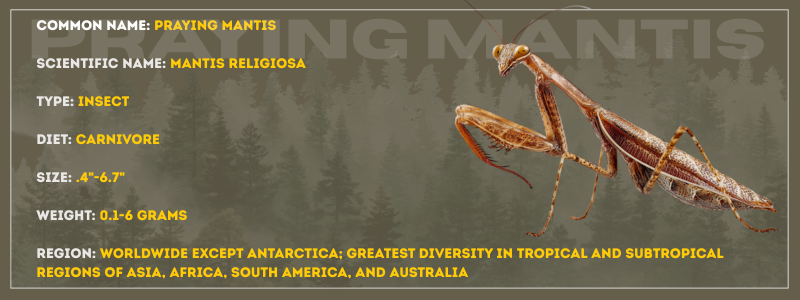

With front legs folded in a posture that resembles prayer, the praying mantis cuts an unmistakable figure in the insect world. But don’t let this seemingly pious stance fool you—these remarkable creatures are among nature’s most efficient and patient predators, capable of striking with lightning speed and possessing abilities that seem almost supernatural. From their uncanny ability to swivel their heads like tiny owls to their sometimes-controversial mating habits, praying mantises have captivated human imagination for millennia, appearing in art, mythology, and martial arts traditions across cultures. These ancient insects, which have walked the Earth for over 135 million years, represent a masterclass in evolutionary engineering, combining stealth, precision, and raw hunting prowess into a deceptively delicate-looking package.
Facts
- 360-Degree Vision with Binocular Sight: Praying mantises are the only invertebrates known to have stereoscopic vision, allowing them to perceive depth and accurately judge the distance to their prey with remarkable precision.
- Masters of Disguise: Beyond the common green and brown varieties, some mantis species have evolved to mimic flowers, orchids, dead leaves, and even tree bark, making them virtually invisible to both prey and predators.
- Supersonic Strike Speed: A mantis can strike at prey in as little as 50-70 milliseconds—faster than a human can blink—with front legs that accelerate at speeds up to 2.3 meters per second.
- Ultrasonic Hearing: Many mantis species possess a single ear located in the center of their chest that can detect the ultrasonic echolocation calls of hunting bats, allowing them to execute evasive aerial maneuvers.
- Alien-like Head Rotation: Mantises can rotate their triangular heads a full 180 degrees, making them the only insects capable of looking directly behind themselves without moving their bodies.
- Natural Pest Controllers: A single mantis can consume dozens of pest insects in its lifetime, including flies, moths, crickets, and even larger prey like small rodents or hummingbirds in the case of larger species.
- Ancient Cultural Symbol: In Chinese martial arts, “Tang Lang Quan” or Northern Praying Mantis kung fu was developed in the 1600s after a warrior observed the mantis’s fighting techniques.
Species
Classification:
- Kingdom: Animalia
- Phylum: Arthropoda
- Class: Insecta
- Order: Mantodea
- Family: Multiple families (over 15 recognized families)
- Genus: Over 430 genera
- Species: Approximately 2,400 described species
The order Mantodea encompasses an astonishing diversity of species, with new ones still being discovered regularly. Some of the most notable families and species include:
The European Mantis (Mantis religiosa), perhaps the most recognized species, is widespread across Europe, Asia, and North America (where it was introduced). The Chinese Mantis (Tenodera sinensis), one of the largest species at up to 11 centimeters, has also established populations worldwide. The Orchid Mantis (Hymenopus coronatus) of Southeast Asia is renowned for its stunning pink and white coloration that mimics orchid flowers. The Ghost Mantis (Phyllocrania paradoxa) from Africa resembles dead leaves with its brown, textured appearance. The Spiny Flower Mantis (Pseudocreobotra wahlbergii), also from Africa, displays intricate eyespot patterns on its wings. In the Americas, the Carolina Mantis (Stagmomantis carolina) is the most common native species.
These species vary dramatically in size, from the tiny Bolbe pygmaea at just over one centimeter to the massive Ischnomantis gigas of Africa, which can exceed 17 centimeters in length.
Appearance
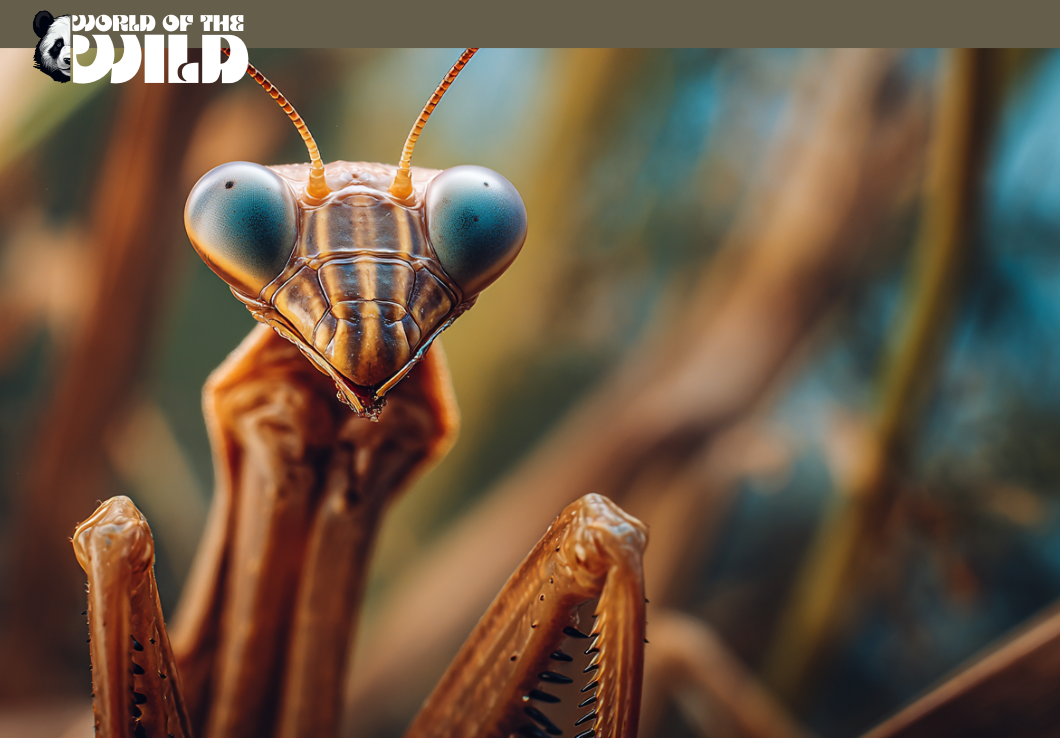
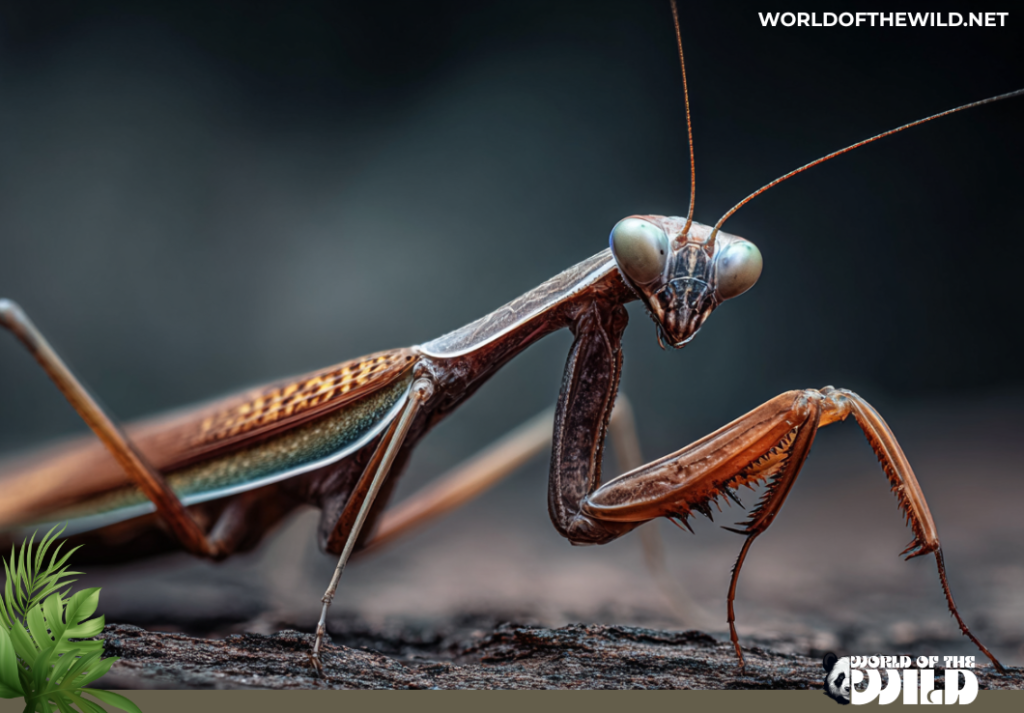
Praying mantises possess one of the most distinctive body plans in the insect world. Their elongated bodies typically range from 1 to 17 centimeters depending on species, with females generally larger and more robust than males. The most recognizable feature is their raptorial front legs—powerful, spined appendages that fold into a “praying” position when at rest. These forelegs are lined with sharp spikes that interlock to create an inescapable trap for prey.
The mantis head is triangular and highly mobile, dominated by two large compound eyes that can contain up to 10,000 individual visual receptors, providing exceptional visual acuity. Between these compound eyes sit three simple eyes (ocelli) that detect light levels. Their antennae vary by sex; males typically have longer, thicker antennae used for detecting female pheromones, while females have shorter, more delicate ones.
Coloration varies spectacularly across species. While many are green or brown to blend with vegetation, others display vibrant pinks, whites, purples, or intricate patterns. Some species can even change color slightly between molts to better match their environment. The prothorax (the section behind the head) is elongated and flexible, allowing the mantis to extend its reach when striking. Four walking legs provide stability, while many species have wings—two pairs in total. The forewings are typically leathery and narrow, while the hindwings are membranous and fan-like, often displaying vivid colors or patterns used in threat displays.
Males are generally lighter and more slender than females, an adaptation for flight that helps them locate mates. Some males weigh only a fraction of what females weigh, particularly in species known for sexual cannibalism.
Behavior
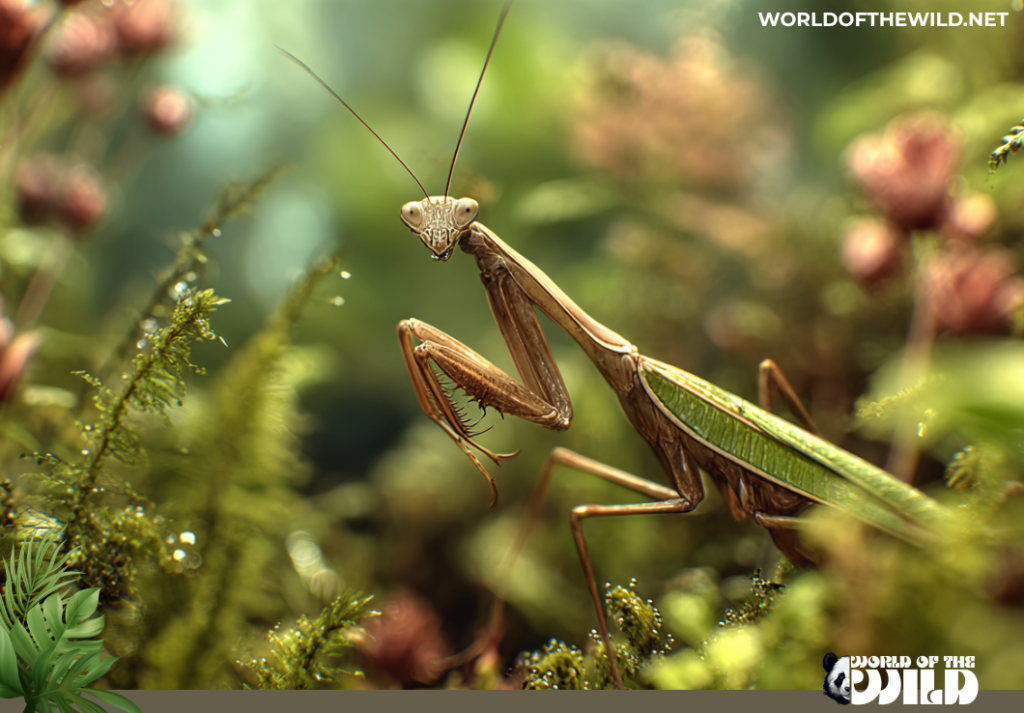
Praying mantises are predominantly ambush predators that employ a “sit-and-wait” hunting strategy. They can remain motionless for hours, swaying gently to mimic vegetation moving in the breeze, all while their compound eyes track potential prey with laser-like focus. This patience is broken in explosive bursts of action—when prey ventures within range, the mantis strikes with those distinctive front legs in a movement so fast it’s almost invisible to the naked eye.
Most mantis species are solitary and fiercely territorial. They communicate primarily through visual displays and chemical signals. When threatened, many species execute a dramatic threat display called a “deimatic display,” rearing back, spreading their wings to reveal bright colors or eyespots, and making themselves appear larger while sometimes producing hissing sounds by rubbing body parts together.
Intelligence in mantises, while different from vertebrate intelligence, is remarkable. They demonstrate complex decision-making in hunting, can learn to avoid certain prey after negative experiences, and show individual personality differences in boldness and hunting styles. Their stereoscopic vision allows them to calculate strike distance with such precision that they adjust their attack trajectory mid-strike if prey moves.
Mantises are largely diurnal (active during the day), though some species hunt at night. Their activity peaks during warm weather when prey is abundant. While most species are terrestrial, spending their lives on plants and branches, some tropical species are ground-dwellers that hunt among leaf litter.
Social behavior is minimal except during mating. Males must approach females with extreme caution, often performing elaborate courtship dances and waiting for the female to signal receptiveness. Even then, mating is a risky endeavor for males of many species, as sexual cannibalism—where the female consumes the male during or after mating—occurs in approximately 13-28% of encounters in the wild, though this percentage varies significantly by species and environmental conditions.
Evolution
The evolutionary history of praying mantises stretches back to the Cretaceous period, with the oldest confirmed mantis fossil dating to approximately 135 million years ago, discovered in Siberian deposits. However, molecular evidence suggests the lineage may be even older, potentially originating in the Late Jurassic period over 150 million years ago.
Mantises belong to the superorder Dictyoptera, making them more closely related to cockroaches and termites than to other predatory insects like dragonflies—a relationship that surprises many people. Early mantis ancestors likely diverged from cockroach-like ancestors during the Jurassic period, developing their characteristic raptorial forelegs through gradual modification of the first pair of legs.
The fossil record shows that mantises have remained relatively stable in their basic body plan over tens of millions of years, a testament to the success of their predatory design. Fossils from the Eocene epoch (56-34 million years ago) show species remarkably similar to modern forms, though the diversity of mantises exploded alongside the diversification of flowering plants and the insects that pollinate them—their primary prey.
One significant evolutionary development was the refinement of their stereoscopic vision, which emerged as mantises became more specialized ambush predators. The evolution of camouflage in mantises represents a spectacular example of convergent evolution and adaptive radiation, with different lineages independently developing similar camouflage strategies—flower mimicry, bark mimicry, and leaf mimicry—in response to their specific ecological niches.
The ultrasonic hearing organ that allows mantises to detect bat echolocation is another fascinating evolutionary innovation, appearing in various mantis lineages that face aerial predation. This single-ear hearing system is unique in the animal kingdom and represents an elegant solution to the challenge of avoiding nocturnal bat predators.
Habitat
Praying mantises inhabit every continent except Antarctica, with the greatest diversity found in tropical and subtropical regions. Their geographic distribution spans from the temperate zones of North America, Europe, and Asia through the tropics of Africa, South America, Southeast Asia, and Australia.
These adaptable predators occupy an impressive range of habitats. Tropical rainforests host the greatest mantis diversity, where species have evolved to exploit every vertical layer from the forest floor to the canopy. Here, mantises thrive in the warm, humid conditions and abundant insect prey. In temperate regions, mantises inhabit grasslands, meadows, gardens, agricultural fields, and woodland edges, typically requiring areas with sufficient vegetation to support both themselves and their prey populations.
Desert-dwelling species have adapted to arid conditions, often displaying pale coloration and spending time on drought-resistant shrubs. Coastal scrublands and Mediterranean habitats support specialized species adapted to salt spray and intense sun. In Asia, mantises are common in rice paddies and agricultural landscapes, while African savannas host ground-dwelling species that hunt among grasses and low vegetation.
Microhabitat selection is crucial for mantises. Each species typically shows preference for specific plant types, heights, and structural features that match their camouflage and hunting strategy. Flower mantises, for instance, spend their lives on specific flowering plants, while bark-mimicking species remain on tree trunks. Most mantises require areas with adequate cover for molting—a vulnerable period when they hang upside down and are defenseless.
Temperature is a critical factor; mantises are most active in warm conditions (20-30°C is optimal for many species) and become sluggish in cold weather. In temperate regions, most species survive winter as eggs in protective cases called oothecae, with adults dying after the first hard frost.

Diet
Praying mantises are obligate carnivores with a diet that consists almost entirely of live prey. Their feeding strategy is that of an opportunistic predator—they will attempt to capture virtually any animal that comes within striking range and is small enough to subdue, though they show preferences for certain prey types based on availability and past success.
The typical diet includes a wide array of insects: flies, moths, butterflies, crickets, grasshoppers, beetles, bees, wasps, and other mantises. Smaller mantis nymphs begin life feeding on tiny prey like fruit flies, aphids, and small gnats, gradually progressing to larger prey as they grow through their instars (developmental stages between molts).
Larger mantis species display impressive predatory ambition, regularly capturing prey their own size or even larger. Documented prey for large females includes small lizards, frogs, mice, small snakes, and even small birds—particularly hummingbirds at feeders in North America. There are verified accounts of large mantises catching and consuming small fish in shallow water and young salamanders near ponds.
The hunting technique is brutally efficient. Once the mantis spots prey with its exceptional vision, it tracks the target by moving only its head, keeping its body motionless. When the prey is within range (typically 3-5 centimeters), the mantis strikes with its raptorial forelegs in a movement lasting 50-70 milliseconds. The spined forelegs close around the prey like a bear trap, and the mantis immediately begins feeding, typically starting with the prey’s head or neck to quickly disable it.
Mantises are remarkably patient hunters, capable of waiting hours or even days in the same position for prey to appear. They don’t actively chase prey but rely on their camouflage to ambush unsuspecting victims. Interestingly, they show no interest in dead or non-moving prey—movement is essential to trigger their hunting response.
Predators and Threats
Despite being formidable predators themselves, praying mantises face numerous threats from animals higher up the food chain. Natural predators include a diverse array of species that have learned to overcome the mantis’s defenses.
Birds represent the most significant predatory threat, with species like shrikes, crows, jays, and various passerines regularly consuming mantises. Bats pose a particular danger during flight; however, many mantis species have evolved ultrasonic hearing specifically to detect and evade hunting bats through aerial maneuvers including spiraling dives. Reptiles such as lizards, snakes, and geckos prey on mantises, as do amphibians like frogs and toads. Among mammals, rodents, shrews, and some primates will eat mantises opportunistically. Within the arthropod world, large spiders, hornets, and other mantises engage in both predation and competition.
Parasitoid wasps and flies represent a more insidious threat, laying eggs inside mantis oothecae or even on the mantis itself. The developing larvae consume the mantis eggs or the host mantis from the inside. Hairworms (Nematomorpha) are particularly dramatic parasites that infect mantises through contaminated water, growing inside their bodies before compelling the infected mantis to seek water, where the worm emerges to continue its lifecycle.
Anthropogenic threats to mantis populations vary by region and species. Habitat loss due to agricultural expansion, urbanization, and deforestation represents the primary human-caused threat, eliminating the specific vegetation and microclimates many species require. Pesticide use has a devastating impact on mantis populations, both through direct toxicity and by eliminating their prey base. The widespread application of neonicotinoids and other systemic insecticides in agriculture has contributed to dramatic declines in many beneficial insect populations, including mantises.
Climate change poses an emerging threat, altering the phenology (seasonal timing) of mantis lifecycles and potentially creating mismatches between mantis emergence and prey availability. Changes in temperature and precipitation patterns can push species beyond their thermal tolerance ranges or eliminate suitable habitat.
Ironically, the introduction of non-native mantis species (particularly the Chinese and European mantises in North America) threatens native mantis populations through competition and predation. The pet trade and biological supply industry also put pressure on some rare tropical species, though most commercial mantises are now captive-bred.
Reproduction and Life Cycle
The reproductive biology of praying mantises is among the most fascinating and sometimes misunderstood aspects of their natural history. The mating process begins when males, guided by pheromones released by receptive females, locate potential mates. This is a perilous journey for males, as females are aggressive predators that may attack approaching males, especially if the male approaches clumsily or the female is particularly hungry.
Courtship involves careful approach behaviors by the male, often including swaying movements and cautious advances. Males of some species perform elaborate dances or vibrate their bodies to signal their intentions and species identity. The male typically approaches from behind and carefully climbs onto the female’s back to mate. Copulation can last from minutes to hours depending on the species.
Sexual cannibalism—the consumption of the male by the female during or after mating—is perhaps the most notorious aspect of mantis reproduction, though it’s often exaggerated in popular culture. In wild populations, research indicates this occurs in roughly 13-28% of mating encounters, with rates varying dramatically by species and environmental conditions. The behavior is more common in laboratory settings where males cannot escape, leading to inflated estimates. When cannibalism does occur, it often begins with the female consuming the male’s head while copulation continues—a macabre scene that actually enhances sperm transfer as the male’s body continues mating reflexively.
From an evolutionary perspective, sexual cannibalism may benefit both parties in some circumstances: the female gains substantial nutrition that increases egg production and offspring survival, while the male potentially fathers more offspring than he would have through additional matings, especially late in the season when future mating opportunities are limited.
After mating, females produce oothecae—foam-like egg cases that harden into protective structures containing 10-400 eggs depending on species. Females typically produce multiple oothecae over their lifetime, often 3-5 cases. The female secretes a frothy protein-based substance from glands in her abdomen, depositing eggs into the foam, which she then shapes and smooths before it hardens. These oothecae provide remarkable protection against temperature fluctuations, desiccation, and many predators.
Development time varies with temperature and species. In temperate species, eggs typically overwinter in the ootheca, hatching in spring when temperatures consistently reach 15-20°C. Tropical species may have much shorter development periods of 4-6 weeks. Upon hatching, tiny nymphs emerge in large numbers, often simultaneously. These nymphs are miniature versions of adults but lack wings and sexual organs.
Mantises undergo incomplete metamorphosis (hemimetaboly), progressing through 5-10 instars (molting stages) depending on species and sex, with females typically requiring more molts than males. Each instar brings the mantis closer to adult form and size. The molting process is dangerous—the mantis hangs upside down, vulnerable and unable to defend itself, as it slowly extracts itself from its old exoskeleton.
Lifespan varies considerably by species and sex. In temperate species, adults typically live 4-8 months, with the entire lifecycle from egg to death spanning one year. Males generally have shorter lifespans than females, often dying shortly after the mating season ends, while females may live several weeks longer as they produce oothecae. Tropical species may have multiple generations per year or longer lifecycles spanning 12-18 months. In optimal captive conditions with consistent food and temperature, some mantis species can live slightly longer than their wild counterparts.
Population
Assessing the conservation status and global population of praying mantises as a whole is challenging due to the sheer diversity of the order Mantodea, with approximately 2,400 described species showing vastly different population statuses. The International Union for Conservation of Nature (IUCN) has not comprehensively assessed most mantis species, but those that have been evaluated generally fall into the “Least Concern” category, indicating stable populations without immediate extinction risk.
However, this broad categorization masks significant variation. Some widespread, generalist species like the European Mantis (Mantis religiosa) and Chinese Mantis (Tenodera sinensis) have stable or even expanding populations, particularly where they’ve been introduced outside their native ranges. These adaptable species thrive in human-modified landscapes including gardens, agricultural areas, and suburban environments.
In contrast, specialist species with narrow habitat requirements face more precarious situations. Island-endemic species, such as certain mantises found only on specific Caribbean or Pacific islands, are particularly vulnerable to habitat loss and climate change. Species that depend on old-growth forests or specific plant associations face declining populations as their habitats disappear. Some flower mantis species in Southeast Asia have experienced population declines due to deforestation and collection for the pet trade.
Exact global population numbers are impossible to determine for most species due to their cryptic nature, vast distributions, and the lack of systematic monitoring programs. However, scientists estimate that the biomass of all insects, including mantises, has declined by approximately 25% over the past 30 years in some regions, primarily due to habitat loss and pesticide use. This trend likely applies to mantis populations as well, particularly in intensively farmed landscapes.
Regional studies provide some insight into population trends. In parts of Europe and North America, citizen science projects and biodiversity surveys suggest that native mantis species have experienced moderate declines in agricultural areas but remain stable in protected habitats and urban gardens. In tropical regions where mantis diversity is highest, habitat loss represents the primary threat, though quantified population trends are largely unavailable.
One concerning trend is the introduction of non-native mantis species, which may compete with or prey upon native species. In North America, the introduced Chinese and European mantises have become far more abundant than native species like the Carolina Mantis in many areas, potentially suppressing native populations through competition for prey and habitat.
Conclusion
The praying mantis stands as a testament to nature’s creativity and efficiency, a predator that has perfected its craft over more than 135 million years of evolution. From its uncanny ability to rotate its head 180 degrees and perceive depth like few other invertebrates can, to its lightning-fast strike and patient hunting strategy, the mantis embodies the principle that effective predation requires more than just strength—it demands precision, patience, and adaptation.
These remarkable insects serve crucial ecological roles as both predators and prey, helping control pest populations while supporting larger food webs. Their presence in gardens and agricultural lands makes them valuable allies to humans, offering natural pest control without the harmful side effects of chemical alternatives. Yet despite their formidable hunting abilities and wide distribution, mantises face increasing pressures from habitat destruction, pesticide use, and climate change.
As we continue to alter natural landscapes and ecosystems at unprecedented rates, the fate of these ancient predators hangs in the balance. While many mantis species remain common, the loss of specialized habitats threatens rare and endemic species we may never fully understand. The next time you spot a mantis in your garden, take a moment to appreciate this living connection to the age of dinosaurs—a creature that has mastered the art of the ambush and reminds us that some of nature’s most sophisticated hunters come in surprisingly small packages. By protecting natural habitats, reducing pesticide use, and supporting biodiversity in our own backyards, we can ensure that future generations will continue to marvel at these patient predators frozen in their posture of prayer.
Scientific Name: Mantodea (Order); Mantis religiosa (most common species)
Diet Type: Carnivore (obligate)
Size: 1-17 cm (0.4-6.7 inches), depending on species
Weight: 0.1-6 grams, depending on species and sex
Region Found: Worldwide except Antarctica; greatest diversity in tropical and subtropical regions of Asia, Africa, South America, and Australia