
Suspended in mid-air like a ghostly apparition, a pearl-white raptor hangs motionless against the azure sky, its wings beating in rapid flutter as blood-red eyes scan the grassland below. This is the White-tailed Kite, one of North America’s most elegant and distinctive birds of prey. Once on the brink of disappearance from the United States, this medium-sized raptor has made a remarkable comeback, transforming from a rarity into a familiar sight across California’s coastal valleys and beyond. What makes this bird truly captivating isn’t just its ethereal beauty or its phoenix-like recovery—it’s the White-tailed Kite’s masterful hunting technique, a hovering display so precise and sustained that it seems to defy the very laws of physics.
Facts
- The White-tailed Kite can hover in place for up to a minute at a time, maintaining a fixed position in the air with only its head moving as it scans for prey below—a feat that requires extraordinary muscle control and stamina.
- Despite their delicate appearance, White-tailed Kites are fierce defenders of their nests and have been known to attack much larger birds of prey, including Red-tailed Hawks, when protecting their young.
- Unlike most raptors that perch to consume their prey, White-tailed Kites often eat on the wing, delicately manipulating their catch with their talons while in flight.
- These kites are so specialized in their hunting technique that they’ve developed a distinctive shoulder muscle structure not found in other North American raptors, allowing them to sustain prolonged hovering.
- White-tailed Kites perform spectacular aerial courtship displays where pairs will climb high into the sky, then plummet downward in synchronized dives while calling to each other.
- They are one of the few raptor species that regularly roost communally outside of the breeding season, with groups of up to 100 individuals gathering to sleep together in dense tree canopies.
- The species was nearly extirpated from the United States by the early 1900s due to shooting and egg collecting, but has made one of the most successful comebacks of any North American raptor without direct conservation intervention.
Sounds of the White Tailed Hawk
Species
Kingdom: Animalia
Phylum: Chordata
Class: Aves
Order: Accipitriformes
Family: Accipitridae
Genus: Elanus
Species: Elanus leucurus
The White-tailed Kite belongs to a small but cosmopolitan genus of hovering kites found across multiple continents. Historically, the White-tailed Kite was considered the same species as the Black-shouldered Kite of the Old World, but modern taxonomic analysis has separated them into distinct species. The genus Elanus contains four recognized species worldwide: the White-tailed Kite of the Americas, the Black-winged Kite of Europe, Africa, and Asia, the Australian Black-shouldered Kite, and the rare Letter-winged Kite of Australia.
Within Elanus leucurus, there is some geographical variation, with birds from North America, Central America, and South America showing slight differences in size and plumage tone, though no formal subspecies are currently recognized by most authorities. The North American population was once treated as a separate subspecies (E. l. majusculus), but this designation is no longer widely accepted.
Appearance
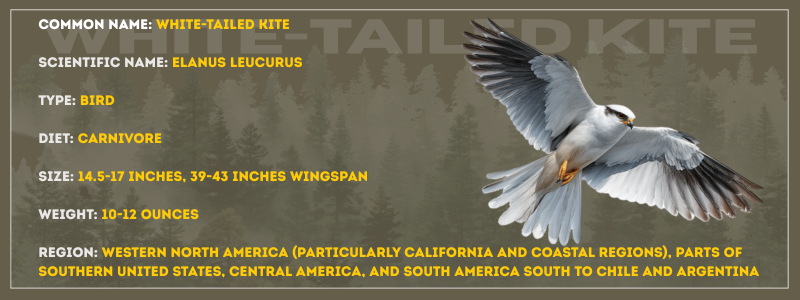
The White-tailed Kite is a study in elegant contrasts. Adults measure 14 to 17 inches in length with a wingspan ranging from 39 to 43 inches, making them similar in size to a large pigeon but with a much more graceful silhouette. These raptors typically weigh between 10 to 12 ounces, with females slightly larger than males—a pattern common among birds of prey.
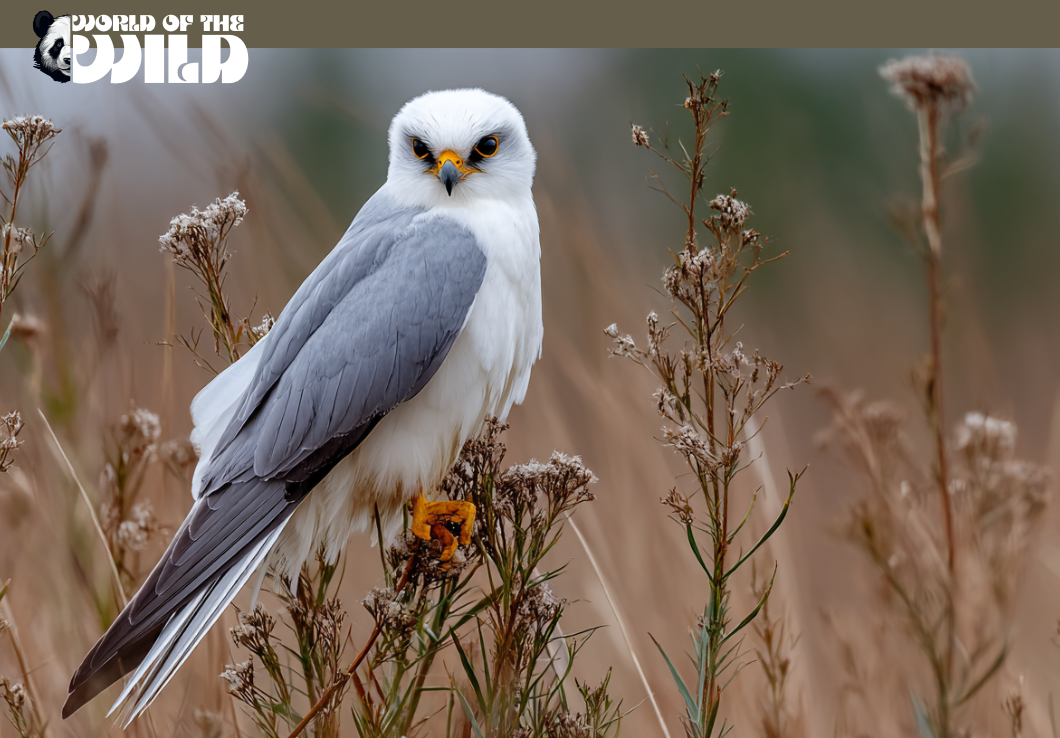
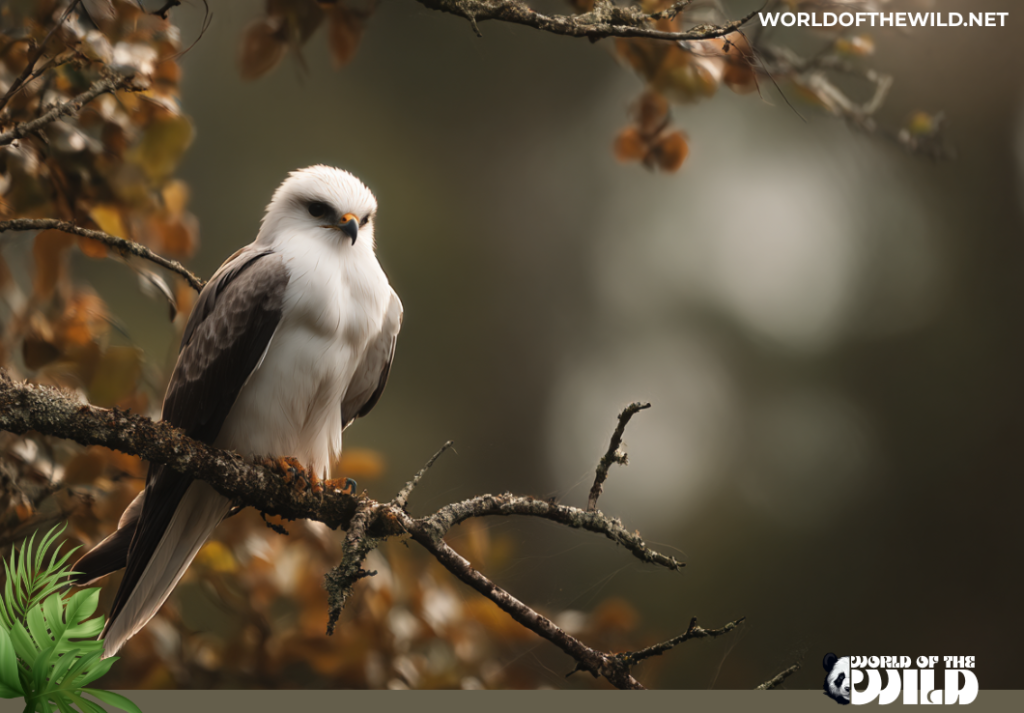
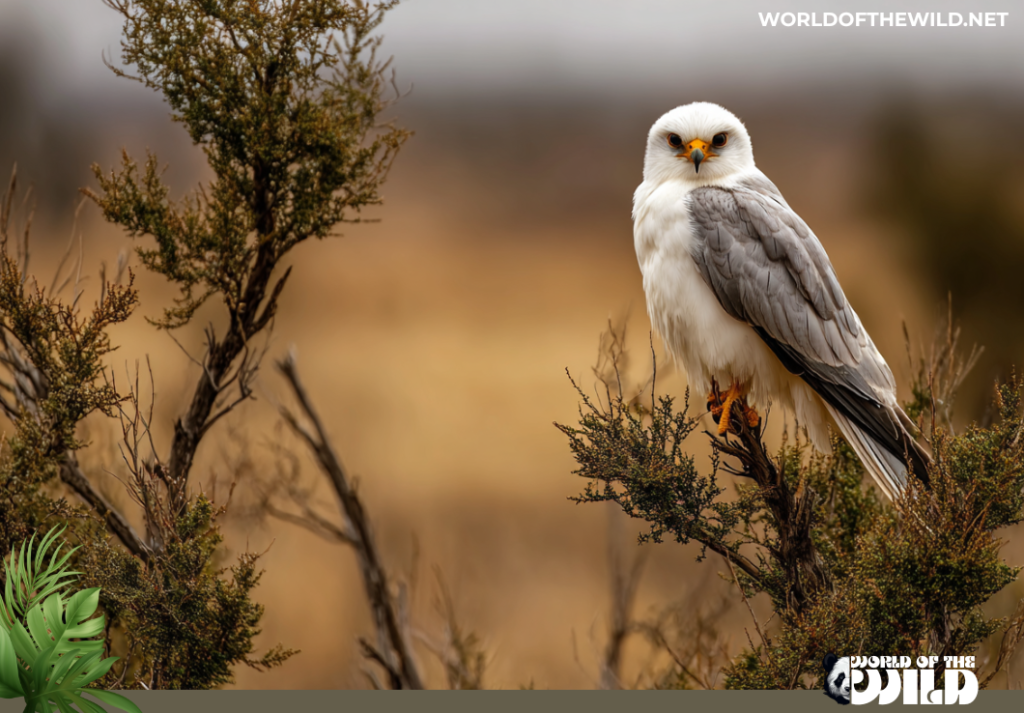
The plumage is predominantly snowy white on the head, breast, and underparts, creating a luminous appearance when viewed from below. The back and upper wings display a pale gray coloring, while the shoulders are marked by striking black patches that are visible both in flight and at rest. The underwings show a distinctive black “wrist” patch near the leading edge, a field mark that aids in identification. The tail is pure white and relatively short, lacking the forked shape seen in many other kite species.
Perhaps the most arresting feature is the eyes—deep crimson-red in adults, these intense orbs give the bird a fierce, penetrating gaze. Juvenile White-tailed Kites have dark brown eyes that gradually transition to the adult red coloration over their first year. The bill is black and sharply hooked, while the legs and feet are yellow with black talons. In flight, the White-tailed Kite presents an almost gull-like appearance with its buoyant, graceful movements and predominantly white coloration.
Behavior
The White-tailed Kite’s most distinctive behavior is its hunting strategy, which centers on its remarkable ability to hover. These raptors will hang suspended in the air at heights ranging from 30 to 100 feet, maintaining a fixed position through rapid wingbeats while their head remains perfectly still, locked onto the ground below. This “kiting” behavior allows them to scan for the slightest movement in the grass before diving swiftly to capture prey. The energy expenditure required for this hunting method is substantial, which is why White-tailed Kites must consume nearly one-third of their body weight in food each day.
White-tailed Kites are primarily diurnal hunters, most active during the early morning and late afternoon hours. They are generally solitary or found in pairs during the breeding season, but their social structure shifts dramatically outside of nesting periods. During fall and winter, these kites often form communal roosts in dense trees, with dozens of individuals gathering at dusk to spend the night together. This roosting behavior provides warmth and protection from predators.
Communication involves a variety of vocalizations, with the most common being a whistled “kee-kee-kee” call used during territorial displays and when alarmed. During courtship and nest building, pairs engage in frequent calling back and forth. White-tailed Kites are notably aggressive in defending their nesting territories, not hesitating to mob and attack larger raptors, corvids, or even humans who venture too close to active nests. They’ll perform dramatic swooping attacks, sometimes striking intruders with their talons.
Intelligence is demonstrated through their adaptable hunting strategies and their ability to exploit human-altered landscapes. These kites have learned to hunt along roadsides and agricultural edges where rodent populations are often concentrated, and they’ve shown the capacity to remember and return to productive hunting areas.
Evolution
The White-tailed Kite belongs to an ancient lineage of small, hovering raptors within the family Accipitridae. The genus Elanus appears to have originated in the Old World, with fossil evidence suggesting that hovering kites similar to modern species existed at least several million years ago. The evolutionary path that led to the White-tailed Kite likely involved the colonization of the Americas by an ancestral Elanus population during the Pleistocene epoch, though the exact timing and route of this dispersal remain subjects of ongoing research.
The separation of the White-tailed Kite from its Old World relatives—particularly the Black-winged Kite—probably occurred as populations became geographically isolated across oceanic barriers. Over time, these isolated populations diverged in subtle ways, though the overall body plan and hunting strategy remained remarkably conserved, suggesting that the hovering lifestyle represents a highly successful evolutionary solution to capturing small prey in grassland habitats.
The specialized shoulder musculature and wing shape that enable sustained hovering represent key evolutionary adaptations. These features have evolved convergently in several unrelated bird groups, including certain hummingbirds and some other kite species, demonstrating that this hunting method has significant advantages in specific ecological niches. The White-tailed Kite’s red eyes, shared with several other Elanus species, may have evolved to enhance visual acuity or to play a role in social signaling and mate selection.
Habitat
The White-tailed Kite inhabits a broad range across the Americas, from the southwestern United States through Central America and into South America, reaching as far south as central Chile and Argentina. In North America, the species is most abundant along the Pacific Coast, particularly in California’s Central Valley and coastal regions, but populations also exist in parts of Texas, Oklahoma, and Florida. Their range has expanded significantly over the past century, with breeding populations now established in areas where the species was previously absent or rare.
These kites show a strong preference for open habitats with scattered trees or shrubs. Ideal habitat includes grasslands, agricultural fields, marshes, savanna, and coastal prairies—essentially any landscape that provides both hunting grounds and suitable nest sites. They require short to medium-height vegetation for hunting, as dense cover makes it difficult to spot prey from above. The presence of isolated trees, tree groves, or riparian corridors is essential for nesting and roosting.
In California, White-tailed Kites have adapted remarkably well to human-modified landscapes, thriving in areas with a mosaic of agricultural fields, pastures, and remnant natural grasslands. They’re frequently seen hovering over roadside verges, levees, and the margins of urban parks. However, they do require some degree of tree cover and avoid completely treeless regions or heavily forested areas. Near coastal areas, they may hunt over salt marshes and tidal flats, while inland populations favor river valleys and foothill grasslands.
Diet
The White-tailed Kite is an obligate carnivore highly specialized for hunting small mammals. Voles and mice constitute approximately 90-95% of their diet, making them among the most rodent-dependent raptors in North America. The California vole is a particularly important prey species in the coastal regions of California, while other microtine rodents fulfill this role in other parts of their range. The kites’ entire hunting strategy—their hovering technique, their habitat selection, and their daily activity patterns—is optimized for capturing these small, grass-dwelling mammals.
Beyond rodents, White-tailed Kites occasionally supplement their diet with other prey items. Large insects such as grasshoppers, beetles, and crickets may be taken, particularly by juveniles still perfecting their hunting skills. Small birds, lizards, and frogs appear in the diet occasionally, but these make up less than 5% of their total food intake. During periods when rodent populations crash, White-tailed Kites may temporarily shift to hunting insects more heavily, though such prey is insufficient to support breeding.
The hunting process is a marvel of precision. After locating prey from their hovering position, the kite will fold its wings and plunge downward feet-first, extending its talons at the last moment to snatch the rodent from the grass. The entire strike takes only a few seconds. Smaller prey may be consumed in flight, with the kite transferring the food from its talons to its beak while continuing to fly. Larger items are carried to a perch for consumption. White-tailed Kites typically hunt during daylight hours, though they may extend their hunting into twilight during the breeding season when feeding demands are highest.

Predators and Threats
Adult White-tailed Kites face relatively few natural predators due to their aerial agility and vigilant behavior, but they are not invulnerable. Great Horned Owls are perhaps their most significant natural enemy, capable of taking adult kites from their nighttime roosts. Red-tailed Hawks and other large buteos may occasionally kill White-tailed Kites, particularly during territorial disputes. Cooper’s Hawks and Sharp-shinned Hawks sometimes prey on juveniles. Eggs and nestlings are vulnerable to climbing predators including raccoons, opossums, snakes, and corvids such as crows and ravens.
Anthropogenic threats pose more substantial challenges to White-tailed Kite populations. Habitat loss and degradation remain primary concerns, particularly the conversion of grasslands to intensive agriculture or urban development. While kites can utilize agricultural landscapes, certain farming practices—such as the removal of all trees and the use of heavy pesticides—render areas unsuitable. Pesticide exposure represents both a direct and indirect threat; rodenticides can poison kites that consume contaminated prey, and agricultural pesticides reduce prey abundance.
Collisions with vehicles are a notable source of mortality, as kites often hunt along roadsides where rodent populations are concentrated. Power line collisions and electrocutions also occur, though less frequently than with some other raptor species. Climate change may affect White-tailed Kite populations indirectly by altering grassland ecosystems and rodent population dynamics, though the full implications remain uncertain.
Historically, the White-tailed Kite population in North America was decimated by direct persecution. During the late 1800s and early 1900s, these beautiful raptors were shot extensively, both for sport and because of misguided beliefs that all hawks were harmful to agriculture. Egg collecting by hobbyists further reduced populations. By the 1930s, the species had been nearly eliminated from the United States. The subsequent recovery, which began in the 1940s and accelerated after legal protection was established, stands as one of the great conservation success stories in North American ornithology.
Reproduction and Life Cycle
White-tailed Kites form monogamous pair bonds that may last for multiple breeding seasons, though not necessarily for life. Courtship begins in late winter or early spring with spectacular aerial displays. Males perform impressive flight exhibitions, climbing high into the sky before diving steeply while calling. Pairs may fly together in synchronized patterns, sometimes grasping talons mid-flight. The male also demonstrates his hunting prowess by catching prey and transferring it to the female in mid-air—a behavior called “courtship feeding” that continues throughout incubation.
Nest construction is a collaborative effort, though the female does most of the building while the male delivers materials. The nest is a bulky platform of sticks, typically 12-18 inches in diameter, lined with grass, bark strips, and other soft materials. Nests are usually placed 20-60 feet high in trees, often at the outer edge of a grove or along a riparian corridor. In some regions, particularly California, kites may build nests in relatively small or isolated trees in otherwise open landscapes.
The female lays 3-6 eggs, most commonly 4, which are whitish with brown markings. Incubation lasts approximately 30-32 days and is performed primarily by the female, though the male occasionally takes brief shifts. During this period, the male provides all food for both himself and the incubating female. The eggs hatch asynchronously, leading to a size hierarchy among nestlings.
Chicks are covered in white down and are brooded constantly for the first two weeks of life. Both parents hunt to feed the growing nestlings, though the male typically does more of the hunting while the female guards and feeds the young. The chicks fledge at about 35-40 days of age but remain dependent on their parents for an additional 30-45 days while learning to hunt. This extended period of parental care is crucial, as mastering the hovering hunting technique requires considerable practice.
White-tailed Kites can raise two broods in a single season in favorable years, particularly in areas with long breeding seasons and abundant prey. First-year mortality is relatively high, with many juveniles succumbing to starvation, predation, or accidents as they learn to hunt independently. Those that survive to adulthood have a much better survival rate. The average lifespan in the wild is estimated at 6-8 years, though some individuals have been documented living beyond 10 years. The oldest known White-tailed Kite reached at least 16 years of age.

Population
The White-tailed Kite is currently classified as “Least Concern” by the International Union for Conservation of Nature (IUCN), reflecting its stable or increasing population across much of its range. This status represents a remarkable turnaround from the species’ precarious position in the early 20th century, when it teetered on the edge of extirpation from the United States.
Estimating the global population of White-tailed Kites is challenging due to their extensive range across the Americas and the difficulty of surveying populations in some regions. In North America, the population is estimated at approximately 100,000-150,000 individuals, with California hosting the largest concentration. The species is also common in parts of Central and South America, though comprehensive population surveys are lacking for these regions. The total global population likely numbers in the hundreds of thousands.
Population trends vary by region. In North America, the species has shown a strong overall increase over the past several decades, expanding its range northward and eastward from historical strongholds. This expansion has been documented through breeding bird surveys and Christmas bird counts. The recovery has been attributed to legal protection under the Migratory Bird Treaty Act, the reduction in shooting and egg collecting, and the species’ adaptability to agricultural landscapes.
However, localized declines have been noted in some areas, particularly where intensive agricultural practices have eliminated nesting trees or reduced prey populations. In parts of California’s Central Valley, vineyard expansion and the removal of riparian woodlands have reduced suitable habitat. Conservation challenges also exist in portions of Central and South America where habitat conversion continues.
The White-tailed Kite’s population stability depends on the maintenance of suitable habitat—a mosaic of grasslands and scattered trees that supports both abundant prey and nesting sites. As climate patterns shift and land use intensifies, continued monitoring will be essential to ensure this elegant raptor remains a common sight across its range.
Conclusion
The White-tailed Kite embodies both the fragility and resilience of wildlife in our rapidly changing world. From near-extinction to thriving populations, this ghostly raptor has demonstrated a remarkable capacity to coexist with human landscapes, transforming roadsides and agricultural margins into productive hunting grounds. Yet its story also reminds us of the delicate balance required to maintain healthy ecosystems—the kite’s dependence on rodent populations, which in turn depend on grassland habitats, illustrates the interconnected web of life.
As we watch a White-tailed Kite hover effortlessly above a golden field, head motionless as wings blur in constant motion, we witness millions of years of evolutionary refinement perfected into a single moment of aerial mastery. These birds ask relatively little of us: preserve some open spaces, maintain scattered trees, avoid indiscriminate pesticide use, and protect the grasslands that sustain their prey. In return, they offer beauty, natural pest control, and the privilege of observing one of nature’s most elegant predators. The White-tailed Kite’s successful recovery proves that when we make space for wildlife, nature responds with abundance. Our challenge now is to ensure that the habitats these magnificent birds need remain part of our shared landscape for generations to come.
Scientific Name: Elanus leucurus
Diet Type: Carnivore (primarily small rodents)
Size: 14-17 inches (36-43 cm) length; 39-43 inches (99-109 cm) wingspan
Weight: 10-12 ounces (280-340 grams)
Region Found: Western North America (particularly California and coastal regions), parts of southern United States, Central America, and South America south to Chile and Argentina.