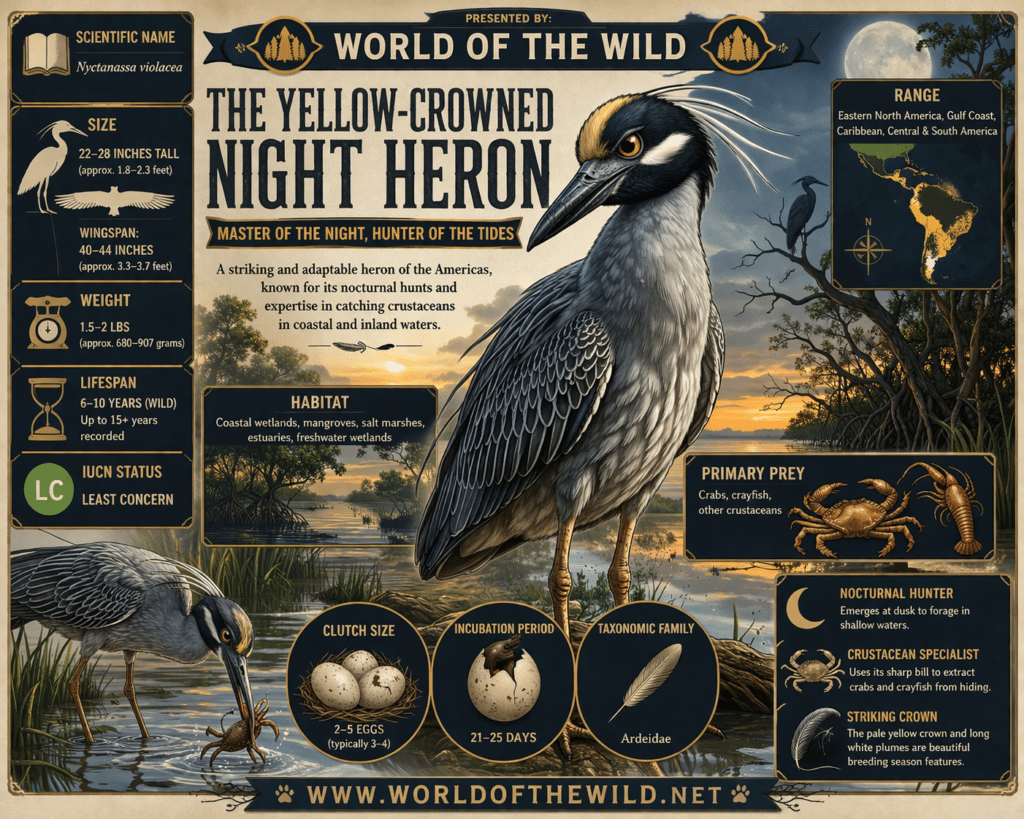

There is something almost mythical about catching a glimpse of a Yellow-Crowned Night Heron standing motionless at the edge of a moonlit marsh, its striking plumage glowing faintly against the dark water. Unlike the more commonly celebrated wading birds — the snowy egret, the great blue heron — this compact, stocky bird tends to fly under the radar, both literally and figuratively. Yet those who take the time to truly observe it are rewarded with one of nature’s most elegantly designed hunters.
The Yellow-Crowned Night Heron (Nyctanassa violacea) is a bird that thrives in the shadows, navigating estuaries, mangroves, and coastal wetlands with quiet, unhurried precision. It is a specialist in every sense — built for stealth, adapted for a diet that most birds would never attempt, and possessing a beauty that rewards the patient observer. In a world where nature’s showiest creatures tend to steal the spotlight, the Yellow-Crowned Night Heron is a compelling reminder that some of the most extraordinary animals are the ones watching us from the reeds.
Facts
- Built for crustaceans: The Yellow-Crowned Night Heron has an unusually thick, powerful bill specifically adapted to crush the hard shells of crabs and crayfish — a dietary specialty that few other herons can match.
- Not strictly nocturnal: Despite the “night” in its name, this heron is actually crepuscular and will hunt actively during the day, particularly during the breeding season when it needs extra calories.
- A bird of the Americas: Unlike many heron species with vast intercontinental ranges, the Yellow-Crowned Night Heron is found exclusively in the Western Hemisphere, from the eastern United States down through Central and South America and into the Caribbean.
- Lifelong landmarks: These herons often return to the same nesting sites year after year, sometimes using and repairing the same nest platform across multiple breeding seasons.
- Solo commuters: While they may nest in loose colonies, Yellow-Crowned Night Herons are notably solitary feeders — individuals actively defend feeding territories and rarely share foraging grounds.
- The juveniles are unrecognizable: Young birds look dramatically different from adults, sporting streaky brown-and-white plumage that bears almost no resemblance to their parents’ bold black, white, and gold coloring — causing frequent misidentification in the field.
- Surprising urban adaptability: Unlike many wetland birds that have struggled with urban encroachment, Yellow-Crowned Night Herons have demonstrated a remarkable ability to colonize suburban neighborhoods, nesting in ornamental trees near drainage ditches, golf course ponds, and manicured parks.
Species
The Yellow-Crowned Night Heron belongs to one of the most diverse and ancient bird lineages on Earth. Its full taxonomic classification is as follows:
- Kingdom: Animalia
- Phylum: Chordata
- Class: Aves
- Order: Pelecaniformes
- Family: Ardeidae
- Genus: Nyctanassa
- Species: Nyctanassa violacea
The genus Nyctanassa is monotypic at the genus level — meaning the Yellow-Crowned Night Heron is the only living member of its genus, which sets it apart from its closest relative, the Black-Crowned Night Heron (Nycticorax nycticorax), which belongs to a separate but closely related genus. The two share similar ecological niches and a general body plan but diverged significantly in appearance, diet, and geographic emphasis.
Several subspecies of Nyctanassa violacea are recognized, with variation occurring primarily across their geographic range:
- N. v. violacea — The nominate subspecies, breeding along the Atlantic and Gulf Coasts of North America and throughout the Caribbean.
- N. v. bancrofti — Found along the Pacific Coast of Mexico and Central America, this subspecies tends to be paler in overall coloration.
- N. v. caliginis — Residing in Panama and northwestern South America, this form represents the southernmost extent of the species’ mainland range.
- N. v. gravirostris — Isolated on the Tres Marías Islands off the Pacific coast of Mexico, this island subspecies has developed subtle morphological distinctions including a notably heavier bill.
The various Caribbean island populations have historically been subject to taxonomic debate, with some ornithologists arguing that certain island forms deserve full species status, though the current scientific consensus continues to treat them as subspecies.
Appearance
The Yellow-Crowned Night Heron is a compact, sturdy wading bird with a silhouette quite distinct from the more elongated, graceful herons most people picture. Adults stand approximately 22 to 28 inches tall and have a wingspan ranging from 40 to 44 inches. They typically weigh between 1.5 and 2 pounds, making them considerably stockier and heavier-bodied than their build might suggest.
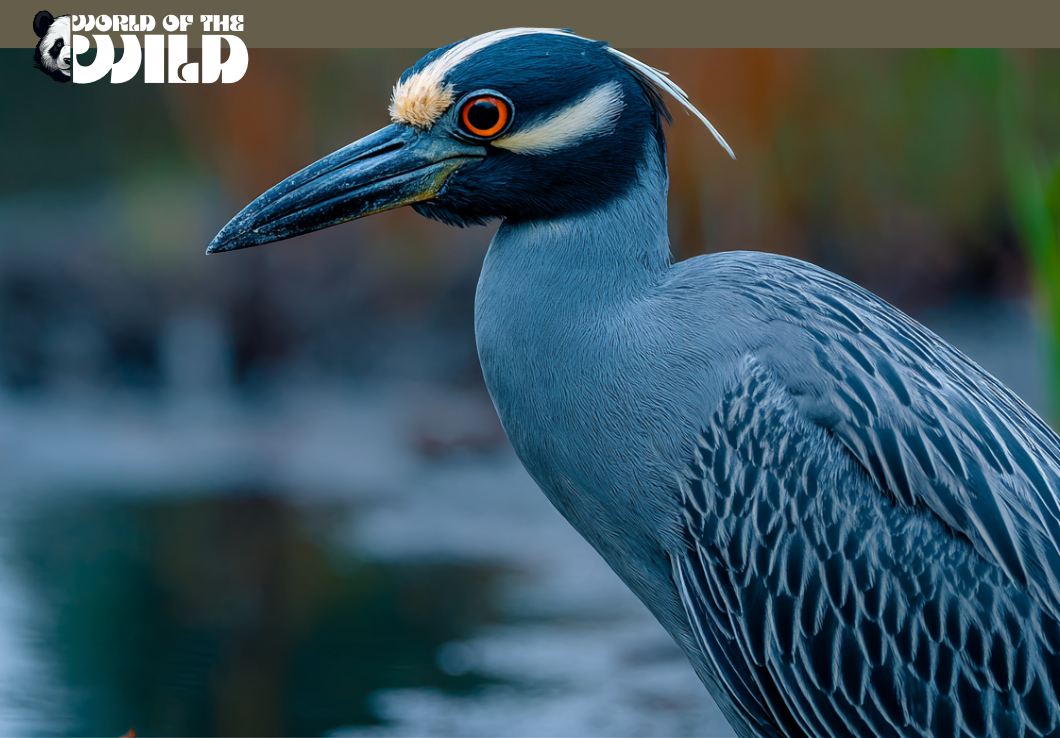
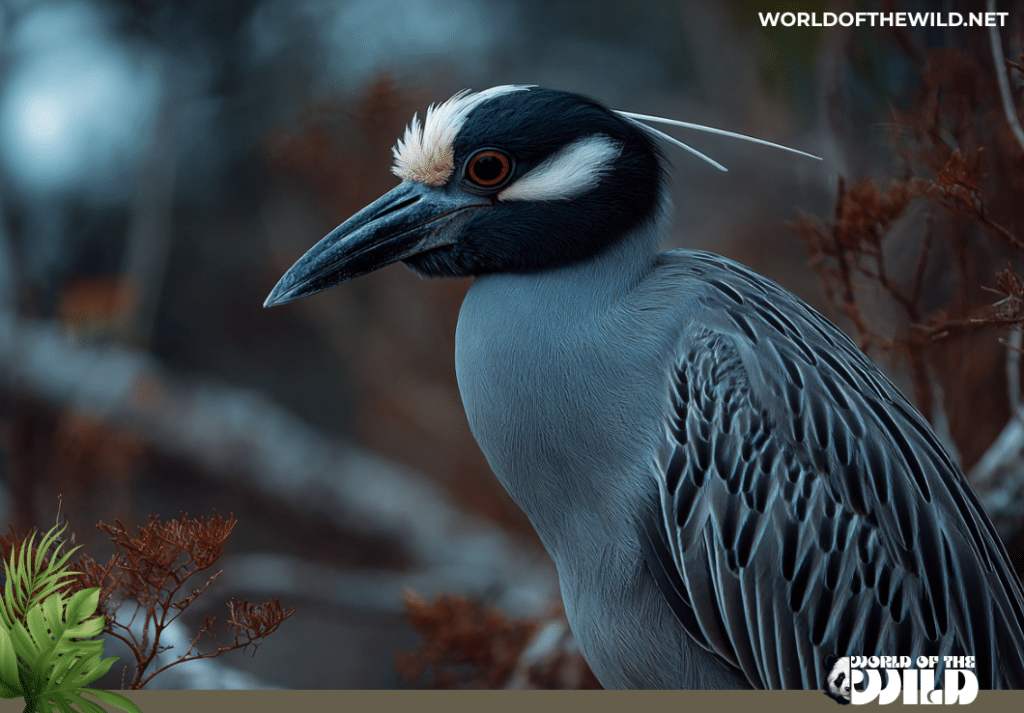
The plumage of adults is genuinely striking. The head is the bird’s most dramatic feature: a jet-black face framing a bold white cheek patch, topped by a pale yellow-to-cream crown that gives the species its name. During breeding season, this crown develops elongated white plumes that stream elegantly backward from the nape, adding theatrical flair to an already eye-catching bird. The eyes are a vivid, burning orange-red, giving the bird an intensity of expression that is almost unsettling up close.
The body plumage is a subtle but beautiful blue-gray, finely streaked with black along the back and wings. The bill is thick, blunt, and powerful — dark gray to black in color — a tool visibly designed for force rather than finesse. The legs are yellow to orange-yellow, often becoming more intensely colored during the breeding season as a signal of reproductive fitness.
Juvenile birds are, as mentioned, radically different in appearance. They display a heavily streaked brown and buff plumage across the entire body, with small white spots on the wing feathers and dark streaking on an ochre-toned face. They lack any trace of the adult’s bold head pattern and can easily be mistaken for juvenile Black-Crowned Night Herons or even immature bitterns. This juvenile plumage is worn for roughly the first year of life, gradually transitioning through intermediate stages before the full adult plumage is achieved by the second or third year.
Sexual dimorphism in this species is minimal — males and females share nearly identical plumage, though males tend to be very slightly larger on average.
Behavior
The Yellow-Crowned Night Heron is a bird defined by patience and precision. Its hunting strategy is one of calculated stillness punctuated by explosive action. It will stand motionless at the water’s edge for extended periods, neck drawn back into its shoulders, eyes fixed on the shallows below. When prey is detected, the strike is delivered with remarkable speed — a sudden, decisive lunge that leverages the bird’s powerful neck muscles.
What makes this heron particularly fascinating behaviorally is its relationship with crustaceans. Rather than simply swallowing prey whole as many herons do, the Yellow-Crowned Night Heron often manipulates crabs in its bill — rotating them, crushing the shell, and carefully removing or flattening appendages before consumption. This level of food handling sophistication is unusual among herons and speaks to a degree of learned, experience-refined behavior.
Despite being named a “night” heron, these birds are highly flexible in their activity patterns. Foraging can occur at any hour, though peak activity tends to occur during dawn and dusk. During breeding season, both day and night hunting is common as the energetic demands of raising chicks intensify.
Socially, Yellow-Crowned Night Herons occupy an interesting middle ground. They nest in loose colonies — sometimes alongside other heron and egret species in mixed heronries — but are fiercely territorial when it comes to foraging. Individual birds will actively chase competitors away from productive feeding sites, using a combination of aggressive postures, vocalizations, and short pursuit flights.
Their vocalizations are relatively limited compared to songbirds, but include a sharp, barking quawk alarm call — somewhat hoarser than that of the Black-Crowned Night Heron — as well as softer clucking and bill-snapping sounds used during pair bonding and chick communication at the nest.
The species also displays notable site fidelity, not just to nesting colonies but to specific foraging routes and territories, suggesting spatial memory and individual recognition of productive habitat features.
Evolution
The family Ardeidae — the herons, egrets, and bitterns — is an ancient and remarkably successful lineage with fossil records extending back approximately 60 million years to the early Eocene epoch. The broader group of wading birds to which herons belong diversified rapidly during the Paleogene period as continental configurations shifted and new wetland ecosystems emerged across the globe.
The genus Nyctanassa diverged from its close relatives relatively early within the heron family, and its isolation to the Western Hemisphere suggests a lineage that established itself in the Americas during a period when faunal interchange between the continents was occurring. The split between Nyctanassa and the closely related Old World genus Nycticorax (the Black-Crowned Night Heron’s group) is estimated to have occurred several million years ago, likely during the Miocene or Pliocene, as ecological and geographic pressures drove the two lineages toward divergent specializations.
The Yellow-Crowned Night Heron’s most significant evolutionary signature is its dietary specialization toward hard-shelled crustaceans. This is reflected directly in its morphology — the unusually heavy, blunt bill and robust jaw musculature are derived features that distinguish it from the more generalist bill shapes seen in closely related species. This specialization represents a classic example of niche partitioning, allowing the Yellow-Crowned Night Heron to exploit a food resource that other herons largely avoid, thereby reducing direct competition.
Island colonization also appears to have been an important driver of differentiation within the species, with isolated Caribbean and Pacific island populations evolving subtle morphological distinctions over thousands of generations — a process of microevolution in real time that continues to be studied by ornithologists today.
Habitat
The Yellow-Crowned Night Heron is fundamentally a bird of warm, coastal wetlands. Its core range extends along the Atlantic Coast of North America from Massachusetts south through Florida, across the Gulf Coast states, through the Caribbean archipelago, and along both the Atlantic and Pacific coasts of Central and South America, reaching as far south as Peru and Brazil.
Within this geographic range, the species shows a strong preference for coastal and near-coastal habitats, particularly mangrove forests, salt marshes, tidal mudflats, estuaries, and the edges of brackish and freshwater wetlands. Mangroves are especially important — they serve simultaneously as nesting habitat (providing dense, elevated cover for colonies) and foraging habitat (their intricate root systems are prime hunting grounds for crabs and other crustaceans).
In the interior of North America, Yellow-Crowned Night Herons are far less common but do occur along major river systems, swamps, and freshwater wetlands where crayfish populations are abundant. This inland distribution has expanded in some areas, particularly in the southeastern United States, as the birds have demonstrated an increasing willingness to colonize suburban and semi-urban green spaces.
The species is largely non-migratory in tropical portions of its range but is migratory in North America, with northern breeding populations withdrawing to the Gulf Coast, Florida, and the Caribbean during winter months. Some individuals, particularly those breeding in the coastal Southeast, may remain year-round in areas with mild winters and reliable food sources.
Key features of quality habitat include: shallow water for foraging, dense woody vegetation for nesting, abundant crustacean prey, and proximity to undisturbed refugia during the nesting season.

Diet
The Yellow-Crowned Night Heron is a carnivore with a deeply specialized dietary profile. While it is technically capable of consuming a variety of small aquatic prey — fish, frogs, small snakes, insects, worms, and the occasional small mammal — its diet is dominated to an extraordinary degree by crustaceans, specifically crabs and crayfish.
In coastal habitats, fiddler crabs, mud crabs, and other intertidal crustaceans form the cornerstone of the diet. In freshwater and inland habitats, crayfish take center stage. Studies of stomach contents and regurgitated pellets from Yellow-Crowned Night Herons consistently reveal that crustaceans account for the vast majority of prey items by both number and biomass — in some populations, crustaceans represent more than 90% of the diet.
Hunting is primarily a visual, ambush-based enterprise. The heron positions itself at the water’s edge or wades slowly in very shallow water, adopting a hunched, motionless posture. When a crab or crayfish is detected — often through subtle movement in the mud or shallows — the bird strikes with explosive speed, seizing the prey crossways in its bill. The thick, muscular bill then works to crush the shell, and the bird maneuvers the prey into a head-first position for swallowing.
This feeding strategy is most effective during low tide in coastal areas, when crabs are most exposed and concentrated. Foraging activity correspondingly tracks tidal cycles, with birds often timing their hunting periods to coincide with falling and low tides regardless of time of day or night.
Indigestible material — shell fragments, exoskeletal pieces — is compacted and regurgitated as pellets, much like those produced by owls, providing researchers with a convenient and informative record of dietary habits.
Predators and Threats
Natural Predators
Yellow-Crowned Night Herons face a relatively modest suite of natural predators as adults, given their wariness and the protective cover of their typical habitats. Great Horned Owls are perhaps the most significant avian predator, capable of taking adult herons from their nocturnal roosts. Raccoons, rat snakes, and other climbing predators pose a significant threat to nests — raiding eggs and taking small chicks from colonial nesting sites. American Alligators may take birds at the water’s edge in southeastern U.S. habitats, and large raptors such as Red-tailed Hawks can threaten juveniles and younger birds.
The colonial nesting behavior, while offering some degree of collective vigilance, also concentrates the birds in ways that can make entire nesting cohorts vulnerable to a single predator event.
Human-Caused Threats
The most significant threats to Yellow-Crowned Night Herons today are those created directly or indirectly by human activity:
- Habitat loss and degradation: The destruction of mangrove forests, coastal wetland drainage, and the conversion of estuarine habitats for agriculture, aquaculture, and coastal development represent the single largest threat category. Mangroves alone are being lost at alarming rates globally, and each acre lost removes both foraging and nesting habitat.
- Pollution: Pesticide accumulation — particularly organochlorines and heavy metals — concentrates through the food chain in crustaceans and can cause eggshell thinning, reproductive failure, and physiological harm in herons.
- Climate change: Sea level rise threatens low-lying coastal nesting sites, while shifts in temperature and precipitation alter the distribution and abundance of crustacean prey populations. Increased storm frequency and intensity can devastate entire nesting colonies during the breeding season.
- Disturbance at nesting colonies: Human recreational activity, development near heronries, and urban noise and light pollution can cause colony abandonment, particularly during the sensitive early nesting period.
- Vehicle strikes: As the species increasingly colonizes suburban environments, road mortality has emerged as a localized but meaningful threat to juveniles dispersing from nesting sites.
Reproduction and Life Cycle
The breeding season for Yellow-Crowned Night Herons in North America typically runs from March through July, with timing shifting somewhat later in more northern portions of the range. In tropical populations, breeding may occur across a broader seasonal window tied more closely to local resource availability than to temperature cues.
Courtship and Pair Bonding
Courtship is an elaborate affair by heron standards. Males arrive at nesting sites first and begin establishing territory, advertising their presence through upright posturing, the display of their ornamental crown plumes, and repeated vocalizations. As females arrive, pairs engage in mutual preening, bill-clapping displays, and the offering of nest sticks — a ritualized behavior common in many heron species that reinforces pair bond formation. Pairs are generally monogamous within a breeding season, and many individuals reunite with the same mate in successive years.
Nesting
Nests are substantial platform structures built of sticks and lined with finer plant material, typically placed in the forks of trees or dense shrubs — mangroves, live oaks, baldcypress, and suburban ornamental trees are all commonly used. Nest sites may be anywhere from 10 to 50 feet above the ground or water. Both sexes contribute to nest construction, with the male typically gathering material and the female doing most of the actual building and arranging.
Eggs and Incubation
Clutch size typically ranges from 2 to 5 eggs, with 3 to 4 being most common. Eggs are pale blue-green and are incubated by both parents for approximately 21 to 25 days. Hatching is asynchronous — eggs hatch sequentially rather than simultaneously — meaning chicks within the same nest are of slightly different ages and sizes, which can influence survival rates during food-limited periods.
Chick Development and Parental Care
Chicks are altricial at hatching — helpless, covered in sparse white down, and entirely dependent on parental brooding and feeding. Both parents participate actively in feeding, regurgitating partially digested food directly into the nest or allowing chicks to reach into the parent’s throat. Chicks grow rapidly and begin standing and moving around the nest platform within two to three weeks. By approximately five to six weeks of age, young birds begin making short flights to nearby branches, and full fledging occurs at around six to seven weeks.
Family bonds persist for several weeks post-fledging, with parents continuing to provision juveniles as they learn to hunt independently. First-year survival rates are considerably lower than those of experienced adults, with the acquisition of efficient foraging skills representing the primary challenge of early life.
Lifespan
Wild Yellow-Crowned Night Herons typically live 6 to 10 years, though banding records have documented individuals surviving to more than 15 years in exceptional cases. Captive individuals have lived longer still, though this species is not commonly held in captivity.

Population
The Yellow-Crowned Night Heron is currently listed as Least Concern on the IUCN Red List of Threatened Species, reflecting the fact that globally, the species maintains a sufficiently large and widespread population that it does not currently meet the thresholds for a threatened category.
Global population estimates are difficult to pin down precisely due to the species’ often-secretive habits and wide distribution across two continents and numerous island chains, but North American breeding population estimates from recent continent-wide bird surveys have suggested somewhere in the range of 70,000 to 100,000 individuals in the United States and Canada alone, with additional populations across the Caribbean and Latin America pushing global numbers considerably higher.
However, the “Least Concern” designation should not breed complacency. North American breeding bird survey data has revealed meaningful declines in certain regional populations over recent decades, particularly in areas where coastal wetland loss has been most severe. Gulf Coast populations have shown some of the most pronounced declines, consistent with the catastrophic loss of Louisiana coastal marshes and the broader degradation of Gulf estuarine ecosystems.
Caribbean island subspecies are of particular concern. Smaller, more geographically isolated populations are inherently more vulnerable to stochastic events — a single powerful hurricane season, an introduced predator, or a localized pollution event can have disproportionate impacts on island birds. Several Caribbean subspecies are monitored with greater scrutiny than the mainland populations.
The species has shown genuine resilience in some urban and suburban environments, with populations establishing in cities from Houston to Baltimore, suggesting a degree of ecological flexibility that offers cautious optimism. Nevertheless, the long-term trajectory of the species is inextricably linked to the fate of coastal wetlands — habitats that are among the most threatened ecosystems on Earth.
Conclusion
The Yellow-Crowned Night Heron is, in many ways, a bird that encapsulates the complicated beauty of the natural world. It is ancient in lineage yet modern in its adaptations, a specialist that has carved out a living from one of the ocean’s most armor-plated food sources. It haunts the margins — of water and land, of day and night, of wilderness and city — with a quiet authority that demands attention from those willing to slow down and look.
Its story is also, inevitably, a story about the coastlines we are losing. Every mangrove forest cleared, every wetland drained, every estuary choked with runoff represents not just an abstraction but a direct cost paid by creatures like the Yellow-Crowned Night Heron and the vast, interconnected webs of life they inhabit. This bird is a sentinel species — its health and abundance is a direct reflection of the health of the coastal systems upon which so many other species, including our own, ultimately depend.
The next time you find yourself near a tidal creek at dusk, scan the edges carefully. If you are patient enough, you may catch the orange eye and the gilded crown of a bird that has been perfecting its craft for millions of years — and in that moment, consider what it would mean to lose it.
Quick Reference
| Scientific Name | Nyctanassa violacea |
| Diet Type | Carnivore (crustacean specialist) |
| Size | 22–28 inches tall (approx. 1.8–2.3 feet); Wingspan: 40–44 inches (approx. 3.3–3.7 feet) |
| Weight | 1.5–2 lbs (approx. 680–907 grams) |
| Lifespan | 6–10 years (wild); up to 15+ years recorded |
| IUCN Status | Least Concern |
| Habitat | Coastal wetlands, mangroves, salt marshes, estuaries, freshwater wetlands |
| Range | Eastern North America, Gulf Coast, Caribbean, Central & South America |
| Primary Prey | Crabs, crayfish, other crustaceans |
| Clutch Size | 2–5 eggs (typically 3–4) |
| Incubation Period | 21–25 days |
| Taxonomic Family | Ardeidae |