
Imagine standing on a cliff’s edge, scanning the open sky, when suddenly a dark silhouette rockets downward at over 240 miles per hour — a living missile locked onto its prey with terrifying precision. In the blink of an eye, the strike is complete. This is the Peregrine Falcon: arguably the most awe-inspiring predator on the planet, and without question, the fastest animal alive.
But raw speed is only part of the story. The Peregrine Falcon is a creature of extraordinary resilience, having pulled itself back from the very brink of extinction in the twentieth century — a comeback story so dramatic it reshaped how humanity thinks about conservation. Found on every continent except Antarctica, this raptor has conquered urban skylines and remote Arctic tundra alike, adapting to virtually any environment that offers open sky and a reliable meal. To understand the Peregrine is to understand one of nature’s most elegant designs: a body and mind honed over millions of years into the perfect aerial predator.
Facts
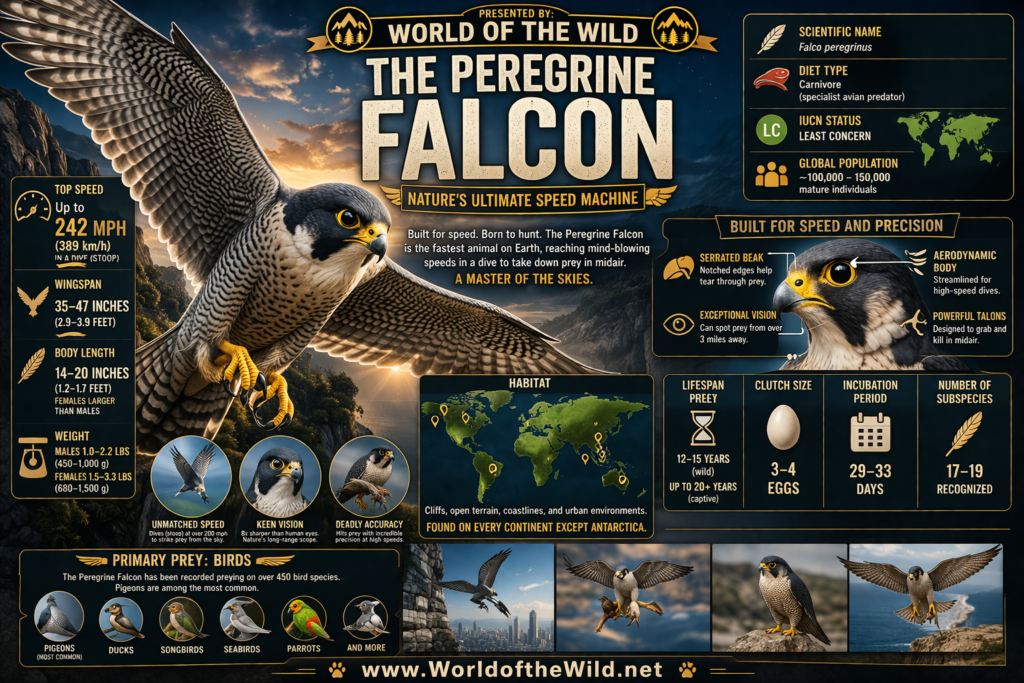
- Speed record holder — by a wide margin. The Peregrine Falcon holds the title of fastest animal on Earth, reaching dive speeds of up to 242 mph (389 km/h). For context, that’s faster than a Formula 1 race car at full throttle.
- Their nostrils are engineered like jet engine baffles. Small bony tubercles inside their nostrils redirect airflow during high-speed dives, preventing the rush of air from damaging their lungs — a feature so effective that aerospace engineers modeled jet engine intake designs after it.
- They see in slow motion — relatively speaking. Peregrine Falcons have a flicker fusion rate (the speed at which the eye processes individual images) of roughly 129 Hz, compared to about 60 Hz in humans. This allows them to track fast-moving prey without losing visual clarity during a stoop.
- A third eyelid protects their eyes mid-dive. Called the nictitating membrane, this translucent inner eyelid sweeps across the eye during a stoop, keeping it moist and shielded from debris and high-velocity airflow.
- They were among the first animals protected under the Endangered Species Act. In the United States, Peregrine populations were decimated by the pesticide DDT. After the chemical was banned in 1972, the Peregrine became a flagship species for recovery efforts — and it worked spectacularly.
- Urban falcons have developed a new hunting strategy. City-dwelling Peregrines exploit artificial light to hunt migrating songbirds at night — a behavioral adaptation documented only in urban populations, illustrating just how quickly this species can evolve its tactics.
- They “ring up” their prey before striking. Peregrines often soar in wide, thermal-riding spirals to gain altitude before hunting — a technique called “ringing up” — so that gravity amplifies the lethal force of their dive.
Species
The Peregrine Falcon belongs to the following taxonomic hierarchy:
| Rank | Classification |
|---|---|
| Kingdom | Animalia |
| Phylum | Chordata |
| Class | Aves |
| Order | Falconiformes |
| Family | Falconidae |
| Genus | Falco |
| Species | Falco peregrinus |
The species name peregrinus is Latin for “wanderer” or “pilgrim” — a fitting tribute to one of the world’s most widely distributed birds.
Scientists recognize between 17 and 19 subspecies of Peregrine Falcon, though classification varies by authority. The most notable include:
- Falco peregrinus anatum — The American Peregrine Falcon, historically distributed across much of North America. This subspecies was the hardest hit by DDT contamination and was the focus of intensive captive breeding programs. It has since made a remarkable recovery.
- Falco peregrinus tundrius — The Tundra Peregrine, breeding across Arctic North America and Greenland. It is notably paler than other subspecies, likely an adaptation for its open, high-latitude environment.
- Falco peregrinus peregrinus — The Nominate subspecies, found across Europe and much of Asia. This is the “textbook” Peregrine — medium-sized, darkly marked, and the form most commonly depicted in field guides.
- Falco peregrinus pealei — Peale’s Falcon, one of the largest subspecies, resident along the coasts of the North Pacific from British Columbia to the Aleutian Islands. Unlike most Peregrines, it is largely non-migratory.
- Falco peregrinus calidus — A pale, large subspecies breeding across the northern Palearctic tundra and wintering as far south as sub-Saharan Africa and South Asia.
The closest relatives within the Falco genus include the Prairie Falcon (Falco mexicanus), the Lanner Falcon (Falco biarmicus), and the Saker Falcon (Falco cherrug) — all powerful hunters in their own right, but none approaching the Peregrine’s legendary velocity.
Appearance
The Peregrine Falcon is built for one thing above all else: speed. Every dimension of its body reflects this singular evolutionary purpose.
Size and Weight: Adult Peregrines are medium-to-large falcons, with females (called falcons) considerably larger than males (called tiercels) — a size difference known as reverse sexual dimorphism, common among raptors. Females typically measure 17–20 inches (1.4–1.7 feet) in body length with a wingspan of 39–47 inches (3.3–3.9 feet), while males are smaller at 14–17 inches (1.2–1.4 feet) with a 35–43 inch (2.9–3.6 feet) wingspan. Females weigh between 1.5–3.3 lbs (680–1,500 g), while males weigh a lighter 1.0–2.2 lbs (450–1,000 g).
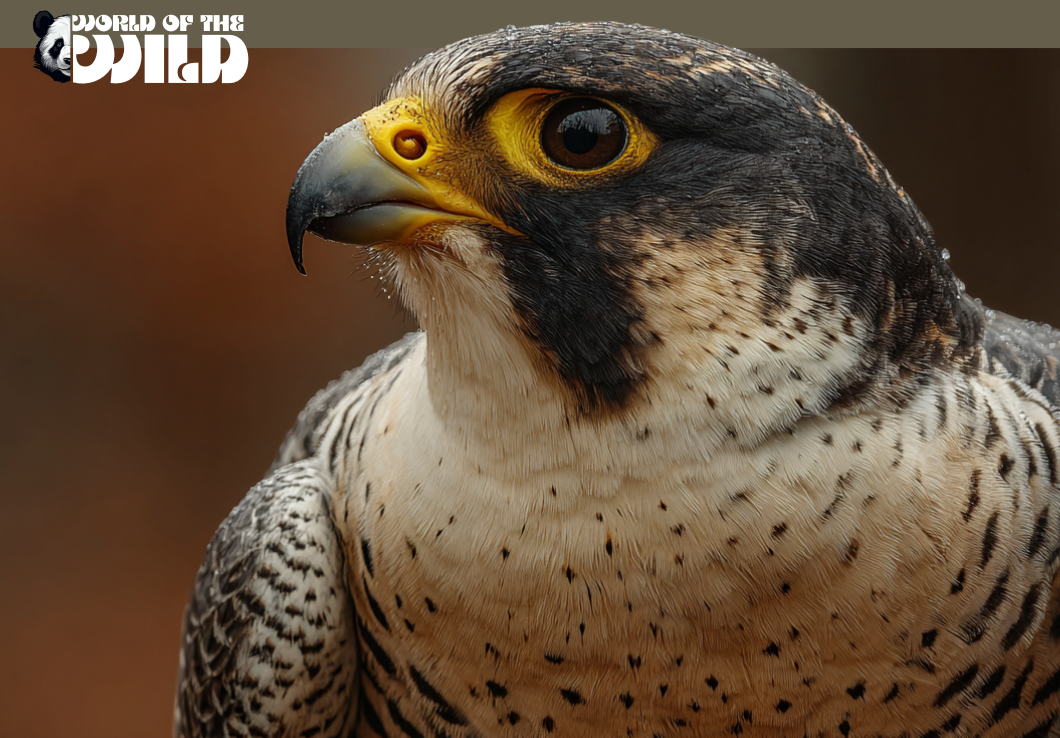
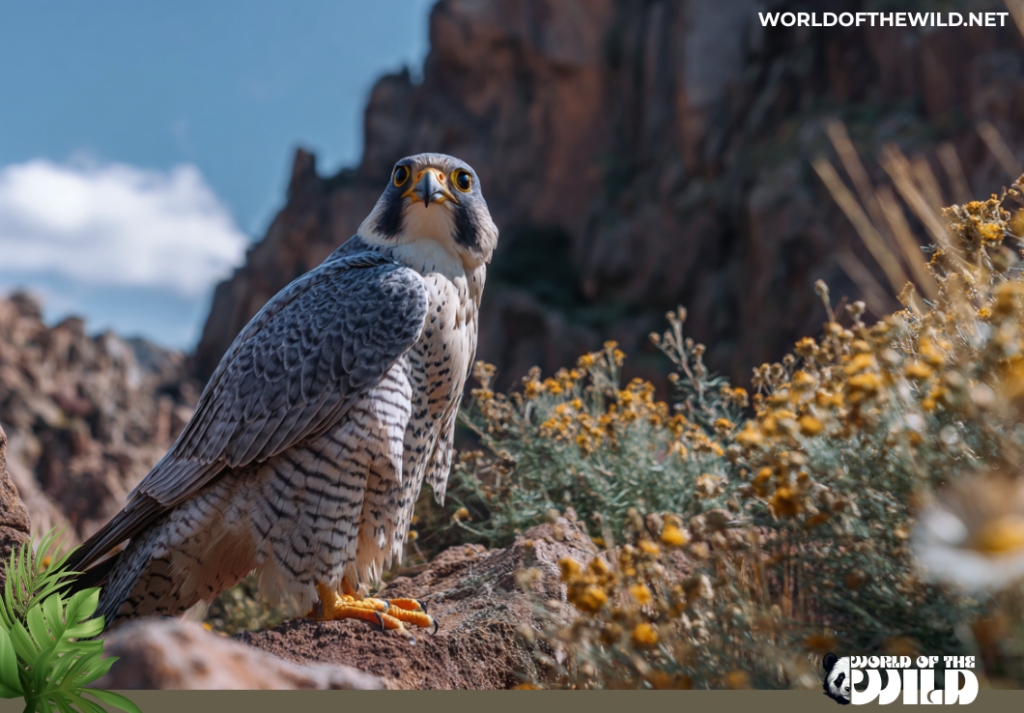
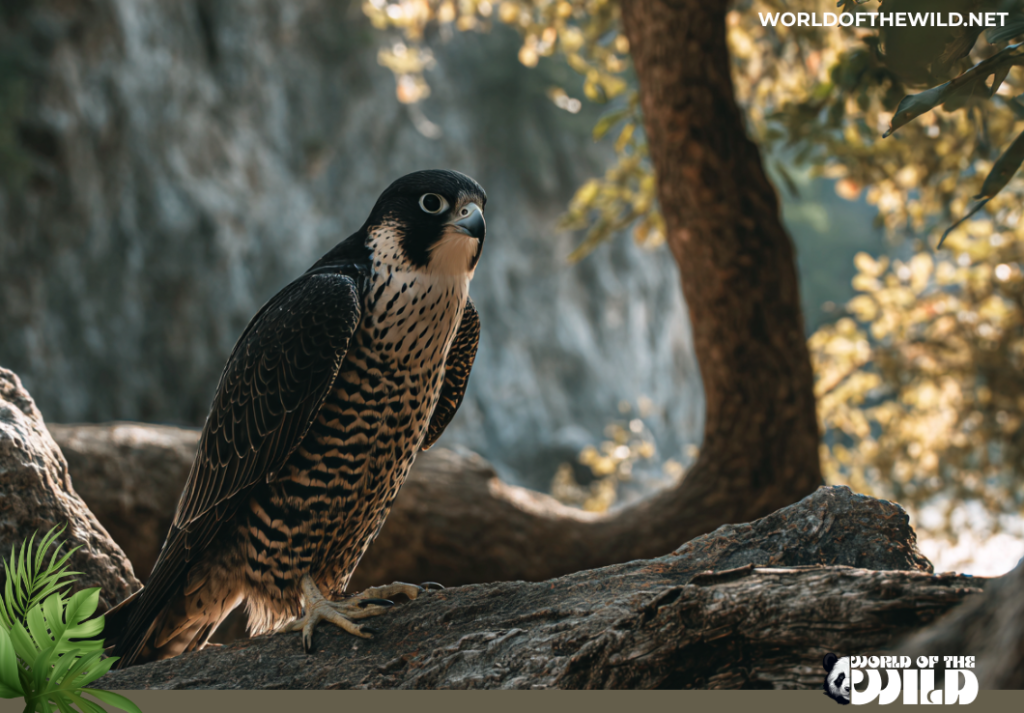
Plumage and Coloration: Adults display a distinctive and striking color palette. The upperparts (back, wings, and crown) are a deep blue-gray to slate, almost charcoal in some subspecies. The underparts are pale cream to white, heavily barred with dark horizontal streaks across the belly and flanks. The face bears one of the most recognizable markings in the avian world: bold, dark “mustache” or malar stripes that extend downward from below each eye. These markings are thought to function like an athlete’s eye-black, reducing solar glare during hunts.
The crown and nape are dark, nearly black, giving the head a helmeted appearance perfectly suited to its predatory identity. The cere (the fleshy covering at the base of the bill), eye ring, and feet are bright yellow — vivid anatomical punctuation against the otherwise muted palette.
Structural Features: The Peregrine’s silhouette in flight is unmistakable: long, pointed, swept-back wings and a relatively short, tapered tail create an anchor-like or crossbow shape when viewed from below. This aerodynamic form minimizes drag during a stoop. The talons are long, sharp, and powerful — designed not just to grip but to deliver a stunning blow to prey mid-air. The notched upper beak (tomial tooth) allows the falcon to efficiently sever the spinal cord of captured prey, making the kill rapid and efficient.
Juveniles are considerably browner overall, with streaked (rather than barred) underparts, and they lack the polished, clean-cut appearance of adults until they complete their first full molt at around 12–16 months of age.
Behavior
Daily Activity and Hunting: Peregrines are primarily diurnal hunters, most active in the hours around dawn and dusk when prey birds are on the move. Their famous hunting method — the stoop — is a near-vertical dive that begins from a significant altitude advantage gained by soaring on thermals or from a commanding perch such as a cliff face, tall building, or bridge tower. During the stoop, the falcon partially folds its wings against its body, becoming a teardrop of biological engineering. It does not merely dive and hope — it adjusts its trajectory continuously, tracking its prey with those extraordinary eyes, before delivering a devastating strike with closed talons that can knock a bird clean out of the sky.
In urban environments, Peregrines have been documented hunting at night, exploiting the disorienting effect of city lights on migrating songbirds — a behavioral flexibility that speaks to the species’ remarkable adaptability.
Social Structure: Peregrines are largely solitary outside of the breeding season, defending individual home ranges and hunting territories aggressively. They are known to be highly site-faithful, returning to the same nesting cliff or building year after year, sometimes for multiple generations. Pairs are generally monogamous, often maintaining the same partner across multiple breeding seasons.
Communication: These falcons are not particularly vocal by raptor standards, but they possess a repertoire of calls used in specific contexts. The “cack” call — a rapid, rasping kak-kak-kak-kak — is their most frequently heard vocalization, used in aggressive defense of the nest, alarm responses, and territorial disputes. Pairs also communicate with softer “wailing” and “creaking” calls during courtship and food transfers.
Intelligence and Problem-Solving: Peregrines demonstrate impressive learned behavior and spatial memory. Experienced individuals have been observed deliberately flushing prey birds from cover before climbing to gain a height advantage — suggesting pre-planned, tactical hunting. Captive-bred birds released into the wild can learn to hunt effectively, suggesting a significant capacity for behavioral adaptation beyond pure instinct.
Evolution
The evolutionary history of the Peregrine Falcon stretches back to the deep past of avian diversification. Birds of prey in the order Falconiformes share ancestry with other modern birds but diverged on a distinct evolutionary trajectory approximately 40–50 million years ago during the Eocene epoch, as the proliferation of small birds created a rich ecological niche for aerial predators.
Falcons, however, are fascinating outliers within the raptor world. Molecular phylogenetic studies conducted in the late 20th and early 21st centuries revealed a stunning discovery: falcons are not closely related to hawks and eagles (order Accipitriformes). Despite their shared predatory lifestyle and superficial similarities, falcons evolved independently — their “raptor” traits are the product of convergent evolution, not shared ancestry. Falcons are, in fact, more closely related to parrots and passerines (perching birds) than they are to red-tailed hawks or bald eagles.
The genus Falco itself is estimated to have originated approximately 8–10 million years ago during the Miocene, likely in Africa, before diversifying and spreading across the globe. The Peregrine lineage as a distinct species is thought to have emerged around 1–2 million years ago, during the Pleistocene — a period of dramatic climate fluctuations that may have driven the geographic isolation and subsequent divergence of the various subspecies we recognize today.
The tomial tooth — that sharp notch on the upper beak used to sever prey’s spinal cord — evolved independently in falcons and was not inherited from a common ancestor shared with other raptors. This is a textbook example of how similar selection pressures (the need to kill quickly) can produce identical anatomical solutions in unrelated lineages.
Habitat
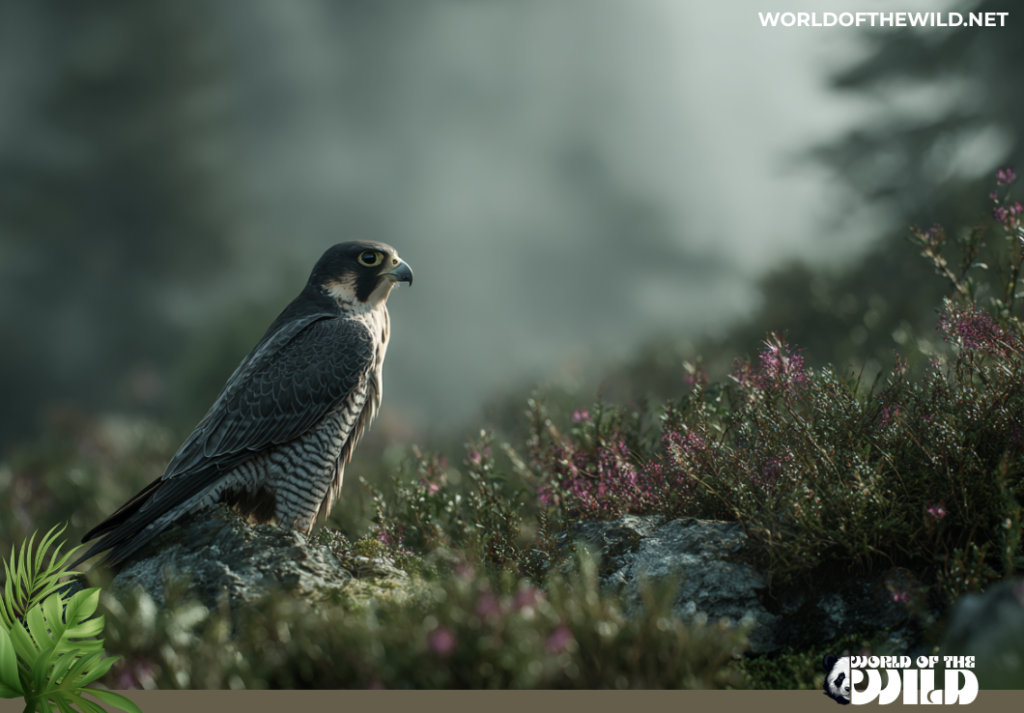
Few animals on Earth match the Peregrine Falcon’s geographic breadth. It is found on every continent except Antarctica, making it one of the most cosmopolitan wild birds in existence. Its range spans from the high Arctic tundra of Canada and Russia to the temperate forests of Europe, the open deserts of the Middle East, the coastal cliffs of South America, and the tropical regions of sub-Saharan Africa and Southeast Asia.
Natural Habitats: In their most traditional form, Peregrines are associated with open landscapes and cliff faces. Coastal cliffs, river gorges, mountainsides, and rocky escarpments provide ideal nesting sites with commanding views of surrounding terrain — essential for spotting and intercepting prey. Open water bodies, wetlands, estuaries, and shorelines are especially productive hunting grounds, as they concentrate large flocks of shorebirds and waterfowl.
Urban Environments: Over the past several decades, Peregrines have colonized cities worldwide with remarkable success. Skyscrapers, bridges, cathedrals, and power station chimneys serve as functional analogues to natural cliff faces — tall, flat-faced structures from which falcons can survey and hunt. Cities also offer a year-round buffet of feral pigeons, the Peregrine’s most abundant urban prey. Major cities including New York, London, Chicago, Toronto, and Sydney now host established and often thriving urban Peregrine populations.
Migratory Behavior: Many Peregrine populations — particularly those breeding at high latitudes — are long-distance migrants, traveling thousands of miles between breeding and wintering grounds. Arctic-breeding Tundra Peregrines (F. p. tundrius) may migrate from the Canadian Arctic to southern South America, covering distances of up to 15,000 miles annually. Other populations, particularly those in temperate climates and urban environments, are largely resident year-round.
Diet
The Peregrine Falcon is an obligate carnivore and, with very few exceptions, an exclusive hunter of birds. This specialization in avian prey is one of the defining characteristics of the species and a primary driver of many of its remarkable physiological and behavioral adaptations.
Primary Prey: The Peregrine’s menu is breathtakingly diverse — over 450 species of birds have been recorded as prey across its global range. Primary targets include:
- Pigeons and doves (especially feral rock pigeons in urban environments)
- Shorebirds and wading birds (sandpipers, dunlins, godwits)
- Waterfowl (teal, ducks, and coots, particularly smaller species)
- Songbirds and starlings (especially during migration)
- Swifts and swallows (which the falcon can outmaneuver even in level flight)
- Waders and gulls (along coastal hunting grounds)
In rare instances — particularly among Arctic populations when avian prey is seasonally scarce — Peregrines have been documented taking bats, small mammals such as voles, and even large insects. These occurrences, however, are exceptions rather than rules.
Hunting Technique: The Peregrine’s primary strategy is the aerial stoop. After gaining height advantage (often 1,000 feet or more above the prey), the falcon tilts into a dive, accelerating rapidly while making real-time corrections to intercept the target. The kill is typically delivered via a closed-talon strike to the head or body of the prey bird — the impact alone is often fatal. The Peregrine then catches the falling prey or descends to retrieve it from the ground. If the prey survives the strike, the tomial tooth is used to deliver a swift bite to the base of the skull.
Peregrines are also capable of horizontal pursuit in level flight and have been recorded catching highly maneuverable prey like swifts — a testament to their aerial agility, not just their speed.
Predators and Threats
Natural Predators: Adult Peregrine Falcons have few natural predators, owing to their speed, agility, and aggressive nest defense. However, eggs, chicks, and inexperienced juveniles face threats from:
- Great Horned Owls (Bubo virginianus) — one of the primary natural enemies of nesting Peregrines in North America, capable of overpowering adults at night
- Golden Eagles (Aquila chrysaetos) — large enough to predate or displace Peregrines
- Red-tailed Hawks (Buteo jamaicensis) — occasional nest raiders
- Raccoons and other climbing mammals — opportunistic egg and chick predators at accessible nest sites
Interestingly, Peregrines are known for their ferocious nest defense and will physically strike intruders many times their own size, including humans, crows, ravens, and even eagles.
Human-Caused Threats:
- DDT and Organochlorine Pesticides — The most catastrophic human threat in the Peregrine’s history. DDT, widely used after World War II, bioaccumulated up the food chain and caused eggshell thinning in Peregrines, leading to mass reproductive failure. By the 1970s, Peregrines had been extirpated from the entire eastern United States. The 1972 ban of DDT in the US, and subsequent bans in other nations, was the critical turning point for their recovery. However, organochlorine pesticides remain in use in parts of Latin America and Africa, still posing a threat to migratory birds.
- Rodenticides (Second-Generation Anticoagulants) — Urban Peregrines frequently prey on poisoned pigeons and rats, leading to secondary poisoning. This remains a significant and underappreciated threat to urban raptor populations globally.
- Habitat Disturbance and Human Encroachment — Nest site disturbance during the critical breeding period, particularly near recreational climbing areas, is a persistent challenge. Even well-intentioned human presence near cliff nests can cause nest abandonment.
- Illegal Persecution and Falconry Poaching — Despite legal protections in most countries, Peregrine eggs and chicks are still stolen for the illegal falconry trade, particularly in the Middle East, where trained Peregrines command extraordinarily high prices.
- Climate Change — Shifting prey migration timing, altered weather patterns during breeding season, and the northward compression of Arctic tundra habitat pose growing long-term threats to high-latitude populations.
- Collisions — Urban Peregrines, particularly juveniles during their first flights, face collision risks with glass buildings — an increasingly recognized urban wildlife challenge.
Reproduction and Life Cycle
Courtship and Pair Bonding: Peregrine courtship is an aerial spectacle worthy of its performer. Beginning in late winter or early spring, potential pairs engage in elaborate flight displays — mutual soaring, high-speed chases, steep dives, and mid-air food passes in which the male drops prey for the female to catch. These performances serve both to assess fitness and reinforce the pair bond. Once formed, pairs are typically monogamous for life (or until a partner dies), returning to the same territory and often the same nest site each year.
Nesting: Peregrines do not build traditional nests. Instead, they use a scrape — a shallow depression scratched into a bare ledge, cliff face, gravel rooftop, or even a simple ledge on a tall building. They do not add nesting material. In conservation programs, nest boxes filled with gravel have been installed on buildings and bridges to encourage urban nesting and improve chick survival rates. Both parents actively defend the scrape from all perceived threats with remarkable aggression.
Eggs and Incubation: A typical clutch consists of 3–4 eggs (range: 2–5), which are brick-red to creamy brown with darker mottling — coloring that provides camouflage against bare rock. Both parents share incubation duties over approximately 29–33 days. The female performs the majority of incubation, while the male hunts and delivers prey.
Chick Development: Hatchlings, called eyases, emerge covered in white down and are entirely dependent on their parents for warmth and food. The female remains with the chicks (broods them) while the male hunts almost continuously during the first few weeks. By 5–6 weeks, the eyases are feathered and begin flapping and exercising their wings. Fledging (first flight) occurs at approximately 35–45 days after hatching.
Post-Fledging and Dispersal: Even after fledging, young Peregrines remain dependent on their parents for several more weeks, learning to hunt through a combination of parental demonstration and trial and error. By early autumn, juveniles disperse from the natal territory to find their own ranges. Sexual maturity is typically reached at 1–3 years of age.
Lifespan: Wild Peregrines typically live 12–15 years, though exceptional individuals have been documented living beyond 20 years. Captive birds, free from predation and environmental hazard, can live into their mid-twenties.
Population
The Peregrine Falcon is currently listed as Least Concern on the IUCN Red List of Threatened Species — a remarkable reversal from its near-extinction in the mid-twentieth century. Global population estimates place the total number of mature individuals at approximately 100,000–150,000 birds, though precise global counts are inherently difficult given the species’ vast range and dispersed breeding territories.
In the United States specifically, the Peregrine Falcon was removed from the federal Endangered Species List in 1999, having recovered from fewer than 400 known nesting pairs in North America in the 1970s to more than 3,000 breeding pairs by the late 1990s. This recovery is widely regarded as one of the greatest success stories in the history of wildlife conservation, achieved through the combination of DDT banning, captive breeding and reintroduction programs (led by The Peregrine Fund, founded by ornithologist Tom Cade), and legal protection under the Migratory Bird Treaty Act.
Population Trends: Overall global trends are considered stable to increasing in regions where DDT has been effectively banned and legal protections are enforced. Urban populations in North America and Europe continue to expand, with new breeding pairs establishing territories in cities each year. However, populations in parts of sub-Saharan Africa, the Indian subcontinent, and Southeast Asia face ongoing pressure from pesticide use, habitat degradation, and poaching. Some Arctic subspecies may face future demographic pressure as climate change alters the timing and availability of migratory prey.
The Peregrine’s story remains one of cautious optimism — proof that conservation intervention, when scientifically grounded and politically supported, can genuinely rescue a species from the edge of oblivion.
Conclusion
The Peregrine Falcon is many things at once: the fastest animal on Earth, a master of aerodynamic physics, a survivor of one of the most devastating ecological catastrophes humans have ever unleashed, and an increasingly common resident of the steel-and-glass cliffs we call cities. It is a bird that demands attention — both for the breathtaking efficiency of its design and for the sobering lesson embedded in its near-disappearance.
That near-disappearance was entirely our doing. And so was its return.
The Peregrine’s recovery from the DDT catastrophe is not merely a wildlife success story — it is a moral one. It demonstrates that when humanity recognizes the harm it has caused and chooses to act with urgency and sustained commitment, ecosystems can heal. Species can return from the edge. But recovery is never guaranteed, and it is never permanent without continued vigilance.
The next time you spot a dark silhouette perched high atop a city building — still, watchful, and utterly composed — take a moment. What you’re looking at is 50 million years of evolutionary refinement, wrapped in slate-gray feathers, scanning a world it has mastered with a speed and precision we can barely comprehend. And thanks to the hard work of scientists, conservationists, and policymakers who refused to let this bird vanish, you get to see it at all.
That is worth protecting — with every tool, every policy, and every ounce of will we have.
📋 Quick Reference: Peregrine Falcon
| Scientific Name | Falco peregrinus |
| Diet Type | Carnivore (specialist avian predator) |
| Body Length | 14–20 inches (1.2–1.7 feet); females larger than males |
| Wingspan | 35–47 inches (2.9–3.9 feet) |
| Weight | Males: 1.0–2.2 lbs (450–1,000 g) / Females: 1.5–3.3 lbs (680–1,500 g) |
| Top Speed | Up to 242 mph (389 km/h) in a dive (stoop) |
| Lifespan | 12–15 years (wild); up to 20+ years (captive) |
| IUCN Status | Least Concern |
| Global Population | ~100,000–150,000 mature individuals |
| Clutch Size | 3–4 eggs |
| Incubation Period | 29–33 days |
| Habitat | Cliffs, open terrain, coastlines, urban environments; every continent except Antarctica |
| Number of Subspecies | 17–19 recognized |
| Primary Prey | Birds (450+ recorded species); pigeons most common |