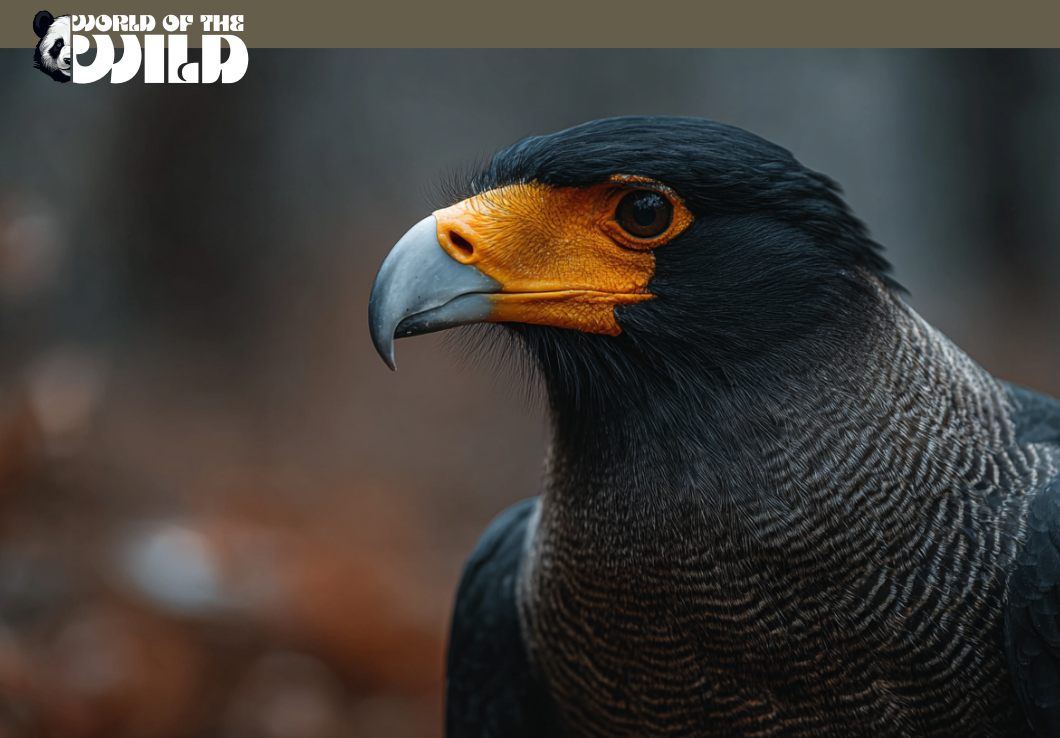

Deep within the steaming rainforests of the Amazon Basin, a striking silhouette cuts through the humid air above meandering rivers. Glossy as polished obsidian and fearless as any apex predator, the Black Caracara is one of the Amazon’s most intriguing yet least understood birds of prey. Unlike the soaring hawks or swift falcons that dominate most raptor folklore, this crow-sized hunter walks boldly along riverbanks, picks parasites from the backs of tapirs like an avian groomer, and fishes with the patience of a heron.
What makes the Black Caracara truly fascinating is its remarkable versatility. This is a raptor that defies every stereotype about birds of prey. It’s as comfortable scavenging roadkill as it is stalking live fish in rapids, as willing to raid bird nests as it is to feast on palm nuts. German-Brazilian ornithologist Helmut Sick aptly nicknamed it “gavião-de-anta”—the tapir-hawk—for its famous mutualistic relationship with these massive mammals. In a world where specialization often means survival, the Black Caracara has chosen a different path: becoming a jack-of-all-trades in the Amazonian ecosystem, and thriving because of it.
Facts
1. Master Cleaners of the Amazon: Black Caracaras engage in one of nature’s most fascinating cleaning services, removing ticks and parasites from tapirs and capybaras. Tapirs have been observed actually calling to nearby caracaras and lying still to facilitate this tick removal—a true example of interspecies communication.
2. Skilled Riverine Fishers: Unlike most raptors, Black Caracaras hunt fish by walking slowly along exposed rocks and vegetation in fast-moving rivers, peering into the water like patient anglers. They catch small fish using either their bill or talons, particularly targeting areas where fish become trapped in shallow pools during migrations.
3. Harpy Eagle Food Pirates: Researchers in Ecuador documented Black Caracaras brazenly stealing food from Harpy Eagle nests, timing their raids carefully to avoid the adult eagles—a testament to their intelligence and opportunistic nature.
4. Rarely Soar: Unlike most birds of prey that circle high in thermals, Black Caracaras rarely soar. When observed from a distance, they can be identified by their continuous flapping flight pattern, making them appear more crow-like than falcon-like.
5. Social Sophistication: While many raptors are solitary hunters, Black Caracaras regularly travel and forage in family groups of 3-5 individuals, often perching together in tall riverside trees.
6. Fearless Around Humans: Black Caracaras show remarkably little fear of human presence, regularly scavenging around settlements, garbage sites, and riverside towns—a behavior that has made them both easy to observe and vulnerable to hunting pressure.
7. Vocal Communicators: These birds produce harsh, piercing single-note calls that sound like “kraaaa,” typically repeated several times during flight in a distinctive decrescendo pattern that echoes through the forest canopy.
Species
The Black Caracara belongs to the following taxonomic classification:
Kingdom: Animalia
Phylum: Chordata
Class: Aves
Order: Falconiformes
Family: Falconidae
Genus: Daptrius
Species: Daptrius ater
The Black Caracara was first scientifically described by French ornithologist Louis Pierre Vieillot in 1816. The genus Daptrius is often considered monotypic, meaning the Black Caracara is the sole member of its genus, though some taxonomic sources previously included the Red-throated Caracara (now classified as Ibycter americanus) in the same genus.
Recent molecular studies using mitochondrial DNA and nuclear sequence data have revealed surprising evolutionary relationships. Despite physical similarities to the Red-throated Caracara, genetic analysis shows these two species are not closely related and exist in polyphyly—they don’t share a recent common ancestor. Instead, the Black Caracara’s closest living relative is actually the Yellow-headed Caracara (Milvago chimachima), with which it forms a sister group on the phylogenetic tree.
There are no recognized subspecies of Daptrius ater, with populations throughout its range showing consistent characteristics. However, the species is part of the larger caracara subfamily (Polyborinae), which includes approximately 11 species distributed throughout the Americas, from the southern United States to Tierra del Fuego.
Appearance
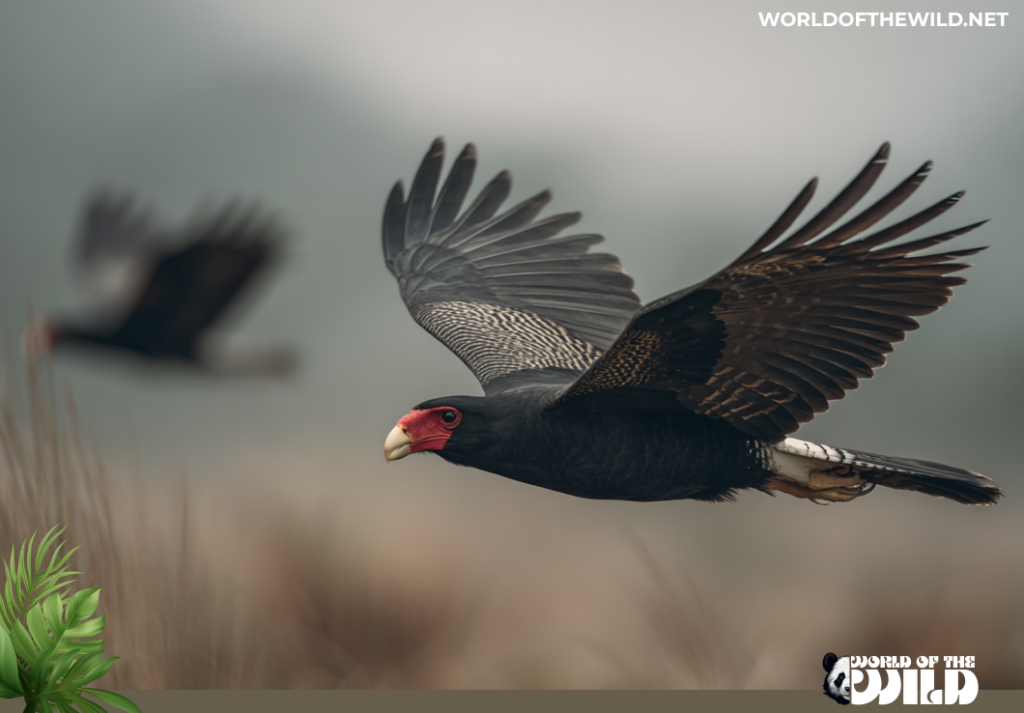
The Black Caracara is aptly named, presenting a striking and unmistakable appearance. Adults are cloaked in glossy black plumage that shines with an almost iridescent quality in sunlight, covering most of their body including the wings, back, belly, and crown. The only dramatic exception to this dark palette is a distinctive white band at the base of the tail, creating a bold contrast visible both when perched and in flight.
The bird’s bare facial skin ranges from vibrant orange to deep red, while the legs and feet display similar yellow to orange-red coloration. This bare skin is not merely decorative—like other scavenging birds, featherless faces prevent the accumulation of debris when feeding on carrion or probing for parasites. The beak is solidly black and, like other caracaras, is sharp and slightly hooked—well-suited for both tearing flesh and grasping live prey.
Black Caracaras measure 41-47 centimeters (16-19 inches) in length from beak to tail tip, roughly the size of a large crow or small chicken. Their wings are notably long and narrow compared to other caracara species, with an equally elongated tail. When observed in flight, they present a distinctive silhouette with continuous flapping rather than the soaring behavior typical of many raptors.
Sexual dimorphism is present but subtle. Females average 350-440 grams (12-16 ounces) and are typically larger than males, which average around 330 grams (12 ounces). Juvenile Black Caracaras can be distinguished from adults by their duller black plumage, pale yellow facial skin instead of the vibrant orange-red of adults, and the presence of 3-4 black bars on the tail feathers (rectrices).
The Black Caracara can potentially be confused with its close relative, the Red-throated Caracara, which shares similar overall dark plumage and habitat preferences. However, the Red-throated Caracara can be readily distinguished by its namesake red throat patch and white belly, whereas the Black Caracara is uniformly black-bodied.
Behavior
Black Caracaras exhibit a fascinating array of behaviors that set them apart from typical raptors. Unlike the solitary hunting styles of most birds of prey, Black Caracaras are notably social creatures. They’re most commonly observed in pairs or family groups consisting of 3-5 individuals, though solitary birds are also regularly spotted. These groups frequently perch together in tall trees along rivers, and their social bonds appear to be relatively stable over time.
Their flight pattern is distinctive and unusual for a raptor. Black Caracaras rarely engage in soaring behavior, instead flying with continuous, active wing-flapping in straight patterns. They’re also accomplished gliders and are frequently observed walking along riverbanks—a terrestrial behavior uncommon among falcons. This comfort on the ground extends to their foraging strategy, where they walk slowly along exposed rocks and emergent vegetation, hunting for food with a patience more reminiscent of herons than hawks.
Perhaps the most remarkable aspect of Black Caracara behavior is their mutualistic relationship with large mammals, particularly tapirs and capybaras. These birds act as living parasite-removal services, landing on or near these mammals and methodically picking ticks, botfly larvae, and other ectoparasites from their fur. What makes this interaction truly extraordinary is that tapirs have learned to actively solicit this service—they emit specific calls when Black Caracaras are nearby, then lie still on the ground to facilitate the cleaning process. The caracaras benefit from an easy meal of protein-rich parasites, while the mammals gain relief from potentially disease-carrying pests. This represents one of the clearest examples of mutualism between birds and mammals in the Neotropical region.
Black Caracaras demonstrate remarkable boldness around human activity. They show little fear when scavenging around settlements, garbage sites, and riverside towns. This fearlessness, combined with their intelligence, allows them to exploit anthropogenic food sources effectively. They’ve been observed following farming operations and fires to catch fleeing animals or pick up casualties.
Vocally, Black Caracaras are quite active. They produce harsh, piercing calls—single notes described as “kraaaa”—that are usually repeated several times, often ending in a distinctive decrescendo. These calls are most frequently heard during flight and likely serve both as contact calls between group members and territorial announcements.
Their hunting and foraging strategies showcase remarkable behavioral flexibility. They directly attack the nests of other birds, search through canopy foliage for insects, walk rivers hunting for fish, dig up turtle eggs from sandbanks, and even engage in food piracy—stealing catches from other birds. When fishing, they make use of their keen eyesight to spot small fish from riverside perches, then capture them using either bill or talons with impressive precision.
Evolution
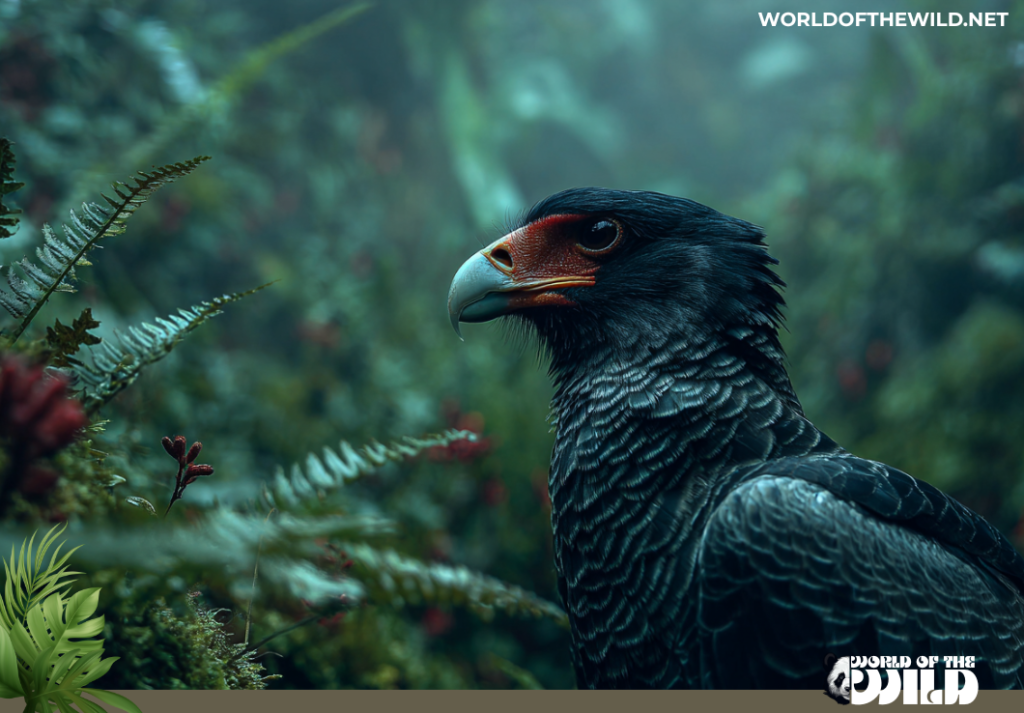
The evolutionary history of the Black Caracara offers fascinating insights into the adaptive radiation of caracaras in the Neotropics. The species was first scientifically described in 1816 by French ornithologist Louis Pierre Vieillot, making it one of the earlier South American raptors to receive formal scientific recognition. The type locality for the species was recorded simply as “Brazil,” reflecting the limited ornithological knowledge of the vast Amazon Basin during the early 19th century.
For much of the 20th century, taxonomists debated the Black Caracara’s closest relatives based on morphological similarities. The bird was long considered closely allied with the Red-throated Caracara due to their similar size, coloration, and overlapping habitats. In 1950, ornithologist Herbert Friedmann formally grouped these species together in the genus Daptrius, a classification supported by Dean Amadon in 1968. However, this traditional view has been dramatically revised by modern molecular genetics.
Recent studies utilizing mitochondrial DNA and nuclear sequence data have revolutionized our understanding of caracara phylogeny. These genetic analyses revealed that the Black Caracara and Red-throated Caracara are not sister species at all—in fact, they exist in polyphyly, meaning they don’t share a recent common ancestor despite their superficial similarities. This is a remarkable example of convergent evolution, where two unrelated lineages independently evolved similar physical characteristics in response to similar ecological pressures.
Perhaps most surprisingly, molecular data identified the Black Caracara’s true closest relative as the Yellow-headed Caracara (Milvago chimachima), with which it forms a sister group on the phylogenetic tree. This relationship was unexpected given the substantial differences in appearance and ecology between these species. The Yellow-headed Caracara is smaller, more colorful, and occupies more open habitats, yet genetically it shares more recent ancestry with the Black Caracara than any other living caracara species.
The caracara lineage itself represents an ancient radiation within the falcon family (Falconidae). Caracaras diverged from the typical falcon lineage millions of years ago, adapting to ecological niches that favored opportunistic feeding, ground foraging, and scavenging rather than the aerial hunting specialization of true falcons. The Black Caracara represents one endpoint of this adaptive radiation, having become specialized for riverine forest habitats in the Amazon Basin.
The species’ current distribution and behavior suggest it has been remarkably successful at exploiting the unique ecological opportunities presented by Amazonian river systems. Its ability to fish, hunt terrestrial prey, scavenge carrion, and even consume fruit represents a generalist survival strategy that has likely served the species well through the climatic fluctuations of the Pleistocene and Holocene epochs.
Habitat
The Black Caracara is intimately tied to the vast network of rivers and waterways that characterize the Amazon Basin and surrounding lowland forests. This species has an extensive range across northern South America, including Bolivia, Brazil, Colombia, Ecuador, French Guiana, Guyana, Peru, Suriname, and Venezuela. However, within this broad distribution, Black Caracaras show strong habitat preferences that center around water.
The species primarily inhabits the lowland regions of the Amazon Basin and the Guianas, generally occurring at low to middle elevations below 500 meters, though they can occasionally be found at higher elevations. They are most abundant along rivers and around lakes, where they find their preferred combination of foraging opportunities and nesting sites. The riverine association is so strong that local names often reference this connection—the birds are frequently spotted perching in tall trees along riverbanks, walking on exposed sandbars, or fishing at the edges of rapids.
Their preferred habitat consists of humid tropical forest in proximity to water. Unlike some Amazonian specialists that require pristine old-growth forest, Black Caracaras demonstrate considerable habitat flexibility. They readily occupy forest edges, newly cleared areas, wooded savannas, secondary growth forests, swamps, and even degraded former forest. This adaptability to disturbed habitats has allowed them to persist, and in some cases even increase, as human activities fragment the Amazon landscape.
Black Caracaras are particularly common in areas of varzea—seasonally flooded forest along whitewater rivers—where fluctuating water levels create abundant opportunities for fishing and expose sandbars perfect for foraging. They also frequent igapo (blackwater-flooded forest) and terra firme (unflooded) forests when these occur near watercourses. Mangrove forests along coastal regions also provide suitable habitat where their range extends to the coast.
The species shows a notable affinity for areas of human habitation when these occur within their preferred habitats. Black Caracaras regularly appear around riverside settlements, ranches, and even urban areas near the forest, where they scavenge garbage and take advantage of disturbance. However, they require tall trees for nesting and roosting, typically selecting the tallest available trees in their territory—often emergent canopy trees reaching 25 meters or higher.
Unlike migratory raptors, Black Caracaras are sedentary residents throughout their range. No seasonal migrations have been documented, and individuals appear to maintain territories year-round. This sedentary nature means local populations are particularly vulnerable to habitat loss, as birds cannot easily relocate to distant suitable habitats if their home territories are destroyed.
The association with water is not merely coincidental—rivers provide the Black Caracara with fishing opportunities, concentrations of prey during seasonal migrations, nesting trees (which tend to be tallest along riverbanks), and convenient travel corridors through the dense forest. The network of Amazonian waterways essentially creates linear highways of suitable habitat extending thousands of kilometers throughout the basin.
Diet
The Black Caracara is the epitome of an opportunistic omnivore, with one of the most diverse diets of any Amazonian raptor. This dietary flexibility is key to the species’ success across varied habitats and conditions. These birds truly eat almost anything they can capture, find, or scavenge, making them the feathered equivalent of the Amazon’s generalist foragers.
As carnivores, Black Caracaras consume a wide variety of animal prey. They actively hunt smaller birds, targeting species such as flycatchers, pigeons, parrots, and even occasionally other birds of prey. They’re particularly notorious as nest raiders, attacking the nests of caciques, oropendolas, and other colonial-nesting birds to consume eggs, nestlings, and fledglings. Small mammals feature in their diet, along with frogs, lizards, snakes, and various amphibians and reptiles they encounter during ground foraging.
Invertebrates form a substantial portion of their diet, particularly during certain seasons. Black Caracaras actively search through foliage for caterpillars, beetles, and beetle larvae. They hunt ants and other social insects, taking advantage of swarm activities. When cleaning parasites from tapirs and capybaras, they consume numerous ticks and botfly larvae—parasites that are rich in protein and readily available from their mammalian hosts.
Their fishing behavior sets them apart from most raptors. Black Caracaras wade at the edges of rivers and lakes, walking slowly on exposed rocks and emergent vegetation while peering intently into the water for small fish, particularly species in the family Characidae. They preferentially fish in areas of fast-moving water where migratory fish become trapped in shallow pools or bottlenecked among aquatic plants. Once prey is spotted, they strike with either bill or talons, then carry the fish to a nearby perch for consumption.
The omnivorous aspect of their diet includes various plant materials. They consume palm nuts, particularly dendê nuts, and feed on a variety of tropical fruits. This plant consumption likely provides important nutrients and helps sustain them during periods when animal prey is less abundant.
As scavengers, Black Caracaras play an important ecological role. They readily consume carrion, often joining vultures at carcasses. Around human settlements, they scavenge roadkill, garbage, and discarded fish or meat from markets and docks. They’ve been observed eating dead mammals, reptiles, and fish that they discover during their foraging rounds. Like vultures, their consumption of carrion helps clean the environment and recycle nutrients.
Their foraging strategies are equally diverse. They hunt on the wing, albeit less commonly than on the ground. They walk along riverbanks and beaches, turning over debris with their feet to uncover hidden prey. They follow agricultural activities and grass fires to catch fleeing animals or pick up casualties. They dig into sandbanks with their strong bills and feet to excavate turtle eggs. They even practice kleptoparasitism—food piracy—stealing catches from other birds.
The Black Caracara’s ability to exploit such a wide range of food sources represents a survival strategy perfectly suited to the unpredictable and highly seasonal Amazonian environment. When fish are running in the rivers, they fish. When nesting season brings vulnerable chicks, they raid nests. When large mammals are heavily parasitized, they become living tick-removal services. This dietary opportunism, combined with their willingness to scavenge, means Black Caracaras can find food in almost any circumstances.
Predators and Threats
As a medium-sized raptor, the adult Black Caracara has relatively few natural predators, though they are not entirely free from predation risk. Large forest eagles, particularly the formidable Harpy Eagle—one of the Amazon’s apex predators—could potentially prey on Black Caracaras, though documented cases are rare. Ironically, Black Caracaras have been observed stealing food from Harpy Eagle nests, suggesting a complex relationship where the smaller bird balances food piracy with predation risk.
Other potential predators include large forest cats such as jaguars and ocelots, which might capture caracaras when the birds are foraging on the ground or at low perches. Large snakes, including boas and anacondas, could pose threats to nesting birds or fledglings. Juveniles and eggs face greater predation pressure from a wider array of forest predators, including smaller cats, tree-climbing mammals like tayras and coatis, and egg-eating snakes.
However, natural predation pales in comparison to the anthropogenic threats facing Black Caracaras. The most significant threat is habitat loss and degradation. The Amazon Basin continues to experience substantial deforestation for agriculture, cattle ranching, logging, and infrastructure development. When riverine forests are cleared—the Black Caracara’s preferred habitat—these birds lose both nesting sites and critical foraging areas. The species’ strong association with tall trees near water makes them particularly vulnerable to selective logging operations that target the largest trees.
Interestingly, Black Caracara populations show complex responses to habitat modification. In some areas, particularly Ecuador, populations appear to be increasing as newly cleared forest creates edge habitat and disturbed areas where the birds can scavenge. This may provide short-term benefits, but likely cannot sustain populations over the long term as forest cover continues to decline and fragmentation intensifies.
Hunting pressure represents another significant threat. In some regions, particularly French Guiana, the species appears to be absent from seemingly suitable habitat, possibly due to direct hunting by humans. Black Caracaras’ fearlessness around human settlements and their habit of scavenging at ranches and garbage sites make them vulnerable to both intentional killing (by landowners who perceive them as pests or threats to poultry) and incidental poisoning from contaminated food sources.
The species may also face threats from bioaccumulation of environmental toxins. As birds that consume carrion and fish from potentially contaminated waterways, Black Caracaras could accumulate mercury, pesticides, and other pollutants that biomagnify through food chains. The impacts of such contamination on reproductive success and survival remain poorly studied.
Climate change poses emerging threats through alterations to river hydrology and forest composition. Changes in seasonal flooding patterns could affect fish availability, while increased drought frequency might reduce the aquatic food sources these birds depend on. More intense forest fires associated with climate change and human activities could destroy nesting habitat, though caracaras have shown they can exploit fire-affected areas for feeding opportunities in the short term.
Despite these threats, Black Caracaras possess some characteristics that provide resilience. Their dietary flexibility means they can shift food sources as conditions change. Their tolerance of disturbed habitats allows them to persist in partially degraded landscapes. Their sedentary nature means they don’t face migration-related mortality. However, these adaptive traits have limits, and continued habitat loss coupled with direct persecution could eventually fragment populations and reduce genetic diversity.
The species’ current status suggests populations are declining gradually rather than crashing precipitously. However, the lack of detailed population monitoring across much of their range means the true trajectory remains uncertain. Conservation of Black Caracaras ultimately depends on maintaining connected networks of riverine forest habitat throughout the Amazon Basin—a challenge that requires addressing the broader forces driving Amazonian deforestation.
Reproduction and Life Cycle
The reproductive biology of the Black Caracara remains surprisingly mysterious despite the species’ relatively common status and fearless nature around humans. This knowledge gap reflects both the difficulty of accessing nest sites in remote Amazonian forests and the bird’s preference for nesting high in the forest canopy.
What little is known about Black Caracara breeding comes primarily from scattered observations. Nests are constructed from sticks and twigs, built into substantial platforms placed high in tall trees—typically 25 meters (82 feet) or more above the ground. One detailed observation in Brazil documented a nest built from twigs 60-70 centimeters in length, positioned at a commanding height that likely provides protection from tree-climbing predators while offering views of the surrounding riverine landscape.
The typical clutch consists of 2-3 eggs. The eggs are described as having a base color with brown spotting or mottling, providing camouflage in the stick nest. Beyond these basic facts, virtually nothing is known about incubation behavior, including which sex incubates (or whether both parents share duties), how long incubation lasts, or what the hatching success rate might be in wild populations.
Similarly, information about nestling care, fledging age, and post-fledging dependency periods remains largely undocumented. Given that Black Caracaras are frequently observed in family groups of 3-5 individuals, it’s likely that offspring remain with parents for an extended period after fledging, as occurs in many other caracara species. This extended family association probably serves important functions in teaching young birds the diverse foraging skills they’ll need as adults—how to fish, which nests to raid, how to solicit cleaning behavior from tapirs, and where to find seasonally available food sources.
The breeding season for Black Caracaras hasn’t been precisely defined, though nests have been observed during various months, suggesting either an extended breeding period or regional variation in timing. In tropical regions with relatively little seasonal variation, many bird species can breed opportunistically when conditions are favorable rather than adhering to strict seasonal schedules.
Mating behaviors, courtship displays, and pair-bonding patterns remain essentially unknown. Given the species’ social nature and the fact that pairs are frequently observed together, it seems likely that Black Caracaras form lasting pair bonds, as do many other caracaras. However, whether these bonds are truly lifelong or simply long-term remains undetermined.
Regarding lifespan, no reliable data exists for wild Black Caracaras. Based on longevity records for related caracara species, which can live 15-20+ years in the wild, Black Caracaras likely have similar potential lifespans. Their relatively large size for a tropical raptor, combined with their adaptable omnivorous diet, would support longer lifespans than many smaller tropical birds.
The lack of detailed reproductive knowledge represents a significant gap in our understanding of Black Caracara ecology. Without knowing reproductive rates, age at first breeding, typical brood sizes, and juvenile survival rates, it becomes difficult to model population dynamics or predict how populations might respond to habitat loss and other threats. This knowledge gap is particularly concerning given evidence of gradual population declines.
The difficulty of studying Black Caracara reproduction highlights a broader challenge in Amazonian ornithology—many species remain poorly known despite being relatively common, simply because their nesting behaviors are difficult to observe in the vast, remote forests where they live. Future research using modern techniques such as radio telemetry, nest cameras, and genetic parentage analysis could finally unveil the hidden reproductive lives of these remarkable birds.
Population
The Black Caracara is currently classified as a species of Least Concern by the International Union for Conservation of Nature (IUCN), reflecting its wide distribution across the Amazon Basin and its ability to tolerate some degree of habitat disturbance. However, this designation shouldn’t inspire complacency, as closer examination reveals concerning trends and significant uncertainties.
Population estimates for the species are notably imprecise, reflecting the challenges of conducting comprehensive surveys across the vast and often inaccessible regions where Black Caracaras live. The IUCN estimates a total population ranging from 1,000 to 10,000 individuals, with an estimated adult population between 670 and 6,700 individuals. This wide range in estimates highlights the substantial uncertainty surrounding the species’ true numbers. Given their extensive range and regular presence in suitable habitats, the actual population likely falls toward the higher end of these estimates, though rigorous census work is needed to establish more precise figures.
More concerning than the absolute numbers is the population trend. Declines have been documented over the past decade across portions of the species’ range. While these declines are not currently considered critical, they represent a warning signal that deserves attention. The gradual nature of these reductions could easily accelerate if current threats intensify, potentially moving the species toward a more precarious conservation status before adequate protective measures are implemented.
The species’ conservation status is maintained as Least Concern largely due to three factors: their relatively large geographic range spanning multiple countries and millions of hectares of habitat, their demonstrated ability to survive in fragmented and partially degraded forests, and their dietary flexibility allowing them to exploit diverse food sources. These characteristics provide some resilience against localized disturbances and habitat changes.
However, population patterns vary notably across the Black Caracara’s range. In Ecuador, for instance, populations appear to be increasing as forest clearing creates edge habitats and disturbed areas that caracaras can exploit for foraging. This population growth in recently disturbed areas might seem encouraging but likely represents a short-term response that cannot be sustained as forest cover continues to decline and becomes increasingly fragmented. The birds may be concentrating in remaining suitable habitats rather than actually increasing in total numbers.
Conversely, in French Guiana, Black Caracaras are conspicuously absent from areas of seemingly suitable habitat, suggesting that local extinction or severe population reduction has occurred. Evidence points to human hunting pressure as a likely cause for these absences, demonstrating that even seemingly widespread species can be extirpated from portions of their range through direct persecution.
The species’ sedentary nature—showing no migratory behavior—means populations are structured into relatively discrete local groups connected primarily along river corridors. This population structure creates vulnerability, as habitat loss or persecution in specific areas cannot be easily compensated by immigration from distant regions. If key river systems lose their caracara populations, natural recolonization may be slow or impossible.
A significant challenge in assessing Black Caracara conservation status is the lack of systematic long-term monitoring across much of their range. While the species is regularly observed and appears relatively common in appropriate habitats, actual population trends, breeding success rates, and responses to habitat change remain poorly quantified. This data gap makes it difficult to detect problems until they become severe.
The designation of Least Concern should not be interpreted as meaning the species faces no conservation challenges. Rather, it indicates that current evidence suggests the species is not yet at immediate risk of extinction. However, the combination of documented population declines, ongoing habitat loss throughout the Amazon, evidence of local hunting pressure, and substantial uncertainty about population sizes and trends all suggest that conservation attention is warranted.
Conclusion
The Black Caracara stands as a testament to the power of adaptability in nature. Unlike the specialized hunters that often capture our imagination—the peregrine’s stoop, the osprey’s plunge, the hawk’s precision strike—the Black Caracara succeeds through versatility. It is simultaneously hunter and scavenger, fisherman and fruit-eater, social partner and opportunistic thief. It grooms parasites from the backs of tapirs one moment and raids vulnerable nests the next. This remarkable ecological flexibility has allowed the species to thrive across the vast expanse of Amazonian waterways for millennia.
Yet this success story remains fragile. The very rivers that define the Black Caracara’s world are increasingly threatened by deforestation, pollution, and altered hydrology from upstream development. The tall riverbank trees where these birds nest and roost are targets for selective logging. The fearless nature that makes them such fascinating subjects for wildlife observers also makes them vulnerable to human persecution. Population declines documented over the past decade suggest that even this adaptable species has its limits.
Perhaps most concerning is how little we truly know about these striking black raptors. Basic aspects of their biology—breeding behavior, population dynamics, responses to habitat change—remain poorly documented. We know the Black Caracara picks ticks from tapirs and catches fish at river rapids, but we don’t know if these populations are thriving or quietly disappearing. This knowledge gap hinders effective conservation planning at a time when the Amazon faces unprecedented pressures.
The fate of the Black Caracara is inextricably linked to the fate of Amazonian riverine forests. Protecting these birds means maintaining the tall trees, clean waters, and intact forest corridors that define their habitat. It means curbing illegal hunting and reducing pollution in Amazonian waterways. It means conducting the research needed to understand their true conservation status and needs.
For those who care about the Amazon’s biodiversity, the Black Caracara offers a compelling ambassador. This is not an obscure species teetering on the edge of extinction—it remains widespread and observable. But its gradual decline reminds us that even common, adaptable species can slide toward endangerment if we fail to act. Every effort to protect Amazonian forests, every initiative to reduce deforestation, every research project documenting these birds’ ecology contributes to ensuring that future generations will still witness the striking sight of glossy black caracaras walking the riverbanks, calling across the water, and engaging in their ancient partnership with the tapirs of the forest.
The Amazon needs its Black Caracaras—and they need us to protect the riverine forests they call home.
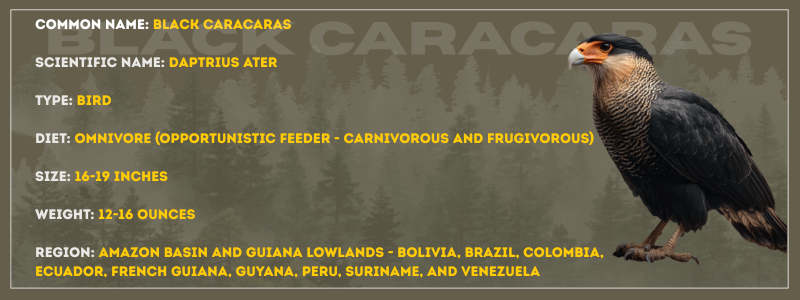
Scientific name: Daptrius ater
Diet type: Omnivore (opportunistic feeder – carnivorous and frugivorous)
Size: 41-47 cm (16-19 inches)
Weight: Males average 330g (12 oz); Females average 350-440g (12-16 oz)
Region found: Amazon Basin and Guiana lowlands – Bolivia, Brazil, Colombia, Ecuador, French Guiana, Guyana, Peru, Suriname, and Venezuela