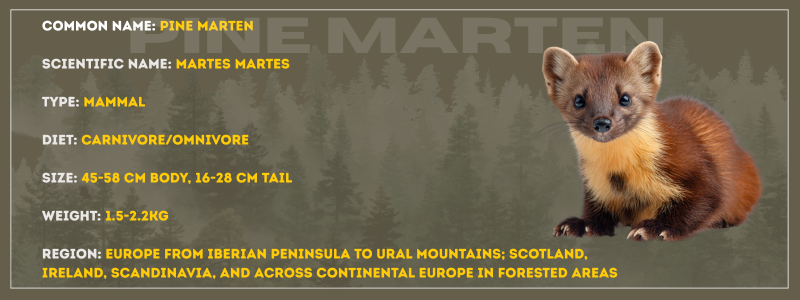

High among the twisted branches of ancient woodlands, a sleek, chocolate-brown figure flows through the darkness with the fluid grace of liquid shadow. The European Pine Marten, one of Europe’s most enigmatic and captivating predators, has haunted the continent’s forests for millennia, yet remains a mystery to most people who share its range. With a face that seems perpetually curious and movements that blend feline agility with mustelid cunning, this remarkable creature represents both a conservation success story and a reminder of how much wild beauty still exists in Europe’s dwindling old-growth forests.
What makes the pine marten so fascinating is its role as a keystone species in forest ecosystems, its remarkable comeback from near-extinction in many regions, and its unexpected impact on other wildlife populations. This is an animal that can leap six meters between trees, remember the location of hundreds of food caches, and is single-handedly helping to restore balance to ecosystems disrupted by invasive species. The pine marten is proof that Europe’s wild heritage is not just a relic of the past, but a living, breathing force that can recover when given the chance.
Facts
- Tree-Top Acrobat: Pine martens can leap up to 6 meters (nearly 20 feet) horizontally between trees and descend tree trunks headfirst, a feat few mammals can accomplish due to their semi-retractable claws and rotating ankle joints.
- Delayed Development: Female pine martens exhibit delayed implantation, meaning fertilized eggs don’t immediately attach to the uterine wall. This allows them to time births perfectly for spring, even when mating occurs in summer.
- The Grey Squirrel’s Nemesis: In areas where pine martens have been reintroduced, invasive grey squirrel populations have declined dramatically while native red squirrels thrive, as grey squirrels spend more time on the ground where they’re vulnerable to marten predation.
- Sweet Tooth Surprise: Despite being carnivores, pine martens have an unusual fondness for jam and peanut butter, which wildlife enthusiasts sometimes use to attract them to camera traps or observation points.
- Scent Communication Masters: Pine martens possess around 200 scent marking sites throughout their territory, using latrines placed on prominent features like logs and rocks to communicate with other martens through scent.
- Ancient Survivors: Fossil evidence shows pine martens have remained largely unchanged for over 2 million years, having successfully weathered multiple ice ages and dramatic climate shifts.
- Solitary by Nature: Adult pine martens are so solitary that males and females only tolerate each other’s presence for a brief few days during the summer mating season, spending the rest of the year in complete isolation.
Species
The European Pine Marten belongs to the following taxonomic classification:
- Kingdom: Animalia
- Phylum: Chordata
- Class: Mammalia
- Order: Carnivora
- Family: Mustelidae
- Genus: Martes
- Species: Martes martes
Within the genus Martes, the European Pine Marten is closely related to several other marten species distributed across the Northern Hemisphere. Its nearest relatives include the American Pine Marten (Martes americana), which occupies a similar ecological niche in North America, and the Japanese Marten (Martes melampus) found in Japan. The genus also includes the Sable (Martes zibellina), highly prized for its luxurious fur, and the Stone Marten (Martes foina), which has adapted more successfully to human-modified landscapes than its pine-dwelling cousin.
Currently, three subspecies of Martes martes are recognized, though some taxonomists debate these divisions. These include M. m. martes, the nominate subspecies found throughout most of continental Europe; M. m. britannicus, specific to the British Isles; and M. m. ruthena, found in Eastern Europe and Russia. However, recent genetic studies suggest that population differentiation may be more complex than these traditional subspecies classifications indicate, with distinct genetic lineages emerging from different glacial refugia following the last Ice Age.
Appearance
The European Pine Marten is a creature of undeniable elegance, built for a life among the treetops. Adults typically measure between 45 and 58 centimeters in body length, with males generally larger than females. Their luxuriously bushy tail adds another 16 to 28 centimeters, serving as both a balance aid during arboreal acrobatics and a visual signal to other martens. Adult males usually weigh between 1.5 and 2.2 kilograms, while females are lighter at 0.9 to 1.5 kilograms, though individuals in particularly resource-rich environments can exceed these ranges.
The marten’s most striking feature is its dense, chocolate-brown fur, which darkens to near-black on the legs and tail. This magnificent coat is composed of two layers: a dense, soft underfur that provides insulation, and longer, glossy guard hairs that shed water and give the animal its characteristic sheen. The quality and color of this fur vary seasonally, becoming thicker and darker in winter, lighter and more golden-brown in summer. On the throat and upper chest, most individuals sport a distinctive bib or patch of cream to orange-yellow fur, varying greatly in size and shape between individuals—almost like a fingerprint that can help researchers identify specific animals.
The head is broad and cat-like, with rounded ears edged in white or cream fur that stand prominently against the dark coat. Large, dark brown eyes provide excellent vision, particularly in low light conditions essential for their crepuscular and nocturnal lifestyle. The marten’s legs are relatively short but powerfully muscled, ending in broad paws equipped with sharp, semi-retractable claws that function like climbing spikes. Their hind feet can rotate nearly 180 degrees, enabling them to descend trees headfirst with complete confidence—a rare ability among tree-dwelling mammals.

Behavior
The European Pine Marten is fundamentally a solitary and territorial animal, with each individual maintaining exclusive use of a home range that varies dramatically with habitat quality and food availability. Males typically control territories of 5 to 25 square kilometers, while females occupy smaller ranges of 2 to 15 square kilometers. These territories are vigorously defended against same-sex intruders through scent marking, vocalizations, and, when necessary, direct confrontation. The boundaries are marked with scent from anal glands, urine, and distinctive latrines strategically placed on elevated features like fallen logs, stumps, and rocks throughout the territory.
Primarily crepuscular and nocturnal, pine martens emerge from their dens around dusk to begin hunting, though they may be active during daylight hours in areas with minimal human disturbance or during summer months when food demands are high. They spend approximately 60-70% of their active time hunting and foraging, moving through their territory with purposeful efficiency. Their movements are a mesmerizing blend of arboreal and terrestrial locomotion—they’re equally comfortable bounding along the ground with a characteristic loping gait or flowing through the canopy in gravity-defying leaps.
Communication among these solitary creatures occurs primarily through scent marking, though they possess a surprisingly varied vocal repertoire. They produce cat-like mews, bird-like chatters when alarmed or excited, and threatening growls and screams during aggressive encounters. Females use soft, warbling calls to communicate with their young. Despite their solitary nature, pine martens demonstrate considerable intelligence and adaptability. They exhibit excellent spatial memory, remembering the locations of hundreds of food caches and productive hunting sites. Research has shown they can solve complex puzzles and modify their behavior based on learned experience, particularly when exploiting new food sources or avoiding danger.
The marten’s hunting technique varies with prey type. For ground-dwelling prey like voles, they employ a characteristic “mousing” behavior similar to foxes, using acute hearing to locate prey beneath snow or leaf litter before pouncing with their front paws pinning the victim. When hunting in trees, they move with silent precision, stalking sleeping birds or raiding nests with methodical efficiency. They show particular boldness and persistence when hunting, often pursuing prey through complex three-dimensional environments that would challenge most predators.
Evolution
The evolutionary history of the European Pine Marten stretches back millions of years within the Mustelidae family, one of the most diverse and successful carnivore families. The mustelids themselves emerged approximately 30-40 million years ago during the Oligocene epoch, evolving from primitive carnivore ancestors. The genus Martes, to which the pine marten belongs, appears in the fossil record around 7-8 million years ago during the late Miocene, with early marten-like ancestors already showing adaptations for both terrestrial and arboreal hunting.
The direct ancestors of Martes martes emerged during the Pliocene epoch, approximately 3-4 million years ago. These early martens were already specialized for forest environments, possessing the semi-retractable claws, flexible spine, and powerful legs that characterize modern species. Fossil evidence from Pleistocene deposits across Europe shows that pine martens successfully survived multiple glaciation cycles over the past 2 million years, retreating to southern refugia during glacial maxima and expanding northward during warmer interglacial periods.
During the last glacial maximum, approximately 20,000 years ago, pine marten populations became fragmented in three main refugial areas: the Iberian Peninsula, the Italian Peninsula, and the Balkans. Genetic studies reveal that modern European populations descended from these isolated groups, which explains some of the subtle genetic and morphological variations observed across the species’ current range. As the ice sheets retreated and forests reclaimed the landscape, pine martens followed, recolonizing northern Europe and the British Isles.
The close relationship between pine martens and other Martes species reflects parallel evolution to exploit similar ecological niches across different continents. The American Pine Marten likely diverged from a common ancestor with the European species 3-4 million years ago when populations became isolated. The evolution of different marten species represents an excellent example of adaptive radiation, with each species evolving specific characteristics suited to their particular environments—from the sable’s adaptation to harsh Siberian winters to the stone marten’s ability to exploit human-modified landscapes.
Habitat
The European Pine Marten enjoys one of the broadest distributions of any marten species, ranging across the Palearctic from the Iberian Peninsula in the west to the Ural Mountains in the east, and from the Mediterranean coast northward to Scandinavia and Scotland. The species is found throughout most of Europe, including significant populations in Scotland, Ireland, Wales, France, Germany, Switzerland, Poland, and extensive forests across Russia. They are notably absent from the southernmost parts of the Mediterranean, the majority of England, and lowland agricultural regions where habitat has been extensively modified.
While adaptable to various forested environments, pine martens show a strong preference for mature, structurally complex woodlands with abundant canopy cover. Their ideal habitat consists of old-growth mixed or coniferous forests with a closed canopy, substantial deadwood, and a complex understory that provides both hunting opportunities and denning sites. They particularly favor forests with a mosaic of different aged stands, fallen logs, rocky outcrops, and dense undergrowth. In Scotland and Ireland, they frequently inhabit native broadleaf woodlands dominated by oak, birch, and hazel, while in Scandinavia and Eastern Europe, they’re commonly found in boreal coniferous forests of pine, spruce, and fir.
The critical habitat features for pine martens include suitable den sites and sufficient tree cover for safe movement. They establish dens in tree cavities, old squirrel dreys, rock crevices, boulder fields, and occasionally in abandoned buildings or bird nest boxes. A single individual may use 10-20 different den sites throughout their territory, rotating between them regularly. The presence of prey-rich ecotones—transitional zones between different forest types or between forest and open habitats—significantly enhances territory quality.
Altitude is not a primary limiting factor; pine martens inhabit forests from sea level to the treeline, found as high as 2,000 meters in the Alps and other mountain ranges. However, they avoid completely open habitats, agricultural lands, and intensively managed forests with minimal structural diversity. The degree of tree cover appears critical—research suggests they require at least 30-40% canopy closure to maintain viable populations, as this provides both security from larger predators and efficient travel routes through their territories.

Diet
The European Pine Marten is classified as a carnivore but functions as an opportunistic omnivore with a remarkably varied diet that shifts seasonally and geographically based on food availability. This dietary flexibility has been key to the species’ success across diverse European ecosystems. Small mammals form the backbone of their diet, particularly voles, which in some regions comprise up to 60% of their food intake during peak vole population years. Bank voles, field voles, and wood mice are primary targets, hunted with remarkable efficiency both on the ground and in trees.
Beyond small mammals, pine martens are skilled avian predators, taking roosting birds, raiding nests for eggs and chicks, and occasionally capturing birds in flight through ambush tactics. They show particular success hunting thrushes, finches, and tits. Squirrels represent another important prey item—both red and grey squirrels feature prominently in their diet where these species are abundant, though interestingly, grey squirrels are taken more frequently, possibly due to their greater ground activity and larger size.
Invertebrates, particularly during summer months, provide crucial protein, with beetles, caterpillars, bees, and wasps (including the contents of wasp nests) being regularly consumed. Carrion is scavenged opportunistically, particularly deer carcasses in winter, and martens will occasionally take amphibians, reptiles, and even fish when encountered. They’ve been observed making audacious raids on bird feeders and even catching bats emerging from roosts.
What sets pine martens apart from many carnivores is their significant consumption of fruit and berries, particularly from late summer through autumn. Bilberries, rowans, cherries, raspberries, and even acorns feature heavily in their autumn diet, sometimes comprising over 50% of food intake during the berry season. This fruit consumption serves the dual purpose of building fat reserves for winter and providing hydration. They also consume fungi and have been documented eating pine seeds extracted from cones.
Their hunting strategy combines stealth, speed, and three-dimensional thinking. They hunt primarily by smell and sound, using their acute hearing to locate prey moving beneath vegetation. Once prey is detected, they employ explosive bursts of speed to capture it, capable of running at speeds up to 30 km/h through cluttered forest environments. They cache excess food during times of abundance, storing items in tree cavities, under logs, or buried in soil, remembering these locations for weeks or months.
Predators and Threats
In their natural environment, adult European Pine Martens have relatively few natural predators due to their arboreal lifestyle, speed, and aggressive defensive behavior. The primary natural predators are large raptors, particularly Golden Eagles and Eagle Owls, which pose a significant threat, especially to juvenile martens. In some regions, Red Foxes may opportunistically kill martens, particularly when caught on the ground, though martens are formidable opponents and such encounters often result in standoffs rather than predation. Wildcats in areas where they still exist may compete with and occasionally kill young martens. Historically, wolves and lynx would have taken martens, but these predators are now absent from most of the marten’s range.
The most significant threats to pine marten populations are anthropogenic. Habitat loss and fragmentation represent the primary existential threat—the conversion of ancient forests to agricultural land, urban development, and intensive forestry practices that favor monoculture plantations over diverse, structurally complex forests has dramatically reduced available habitat. Pine martens require extensive territories with mature forest cover and sufficient connectivity to allow dispersal and gene flow between populations. The fragmentation of forests into isolated patches creates “island” populations vulnerable to local extinction and genetic bottlenecks.
Historically, direct persecution was the primary driver of pine marten decline across Europe. From the 18th through the mid-20th century, they were relentlessly hunted and trapped for their valuable pelts and killed as “vermin” by gamekeepers who viewed them as threats to game birds and poultry. This persecution, combined with habitat loss, drove them to extinction or near-extinction in many regions, including most of England, Wales, and lowland Scotland. While legal protection now exists across most of their range, illegal persecution continues in some areas where game bird interests remain strong.
Road mortality has emerged as a significant modern threat, particularly in fragmented landscapes where martens must cross roads to access different forest patches. Young dispersing individuals are especially vulnerable. Secondary poisoning from rodenticides used in forestry and agriculture poses an insidious threat—martens consuming poisoned rodents accumulate toxins that can prove fatal. Climate change presents emerging concerns, potentially altering prey availability, forest composition, and the distribution of suitable habitats, though the full impacts remain unclear.
Despite these threats, pine martens demonstrate remarkable resilience where given protection and suitable habitat. Their populations are recovering in many regions, proving that with appropriate conservation measures, these adaptable predators can bounce back from the brink of local extinction.

Reproduction and Life Cycle
The reproductive cycle of the European Pine Marten is precisely timed to ensure young are born when conditions are most favorable for survival. The mating season occurs during July and August, a period when adult males temporarily expand their territories to overlap with those of multiple females. During this brief window, the normally solitary martens tolerate each other’s presence, with courtship involving chasing, play-like interactions, and vocalizations. Mating is vigorous and may last for over an hour, with pairs sometimes remaining together for several days before separating.
Following fertilization, female pine martens employ a fascinating reproductive strategy called delayed implantation. The fertilized egg develops into a blastocyst but doesn’t implant in the uterine wall until January or February, approximately 6-8 months after mating. This delay allows females to time the birth perfectly for early spring (usually late March to early April) when prey populations are increasing and weather conditions are improving. The actual pregnancy following implantation lasts only about 28-30 days, meaning the total time from mating to birth spans approximately 8-9 months despite minimal actual fetal development time.
Litters typically consist of 2-5 kits (usually 3), born blind, deaf, and covered in sparse, pale yellow fur. At birth, kits weigh merely 28-35 grams and are entirely dependent on their mother. The female gives birth and raises her young in a natal den, usually a tree cavity lined with grass, moss, and fur, though boulder crevices and even old buildings may serve this purpose. The mother is an attentive parent, nursing her young exclusively for the first 6-7 weeks while they remain in the den.
Kit development follows a consistent timeline. Their eyes open at 34-38 days, and they begin tentatively exploring outside the den entrance around 7-8 weeks of age. By 10-12 weeks, they’re actively following their mother and learning crucial hunting skills through play and observation. Weaning occurs gradually between 6-8 weeks, though kits may continue to nurse occasionally until 12 weeks. The mother provisions her growing family with progressively larger prey items, teaching them hunting techniques and territory navigation.
Young martens remain with their mother until late summer or early autumn (August-September), when they must disperse to establish their own territories. This dispersal period is the most dangerous time in a marten’s life, with mortality rates exceeding 50% as juveniles navigate unfamiliar terrain, compete with established adults, cross roads, and learn to hunt efficiently. Those that survive to establish territories may attempt breeding in their second year, though many females don’t successfully reproduce until their third year.
In the wild, pine martens that survive the vulnerable juvenile period can live 8-10 years, with exceptional individuals reaching 12-15 years. In captivity, where predation, starvation, and disease pressures are absent, they’ve been recorded living up to 18 years. However, survival rates are heavily influenced by habitat quality, food availability, and human pressures, with annual adult mortality rates in the wild typically ranging from 20-40%.
Population
The conservation status of the European Pine Marten is currently classified as “Least Concern” by the International Union for Conservation of Nature (IUCN), reflecting the species’ broad distribution, relatively stable populations across much of its range, and successful recovery in many regions where it had been extirpated. However, this global assessment masks significant regional variation, with some populations thriving while others remain critically endangered or locally extinct.
Estimating the total global population of pine martens is challenging due to their elusive nature and the vast range they inhabit. Current estimates suggest a total European population of several hundred thousand individuals, with the largest populations residing in Russia, Scandinavia, and central European countries with extensive forest cover. Poland alone is estimated to support 80,000-100,000 individuals. Ireland has seen a remarkable population recovery, with estimates of 2,700-3,500 individuals representing a significant increase from historic lows. Scotland’s population is estimated at 3,700-4,600 martens, though this is increasing with natural range expansion and reintroduction efforts.
The population trend across Europe is generally positive, representing one of the more encouraging conservation success stories. Many populations that crashed during the 19th and early 20th centuries due to persecution and habitat loss are now recovering thanks to legal protection, changes in forestry practices, and targeted conservation efforts including reintroductions. In the UK, pine martens were reduced to small populations in the Scottish Highlands by the early 20th century but have since naturally recolonized much of Scotland and have been successfully reintroduced to Wales and areas of England. Ireland’s population, once confined to a small area in the west, is now expanding eastward across the island.
However, significant challenges remain. Populations in some southern European countries, particularly Spain and Greece, remain fragmented and vulnerable. In heavily developed regions of western and central Europe, populations exist as isolated fragments in remaining forest patches, raising concerns about genetic diversity and long-term viability. England’s recovering population remains small and scattered, requiring continued conservation effort and habitat connectivity improvements.
The species benefits from several favorable trends: increasing public appreciation for native wildlife, reduced persecution as attitudes toward predators shift, improvements in forest management that favor older, more diverse woodlands, and legal protection throughout most of its range. Reintroduction projects have demonstrated that pine martens can successfully reestablish in suitable habitats when given protection, with projects in Wales and Gloucestershire showing promising early results.
Conclusion
The European Pine Marten stands as a symbol of Europe’s wild heritage and a testament to the resilience of nature when given the opportunity to recover. From its graceful navigation through the forest canopy to its role as a keystone predator maintaining ecosystem balance, this remarkable mustelid embodies the complex interconnections that define healthy woodland ecosystems. Its recovery from near-extinction in many regions demonstrates that conservation success is possible, even for species that were once persecuted to the brink of disappearance.
Yet the pine marten’s story is far from complete. While populations are recovering in some areas, the species remains vulnerable to habitat fragmentation, human persecution, and the uncertain impacts of climate change. The future of pine martens—and the countless species that share their forest homes—depends on our commitment to protecting and restoring the ancient woodlands that have shaped Europe’s ecological character for millennia.
As we move forward, the pine marten challenges us to envision a Europe where wild forests flourish, where wildlife corridors connect fragmented habitats, and where people embrace rather than fear the predators that help maintain natural balance. By supporting forest conservation, advocating for wildlife-friendly policies, and fostering appreciation for these magnificent animals, each of us can play a role in ensuring that future generations will know the thrill of glimpsing a chocolate-brown shadow flowing through the dusk-lit canopy—the pine marten, at home in the forests it has haunted for millennia.
Scientific Name: Martes martes
Diet Type: Carnivore/Omnivore
Size: 45-58 cm body length (plus 16-28 cm tail)
Weight: Males: 1.5-2.2 kg; Females: 0.9-1.5 kg
Region Found: Europe from Iberian Peninsula to Ural Mountains; Scotland, Ireland, Scandinavia, and across continental Europe in forested areas