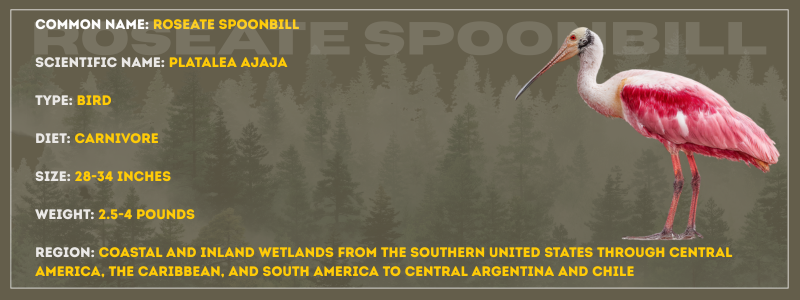

Standing in shallow coastal waters like a flamingo’s eccentric cousin, the Roseate Spoonbill cuts an unforgettable figure against the backdrop of mangrove swamps and tidal flats. With its brilliant pink plumage and distinctive spatula-shaped bill, this remarkable wading bird seems almost too fantastical to be real—as if someone had crossed a flamingo with a pelican and dipped the result in watercolor paint. Yet the Roseate Spoonbill is very much a product of millions of years of evolution, perfectly adapted to its specialized ecological niche. This charismatic species serves as both an indicator of wetland health and a stunning reminder of nature’s capacity for beauty and innovation. Once hunted to the brink of extinction for its feathers, the spoonbill’s remarkable recovery story offers hope for conservation efforts while highlighting the ongoing challenges facing coastal ecosystems across the Americas.
Facts
- Diet Creates Color: Roseate Spoonbills aren’t born pink—their vibrant coloration comes from carotenoid pigments in the crustaceans they consume, similar to flamingos. Younger birds are pale pink or white, gradually deepening to brilliant rose as they mature.
- Tactile Hunters: Unlike herons that hunt by sight, spoonbills feed by touch. They sweep their specialized bills through murky water in a side-to-side motion, snapping shut on prey with incredible reflexes when sensory receptors detect movement.
- Silent Communicators: Adult Roseate Spoonbills are nearly voiceless, rarely producing sounds beyond occasional grunts or clacking their bills. They rely primarily on visual displays for communication.
- Colonial Nesters: These birds nest in large colonies that can include hundreds of pairs, often alongside herons, egrets, and ibises. The communal arrangement provides protection from predators through the “safety in numbers” principle.
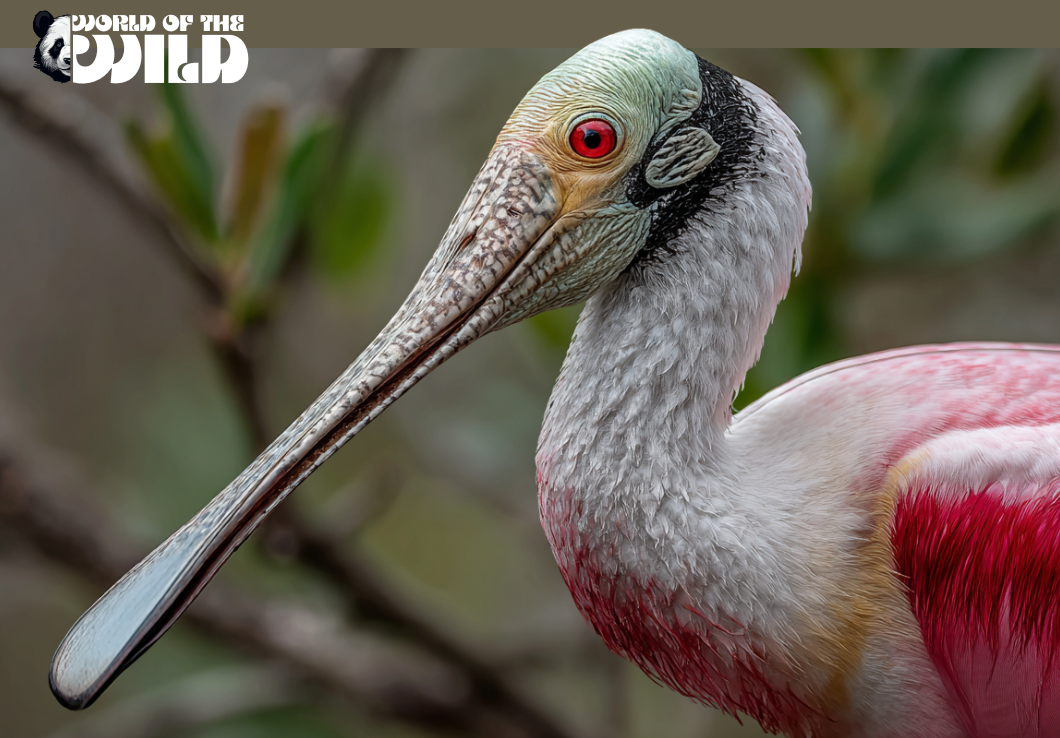
- Bare-Headed Beauty: The spoonbill’s featherless, greenish head isn’t just for aesthetics—it’s a practical adaptation that prevents feathers from becoming matted with mud and debris during their unique feeding technique.
- Temperature Regulators: Spoonbills can control blood flow to their unfeathered legs and head, using these areas to dissipate heat in warm climates or conserve it when needed.
- Ancient Lineage: Fossil evidence suggests that spoonbill ancestors have existed for at least 30 million years, making them one of the more ancient lineages of modern wading birds.
Species
Kingdom: Animalia
Phylum: Chordata
Class: Aves
Order: Pelecaniformes
Family: Threskiornithidae
Genus: Platalea
Species: Platalea ajaja
The Roseate Spoonbill is one of six spoonbill species found worldwide, though it’s the only one with predominantly pink plumage. The genus Platalea includes the Eurasian Spoonbill (P. leucorodia), found across Europe, Asia, and North Africa; the African Spoonbill (P. alba), native to sub-Saharan Africa and Madagascar; the Black-faced Spoonbill (P. minor), a critically endangered species from East Asia; the Royal Spoonbill (P. regia), found in Australia and New Zealand; and the Yellow-billed Spoonbill (P. flavipes), also native to Australia.
While most spoonbills display predominantly white plumage with various facial markings and bill colors, the Roseate Spoonbill stands apart with its stunning pink and red coloration. All spoonbills share the characteristic spatulate bill that gives the group its name. There are no recognized subspecies of the Roseate Spoonbill, though there is some geographic variation in size and intensity of coloration across their range.
Appearance
The Roseate Spoonbill is an unmistakable bird, combining elegance with eccentricity in equal measure. Adults typically measure 28 to 34 inches in length with a wingspan of approximately 47 to 52 inches, making them medium to large-sized wading birds. They generally weigh between 2.6 to 4 pounds, with males typically slightly larger than females, though the sexual dimorphism is minimal.
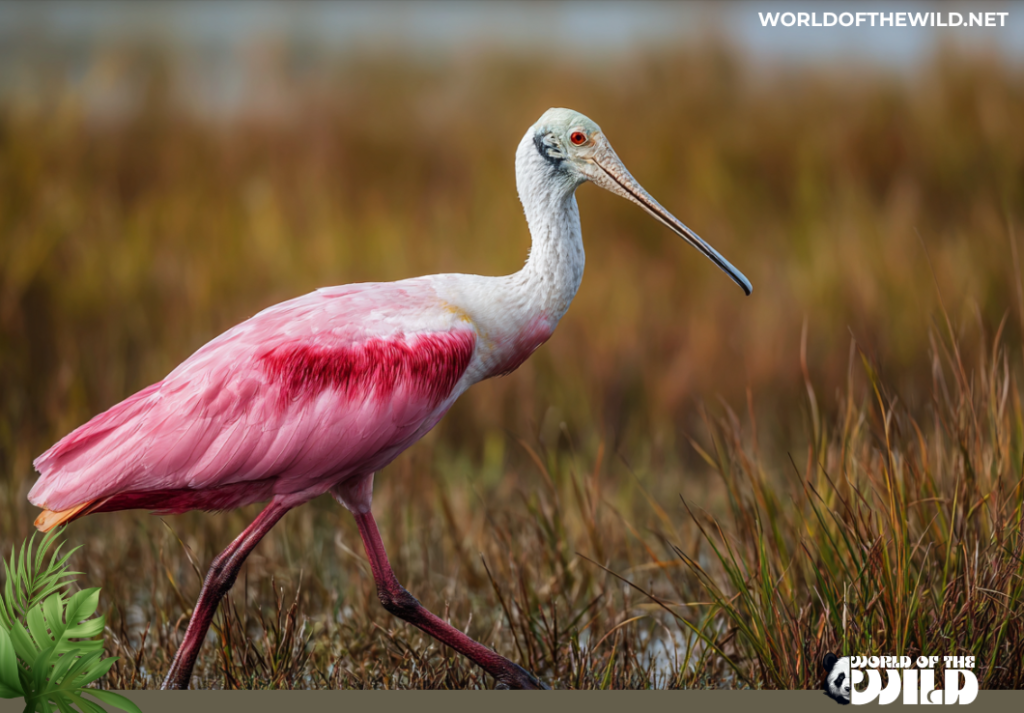
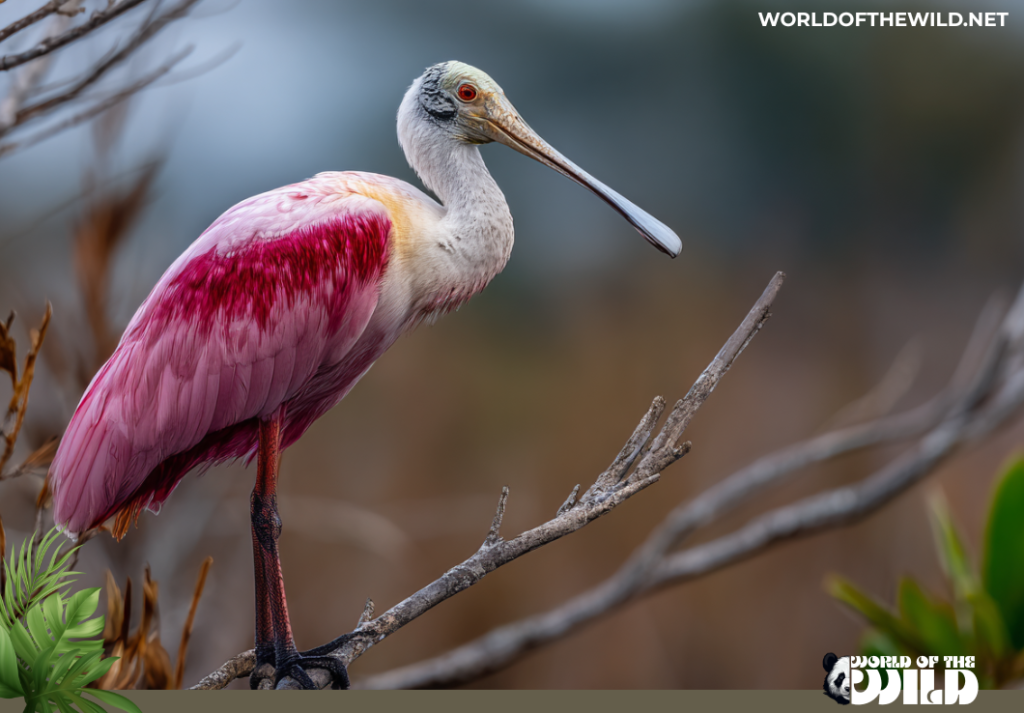
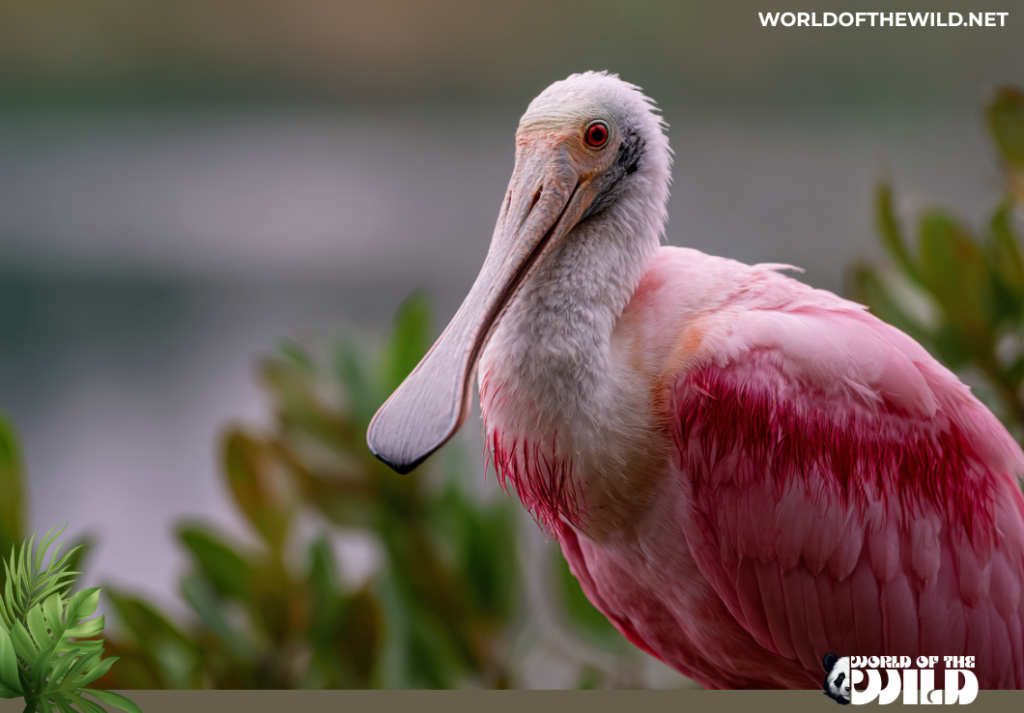
The bird’s most striking feature is its vibrant plumage, which ranges from pale pink to deep rose-red, with the most intense coloration on the wings and shoulder area. The upper back and neck are often white or very pale pink, creating a beautiful gradient effect. The wing coverts display brilliant carmine-red coloration, particularly visible in flight. The tail is a burnt orange color, and the chest and belly range from pink to white.
The bill, the bird’s most distinctive anatomical feature, is long, flat, and spatula-shaped, measuring about 6 inches in length. It’s gray-green in color with a yellowish tinge and has a spoon-like expansion at the tip. The head is entirely featherless, displaying greenish skin with variable coloration that can include yellow, orange, or olive tones. The eyes are bright red, surrounded by this bare skin, giving the bird an almost prehistoric appearance.
Long, pink legs extend from the body, perfectly adapted for wading in shallow waters. During breeding season, adults develop more intense coloration overall, and the bare skin on the head becomes brighter and more vivid. Juvenile birds are considerably paler, with white or very pale pink plumage and a feathered head that gradually becomes bare as they mature.
Behavior
Roseate Spoonbills are highly social birds that exhibit fascinating behavioral patterns both in their daily activities and social interactions. They are diurnal, most active during daylight hours when they engage in their distinctive feeding behavior. Their feeding technique is unique among wading birds: they walk slowly through shallow water, sweeping their partially opened bills from side to side in a graceful, rhythmic motion. This specialized feeding strategy, called “tactile foraging,” relies on sensitive mechanoreceptors inside the bill rather than visual hunting like most herons and egrets.
These birds are gregarious throughout the year, rarely found alone except when individuals are separated from their flock. They typically feed in small groups of 5 to 15 birds, though larger aggregations can occur in areas with abundant food. During the non-breeding season, they may roost communally with hundreds of individuals, often joining mixed-species flocks with herons, egrets, and ibises for added protection against predators.
Communication among adult spoonbills is primarily visual, as they are remarkably quiet birds. They use postures and displays to communicate within the colony, including bill clapping, head bobbing, and ritualized “up-flights” where birds rise a short distance and resettle. During courtship, pairs engage in elaborate displays involving mutual bill clapping, stick presentations, and synchronized movements.
Spoonbills are relatively intelligent and adaptable, capable of learning the best feeding locations and adjusting their foraging times based on tidal patterns. They exhibit strong site fidelity, returning to the same nesting colonies and feeding grounds year after year. When threatened, they typically flush from an area in a coordinated manner, taking flight with their necks extended and legs trailing behind—quite different from herons, which fly with their necks retracted.
One remarkable adaptation is their ability to regulate their body temperature through their unfeathered head and legs. In hot weather, they increase blood flow to these areas to dissipate heat, and they may be observed standing with their wings partially spread to maximize cooling.
Evolution
The evolutionary history of spoonbills stretches back tens of millions of years, with the family Threskiornithidae (which includes both spoonbills and ibises) representing one of the ancient lineages of modern waterbirds. Fossil evidence suggests that spoonbill-like birds existed as early as the Oligocene epoch, approximately 30 million years ago, though the exact relationship between these ancient forms and modern species remains a subject of ongoing paleontological research.
The distinctive spatulate bill of spoonbills represents a remarkable example of evolutionary specialization. This unique feeding apparatus evolved to exploit a specific ecological niche—capturing small prey in murky, shallow water where visual hunting would be ineffective. The tactile feeding strategy allowed ancestral spoonbills to avoid direct competition with visually hunting wading birds like herons and egrets, even when occupying the same habitats.
Molecular studies indicate that the genus Platalea diverged from its closest relatives, the ibises, sometime during the Miocene epoch, roughly 15 to 20 million years ago. The Roseate Spoonbill’s pink coloration likely evolved relatively recently in evolutionary terms, as it represents a unique trait among the six spoonbill species. This pigmentation, derived from dietary carotenoids, may have evolved as a sexual selection mechanism, with brighter individuals signaling better foraging ability and overall fitness to potential mates.
The geographic isolation of ancestral Roseate Spoonbills in the Americas led to their divergence from the white-plumaged spoonbill species of the Old World. During periods of glacial advance and retreat throughout the Pleistocene epoch (2.6 million to 11,700 years ago), spoonbill populations likely contracted into southern refugia and then expanded northward during warmer periods, shaping their current distribution patterns.
The Roseate Spoonbill’s evolution has also been influenced by the development of coastal wetland ecosystems in the Americas. As mangrove forests, salt marshes, and tidal flats expanded and contracted with changing sea levels over millions of years, spoonbill populations adapted to these dynamic coastal environments, developing the specialized feeding behaviors and habitat preferences we observe today.
Habitat
Roseate Spoonbills inhabit coastal and inland wetlands throughout the tropical and subtropical regions of the Americas. Their geographic range extends from the southern United States through Central America, the Caribbean, and into South America, reaching as far south as central Argentina and Chile. In the United States, they are primarily found along the Gulf Coast from Texas to Florida, with smaller populations in coastal South Carolina and occasional wanderers appearing farther north.
These birds show a strong preference for shallow coastal habitats, particularly favoring mangrove swamps, tidal mudflats, coastal marshes, and lagoons. They require waters with depths of 5 to 8 inches for optimal feeding, where they can wade comfortably while sweeping their bills through the water. Mangrove islands are especially important, serving as both feeding grounds and nesting sites, with the dense vegetation providing protection from terrestrial predators.
Beyond coastal areas, Roseate Spoonbills also inhabit inland wetlands including freshwater marshes, swamps, rivers with slow-moving currents, and the edges of lakes and ponds. They are particularly attracted to areas with abundant aquatic vegetation that provides cover for small fish and crustaceans. The muddy or sandy bottoms of these wetlands are ideal for their tactile feeding technique.
Specific habitat features that attract spoonbills include:
- Shallow water bodies with gentle slopes
- Dense emergent vegetation for nesting
- Open mudflats for feeding
- Nearby deeper water for roosting
- Limited human disturbance
- Abundant populations of small fish and crustaceans
Spoonbills require both feeding and nesting habitats within their range. They often travel several miles between roosting sites, nesting colonies, and feeding grounds. In Florida and along the Gulf Coast, they favor the complex mosaic of habitats found in estuarine systems, where freshwater rivers meet the sea, creating brackish conditions rich in biodiversity.
These birds are somewhat nomadic outside the breeding season, with some populations undertaking seasonal movements in response to changing water levels, food availability, and weather patterns. Northern populations may move southward during winter, while tropical populations may disperse more widely when not breeding.
Diet
The Roseate Spoonbill is a carnivore with a diet consisting primarily of small aquatic organisms. Their feeding strategy is highly specialized and perfectly adapted to their unique bill structure and wetland habitats.
Primary food sources include:
- Small fish: Killifish, minnows, and other fish species measuring 1-3 inches long
- Crustaceans: Shrimp, prawns, crayfish, and small crabs—the primary source of the carotenoid pigments that give them their pink color
- Aquatic insects: Beetles, water bugs, and insect larvae
- Mollusks: Small snails and bivalves
- Amphibians: Tadpoles and small frogs occasionally supplement their diet
The spoonbill’s feeding technique is a marvel of evolutionary adaptation. As they wade through shallow water, they sweep their partially opened bill from side to side in a continuous, rhythmic motion, typically making about 3-4 sweeps per second. The interior of the bill is lined with sensitive mechanoreceptors (nerve endings) that detect even the slightest touch or water disturbance caused by potential prey. When these sensors detect movement, the bill snaps shut with remarkable speed—in as little as 25 milliseconds—trapping the prey inside.
This tactile foraging method is particularly effective in murky water where visual hunting would be nearly impossible. The spatulate shape of the bill creates a wider sweep area, increasing the probability of encounter with prey. Spoonbills typically feed in water depths of 5-8 inches, allowing them to maintain comfortable wading posture while maximizing the volume of water they can process.
Feeding often occurs during early morning and late afternoon hours, though spoonbills will adjust their feeding times based on tidal cycles in coastal areas, targeting the optimal water depth as tides ebb and flow. They may feed individually or in loose aggregations, sometimes following behind larger wading birds that stir up prey as they move through the water.
The carotenoid-rich crustaceans in their diet are essential not just for nutrition but for maintaining their characteristic pink coloration. Birds with brighter plumage generally have access to better feeding grounds and are often preferred as mates during breeding season, creating a direct link between diet quality and reproductive success.
Predators and Threats
In their natural environment, Roseate Spoonbills face predation from various species, though adult birds are relatively safe due to their size and their tendency to nest in colonies on isolated islands.
Natural Predators:
- Eggs and chicks: Raccoons, crows, ravens, fish crows, and grackles raid nests for eggs and young birds
- Snakes: Various snake species, particularly in southern ranges, prey on eggs and nestlings
- Raptors: Bald eagles, Harris’s hawks, and occasionally large owls may take juvenile or adult spoonbills
- Alligators: In some regions, American alligators pose a threat to spoonbills wading or nesting near water
- Crocodiles: In Central and South American portions of their range, crocodilians occasionally prey on spoonbills
The colonial nesting strategy and selection of isolated nesting sites (often on islands surrounded by water) represent important anti-predator adaptations that significantly reduce nest predation rates.
Anthropogenic Threats:
The greatest threats to Roseate Spoonbill populations are human-caused:
Habitat Loss and Degradation: Coastal development, wetland drainage for agriculture and urban expansion, and conversion of mangrove forests represent the most significant long-term threats. The loss of both feeding and nesting habitats directly impacts spoonbill populations. In Florida alone, more than 50% of coastal wetlands have been lost since the early 1900s.
Water Management: Alterations to natural water flow through damming, channelization, and water diversion for human use disrupt the natural cycles that spoonbills and their prey depend upon. Changes in water levels can make feeding areas unsuitable or destroy nesting colonies.
Pollution: Agricultural runoff, industrial pollution, and urban wastewater introduce toxins, heavy metals, and excess nutrients into wetland ecosystems. These pollutants can bioaccumulate in spoonbills, affecting their health and reproductive success. Algal blooms caused by nutrient pollution can deplete oxygen and kill fish populations.
Climate Change: Rising sea levels threaten coastal nesting sites, while changing temperature and precipitation patterns affect wetland hydrology and food availability. Increased frequency and intensity of hurricanes can destroy nesting colonies and temporarily reduce food resources.
Disturbance: Human recreation, boat traffic, and low-flying aircraft can disturb nesting colonies, causing adults to flush from nests and exposing eggs and chicks to predation or temperature stress. Repeated disturbance can lead to colony abandonment.
Historical Plume Hunting: Though no longer a direct threat, the near-extirpation of Roseate Spoonbills in the late 19th and early 20th centuries from plume hunting for the millinery trade created population bottlenecks that may have reduced genetic diversity.
Entanglement: Fishing line, nets, and plastic debris can entangle and injure or kill spoonbills.
Reproduction and Life Cycle
Roseate Spoonbills are monogamous during the breeding season, forming pair bonds that last through the nesting period and sometimes beyond. Breeding typically occurs once annually, with timing varying by latitude—generally winter to early spring in southern portions of their range and spring to summer in more northern areas.
Courtship and Pair Bonding:
Courtship is an elaborate affair featuring multiple displays. Males typically initiate courtship by defending a small territory within the colony. When a female approaches, the pair engages in mutual displays including:
- “Stick-shaking”: The male vigorously shakes a stick in his bill
- “Up-flights”: Short vertical flights followed by landing near the partner
- Bill clapping and crossing
- “Sky-gazing”: Both birds point their bills skyward
- Mutual preening and touching
Once pair bonds are established, both partners participate in nest building, though the male typically gathers materials while the female constructs the nest.
Nesting:
Spoonbills nest colonially, often in mixed-species rookeries with herons, egrets, and ibises. Nests are built in trees or shrubs, typically 5-15 feet above ground or water, though heights can vary from 4 to 30 feet. Mangrove trees are preferred nesting substrates in coastal areas. The nest is a platform of sticks and twigs, lined with finer materials like leaves and grass.
Eggs and Incubation:
Females typically lay 2-4 eggs (occasionally 1-5), which are white with brown markings. Eggs are laid at 1-2 day intervals. Both parents share incubation duties, with shifts lasting several hours. The incubation period is approximately 22-24 days.
Chick Development:
Hatchlings are altricial, born with their eyes closed, covered in sparse white down, and completely dependent on parental care. Their bills are short and straight at hatching, developing the characteristic spoon shape over several weeks. Both parents feed the chicks by regurgitation, initially providing partially digested food directly into the chick’s bill, later encouraging chicks to reach into the parent’s throat.
Chicks develop rapidly:
- Eyes open at 5-6 days
- Stand in nest at 2 weeks
- Begin moving along branches at 3-4 weeks
- Fledge (first flight) at 5-6 weeks
- Remain dependent on parents for several more weeks
Juvenile Period:
Young spoonbills are pale pink or white, gradually acquiring adult coloration over 2-3 years as they consume carotenoid-rich prey. They reach sexual maturity at approximately 3 years of age, though they may not breed successfully until age 4.
Lifespan:
In the wild, Roseate Spoonbills typically live 10-15 years, though some individuals have been documented living over 16 years. In captivity, with protection from predators and consistent food supply, they may live into their late teens or early twenties. Survival rates are lowest for eggs and young chicks, with mortality decreasing significantly once birds fledge and join feeding flocks.
Population
The Roseate Spoonbill is currently classified as Least Concern by the International Union for Conservation of Nature (IUCN), indicating that the species is not immediately threatened with extinction. However, this global classification masks significant regional variations and ongoing conservation challenges.
Population Estimates:
Precise global population numbers are difficult to determine due to the species’ wide range across the Americas, but estimates suggest a total population of approximately 50,000-100,000 mature individuals. The population appears to be relatively stable overall, though with regional variations.
Regional Status:
United States: The U.S. population has shown remarkable recovery since the early 20th century, when plume hunting nearly extirpated the species from the country. By the 1930s, only a few dozen nesting pairs remained in Florida and Texas. Thanks to protection under the Migratory Bird Treaty Act and wetland conservation efforts, the population has rebounded to several thousand nesting pairs. Florida alone now hosts approximately 1,200-1,500 nesting pairs, concentrated in Florida Bay, the Everglades, and Tampa Bay. Texas supports another significant population in coastal areas.
Mexico and Central America: These regions host substantial populations, particularly in coastal areas along both the Caribbean and Pacific coasts, though comprehensive population data is limited.
Caribbean: Populations are scattered across various islands, with some islands hosting stable colonies while others have experienced declines.
South America: Large populations exist in Brazil, Venezuela, Colombia, and other countries, though habitat loss in some areas has led to local declines.
Population Trends:
While the global population appears stable, several trends are concerning:
- Continued habitat loss in rapidly developing coastal areas
- Increasing impacts from climate change, particularly sea-level rise
- Local population declines in areas with intensive coastal development
- Some northern populations showing sensitivity to disturbance and water management changes
Conversely, positive trends include:
- Successful range expansion in some U.S. Gulf Coast areas
- Effective protection of key nesting colonies
- Increased awareness and conservation efforts for wetland ecosystems
Conservation Efforts:
The recovery of Roseate Spoonbill populations in the United States serves as a conservation success story, demonstrating the effectiveness of legal protection and habitat preservation. Key conservation measures include:
- Protection of critical nesting colonies
- Wetland restoration and preservation
- Water management policies that maintain natural hydrological cycles
- Monitoring programs to track population trends
- Educational initiatives to reduce human disturbance at colonies
- International cooperation through migratory bird treaties
Despite their current Least Concern status, Roseate Spoonbills remain vulnerable to habitat loss and climate change, making continued conservation efforts essential for long-term population stability.
Conclusion
The Roseate Spoonbill stands as one of nature’s most visually stunning creations, a testament to the power of evolutionary adaptation and the beauty of wetland ecosystems. From its vibrant pink plumage earned through diet to its remarkably specialized tactile feeding technique, every aspect of this extraordinary bird reflects millions of years of refinement for life in shallow coastal waters. The spoonbill’s story is also one of resilience and hope—a species that recovered from the brink of extinction in the United States to once again grace our southern wetlands in healthy numbers.
Yet the challenges facing Roseate Spoonbills remind us that conservation victories are never permanent. As coastal development accelerates, wetlands disappear, and climate change reshapes ecosystems, the continued survival of these magnificent birds depends on our commitment to preserving the complex wetland habitats they require. Spoonbills serve as important indicator species; their presence signals healthy, functioning wetland ecosystems that support countless other species, filter water, protect coastlines from storms, and sequester carbon.
The next time you encounter a Roseate Spoonbill—whether wading through a coastal lagoon with its distinctive spatulate bill sweeping through the water, or standing in brilliant pink splendor against a backdrop of mangroves—take a moment to appreciate not just the bird itself, but the entire interconnected web of life it represents. Support wetland conservation, advocate for responsible water management, and help ensure that future generations will also have the privilege of witnessing these remarkable birds painting our wetlands pink.
Scientific Name: Platalea ajaja
Diet Type: Carnivore
Size: 28-34 inches (71-86 cm) in length; wingspan 47-52 inches (120-132 cm)
Weight: 2.6-4 pounds (1.2-1.8 kg)
Region Found: Coastal and inland wetlands from the southern United States through Central America, the Caribbean, and South America to central Argentina and Chile