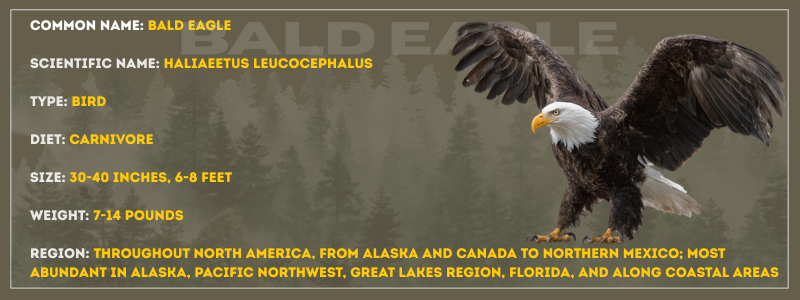

With piercing yellow eyes that can spot a fish from over a mile away and talons powerful enough to crush bone, the Bald Eagle commands the skies of North America as one of nature’s most formidable aerial predators. This magnificent bird of prey, crowned with its distinctive white-feathered head, has soared through centuries of human history—from sacred symbol in Indigenous cultures to emblem of a nation to comeback story of conservation triumph. More than just a symbol on currency and government seals, the Bald Eagle represents a living testament to the wild beauty and resilience of North American ecosystems, embodying both the raw power of nature and the delicate balance required to preserve it.
Facts
Seven Fascinating Bald Eagle Facts:
- They’re kleptomaniacs of the sky – Bald Eagles frequently steal food from other birds, particularly Ospreys, harassing them in mid-air until they drop their catch. Benjamin Franklin famously criticized this “thieving” behavior when opposing the eagle as America’s national symbol.
- Their nests are record-breakers – Bald Eagle nests are the largest tree nests ever recorded for any animal species, with the biggest documented nest in Florida measuring 9.5 feet wide, 20 feet deep, and weighing nearly 3 tons.
- They mate for life with annual renewals – Bonded pairs perform elaborate aerial courtship displays each year, even after decades together, locking talons and cartwheeling through the sky in a breathtaking ritual.
- Their vision is supercharged – Eagles can see four to seven times farther than humans, with eyes that have two focal points (foveae) per eye compared to our one, allowing them to see both forward and to the side simultaneously with extreme clarity.
- They don’t get their iconic look immediately – Juvenile Bald Eagles are completely brown and mottled for their first five years of life, only developing the characteristic white head and tail feathers upon reaching sexual maturity.
- They’re surprisingly vocal – Despite their fierce appearance, Bald Eagles produce a surprisingly weak, high-pitched chattering call. Hollywood often dubs over their calls with the more impressive scream of a Red-tailed Hawk in films.
- They can swim – When a Bald Eagle catches a fish too heavy to lift, it can use its wings in a butterfly stroke to paddle to shore rather than releasing its prize.
Sounds of a Bald Eagle
Species
Taxonomic Classification:
- Kingdom: Animalia
- Phylum: Chordata
- Class: Aves
- Order: Accipitriformes
- Family: Accipitridae
- Genus: Haliaeetus
- Species: Haliaeetus leucocephalus
The Bald Eagle belongs to the genus Haliaeetus, commonly known as sea eagles, a group of large raptors that predominantly feed on fish and inhabit coastal regions and waterways. Within this genus, the Bald Eagle shares its lineage with seven other living species, including the White-tailed Eagle (Haliaeetus albicilla) of Eurasia, which is considered its closest living relative, and Steller’s Sea Eagle (Haliaeetus pelagicus), the heaviest eagle species on Earth.
Historically, ornithologists recognized two subspecies of Bald Eagle: the Northern Bald Eagle (H. l. alascanus) and the Southern Bald Eagle (H. l. leucocephalus), distinguished primarily by size differences corresponding to Bergmann’s rule—the principle that animals in colder climates tend to be larger. However, modern genetic analysis has revealed these populations form a continuous gradient rather than distinct subspecies, and most contemporary taxonomists now treat the Bald Eagle as a single, variable species with clinal variation in size from north to south.
Appearance
The Bald Eagle is an imposing raptor that commands attention with its powerful build and distinctive plumage. Adult eagles display the iconic appearance Americans recognize: a snow-white head and tail contrasting sharply against a dark chocolate-brown body and wings. The term “bald” derives from the archaic English word “balde,” meaning white, rather than indicating hairlessness. Their hooked beaks are bright yellow and exceptionally powerful, while their eyes—also yellow with a piercing, almost supernatural intensity—are positioned forward for binocular vision.
Sexual dimorphism is pronounced in Bald Eagles, with females noticeably larger than males. Females typically measure 37 to 40 inches in length with wingspans reaching 7 to 8 feet, while males are slightly smaller at 30 to 37 inches with wingspans of 6 to 7 feet. Female Bald Eagles weigh between 10 to 14 pounds, whereas males average 7 to 10 pounds. Northern populations tend toward the larger end of these ranges.
Their massive talons, colored the same bright yellow as their beaks, span up to 6 inches and can exert crushing pressure exceeding 400 pounds per square inch—more than ten times the grip strength of an average human hand. Seven-inch-long flight feathers create their broad, powerful wings, which feature distinctive “fingered” wingtip primaries that spread during soaring flight. The tail is relatively short and wedge-shaped.
Juvenile Bald Eagles present an entirely different appearance, covered in mottled dark brown plumage with varying degrees of white or cream streaking. Their beaks and eyes are dark rather than yellow. This camouflage serves young eagles well during their vulnerable early years, and they gradually acquire adult plumage over five years through a series of molts, with the white head and tail being the last features to fully develop.
Behavior
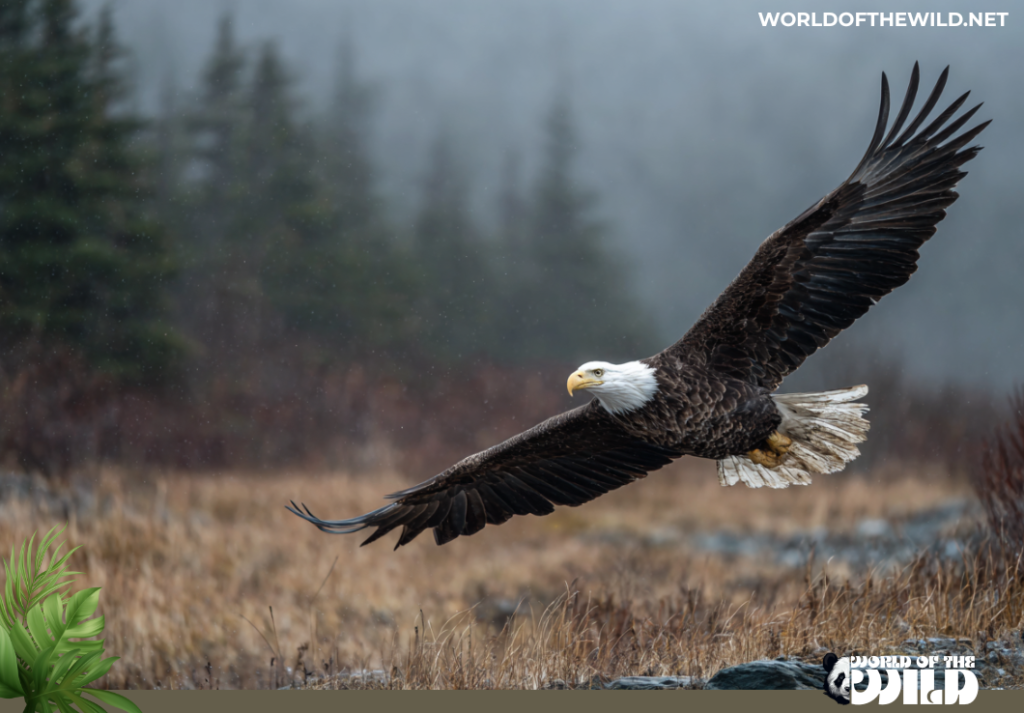
Bald Eagles are predominantly diurnal hunters, most active during early morning and late afternoon when fish—their preferred prey—are most accessible near the water’s surface. They are powerful, agile fliers capable of reaching speeds of 35-40 miles per hour during normal flight and up to 100 miles per hour in a dive, though they spend much of their time conserving energy by soaring on thermal updrafts with minimal wing flapping.
These raptors exhibit complex social behaviors that vary with season and location. While often observed alone or in breeding pairs during nesting season, Bald Eagles can be remarkably gregarious during winter months or when food sources are concentrated. Communal roosts may host dozens or even hundreds of eagles, and abundant fishing sites can attract similar congregations. At these gatherings, a distinct social hierarchy emerges based primarily on age and size, with mature adults dominant over younger birds.
Communication occurs through both vocal and visual displays. Their surprisingly weak, high-pitched calls—often described as a series of chirps, whistles, or chattering sounds—serve territorial and bonding purposes. Body language plays an equally important role: head bowing, wing spreading, and various postures communicate aggression, submission, or courtship intentions.
Bald Eagles demonstrate remarkable intelligence and behavioral flexibility. They’ve been observed using creative hunting strategies, including cooperative fishing where one eagle drives fish toward shallow water while another captures them. They readily adapt to changing conditions, learning to exploit new food sources like roadkill or garbage dumps when natural prey becomes scarce. Their opportunistic nature and willingness to scavenge—despite the association with predatory prowess—actually represents sophisticated energy conservation.
Perhaps most impressive are their aerial acrobatics. Bonded pairs perform elaborate flight displays involving talon-grappling, synchronized flying, and dramatic dives. During these performances, two eagles will lock talons mid-air and cartwheel downward in a spectacular spiral, sometimes plummeting hundreds of feet before releasing and pulling up just above the ground or water.
Evolution
The Bald Eagle’s evolutionary lineage traces back approximately 28 million years to the Oligocene epoch, when the earliest ancestral sea eagles diverged from other raptors. The genus Haliaeetus first appeared in the fossil record around 10 million years ago during the Miocene, with early species inhabiting coastal and aquatic environments across multiple continents.
The Bald Eagle and its closest living relative, the White-tailed Eagle of Eurasia, share a common ancestor that likely lived during the Pliocene epoch, roughly 3 to 5 million years ago. Fossil evidence suggests these two species diverged as populations became geographically isolated when sea levels changed and land bridges formed or disappeared. The Bald Eagle evolved in North America, while the White-tailed Eagle remained in Eurasia. Their remarkable similarity in appearance, behavior, and ecological niche represents parallel evolution in similar environments.
Genetic studies indicate that the Bald Eagle underwent a population bottleneck during the last Ice Age (approximately 20,000 years ago), when glaciation restricted suitable habitat. As the ice retreated and North America’s climate warmed, Bald Eagles expanded their range both northward and inland along major waterways. This relatively recent expansion explains the species’ limited genetic diversity compared to some other widespread raptors.
Fossil remains of Haliaeetus leucocephalus have been found in Late Pleistocene deposits, indicating the species has existed in essentially its modern form for at least 300,000 years. Interestingly, some extinct Pleistocene eagles found in North America were significantly larger than modern Bald Eagles, suggesting that the contemporary species may represent a size reduction following the extinction of megafauna.
The evolution of the Bald Eagle’s distinctive white head plumage is thought to have emerged as a social signal, allowing eagles to quickly identify mature, sexually active individuals from a distance—crucial for both territorial defense and mate selection in a species that maintains long-term pair bonds and defends large territories.
Habitat
Bald Eagles inhabit a vast range extending throughout most of North America, from Alaska and northern Canada south through the continental United States to northern Mexico. They are found in every U.S. state except Hawaii, with the highest concentrations in Alaska, the Pacific Northwest, the Great Lakes region, Florida, and along both the Atlantic and Pacific coasts. Their range has expanded significantly since the 1970s following the ban of DDT pesticides, and they now breed in areas where they were absent for decades.
These magnificent raptors are fundamentally tied to water. Their preferred habitats invariably feature large bodies of open water—including coastlines, rivers, lakes, reservoirs, and marshes—that support abundant fish populations. They typically select territories with minimal human disturbance, though they’ve shown increasing tolerance for human presence in recent decades, occasionally nesting near developed areas with suitable food sources.
Mature forest stands provide essential nesting habitat. Bald Eagles require large, sturdy trees—typically conifers like pines, spruces, or firs, though they also use hardwoods such as cottonwoods, oaks, or sycamores—capable of supporting their massive nests. Ideal nest trees are emergent, rising above the surrounding canopy to provide clear flight paths and unobstructed views of the surrounding landscape. These trees typically stand within a mile of water.
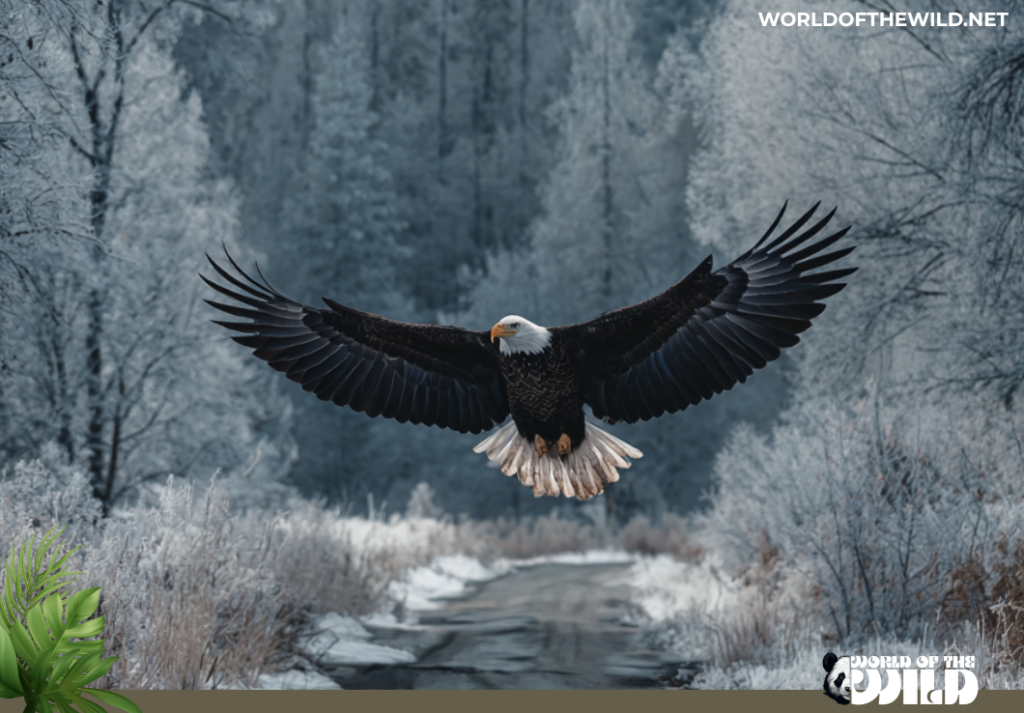
Northern populations are partially migratory, moving southward when their hunting grounds freeze in winter. These eagles often congregate at sites where open water remains available, such as below dams, near power plant outflows, or along ice-free stretches of rivers. Southern populations are generally non-migratory, remaining in their territories year-round.
The specific characteristics of optimal Bald Eagle habitat include tall perching trees for hunting and roosting, shallow waters or exposed shores for foraging, adequate prey populations, and relatively low levels of human disturbance during the sensitive nesting season. Coastal areas, estuaries, and salmon-bearing rivers in the Pacific Northwest provide particularly rich habitat, supporting some of the highest eagle densities in North America.

Diet
Bald Eagles are carnivores with a strong dietary preference for fish, which typically comprises 50-90% of their diet depending on location and season. They are opportunistic hunters and scavengers, however, displaying remarkable dietary flexibility that has contributed to their ecological success.
As piscivores, Bald Eagles target fish weighing between 1 to 6 pounds, though they can carry prey up to 8 pounds and have been observed catching fish exceeding 15 pounds. Preferred fish species include salmon, trout, herring, catfish, carp, and bass. They employ a characteristic hunting technique: soaring or perching high above the water, then swooping down to snatch fish from the surface or just below with their powerful talons. Their specialized feet feature spicules (small spiny bumps) on their toe pads and rear-facing scales on their talons that provide the grip necessary to hold slippery prey.
Beyond fish, Bald Eagles consume a diverse array of prey. Waterfowl such as ducks, geese, and coots feature prominently in their diet, particularly during migration seasons or in areas with abundant bird populations. They hunt these birds both by aerial pursuit and by ambushing them on the water. Mammals ranging from rabbits and squirrels to young deer and seal pups occasionally become prey, as do reptiles like snakes and turtles when available.
Carrion represents a significant dietary component, especially during winter months when live prey becomes scarce. Bald Eagles readily feed on dead fish, mammals, and other animals, and in some regions, they regularly patrol roadways for vehicle-killed deer and other roadkill. This scavenging behavior, while once viewed negatively, actually demonstrates intelligent energy conservation.
Bald Eagles are also notorious kleptoparasites—birds that steal food from other hunters. They routinely harass Ospreys, forcing these skilled fish hunters to drop their catch, which the eagle then snatches mid-air. This behavior, though seemingly unsportsmanlike, is an efficient hunting strategy that reduces the energy expenditure and risk associated with capturing prey.
Predators and Threats
Adult Bald Eagles have few natural predators due to their size, power, and aerial prowess. However, their eggs, nestlings, and occasionally juveniles face various threats. Great Horned Owls represent the most significant avian predator, capable of raiding eagle nests at night to consume eggs or small chicks. Raccoons, ravens, crows, and gulls also opportunistically prey on unguarded eggs. Young eaglets or fledglings may fall victim to bears, wolverines, or bobcats if they become grounded or vulnerable.
Human-caused threats have historically posed—and continue to pose—the greatest danger to Bald Eagle populations. The most catastrophic modern threat came from the widespread use of DDT pesticide from the 1940s through 1972. This chemical accumulated in eagles through biomagnification, concentrating as it moved up the food chain from contaminated fish. DDT interfered with calcium metabolism, causing eagles to lay eggs with shells so thin they broke during incubation. Populations plummeted to fewer than 500 breeding pairs in the contiguous United States by the 1960s.
Contemporary threats include lead poisoning, one of the leading causes of Bald Eagle mortality today. Eagles consume lead when they scavenge animals shot with lead ammunition or ingest lead fishing tackle embedded in fish or waterfowl. Lead causes neurological damage, organ failure, and death. Electrocution from power lines and collisions with vehicles, wind turbines, and aircraft also claim significant numbers of eagles annually.
Habitat loss and degradation continue to challenge Bald Eagle populations, particularly the destruction of old-growth forests containing suitable nesting trees and the pollution or development of shoreline feeding areas. Climate change poses emerging threats by altering fish populations, changing water levels, and affecting the timing of salmon runs that many northern eagles depend upon.
Illegal shooting, though greatly reduced from historical levels, still occurs, as does disturbance of nesting sites by human recreation activities. Eagles are sensitive to disturbance during nesting season, and excessive human presence can cause nest abandonment. Chemical contaminants beyond DDT—including PCBs, mercury, and emerging pollutants—continue to accumulate in aquatic food chains and affect eagle health.
Reproduction and Life Cycle
Bald Eagles are monogamous and typically mate for life, though they will find new partners if one dies. Pair bonds strengthen through annual courtship rituals that begin in late fall or early winter. These elaborate displays include spectacular aerial performances where pairs engage in dramatic sky dances—locking talons and cartwheeling earthward in breathtaking spirals, soaring synchronously, and performing undulating flight patterns while calling to each other.
Breeding season varies by latitude, beginning as early as October in Florida and as late as April or May in Alaska. Pairs return to the same nesting territory year after year, often reusing and adding to the same nest for decades. Both sexes participate in nest construction and maintenance, weaving together sticks, branches, and vegetation to create massive platform nests. Fresh material is added each year, and nests can grow enormous over time—the largest recorded Bald Eagle nest measured nearly 10 feet wide and 20 feet deep.
Females typically lay one to three eggs (most commonly two) at intervals of one to four days. The eggs are dull white and approximately 2.75 inches long. Both parents share incubation duties, which last 34 to 36 days, though the female typically spends more time on the eggs. During incubation, one parent always remains with the nest while the other hunts.
Chicks hatch covered in light gray down and are completely helpless (altricial). Both parents provision the young with progressively larger pieces of food, initially feeding tiny morsels and gradually offering whole fish. Eaglets grow rapidly, and intense sibling rivalry can occur when food is scarce—the oldest, largest chick may dominate or even kill younger, weaker siblings through a behavior called cainism or siblicide.
Young eagles develop quickly, growing dark juvenile plumage and fledging (taking their first flight) at 8 to 14 weeks of age. However, they remain dependent on their parents for an additional 4 to 6 weeks while learning to hunt and refining their flying skills. Juvenile eagles disperse from their natal territory in late summer or fall, beginning a nomadic phase that may last several years.
Sexual maturity arrives around 4 to 5 years of age, coinciding with the development of full adult plumage. Young eagles may spend this time wandering widely, sometimes traveling thousands of miles from their birthplace. Once mature, they seek out territories and mates, often returning to areas relatively near where they hatched.
Bald Eagles in the wild typically live 15 to 25 years, though the oldest known wild Bald Eagle was at least 38 years old when found in New York in 2015, still wearing a band placed on it as a nestling in 1977. Captive eagles can live even longer, with some individuals exceeding 50 years. Most mortality occurs during the first year of life, with survival rates improving dramatically for eagles that successfully navigate their vulnerable juvenile period.
Population
The Bald Eagle’s conservation status represents one of North America’s greatest wildlife recovery achievements. Currently listed as “Least Concern” by the International Union for Conservation of Nature (IUCN), this classification marks a remarkable reversal from the species’ near-extinction in the mid-20th century.
Before European colonization, Bald Eagle populations likely numbered between 300,000 to 500,000 birds across North America. By the 1960s, following decades of persecution, habitat loss, and particularly the devastating effects of DDT pesticide, the population in the lower 48 states had crashed to approximately 417 breeding pairs—a decline of more than 95%. The species was officially listed as endangered under the Endangered Species Act in 1978 (threatened in most states, endangered in several).
The turning point came with the 1972 ban on DDT in the United States, combined with comprehensive protection under the Endangered Species Act, habitat preservation efforts, and intensive management programs including captive breeding and reintroduction initiatives. Eagle populations began a slow but steady recovery that accelerated through the 1990s and 2000s.
By 2007, when the Bald Eagle was removed from the federal threatened and endangered species list, populations had rebounded to approximately 9,800 breeding pairs in the contiguous United States. Current estimates place the total North American Bald Eagle population at roughly 300,000 to 350,000 individuals, including approximately 70,000 breeding pairs in the lower 48 states and another estimated 70,000 birds in Alaska, which never experienced the same population crash.
Population trends remain positive across most of the species’ range. Annual surveys document continued growth in many states, with eagles recolonizing former territories and expanding into new areas. Some states that had no breeding eagles in the 1970s now host hundreds of pairs. The Great Lakes region, Mid-Atlantic states, and Pacific Northwest have experienced particularly strong recoveries.
Despite their improved status, Bald Eagles remain protected under the Bald and Golden Eagle Protection Act and the Migratory Bird Treaty Act, which prohibit killing, selling, or otherwise harming eagles, their eggs, or nests. These protections ensure that the species’ remarkable recovery continues and that the mistakes of the past are not repeated.
Conclusion
The Bald Eagle’s journey from sacred symbol to near-extinction to thriving populations embodies both humanity’s capacity to harm nature and our ability to restore it. These magnificent raptors—with their piercing yellow eyes, powerful talons, and mastery of the skies—represent far more than national pride; they stand as living proof that conservation works when we commit to protecting the natural world. Their recovery required decades of dedicated effort: banning harmful pesticides, protecting critical habitat, enforcing anti-persecution laws, and investing in restoration programs.
Yet the Bald Eagle’s story isn’t finished. While populations have rebounded remarkably, these birds still face modern threats from lead poisoning, habitat loss, and climate change. Ensuring their continued success requires ongoing vigilance and action. We can contribute by supporting the use of non-lead ammunition and fishing tackle, protecting shoreline habitats, maintaining clean waterways, and advocating for policies that safeguard both eagles and the ecosystems they depend upon.
The next time you witness a Bald Eagle soaring overhead or perched majestically beside a river, remember that you’re seeing a conservation triumph—a species brought back from the brink through human determination and care. Let these powerful raptors inspire us not only with their wild beauty but with the knowledge that when we choose to protect nature, remarkable recoveries are possible. The eagles’ return to American skies reminds us that we share this planet with magnificent creatures worthy of our respect and protection, and that our actions today will determine which species future generations inherit.
Scientific Name: Haliaeetus leucocephalus
Diet Type: Carnivore (primarily piscivore)
Size: 30-40 inches in length; wingspan 6-8 feet
Weight: 7-14 pounds (males smaller, females larger)
Region Found: Throughout North America, from Alaska and Canada to northern Mexico; most abundant in Alaska, Pacific Northwest, Great Lakes region, Florida, and along coastal areas