
Deep within the emerald forests of the Philippines, a magnificent predator rules the skies with unmatched power and grace. The Philippine Eagle, known locally as “Haribon” (meaning “bird king”), stands as one of the world’s largest and rarest eagles, a living testament to the extraordinary biodiversity of Southeast Asian rainforests. With piercing blue-gray eyes that can spot a monkey from over a kilometer away and talons powerful enough to crush bone, this apex predator embodies both the majesty and fragility of wilderness. Found nowhere else on Earth, the Philippine Eagle represents not just a species struggling for survival, but a critical indicator of forest ecosystem health and a powerful symbol of national pride for the Filipino people.
Facts
1. The Mistaken Identity: The Philippine Eagle was historically called the “Monkey-Eating Eagle,” but this name is misleading. While monkeys do appear in its diet, they make up only a small portion of what this adaptable hunter consumes.
2. Monogamous for Life: Philippine Eagle pairs mate for life, with bonds lasting 30 years or more. If one partner dies, the surviving eagle may remain alone for years before finding a new mate.
3. One Egg Wonder: These eagles have one of the slowest reproductive rates of any bird, producing just one egg every two years. This makes population recovery extraordinarily difficult.
4. Forest Acrobats: Despite their size and a wingspan exceeding two meters, Philippine Eagles are remarkably agile, able to navigate through dense forest canopy with precision that would make smaller raptors envious.
5. Cultural Icon: Killing a Philippine Eagle in the Philippines is punishable by up to 12 years in prison and hefty fines, reflecting the species’ revered status as the national bird.
6. Incredibly Rare: Scientists estimate there may be fewer than 400 individual Philippine Eagles remaining in the wild, making them rarer than giant pandas.
7. Late Bloomers: Young eagles remain dependent on their parents for up to 18 months after hatching, one of the longest juvenile dependency periods of any raptor species.
Species
The Philippine Eagle belongs to the following taxonomic classification:
- Kingdom: Animalia
- Phylum: Chordata
- Class: Aves
- Order: Accipitriformes
- Family: Accipitridae
- Genus: Pithecophaga
- Species: Pithecophaga jefferyi
The Philippine Eagle is the sole member of its genus, Pithecophaga, making it taxonomically unique. The genus name literally translates to “monkey-eater,” derived from the Greek words “pithekos” (ape) and “phagos” (eater), referencing the historical but somewhat inaccurate common name.
Unlike many eagle species that have multiple subspecies across different regions, the Philippine Eagle has no recognized subspecies. However, some variation exists between populations on different Philippine islands. Historically, the species inhabited four major islands: Luzon, Samar, Leyte, and Mindanao. Today, viable populations exist primarily on Mindanao, with smaller, more vulnerable populations on Luzon and possibly Samar. The Leyte population is believed to be extinct or functionally extinct.
Its closest relatives within the Accipitridae family include other large forest eagles, though the Philippine Eagle’s unique characteristics and isolated evolution have made it distinct enough to warrant its own genus.
Appearance
The Philippine Eagle is a breathtaking specimen of avian evolution, combining massive size with striking elegance. Adults typically measure 86 to 102 centimeters in length from beak to tail, with females being notably larger than males, as is common in raptors. Their wingspan ranges from 184 to 220 centimeters, though their relatively short, broad wings are specifically adapted for forest hunting rather than open-sky soaring.
These eagles typically weigh between 4.5 and 8 kilograms, with females at the heavier end of this range. This places them among the world’s heaviest eagles, alongside the Harpy Eagle and Steller’s Sea Eagle.
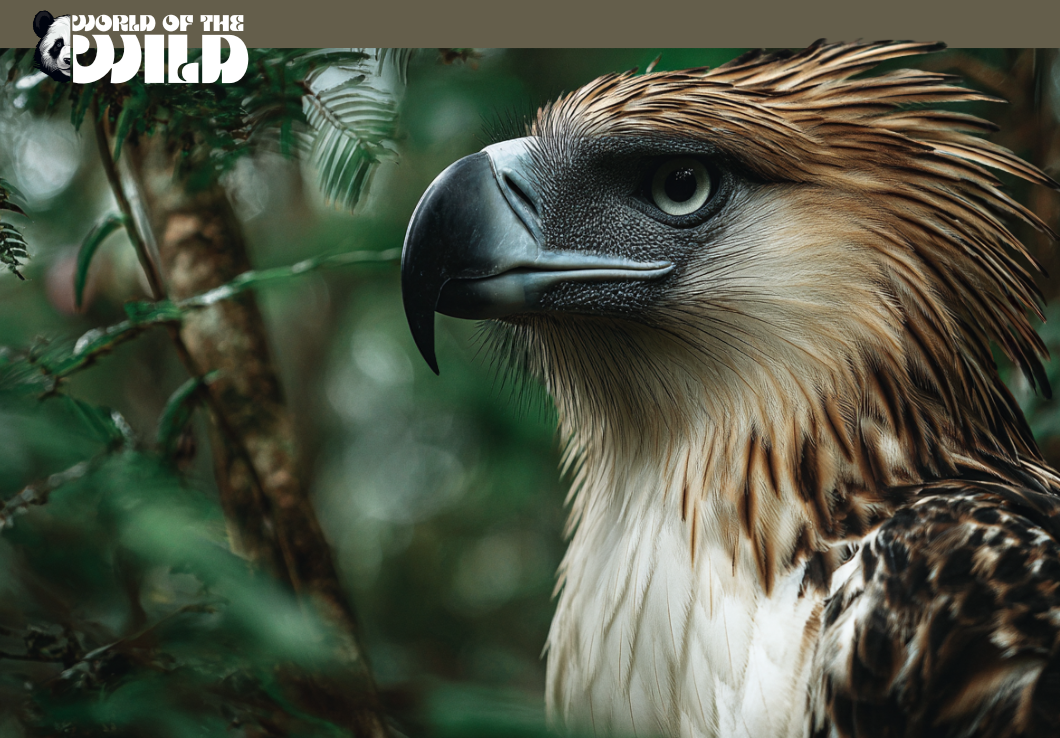
The Philippine Eagle’s most distinctive feature is its shaggy, mane-like crest of long, cream-colored feathers that stands erect when the bird is excited or alarmed, giving it a lion-like appearance. The plumage is predominantly creamy-white to buff on the head, neck, and underparts, contrasting beautifully with dark brown feathers on the back, wings, and tail. The breast feathers have distinctive brown streaks, creating an arrow-like pattern.
The bird’s face is particularly striking, with piercing blue-gray eyes set in a featherless, bluish facial skin. This bare facial skin may help with thermoregulation in the tropical climate. The massive, deeply hooked beak is a deadly weapon, bluish-gray at the base and darkening to almost black at the tip. Perhaps most formidable are the talons: thick, curved, and extraordinarily powerful, designed to pierce through fur, flesh, and even primate skulls. The rear talon can reach up to 7 centimeters in length.
Juvenile Philippine Eagles differ from adults in coloration, sporting lighter brown plumage that gradually darkens as they mature over several years. They also have brown rather than blue-gray eyes, which change color as they reach sexual maturity around five to seven years of age.

Behavior
Organized behavioral section covering daily habits, social dynamics, and adaptations.
Let me continue with the Behavior section. I need to describe daily behaviors, social behaviors, communication, intelligence, and unique adaptations.
The Philippine Eagle exhibits complex behaviors that reflect both its predatory prowess and its challenging environment. These are primarily diurnal hunters, most active during the cooler morning and late afternoon hours when their prey is also active. During the heat of midday, they often perch high in emergent trees, conserving energy while maintaining a watchful eye over their territory.
Philippine Eagles are solitary and highly territorial birds. Mated pairs maintain vast home ranges, typically between 25 and 130 square kilometers, which they defend vigorously against intruders. Within these territories, eagles establish multiple nest sites and hunting perches, learning every tree, canyon, and clearing with remarkable spatial memory.
Communication between Philippine Eagles involves a variety of vocalizations. They produce high-pitched whistles and loud, piercing screams that echo through the forest canopy. During courtship and territorial displays, pairs engage in spectacular aerial performances, soaring together and performing synchronized flight maneuvers that showcase their bond and aerial mastery.
These eagles demonstrate exceptional intelligence, particularly in their hunting strategies. They employ a “perch and pounce” technique, sitting motionless for extended periods before launching devastating surprise attacks. Some individuals have been observed working in pairs, with one eagle flushing prey while the other waits to ambush. This cooperative hunting behavior suggests advanced cognitive abilities and communication between mates.
Their adaptations for forest hunting are remarkable. Unlike open-country eagles that rely on soaring flight, Philippine Eagles have evolved shorter, broader wings and longer tails that provide exceptional maneuverability through dense vegetation. They can snatch prey from tree branches while flying at high speed, demonstrating extraordinary depth perception and reflexes. Their keen eyesight can detect movement through multiple layers of forest canopy, and their hearing is acute enough to locate prey by sound alone.
Philippine Eagles are known to be curious and playful, particularly juveniles, who spend months learning hunting techniques through trial and error. They’ve been observed manipulating objects with their talons and engaging in aerial games, behaviors that likely help develop the coordination necessary for forest hunting.
Evolution
The evolutionary history of the Philippine Eagle is a fascinating story of island adaptation and specialization. The species’ ancestors likely arrived in the Philippine archipelago several million years ago, during periods when sea levels were lower and land bridges periodically connected the islands to mainland Asia. Once isolated on these islands, the ancestral eagles underwent rapid evolutionary changes in response to the unique ecological conditions of the Philippine rainforests.
The Philippine Eagle’s evolution is characterized by adaptation to forest hunting, a relatively rare specialization among large eagles. Most of its relatives are open-country or cliff-dwelling species, but the Philippine Eagle evolved to become a canopy specialist. This required significant morphological changes: the development of shorter, broader wings for agility rather than soaring, enhanced binocular vision for depth perception in cluttered environments, and powerful legs and talons capable of snatching agile, tree-dwelling prey.
Genetic studies suggest that the Philippine Eagle diverged from other large eagles relatively recently in evolutionary terms, perhaps within the last few million years. Its closest living relatives are thought to be other large forest eagles in Southeast Asia and New Guinea, though the exact phylogenetic relationships remain subjects of ongoing research.
The eagle’s evolution was intimately tied to the evolution of Philippine rainforests themselves. As these forests developed unique communities of mammals, birds, and reptiles, the Philippine Eagle evolved to exploit this diverse prey base, becoming increasingly specialized for hunting medium-sized arboreal mammals like flying lemurs and palm civets.
Island evolution also meant developing the ability to survive in relatively small, isolated populations. However, this also made the species vulnerable to genetic bottlenecks and reduced its ability to adapt quickly to environmental changes—a weakness that now threatens its survival in the face of rapid habitat loss.
The species’ slow reproductive rate and long generation time, while successful strategies for thousands of years, evolved in an environment where mature forests were stable and extensive. These same traits now make the Philippine Eagle one of the world’s most vulnerable apex predators.

Habitat
The Philippine Eagle is endemic to the Philippines, meaning it exists nowhere else on Earth. This restriction to a single island nation makes it exceptionally vulnerable to habitat loss and environmental changes. Historically, the species ranged across four major islands: Luzon, Samar, Leyte, and Mindanao, with Mindanao hosting the largest and most stable populations.
These magnificent raptors are specialist inhabitants of primary (old-growth) dipterocarp rainforest, though they can also utilize secondary forest if it retains sufficient structure and prey abundance. They show a strong preference for mountainous and hilly terrain, typically found at elevations ranging from sea level to 1,800 meters, though they’re most common between 400 and 1,000 meters elevation.
The ideal Philippine Eagle habitat features several critical components. First, there must be tall emergent trees that provide nesting sites and commanding perches for hunting surveillance. These giants of the forest, often reaching 30 to 50 meters in height, offer the eagles visibility over the canopy and protection from weather. Second, the forest must maintain a complex, multi-layered structure with dense mid-canopy and understory vegetation where prey species shelter and feed.
The eagles require contiguous forest blocks large enough to support their enormous territories. Fragmented forest patches, even if individually protected, often cannot sustain breeding pairs because they lack sufficient hunting area and prey density. This makes the Philippine Eagle particularly sensitive to forest fragmentation.
Water sources are also important habitat features, as the eagles require streams or rivers within their territories, both for drinking and because riparian (riverside) zones often support high prey densities.
Climate-wise, the Philippine Eagle inhabits a tropical environment characterized by high rainfall, warm temperatures, and high humidity year-round. The forests they inhabit typically receive 2,000 to 4,000 millimeters of rain annually, supporting the lush vegetation necessary for the complex ecosystem the eagles depend upon.
Tragically, the Philippine Eagle’s habitat is among the most threatened in the world. The Philippines has one of the highest deforestation rates in Southeast Asia, with primary forest cover reduced to just a small fraction of historical levels. The remaining eagle habitat exists primarily in scattered protected areas and remote, mountainous regions that have so far resisted development.
Diet
The Philippine Eagle is a formidable apex carnivore, sitting at the top of the forest food chain. These powerful raptors are opportunistic hunters with a diverse diet that reflects the biodiversity of their rainforest home. While historically nicknamed the “Monkey-Eating Eagle,” their diet is far more varied than this moniker suggests.
The primary prey of Philippine Eagles consists of medium-sized arboreal mammals. The Philippine flying lemur, or colugo, is a favored target, comprising a significant portion of their diet in many areas. These cat-sized gliding mammals are abundant in suitable habitats and provide substantial nutrition. Palm civets, small deer, large bats, and yes, occasionally monkeys (particularly the Philippine long-tailed macaque) also feature prominently in their diet.
Beyond mammals, Philippine Eagles are versatile hunters that take a wide variety of prey. Large birds including hornbills, owls, and other raptors are regularly captured, as are various reptiles such as monitor lizards and large snakes, including pythons. Some individuals have even been documented taking prey as large as young pigs and small deer.
The hunting strategy of the Philippine Eagle is based on stealth, patience, and explosive power. They employ a “perch-hunting” technique, spending hours motionless on a high vantage point, scanning the forest with their exceptional vision. When prey is spotted, the eagle launches a swift, silent attack, using the forest structure to mask its approach. The attack is devastatingly quick—the eagle drops or flies rapidly through the canopy, extending its massive talons forward at the last moment to seize the prey with bone-crushing force.
Their feet are their primary weapons. The talons can exert tremendous pressure, capable of piercing skulls and instantly killing prey that might weigh several kilograms. After a successful kill, the eagle typically carries the prey to a feeding perch where it can consume the meal safely, using its powerful beak to tear flesh.
Philippine Eagles require substantial food intake to maintain their massive bodies, consuming approximately 300 to 500 grams of meat daily, though they can survive on less during periods of scarcity. They don’t need to hunt every day; a single large prey item can sustain an eagle for several days.
Interestingly, breeding pairs have been observed hunting cooperatively, with one eagle driving prey toward the other. This sophisticated behavior demonstrates not only intelligence but also strong pair bonding and communication.
Predators and Threats
As apex predators, adult Philippine Eagles have no natural predators in their ecosystem. They sit unchallenged at the top of the food chain, feared by all other forest inhabitants. However, eggs and very young nestlings may occasionally fall prey to large snakes, monitor lizards, or arboreal mammals if left unguarded, though this is rare due to the eagles’ vigilant parental care.
The true threats to Philippine Eagles are almost entirely anthropogenic—caused by humans. These threats are severe enough to push the species to the brink of extinction.
Habitat Loss and Fragmentation: This represents the most devastating threat to the Philippine Eagle. The Philippines has lost more than 90 percent of its original forest cover, primarily due to logging, agricultural expansion, and development. Each year, more forest is cleared for palm oil plantations, coconut farms, and human settlements. As forests disappear and fragment into isolated patches, eagle territories become unsustainable. Even protected forests are often too small to support viable populations.
Hunting and Persecution: Despite legal protection, Philippine Eagles are still occasionally shot by hunters, either deliberately or as accidental victims when mistaken for other species. Some are killed in retaliation for taking domestic animals, though such predation is rare. The black market trade in wildlife also poses a threat, with eggs, chicks, and even adult birds targeted by poachers.
Electrocution and Collision: As human infrastructure expands into eagle habitat, new dangers emerge. Eagles have been electrocuted by power lines and killed by colliding with communication towers and wind turbines, particularly in areas where development encroaches on forest edges.
Pesticide Exposure: Agricultural chemicals used in areas adjacent to forests can accumulate in prey species, potentially poisoning eagles higher up the food chain. While the extent of this threat is not fully understood, bioaccumulation of toxins is a known danger to apex predators worldwide.
Climate Change: Shifting rainfall patterns, increased typhoon intensity, and changing forest composition due to climate change represent emerging threats. Philippine forests are vulnerable to climate-related changes that could alter prey availability and nesting success.
Low Reproductive Rate: While not a direct threat, the eagle’s naturally slow breeding cycle exacerbates all other threats. With pairs producing only one chick every two years, populations cannot quickly recover from losses. This biological limitation means that even small increases in mortality can drive populations toward extinction.
The combination of these threats has created a perfect storm for the Philippine Eagle, pushing it to critically endangered status and making every surviving individual precious.

Reproduction and Life Cycle
The reproductive biology of the Philippine Eagle is characterized by long-term investment and exceptionally slow rates, contributing significantly to the species’ vulnerability. These eagles are among the slowest-breeding birds of prey in the world.
Philippine Eagles form monogamous pair bonds that last for life, which can span three decades or more. Courtship involves spectacular aerial displays, with pairs soaring together, performing synchronized flight maneuvers, and engaging in talon-grappling displays where they clasp feet mid-air and spiral toward the forest canopy. These displays strengthen pair bonds and reaffirm territorial ownership.
The breeding cycle begins with nest building or renovation, as pairs often maintain and reuse the same nest over many years. Nests are massive structures built in the emergent layer of the forest, typically 25 to 30 meters above ground in the crown of the tallest trees. Constructed from large sticks and branches, and lined with green leaves that are continuously refreshed, these nests can measure up to 1.5 meters in diameter. The continuous addition of fresh leaves may serve both hygienic purposes and to signal occupancy to neighboring eagles.
The female lays a single egg, typically between September and February, though timing can vary by location and environmental conditions. The egg is incubated for approximately 58 to 68 days, with both parents sharing incubation duties, though the female performs the majority of this task.
When the chick hatches, it is covered in white down and is completely helpless. The young eagle requires intensive parental care, and the male takes on the primary hunting responsibility during this period, bringing food to the nest while the female broods and protects the chick.
The nestling period is remarkably long, lasting 4 to 6 months before the young eagle fledges (takes its first flight). Even after fledging, the juvenile remains dependent on its parents for an additional 12 to 18 months, during which it learns the complex skills necessary for forest hunting. This extended dependency period is why Philippine Eagles breed only once every two years—they simply cannot support more than one offspring at a time.
Sexual maturity comes late, with eagles not breeding until they are 5 to 7 years old. This delayed maturity further reduces reproductive output over a lifetime.
In the wild, Philippine Eagles can live 30 to 60 years, though few individuals likely reach the upper end of this range due to the numerous threats they face. In captivity, where they are protected from environmental dangers, eagles have lived beyond 40 years.
The entire reproductive strategy of the Philippine Eagle represents a bet on stability—evolved for an environment where mature forests persisted, predation was minimal, and adult survival was high. In today’s rapidly changing landscape, this slow-and-steady approach has become a liability, making population recovery extraordinarily difficult even with intensive conservation efforts.
Population
The Philippine Eagle holds the grim distinction of being classified as Critically Endangered on the International Union for Conservation of Nature (IUCN) Red List, placing it just one step away from extinction in the wild. This classification reflects the species’ perilously small population, restricted range, and continuing decline.
Current estimates suggest that fewer than 400 individual Philippine Eagles remain in the wild, with some conservative estimates placing the number as low as 180 to 500 individuals. Of these, the number of breeding pairs is estimated at 90 to 250 pairs, though this is uncertain due to the difficulty of surveying these rare, forest-dwelling birds across rugged, mountainous terrain.
The population is not evenly distributed. Mindanao, the second-largest Philippine island, hosts the largest population, with perhaps 200 to 300 individuals. Luzon may support 50 to 100 eagles, though these are scattered across fragmented forest patches. Samar’s population is critically low, possibly fewer than 20 individuals. The Leyte population is believed to be extinct or functionally extinct, with no confirmed sightings in recent years.
Population trends are deeply concerning. Despite conservation efforts, the overall population continues to decline at an estimated rate of 10 to 20 percent per decade. This decline is driven primarily by ongoing habitat loss, with the Philippines losing approximately 47,000 hectares of forest annually in recent years.
Genetic analysis has revealed another troubling dimension to the population crisis: low genetic diversity. Small, isolated populations on different islands have limited gene flow between them, leading to inbreeding depression that can reduce fertility, increase susceptibility to disease, and decrease overall fitness. This genetic bottleneck further imperils the species’ long-term survival prospects.
Conservation efforts have had some success. The Philippine Eagle Foundation, established in 1987, has pioneered captive breeding programs, successfully breeding eagles in captivity and releasing some into protected habitats. As of recent counts, the captive population includes approximately 30 to 40 individuals, providing a genetic reservoir and source for potential reintroduction programs.
Protected areas such as Mount Apo Natural Park, Mount Kitanglad Range Natural Park, and the Mindanao rainforest reserves offer refuges where eagles can survive, but these areas are often inadequately funded and face encroachment pressures.
Despite these efforts, the mathematics are sobering. With such a small population and slow reproductive rate, the Philippine Eagle faces a high probability of extinction within the next few generations without dramatic increases in habitat protection and restoration. Each individual eagle is precious, and the loss of even a few breeding pairs could trigger population collapse in isolated areas.
The species serves as both a flagship for Philippine conservation—a charismatic symbol that attracts attention and funding—and a litmus test for the health of Philippine forests. The eagle’s fate is inextricably linked to the survival of the archipelago’s remaining rainforests.
Conclusion
The Philippine Eagle stands as one of nature’s most magnificent achievements—a powerful, intelligent apex predator perfectly adapted to the complex three-dimensional world of tropical rainforest canopies. Yet this same specialization, combined with humanity’s relentless transformation of the Philippine landscape, has made the eagle one of the world’s rarest birds, teetering on the precipice of extinction.
The story of the Philippine Eagle is ultimately about choices. Every forest cleared, every logging concession approved, and every hunting incident moves the species closer to oblivion. Conversely, every hectare of forest protected, every eagle nest guarded, and every community engaged in conservation offers hope. The eagle’s survival depends not on grand, distant gestures, but on the daily decisions made by millions of Filipinos about how to value and interact with their natural heritage.
As the crown jewel of Philippine biodiversity, the eagle’s fate represents something larger than one species. It is a measure of whether humanity can coexist with the wildness that enriches our world, whether we can prioritize long-term ecological health over short-term economic gains, and whether we possess the collective wisdom to preserve the irreplaceable.
The Philippine Eagle has survived millions of years of evolution. Whether it survives the next few decades depends entirely on us.
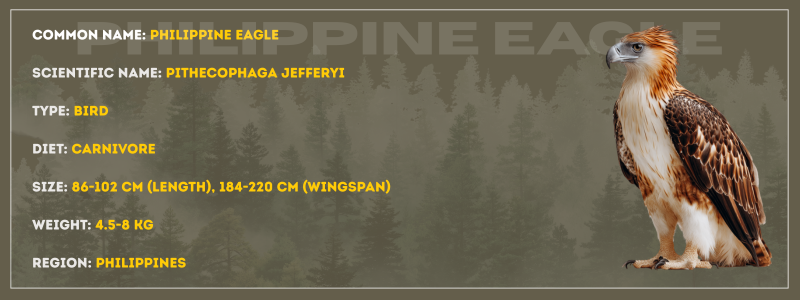
Scientific Name: Pithecophaga jefferyi
Diet Type: Carnivore
Size: 86-102 cm (length), 184-220 cm (wingspan)
Weight: 4.5-8 kg
Region Found: Philippines (primarily Mindanao, Luzon, and Samar)