
On a crisp autumn morning across the prairie wetlands of North America, a sound echoes across the landscape that has remained virtually unchanged for millions of years—the rattling, prehistoric call of the Sandhill Crane. These magnificent birds, standing nearly as tall as an adult human, create one of nature’s most spectacular displays as they gather by the thousands during migration, their bugling calls carrying for miles across open terrain. The Sandhill Crane is not merely fascinating for its impressive stature and ancient lineage; it represents one of the oldest living bird species on Earth, a living connection to the age of dinosaurs, and a conservation success story that demonstrates how dedicated protection efforts can bring species back from the brink of extinction.
Facts
- Ancient Lineage: Fossil evidence shows that Sandhill Cranes have existed in their current form for approximately 2.5 million years, making them one of the oldest surviving bird species on the planet.
- Mud Painting: Sandhill Cranes intentionally preen themselves with mud and vegetation, which stains their normally gray feathers rusty brown. This behavior may serve as camouflage during nesting season.
- Marathon Migrants: Some populations of Sandhill Cranes migrate up to 5,000 miles between their breeding and wintering grounds, crossing entire continents in their annual journey.
- Unison Calling: Mated pairs perform elaborate synchronized duets, with both birds throwing their heads back and calling in perfect harmony—a behavior that strengthens their lifelong pair bond.
- Dancing Masters: Sandhill Cranes engage in complex dancing displays year-round, not just during courtship. These dances include jumping, bowing, running, stick-tossing, and wing-flapping, and are performed by birds of all ages.
- Thermal Soaring: During migration, Sandhill Cranes use thermal air currents to gain altitude, sometimes soaring as high as 13,000 feet without flapping their wings.
- Coloration Quirk: Unlike most birds whose feather color is determined by pigments, the rusty-brown coloring on Sandhill Cranes comes from external staining, not genetics.
Species
Kingdom: Animalia
Phylum: Chordata
Class: Aves
Order: Gruiformes
Family: Gruidae
Genus: Antigone
Species: Antigone canadensis
The Sandhill Crane comprises six recognized subspecies, each varying slightly in size, breeding range, and migratory behavior. The Lesser Sandhill Crane (A. c. canadensis) is the smallest and most abundant, breeding in Siberia, Alaska, and Arctic Canada. The Greater Sandhill Crane (A. c. tabida) is the largest subspecies, found throughout much of the continental United States and southern Canada. The Canadian Sandhill Crane (A. c. rowani) occupies the central Canadian provinces and the northern Great Plains.
Three additional subspecies have more restricted ranges: the Mississippi Sandhill Crane (A. c. pulla), a critically endangered non-migratory population found only in southern Mississippi; the Cuban Sandhill Crane (A. c. nesiotes), endemic to Cuba and the Isle of Youth; and the Florida Sandhill Crane (A. c. pratensis), a non-migratory population residing year-round in Florida and southern Georgia.
Sandhill Cranes are part of the crane family Gruidae, which includes 15 species worldwide. Their closest relatives include the Common Crane of Eurasia and the Whooping Crane, North America’s tallest bird.
Appearance
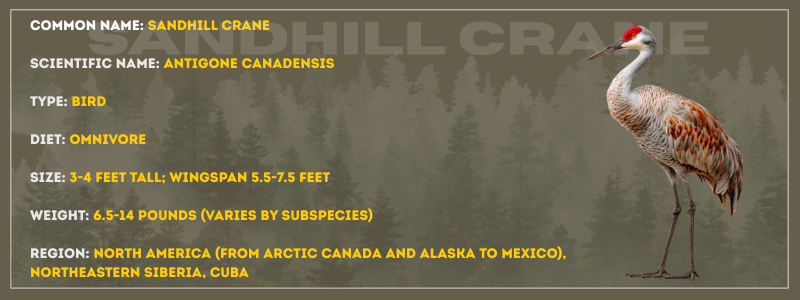
Sandhill Cranes are striking, statuesque birds with an unmistakable profile. Adults typically stand 3 to 4 feet tall and possess a wingspan ranging from 5.5 to 7.5 feet, creating an impressive silhouette against the sky. Their weight varies considerably by subspecies, ranging from 6.5 to 14 pounds, with Greater Sandhill Cranes representing the heavier end of this spectrum.
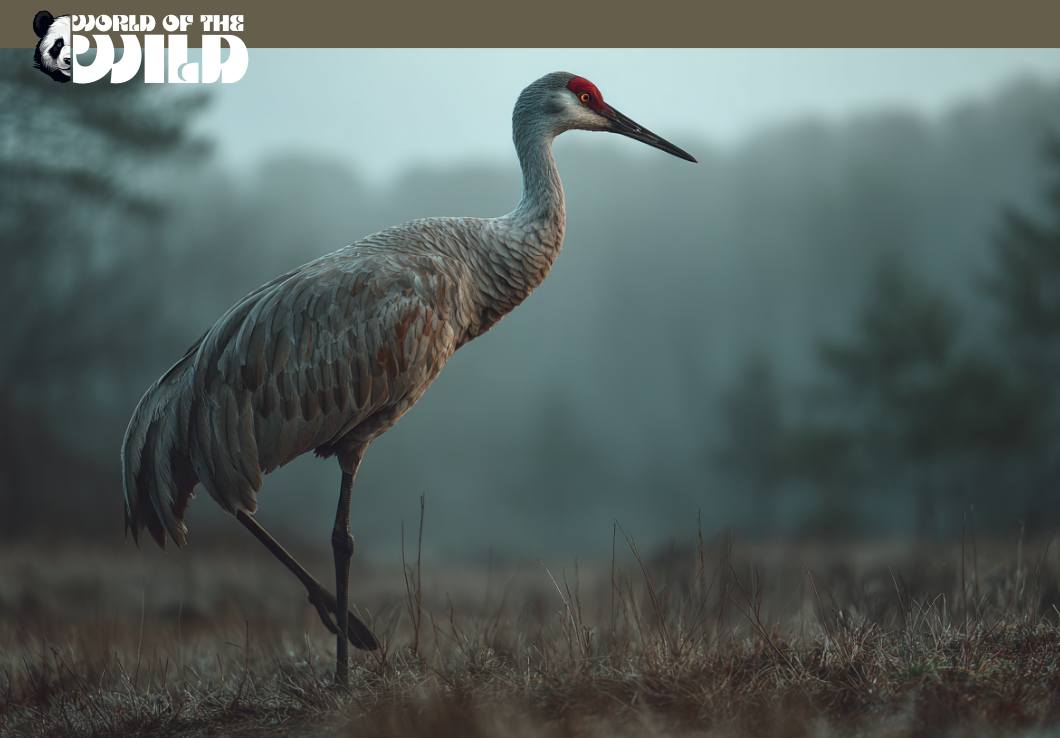
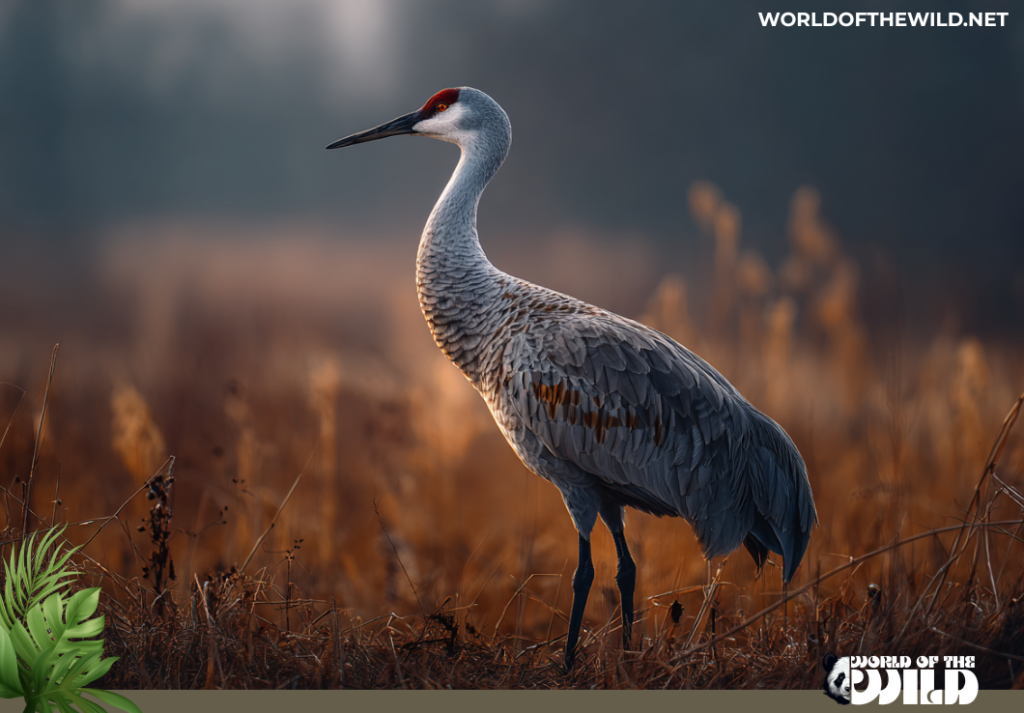
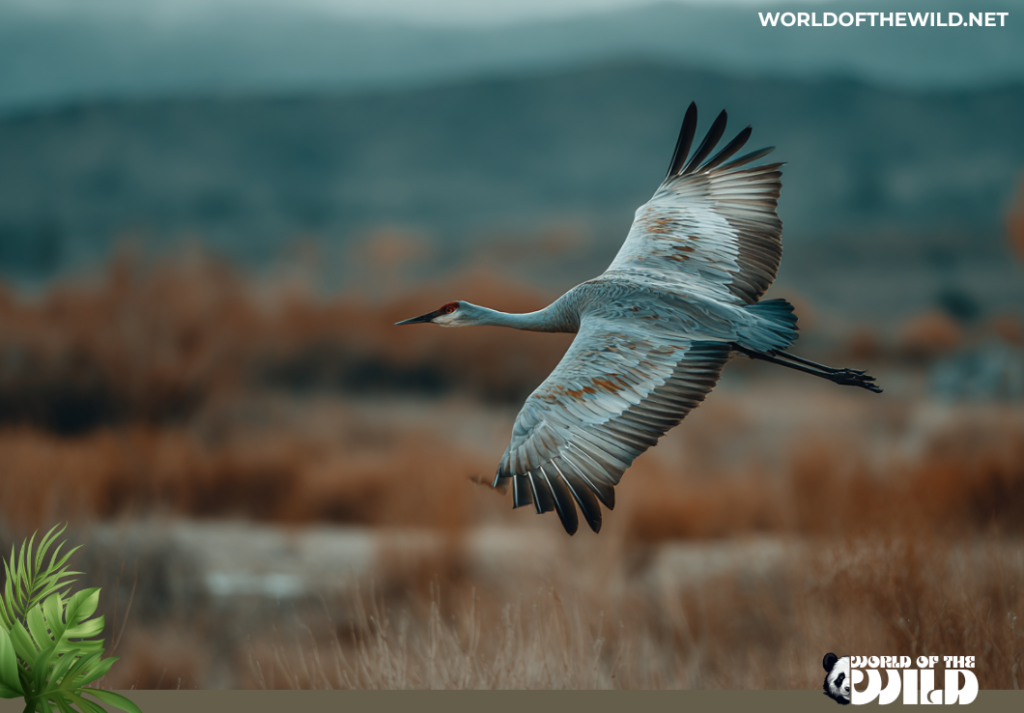
The plumage of adult Sandhill Cranes is predominantly gray, though many individuals appear rusty-brown due to their deliberate staining behavior with iron-rich mud. This coloration can vary dramatically depending on the soil composition of their habitat. Their most distinctive feature is a bright red forecrown—a patch of bare skin on the top of their head that becomes more vibrant during breeding season. This scarlet cap contrasts beautifully with their white cheeks and pale gray face.
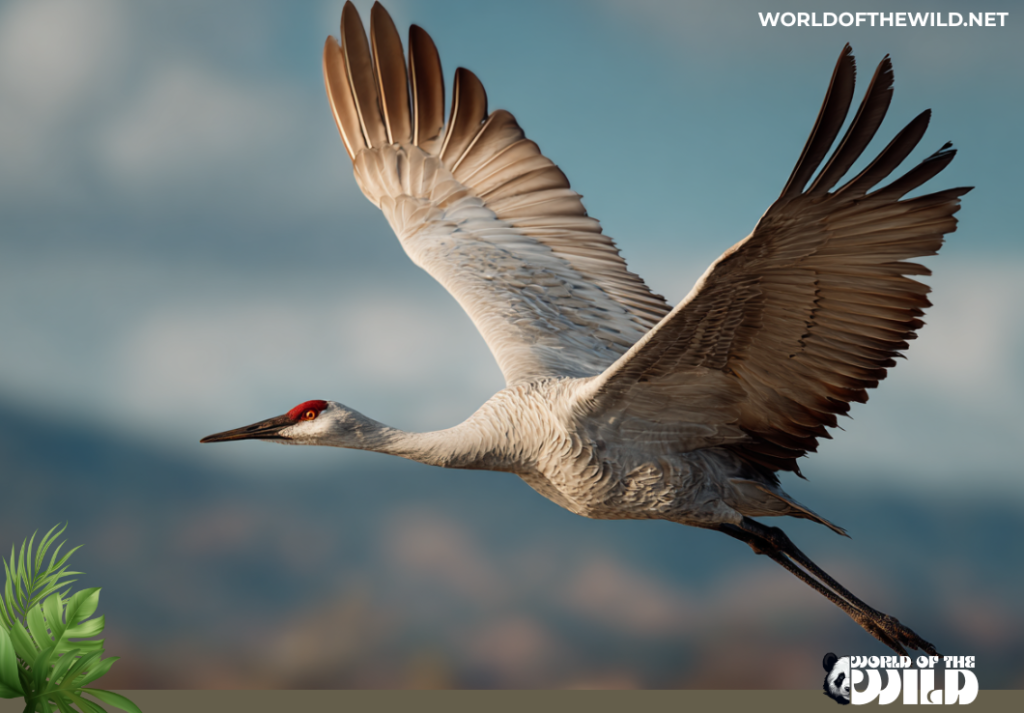
The birds possess long, dark pointed bills perfectly adapted for probing into soil and water. Their legs are long and black, designed for wading through wetlands and standing tall to survey their surroundings. During flight, Sandhill Cranes extend their necks fully forward and trail their legs straight behind, creating a distinctive silhouette that distinguishes them from herons, which fly with their necks curved.
Juvenile Sandhill Cranes look markedly different from adults, sporting cinnamon-brown plumage and lacking the red forecrown patch. They retain this juvenile coloration through their first year of life, gradually molting into adult plumage by their second summer.
The birds’ trachea is elongated and coiled within their sternum, functioning like a trumpet to amplify their calls, allowing their distinctive rattling bugle to carry for distances exceeding two miles.
Behavior
Sandhill Cranes are highly social birds that exhibit complex behavioral patterns reflecting their intelligence and strong family bonds. During the non-breeding season, they congregate in large flocks numbering from dozens to tens of thousands of individuals, creating one of wildlife’s most impressive spectacles at traditional staging areas along migration routes.
Communication is a cornerstone of crane society. Their vocabulary includes more than 20 distinct vocalizations, from soft purrs between family members to loud, rattling bugles used for territorial defense and contact calls during flight. The famous “unison call” performed by mated pairs involves both birds raising their heads skyward and calling in synchronized harmony, a behavior that reinforces their pair bond and announces territorial claims.
Sandhill Cranes are renowned for their elaborate dancing behavior, which serves multiple purposes beyond courtship. Dancing includes a repertoire of movements: vertical leaps up to several feet high, bowing displays, running with wings outstretched, and tossing sticks or vegetation into the air. Young cranes dance as play behavior, practicing movements they’ll need as adults. Paired adults dance to strengthen bonds, and entire flocks may engage in dancing as a social activity.
These birds are diurnal, most active during daylight hours. Their typical day includes foraging in early morning and late afternoon, with midday periods spent loafing, preening, and socializing. They’re cautious and alert, with sentinel birds often watching for danger while others feed.
Sandhill Cranes demonstrate remarkable intelligence and problem-solving abilities. They’ve been observed using tools, adapting their foraging strategies based on food availability, and showing strong spatial memory by returning to the same nesting territories and stopover sites year after year, sometimes for decades.
Family units remain together for 9-10 months, with juvenile cranes accompanying their parents through fall migration, winter, and the return spring journey, only separating when the adults return to nesting territories to breed again.
Evolution
The Sandhill Crane boasts one of the most remarkable evolutionary histories of any living bird species. The crane family Gruidae has ancient origins dating back approximately 60 million years to the Eocene epoch, shortly after the extinction of non-avian dinosaurs. This makes cranes one of the oldest surviving bird families on Earth.
The most extraordinary aspect of Sandhill Crane evolution is the discovery of a 10-million-year-old fossil from Nebraska that is virtually identical to modern Sandhill Cranes. This remarkable stasis indicates that the species has remained largely unchanged for millions of years, successfully adapting to various climate shifts, ice ages, and environmental transformations that eliminated countless other species.
Fossil evidence suggests that ancestral cranes originated in North America, then spread to other continents. The oldest confirmed Sandhill Crane fossil, found in the Macasphalt Shell Pit in Florida, dates back 2.5 million years to the Pliocene epoch. Even more impressively, some paleontologists consider fossils of what they’ve classified as Grus haydeni from the Miocene epoch (about 10 million years ago) to be ancestral Sandhill Cranes, though this classification remains debated.
The evolutionary success of Sandhill Cranes can be attributed to several factors: their omnivorous diet providing flexibility in food resources, their ability to exploit wetland habitats across diverse climates, their strong flight capabilities enabling long-distance migration, and their complex social behaviors that promote survival and successful reproduction.
The various subspecies of Sandhill Crane likely evolved during the Pleistocene ice ages, when crane populations became geographically isolated in different refugia. As ice sheets advanced and retreated, these populations adapted to local conditions, creating the size and behavioral variations we observe today between migratory and non-migratory populations.
Habitat
Sandhill Cranes occupy one of the broadest geographic ranges of any crane species, distributed across North America, northeastern Siberia, and Cuba. Their range extends from the Arctic tundra to subtropical regions, demonstrating remarkable habitat adaptability.
During the breeding season, Sandhill Cranes inhabit freshwater wetlands, including marshes, bogs, wet meadows, and the edges of lakes and ponds. They prefer areas with standing water that provides protection from predators while nesting. Arctic-breeding populations utilize vast expanses of sedge meadows and tundra pools, while more southerly populations favor prairie potholes, wet grasslands, and even cultivated areas near wetlands.
The most critical habitat requirement for breeding Sandhill Cranes is isolation from human disturbance and sufficient wetland vegetation for nest building and cover. They typically nest in areas with water depths of 2 to 18 inches, creating nest mounds in shallow marshes or on floating vegetation.
During migration, Sandhill Cranes utilize major river systems and wetland complexes as stopover sites. The Platte River in Nebraska serves as the most important staging area, where up to 80% of the world’s Sandhill Crane population—approximately 600,000 birds—congregates each spring. This concentration represents one of the greatest wildlife spectacles in North America.
Winter habitat varies by population. Migratory populations winter in southern United States, Mexico, and occasionally northern Central America, favoring agricultural fields, freshwater marshes, and shallow wetlands. They often roost in shallow water or on sandbars in rivers at night for protection from predators, then disperse to feed in grain fields, pastures, and wetlands during the day.
Non-migratory subspecies occupy year-round habitats in Florida, Mississippi, and Cuba, requiring permanent freshwater wetlands, prairies, and adjacent upland feeding areas. Florida Sandhill Cranes have adapted to human-modified landscapes, inhabiting golf courses, suburban wetlands, and agricultural areas while maintaining connections to natural wetland systems.
Diet
Sandhill Cranes are omnivores with a diverse and opportunistic diet that varies seasonally and geographically. Their feeding strategy reflects remarkable adaptability, allowing them to exploit different food resources throughout their annual cycle.
During spring and summer breeding seasons, Sandhill Cranes consume a higher proportion of animal protein to support reproduction and chick development. Their diet includes aquatic invertebrates such as snails, worms, and insects, along with small vertebrates including frogs, lizards, snakes, small rodents, and occasionally small birds or bird eggs. They probe soft mud and shallow water with their bills, using both visual and tactile cues to locate prey.
Plant matter constitutes an increasingly important component of their diet outside the breeding season. They consume seeds, grains, berries, and tubers with particular enthusiasm. Waste grain from agricultural fields—especially corn, wheat, and barley—provides critical energy during migration and winter. In natural settings, they eat the seeds of wetland plants, various berries, and the roots and tubers of aquatic vegetation.
The foraging technique of Sandhill Cranes involves methodical walking through shallow water or fields, periodically probing the ground or water with their bills. They use their long bills like precision instruments, delicately picking up small items or forcefully probing several inches into soil to extract roots and invertebrates.
During the critical spring migration stopover along the Platte River, Sandhill Cranes feed intensively in nearby agricultural fields, consuming waste corn that provides the high-energy fuel needed to complete their journey to Arctic breeding grounds. A single crane can consume several hundred kernels of corn per day during this period.
Young chicks are fed a protein-rich diet by their parents, primarily consisting of insects and other invertebrates during their first weeks of life. As they mature, juveniles gradually transition to a more omnivorous diet, though they continue learning foraging techniques from their parents throughout their first year.
Predators and Threats
Adult Sandhill Cranes, due to their large size and vigilant behavior, face relatively few natural predators, though threats certainly exist. Eggs and chicks are far more vulnerable. Primary predators of Sandhill Crane nests include coyotes, foxes, ravens, gulls, raccoons, and corvids, which raid nests for eggs. In northern breeding areas, wolverines, lynx, and bears may also opportunistically destroy nests.
Juvenile cranes, especially during their first few weeks when they cannot yet fly, face predation from coyotes, foxes, bobcats, and large raptors such as Golden Eagles and Great Horned Owls. Adult cranes vigorously defend their young, using their sharp bills and powerful kicks to drive away predators, but smaller chicks remain vulnerable despite parental protection.
In aquatic environments, large predatory fish and American alligators in southern regions may occasionally capture young cranes. Even adult cranes can fall victim to predation, particularly when they’re sick, injured, or caught unaware. Bald Eagles and Golden Eagles have been documented attacking adult cranes, though such events are rare.
The most significant threats to Sandhill Crane populations are anthropogenic. Habitat loss and degradation represent the primary concern, particularly the draining and conversion of wetlands for agriculture and development. The loss of critical staging areas along migration routes poses serious risks, as cranes depend on specific stopover sites to rest and refuel during their long journeys.
Collisions with power lines cause substantial mortality, particularly during migration when large flocks fly in low visibility conditions. Thousands of cranes die annually from these collisions, representing one of the most significant human-caused mortality factors.
Agricultural expansion presents a complex relationship with crane conservation. While grain fields provide abundant winter food resources, agricultural pesticides and the loss of natural wetlands fragment and degrade habitat. Additionally, hunting of Sandhill Cranes occurs legally in several states and provinces, with harvest carefully regulated through permit systems, though this remains controversial among conservationists.
Climate change poses emerging threats through altered wetland hydrology, shifts in migration timing, changes to food availability, and potential mismatches between crane breeding cycles and peak food resources in Arctic environments.
Disease outbreaks, particularly avian cholera and West Nile virus, occasionally cause mortality events at concentration sites where thousands of birds gather in close proximity.
Reproduction and Life Cycle
Sandhill Cranes form monogamous pair bonds that typically last for life, though birds will re-pair if a mate dies. Courtship begins with spectacular dancing displays that include leaping, bowing, running, and wing-flapping, performed by both sexes. These elaborate dances strengthen the pair bond and synchronize the birds physiologically for breeding.
Pairs return to the same nesting territories year after year, often using the same wetland area or even the exact nesting site. The breeding season varies by latitude, beginning as early as December in southern Florida and as late as June in Arctic regions.
Nest construction is a joint effort, with both parents building a large mound of vegetation in shallow water or on the ground in wet areas. The nest is typically composed of grasses, sedges, cattails, and other wetland plants, creating a platform that rises several inches above water level. Nests can measure up to six feet in diameter, though the actual egg cup is much smaller.
The typical clutch consists of two eggs, occasionally one or three, with eggs laid one to two days apart. The eggs are pale brownish or olive-colored with darker markings, measuring approximately 3.7 inches long. Both parents share incubation duties, which lasts 29-32 days. The incubating parent carefully turns the eggs and adjusts their position to ensure even temperature distribution.
Chicks hatch covered in cinnamon-colored down and are precocial, meaning they can leave the nest within 24 hours of hatching. However, they remain dependent on their parents for food, warmth, and protection for several weeks. The chicks grow rapidly, gaining the ability to fly (fledge) at approximately 65-75 days of age.
Typically, only one chick survives to fledging, even when two eggs hatch successfully. This phenomenon, called “siblicide” or “cainism,” occurs because the slightly older, larger chick often outcompetes its sibling for food provided by parents. However, in years of abundant food resources, both chicks may survive.
Juvenile cranes remain with their parents through their first fall migration, winter, and spring migration, separating only when the adults return to breeding territories. This extended family period allows juveniles to learn migration routes, identify quality feeding areas, and develop social skills essential for survival.
Sandhill Cranes reach sexual maturity at 2-7 years of age, with most individuals first breeding around 3-5 years old. The average lifespan in the wild is estimated at 20-30 years, though individuals can live much longer. The oldest known wild Sandhill Crane was at least 36 years old, and cranes in captivity have lived over 40 years.
Population
The Sandhill Crane is currently classified as “Least Concern” by the International Union for Conservation of Nature (IUCN), reflecting a relatively stable and healthy global population. This represents a remarkable conservation success story, as some subspecies were severely threatened in the mid-20th century.
The global population of Sandhill Cranes is estimated at approximately 800,000 to 900,000 individuals, with populations showing generally stable or increasing trends across most of their range. The Lesser Sandhill Crane is the most abundant subspecies, with population estimates around 600,000 birds. The Greater Sandhill Crane population exceeds 100,000 individuals.
However, conservation status varies dramatically among subspecies. The Mississippi Sandhill Crane remains critically endangered, with only about 100-150 individuals surviving in the wild, confined to a small area in Jackson County, Mississippi. Intensive management efforts, including captive breeding and habitat restoration, have prevented extinction, though this population remains extremely vulnerable.
The Cuban Sandhill Crane is also considered threatened, with approximately 500-600 individuals remaining in Cuba. Political changes and limited conservation resources in Cuba have complicated protection efforts for this endemic subspecies.
In contrast, migratory populations in North America have demonstrated impressive recovery from historical lows. During the early 20th century, widespread wetland drainage and unregulated hunting reduced populations to alarming levels. The implementation of protective legislation, establishment of critical habitat refuges, and regulation of hunting allowed populations to rebound dramatically.
The most significant population trend is the continued growth of migratory populations, particularly in the Central Flyway. This success can be attributed to several factors: protection of key staging areas like the Platte River, regulation of harvest, wetland conservation programs, and the cranes’ adaptation to feeding in agricultural landscapes.
Annual monitoring programs track Sandhill Crane populations through coordinated surveys at major concentration sites and breeding areas. These surveys indicate that most populations remain stable or are increasing, though localized declines occur in areas experiencing rapid habitat loss or degradation.
Climate change presents an uncertain future threat, potentially affecting breeding habitat in Arctic regions, altering migration timing, and changing the distribution of suitable wetland habitat throughout their range.
Conclusion
The Sandhill Crane stands as both an ancient marvel and a modern conservation triumph. These magnificent birds, whose ancestors witnessed the rise and fall of countless species across millions of years, continue to grace our skies with their presence, their rattling calls echoing across wetlands as they have for epochs. From the Arctic tundra to subtropical marshes, from their spectacular dancing displays to their remarkable multigenerational migrations, Sandhill Cranes embody the resilience of nature and the profound interconnectedness of ecosystems.
Yet their story also serves as a reminder of our responsibility as stewards of the natural world. While most populations thrive today due to dedicated conservation efforts, subspecies like the Mississippi Sandhill Crane teeter on the edge of extinction, and ongoing threats from habitat loss, climate change, and human development continue to challenge these ancient birds. The success of Sandhill Crane conservation demonstrates what can be achieved through commitment, science-based management, and respect for wild spaces.
The next time you hear the primordial bugle of Sandhill Cranes overhead or witness thousands gathering at a migration staging area, recognize that you’re experiencing a connection to deep time—a living link to an ancient world. Support wetland conservation, protect critical habitats, and advocate for the preservation of wild places. The future of the Sandhill Crane, and countless other species that share their habitats, depends on the choices we make today. Ensure that these magnificent dancers of the sky continue their timeless journeys for millions of years to come.
Scientific Name: Antigone canadensis
Diet Type: Omnivore
Size: 3-4 feet tall; wingspan 5.5-7.5 feet
Weight: 6.5-14 pounds (varies by subspecies)
Region Found: North America (from Arctic Canada and Alaska to Mexico), northeastern Siberia, Cuba