
A flash of silvery-grey glides low over a winter marsh, wings held in a distinctive shallow V, quartering back and forth with almost supernatural grace. This is the Northern Harrier, a raptor so ethereal in appearance and behavior that birders have dubbed the adult male the “Grey Ghost.” Unlike most hawks that perch high and plunge down on prey, this remarkable bird of prey hunts like no other raptor in North America, relying not just on keen eyesight but on an exceptional sense of hearing that would make an owl envious.
The Northern Harrier stands out as the only harrier species inhabiting North America, making it a unique and essential part of grassland and wetland ecosystems across the continent. With its owl-like facial disc, ground-level hunting style, and remarkable breeding behaviors, this medium-sized raptor offers a fascinating glimpse into the diverse strategies birds of prey have evolved to survive and thrive.
Facts
Seven Intriguing Facts About the Northern Harrier:
- Owl-Like Hearing: Northern Harriers possess an owl-like facial disc composed of short, stiff feathers that functions like a satellite dish, channeling sound directly to their ears. This gives them exceptionally good hearing for a diurnal raptor, allowing them to locate voles and mice rustling beneath vegetation even when they can’t see them.
- Extreme Polygyny: While most raptors are monogamous, male Northern Harriers can mate with up to five females in a single breeding season, making them one of the few polygynous birds of prey. This behavior is closely tied to abundant food supplies during spring.
- Aerial Food Transfers: When a hunting male returns with prey, he doesn’t land at the nest. Instead, he calls to his mate, who flies up to meet him mid-air. He then drops the food to her, and she catches it in an impressive aerial maneuver before returning to feed the young.
- Ancient Lineage: Fossils of Northern Harriers have been discovered in northern Mexico dating back 11,000 to 40,000 years, providing evidence of their long presence in North America during the Pleistocene epoch.
- Winter Roosting Communities: During winter months and migration, Northern Harriers abandon their typically solitary nature and roost communally on the ground in groups, often sharing these roosts with Short-eared Owls.
- Drowning Hunters: When tackling larger prey like rabbits or adult ducks, harriers have been observed using their long legs to hold prey underwater until it drowns—an unusual hunting technique among raptors.
- Juvenile Play Behavior: Young harriers hone their hunting skills by pouncing on inanimate objects resembling their prey, such as vole-sized corncobs, demonstrating sophisticated learning behavior.
Species
Scientific Classification:
- Kingdom: Animalia
- Phylum: Chordata
- Class: Aves
- Order: Accipitriformes
- Family: Accipitridae
- Genus: Circus
- Species: Circus hudsonius
The Northern Harrier was first described by English naturalist George Edwards in 1750 as “The Ring-tail’d Hawk.” Swedish naturalist Carl Linnaeus later classified it in 1766, giving it the scientific name Falco hudsonius (after Hudson Bay, where the type specimen was collected). The species was eventually moved to the genus Circus, introduced by French naturalist Bernard Germain de Lacépède in 1799. The genus name derives from the Ancient Greek kirkos, meaning “circle,” a reference to the bird’s characteristic circling flight pattern while hunting.
Related Species and Taxonomic Notes:
The Northern Harrier is monotypic, meaning no subspecies are currently recognized. However, its taxonomic history is complex and fascinating. Until recently, the Northern Harrier was considered conspecific (the same species) with the Hen Harrier (Circus cyaneus) of Eurasia, and many taxonomic authorities still debate this classification. Recent molecular phylogenetic studies examining mitochondrial DNA and nuclear genes have revealed that these two populations form reciprocally monophyletic groups with substantial genetic divergence, supporting their designation as separate species.
The Northern Harrier’s closest living relative is the Cinereous Harrier (Circus cinereus) of South America. The genus Circus is cosmopolitan, with 13 species of harriers distributed worldwide, making the Northern Harrier the sole representative of this fascinating group in North America. These harriers share characteristic low-flying hunting behavior and long wings and tails adapted for gliding flight over open terrain.
Appearance
The Northern Harrier is a slender, medium-sized raptor with several distinctive features that make it easily identifiable in the field. The species exhibits striking sexual dimorphism, meaning males and females look dramatically different from each other.
Size and Proportions:
Adult Northern Harriers measure 41 to 52 centimeters (16 to 20 inches) in length with an impressive wingspan of 97 to 122 centimeters (38 to 48 inches). They have the longest wings and tail relative to body size of any raptor occurring in North America, giving them an exceptionally slim and elongated appearance. The wing chord measures 32.8 to 40.6 centimeters, while the tail stretches 19.3 to 25.8 centimeters. Their tarsus (lower leg) ranges from 7.1 to 8.9 centimeters, notably long for a raptor their size.
Weight:
There is significant sexual size dimorphism, with females considerably larger than males. Males weigh 290 to 400 grams (10 to 14 ounces), averaging around 350 grams (12 ounces). Females are substantially heavier at 390 to 750 grams (14 to 26 ounces), with an average weight of 530 grams (19 ounces).
Plumage and Distinctive Features:
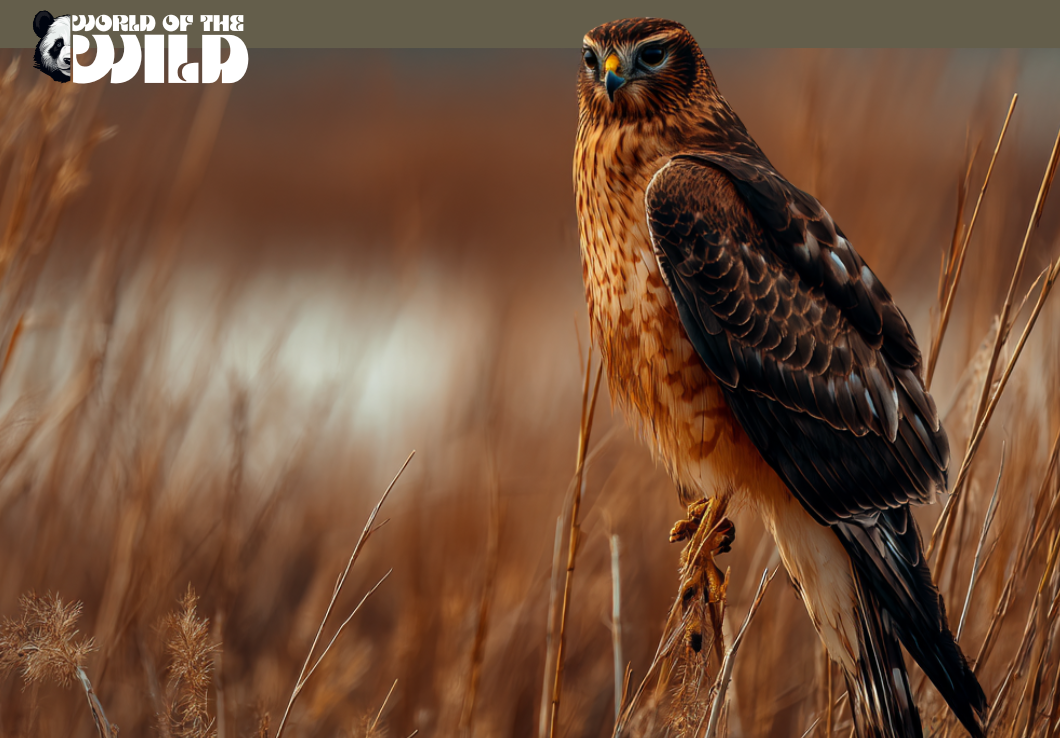
Adult Male: The adult male sports striking plumage that earns him the nickname “Grey Ghost.” He is predominantly slate-grey on the upperparts, with white underparts marked by darker spots on the chest. The wing tips are distinctively black, as is a black trailing edge on the secondaries. In spring, males appear paler due to feather fading. Some males show rufous wash on the chest and leg feathers, or brownish tones on the head and upperwing coverts. All adult males have bright lemon-yellow eyes.
Adult Female: Females present a completely different appearance, streaked brown on buff below and dark brown above with tan to rufous mottling on the upperwing coverts. Some females show limited streaking on the underbody while others display more prominent rufous coloring. Female eye color transitions from dark brown to yellow over approximately three years as they mature.
Immature Birds: Juvenile harriers resemble adult females but tend to be darker brown overall with a richer rusty or cinnamon color underneath. They retain brown eyes until they begin to mature.
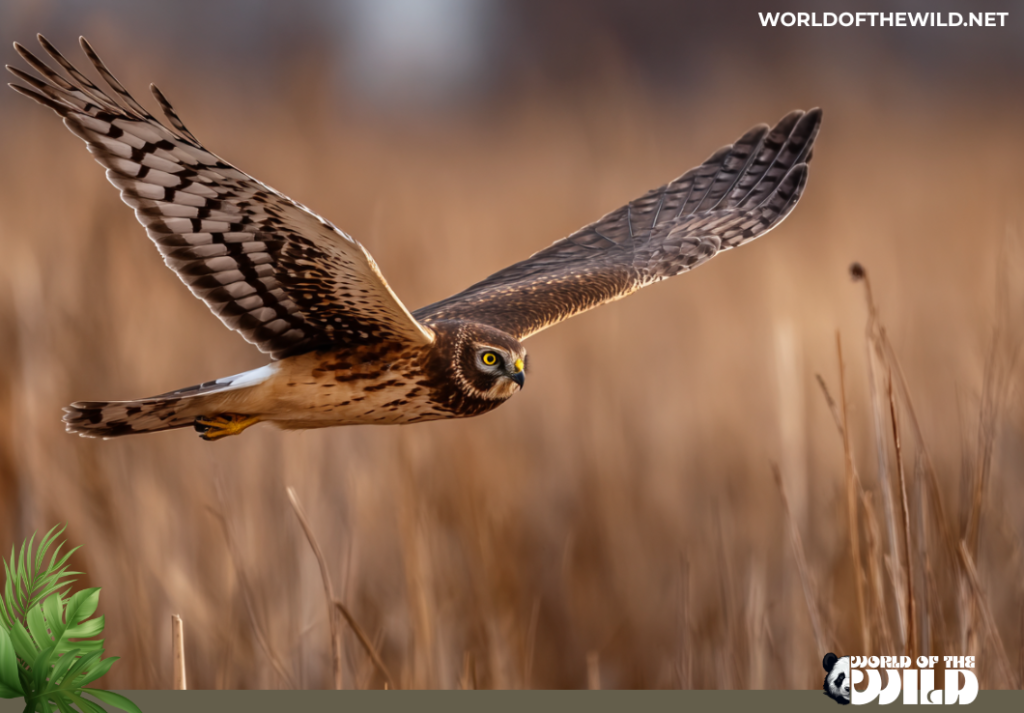
Universal Field Marks: Regardless of age or sex, all Northern Harriers display a brilliant white rump patch (technically the uppertail coverts) that is highly conspicuous in flight and serves as one of the most reliable field identification marks. Additionally, all harriers possess an owl-like facial disc—a circular arrangement of short, stiff feathers around the face that helps direct sound to their ears.
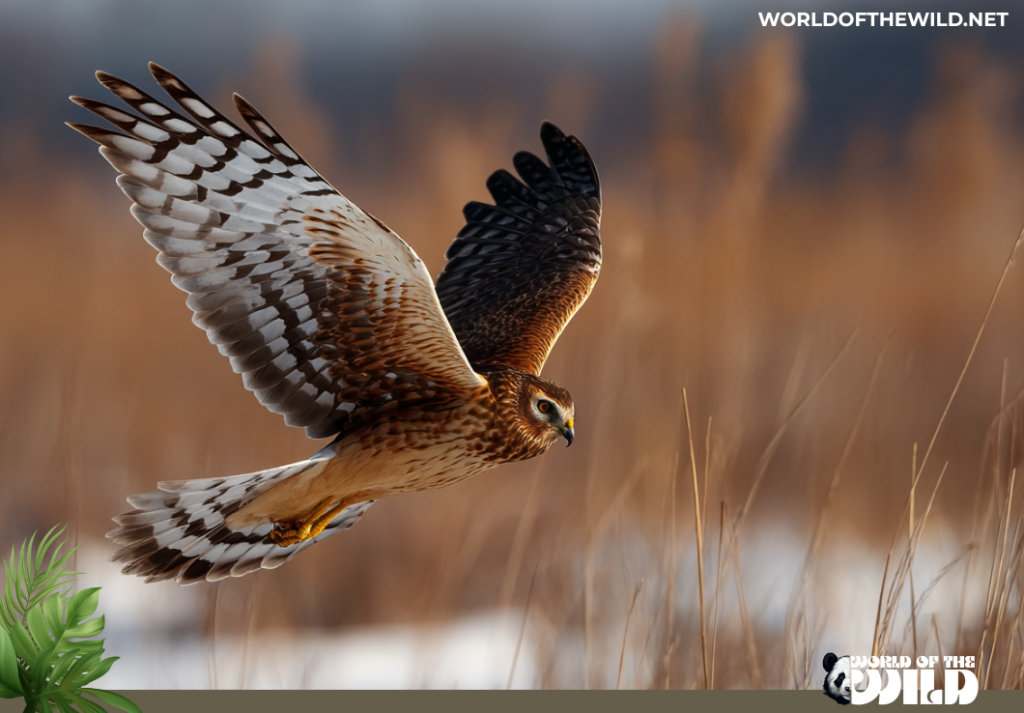
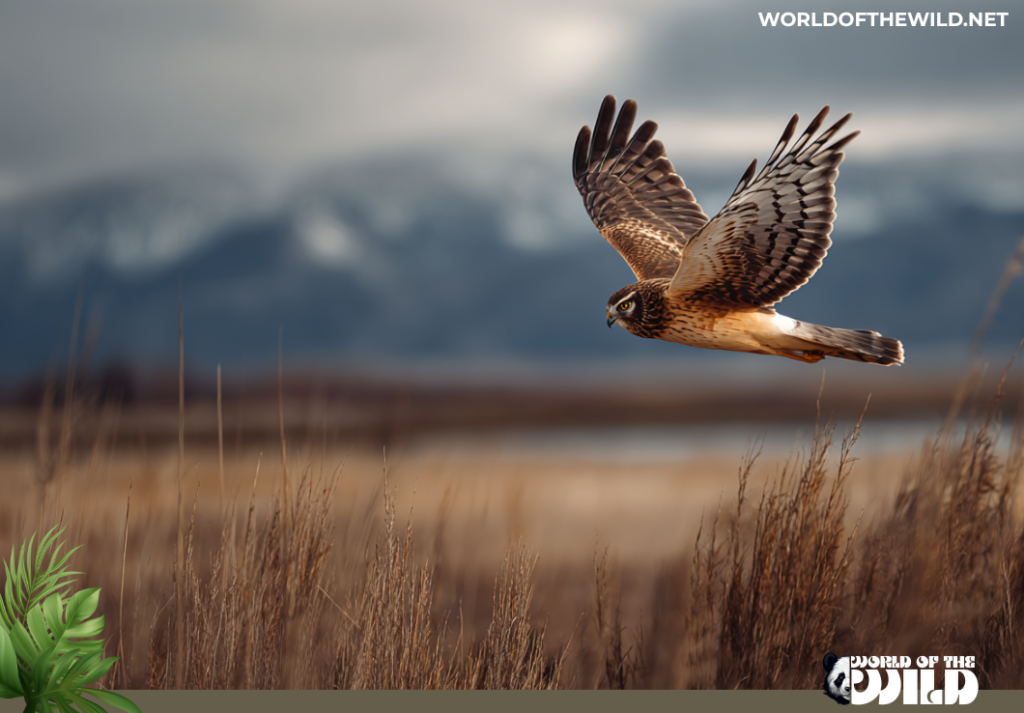
In Flight: When soaring, Northern Harriers may appear buteo-like, but in their characteristic hunting glide, they adopt a distinctive profile with wings held in a shallow V (called a dihedral) and their long, narrow wings taper sharply at the tips. The body lacks the bulky “chesty” appearance of many hawks, and the head appears relatively small and squarish. Their flight style is uniquely buoyant and graceful, with the bird appearing to float effortlessly just above the ground.
Behavior
The Northern Harrier exhibits a fascinating array of behaviors that distinguish it from other North American raptors, from its unique hunting techniques to its complex social dynamics.
Hunting Behavior:
Northern Harriers are primarily diurnal hunters that spend most of their active hours searching for prey. Their hunting strategy is distinctive and immediately recognizable: they fly low over open terrain in a slow, methodical pattern, quartering back and forth across fields, marshes, and grasslands. Unlike most hawks that rely exclusively on vision, harriers hunt using both sight and sound, tilting their heads from side to side as they glide to better capture sounds from below.
When prey is detected, harriers may hover briefly over the spot before dropping down to make the capture, or they may attempt to flush prey from dense cover by flying low over it repeatedly. Males tend to fly lower and faster than females while hunting. The harrier’s facial disc functions like an owl’s, focusing sound waves toward their ears and enabling them to pinpoint the location of voles, mice, and other prey moving through grass and vegetation.
Upon locating larger prey such as rabbits or ducks, harriers have been documented using their long legs to hold the animal underwater until it drowns—a remarkable and rarely-seen hunting adaptation. They sometimes cache extra prey to consume later, particularly during abundant food periods.
Social Behavior and Communication:
Northern Harriers are generally solitary during the breeding season, though they may nest in loose colonies of 15 to 20 individuals. Males establish and defend territories averaging 2.6 square kilometers, though territory sizes can range dramatically from 1.7 to 150 square kilometers depending on prey abundance and habitat quality.
Territorial defense focuses primarily on the immediate nest area rather than the entire home range. Females vigorously chase away other females, while males confront other males. The species becomes notably vocal during breeding season and when defending territory.
During migration and winter, harriers change their social patterns dramatically. They migrate singly rather than in flocks, but upon reaching wintering grounds, they form communal ground roosts that may include dozens or even hundreds of birds. These winter roosts are frequently shared with Short-eared Owls, their ecological counterparts. In winter, females become more aggressive, actively excluding males from prime feeding territories despite their communal roosting behavior.
Vocalizations:
Northern Harriers are relatively vocal for raptors. Both sexes give rapid, emphatic “kek-kek-kek” notes lasting one to two seconds. When threatened by predators or mobbed by smaller birds, these calls become higher-pitched. During the breeding season, females emit loud screams that prompt males to either mate or deliver food. Males produce a “chek-chek-chek” call that transforms into a rhythmic “chuk-uk-uk-uk” during their spectacular display flights.
Courtship and Display:
Male courtship behavior is one of the most dramatic aspects of harrier biology. Males perform elaborate “sky-dancing” displays to attract females and advertise their territories. These breathtaking aerial performances involve undulating, rollercoaster-like flights where the male climbs to heights of up to 1,000 feet before diving down in a series of U-shaped maneuvers, sometimes covering more than half a mile. During these dives, the male twirls and spins, creating a mesmerizing spectacle.
Intelligence and Learning:
Young harriers demonstrate sophisticated learning behavior through play. Juveniles practice hunting by pouncing on inanimate objects that resemble their prey in size, such as corncobs that mimic voles. This play behavior helps fledglings develop the precise timing and coordination needed for successful hunting.
Migration:
Northern Harriers are partial migrants, with populations in the northern portions of their range undertaking long-distance migrations while southern populations may remain year-round. They migrate singly, unlike many raptors that travel in groups. Migration is protracted, occurring over an extended period in both autumn and spring. During migration, harriers use a mixture of flapping and gliding flight with minimal soaring, and they tend to fly closer to the ground than most other migrating raptors. They generally avoid flying over large bodies of open water.
Evolution
The Northern Harrier belongs to the ancient and widespread genus Circus, which has representatives on every continent except Antarctica. The evolutionary history of harriers reflects their adaptation to open-country hunting across diverse ecosystems.
Fossil Record:
Fossil evidence confirms the Northern Harrier’s long presence in North America. Fossil remains have been discovered in northern Mexico dating from approximately 11,000 to 40,000 years ago, placing the species firmly within the late Pleistocene epoch. This period coincided with major climatic fluctuations, the presence of megafauna, and eventually the arrival of humans in North America. The species successfully weathered these dramatic environmental changes, demonstrating remarkable adaptability.
Relationship to the Hen Harrier:
The Northern Harrier’s most significant evolutionary relationship is with the Hen Harrier (Circus cyaneus) of Eurasia. For many years, these two populations were considered a single species with a Holarctic distribution. However, recent molecular phylogenetic studies have revealed a more complex picture.
Analysis of multiple mitochondrial genes (including cytochrome b) and nuclear DNA markers has demonstrated that Northern Harriers and Hen Harriers form reciprocally monophyletic groups—meaning each represents a distinct evolutionary lineage. The two populations show substantial mitochondrial DNA sequence divergence, suggesting they have been separated and evolving independently for a significant period. This genetic evidence is supported by consistent differences in body size, plumage characteristics, breeding biology, dispersal patterns, and behavioral traits.
These findings led the British Ornithologists’ Union to recognize them as separate species, though some authorities, including various international taxonomic committees, continue to debate this split. The divergence likely occurred when ancestral harrier populations became separated into Nearctic (North American) and Palearctic (Eurasian) populations, possibly during glacial periods that created barriers to gene flow.
Closest Living Relatives:
Within the genus Circus, the Northern Harrier’s closest living relative is the Cinereous Harrier (Circus cinereus) of South America. This relationship suggests an ancient New World harrier lineage that diverged into northern and southern hemisphere species. The Northern and Cinereous Harriers share similar ecological niches and hunting behaviors, representing parallel adaptations to open-country habitats in their respective ranges.
Evolutionary Adaptations:
The Northern Harrier exhibits several key evolutionary adaptations that define its ecological niche. The development of the facial disc and enhanced auditory capabilities represents a convergent evolution with owls—an adaptation for hunting in habitats with dense ground vegetation where visual hunting alone would be inefficient. The species’ extreme sexual dimorphism in size and plumage, along with its propensity for polygyny, represents an evolutionary response to variable food resources and the demands of raising multiple broods across scattered territories.
Habitat
The Northern Harrier is a bird of open spaces, showing a strong preference for expansive, low-lying habitats where its unique hunting style can be employed most effectively.
Geographic Range:
The Northern Harrier has a vast distribution across North America. During the breeding season, it can be found from northern Alaska and Arctic Canada south through the northern United States, extending into parts of central and southern California and portions of the southern U.S. (excluding the southeastern region). The species breeds across virtually the entire width of the continent.
In winter, the distribution shifts southward. Northern breeding populations migrate to the southern United States, Mexico, and Central America, with some individuals reaching as far south as northern South America. However, in the midwestern states, mountain west, Pacific Northwest, and northern Atlantic states, populations may remain year-round if food is sufficiently available.
The species shows a broad wintering range from southern Canada through the continental United States into Central America, occupying diverse habitats across this expansive area.
Breeding Habitat:
Northern Harriers require large, undisturbed tracts of open habitat for breeding. In eastern North America, they predominantly breed in wetland habitats including freshwater and brackish marshes, beaver meadows, and wet sedge meadows. Western populations show a preference for drier upland habitats such as prairies, high-desert shrubsteppe, and dry grasslands.
Specific breeding habitats include:
- Freshwater marshes with cattails, reeds, and bulrushes
- Brackish coastal marshes
- Lightly grazed meadows and old fields
- Arctic and alpine tundra
- Dry upland prairies
- Drained marshlands
- Sagebrush steppe
- Riverside woodlands and floodplains
- Fallow agricultural fields
The unifying characteristic across all breeding habitats is the presence of low, dense vegetation that provides cover for ground nests and abundant prey populations. Harriers avoid heavily forested areas and mountainous terrain.
Winter Habitat:
During winter, Northern Harriers utilize an even broader range of open habitats with low vegetation:
- Desert scrublands
- Coastal sand dunes
- Pasturelands and rangeland
- Active and fallow croplands
- Dry plains and grasslands
- Abandoned agricultural fields
- Estuaries and coastal marshes
- Open floodplains
- Semiarid shrubsteppe
Winter harriers concentrate in areas with herbaceous cover and abundant small mammal populations, particularly favoring the semiarid scrub and grasslands of the Great Basin and southern Great Plains.
Habitat Requirements:
Successful harrier habitat must provide three key elements: extensive open terrain for hunting, dense ground vegetation for nesting (during breeding season), and healthy populations of small mammals and birds for prey. The species shows strong fidelity to large, intact habitat blocks and tends to avoid fragmented landscapes and areas with tall or woody vegetation that impedes their low-flying hunting style.
Diet
Dietary Classification:
The Northern Harrier is a carnivore, feeding exclusively on animal prey captured during active hunting.
Primary Food Sources:
Small mammals constitute the overwhelming majority of the Northern Harrier’s diet, particularly in areas with robust rodent populations. Studies indicate that small mammals can comprise up to 95% of the diet in areas where these prey are abundant.
Preferred prey includes:
- Voles (Microtus species) – the single most important prey item in northern grasslands
- Deer mice
- House mice
- Cotton rats
- Ground squirrels
- Harvest mice
- Rice rats
- Shrews
- Rabbits (occasional, larger prey)
Secondary Prey:
Birds form a significant secondary component of the diet, hunted with particular regularity by males. Avian prey includes:
- Passerines of open country (sparrows, larks, pipits, meadowlarks)
- Small shorebirds
- Northern Cardinals and Song Sparrows (in winter)
- Young waterfowl and gallinaceous birds
- Adult ducks (occasionally)
Supplemental Prey:
Harriers opportunistically hunt other vertebrates and invertebrates:
- Amphibians (particularly frogs)
- Reptiles (snakes and lizards)
- Large insects (especially grasshoppers and crickets)
- Bats (when available)
Geographic and Seasonal Variation:
Diet composition varies significantly based on location and season. In northern regions during winter, harriers feed almost exclusively on meadow voles. In southern wintering areas, the diet diversifies to include cotton rats, house mice, and various songbirds. Breeding season diets are more diverse, incorporating reptiles, amphibians, and insects when small mammals are less abundant.
Hunting and Foraging Methods:
Northern Harriers employ a distinctive coursing hunting strategy, flying low over open ground at slow speeds while scanning and listening for prey. The hunting sequence typically involves:
- Quartering Flight: The harrier flies back and forth across suitable habitat in a systematic pattern, wings held in a characteristic shallow V, maintaining an altitude of just a few feet above the vegetation.
- Detection: The bird uses both vision and hearing to locate prey, tilting its head from side to side to focus sound through its facial disc. The owl-like hearing allows detection of prey rustling beneath vegetation.
- Attack: Upon detecting prey, the harrier may hover briefly over the spot or immediately drop down with legs extended to make a quick capture. When prey is in dense cover, harriers sometimes make repeated low passes to flush it into the open.
- Subduing Prey: Smaller prey is killed with the sharp talons and consumed quickly. Larger animals like rabbits or adult ducks may be drowned by holding them underwater using the harrier’s long legs.
- Caching: During periods of abundant food, harriers sometimes store extra prey to eat later.
While the vast majority of hunting occurs during active flight, harriers occasionally hunt from perches or on foot, though these methods are rare. In winter, individuals have been observed engaging in kleptoparasitism—stealing prey from other harriers or from Short-eared Owls by harassing them until they drop their catch.
Food Provisioning:
During breeding season, males provide most of the food for incubating females and young nestlings. The male does not approach the nest directly; instead, he calls out when approaching with prey, prompting the female to fly up and catch the food he drops to her in an impressive mid-air transfer. As nestlings grow, females increasingly take over hunting duties, eventually providing the majority of food once chicks are about two weeks old.
Predators and Threats
Natural Predators:
Despite being skilled predators themselves, Northern Harriers face threats from various animals throughout their life cycle.
Egg and Nestling Predators:
- Raccoons (Procyon lotor)
- Striped skunks (Mephitis mephitis)
- Red foxes (Vulpes vulpes)
- Badgers
- Coyotes (Canis latrans)
- Feral and domestic dogs
- American Crows (Corvus brachyrhynchos)
- Common Ravens (Corvus corax)
These predators target ground nests, which are inherently vulnerable to terrestrial mammals. Corvids opportunistically raid nests for eggs.
Fledgling and Adult Predators:
- Great Horned Owls (Bubo virginianus) – the primary predator of fledgling and occasionally adult harriers
- Other large raptors
Accidental Mortality:
- Livestock and deer sometimes accidentally trample nests and nestlings underfoot
Both parent harriers vigorously defend their nests against predators, responding with alarm calls and striking at intruders with their talons. Despite these defensive behaviors, predation remains a primary cause of early mortality.
Anthropogenic (Human-Caused) Threats:
Habitat Loss and Degradation: The most significant threat to Northern Harrier populations is the loss and degradation of suitable breeding and foraging habitat. Major factors include:
- Wetland Drainage: Extensive draining and filling of marshes for development and agriculture has eliminated vast areas of prime harrier habitat, particularly in eastern North America
- Agricultural Intensification: Conversion of diverse grasslands to monoculture cropland, increased mowing frequency for hay production, and hayfield conversion reduce both nesting opportunities and prey populations
- Reforestation: Natural succession of abandoned farmland and old fields into forests has reduced the open habitats harriers require
- Urban and Industrial Development: Expansion of cities, suburbs, and infrastructure fragments remaining habitat
- Habitat Fragmentation: Breaking up large, intact habitat blocks into smaller, isolated patches reduces habitat quality and breeding success
Agricultural Impacts:
- Mowing During Breeding Season: Frequent mowing of hayfields for increased production leads to high mortality of eggs, nestlings, and even incubating adults
- Livestock Trampling: Grazing livestock can destroy nests in pastures
- Overgrazing: Excessive grazing reduces shrub cover and alters vegetation structure needed by prey species
- Pesticides: Chemical pest control reduces prey populations and poses direct toxicity risks
Chemical Contamination:
Historical DDT Impact: During the mid-20th century, Northern Harrier populations declined significantly due to contamination by DDT and other organochlorine pesticides. These chemicals caused eggshell thinning and reproductive failure. Populations rebounded following DDT restrictions implemented in the 1970s, demonstrating the species’ capacity for recovery when threats are addressed.
Ongoing Pesticide Concerns: Because harriers feed primarily on small mammals, they remain susceptible to bioaccumulation of pesticides and direct effects from consuming poisoned rodents. Rodenticides used in agricultural pest control pose continuing risks.
Direct Persecution: Though less common than historically, Northern Harriers are still occasionally shot, particularly at communal winter roosts in Texas and the southeastern United States. However, the species has largely been spared from hunting pressure due to farmers’ recognition that harriers help control rodent pests rather than threatening poultry.
Climate Change: Climate change poses emerging threats through:
- Alteration of wetland hydrology
- Changes in prey population dynamics and distribution
- Shifts in vegetation communities
- Altered snow and ice cover affecting winter survival
Conservation Concerns: The cumulative impact of these threats has resulted in significant population declines across much of the species’ range. Northern Harriers are now listed as endangered or threatened in several northeastern states and provinces despite their global “Least Concern” status, highlighting regional conservation challenges.
Reproduction and Life Cycle
Mating System and Courtship:
The Northern Harrier exhibits a fascinating and unusual mating system among birds of prey—it is one of the few raptorial species known to regularly practice polygyny. While most males are monogamous or simultaneously bigamous (mated to two females), some males pair with up to five females in a single breeding season. The frequency of polygyny is strongly influenced by the abundance of food during spring, with males more likely to attract multiple mates when prey populations are high.
Harriers generally begin breeding in their second year, though some individuals, particularly males, may breed during their first year if vole populations are exceptionally abundant.
Courtship Displays:
Male courtship behavior is spectacular and acrobatic. To attract females and advertise territory, males perform dramatic “sky-dancing” displays consisting of undulating, rollercoaster-like flights. During these displays, males climb to heights of up to 1,000 feet before executing a series of U-shaped dives, sometimes covering more than half a mile. As they dive, males twist, twirl, and spin through the air, creating a mesmerizing aerial ballet. Throughout the display, males vocalize with their rhythmic “chuk-uk-uk-uk” calls.
Interested females respond to these displays by moving into the male’s territory and selecting a nest site. The male continues to provide displays and vocalizations, with the female sometimes emitting loud screams that prompt the male to mate or deliver food.
Nesting:
Northern Harriers are ground nesters, building their nests either directly on the ground or atop low mounds of vegetation. Nest sites are typically located in dense clumps of vegetation that provide concealment and protection. Common nest site vegetation includes:
- Cattails
- Reeds and bulrushes
- Sedges and grasses
- Willows
- Dense brush in old fields
Either the male or female chooses the nest site. Males sometimes begin construction of a nest platform, which the female then completes. Both sexes contribute nesting material, but the female takes charge of arranging materials into the final structure. The nest platform is constructed from thick-stalked plants like cattails, alders, and willows, while the inner cup is lined with finer grasses, sedges, and rushes. Nest building typically takes one to two weeks.
The completed nest measures 16 to 24 inches wide by 1.5 to 8 inches high on the outside, with an interior cup measuring 8 to 10 inches wide by 2 to 4 inches deep.
Harriers may nest solitarily or in loose colonies of 15 to 20 pairs. Even colonial nesters defend only the immediate nest area rather than large exclusive territories.
Eggs and Incubation:
Females typically lay clutches of 4 to 6 eggs, though clutch size can range from 2 to 7 eggs, and rarely even more. Clutch size and reproductive success are strongly correlated with vole abundance—larger clutches occur during years when prey populations are high.
The eggs are pale bluish-white when freshly laid, fading to white and often becoming nest-stained during incubation. They may occasionally show pale brown spotting.
Incubation is performed exclusively by the female and lasts 30 to 32 days. The female begins incubating before the last egg is laid, resulting in asynchronous hatching and nestlings of varying sizes and ages. During incubation, the male provides all food for the female through the dramatic aerial food transfers—calling to alert his mate, who then flies up to catch the prey he drops to her.
Nestling Care:
Upon hatching, the female remains with the young continuously for approximately the first two weeks, brooding them and regulating their temperature. During this period, the male continues to bring all food, transferring it to the female, who then feeds it to the nestlings in small pieces.
After about two weeks, when the young are larger and can better regulate their own temperature, the female begins to leave the nest for extended periods and takes over much of the hunting responsibility for feeding the growing brood.
By one week of age, nestlings begin to walk and may hop short distances (up to 15 meters) from the nest, though they return to be fed. Young harriers take their first short flights when they are four to five weeks old (30 to 35 days after hatching).
Fledgling Period:
After fledging, young harriers remain dependent on their parents for an additional two to four weeks. During this period, siblings often roost together at night near the nest site. They spend much of the day perched, waiting for parents to return with food.
When parents approach with prey, siblings may chase each other and engage in play-flights, competing to be the first to intercept the returning adult and receive the food transfer. Parents transfer prey to fledglings in mid-air, and the first young bird to reach the returning parent typically receives the meal.
Fledglings spend less than an hour each day practicing hunting and rarely catch prey successfully before becoming independent. Parents gradually reduce food provisioning, encouraging the young to develop hunting skills.
Life Span:
Northern Harriers face high early mortality rates, with predation being the primary cause of death for young birds. While the longest-lived known Northern Harrier reached 16 years and 5 months of age (recorded from banding data), most adults rarely survive beyond 8 years in the wild. The oldest recorded female was at least 15 years, 4 months old when last captured and released in Quebec in 2001; she had originally been banded in New Jersey in 1986.
Life Cycle Summary:
- Breeding begins: First or second year
- Courtship displays: Spring, prior to egg-laying
- Clutch size: 4-6 eggs (range 2-7+)
- Incubation period: 30-32 days (female only)
- Nestling period: 30-35 days to first flight
- Fledgling dependency: 2-4 additional weeks
- Typical lifespan: Maximum 8 years for most adults
- Maximum recorded lifespan: 16+ years
Population
Conservation Status:
The Northern Harrier is classified as Least Concern by the International Union for Conservation of Nature (IUCN) Red List, and is also ranked as Secure (G5) by NatureServe Explorer at the global level. This classification reflects the species’ large geographic range and substantial overall population size. However, these global assessments mask significant regional declines and conservation concerns.
Regional Status Variations:
Despite the “Least Concern” global status, Northern Harriers face serious conservation challenges in many regions:
State-Level Listings:
- Endangered: Connecticut, New Hampshire, New Jersey, Rhode Island
- Threatened: Massachusetts, New York
- Species of Greatest Conservation Need: Delaware, Maryland, Pennsylvania, Vermont
- Critically Imperiled: New Jersey (state rank), New Hampshire (state rank), Rhode Island (state rank)
- Imperiled: Massachusetts (state rank), Vermont (state rank)
The species is protected under the Migratory Bird Treaty Act of 1918 throughout its range.
Global Population Estimate:
Partners in Flight estimates the global breeding population at approximately 820,000 individuals. However, this figure comes with considerable uncertainty given the species’ wide distribution and the difficulty of surveying populations in remote northern breeding areas.
Population Trends:
Long-Term Decline: North American Breeding Bird Survey data reveals a concerning long-term population decline. Survey-wide data from 1966 to 2022 shows a statistically significant decline of 0.97% per year over this 56-year period. More recent data (2000-2022) indicates an accelerated decline of 1.3% per year.
Regional Patterns: From 1966 to 2019, the species experienced a steady decline of over 1% annually, resulting in a cumulative population loss of approximately 34% over this period. Regional patterns show even more dramatic declines in some areas:
- Northeastern states (CT, RI, MA, NY, NJ, DE, MD): Significant decline of 4.07% per year between 2000 and 2022
- Lower Great Lakes/St. Lawrence Plain: Decline of 2.92% per year during the same period
Winter Population Trends: Christmas Bird Count data through 2019 shows a non-significant increasing trend since 1970 for New York State at 1.96% per year. However, during the most recent decade (2010-2019), winter populations have been stable at best, with a non-significant declining trend of -1.11% per year. These changes in wintering populations are likely related to fluctuations in prey populations and variations in snow and ice cover.
Migration Count Trends: Hawk migration count data from sites like Hawk Mountain Sanctuary in Pennsylvania show declining numbers of Northern Harriers passing through northeastern migration corridors. The Raptor Population Index Assessment indicates that 43% of monitored sites show declining Northern Harrier populations.
Factors Influencing Population Trends:
Population declines are closely tied to:
- Habitat loss and degradation (most significant factor)
- Reduction in prey populations from pesticides and habitat changes
- Agricultural intensification and changes in farming practices
- Wetland loss and grassland conversion
- Historical pesticide contamination (though populations recovered after DDT bans)
Population Dynamics:
Northern Harrier populations exhibit natural fluctuations linked to prey availability. The species is nomadic, with breeding populations shifting in response to vole and other small mammal population cycles. This makes determining clear population trends challenging, as apparent changes in local abundance may reflect population movements rather than true declines.
Despite these natural fluctuations, the consistent downward trend across multiple decades and survey methods indicates genuine population decline rather than simple redistribution.
Conservation Priority:
Partners in Flight rates Northern Harriers at 11 out of 20 on the Continental Concern Score, indicating a species of relatively low conservation concern at the continental scale. However, this score does not reflect the serious conservation status in portions of the species’ range, particularly in the northeastern United States where populations have declined dramatically and suitable habitat continues to diminish.
Conclusion
The Northern Harrier stands as a testament to the remarkable diversity of hunting strategies that evolution has produced among birds of prey. This elegant raptor, with its owl-like hearing, low coursing flight, and ethereal appearance, represents a unique ecological niche in North American grassland and wetland ecosystems. From the male’s spectacular sky-dancing courtship displays to the species’ unusual polygynous breeding system and communal winter roosting behavior, every aspect of the Northern Harrier’s life history reveals a bird exquisitely adapted to open-country living.
Yet despite its adaptability and wide distribution, the Northern Harrier faces an uncertain future. The steady population declines documented across much of its range—with losses exceeding 30% over recent decades—sound a clear alarm about the health of the grassland and wetland habitats this species requires. The conversion of marshes to development, intensification of agriculture, reforestation of abandoned fields, and fragmentation of remaining habitats all conspire to reduce the expansive open spaces where harriers hunt and breed.
The harrier’s story is ultimately a reflection of the broader crisis facing North America’s grassland birds, many of which have experienced even more precipitous declines. These ecosystems, often undervalued and poorly protected compared to forests and coastal areas, provide essential services including flood control, water filtration, carbon storage, and biodiversity support. The Northern Harrier serves as both an indicator and a beneficiary of healthy grassland and wetland systems.
Conservation of the Northern Harrier requires immediate action on multiple fronts: protecting and restoring large blocks of grassland and wetland habitat, managing agricultural lands to accommodate ground-nesting birds, reducing pesticide use that depletes prey populations, and maintaining natural wetland hydrology. For harriers nesting in hayfields, delayed mowing schedules can mean the difference between successful reproduction and nest destruction.
As we watch a “Grey Ghost” glide low over a winter marsh, quartering back and forth with patient precision, we witness not just a skilled predator at work but a reminder of what we stand to lose. The Northern Harrier’s future rests in our hands—in the land management decisions we make, the habitats we choose to protect, and the value we place on the open spaces that sustain not only this remarkable raptor but countless other species that share its home. The choice is ours: will future generations know the thrill of watching a harrier’s graceful hunt across an open field, or will the Grey Ghost fade into memory like so many species before it?
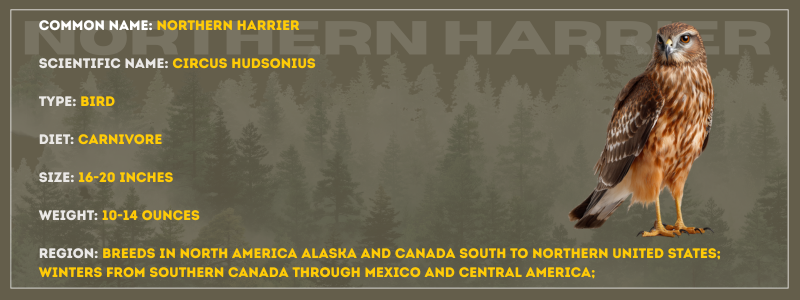
Scientific name: Circus hudsonius
Diet type: Carnivore (primarily small mammals, also birds, amphibians, reptiles, and insects)
Size: 41-52 cm (16-20 inches) in length
Weight: Males: 290-400 g (10-14 oz); Females: 390-750 g (14-26 oz)
Region found: Breeds in northern North America from Alaska and Canada south to northern United States; winters from southern Canada through Mexico and Central America; year-round resident in portions of the central and western United States