
In the shadowy undergrowth of eastern woodlands, a flash of russet, black, and white announces the presence of one of North America’s most charismatic ground-dwellers. The Eastern Towhee, with its bold plumage and distinctive “drink-your-tea!” call, commands attention despite spending much of its life hidden beneath dense thickets. This robin-sized songbird has mastered the art of living at the forest floor’s edge, where it performs an energetic two-footed scratching dance that sends leaves flying in all directions. Far more than just another pretty bird, the Eastern Towhee represents a fascinating example of evolutionary specialization, having developed unique foraging techniques and complex vocal repertoires that make it a subject of endless fascination for ornithologists and backyard birders alike. As forests fragment and habitats shift, understanding this remarkable species becomes increasingly important for conservation efforts across the eastern United States.
Facts
- Bilateral Scratching Maestro: The Eastern Towhee uses a distinctive double-scratch technique, jumping backward with both feet simultaneously to uncover hidden insects and seeds—a behavior so vigorous it can be heard from considerable distances rustling through leaf litter.
- Dialects and Diversity: Male Eastern Towhees in different regions sing with distinct dialects, and individual males can possess repertoires of 3-6 different song types, which they strategically deploy during territorial disputes and courtship.
- Eye Color Transformation: Juvenile Eastern Towhees have dark brown eyes that gradually change to brilliant red in adults, a transformation that takes nearly a year to complete and serves as an indicator of maturity and breeding readiness.
- Cryptic Ground Nester: Unlike many songbirds that nest in trees, Eastern Towhees build their nests directly on or very close to the ground, expertly concealed in dense vegetation, making them notoriously difficult to locate even when researchers know the approximate location.
- Partial Migration Mystery: Eastern Towhee populations exhibit partial migration, where northern birds migrate south while southern populations remain year-round, and remarkably, some populations in the middle of their range contain both migrating and non-migrating individuals.
- Flash Display Defense: When startled or threatened, the Eastern Towhee employs a “flash display,” suddenly spreading its tail to reveal white outer feathers that may confuse predators or signal alarm to nearby birds.
- Ancestral Name Origins: The name “towhee” is derived from the bird’s call note, which early naturalists phonetically transcribed as “tow-hee” or “che-wink,” demonstrating how indigenous onomatopoeia influenced scientific nomenclature.
Species
Taxonomic Classification:
- Kingdom: Animalia
- Phylum: Chordata
- Class: Aves
- Order: Passeriformes
- Family: Passerellidae (New World sparrows)
- Genus: Pipilo
- Species: Pipilo erythrophthalmus
The Eastern Towhee belongs to the genus Pipilo, which contains eight species of towhees distributed across North and Central America. Until 1995, the Eastern Towhee and the Spotted Towhee were considered a single species called the Rufous-sided Towhee, but genetic and behavioral studies revealed sufficient differences to warrant their separation into distinct species.
Within the Eastern Towhee, ornithologists recognize four subspecies based on geographic distribution and subtle variations in plumage and size:
P. e. erythrophthalmus (Nominate subspecies): Found throughout most of the bird’s range from the Great Plains eastward.
P. e. canaster: Inhabits the southern Appalachian region, characterized by slightly larger size and whiter wing markings.
P. e. rileyi: Restricted to peninsular Florida and the coastal southeastern United States, featuring paler overall coloration adapted to the warmer climate.
P. e. alleni: Found primarily in northern Florida and parts of Georgia, representing an intermediate form between southern and northern populations.
The Eastern Towhee’s closest relatives include the Spotted Towhee of western North America, the Green-tailed Towhee, and various species of Mexican towhees. All members of the Pipilo genus share similar ecological niches as ground-foraging birds of scrubby habitats, though they’ve evolved distinct appearances and behaviors suited to their specific environments.
Appearance
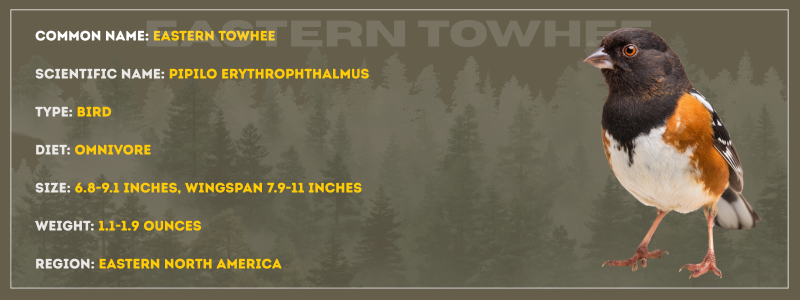
The Eastern Towhee is a striking, robin-sized songbird measuring 17.3-23 cm (6.8-9.1 inches) in length with a wingspan of 20-28 cm (7.9-11 inches). Adults typically weigh between 32-53 grams (1.1-1.9 ounces), with males averaging slightly heavier than females.
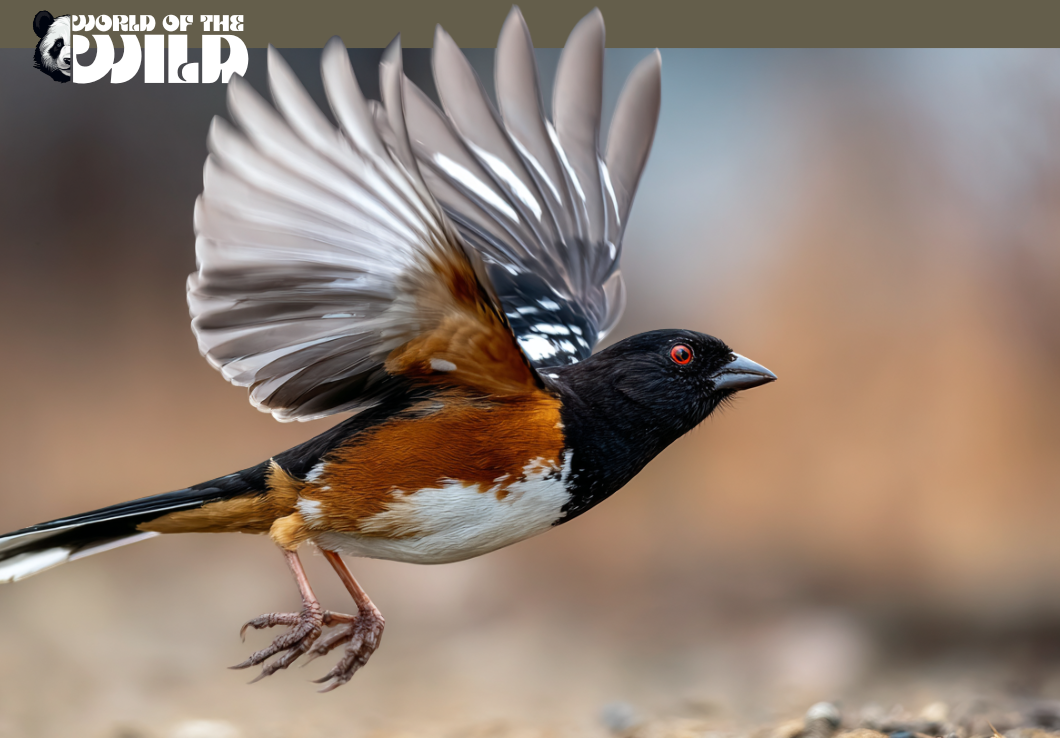
Sexual dimorphism is pronounced in this species, making males and females readily distinguishable. Adult males display dramatic tricolored plumage: a glossy jet-black hood, back, wings, and tail contrast sharply with brilliant rufous-orange flanks and a pristine white belly. The wings feature small white spots on the coverts, and the long, rounded tail shows prominent white corners that flash conspicuously during flight and territorial displays. The eyes are a striking deep red, creating an almost jewel-like appearance against the black head. The bill is dark and conical, perfectly adapted for both seed-cracking and insect-catching, while the legs and feet are pink-gray and notably robust for scratching.
Adult females share the same basic pattern but replace the male’s black plumage with rich chocolate brown, creating a more subtle but equally elegant appearance. Their rufous flanks are equally vibrant, and they share the white belly and tail corners. Female eyes are also red, though sometimes slightly less intense than males.
Juvenile Eastern Towhees appear quite different from adults, sporting heavily streaked brown plumage on both the head and underparts, with buff-colored wing bars. Their cryptic coloration provides excellent camouflage during their vulnerable early weeks. The transition to adult plumage occurs gradually over several months, with young birds showing a mottled mixture of juvenile and adult feathers during their first fall.
The bird’s overall silhouette is distinctive: relatively large-headed with a thick neck, a long graduated tail often held cocked at various angles, and a sturdy, medium-length conical bill. When perched, the Eastern Towhee appears robust and somewhat thick-set, quite different from the more streamlined appearance of many other songbirds.
Geographic variation exists among subspecies, with the Florida population (P. e. alleni) showing paler overall coloration and reduced white in the wings, while Appalachian birds (P. e. canaster) tend toward larger size and more extensive white markings.

Behavior
The Eastern Towhee exhibits a fascinating repertoire of behaviors centered around its ground-dwelling lifestyle. Its most distinctive and recognizable behavior is its unique foraging technique: a vigorous two-footed backward scratch that sends leaf litter flying in small explosions of debris. This “double-scratch” involves the bird jumping forward slightly, then immediately hopping backward with both feet simultaneously raking through leaves. This energetic display can be heard from remarkable distances, often alerting observers to the bird’s presence long before visual confirmation. Individual towhees may scratch in the same spot repeatedly, creating small cleared areas in the leaf litter as they systematically search for hidden food items.
Eastern Towhees are primarily solitary or found in pairs during the breeding season, becoming somewhat more tolerant of conspecifics during winter months, though they rarely form true flocks. They maintain territories vigorously during breeding season, with males singing persistently from exposed perches to advertise ownership and attract mates. Territorial disputes between males involve elaborate displays including tail-spreading, wing-drooping, and chasing, occasionally escalating to brief aerial confrontations.
The species demonstrates a strong preference for low, dense vegetation, spending approximately 70% of their time on or near the ground. When alarmed, they typically dive into thick cover rather than flying away, emerging cautiously to assess threats from a different position. This behavior, combined with their cryptic habits, makes them surprisingly difficult to observe despite their bold coloration and loud vocalizations.
Communication in Eastern Towhees is remarkably sophisticated. Males possess complex song repertoires, typically including 3-6 distinct song types that vary regionally. The most common vocalization is often phonetically rendered as “drink-your-TEA!” with the final note rising and strongly emphasized, though variations include two-noted songs and simpler patterns. These songs carry considerable distances and are delivered from prominent perches, particularly during dawn and dusk. Call notes include a distinctive, nasal “chewink” or “che-wee” (from which the bird’s name derives), sharp “tow-hee” notes, and various chips and trills used in different contexts. Females occasionally sing as well, though more quietly and less frequently than males.
The Eastern Towhee exhibits interesting seasonal behavioral shifts. Northern populations that migrate do so nocturnally, traveling singly or in loose aggregations. During migration and winter, their scratching behavior continues unabated, but they become less vocal and more secretive. Winter birds may join mixed-species foraging flocks loosely, though they maintain a preference for operating independently within dense thickets.
Intelligence manifests in several ways: the birds demonstrate excellent spatial memory for productive foraging sites, can adjust their scratching intensity based on substrate type, and show rapid learning when encountering novel food sources at feeders. They’re also capable of assessing predation risk, modifying their behavior near known threat locations.
Parent birds display sophisticated anti-predator behaviors, including distraction displays when nests are threatened. They may feign injury, dragging a wing and calling loudly to lure potential predators away from vulnerable eggs or nestlings.
Evolution
The evolutionary history of the Eastern Towhee traces back millions of years through the radiation of New World sparrows (Passerellidae), a diverse family that colonized the Americas following their ancestors’ arrival from Eurasia. Molecular clock studies suggest the Passerellidae family diverged from other passerine lineages approximately 15-20 million years ago during the Miocene epoch, a period of significant climate change and habitat diversification in North America.
The genus Pipilo represents a relatively recent evolutionary development within this family, likely emerging 3-5 million years ago during the Pliocene. This timing corresponds with the continued development of temperate deciduous forests and scrubland habitats across North America, environments to which towhees became exquisitely adapted. The genus evolved a suite of specialized characteristics including robust legs for scratching, ground-dwelling habits, and preferences for dense, shrubby vegetation—all features that distinguish them from their more arboreal sparrow relatives.
The split between the Eastern Towhee and its sister species, the Spotted Towhee, represents one of the more recent speciation events in the genus, occurring approximately 2-3 million years ago. This divergence likely resulted from geographic isolation during glacial periods of the Pleistocene epoch. As ice sheets advanced and retreated, bird populations became separated into eastern and western refugia. The isolated populations evolved distinct plumage patterns, vocalizations, and subtle behavioral differences—sufficient to maintain reproductive isolation when their ranges eventually came back into contact along the Great Plains.
The geographic separation also drove the evolution of different ecological adaptations. The Eastern Towhee evolved preferences for the mixed deciduous and coniferous forests of eastern North America, while the Spotted Towhee adapted to the chaparral and coniferous forests of the west. These habitat preferences remain strong even where ranges overlap, suggesting deep evolutionary programming.
Fossil evidence for the Eastern Towhee specifically is limited, as small passerine bones preserve poorly. However, fossils attributed to the genus Pipilo have been recovered from Pleistocene deposits in Florida and other southeastern states, indicating the genus has maintained a presence in North America for at least 1-2 million years. These fossils show skeletal characteristics virtually identical to modern towhees, suggesting the basic body plan has proven highly successful and remained relatively unchanged.
The evolution of the Eastern Towhee’s distinctive foraging behavior—the bilateral backward scratch—represents a significant evolutionary innovation. This behavior likely evolved from more typical avian scratching movements, becoming amplified and specialized for efficient leaf litter disruption. The behavior requires considerable neural coordination and muscular control, suggesting selective pressure favored individuals capable of this energetic foraging technique in environments with deep leaf litter.
Recent genetic studies reveal that different Eastern Towhee populations maintain subtle genetic distinctiveness, with southern populations showing greater genetic diversity than northern ones—a pattern consistent with northern populations having recolonized their range following glacial retreat within the last 10,000-20,000 years.
Habitat
The Eastern Towhee occupies a broad geographic range across the eastern half of North America, from southern Canada through the eastern United States to the Gulf Coast and into northeastern Mexico. The breeding range extends from southern Saskatchewan and Manitoba eastward across southern Ontario and Quebec to Nova Scotia, then south through New England, the Appalachian Mountains, and throughout the southeastern states to Florida and eastern Texas. Northern populations are migratory, withdrawing from Canada and the northern United States during winter months, while southern populations remain year-round residents. The winter range contracts to include the southern two-thirds of the breeding range, roughly from southern New England and the lower Great Lakes region southward.
Within this extensive range, Eastern Towhees exhibit strong habitat preferences that transcend geographic boundaries. They thrive in early successional habitats, forest edges, and areas with dense shrubby understory—environments that provide a critical combination of ground-level cover and open leaf litter for foraging. Their ideal habitat features a complex vertical structure: a closed or semi-open canopy overhead, a well-developed shrub layer at mid-level (typically 1-3 meters high), and a thick leaf litter layer on the ground interspersed with patches of bare soil and low herbaceous vegetation.
Primary habitat types include:
Deciduous and Mixed Forests: Eastern Towhees flourish in oak-hickory forests, maple-beech woodlands, and mixed pine-hardwood systems, particularly where natural disturbances or forest management create gap dynamics and maintain shrubby understory. They favor forest edges and areas with abundant woody debris.
Forest Regeneration Areas: Recently logged areas, windthrow sites, and forests recovering from fire provide excellent habitat during the dense shrub stage of succession, typically 3-15 years post-disturbance.
Riparian Zones: Stream-side thickets with dense willow, alder, and dogwood shrubs support substantial populations, particularly during migration and winter.
Old Fields and Shrublands: Abandoned agricultural land reverting to forest, with scattered saplings and dense brambles, represents prime towhee territory.
Pine Barrens and Oak Scrubland: Specialized habitats like the New Jersey Pine Barrens and southeastern oak scrub communities support distinctive populations adapted to fire-maintained ecosystems.
Suburban and Urban Edge Habitats: Parks, large gardens, greenbelts, and suburban woodlots with sufficient understory development increasingly provide refuge, particularly in fragmented landscapes.
Critical habitat features include:
- Dense understory coverage: Thickets of greenbriar, multiflora rose, honeysuckle, blueberry, mountain laurel, rhododendron, or similar shrubs provide essential cover from predators.
- Deep leaf litter: Accumulations of 5-15 cm of decomposing leaves harbor the invertebrates and seeds central to towhee diet.
- Structural heterogeneity: Varied vegetation heights and densities allow for diverse foraging opportunities and nest site selection.
- Edge habitat: The transition zones between forest and field, forest and wetland, or forest of different ages concentrate towhee activity.
Eastern Towhees generally avoid mature, closed-canopy forests with sparse understory, extensive open grasslands without woody vegetation, and wetlands lacking dense shrubby borders. However, they readily colonize appropriate habitat fragments, persisting in relatively small patches (1-5 hectares) if vegetation structure meets their requirements.
Elevation range is broad, from sea level along the Atlantic and Gulf Coasts to approximately 1,800 meters (6,000 feet) in the southern Appalachian Mountains, where they inhabit mountain laurel and rhododendron thickets interspersed with deciduous forest.

Diet
The Eastern Towhee is an omnivore with a diet that shifts seasonally between animal and plant matter, demonstrating remarkable adaptability to available food resources. During the breeding season (spring and summer), their diet consists of approximately 60-70% invertebrates, shifting to 70-80% plant material during fall and winter months.
Animal Prey:
The towhee’s invertebrate diet includes an impressive diversity of ground-dwelling and leaf-litter inhabitants. Beetles (Coleoptera) constitute the largest proportion of animal food, including ground beetles, click beetles, lady beetles, and various weevil species. Caterpillars (Lepidoptera larvae) rank second in importance, particularly during the breeding season when protein demands peak for egg production and nestling growth. Other significant prey includes:
- Spiders and harvestmen (Arachnida)
- Ants, wasps, and bees (Hymenoptera)
- Grasshoppers, crickets, and katydids (Orthoptera)
- True bugs (Hemiptera)
- Flies (Diptera)
- Millipedes and centipedes
- Earthworms
- Snails and slugs (especially in moist habitats)
Plant Matter:
The vegetable portion of the diet varies seasonally but includes:
Seeds comprise the bulk of plant food, with preferences for:
- Grass seeds (various species)
- Ragweed (Ambrosia spp.)
- Smartweed and knotweed (Polygonum spp.)
- Sedges and rushes
- Pine seeds
- Oak acorns (consumed when broken by other animals)
Fruits and berries become important in late summer and fall:
- Blackberries and raspberries (Rubus spp.)
- Blueberries (Vaccinium spp.)
- Dogwood berries
- Sumac drupes
- Wild cherry
- Virginia creeper berries
- Poison ivy berries (consumed without ill effect)
Occasionally, towhees consume small amounts of soft plant buds, tender shoots, and even moss capsules.
Foraging Behavior:
The Eastern Towhee employs highly specialized foraging techniques centered on their signature double-scratch behavior. This vigorous bilateral scratching disturbs leaf litter up to 15 cm deep, exposing hidden invertebrates, seeds, and other food items. The bird then visually scans the disturbed area, pecking at discovered items. This technique proves remarkably efficient in forest-floor environments where prey and seeds concentrate beneath accumulated leaves.
Foraging occurs primarily on the ground (approximately 85% of time), though towhees occasionally glean insects from low vegetation and make short flights to snatch insects from foliage or tree bark. They rarely forage above 2 meters height.
During winter, Eastern Towhees readily visit bird feeders, showing particular preference for:
- White proso millet (scattered on the ground)
- Black oil sunflower seeds
- Cracked corn
- Peanut pieces
- Commercial mixed seed scattered beneath feeders
Their ground-feeding preference means they often clean up seeds spilled by other birds, making them valuable members of backyard bird communities.
Foraging typically occurs in short, intense bouts. A towhee may scratch vigorously in one area for 30-60 seconds, consuming discovered items, then move 1-2 meters and repeat. This pattern continues through prime foraging periods at dawn and dusk, with reduced activity during midday, particularly in hot weather.
Young birds are fed almost exclusively insects and spiders during their first weeks, with parents making frequent foraging trips to deliver small caterpillars, beetles, and spiders to nestlings. The protein-rich diet supports rapid growth during the critical developmental period.
Predators and Threats
Natural Predators:
Eastern Towhees face predation pressure from a diverse array of natural enemies throughout their life cycle. Ground-nesting habits and extensive time spent foraging in leaf litter make them particularly vulnerable to terrestrial hunters.
Avian predators include:
- Sharp-shinned Hawks and Cooper’s Hawks (primary aerial threats to adults)
- American Kestrels
- Screech Owls (nocturnal threat during migration)
- Blue Jays and American Crows (nest predators)
- Shrikes (occasional predators in open habitats)
Mammalian predators pose the greatest threat, especially to nests:
- Domestic and feral cats (significant cause of adult mortality)
- Raccoons (major nest predators)
- Opossums
- Striped skunks
- Red foxes
- Weasels and mink
- Chipmunks and squirrels (egg predators)
- White-footed mice (egg and small nestling predators)
Snakes, particularly rat snakes, black racers, and other climbing species, also prey on eggs and nestlings.
Nest parasitism by Brown-headed Cowbirds affects Eastern Towhee populations in some regions, with cowbird chicks often outcompeting towhee nestlings for parental care. However, towhees show moderate resistance to parasitism through egg rejection in some populations.
Anthropogenic Threats:
Human activities pose increasingly significant challenges to Eastern Towhee populations:
Habitat Loss and Fragmentation: The most pressing threat stems from destruction and degradation of early successional habitats. Modern forestry practices that eliminate understory, suburban development that removes shrubby vegetation, and agricultural intensification all reduce available habitat. Forest fragmentation creates smaller, isolated patches that may not sustain viable breeding populations and increases edge effects that benefit nest predators.
Fire Suppression: Many towhee populations depend on fire-maintained habitats like pine barrens and oak scrublands. Aggressive fire suppression allows succession to proceed unchecked, converting optimal shrubby habitat into mature, closed-canopy forest unsuitable for towhees. This proves particularly problematic in specialized ecosystems like the New Jersey Pine Barrens.
Invasive Species: Non-native plants alter habitat structure in complex ways. While some invasive shrubs like multiflora rose and honeysuckle can provide suitable cover, others like Japanese stiltgrass reduce leaf litter quality and invertebrate abundance. Dense invasive stands may create ecological traps—habitats that appear suitable but support reduced reproductive success.
Window Collisions: Like many migratory songbirds, Eastern Towhees suffer mortality from colliding with glass windows, particularly during migration when navigation challenges peak.
Pesticide Use: Agricultural and suburban pesticide application reduces insect availability, directly impacting food resources during critical breeding season. Indirect effects include potential contamination of prey items and vegetation.
Climate Change: Shifting climate patterns affect towhees through multiple pathways: altered migration timing, mismatches between breeding phenology and peak insect abundance, range shifts forcing populations into suboptimal habitats, and increased frequency of extreme weather events during nesting season. Warmer winters may benefit some populations by reducing energetic costs, but could also increase parasite and disease pressure.
Predation by Domestic Cats: Free-roaming domestic and feral cats kill millions of songbirds annually in North America. Ground-foraging species like Eastern Towhees are disproportionately vulnerable, particularly in suburban and rural residential areas.
Vehicle Strikes: Roads fragmenting habitat create mortality risks, particularly during the breeding season when adults make frequent foraging trips and recently fledged young disperse.
Brood Parasitism Increase: Forest fragmentation and habitat changes have expanded Brown-headed Cowbird populations into previously unaffected areas, increasing parasitism rates on towhee nests in some regions.
Despite these challenges, Eastern Towhees show resilience and adaptability, maintaining stable populations across much of their range through their ability to exploit early successional habitats created by various disturbances.

Reproduction and Life Cycle
Mating System and Courtship:
Eastern Towhees practice social monogamy, with pair bonds typically forming soon after spring arrival on breeding grounds. Courtship begins with males establishing and defending territories through persistent singing from prominent perches. Territory sizes vary from 0.5 to 4 hectares depending on habitat quality and population density.
Courtship displays involve the male performing exaggerated flights with rapid wingbeats and spread tail, showcasing the white tail corners while vocalizing loudly. Males may also engage in wing-drooping displays where they lower and flutter their wings while approaching females. Once a female enters a male’s territory, pair formation progresses through ritualized behaviors including mutual bill-touching and the male feeding the female choice food items.
Nesting:
Females assume primary responsibility for nest construction, though males occasionally assist by bringing materials. Nest building typically requires 3-5 days of intensive work. Nests are placed on or very near the ground (0-1.5 meters high), usually concealed in dense shrubs, vine tangles, brush piles, or at the base of small saplings. The structure is a bulky but well-constructed cup composed of:
- Foundation and outer layers: dead leaves, bark strips, twigs, and grasses
- Middle layer: finer grasses and rootlets
- Inner cup lining: fine grasses, pine needles, hair, and occasionally moss
The finished nest measures approximately 11-13 cm in diameter with an inner cup 6-7 cm across and 4-5 cm deep.
Egg Laying and Incubation:
Females lay 2-6 eggs (typically 3-4) at a rate of one egg per day. Eggs are creamy white to pale gray, heavily marked with reddish-brown spots and blotches that concentrate toward the larger end. Each egg measures approximately 23-24 mm long and weighs about 4 grams.
Incubation begins after the clutch is complete or near-complete and lasts 12-13 days. The female alone incubates, sitting tightly on the nest and taking brief breaks for feeding. During incubation, males defend the territory and occasionally feed their mates.
Nestling Period:
Hatchlings emerge altricial—naked, blind, and completely dependent on parental care. Both parents feed nestlings, making frequent trips with small invertebrates, particularly soft-bodied caterpillars and spiders. Nestlings develop rapidly:
- Days 1-3: Eyes remain closed, minimal movement
- Days 4-5: Eyes open, pin feathers emerge
- Days 6-8: Feathering progresses rapidly
- Days 9-11: Nestlings nearly fully feathered, becoming active
Fledging occurs at 10-12 days of age, though the exact timing varies with food availability and disturbance pressure. Young leave the nest before achieving full flight capability, hopping and fluttering into nearby cover where they remain hidden while parental feeding continues.
Post-Fledging:
Fledglings remain dependent on parents for 3-4 additional weeks, during which adults continue intensive feeding while teaching foraging skills. Young towhees practice the characteristic scratching behavior, initially with awkward, uncoordinated movements that gradually improve through trial and error and apparent observation of adults.
Juvenile plumage is heavily streaked brown, providing excellent camouflage. The molt into adult-like plumage begins in late summer and continues through fall, with complete adult coloration achieved by the following spring.
Breeding Season and Multiple Broods:
The breeding season spans April through August across most of the range, with southern populations potentially beginning earlier. Eastern Towhees commonly attempt 2-3 broods per season, particularly in southern regions with longer breeding seasons. After successful fledging of a first brood, females typically begin nest construction for a second clutch within 1-2 weeks. Males may assume primary care of fledglings from the first brood while females incubate the second clutch.
Reproductive Success:
Nest success rates vary considerably but typically range from 30-60% depending on predation pressure and habitat quality. Ground nesting makes towhees particularly vulnerable to predators, and many pairs lose at least one nesting attempt during the season. The multiple-brood strategy compensates for high nest failure rates.
Lifespan:
Eastern Towhees can live surprisingly long for small songbirds. The oldest recorded individual in the wild reached 12 years and 3 months, documented through bird banding records. However, average lifespan is considerably shorter. Most individuals survive only 1-2 years, with first-year mortality particularly high. Birds that survive their first year have substantially improved prospects, with typical adult lifespan ranging from 3-5 years.
Causes of mortality include predation, severe weather events (particularly during migration and winter), starvation during resource-limited periods, collisions, disease, and parasitism.
Sexual Maturity:
Eastern Towhees typically reach sexual maturity and breed for the first time at one year of age, though some individuals, particularly those hatched early in the season, may achieve maturity and breeding condition by 10-11 months if they’ve molted into adult plumage.
Population
Conservation Status:
The Eastern Towhee is currently classified as Least Concern on the IUCN Red List of Threatened Species. This designation reflects the species’ large geographic range, substantial total population, and the fact that population declines, while occurring in some regions, have not reached threshold levels that would warrant a higher threat category. Partners in Flight, a collaborative bird conservation organization, assigns the Eastern Towhee a Continental Concern Score of 10 out of 20, indicating moderate conservation priority—not critically threatened but deserving of monitoring and proactive conservation.
Population Estimates:
Estimating precise population numbers for widely distributed songbirds presents significant challenges, but the best available data suggests a global population of approximately 38-52 million individual Eastern Towhees. This figure derives from breeding bird survey data, Christmas bird counts, and habitat-based modeling that extrapolates local densities across the species’ range.
Population Trends:
Population dynamics vary considerably across the Eastern Towhee’s range, creating a complex conservation picture:
Declining Regions: The northeastern United States and parts of the upper Midwest have experienced notable population declines over recent decades. Long-term data from the North American Breeding Bird Survey (BBS) indicates population decreases of approximately 1-2% per year in these regions since the 1960s. Cumulative declines in the northeastern portions of the range may exceed 50% over the past 50 years. These declines correlate strongly with:
- Maturation of forests and loss of early successional habitat
- Reduced forest management and logging
- Suppression of natural fire regimes
- Suburban development eliminating shrubby edge habitat
- Declining prevalence of small-scale agriculture that created diverse habitat mosaics
Stable or Increasing Regions: Conversely, populations in parts of the Southeast and mid-Atlantic states show stability or modest increases. Factors contributing to regional stability include:
- Active forest management creating suitable early successional habitat
- Large preserves maintaining habitat heterogeneity
- Adaptation to suburban environments where understory development is permitted
- Prescribed fire programs in pine barrens and oak savannas
Overall Continental Trend: Continent-wide, the species has declined by an estimated 20-30% since 1970, though the decline rate has moderated in recent years. The overall trend raises concern but does not yet indicate imminent risk of species-level population collapse.
Factors Influencing Population Dynamics:
Several interconnected factors drive observed population patterns:
Habitat succession: Natural forest maturation eliminates the shrubby understory towhees require. In pre-colonial times, fire, windstorms, and other disturbances continually created early successional habitat. Modern fire suppression and forest protection, while valuable for other conservation goals, reduce habitat availability for towhees and other scrub-dependent species.
Conservation programs: Targeted management on public and private lands increasingly recognizes the need for early successional habitat. Initiatives creating young forest patches, maintaining shrubby edges, and employing prescribed fire have locally stabilized or reversed declines.
Climate change effects: Shifting climate patterns create both opportunities and challenges. Warmer temperatures may reduce winter mortality in northern populations but could also alter plant communities and insect phenology, potentially creating mismatches between breeding and peak food availability.
Geographic Variation:
Population density varies dramatically across the range. Optimal habitats in the Appalachian region and parts of the Southeast may support 0.5-2.0 pairs per hectare, while marginal habitats in fragmented landscapes contain far fewer breeding pairs. Some regions now contain only scattered, isolated populations rather than continuous distributions.
Conservation Efforts:
Multiple initiatives target Eastern Towhee conservation:
- Young Forest Initiative: Programs creating and maintaining early successional forest through timber harvest rotation, patch cuts, and controlled burns
- Habitat Restoration: Removal of invasive plants and restoration of native shrub communities in degraded habitats
- Private Lands Conservation: Outreach to landowners promoting Wildlife Management Areas that include shrubby habitat
- Monitoring Programs: Continued breeding bird surveys, banding studies, and citizen science projects tracking population trends
- Prescribed Fire Programs: Reintroduction of fire regimes in fire-adapted ecosystems
Research Needs:
Ongoing research focuses on understanding how Eastern Towhees respond to different habitat management strategies, the impacts of climate change on migration and breeding phenology, and the effects of urbanization on survival and reproductive success.
Conclusion
The Eastern Towhee stands as both a resilient survivor and a species of increasing conservation concern—a paradox that captures the complexity of modern bird conservation. This charismatic ground-dweller, with its brilliant plumage, energetic scratching dance, and distinctive “drink-your-tea!” call, has adapted to dynamic landscapes for millennia. Yet the bird now faces challenges unprecedented in evolutionary timescales: habitat fragmentation, fire suppression, and rapid climate change fundamentally alter the conditions to which these birds have become so exquisitely adapted.
What makes the Eastern Towhee’s story particularly compelling is its dependence on disturbance—those early successional, shrubby habitats that many view as “waste ground” or stages to rush through on the way to mature forest. Understanding and valuing these transitional environments represents a critical shift in conservation thinking. The towhee reminds us that biological diversity depends on habitat diversity, and that sometimes the most valuable landscapes are the scruffy, tangled edges we’re tempted to tidy up.
The path forward requires balancing multiple conservation goals: protecting old-growth forests while also creating and maintaining young forest patches, managing fire-adapted ecosystems with prescribed burns, and designing human landscapes that accommodate the messy, complex habitats that species like the Eastern Towhee need to thrive. Every patch of brambles left to grow wild, every forest edge maintained in shrubby splendor, becomes potential towhee territory.
For those who encounter this remarkable bird—whether through the rustling sounds of vigorous leaf scratching, the flash of rufous and white through shadowy undergrowth, or that insistent territorial song ringing through spring mornings—the Eastern Towhee offers an invitation to appreciate the overlooked. These birds challenge us to find beauty not just in the spectacular but in the subtle, to value not just the pristine but the tangled and wild. In protecting the scrubby sanctuaries that towhees call home, we preserve not just one species but the countless others—from invertebrates to wildflowers to fellow birds—that share these dynamic, life-rich environments.
Scientific Name: Pipilo erythrophthalmus
Diet Type: Omnivore (primarily insects during breeding season, seeds and berries in fall/winter)
Size: 17.3-23 cm (6.8-9.1 inches) in length; wingspan 20-28 cm (7.9-11 inches)
Weight: 32-53 grams (1.1-1.9 ounces)
Region Found: Eastern North America from southern Canada through the eastern United States to the Gulf Coast; breeding range extends from southern Saskatchewan and Manitoba to Nova Scotia, south to Florida and eastern Texas; northern populations migrate south in winte