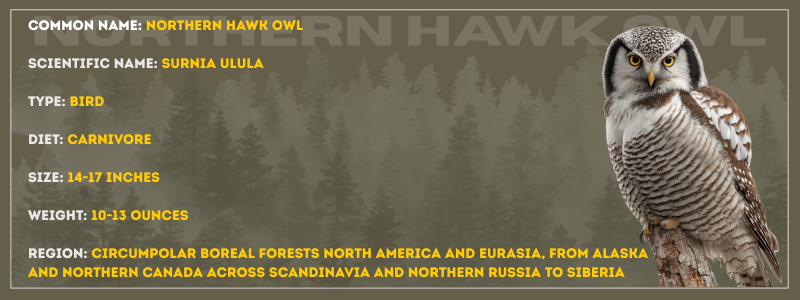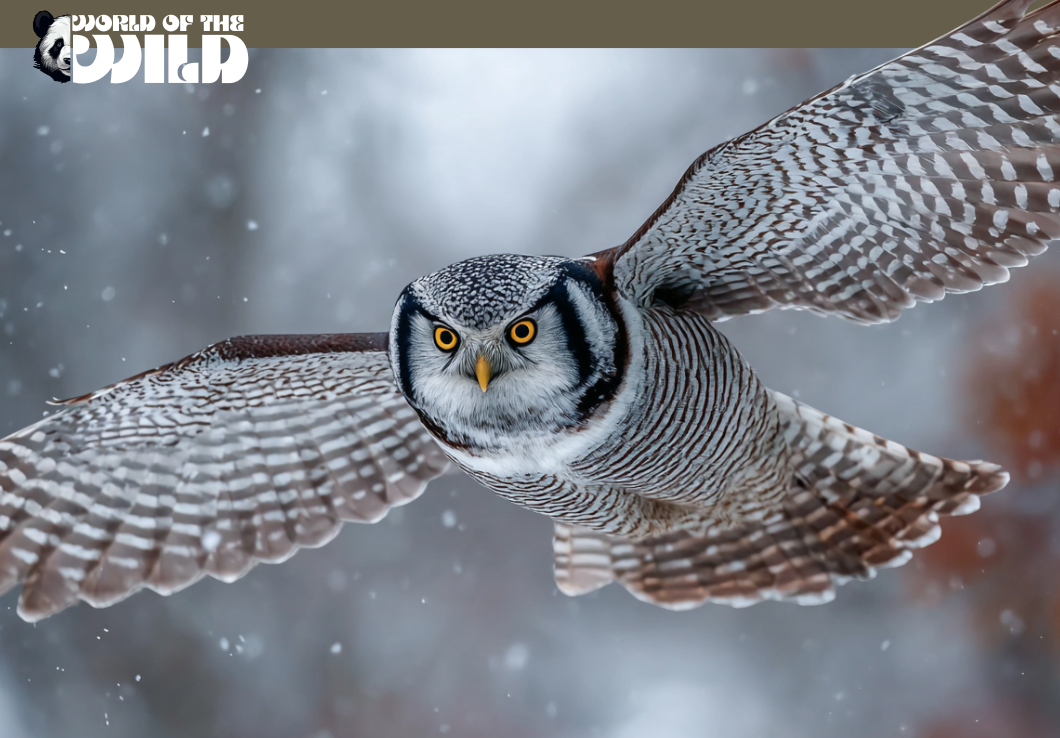

Perched atop a skeletal spruce in the frozen silence of the boreal forest, a bird scans the snow-covered landscape with piercing yellow eyes. At first glance, you might mistake it for a hawk—its long tail flicking with anticipation, its sleek profile cutting against the pale winter sky. But this is no hawk. This is the Northern Hawk Owl, one of nature’s most remarkable examples of convergent evolution and a master of survival in some of the planet’s harshest environments.
What makes the Northern Hawk Owl truly fascinating is its defiance of owl conventions. While most owls are creatures of twilight and darkness, this bold hunter conducts its business in broad daylight, behaving more like a raptor than its nocturnal cousins. It represents a perfect marriage of owl and hawk characteristics, challenging our preconceptions about what an owl should be and offering a glimpse into the incredible adaptability of predatory birds.
Facts
- Daylight Hunter: Unlike the vast majority of owl species, the Northern Hawk Owl is primarily diurnal, hunting during daylight hours much like true hawks, especially during the endless summer days of the Arctic.
- Fearless Defender: These owls are notoriously aggressive when defending their nests, known to strike humans, bears, and other large animals that venture too close to their young.
- Extraordinary Hearing: The Northern Hawk Owl can detect a vole moving beneath a foot of snow from over 800 feet away, thanks to asymmetrically positioned ear openings that create a three-dimensional sound map.
- Nomadic Wanderer: Rather than migrating on a predictable schedule, these owls are irruptive migrants, sometimes traveling hundreds of miles south during years when prey populations crash in their northern territories.
- Perch Patience: A hunting Northern Hawk Owl can remain motionless on a perch for hours, watching and listening, before executing a lightning-fast strike that covers distances of up to 100 feet.
- Longevity Record: The oldest known Northern Hawk Owl in the wild lived to be over 16 years old, remarkable for a medium-sized predatory bird facing the extreme conditions of the far north.
- Vocal Repertoire: They produce a distinctive bubbling trill and whistling calls that carry for considerable distances across the northern wilderness, sounds quite unlike the hoots of typical owls.
Species
Kingdom: Animalia
Phylum: Chordata
Class: Aves
Order: Strigiformes
Family: Strigidae
Genus: Surnia
Species: Surnia ulula
The Northern Hawk Owl is the sole member of its genus Surnia, making it taxonomically unique among owls. This distinctiveness reflects its specialized adaptations and evolutionary path.
While the Northern Hawk Owl has no subspecies currently recognized by most taxonomic authorities, some historical classifications identified up to three subspecies based on geographic variation: S. u. ulula (Eurasian populations), S. u. caparoch (North American populations), and S. u. tianschanica (Central Asian populations). However, modern genetic analysis suggests these variations are clinal rather than representing true subspecies, and most ornithologists now treat the Northern Hawk Owl as a single species with gradual geographic variation.
The Northern Hawk Owl’s closest relatives within the Strigidae family include other cavity-nesting owls, though none share its distinctive hawk-like morphology and diurnal habits to the same degree.
Appearance
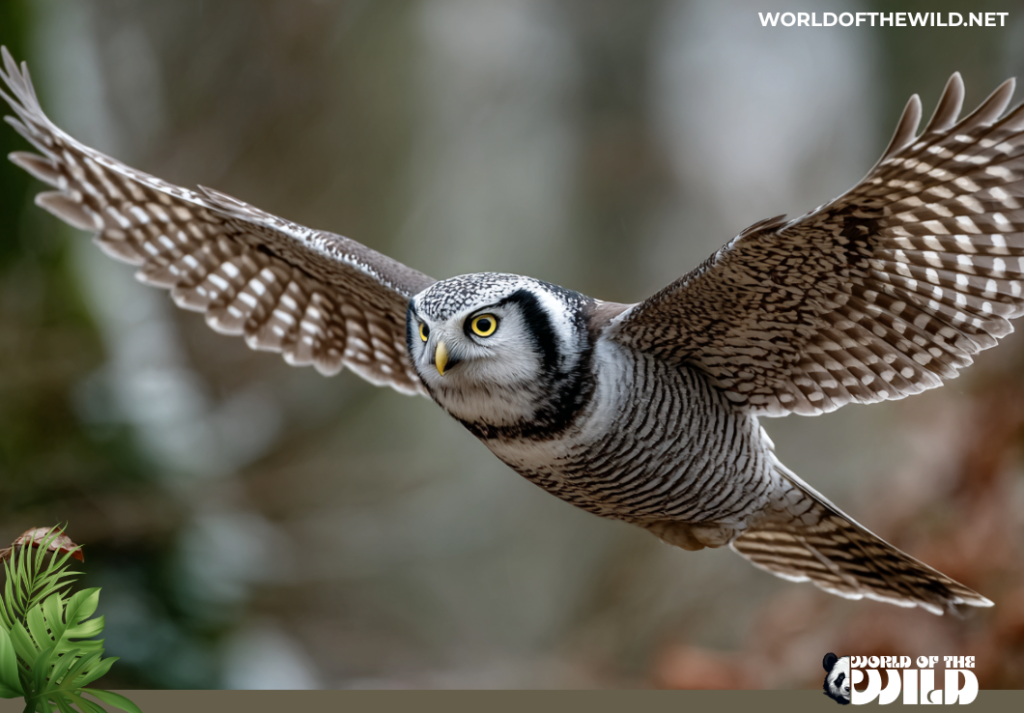
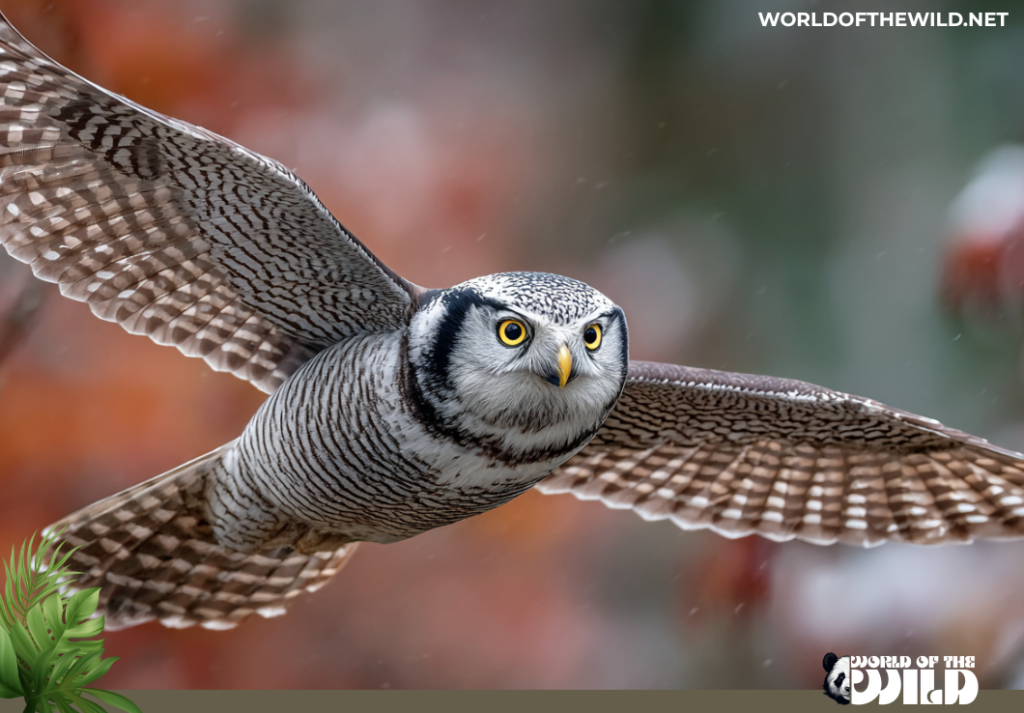
The Northern Hawk Owl is a study in contradictions—possessing the face of an owl and the body of a hawk. Medium-sized for an owl, adults measure 14 to 17 inches in length with a wingspan of 28 to 32 inches. Despite their robust appearance, they are relatively lightweight birds, with males typically weighing between 10 to 12 ounces and females slightly heavier at 11 to 13 ounces, demonstrating the subtle sexual dimorphism common in birds of prey where females tend to be larger.
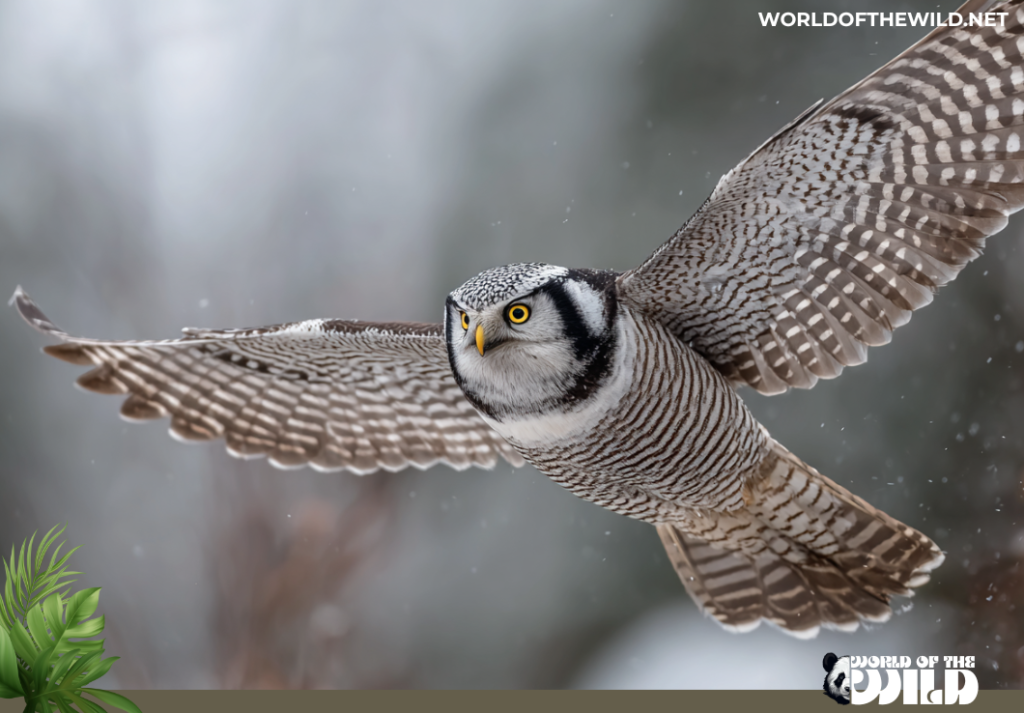
The plumage is a masterwork of natural camouflage. The upperparts are dark chocolate brown, heavily marked with white spots that create a speckled effect, particularly dense on the wings and shoulders. The underparts are white with fine dark brown barring that runs horizontally across the breast and belly, creating a distinctive scaled appearance. This barring is more pronounced than in most owls, contributing to the bird’s overall streamlined look.
The head is rounded but less dramatically so than in typical owls, with a bold white facial disc bordered by thick black lines that frame the face like parentheses. Unlike the concealed ears of most owls, the Northern Hawk Owl’s facial features are sharply defined, giving it an alert, intense expression. The eyes are striking—brilliant yellow and forward-facing, providing the binocular vision essential for judging distances when hunting.
Perhaps the most hawk-like feature is the tail—exceptionally long for an owl, measuring about 7 inches, and graduated, meaning the central feathers are longest. This tail is crucial for the bird’s agility in flight and provides the silhouette that so easily confuses observers. The wings are pointed rather than rounded, another departure from typical owl morphology, enabling swift, direct flight patterns similar to those of accipiters.
Behavior
The Northern Hawk Owl’s behavior reads like a fascinating hybrid user manual, borrowing equally from the owl and hawk playbooks. As a predominantly diurnal hunter, this bird is most active during daylight hours, particularly in the early morning and late afternoon, though it will hunt around the clock during the Arctic summer when darkness never falls. This daytime activity pattern is rare among owls and represents a significant ecological niche adaptation.
Hunting strategy is where the Northern Hawk Owl truly shows its dual nature. Like a hawk, it employs a “perch and pounce” technique, spending long periods motionless atop an exposed tree, post, or snag, scanning the landscape below. From these vantage points, the owl relies on both its exceptional vision and phenomenal hearing to detect prey. When a target is spotted, the attack is swift and direct—the owl launches from its perch in a characteristic downward glide, accelerating rapidly before striking with its talons extended.
These owls are solitary outside the breeding season, maintaining and defending hunting territories with surprising aggression. They are remarkably fearless birds, showing little concern for animals many times their size. During nesting season, this fearlessness intensifies to outright aggression—Northern Hawk Owls are known to dive-bomb and strike intruders, including humans, bears, and wolves that venture too near their nests, aiming for the head with their sharp talons.
Communication involves a variety of vocalizations distinct from the hoots of other owls. The most common call is a rapid, rolling trill—a bubbling sound often described as “ululululu”—which gives the species its scientific name. Males also produce a series of sharp whistles during courtship and territorial displays. Body language plays a role too, with tail-pumping and wing-spreading used to communicate excitement or aggression.
The Northern Hawk Owl demonstrates notable intelligence in adapting to prey availability. When primary prey species are abundant, individuals establish and maintain territories. During population crashes of voles and lemmings, however, these owls become nomadic, wandering vast distances in search of food, sometimes appearing hundreds of miles south of their normal range in what are called irruption years.
Evolution
The evolutionary history of the Northern Hawk Owl traces back to the diversification of the Strigidae family during the Miocene epoch, roughly 23 to 5 million years ago, when modern owl lineages began to diverge and specialize. The Northern Hawk Owl’s ancestors likely evolved in the northern Palearctic region, where the harsh climatic conditions and specific prey availability drove the development of its unique suite of adaptations.
Fossil evidence for the genus Surnia is limited, as is common with bird fossils, but the species likely emerged as a distinct lineage during the Pliocene or early Pleistocene, between 5 and 2 million years ago. During this period, the Northern Hemisphere experienced significant cooling and the expansion of boreal forests—the exact habitat that the Northern Hawk Owl would come to dominate.
The species’ most distinctive evolutionary adaptations—its diurnal hunting pattern, hawk-like morphology, and specialized hunting techniques—represent responses to the ecological opportunities presented by the northern boreal ecosystem. Unlike the nocturnal niche occupied by most owls, the Northern Hawk Owl evolved to exploit daylight hunting in an environment where small mammals are active during the day and where the extreme seasonal light variations (including 24-hour daylight in summer) made strict nocturnality impractical.
The elongated tail, pointed wings, and streamlined body are examples of convergent evolution with true hawks, representing independent evolution of similar solutions to similar ecological challenges. These features enhance maneuverability in the dense boreal forest and improve hunting efficiency when pursuing agile prey across snow-covered landscapes.
Genetic studies suggest that Northern Hawk Owl populations in North America and Eurasia have been separated long enough to show some genetic divergence, likely due to isolation during glacial periods of the Pleistocene, though not sufficiently to warrant subspecies designation. The species’ ability to survive repeated glacial cycles speaks to its adaptability and resilience.
Habitat
The Northern Hawk Owl is a bird of the far north, its range forming a nearly continuous belt across the boreal regions of North America and Eurasia. In North America, it inhabits Alaska and extends across northern Canada from Yukon to Newfoundland, occasionally ranging south into the northern United States during winter irruptions. In Eurasia, its range spans from Scandinavia across northern Russia and Siberia to Kamchatka, with isolated populations in the mountains of central Asia.
This owl is a specialist of the boreal forest, also known as the taiga—the vast coniferous woodland that circles the globe just south of the Arctic tundra. The ideal Northern Hawk Owl habitat features open or semi-open coniferous forests dominated by spruce, pine, larch, and fir, often interspersed with birch and aspen. These forests are characterized by a mosaic pattern: dense stands of trees broken by natural clearings created by fire, windfall, beaver activity, or wetlands.
The key habitat requirements reveal the species’ hunting adaptations. Northern Hawk Owls prefer areas with abundant perching opportunities—dead standing trees (snags), exposed branches, and forest edges—that provide commanding views over open ground where prey can be detected. Bogs, muskegs, clearcuts, burned areas, and meadows within the forest matrix are particularly important as they create the open hunting grounds where voles, lemmings, and other small mammals are most vulnerable.
Elevation varies with latitude, from sea level in the far north to mountainous regions in the southern portions of the range. The species is associated with relatively harsh climatic conditions, thriving in areas with long, severe winters and short, cool summers. Annual temperature ranges can be extreme, from summer highs occasionally exceeding 80°F to winter lows plummeting below -40°F.
During irruption years, when prey populations crash, Northern Hawk Owls may appear far south of their typical range, showing up in southern Canada and the northern tier of U.S. states. During these wanderings, they often occupy similar habitats—open country with scattered trees, agricultural areas, and forest edges—that mimic the structural characteristics of their boreal homeland.
Diet
The Northern Hawk Owl is a dedicated carnivore, a specialized predator whose diet and hunting techniques are finely tuned to the rhythms of the boreal ecosystem. Its primary food source consists of small to medium-sized mammals, with voles and lemmings forming the cornerstone of its diet throughout most of its range. These small rodents can comprise 80-90% of the owl’s diet during peak population years, making the Northern Hawk Owl’s fortunes closely tied to the cyclical boom-and-bust populations of these prey species.
Specific prey preferences vary by region and season. In North America, northern red-backed voles, meadow voles, and tundra voles are primary targets. In Eurasia, various Microtus and Clethrionomys species fill the same ecological role. During summer months in the Arctic, brown lemmings and collared lemmings become important prey items. The 3-4 year population cycles of these rodents directly influence Northern Hawk Owl breeding success and movement patterns.
Beyond rodents, the diet includes a diverse array of supplementary prey. Small birds form a significant secondary food source, particularly during winter when ground-dwelling mammals are less accessible beneath deep snow. Target species include ptarmigan, redpolls, snow buntings, and various small songbirds. The owl’s diurnal hunting habits allow it to catch birds that would be unavailable to nocturnal hunters.
Larger prey occasionally appears on the menu, demonstrating the Northern Hawk Owl’s hunting prowess. Documented prey includes weasels, young snowshoe hares, and even young spruce grouse—animals that can rival the owl in size. Opportunistic hunting of shrews, although these are less nutritious, supplements the diet when preferred prey is scarce.
Hunting technique is methodical and energy-efficient. The owl typically hunts from an exposed perch 5 to 30 feet above the ground, remaining motionless while scanning the landscape. Its asymmetrically placed ear openings allow precise sound localization—it can pinpoint a vole moving beneath snow cover with remarkable accuracy. Once prey is detected, the owl launches in a characteristic shallow glide, accelerating as it approaches, before plunging talons-first onto the target. In summer, when ground is bare, prey is often spotted visually; in winter, hunting relies more heavily on auditory cues.
The Northern Hawk Owl’s feeding behavior includes caching—storing excess prey during times of abundance for later consumption. Prey items are wedged into tree forks or cached in cavities, a behavior particularly important during the breeding season when consistent food delivery to nestlings is critical.
Predators and Threats
In the harsh environment of the boreal forest, the Northern Hawk Owl faces relatively few natural predators, though it is not without threats. Its medium size, aggressive defensive behavior, and remote habitat provide some protection, but certain predators do pose risks, particularly to eggs, nestlings, and unwary adults.
The primary natural predators are larger raptors and carnivorous mammals. Great Horned Owls, apex predators among North American owls, will kill and eat Northern Hawk Owls when the opportunity arises, particularly targeting roosting birds at night when the diurnal hawk owl is at a disadvantage. In Eurasia, Eagle Owls (Bubo bubo) fill a similar predatory role. Northern Goshawks, powerful forest hawks that share the Northern Hawk Owl’s habitat, occasionally prey on adults and are significant predators of owl nestlings.
Mammalian predators pose the greatest threat to nests and young birds. Pine martens and American martens are agile tree climbers capable of raiding nest cavities to take eggs and chicks. Black bears, when emerging hungry from hibernation in spring, will tear apart nest trees to access nutritious owl eggs and young. Red squirrels, though much smaller, occasionally destroy eggs. On the ground, foxes and lynx may catch young owls during their vulnerable first days out of the nest.
Anthropogenic threats, while less immediate than in many ecosystems, are increasingly significant. Habitat loss through logging of old-growth boreal forest eliminates the large-diameter trees with natural cavities that the owls require for nesting. While the species can adapt to some level of forest management, clear-cutting of vast areas and the removal of snags reduce both nesting opportunities and hunting habitat.
Climate change represents a more insidious and potentially catastrophic threat. Warming in the Arctic and boreal regions is occurring at roughly twice the global average rate, fundamentally altering the ecosystems on which the Northern Hawk Owl depends. Changes include shifts in prey population cycles, alterations in forest composition as the tree line moves northward, and increased frequency of catastrophic wildfires. Warmer winters with unstable snow cover affect both the owl’s hunting success (inconsistent snow makes prey detection more difficult) and prey availability.
Human disturbance during the critical breeding season can cause nest abandonment. While the species inhabits relatively remote areas, increasing development, recreational activities, and resource extraction in boreal regions bring more human contact. Additionally, collisions with vehicles during irruption years when owls venture south into more populated areas cause mortality.
Poisoning through bioaccumulation of environmental contaminants, particularly rodenticides and pesticides, affects Northern Hawk Owls that hunt in agricultural areas or near human development. Heavy metals and persistent organic pollutants have been detected in tissue samples from some populations.
Despite these threats, the Northern Hawk Owl’s vast range, relatively healthy populations, and adaptability to various forest types provide some resilience. However, the cumulative impact of multiple stressors, particularly climate-driven changes, warrant ongoing monitoring and conservation attention.
Reproduction and Life Cycle
The reproductive cycle of the Northern Hawk Owl is intimately connected to the availability of prey, with breeding success rising and falling in rhythm with vole and lemming population cycles. These owls reach sexual maturity at one year of age, though first-time breeders are typically less successful than experienced adults.
Courtship begins in late winter, typically March or early April, though timing varies with latitude and conditions. The male initiates courtship through aerial displays and vocalizations, performing undulating flight patterns while delivering his bubbling trill call. He selects and defends a nesting territory, often returning to previously successful sites year after year. Courtship feeding is an essential component—the male demonstrates his hunting prowess by delivering prey to the female, a behavior that continues intensively throughout incubation and early chick-rearing.
Northern Hawk Owls are cavity nesters, most commonly using natural tree cavities, old Pileated Woodpecker holes, or hollow tops of broken snags. They show a preference for cavities in large-diameter trees, typically 15-30 feet above the ground, though nest heights can range from 6 to 60 feet. Unlike some owl species, they do not build nests or add material—eggs are laid directly on the debris at the bottom of the cavity. In areas where suitable cavities are scarce, they may occasionally use old stick nests of hawks or crows.
Egg-laying timing is flexible, occurring from late April to early June depending on location and prey availability. During years when vole populations are high, owls breed earlier and more successfully. The clutch typically contains 3-7 eggs, though exceptionally productive years may see clutches of up to 13 eggs—one of the largest clutch sizes among owls. Eggs are white, oval, and relatively small for the bird’s size, measuring approximately 1.6 by 1.3 inches.
Incubation is performed exclusively by the female and lasts 25-30 days. During this period, the male assumes sole responsibility for hunting, delivering food to the female on the nest. The female is a fierce guardian, leaving the nest only briefly and attacking any potential threats with startling aggression. The eggs hatch asynchronously over several days, resulting in chicks of different sizes within the same brood.
Nestlings are born altricial—blind, helpless, and covered in white down. Their eyes open after about 8-10 days, and they develop rapidly on a diet of whole small mammals. The female broods the young continuously for the first two weeks while the male continues provisioning the family. As chicks grow and develop better thermoregulation, both parents hunt to meet the increasing food demands.
Fledging occurs at approximately 25-35 days after hatching, though the young are not fully capable fliers and may scramble around branches near the nest cavity for several days before achieving true flight. Post-fledging dependency continues for several weeks as the young owls perfect their flying and hunting skills under parental supervision. Family groups typically disperse by late summer or early fall.
Lifespan data for wild Northern Hawk Owls is limited, but banding studies indicate maximum lifespans exceeding 16 years, with typical life expectancy likely in the range of 10-12 years for birds that survive the vulnerable first year. Juvenile mortality during the first year can be substantial, with estimates ranging from 40-60% depending on prey availability and environmental conditions.
Reproductive success varies dramatically with prey cycles. During peak vole years, a high percentage of pairs breed successfully and raise large broods. During crash years, many pairs may skip breeding entirely, or experience complete nest failure due to insufficient food. This boom-and-bust reproductive strategy, while seemingly risky, is an adaptation to the highly variable prey base of the boreal ecosystem.
Population
The Northern Hawk Owl is currently classified as “Least Concern” by the International Union for Conservation of Nature (IUCN), a designation reflecting the species’ extensive range, relatively large total population, and lack of severe immediate threats that would warrant a higher conservation priority. However, this stable status masks some regional variations and emerging concerns.
Estimating the global population of Northern Hawk Owls is challenging due to the species’ vast range across remote, sparsely monitored boreal regions and its nomadic tendencies during low prey years. Current estimates suggest a global population of approximately 100,000 to 500,000 individuals, though these figures carry considerable uncertainty. The European population is estimated at 40,000-90,000 pairs, while North American populations are less precisely quantified but believed to be of similar magnitude.
Population trends are difficult to assess definitively due to natural cyclical fluctuations tied to prey abundance. Unlike a straightforward declining or increasing trajectory, Northern Hawk Owl numbers oscillate dramatically over 3-4 year cycles corresponding to vole and lemming populations. During peak years, certain regions may see high densities of breeding pairs, while the same areas might host virtually no breeding owls during crash years. This natural variability makes it challenging to distinguish between normal cyclical patterns and genuine long-term trends.
Some monitoring programs suggest possible localized declines in certain regions, particularly in areas experiencing intensive forestry or rapid climate change. In parts of Scandinavia and western Europe, long-term datasets indicate potential contractions in range and reduced breeding success, possibly linked to forest management practices and climate-driven changes in prey populations. Conversely, some northern regions may be experiencing range expansions as climate change pushes suitable habitat farther north.
The species’ dependence on old-growth forest features for nesting makes it vulnerable to cumulative habitat degradation. In regions with intensive forestry, the removal of large snags and mature trees with natural cavities reduces available nesting sites, potentially limiting populations even when prey is abundant.
Bird surveys and Christmas Bird Counts in southern Canada and the northern United States document significant year-to-year variation in sightings, with dramatic spikes during irruption years when owls move south in search of prey. These periodic southern movements provide valuable data points but also underscore the species’ variable and sometimes unpredictable population dynamics.
Conservation efforts specific to Northern Hawk Owls are limited, reflecting the species’ current stable status. However, broader boreal forest conservation initiatives, sustainable forestry practices that retain snags and cavity trees, and climate change mitigation efforts all benefit this species. Nest box programs in some regions have shown that supplemental cavities can increase breeding density in areas where natural cavities are limited, suggesting potential for targeted conservation interventions if populations decline.
The Northern Hawk Owl serves as an indicator species for boreal forest health, and monitoring its populations can provide insights into broader ecosystem changes occurring in these critical northern habitats.
Conclusion
The Northern Hawk Owl stands as a testament to nature’s creativity—a bird that defies easy categorization by embodying the best of both owls and hawks. From its sunlit hunting perches in the endless boreal forest to its fearless defense of territory and young, this remarkable predator has carved out a unique ecological niche in one of Earth’s most challenging environments.
Throughout this exploration, we’ve seen how every aspect of the Northern Hawk Owl’s biology reflects adaptation to the northern wilderness: its hawk-like hunting style captures diurnal prey that nocturnal owls would miss; its nomadic tendencies allow survival during prey crashes; its aggressive nature protects its young in a landscape of threats; and its specialized hearing detects prey beneath winter’s blanket of snow. This is a species perfectly engineered for survival in a realm of extremes.
Yet the Northern Hawk Owl’s future is not entirely certain. While currently not threatened, the species faces mounting challenges from climate change, habitat alteration, and the cumulative impacts of human activity in the boreal zone. The vast northern forests that this owl calls home are among the planet’s most important ecosystems—critical carbon stores, biodiversity reservoirs, and climate regulators. As these forests change, so too will the fortunes of the species that depend on them.
The Northern Hawk Owl reminds us that wildness still exists, that there are creatures superbly adapted to places most humans will never visit. By protecting the boreal forests and the intricate web of life they support, we ensure that future generations might still glimpse this extraordinary owl perched atop a snow-laden spruce, yellow eyes scanning the white horizon, embodying the fierce beauty of the North.
Scientific Name: Surnia ulula
Diet Type: Carnivore
Size: 14-17 inches (36-43 cm)
Weight: 10-13 ounces (280-370 grams)
Region Found: Circumpolar boreal forests of North America and Eurasia, from Alaska and northern Canada across Scandinavia and northern Russia to Siberia