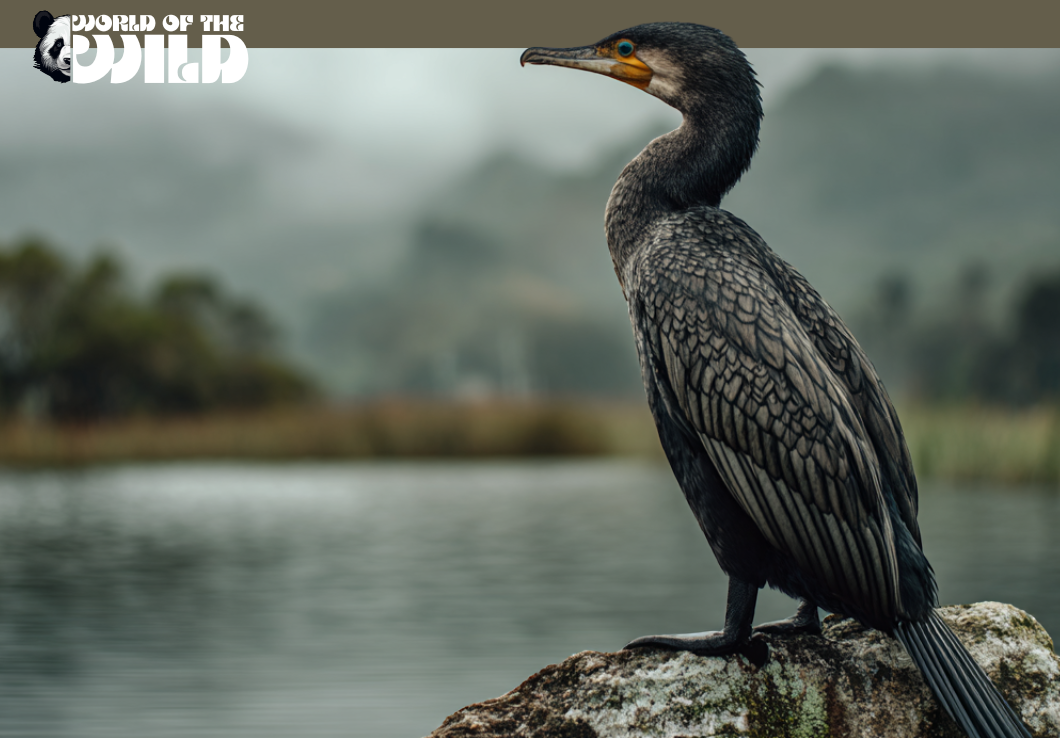

Scan the surface of almost any lake, river, reservoir, or coastal bay in North America and you may spot it: a large, dark, serpentine-necked bird perched on a rocky outcrop, wings outstretched like a heraldic emblem drying in the breeze. The Double-Crested Cormorant is one of the continent’s most widespread waterbirds — and, depending on who you ask, one of the most polarizing. Fishermen curse it. Birders celebrate it. Ecologists study it with fascination.
What makes this bird so compelling is not just its dramatic silhouette or its almost prehistoric appearance, but the remarkable story it tells about resilience, ecology, and our complicated relationship with wildlife. Once nearly wiped out by the pesticide DDT in the mid-20th century, the Double-Crested Cormorant rebounded spectacularly, reclaiming waterways from Alaska to the Gulf of Mexico. That comeback — equal parts triumph and controversy — makes it one of the most revealing mirrors of modern conservation. This is a bird that refuses to be ignored.
Fast Facts
- Despite being expert divers, Double-Crested Cormorants have feathers that are only partially waterproof — unlike ducks. This is why they must spread their wings to dry after diving, a behavior called “wing-drying.” Their wettable feathers actually help them dive more efficiently by reducing buoyancy.
- Their name comes from two small tufts of feathers — one white, one black — that appear on the heads of adults during breeding season. These crests are so brief and subtle that most people never see them.
- Cormorants have striking turquoise-blue eyes and bright orange-yellow facial skin that intensifies during courtship, functioning much like a peacock’s tail as a signal of fitness to potential mates.
- They can dive to depths of 25 feet or more and stay submerged for up to 70 seconds, using their powerful, fully webbed feet to propel themselves underwater in pursuit of fish.
- The Double-Crested Cormorant is the only cormorant species found regularly in freshwater habitats across interior North America — a trait unique among its relatives.
- A single cormorant can consume roughly 1 to 1.5 pounds of fish per day — a fact that has placed it at the center of conflict with commercial and sport fishing interests for decades.
- Fossil evidence shows that cormorants have existed in essentially their current form for over 30 million years, making them one of the oldest surviving bird lineages on Earth.
Species & Classification
The Double-Crested Cormorant belongs to a highly successful family of waterbirds with a nearly global distribution.
| Rank | Classification |
|---|---|
| Kingdom | Animalia |
| Phylum | Chordata |
| Class | Aves |
| Order | Suliformes |
| Family | Phalacrocoracidae |
| Genus | Nannopterum |
| Species | N. auritum |
The species was recently reclassified from the large genus Phalacrocorax to the resurrected genus Nannopterum following comprehensive phylogenetic analyses. There are four recognized subspecies: the nominate form (N. a. auritum) across much of interior North America; the Floridian subspecies (N. a. floridanus), a smaller, more sedentary bird; the western subspecies (N. a. albociliatus) along the Pacific Coast and Great Basin; and (N. a. cincinatus) in the Aleutian Islands of Alaska.
Close relatives include the Neotropic Cormorant, which overlaps with the Double-Crested in Texas and along the Gulf Coast, distinguishable by its smaller size, longer tail, and white border on its throat pouch. Globally, the Phalacrocoracidae family contains approximately 40 species, including the famously flightless Galapagos Cormorant.

Appearance
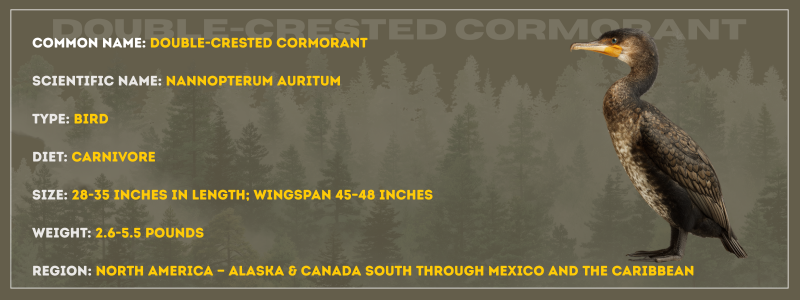
The Double-Crested Cormorant is a large, stocky waterbird measuring 28 to 35 inches in length with a wingspan of 45 to 48 inches and a weight of 2.6 to 5.5 pounds. Males are generally larger than females, though the sexes look nearly identical in plumage.
Adults in non-breeding plumage are almost uniformly dark — their body feathers appear black but carry an iridescent greenish or bronzy sheen in strong sunlight, with individual feathers edged in darker black giving a scaled appearance to the back and wings. The most immediately striking features are the bare orange-yellow skin of the face and throat pouch, and the distinctive hooked tip to the bill — an adaptation perfectly suited to gripping slippery prey.
During breeding season, adults develop the namesake double crest: two small, wispy tufts of feathers arising from the crown. In eastern populations, these crests tend to be white; in western populations, they are black or mixed. The eye is a vivid turquoise — a detail often missed at a distance but startling up close. Immature birds are browner overall with pale buff or whitish underparts, gradually acquiring adult plumage over two to three years.
Behavior
Double-Crested Cormorants are highly social birds, nesting in large colonies that can number in the thousands and often sharing space with herons, egrets, and gulls. Outside of the breeding season, they roost communally on trees, utility poles, buoys, and rocky outcrops — frequently in groups that blacken entire islands or treelines.
Foraging is done alone or in loose groups, and the birds are consummate pursuit divers. They plunge beneath the surface and use powerful kicks of their large, fully webbed feet to chase fish. After each diving session they must return to a perch and spread their wings wide to dry — creating one of the most recognizable silhouettes in North American birdwatching.
Communication within colonies is vocal and varied: guttural grunts, croaks, and clicks during courtship and territorial disputes. Courtship involves elaborate wing-waving displays, neck-stretching, and the presentation of nesting material by males to females. Cormorants are intelligent birds capable of learning feeding territories and returning to the same nesting sites year after year, sometimes across decades.
Evolution
Cormorants represent one of the oldest surviving avian lineages. Fossil evidence places ancestral cormorant-like birds in the Paleogene period, with the family Phalacrocoracidae well-established by the Oligocene epoch approximately 30 to 35 million years ago. Some paleontologists identify even older fossil candidates, suggesting that diving pursuit-fishers of a recognizably cormorant body plan may have existed since the late Cretaceous.
The Double-Crested Cormorant’s lineage belongs to the order Suliformes, which also includes gannets, boobies, frigatebirds, and anhingas — a group sharing a common ancestry among colonial waterbirds specialized for fish predation. Molecular studies have increasingly supported the separation of North American cormorants from the large Old World assemblage, reflecting deep evolutionary divergence.
The species’ remarkable ability to thrive in both freshwater and marine environments is considered a relatively recent evolutionary innovation — an ecological flexibility that has allowed the Double-Crested Cormorant to colonize reservoirs, large rivers, and the Great Lakes in ways that no other cormorant species has managed on the continent.
Habitat
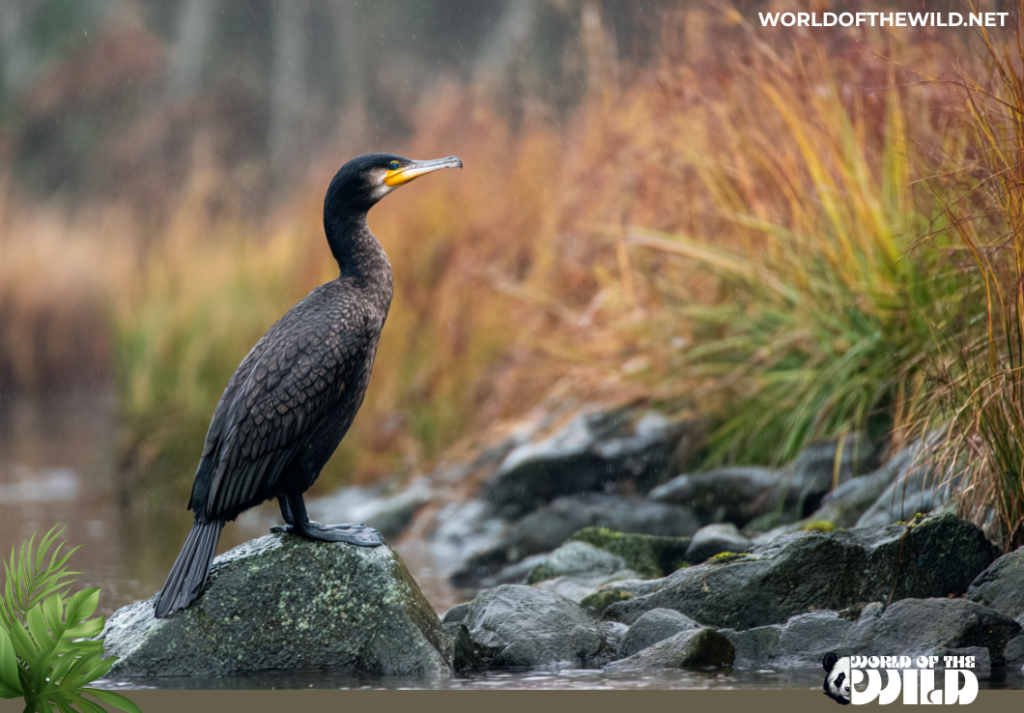
The Double-Crested Cormorant is one of the most geographically versatile waterbirds in North America, inhabiting virtually every major aquatic environment from the subarctic to the subtropical. Its range extends from Alaska and Newfoundland south through Mexico and into the Caribbean, with breeding populations distributed across the continent’s interior as well as its coasts.
In coastal regions, birds occupy rocky islands, sandy barrier islands, mangrove forests, and estuarine bays. Inland, they are equally at home on large lakes, reservoirs, rivers, and wetlands — one of very few cormorants in the world with such a strong presence far from any ocean. The Great Lakes and the large reservoirs of the American West have become particularly important strongholds.
Nesting habitat requires elevated, protected structures — typically trees (alive or dead), rocky cliffs, or islands relatively free from ground predators. Large, established nesting colonies can become ecologically transformative: the nitrogen-rich guano from thousands of birds kills host trees over time, creating stark, bleached “ghost forests” that are sometimes controversial with local communities.
Diet
The Double-Crested Cormorant is a strict carnivore and a highly specialized piscivore — an eater almost exclusively of fish. Studies of stomach contents have identified a broad diet spanning dozens of species, with birds typically targeting whatever is most abundant in local waters. Common prey includes alewife, yellow perch, sunfish, catfish, carp, herring, and mullet.
Hunting is done entirely by pursuit-diving beneath the surface. The bird enters the water with a small leap and forward dive, then propels itself using powerful kicks of its large webbed feet. The hooked bill acts as a gripping tool, allowing the bird to seize and reposition fish for head-first swallowing at the surface. Larger fish are sometimes taken to a perch and beaten into submission before being swallowed.
An adult cormorant typically consumes one to one-and-a-half pounds of fish per day. In large colonies, this aggregate consumption can be ecologically significant — a fact that has made the species a flashpoint for conflict with commercial aquaculture and sport fishery interests across much of its range.
Predators & Threats
Natural predators of adult Double-Crested Cormorants are few, owing to their large size. Bald Eagles are perhaps the most significant, regularly harassing and occasionally killing cormorants at nesting colonies. Great Horned Owls and Red-tailed Hawks may take juveniles. At ground-nesting island colonies, American Mink and river otters can devastate eggs and chicks, while ravens and gulls opportunistically prey on unguarded eggs.
The most serious historical threat was the widespread use of organochlorine pesticides — particularly DDT — in the mid-20th century. DDT caused eggshell thinning across fish-eating birds, devastating cormorant populations continent-wide. After DDT was banned in the United States in 1972, the species recovered with remarkable speed.
Today, anthropogenic threats take different forms. Government-sanctioned lethal control programs at fish hatcheries, aquaculture facilities, and sport fisheries represent the most direct human pressure on populations. Entanglement in fishing gear causes mortality in some areas. Habitat disturbance at nesting colonies from recreational boating can cause reproductive failure. Climate change poses an emerging threat by altering fish communities and increasing the frequency of extreme weather events that can flood or destroy nesting colonies.
Reproduction & Life Cycle
Double-Crested Cormorants are seasonally monogamous and highly colonial nesters, returning each spring to established colonies that may have been active for decades. Males arrive first and perform elaborate courtship displays — wing-waving, neck-stretching, and gargling vocalizations — to attract females. Once pairs bond, both birds engage in mutual preening and nest-building, constructing a bulky platform of sticks, seaweed, and debris.
Clutch size is typically three to four eggs, and both parents share incubation duties using their large, webbed feet (cormorants lack a brood patch). Incubation lasts approximately 25 to 28 days. Chicks hatch helpless and naked, and are fed regurgitated fish by both parents. Young birds fledge at around 35 to 42 days and become independent within two to three months.
Sexual maturity is typically reached at two to three years of age. Wild Double-Crested Cormorants have been recorded living up to 22 years, though average lifespan in the wild is likely closer to six to eight years.
Population & Conservation Status
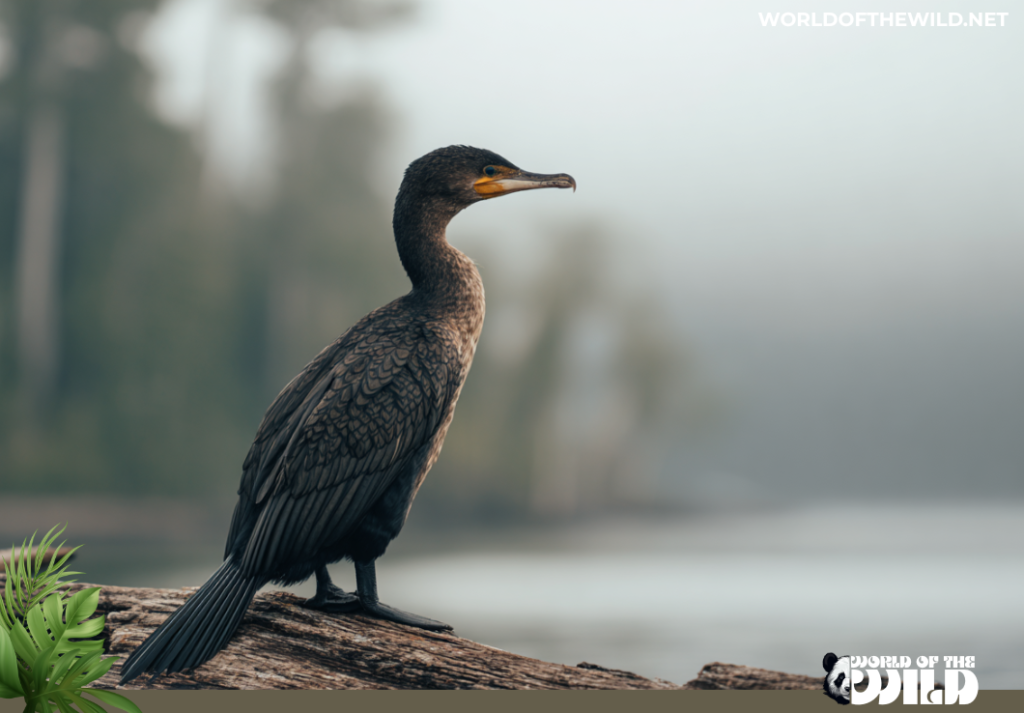
The Double-Crested Cormorant is currently listed as Least Concern on the IUCN Red List, reflecting its large, widespread, and stable population. The species is protected under the Migratory Bird Treaty Act in the United States and Canada, though special provisions allow for lethal control under certain conditions.
Population estimates for the United States and Canada combined typically range from 700,000 to over 2 million individuals, with significant regional variation. The Great Lakes region holds some of the densest breeding concentrations on the continent. Following the DDT-era crash, populations grew at rates of up to 30 percent per year through the 1980s and 1990s, and growth has since stabilized in many areas.
The recovery of the Double-Crested Cormorant remains one of the great success stories of the post-DDT era — and also one of its most complicated legacies. The bird’s return in large numbers has prompted genuine ecological debate about its interactions with fish communities and other colonial waterbirds, alongside ongoing political battles over wildlife management.
Conclusion
The Double-Crested Cormorant is the perfect subject for anyone interested in the intersections of ecology, conservation, and the messy realities of sharing a continent with wildlife. It is a bird of extremes: ancient in lineage yet modern in its adaptability; once nearly extirpated, now abundantly present; celebrated by naturalists and vilified by fishermen; protected by law and yet legally culled by the thousands.
Above all, the cormorant is a reminder that conservation success stories are rarely simple. The comeback of this species from the ravages of DDT represents a genuine triumph of environmental regulation and ecological resilience. But it also asks harder questions: What do we do when wildlife recovers? Whose interests count? How do we make space for animals that don’t conform to our expectations of how nature should look?
The next time you see a dark, angular silhouette perched at the water’s edge — wings spread wide against the sky — take a moment to look closely. Behind those turquoise eyes is an evolutionary lineage stretching back tens of millions of years. The Double-Crested Cormorant has outlasted nearly everything the world has thrown at it. Whether it can outlast us remains, as always, up to us.
Quick Reference
| Scientific Name | Nannopterum auritum |
| Diet Type | Carnivore (Piscivore) |
| Length | 28–35 inches |
| Wingspan | 45–48 inches |
| Weight | 2.6–5.5 lbs |
| Region Found | North America — Alaska & Canada south through Mexico and the Caribbean |