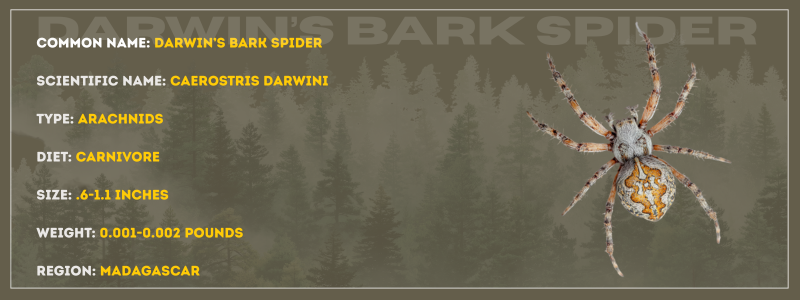

Imagine standing at the edge of a river in Madagascar, watching the morning light filter through the forest canopy, when suddenly you notice something extraordinary stretched across the water above you — a gossamer curtain of silk spanning nearly 82 feet from bank to bank, studded with dozens of trapped insects and anchored by threads so tough they would make a materials engineer weep with envy. You have just stumbled upon the handiwork of one of nature’s most astonishing architects: the Darwin’s Bark Spider.
Discovered in 2009 and formally described to science in 2010, Caerostris darwini was named in honor of Charles Darwin’s 200th birthday and the 150th anniversary of On the Origin of Species — a fitting tribute given that this tiny spider produces what scientists have confirmed is the toughest biological material ever recorded on Earth. Despite being no bigger than a thumbnail, Darwin’s Bark Spider has fundamentally changed the way we think about silk, survival, and the breathtaking ingenuity of evolution. In a world full of remarkable spiders, this one stands in a class entirely its own.
Facts
- The silk of Darwin’s Bark Spider is, pound for pound, ten times stronger than Kevlar — the material used to make bulletproof vests — making it the toughest known biological substance ever studied.
- This species builds the largest orb webs ever documented, with some spanning over 82 feet (25 meters) across rivers and lakes, with anchor lines stretching even farther.
- Despite the monumental size of its webs, the spider itself is tiny, with females rarely exceeding about an inch in body length.
- Darwin’s Bark Spider produces two distinct types of silk in its web — a dragline silk for the frame and a capture spiral silk — and both are extraordinarily tough compared to silk produced by other spider species.
- The spider strategically builds its webs over water, where flying insects congregate in massive numbers, dramatically increasing hunting efficiency.
- Researchers discovered that the spider traverses the water’s surface or travels along overhanging branches to deploy anchor lines, showing remarkable engineering problem-solving behavior.
- Its silk has sparked serious scientific interest in biomedical and military applications, including suture materials, body armor, and flexible electronics.
Species
Darwin’s Bark Spider belongs to the following taxonomic classification:
- Kingdom: Animalia
- Phylum: Arthropoda
- Class: Arachnida
- Order: Araneae
- Family: Araneidae
- Genus: Caerostris
- Species: Caerostris darwini
The genus Caerostris contains several other bark spider species, all of which share the remarkable ability to camouflage themselves against tree bark with uncanny effectiveness. Close relatives include Caerostris sexcuspidata, found across sub-Saharan Africa and parts of Asia, which also builds large orb webs and exhibits impressive silk production. However, none of the other Caerostris species have been documented producing silk with the extraordinary tensile strength of C. darwini, nor do they construct webs of comparable scale. The Darwin’s Bark Spider is therefore considered exceptional even within its already impressive genus. The broader family Araneidae — the orb-weavers — is one of the most speciose spider families on Earth, containing over 3,000 described species, including garden spiders, golden silk orb-weavers, and banded garden spiders.
Appearance
Darwin’s Bark Spider exhibits striking sexual dimorphism, a common trait among orb-weaving spiders. Females are significantly larger than males, with a body length ranging from about 0.6 to 1.1 inches (15–18 mm), while males are considerably smaller, typically measuring only around 0.2 to 0.35 inches (6–9 mm). In terms of weight, females are relatively lightweight as spiders go, tipping the scales at roughly 0.5 grams or less.
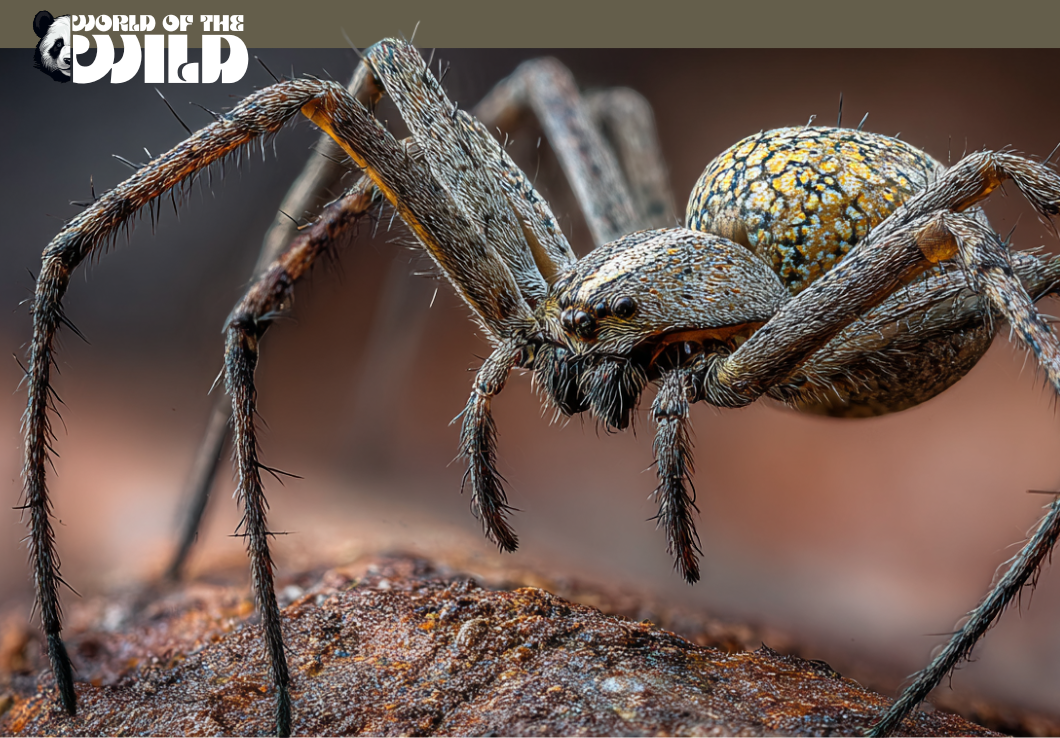
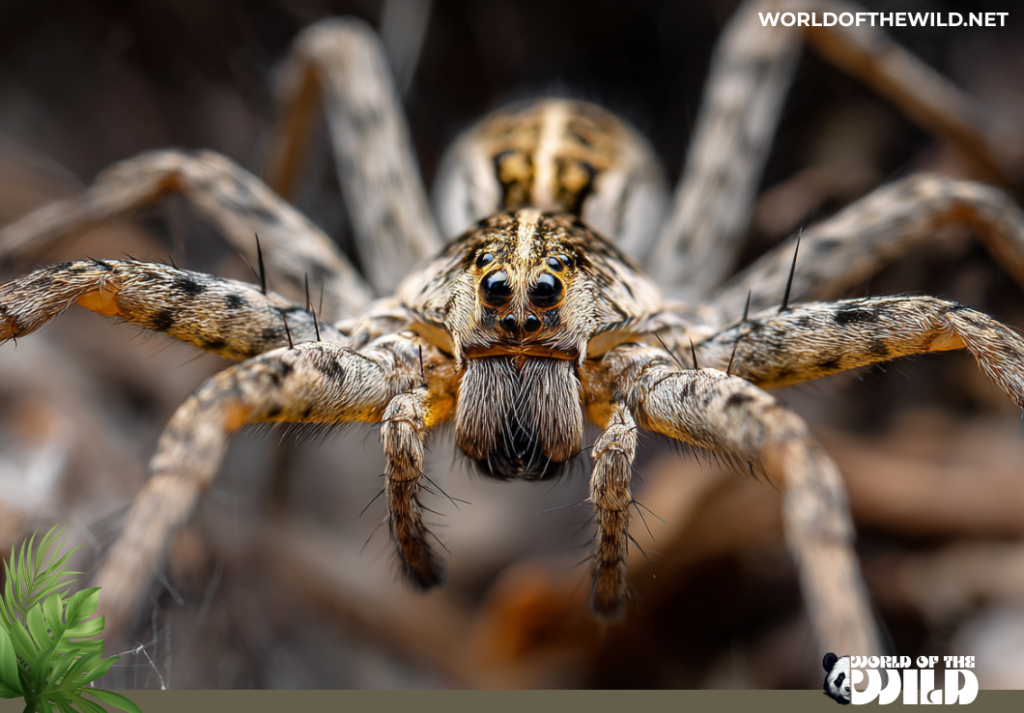
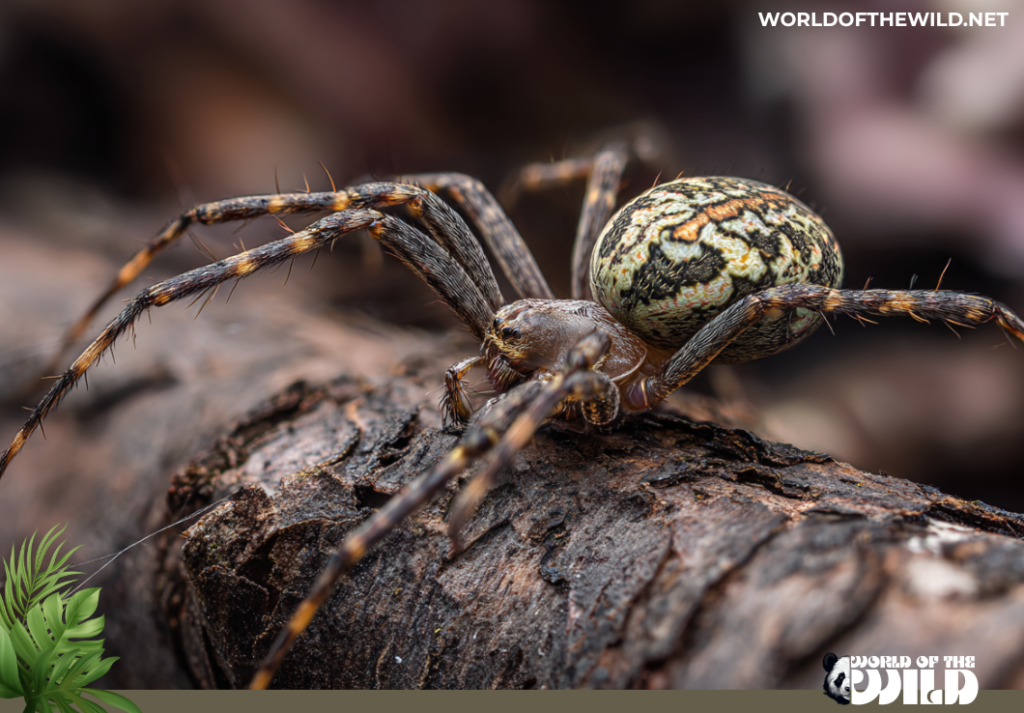
The spider’s body is a masterwork of natural camouflage. Its abdomen is predominantly brownish-gray with irregular patches of cream, tan, and dark brown — a pattern that mimics the texture and coloration of tree bark with remarkable precision. The abdomen itself is somewhat bumpy and irregular in shape, further enhancing the bark-like illusion. The legs are long, spiny, and banded in alternating shades of brown and beige, allowing the spider to press flat against a surface and virtually disappear. When at rest on a branch or log, Darwin’s Bark Spider is almost impossibly difficult to spot, even for trained observers actively searching for it. Its cephalothorax (the fused head and thorax region) is similarly earthy in tone, and its multiple eyes — like all spiders, it has eight — are arranged in two rows, well-adapted for detecting movement and light changes in its forest environment.
Behavior
Darwin’s Bark Spider is primarily solitary and nocturnal, spending daylight hours pressed motionless against bark in its remarkably effective camouflage. As dusk approaches, the spider becomes active and industrious, engaging in the extraordinary feat of web construction that has made it famous.
Web-building is a multi-stage engineering process. The spider first scouts a suitable river or stream crossing, then releases a long silk thread into the air, allowing the breeze to carry it to the opposite bank. Once the bridge line is established, the spider constructs a massive orb web suspended above the water — sometimes reinforcing it over multiple nights. The finished web can contain dozens of anchor lines and a capture zone that dwarfs anything produced by other orb weavers.
Communication in Darwin’s Bark Spider, as with most spiders, is largely tactile and vibrational. Males approaching females during mating season must navigate the female’s web carefully, using gentle vibrations to signal their presence and intentions rather than triggering a predatory response. The species is not known for complex social behavior — outside of mating, individuals do not tolerate others in their web territory. Their intelligence, while not cerebral in any mammalian sense, is expressed through sophisticated behavioral routines: the ability to assess wind patterns, structural anchor points, and prey availability speaks to a form of adaptive problem-solving that continues to astonish arachnologists.
Evolution
Spiders have been spinning silk for an estimated 380 million years, and the orb-weaving lineage to which Darwin’s Bark Spider belongs represents one of the most successful evolutionary experiments in the history of arthropods. The family Araneidae is believed to have diverged and diversified extensively during the Cretaceous period, a time when flowering plants were also proliferating and creating new ecosystems teeming with insect life — the perfect evolutionary pressure to drive the development of increasingly sophisticated web architecture.
The Caerostris genus itself is thought to have originated in Africa, with Darwin’s Bark Spider subsequently colonizing Madagascar — an island that has been a crucible of evolutionary innovation for millions of years due to its long isolation from the mainland. Madagascar’s unique ecosystems and insect communities likely created the selective pressure driving C. darwini toward ever-larger and tougher webs, as spiders capable of spanning wide rivers and catching more prey would have significant reproductive advantages. The extraordinary toughness of its silk is thought to be an evolutionary response to the challenge of constructing webs that must withstand wind, rain, and the physical stress of spanning large bodies of water while remaining functional. This represents an elegant example of how environmental challenges can drive biological materials to achieve performance characteristics that human engineering is still struggling to replicate.
Habitat
Darwin’s Bark Spider is endemic to Madagascar, meaning it is found nowhere else on Earth. Within Madagascar, it has been documented primarily along the edges of rivers and lakes in the eastern and northern regions of the island, particularly in humid, lowland tropical rainforest environments. The species shows a strong preference for habitats where trees overhang bodies of water, as these locations provide both the anchor points needed for its enormous webs and the concentrated insect traffic that makes such large webs profitable.
The forests of Madagascar are among the most biodiverse and most threatened on the planet. The spider thrives in areas where the forest canopy remains intact and the waterways are healthy — conditions that are unfortunately becoming harder to find on the island. Its habitat is characterized by dense vegetation, high humidity, warm temperatures year-round, and an abundance of aquatic and semi-aquatic insects. The specific microhabitat along riverbanks and lakeshores is essential to this species; it is not typically found in dry forests, highland areas, or degraded secondary growth far from water.
Diet
Darwin’s Bark Spider is a carnivore, subsisting almost entirely on insects caught in its web. Thanks to the exceptional size of its webs — which can cover a capture area of up to 30 square feet or more — the spider is capable of trapping a far greater variety and quantity of prey than most other orb weavers. Its diet consists primarily of flying insects that hover over or cross bodies of water, including mayflies, midges, dragonflies, damselflies, and various other aquatic insects emerging from rivers and lakes.
The spider does not actively hunt; instead, it relies on its web as a passive trap. When prey strikes the sticky capture spiral, vibrations travel through the web to the spider, which rapidly moves to subdue and wrap the catch in silk before delivering a venomous bite. The venom immobilizes the prey, and the spider then begins the process of liquefying and consuming internal tissues — the standard feeding method of most spiders. The strategic placement of webs over water essentially turns the spider into an ambush predator positioned at one of nature’s richest insect corridors, maximizing caloric return for energy invested in web construction.
Predators and Threats
As a small spider, Darwin’s Bark Spider faces predation from a range of animals. Birds are among its most significant natural predators, and the spider’s bark-mimicking camouflage is thought to be primarily an adaptation against avian hunters. Certain parasitoid wasps also target spiders of this size, laying eggs on or near the spider that eventually hatch into larvae that consume the host. Lizards and other insectivorous reptiles native to Madagascar may also occasionally prey upon the species.
The far greater threat, however, comes from human activity. Madagascar has lost approximately 90% of its original forest cover due to slash-and-burn agriculture (known locally as tavy), illegal logging, charcoal production, and subsistence farming. This catastrophic deforestation is the single most pressing threat to Darwin’s Bark Spider, as it destroys the riverside forest habitat the species depends on. Water pollution from agricultural runoff reduces insect populations in rivers and streams, cutting off the spider’s food supply. Climate change adds another layer of threat, with shifting rainfall patterns and temperature increases affecting both the forest ecosystems and aquatic insect communities the spider relies upon. Given how recently the species was discovered, there has been little time to assess the full scope of threats it faces.
Reproduction and Life Cycle
Like most orb-weaving spiders, Darwin’s Bark Spider follows a reproductive strategy centered on the considerable size difference between the sexes. Males must approach females with great care — the female is not only several times larger but is also a predator by nature. Males are believed to use vibrational signals on the web to communicate mating intent and reduce the likelihood of being mistaken for prey. Some researchers have observed male spiders engaging in opportunistic mating while the female is feeding, taking advantage of her distraction.
After mating, females produce egg sacs containing multiple eggs, which they typically secure in sheltered locations near the web site, often wrapped in silk attached to vegetation or bark. The female guards the egg sac during the incubation period. Spiderlings emerge as miniature versions of the adults and must quickly disperse to avoid cannibalism — a common hazard in spider populations. Young spiders disperse through ballooning, releasing silk threads that catch air currents and carry them to new locations. Darwin’s Bark Spider, like most spiders of its type, likely lives for roughly one to two years, with females generally outliving males. Males often die shortly after mating, while females may survive to produce multiple egg sacs.
Population
Darwin’s Bark Spider is currently listed under a status of Least Concern by the IUCN, though this assessment is partly a reflection of how little data exists about the species rather than definitive evidence of population health. Given that the spider was only formally described to science in 2010, comprehensive population surveys are limited, and precise global population estimates are not available. What is known is that the species appears to exist in patchy distributions across suitable riverside habitats in Madagascar, and its range is inherently limited by both its island endemism and its specific habitat requirements.
The trajectory of Madagascar’s forests is cause for significant concern. With deforestation continuing at alarming rates and Madagascar consistently ranking among the world’s most threatened biodiversity hotspots, species with narrow habitat requirements like C. darwini are vulnerable even when not yet formally listed as threatened. Conservation biologists emphasize that the lack of data on a species should never be interpreted as safety — many species have gone extinct before they were adequately studied.
Conclusion
Darwin’s Bark Spider is, in almost every measurable sense, one of the most extraordinary animals on Earth. A creature smaller than a matchbook has produced the toughest material biology has ever generated, engineered structures that would be impressive at human scale, and carved out a niche so specialized and effective that it seems almost too clever to be real. It is a reminder that evolution, given enough time and pressure, arrives at solutions that continue to humble our best engineers and scientists.
But the story of Darwin’s Bark Spider is also an urgent one. Madagascar — this spider’s only home — stands at an ecological crossroads. The forests that shelter this master weaver are disappearing at a rate that should alarm anyone who cares about the living world. Supporting conservation organizations working in Madagascar, raising awareness about the island’s biodiversity crisis, and advocating for sustainable land-use policies are all meaningful steps toward ensuring that Caerostris darwini continues to string its impossible bridges across wild Malagasy rivers for generations to come. In the web of life, every thread matters — and few threads are as remarkable as this one.
| Attribute | Details |
| Scientific Name | Caerostris\ darwini |
| Diet Type | Carnivore |
| Size | Females: 0.6-1.1 inches (body length); Males: 0.2-0.35 inches (body length) |
| Weight | Approximately 0.001-0.002 lbs (under 1 gram) |
| Region Found | Madagascar (endemic) |