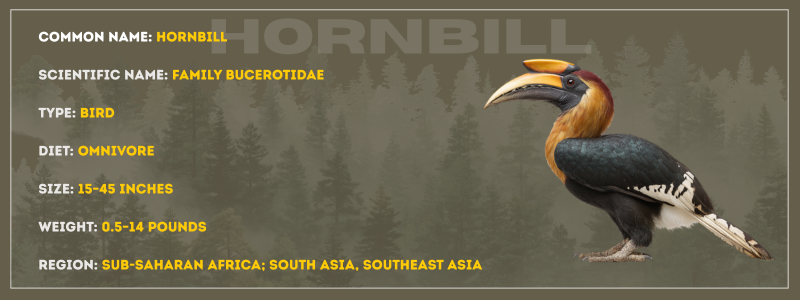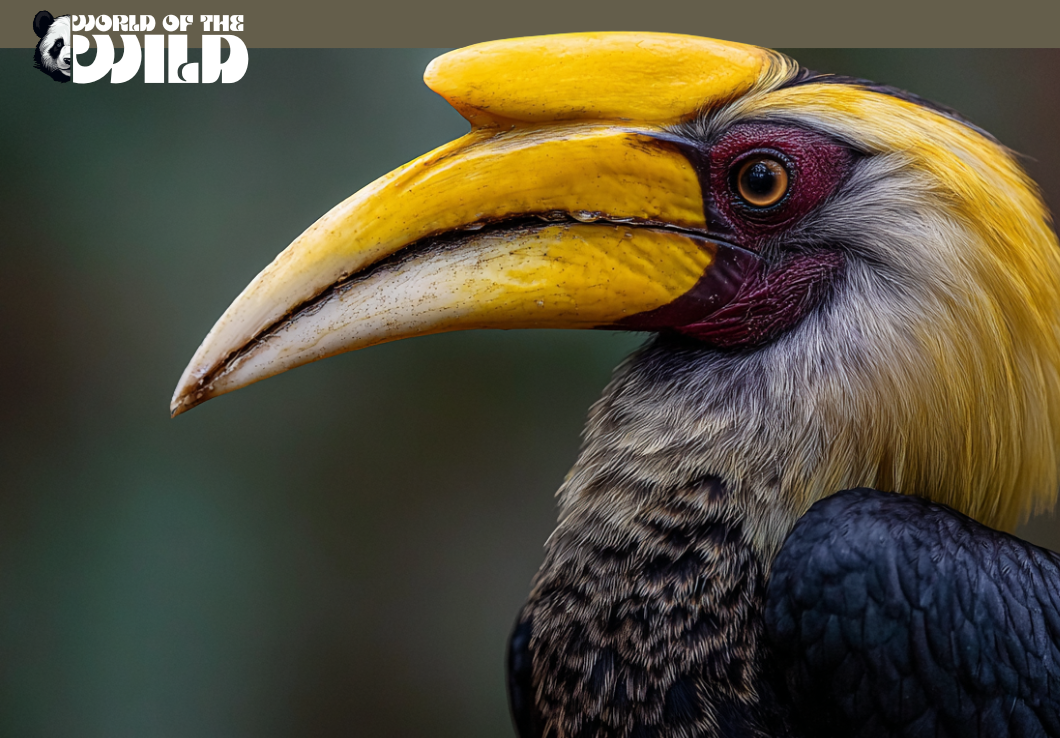

Imagine wandering through a dense tropical rainforest when suddenly, the air fills with a thunderous, prehistoric whooshing sound — not from a storm, but from the wingbeats of a single bird passing overhead. You look up to see a creature so gloriously improbable that it seems conjured from a fantasy novel: a large, stout bird with a sweeping tail, vivid plumage, and perched atop its enormous bill, a golden helmet-like structure that looks as though it was sculpted rather than grown. This is the hornbill — one of the most visually spectacular and ecologically vital birds on the planet.
Hornbills have captivated humans for millennia. They appear in the folklore of indigenous tribes across Africa and Asia, serve as national symbols, and play a role in their ecosystems so important that many forests quite literally cannot survive without them. Whether you’re drawn in by their dramatic appearance, their extraordinary nesting habits, or their surprisingly tender family lives, there is no shortage of reasons to be utterly enchanted by these birds.
Facts
- The casque on a hornbill’s bill is mostly hollow and made of keratin — the same protein found in human fingernails — but in the Helmeted Hornbill, it is nearly solid, making it one of the few birds with a genuinely dense, ivory-like structure.
- Hornbills are one of the only bird families in the world that have fused neck vertebrae (the first and second cervical vertebrae are fused), a trait shared with other large-billed birds that helps support the weight of their massive bills.
- The Great Hornbill’s wingbeats produce such a powerful whooshing sound that it can be heard from over half a mile away in dense forest.
- Hornbills engage in a behavior called “anting,” where they rub insects on their feathers, likely to deter parasites with the insects’ secretions.
- Some hornbill species can live for over 50 years in captivity, making them surprisingly long-lived among birds their size.
- The red color found on the skin and casques of several hornbill species comes not from pigment in the traditional sense, but from preen gland secretions that the birds apply to their feathers and bills — essentially a natural cosmetic.
- Hornbills are considered “farmers of the forest” because they disperse seeds across vast distances, and certain trees in Southeast Asian rainforests have co-evolved specifically to be eaten and spread by hornbills.
Species
| Rank | Classification |
|---|---|
| Kingdom | Animalia |
| Phylum | Chordata |
| Class | Aves |
| Order | Bucerotiformes |
| Family | Bucerotidae |
| Genus | Multiple — Buceros, Aceros, Bycanistes, Tockus, and others |
| Species | Approximately 59–60 recognized species |
The family Bucerotidae is extraordinarily diverse, spanning two continents and dozens of genera. Within this family, species range dramatically in size, habitat preference, and appearance.
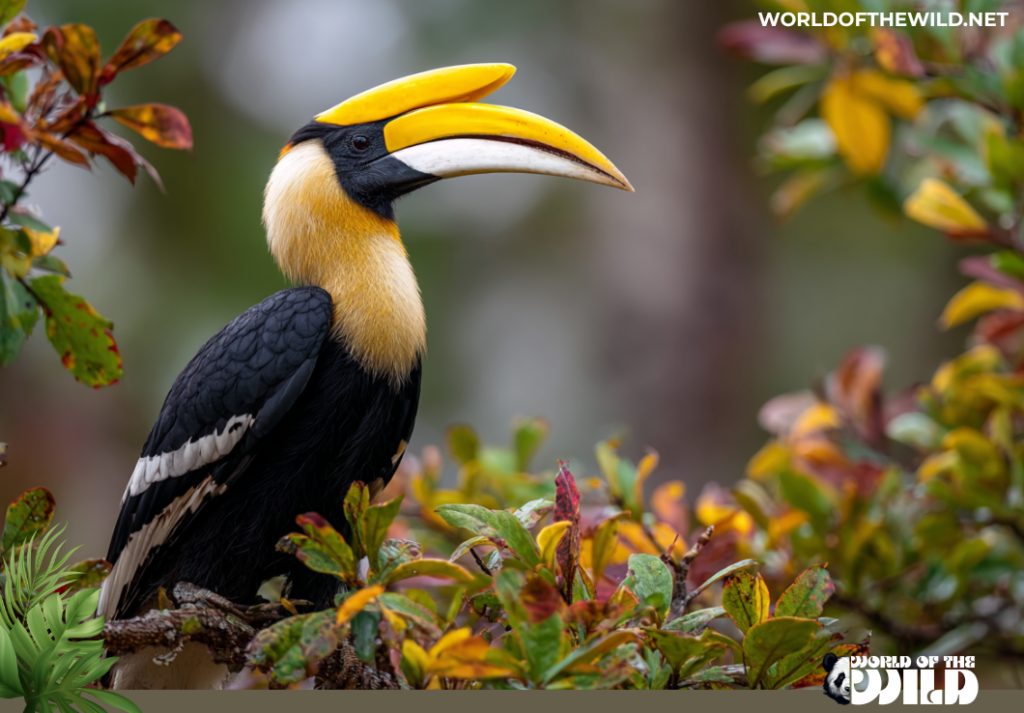
Among the most well-known species is the Great Hornbill (Buceros bicornis), found across South and Southeast Asia, which is celebrated for its bold black-and-white plumage and massive yellow-and-black casque. The Rhinoceros Hornbill (Buceros rhinoceros) of the Malay Peninsula and Borneo is equally iconic, its upturned orange and red casque resembling a rhinoceros horn and earning it a place as Malaysia’s national bird.
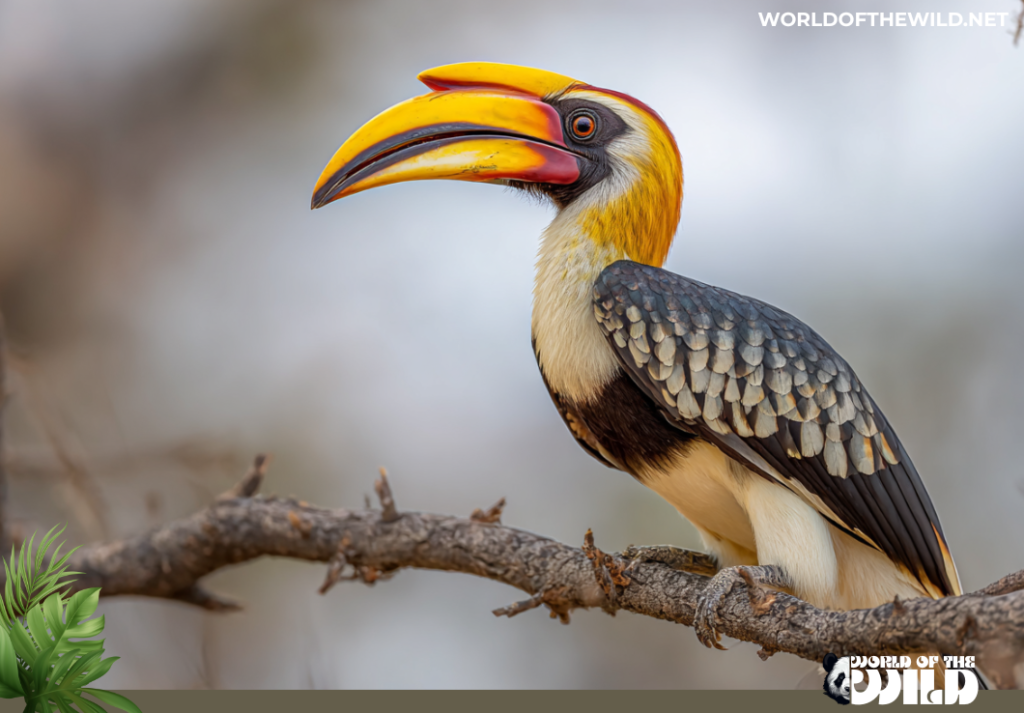
In Africa, the Southern Yellow-Billed Hornbill (Tockus leucomelas) — affectionately nicknamed the “flying banana” — is a familiar savanna bird known for its cheerful, chattering calls. The rarer and more secretive Abyssinian Ground Hornbill (Bucorvus abyssinicus) is a terrestrial species that walks the open grasslands of sub-Saharan Africa like a feathered sentinel. The Helmeted Hornbill (Rhinoplax vigil) of Southeast Asia stands apart from all others due to its dense, ivory-like casque, which has tragically made it a target for illegal trade. The Wreathed Hornbill (Rhyticeros undulatus) and the Rufous Hornbill (Buceros hydrocorax) of the Philippines round out a family of extraordinary variety and beauty.
Appearance
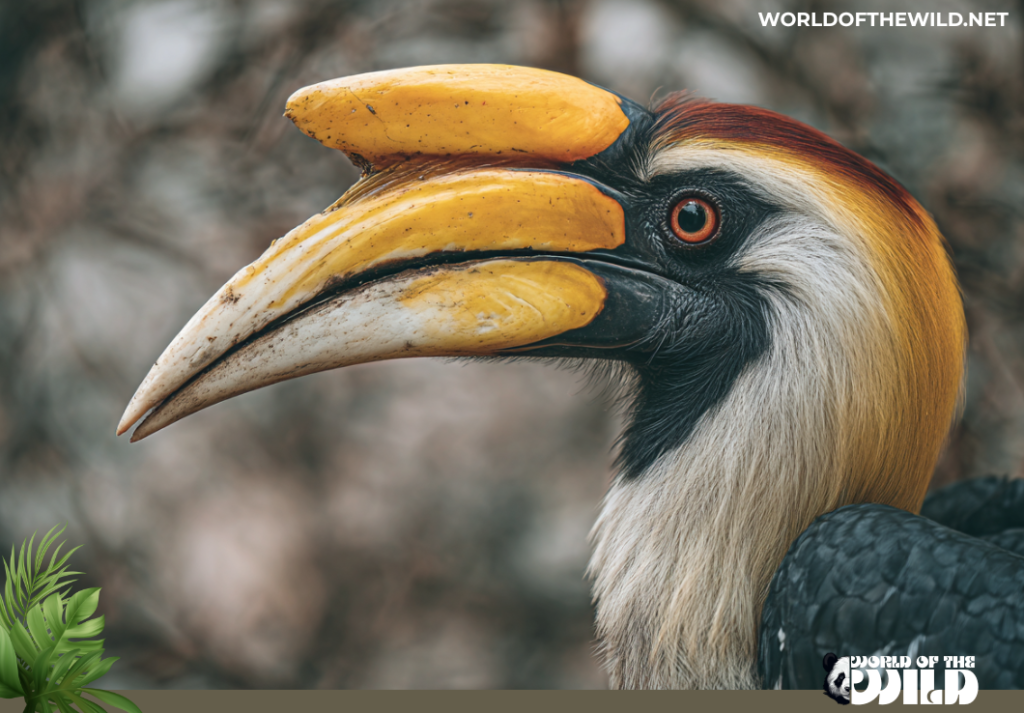
Hornbills are impossible to misidentify. Their most defining feature is, of course, the bill — long, curved, and often brightly colored in shades of yellow, red, orange, or ivory. Sitting atop this bill is the casque, a hollow (or in the Helmeted Hornbill’s case, solid) protrusion that varies enormously between species. In some, it is a modest ridge; in others, it is a flamboyant crest that seems to defy aerodynamics entirely.
Body size varies significantly across the family. The smallest hornbills, such as the Dwarf Red-Billed Hornbill (Tockus camurus) of Central Africa, measure around 15 inches in length and weigh less than a pound. At the other extreme, the Southern Ground Hornbill (Bucorvus leadbeateri) can reach up to 45 inches in length and tip the scales at nearly 14 pounds, making it the largest hornbill species by weight.
Plumage is often striking, with many species exhibiting bold contrasts of black, white, and chestnut brown, often accented with patches of vivid bare skin around the eyes and throat in colors of red, blue, yellow, or purple. The eyelashes of hornbills are a particularly charming detail — they are long, thick, and pronounced, formed from modified feathers, giving the birds an almost theatrical, glamorous expression. Their tails are typically long and broad, and their wings, while rounded and relatively short for their body size, are powerful enough to carry them through dense forest canopies.
Behavior
Hornbills are intelligent, socially complex birds that exhibit a rich range of behaviors. Many species are monogamous and form strong, long-lasting pair bonds. They are known to communicate through a variety of loud, resonant calls — from deep, booming honks to rapid, cackling chatter — that carry effectively through the dense habitats they occupy. The casque likely functions as a resonating chamber, amplifying these vocalizations to make them even more impressive.
While some smaller species such as the red-billed hornbills of Africa are somewhat gregarious, gathering in loose flocks to forage, larger species like the Great Hornbill tend to live in smaller family groups or pairs. Ground hornbills are particularly social, living in cooperative groups of up to eight individuals where subordinate members help the dominant pair raise chicks — a behavior known as cooperative breeding.
Hornbills display notable intelligence. They have been observed using objects in their environment, problem-solving during foraging, and engaging in what appears to be playful behavior. Their feeding techniques are equally impressive: they toss food items into the air and catch them with the tip of the bill, using a skill that combines precision and coordination and is particularly useful for handling large fruits or slippery prey.
Perhaps the most remarkable behavioral adaptation of hornbills is their extraordinary nesting strategy — a subject that deserves its own spotlight.
Evolution
The evolutionary history of hornbills stretches back tens of millions of years, though the fossil record for the family is frustratingly sparse, largely because birds with hollow bones rarely fossilize well. The oldest definitive hornbill fossils date to the Miocene epoch, approximately 15–20 million years ago, and have been found in Europe and Asia, suggesting the family once had a much broader distribution than it does today.
Hornbills are thought to have diverged from a common ancestor shared with the Upupiformes — the order that includes hoopoes and wood-hoopoes — somewhere in the ancient supercontinent’s fragmented aftermath. Molecular studies suggest that the split between African and Asian hornbill lineages occurred tens of millions of years ago as continents drifted and land bridges formed and disappeared.
The casque is believed to have evolved under strong sexual selection pressure — females consistently preferring males with larger, more elaborate casques, driving the development of this increasingly extravagant structure over successive generations. In the Helmeted Hornbill, the solidification of the casque likely evolved as a result of male-to-male combat, as these birds are known to engage in dramatic aerial jousting contests where they fly at each other and clash casques mid-air.
Ground hornbills represent an older, more basal lineage within the family, having diverged early and retained more primitive characteristics such as terrestrial foraging habits and a generally more predatory diet. Their lineage hints at what early hornbills may have looked like before the family diversified into the arboreal specialists we see across Africa and Asia today.
Habitat
Hornbills are found across two broad geographic regions: sub-Saharan Africa and South to Southeast Asia, extending through the Indian subcontinent, across Indochina, the Malay Peninsula, and into the islands of Borneo, Sumatra, Sulawesi, and the Philippines.
Within these regions, hornbills occupy a remarkable range of habitats. The majority of Asian species are forest dwellers, inhabiting dense tropical and subtropical rainforests where old-growth trees provide both nesting cavities and abundant fruit. These forests must be ancient and largely undisturbed — young, secondary forests rarely contain the large, hollow trees that hornbills require for breeding.
African hornbills are somewhat more versatile. While several species are forest inhabitants, many — including the various red-billed and yellow-billed hornbills — thrive in open woodlands, savannas, and bushveld. Ground hornbills are perhaps the most habitat-flexible of all, walking the open grasslands and shrublands of eastern and southern Africa in search of prey.
Elevation also varies: some species are found in lowland forests at sea level, while others range into montane forests at altitudes exceeding 6,000 feet. One constant across nearly all species, however, is the need for large, mature trees — either for foraging, roosting, or nesting — which makes habitat integrity absolutely critical to their survival.
Diet
Hornbills are omnivores, though the balance between fruit and animal matter varies considerably between species. Broadly speaking, the larger forest hornbills of Asia are predominantly frugivorous, with figs forming a cornerstone of their diet. They supplement this with insects, small reptiles, and occasionally small mammals or eggs. African savanna hornbills lean more heavily on invertebrates and small vertebrates, supplementing with fruits and seeds when available.
Ground hornbills are the most carnivorous of the family, functioning almost as avian raptors. They hunt actively on foot, using their powerful bills to dispatch prey including snakes, lizards, frogs, insects, small mammals, and even tortoises. A group of ground hornbills moving methodically through the grass, flipping stones and probing the soil, is one of the more dramatic foraging scenes in the African bush.
Foraging strategies are adapted to bill shape. Larger, curved bills are adept at plucking and tossing fruit. The toss-and-catch method allows hornbills to position food for swallowing without the use of hands or feet, a necessity since their feet are not adapted for grasping food the way parrots’ feet are. This reliance on fruit makes them critically important seed dispersers — some seeds pass through hornbill digestive systems and are deposited miles from the parent tree, effectively reforesting the landscape one meal at a time.
Predators and Threats
In the wild, adult hornbills have relatively few natural predators, largely owing to their size, alertness, and the fact that many roost high in the forest canopy. However, large raptors — including hawk-eagles and crowned eagles in Africa — do occasionally take hornbills, particularly younger or smaller species. Nest predation is a more significant concern; snakes, monitor lizards, and small carnivorous mammals may attempt to raid nests, though the unique sealing behavior of hornbill nests (see Reproduction) provides substantial protection.
The far more pressing threats to hornbills are human-caused. Habitat loss is the dominant driver of population decline across virtually all hornbill species. Rapid deforestation for palm oil, logging, agricultural expansion, and human settlement has devastated the old-growth forests that forest hornbills depend upon. In Southeast Asia in particular, this destruction has been staggering in scale and speed.
Hunting represents another serious threat. Hornbills are hunted for food across parts of Africa and Asia, and their feathers and casques hold cultural significance in many communities, being used in traditional headdresses, ceremonial regalia, and rituals. This cultural demand, while ancient, has become unsustainable given modern population pressures.
Most alarmingly, the Helmeted Hornbill faces an acute crisis driven by illegal wildlife trade. Its solid casque, sometimes called “red ivory,” is carved into ornate objects and smuggled primarily into China, where demand has surged dramatically in recent decades. The scale of poaching has been so severe that some conservationists fear the species could face extinction within decades if trends are not reversed.
Reproduction and Life Cycle
The reproductive biology of hornbills is among the most extraordinary in the entire bird world. Most species are cavity nesters, relying on natural hollows in large, old trees — and what happens inside those cavities is nothing short of remarkable.
Once a pair selects a suitable nest cavity, the female enters and — with the help of the male — seals the entrance using a mixture of mud, droppings, fruit pulp, and bark. The opening is reduced to a narrow slit, just wide enough for the female’s bill to protrude. She then remains sealed inside for the duration of incubation and much of the chick-rearing period — sometimes for three to four months in larger species. During this time, the male is solely responsible for feeding her and the chicks through the slit, making dozens of trips per day.
This extraordinary behavior is thought to provide outstanding protection against predators. The female molts her flight feathers completely while sealed inside, rendering her flightless and entirely dependent on the male. If the male dies during this period, the female and chicks will almost certainly perish — a stark illustration of just how total the pair bond and parental commitment truly are.
Clutch sizes range from one to six eggs depending on the species, with larger species typically laying fewer eggs. Incubation lasts between 23 and 40 days. Chicks are altricial — hatching naked and helpless — and develop slowly under the intense care of their mother and father. In some species, once the chicks grow large enough, the female breaks out of the sealed nest and reseals it, leaving the chicks to manage the entrance slit themselves until they are ready to fledge.
Hornbills are slow reproducers, typically raising only one clutch per year and not reaching sexual maturity until three to six years of age in larger species. This slow reproductive rate makes population recovery from decline particularly challenging. Lifespan varies by species but many live 20–30 years in the wild, with some individuals in captivity exceeding 50 years.
Population
The conservation status of hornbills varies widely across the family’s 59–60 species. Several smaller African species remain relatively common and are classified as Least Concern by the IUCN. However, a worrying number of species — particularly those dependent on old-growth Asian forests — are in serious trouble.
The Helmeted Hornbill is classified as Critically Endangered, with its population having crashed dramatically due to poaching and habitat loss. Exact numbers are difficult to determine given the species’ secretive nature, but the decline has been recognized as one of the most urgent conservation crises among birds in Southeast Asia.
The Sulu Hornbill (Anthracoceros montani) of the Philippines is also Critically Endangered, with a population estimated at fewer than 40 individuals, making it one of the rarest birds on Earth. Several other Philippine endemic hornbills, including the Visayan Hornbill and the Writhed Hornbill, are listed as Vulnerable or Endangered.
The Rufous-headed Hornbill and Walden’s Hornbill face similarly dire situations. Even species not yet on the endangered list are experiencing measurable declines as forests continue to shrink. Ground hornbills in Africa, once widespread, have disappeared from significant portions of their former range in West Africa and are listed as Vulnerable.
Across the family, the overarching trend is one of slow contraction — fewer birds, smaller ranges, and increasing fragmentation of the populations that remain.
Conclusion
The hornbill is far more than an exotic spectacle. It is a keystone species, an evolutionary marvel, and a creature whose fate is inextricably tied to the health of some of the most biodiverse ecosystems on Earth. From the sealed nurseries of Asian rainforests to the striding patrols of African ground hornbills across open plains, these birds have carved out ecological roles that no other creature can easily fill. When hornbills disappear from a forest, that forest eventually changes — the seeds go undispersed, the trees stop regenerating, and a cascade of consequences ripples outward.
The good news is that hornbills inspire passion. Conservation programs across Asia and Africa are working to protect nesting sites, combat poaching, work with local communities, and establish captive breeding programs for the most critically threatened species. Eco-tourism centered on hornbills has brought economic value to communities that might otherwise view these birds as competition for forest resources.
But awareness remains the most powerful tool of all. Every person who learns to care about hornbills becomes part of the network of advocates these birds desperately need. So the next time you hear that deep, resonant call echoing through a forest — or even across a nature documentary — remember: you are listening to one of the oldest, strangest, most magnificent stories evolution has ever told. And it is still worth fighting to keep that story going.
| Category | Details |
|---|---|
| 🔬Scientific Name | Family BucerotidaeMultiple genera and species. Great Hornbill: Buceros bicornis |
| 🍽️Diet Type | OmnivoreFrugivore-dominant in forest species; more carnivorous in ground hornbills |
| 📏Size | 15–45 inchesVaries significantly depending on species |
| ⚖️Weight | 0.5–14 lbsVaries significantly depending on species |
| 🌍Region Found | Sub-Saharan Africa; South & Southeast AsiaIndian subcontinent through the Philippines and Indonesia |