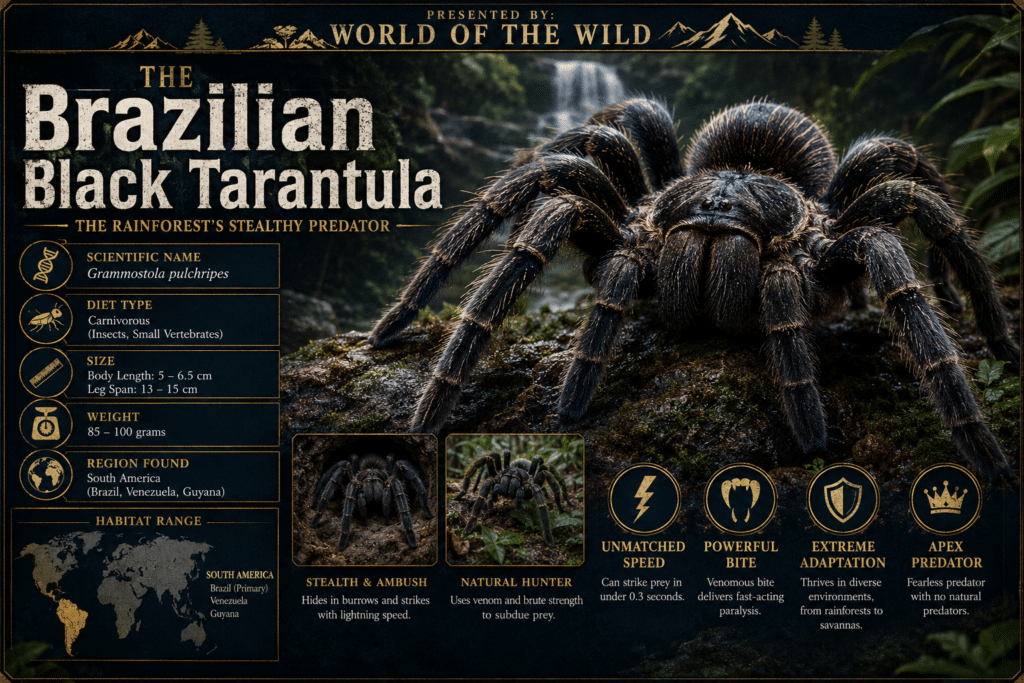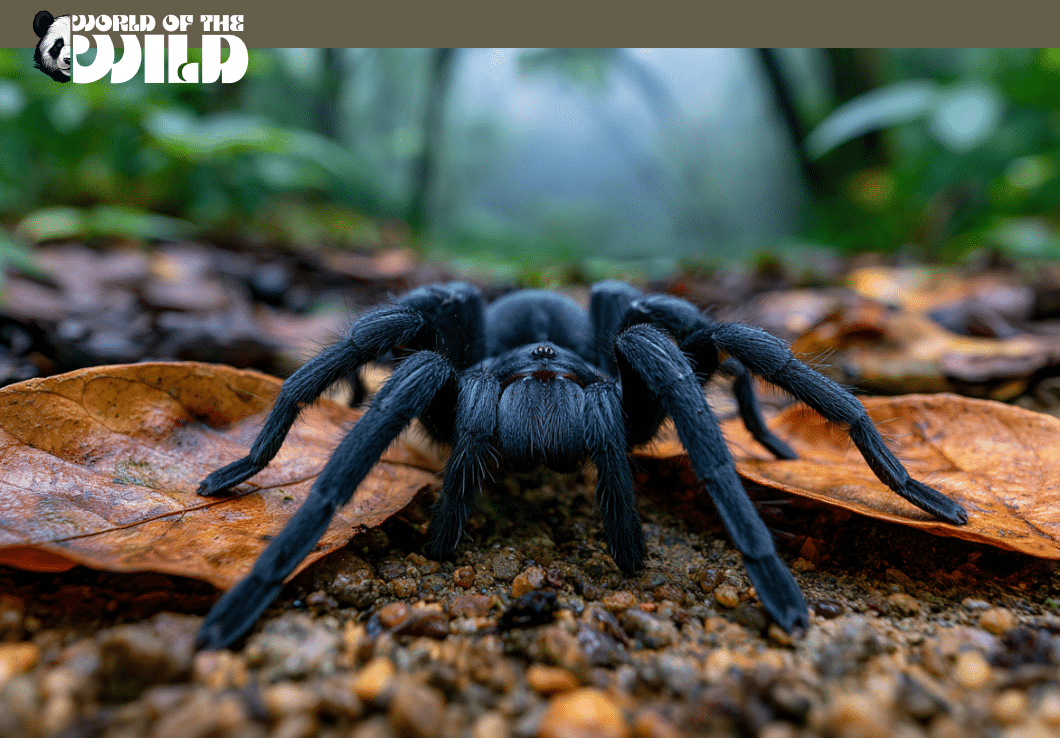

Picture a spider the size of your palm, cloaked in hair so deeply, uniformly black it seems to swallow the light around it — and picture that same spider as one of the calmest, most unbothered creatures in the arachnid world. That’s the Brazilian Black Tarantula, a species that has quietly become one of the most beloved spiders on the planet, not despite its intimidating size, but almost because of how little that size seems to matter to its temperament. In a world where “tarantula” conjures images of venomous nightmares crawling out of horror movies, this species offers something almost paradoxical: a giant, hairy, fanged predator that would rather retreat into its burrow than raise a leg in aggression. It’s an animal that challenges our assumptions about what a spider “should” be, and in doing so, it’s earned a devoted following among scientists, hobbyists, and casual nature lovers alike.
Quick Facts
- Despite looking jet black as adults, spiderlings are born a dull brownish-grey and only deepen into their signature velvet black color after several molts.
- Females can live for 20 to 30+ years — longer than many dogs, cats, or even some small primates — while males typically live only 6 to 8 years.
- This tarantula doesn’t build webs to catch prey. Instead, it relies on tiny vibration-sensing hairs covering its entire body to “feel” the world around it.
- It’s one of the slowest-growing tarantulas known, sometimes taking up to 8 years just to reach full adulthood.
- Rather than biting, its main defense is kicking barbed “urticating” hairs off its abdomen into the air — a move that causes itching and irritation without ever making physical contact.
- Its scientific name, pulchra, is Latin for “beautiful,” a nod to its striking, uniform coloration.
- Ongoing genetic research suggests many tarantulas sold in the pet trade as “Brazilian Black” may actually be a very similar, closely related species from Uruguay — the two are almost impossible to tell apart without a DNA test or close examination of the male’s anatomy.
Species
Full taxonomic classification of the Brazilian Black Tarantula:
- Kingdom: Animalia
- Phylum: Arthropoda
- Class: Arachnida
- Order: Araneae
- Family: Theraphosidae
- Genus: Grammostola
- Species: Grammostola pulchra
The genus Grammostola is home to several other well-known “New World” tarantulas, including the Chilean Rose Hair (Grammostola rosea) and the Chaco Golden Knee (Grammostola pulchripes), both also popular in the exotic pet world for their docile dispositions. The closest relative to the Brazilian Black, however, is almost certainly Grammostola quirogai, sometimes called the “Uruguayan Black Beauty.” The two species are so visually similar that taxonomists have struggled to reliably separate them without genetic testing or a detailed look at the reproductive structures of mature males. Because of this confusion, many spiders sold commercially under the “Brazilian Black” label may technically belong to this sister species instead — a reminder that even well-studied animals can still hold taxonomic surprises.
Appearance
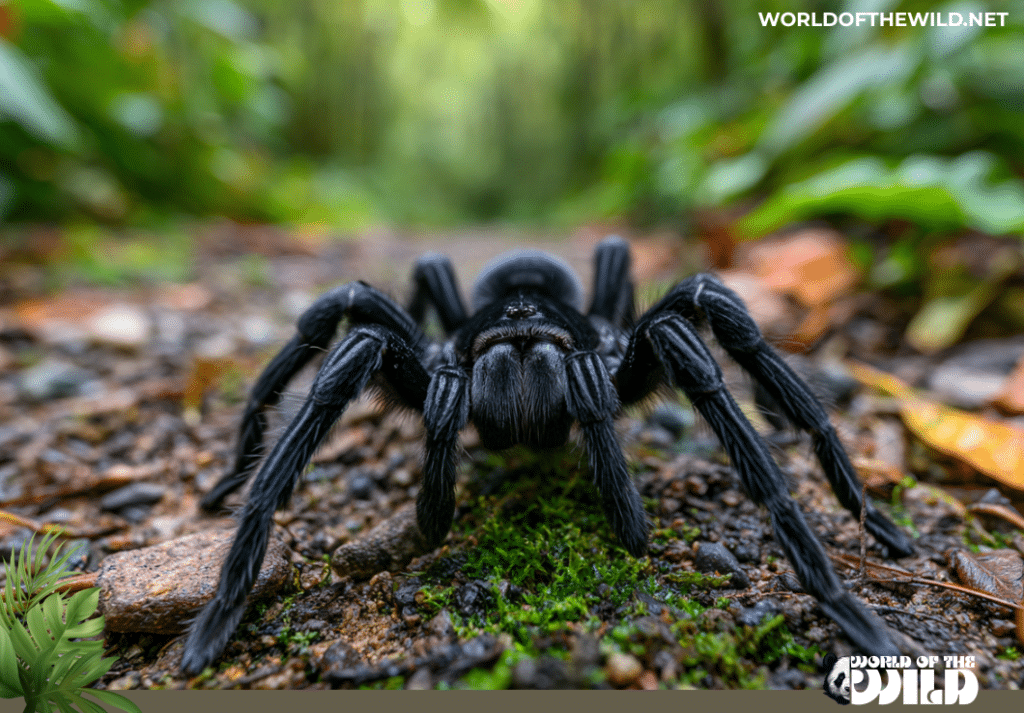
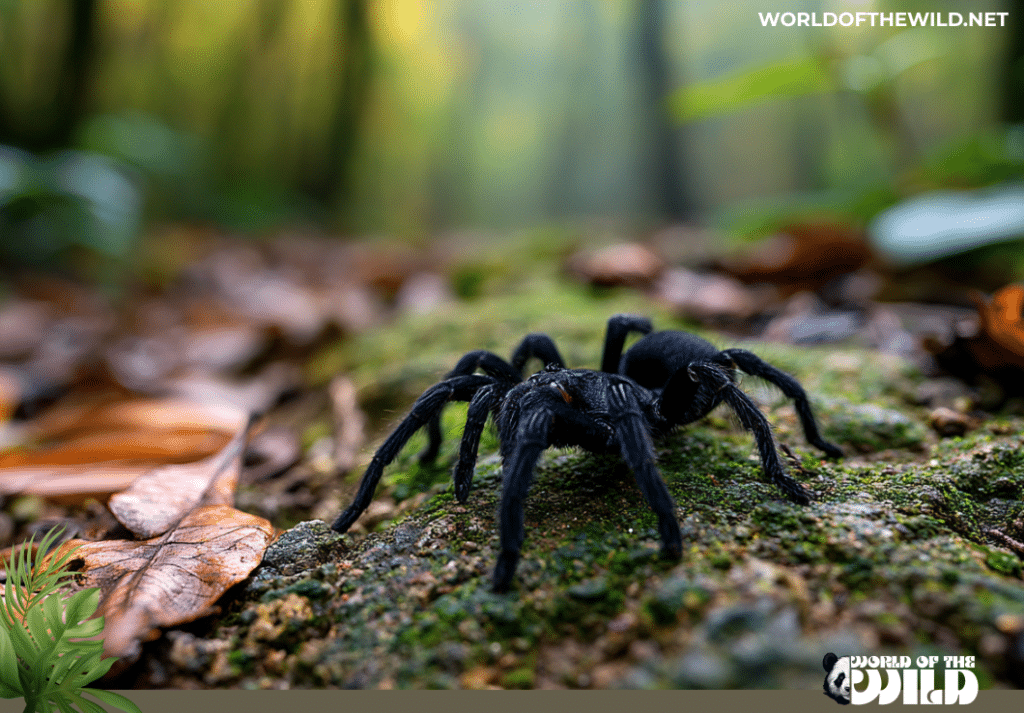
The Brazilian Black Tarantula is a heavy-bodied, thickly built spider, with adult females typically reaching a leg span of around 6 to 8 inches — roughly the length of a smartphone laid diagonally, or a bit larger. Males are generally slimmer and slightly smaller. True to its name, the adult spider is covered from head to abdomen, including all eight legs, in dense, velvety black hair. That blackness isn’t present from birth, though — spiderlings hatch a muted brown or charcoal grey and gradually darken with each successive molt, eventually reaching that signature, almost light-absorbing black by adulthood.
Structurally, like all spiders, its body is divided into two main sections: the cephalothorax (a fused head and thorax) and the abdomen, connected by a narrow waist-like structure called the pedicel. Its legs, thick as a human finger in large specimens, are lined with fine sensory hairs that pick up the faintest vibrations in the air and ground. It has eight eyes clustered near the front of its cephalothorax, but vision plays a surprisingly minor role in how it experiences the world — those sensory hairs do most of the heavy lifting. On the abdomen, specialized urticating hairs form part of its passive defense system, ready to be kicked loose at a moment’s notice.
Behavior
For an animal often stereotyped as menacing, the Brazilian Black Tarantula is remarkably laid-back. It’s solitary by nature, spending the vast majority of its life alone in or near a burrow, only seeking out others of its kind briefly during the mating season. It’s primarily nocturnal, tucking itself away during daylight hours and becoming more active as darkness falls, though captive specimens are often seen calmly sitting in the open even during the day.
Communication in this species is almost entirely tactile and chemical rather than vocal or visual. Vibrations transmitted through silk draglines, substrate, and air currents tell it when prey — or a potential predator — is nearby. Pheromones play a key role during mating season, helping males locate receptive females across the grasslands they call home.
Its most notable adaptations are defensive rather than aggressive. When threatened, its first instinct is almost always to flee or retreat into its burrow. If truly cornered, it may rub its hind legs against its abdomen to launch a cloud of urticating hairs at the threat — nearly always preferring this method to biting. Juveniles instinctively burrow when startled, a behavior that persists into adulthood and shapes much of how the species interacts with its environment. Slow, deliberate, and unhurried in almost everything it does — including its legendarily slow growth rate — this is a spider that seems to operate on its own patient timescale.
Evolution
Tarantulas belong to one of the older lineages of spiders, with the infraorder Mygalomorphae (which includes tarantulas, funnel-web spiders, and trapdoor spiders) tracing back roughly 200 million years, likely to the early Jurassic period. Unlike the more familiar “modern” spiders (Araneomorphae) that evolved more complex web-spinning behaviors and venom systems, mygalomorphs retained older anatomical traits — including downward-striking, parallel fangs rather than the pincer-like fangs of most other spiders.
Within this ancient lineage, the family Theraphosidae — true tarantulas — began diversifying across the world’s tropical and subtropical regions, eventually giving rise to hundreds of species across the Americas, Africa, Asia, and Australia. The genus Grammostola represents a South American branch of this family that adapted specifically to open grassland and scrub environments rather than dense rainforest, favoring a burrowing lifestyle over the arboreal habits seen in some tropical tarantula genera. Grammostola pulchra itself was formally described by Brazilian naturalist Cândido de Mello-Leitão in 1921, and its close evolutionary relationship to species like G. quirogai suggests a relatively recent split, likely driven by geographic separation across river systems and habitat boundaries in the southern cone of South America.
Habitat
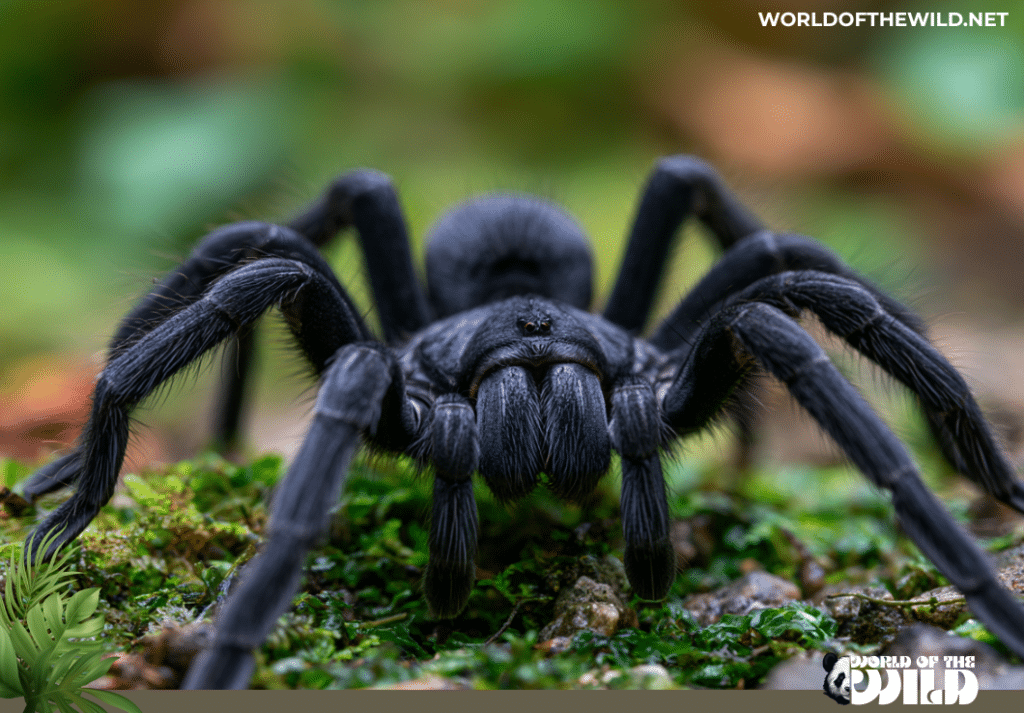
The Brazilian Black Tarantula is native to South America, primarily inhabiting the grasslands, scrublands, and savanna-like regions of Brazil, with closely related populations extending into Uruguay and possibly parts of Argentina. Rather than the dense, humid rainforests many people associate with tarantulas, this species favors open, temperate grassland environments where vegetation is low and the ground offers opportunities for digging.
It’s a fundamentally terrestrial and burrowing species, spending much of its life in deep burrows it excavates itself, often nestled beneath low-growing plants, fallen logs, or rocks that offer additional structural stability and camouflage. These burrows serve multiple purposes: shelter from temperature extremes, protection from predators, a safe space to molt, and an ambush point for hunting. The regional climate — with warm summers, cooler winters, and fluctuating humidity — has shaped both its burrowing habits and its slow, deliberate metabolism.
Diet
The Brazilian Black Tarantula is a carnivore, and an opportunistic one at that. In the wild, its diet consists primarily of ground-dwelling insects and other arthropods — crickets, cockroaches, beetles and their larvae, and moths — along with occasional larger prey like small lizards when the opportunity arises.
As an ambush predator, it doesn’t chase down its meals. Instead, it relies on its burrow and its acute vibration sense, waiting patiently near the entrance or just inside for unsuspecting prey to wander close. Once it detects the tell-tale vibrations of movement, it strikes quickly, pinning prey with its front legs before delivering a bite that injects both venom and digestive enzymes. Those enzymes begin breaking down the prey’s internal tissues, allowing the spider to consume its meal in liquid form rather than chewing solid matter — a common feeding strategy across the spider world.
Predators and Threats
Despite its formidable appearance, the Brazilian Black Tarantula faces real threats in the wild. Natural predators include birds, snakes, and other reptiles, as well as specialized parasitic wasps that target tarantulas specifically, laying eggs on or near them in a grim but ecologically important check on tarantula populations.
Human-driven threats are arguably more significant to the species’ long-term outlook. Habitat loss from agricultural expansion and land development across Brazil’s grasslands has steadily reduced the open spaces this species depends on for burrowing. The exotic pet trade has also historically put pressure on wild populations, though Brazilian law now prohibits the capture, keeping, or export of native wildlife — including this species — without authorization, pushing much of the legal trade toward captive-bred specimens instead. Illegal wild collection nonetheless remains a concern, compounded by the taxonomic confusion between this species and its close relatives, which can make enforcement and population monitoring more difficult.
Reproduction and Life Cycle
Mating season for the Brazilian Black Tarantula typically occurs during the warmer months, roughly June through September in its native range. Males, upon reaching maturity, develop specialized hook-like structures on their front legs and modified pedipalps used to transfer sperm. A mature male will seek out a female’s burrow, often using a cautious courtship display of tapping and vibrating to signal his intentions and avoid triggering a defensive — or predatory — reaction. If the female is receptive, mating occurs quickly, after which the male typically departs as fast as possible, since females have been known to be aggressive toward male suitors once mating concludes.
Several weeks after mating, the female produces an egg sac, which she guards closely, sometimes carrying it near her burrow entrance and rotating it periodically to ensure even development. A single egg sac can contain several hundred eggs, with some reports of clutches reaching into the many hundreds. Spiderlings emerge after an incubation period of several weeks and are entirely independent from birth, receiving no further parental care once they disperse — a stark contrast to the extended parental investment seen in many vertebrate species.
Growth from spiderling to full adulthood is exceptionally slow for this species, often taking anywhere from 4 to 8 years depending on sex and conditions. Once mature, the lifespan disparity between sexes is dramatic: males typically live only 6 to 8 years after reaching maturity, often dying shortly after their final mating season, while females can live for 20 to 30 years or more — an extraordinary lifespan for an invertebrate, rivaling that of many small mammals.
Population
The Brazilian Black Tarantula has not yet been formally evaluated by the International Union for Conservation of Nature (IUCN), meaning it currently lacks an official conservation status such as “Least Concern” or “Vulnerable.” This isn’t unusual for invertebrates — the vast majority of the world’s arachnid and insect species have never been formally assessed, largely due to limited research funding and the sheer scale of invertebrate biodiversity compared to available scientific resources.
No reliable global population estimate exists for this species, and comprehensive population trend data is similarly lacking. What is known is that ongoing habitat conversion in Brazil’s grasslands, combined with historical pressure from wild collection for the pet trade, likely represents a meaningful long-term risk — even in the absence of hard population numbers. Brazil’s legal protections for native wildlife, including restrictions on wild capture and export, offer some safeguard, and the growing prevalence of captive breeding within the hobbyist community has helped reduce reliance on wild-caught specimens.
Conclusion
The Brazilian Black Tarantula is, in many ways, a lesson in not judging a creature by its silhouette. Here is an animal built like something out of a nightmare — thick-legged, fanged, cloaked entirely in black — that spends its long life being almost aggressively unbothered by the world around it, preferring flight and quiet burrowing to confrontation. Its extraordinary longevity, its slow and deliberate pace of life, and its almost meditative temperament make it one of the more quietly remarkable animals in the arachnid world. Yet, like so many species without a formal conservation status, its future is shaped more by assumption than by data. Protecting the grasslands it calls home, supporting ethical, captive-bred sourcing over wild collection, and pushing for better population research aren’t dramatic conservation actions — but for a species this overlooked, they may be exactly the quiet, patient support it needs.
Quick Reference
| Scientific name | Grammostola pulchra |
| Diet type | Carnivore |
| Size in inches (and feet) | 6–8 inches leg span (~0.5–0.67 feet) |
| Weight in pounds | Approx. 0.06–0.1 lbs (roughly 25–45 grams) |
| Region found | Grasslands of Brazil (with closely related populations in Uruguay) |