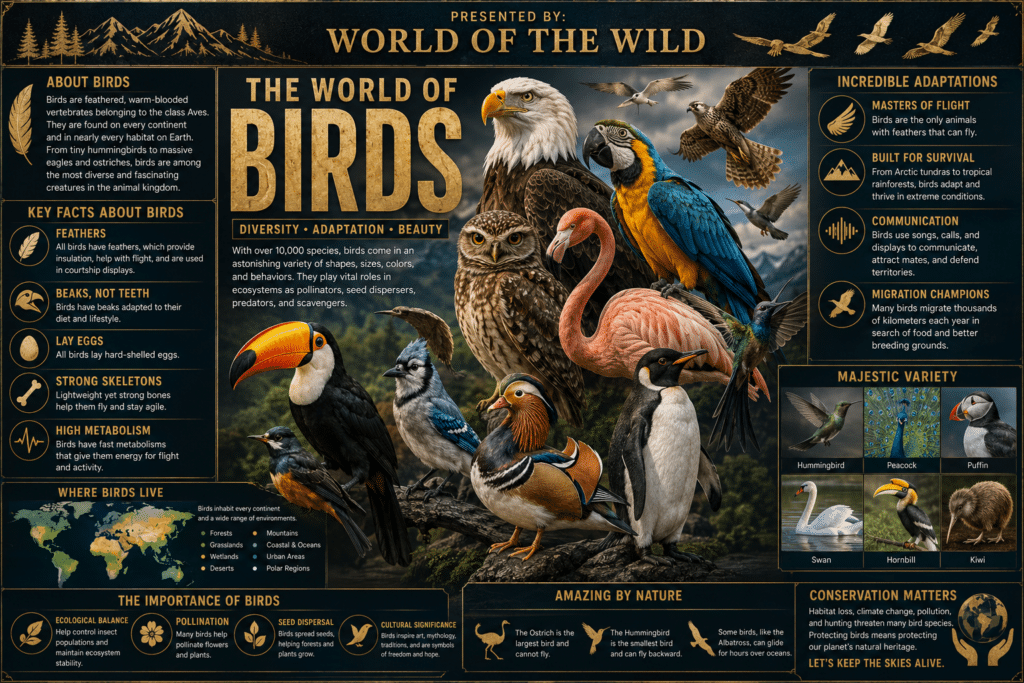

Imagine waking before dawn to the sound of a wood thrush weaving liquid notes through a misty forest, or watching a peregrine falcon fold its wings and plummet from the sky at over 240 miles per hour. Birds are everywhere — on every continent, in every habitat, from the frozen tundra of Antarctica to the scorching heat of the Sahara — and yet, after thousands of years of human fascination, they continue to astonish us. With nearly 10,500 known species, birds represent one of the most diverse and successful groups of animals ever to have evolved on Earth. They are architects, navigators, musicians, and survivors. They are the living descendants of dinosaurs, and they are, quite simply, one of the greatest wonders of the natural world. This article takes you deep into The World of Birds — their biology, behavior, evolution, and the urgent conservation challenges they face today.
Facts
Here are some remarkable, lesser-known facts about birds that might just change the way you look at your backyard feeder:
- The Arctic Tern holds the record for the longest migration of any animal on Earth, traveling roughly 44,000 miles round-trip each year between the Arctic and Antarctic — the equivalent of flying to the moon and back three times over the course of its lifetime.
- Birds are the only living animals with feathers — a trait so defining that paleontologists now use feather impressions in fossils as one of the key markers for identifying early avian lineages.
- Some birds can sleep with one eye open, a phenomenon called unihemispheric slow-wave sleep, allowing half of the brain to rest while the other half stays alert for predators.
- The Clark’s Nutcracker can cache up to 98,000 seeds per season and recover the vast majority of them months later, demonstrating a spatial memory that rivals — and often exceeds — that of mammals many times its size.
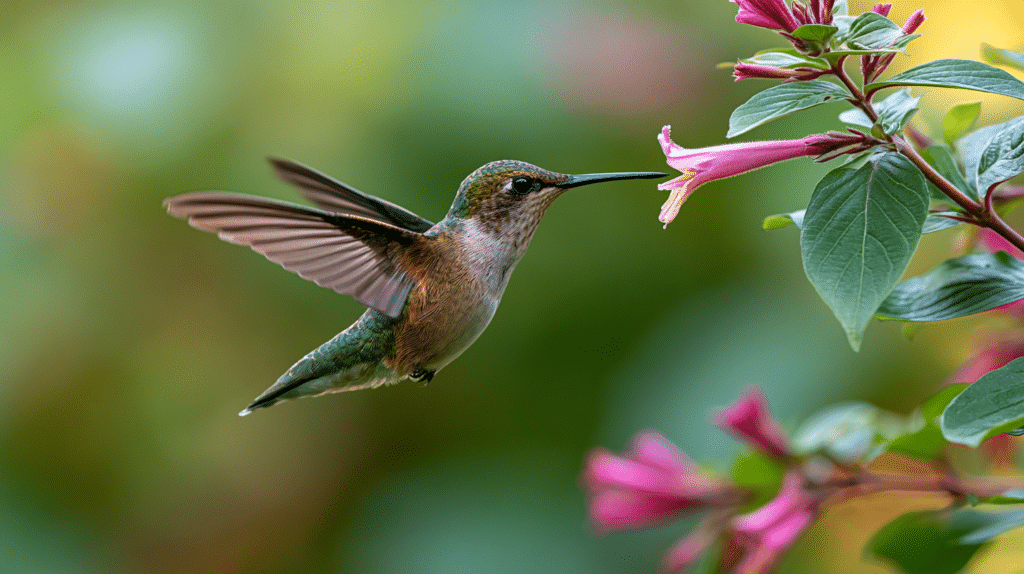
- Hummingbirds are the only birds capable of sustained backward flight, achieving this through a uniquely flexible shoulder joint that allows them to rotate their wings in a figure-eight pattern.
- The common swift spends almost its entire life in the air, eating, sleeping, and even mating on the wing. Young swifts may remain airborne for up to ten months after fledging without ever landing.
- Birds have four types of color-sensitive cone cells in their eyes, compared to three in humans, allowing many species to perceive ultraviolet light — a hidden dimension of color invisible to us but critical to mate selection and foraging.
Species
Birds belong to the class Aves, and their full taxonomic placement reflects their deep evolutionary roots:
| Rank | Classification |
|---|---|
| Kingdom | Animalia |
| Phylum | Chordata |
| Class | Aves |
| Order | Multiple (approx. 40 recognized orders) |
| Family | Multiple (approx. 249 recognized families) |
| Genus | Multiple (thousands) |
| Species | ~10,500 known species |
The class Aves is divided into two primary subclasses: Palaeognathae, the ancient lineage of flightless and weakly flying birds, and Neognathae, which encompasses the vast majority of all living bird species.
Palaeognathae includes the ratites — large, flightless birds such as the ostrich (Struthio camelus), emu (Dromaius novaehollandiae), rhea (Rhea americana), cassowary (Casuarius casuarius), and kiwi (Apteryx spp.) — as well as the tinamous, small ground-dwelling birds of Central and South America that retain limited flight capability.
Neognathae is further subdivided into roughly 40 orders, a few of the most notable being:
- Passeriformes — the perching birds or “songbirds,” by far the largest order with over 6,000 species, including sparrows, warblers, crows, and birds-of-paradise.
- Accipitriformes — the diurnal raptors, including hawks, eagles, and Old World vultures.
- Psittaciformes — the parrots, macaws, and cockatoos, celebrated for intelligence and longevity.
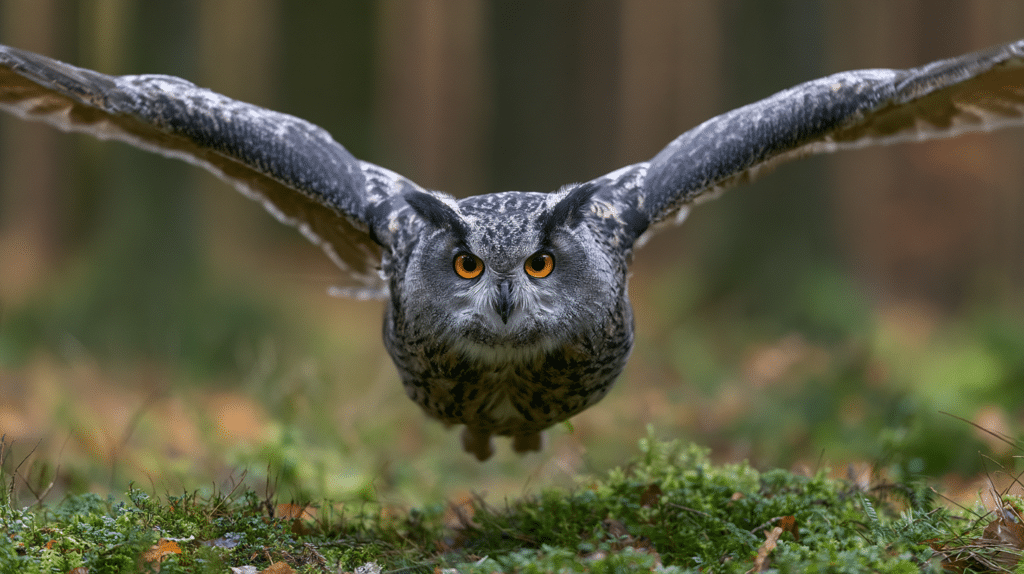
- Strigiformes — the owls, masters of nocturnal predation.
- Apodiformes — swifts and hummingbirds, the aerial specialists.
- Sphenisciformes — the penguins, highly adapted for life in the southern oceans.
The diversity within these orders is staggering. Closely related species often exhibit dramatic differences shaped by local environments — consider the Darwin’s finches of the Galápagos, a single ancestral lineage that radiated into 18 distinct species, each with a beak precisely tuned to a different food source.
Appearance
Birds are instantly recognizable by their feathers — the single trait that defines them above all others. Beyond that, however, the physical variation across nearly 10,500 species is breathtaking.
Size spans an enormous range. The ostrich (Struthio camelus) stands up to 9 feet tall and can weigh over 330 pounds, making it the largest living bird. At the opposite extreme, the bee hummingbird (Mellisuga helenae) of Cuba measures just 2.2 inches in length and weighs a mere 0.06 ounces — lighter than a penny.
Plumage varies from the cryptic earth tones of nightjars and woodcocks — evolved for near-perfect camouflage — to the electric blues and greens of kingfishers, the blazing scarlet of scarlet macaws, and the impossibly ornate tail plumes of male peacocks and birds-of-paradise. Color in birds is produced through two distinct mechanisms: pigments (such as melanins for browns and blacks, and carotenoids for reds, oranges, and yellows) and structural coloration, where microscopic arrangements of feather barbs scatter light to produce iridescent blues, greens, and purples.
Wings and flight apparatus also vary dramatically. Albatrosses possess the longest wingspan of any living bird — up to 11.5 feet in the wandering albatross — optimized for effortless dynamic soaring over open ocean. By contrast, penguins have evolved their wings into rigid, paddle-like flippers perfectly adapted for underwater propulsion.
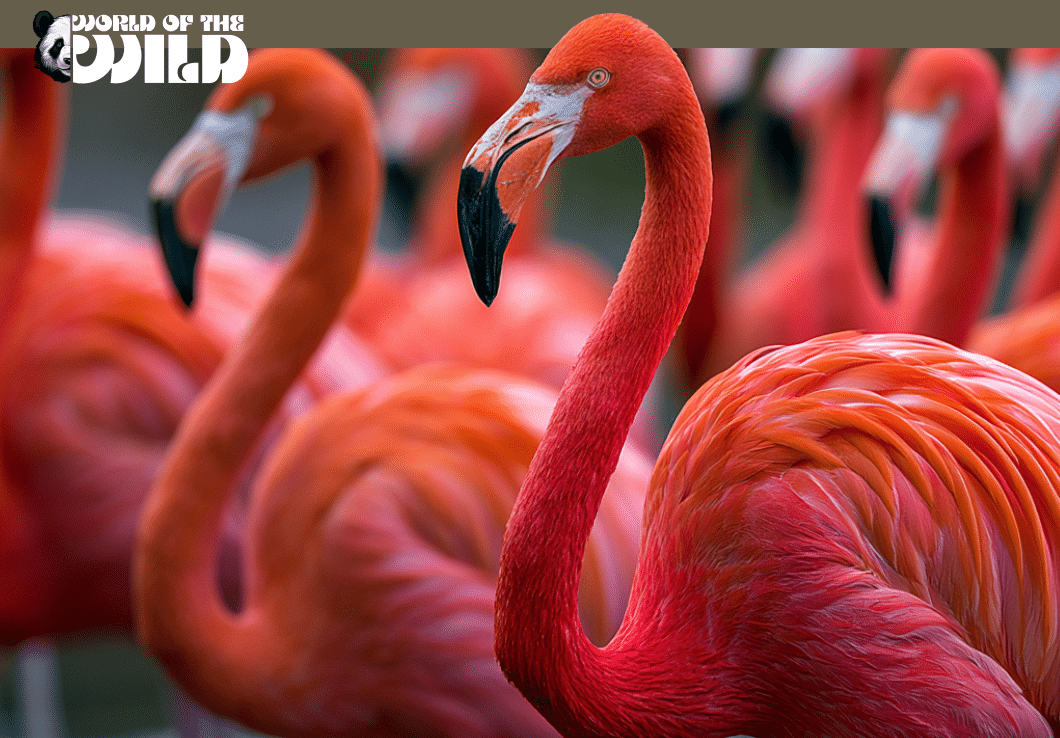
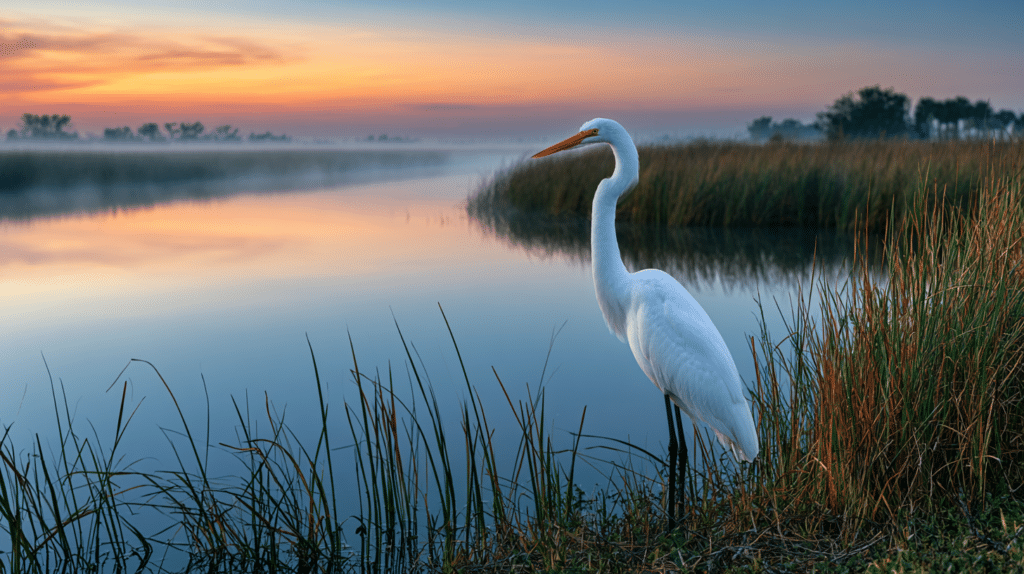
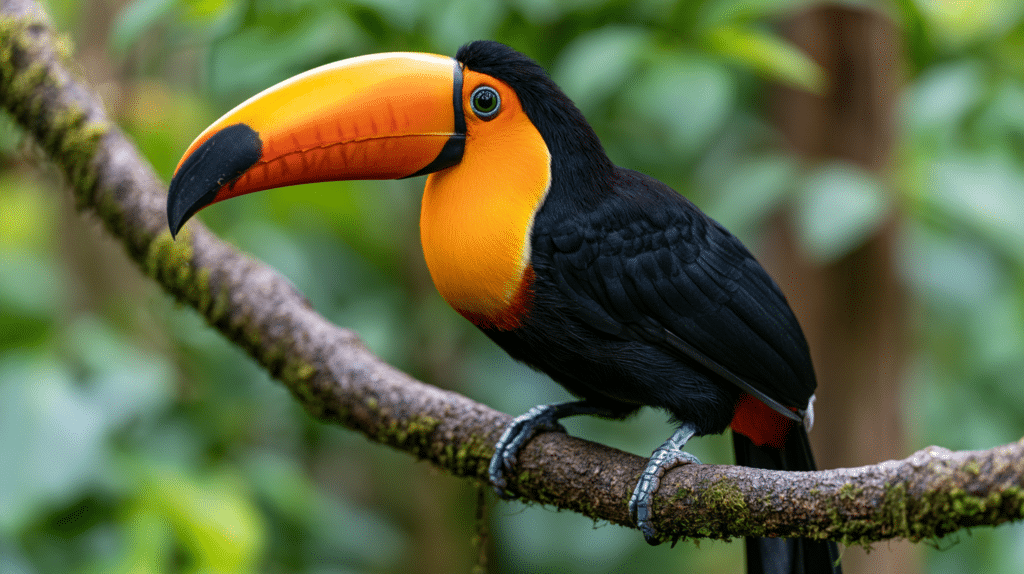
Bills are perhaps the most functionally diverse structure in the animal kingdom. The spear-like bill of the heron, the hooked beak of the eagle, the crossed mandibles of the crossbill (designed to pry open pine cones), the flat, filter-feeding bill of the flamingo, and the enormous colorful casque of the toucan all speak to the extraordinary adaptive power of this single structure.
Feet and talons are equally varied: the zygodactyl feet of woodpeckers and parrots (two toes forward, two back) for gripping bark and branches; the webbed feet of ducks and pelicans for swimming; the needle-like talons of ospreys for snatching slippery fish; and the massive, pillar-like feet of the ostrich built for sprinting at up to 45 miles per hour.
Behavior
Birds are among the most behaviorally complex animals on the planet, demonstrating sophisticated communication, tool use, social organization, and problem-solving that have long fascinated scientists.
Vocalization and Song
Birdsong is one of nature’s most intricate communication systems. Songbirds (order Passeriformes) learn their songs culturally — young birds listen to adults and gradually refine their own vocalizations, much like human children learning language. Some species, like the brown thrasher, have repertoires of over 1,000 distinct song phrases. The lyrebird of Australia is perhaps the most remarkable vocal mimic alive, capable of reproducing chainsaws, camera shutters, car alarms, and the calls of dozens of other species with near-perfect fidelity.
Social Structure
Social organization ranges from intensely solitary species to those that form colonies of millions. Starlings famously gather in murmurations — swirling, shape-shifting flocks of hundreds of thousands — a behavior thought to confuse predators. Emperor penguins huddle together in tightly packed masses of thousands, taking turns at the warm center to survive Antarctic winters that can drop to -76°F. Many raptors, by contrast, are fiercely territorial and largely solitary outside of the breeding season.
Intelligence and Tool Use
The cognitive abilities of birds — particularly corvids and parrots — rival those of great apes. New Caledonian crows craft multi-step tools from leaves and sticks to extract insects from bark, and have been observed manufacturing hooked tools — a behavior previously thought unique to humans. Keas (New Zealand’s alpine parrots) solve puzzles collaboratively. African grey parrots have demonstrated vocabularies of hundreds of words and appear to understand basic concepts of number, color, and category.
Navigation
Migratory birds navigate using a stunning array of sensory inputs: the position of the sun, the pattern of stars, the Earth’s magnetic field (sensed through cryptochrome proteins in their eyes), and even olfactory cues. The bar-tailed godwit undertakes the longest non-stop flight of any bird — roughly 7,000 miles from Alaska to New Zealand — without eating, drinking, or resting, a feat that requires the bird to shrink its digestive organs to fuel more efficient fat-burning before departure.
Evolution
Birds evolved from a lineage of small, feathered theropod dinosaurs during the Mesozoic Era, making them — in the most literal biological sense — living dinosaurs. The evolutionary story of birds is one of the most dramatic and well-documented in paleontology.
The Dinosaur Connection
The discovery of Archaeopteryx lithographica in Bavaria in 1861 was revolutionary. Dating to approximately 150 million years ago (Late Jurassic), Archaeopteryx displayed a mosaic of reptilian features (teeth, a bony tail, clawed wings) and avian ones (feathers, a wishbone). For over a century, it was considered the “first bird.” Since then, hundreds of feathered dinosaur fossils — particularly from the Yixian Formation in northeastern China — have dramatically expanded our understanding, revealing that feathers evolved long before flight, likely for insulation or display.
Key Evolutionary Milestones
- ~230 million years ago: The first archosaurs, the broader group that includes both dinosaurs and modern birds, emerge.
- ~165–150 MYA: Feathered maniraptoran theropods (close dinosaur relatives of birds) proliferate; Archaeopteryx appears.
- ~125–100 MYA: Early birds diversify into the Enantiornithes (a now-extinct group) and the ancestors of modern birds (Ornithuromorpha).
- ~66 MYA: The mass extinction event at the end of the Cretaceous eliminates all non-avian dinosaurs. A small lineage of toothed, ground-dwelling birds survives and rapidly diversifies.
- ~60–50 MYA: The explosive radiation of Neognathae produces the ancestors of most modern bird orders in a geologically brief burst of evolution.
- Ongoing: Modern species continue to speciate, particularly in biodiverse hotspots like the Amazon basin and New Guinea highlands.
The loss of teeth (replaced by lightweight, versatile beaks), the fusion of bones to reduce weight, and the development of an efficient four-chambered heart and a unidirectional respiratory system using air sacs were all critical evolutionary innovations that made powered flight not just possible but spectacularly efficient.
Habitat
One of the defining characteristics of birds as a group is their extraordinary ecological versatility. No other class of terrestrial vertebrates has colonized so many diverse habitats so completely.
Forests — tropical, temperate, and boreal — support the greatest diversity of bird species. The Amazon rainforest alone is home to over 1,300 species, accounting for roughly 13% of the world’s entire avifauna. Canopy specialists, understory insectivores, and ground-dwelling antbirds partition this three-dimensional space with remarkable precision.
Grasslands and savannas host their own specialized communities: larks, pipits, bustards, secretary birds, and ground-nesting raptors. The open visibility of these habitats has driven adaptations for speed (the ostrich), cryptic coloration (the stone curlew), and elaborate aerial displays (the superb lyrebird and birds-of-paradise).
Wetlands, coastlines, and open ocean support wading birds, seabirds, and waterfowl. Albatrosses may spend years at a time over open ocean, returning to land only to breed. Shorebirds like sandpipers probe tidal mudflats on six continents. Kingfishers and herons patrol rivers and streams worldwide.
Mountains and polar regions represent the extreme ends of avian habitat tolerance. Bar-headed geese migrate directly over the Himalayas at altitudes exceeding 29,000 feet, where oxygen levels are less than a third of those at sea level. Snow petrels nest on Antarctic nunataks — rocky outcrops jutting from the ice — farther south than any other bird.
Urban environments have increasingly become significant habitats, with species like peregrine falcons, house sparrows, European starlings, and a growing number of urban-adapted corvids thriving alongside human infrastructure.
Diet
Birds occupy virtually every dietary niche in the animal kingdom. Their metabolic demands are high — a small songbird may need to consume up to 40% of its body weight in food each day — which has driven extraordinary specialization in foraging strategies.
Carnivores: Raptors such as eagles, hawks, and falcons hunt live prey ranging from insects and fish to mammals and other birds. The osprey dives feet-first into water to seize fish, its reversible outer toe and spiny foot pads providing a grip that even a thrashing salmon cannot escape. Owls hunt primarily by hearing; the barn owl’s asymmetrically placed ears allow it to triangulate the precise location of a mouse beneath six inches of snow.
Herbivores: Waterfowl, finches, pigeons, and many parrots subsist primarily on seeds, fruits, leaves, and flowers. The hoatzin of the Amazon is unique among birds in fermenting leaves in its crop — a digestive strategy more reminiscent of a cow than a bird.
Insectivores: Swallows, warblers, flycatchers, and bee-eaters specialize in arthropod prey. Woodpeckers use their reinforced skulls and barbed tongues to excavate wood-boring beetle larvae from deep within tree trunks.
Omnivores: Corvids, gulls, thrushes, and many ground-dwelling species eat broadly across food categories. The American crow is famously opportunistic, consuming everything from carrion and garbage to berries, insects, small mammals, and the eggs of other birds.
Filter feeders and specialized foragers: Flamingos use their uniquely bent bills to filter cyanobacteria and small crustaceans from saline lakes. Hummingbirds lap nectar with tongues that extend far beyond the bill tip and can flick in and out up to 18 times per second.
Predators and Threats
Natural Predators
Birds face predation throughout their lives. Eggs and nestlings are vulnerable to snakes, raccoons, crows, jays, and a wide array of small mammals. Adult birds must contend with raptors — particularly accipiters like the sharp-shinned hawk, which specialize in pursuing birds in aerial chases through dense vegetation — as well as domestic and feral cats, foxes, and larger owls. At sea, skuas, frigatebirds, and large gulls harry and kleptoparasitize smaller seabirds.
Human-Caused Threats
The threats posed by humans dwarf those from natural predation in their scale and severity:
- Habitat loss is the single greatest driver of bird population decline globally. Deforestation (particularly in tropical regions), wetland drainage, agricultural intensification, and urban sprawl have eliminated or fragmented billions of acres of critical bird habitat.
- Domestic and feral cats kill an estimated 1.3 to 4 billion birds in the United States alone each year, making them one of the most devastating human-introduced threats.
- Window collisions claim an additional 600 million birds annually in North America.
- Climate change is shifting habitat ranges, disrupting migratory timing, and causing dangerous mismatches between breeding seasons and food availability (a phenomenon called phenological mismatch).
- Pesticides — particularly neonicotinoids — decimate insect populations that birds depend on and cause direct neurological harm to birds themselves.
- Light pollution disorients nocturnal migrants, contributing to millions of collisions with illuminated buildings during migration.
- Illegal poaching and trade continues to threaten parrots, birds-of-paradise, and many raptors, particularly in Asia and Africa.
- Invasive species — rats, stoats, and cats on island ecosystems — have been responsible for the majority of bird extinctions in the modern era.
Reproduction and Life Cycle
Bird reproduction is as varied and inventive as every other aspect of their biology, ranging from the elaborate to the astonishingly simple.
Courtship and Mating
Courtship displays in birds rank among the most spectacular performances in the natural world. Male birds-of-paradise in New Guinea perform gravity-defying dances, spreading iridescent plumage into impossible geometric shapes to attract discerning females. Bowerbirds construct elaborately decorated structures — bowers — decorated with colored objects, arranging them by hue and perspective to maximize visual impact. Many albatrosses perform complex, synchronized dances that may last years before a pair finally mates — and then bond for life.
Mating systems include monogamy (the majority of bird species, at least in a given season), polygyny (one male, multiple females — common in species like the red-winged blackbird), polyandry (one female, multiple males — seen in jacanas and some sandpipers), and promiscuity (birds-of-paradise, manakins).
Nesting and Eggs
Bird nests range from the bare rock scrapes of some terns to the massive woven constructions of weaver birds to the enormous communal haystacks of sociable weavers that house hundreds of pairs. Megapodes (mound builders) bypass incubation entirely, burying eggs in decomposing vegetation and using the heat of fermentation to incubate them.
Clutch sizes vary from a single egg (albatrosses, many large raptors) to over a dozen (some ducks and gallinaceous birds). Incubation periods range from 11 days in some small passerines to 75–80 days in the royal albatross.
Parental Care
Most birds provide extensive parental care, a major factor in their evolutionary success. Altricial species (songbirds, raptors) hatch helpless and require weeks of brooding and feeding before fledging. Precocial species (ducks, shorebirds, ratites) hatch fully feathered and mobile, following parents shortly after birth.
Lifespan
Small songbirds typically live 2–5 years in the wild, though some individuals survive far longer. Larger species live dramatically longer: parrots and corvids commonly live 20–40 years; the wandering albatross can exceed 60 years. The oldest known wild bird — a Laysan albatross named Wisdom — was banded in 1956 and was still successfully raising chicks as of 2021, making her at least 70 years old.
Population
Conservation Status
Birds as a class span the full spectrum of IUCN conservation categories. The majority of species are listed as Least Concern, but the overall picture is deeply alarming:
- Approximately 1,409 bird species (roughly 13% of all birds) are currently threatened with extinction according to the IUCN Red List.
- 187 species are listed as Critically Endangered, including the Spix’s macaw (possibly extinct in the wild), the kakapo of New Zealand (~250 individuals), and the regent honeyeater of Australia (~300 individuals remaining).
- Iconic species like the California condor were reduced to just 27 individuals in the 1980s before intensive captive breeding programs helped rebuild the population to over 500 birds.
Global Population Trends
The scale of decline has been staggering. A landmark 2019 study published in Science estimated that North America has lost approximately 3 billion birds — nearly 30% of its total bird population — since 1970. Grassland birds have declined by 53%; shorebirds by 37%. Even common species once considered abundant — the common swift in Europe, the house sparrow in the UK — have crashed in recent decades.
Globally, migratory birds face compound pressures across multiple countries and ecosystems throughout their annual cycles, making their conservation particularly complex and demanding international cooperation.
Despite the grim trends, there are genuine success stories. Bald eagle populations in the US have recovered from under 500 breeding pairs in the 1960s to over 9,000 pairs today, following the banning of DDT and targeted conservation efforts. The whooping crane, reduced to just 15 individuals in 1941, now numbers over 800 in wild and captive populations combined.
Conclusion
Birds are far more than beautiful ornaments on the natural world’s surface. They are pollinators, seed dispersers, pest controllers, scavengers, and ecological engineers — species upon which entire ecosystems depend. They are barometers of environmental health: when bird populations crash, it signals that something fundamental in the ecosystem is broken. And they are, perhaps more than any other group of wild animals, our daily, intimate companions — singing in our gardens, nesting under our eaves, filling the air above our cities and coastlines with life and motion.
The loss of nearly three billion birds in half a century is not a distant, abstract statistic. It is a wound in the living fabric of the planet, one that echoes through food chains, forests, and farmlands in ways we are only beginning to understand. The good news is that birds respond to protection. When we restore habitats, remove invasive predators, phase out harmful pesticides, and make our windows and buildings safer, bird populations recover — sometimes with remarkable speed.
Every native plant added to a garden, every outdoor cat kept indoors, every light turned off during migration season is a small act with real consequences. Birds have survived asteroid impacts and ice ages. Whether they survive us is, ultimately, a choice we still have the power to make.