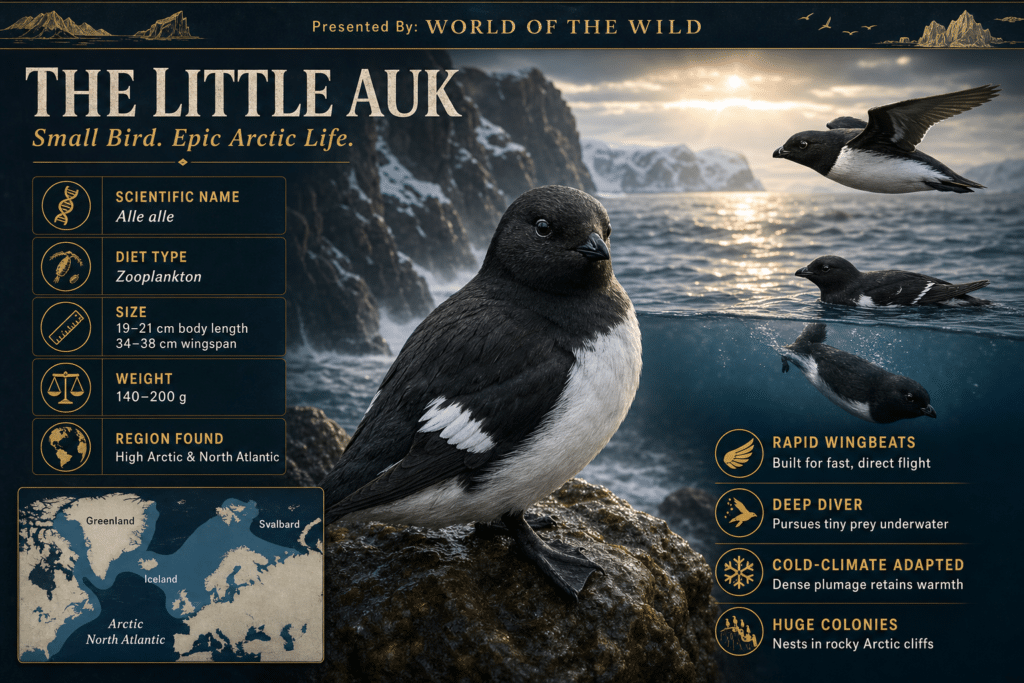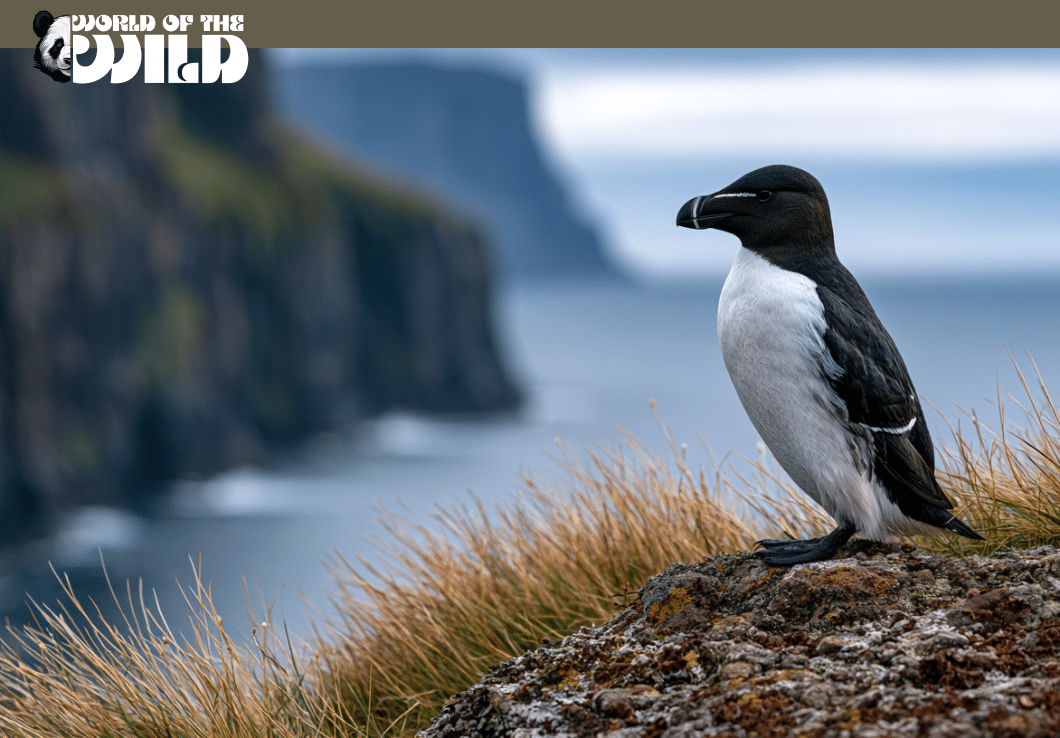

Picture a bird small enough to cup in your hands, built like a flying tennis ball, that spends its winters bobbing on the frigid waves of the North Atlantic and its summers packed shoulder to shoulder with millions of its kind on windswept Arctic cliffs. This is the little auk — a bird so abundant that a single colony can outnumber the population of a mid-sized city, yet so unassuming that most people have never heard its name. Don’t let its size fool you. The little auk is a master of extremes: it dives like a torpedo, flies like a buzzing insect, and somehow thrives in one of the harshest environments on Earth. It is, in every sense, a giant packed into a tiny frame.
Facts
- The little auk is the smallest auk species in the Atlantic Ocean, weighing about as much as a can of soda.
- Its colonies are among the largest seabird gatherings on the planet, with some sites hosting several million breeding pairs.
- Despite its stubby wings, it can dive to depths of over 30 meters (100 feet) in pursuit of tiny crustaceans.
- Little auks have a special throat pouch that lets them carry hundreds of prey items back to their chick in a single trip.
- In North America, this same bird is known by a different name entirely: the dovekie.
- Its wings are so short relative to its body that flight looks almost frantic — a constant, whirring effort rather than graceful soaring.
- Indigenous Arctic communities in Greenland have hunted little auks for centuries, and the bird remains a culturally important food source, sometimes fermented in seal skins as a traditional delicacy called kiviaq.
Species
The little auk belongs to the following taxonomic classification:
- Kingdom: Animalia
- Phylum: Chordata
- Class: Aves
- Order: Charadriiformes
- Family: Alcidae
- Genus: Alle
- Species: Alle alle
The little auk is the sole living species in the genus Alle, making it taxonomically unique among its relatives. Some ornithologists recognize two subspecies: the nominate Alle alle alle, found across most of the species’ breeding range, and Alle alle polaris, a slightly larger form breeding in the high Arctic around Franz Josef Land. The distinction between these two forms remains debated, and many taxonomists treat the species as monotypic. Its closest relatives within the auk family include puffins, guillemots, and razorbills — all members of Alcidae, a group of diving seabirds often described as the Northern Hemisphere’s answer to penguins.
Appearance
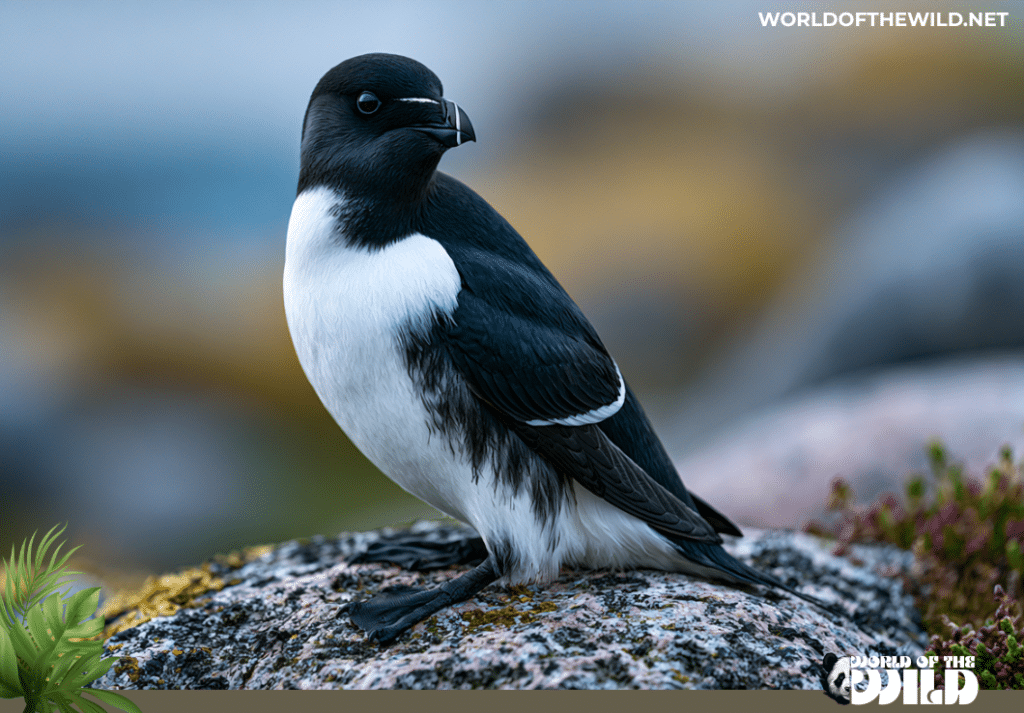
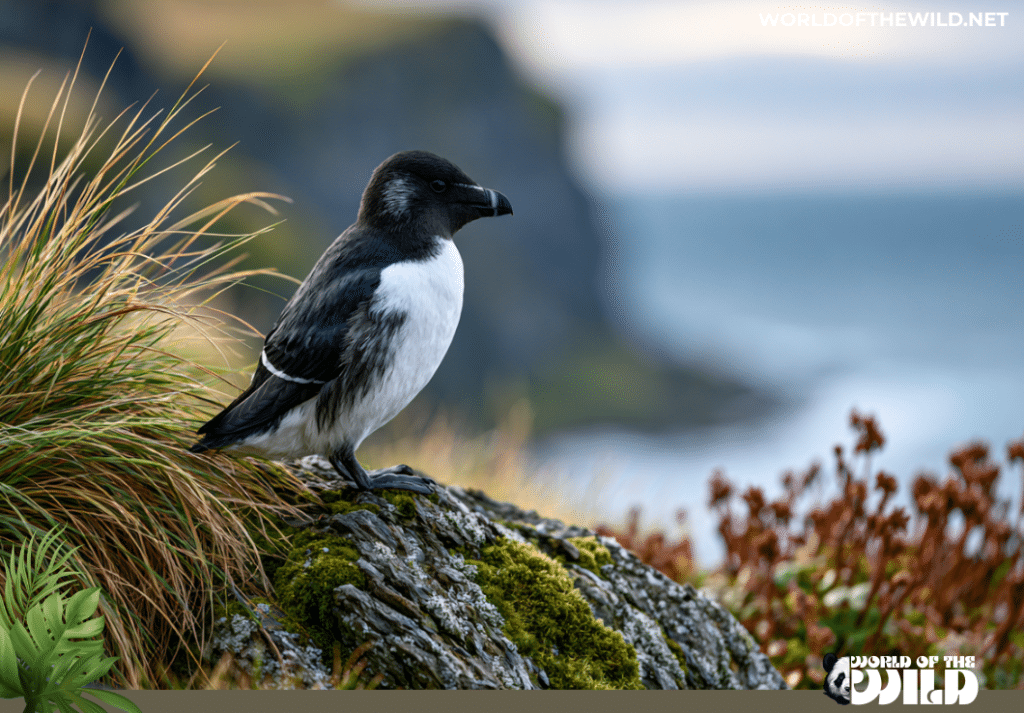
The little auk is a compact, barrel-shaped bird measuring roughly 19–21 centimeters (about 7.5–8 inches) in length, with a wingspan of around 34–38 centimeters (13–15 inches). It typically weighs between 140 and 200 grams (about 5–7 ounces) — lighter than a standard smartphone. Its body is built for the water rather than the air: a short neck, a stubby triangular bill, and dense, tightly packed feathers give it a rounded, almost comical silhouette.
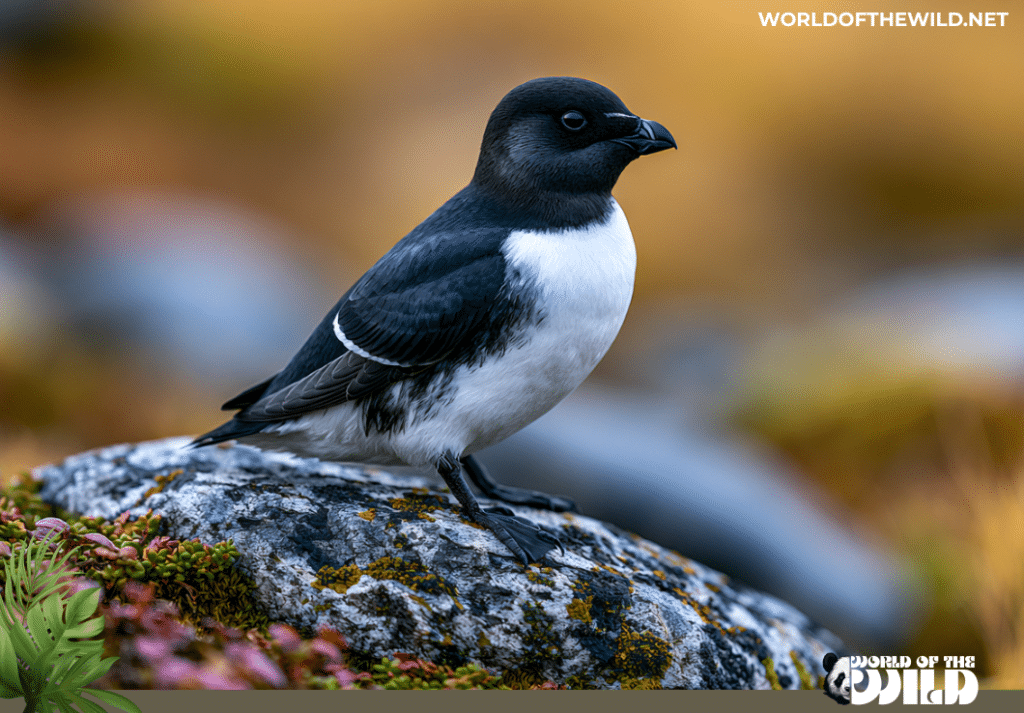
In breeding plumage, the little auk sports a striking black head, neck, and back contrasted against a crisp white belly, with a thin white stripe above the eye called a supercilium. In winter, the throat and lower face turn white, giving the bird a more piebald appearance. Its short wings, so useful underwater, make aerial flight look rushed and beelike, with rapid wingbeats and little gliding.
Behavior
Little auks are intensely social animals, rarely seen alone. They breed in enormous, densely packed colonies on rocky scree slopes, where the constant chatter of hundreds of thousands of birds creates a deafening background hum audible from far offshore. This vocal chorus, made up of trilling and chattering calls, helps individuals recognize mates and neighbors amid the chaos.
Underwater, the little auk transforms from an awkward flier into an agile hunter. It “flies” through the water using its wings for propulsion, a technique shared with penguins and other alcids, allowing it to chase down fast-moving prey at considerable depths. On land, colonies show remarkable coordination: birds arrive and depart in synchronized waves, likely a strategy to overwhelm predators through sheer numbers — a phenomenon sometimes called predator swamping. This blend of vocal complexity, cooperative timing, and precise underwater navigation reveals a level of behavioral sophistication that belies the bird’s small stature.
Evolution
The little auk’s lineage traces back to the broader radiation of the Alcidae family, a group of wing-propelled diving birds that evolved in the North Pacific before spreading into the Atlantic and Arctic basins over millions of years. Alcids as a whole represent a striking case of convergent evolution with penguins: though not closely related, both groups independently evolved compact bodies, dense waterproof plumage, and modified wings suited for underwater “flight” rather than aerial soaring — a response to similar ecological pressures in cold, prey-rich seas.
Within this family, the little auk’s ancestors likely diverged early, giving rise to the highly specialized, planktivorous lifestyle that defines the species today. Its small size and short wings represent an evolutionary trade-off: it sacrificed some aerial efficiency in exchange for exceptional diving ability and metabolic efficiency, allowing it to survive on tiny, energy-dense Arctic prey unavailable to many larger seabirds.
Habitat
Little auks breed exclusively in the high Arctic, with major colonies in Greenland, Svalbard, Franz Josef Land, Novaya Zemlya, and Jan Mayen. They favor steep, boulder-strewn slopes and cliffside scree fields, where gaps between rocks provide natural nesting crevices sheltered from predators and harsh weather.
Outside the breeding season, little auks disperse widely across the North Atlantic, spending winter entirely at sea — often far from land, riding out storms on the open ocean. Their at-sea range can extend as far south as the coasts of Britain, and occasionally further, particularly during severe winter storms that blow exhausted individuals off course. This dual life — cliffside crowding in summer, solitary ocean wandering in winter — makes the species a true creature of the Arctic and North Atlantic marine ecosystem.
Diet
The little auk is primarily a planktivore, feeding on tiny marine crustaceans, especially copepods such as Calanus species, along with small amphipods and occasionally tiny fish. It forages by diving from the sea surface, using its wings to “fly” underwater in pursuit of dense plankton swarms, often reaching depths well beyond what its small size would suggest possible.
One of its most remarkable foraging adaptations is a expandable throat pouch, which allows adults to collect and transport hundreds of prey items in a single dive session before returning to the colony to feed their chick. This efficient bulk-feeding strategy is essential in the Arctic, where feeding grounds can be far from nesting sites and time is precious during the short summer breeding window.
Predators and Threats
Natural predators of the little auk include Arctic foxes, which raid colonies for eggs and chicks, as well as glaucous gulls, skuas, and occasionally ivory gulls, which prey on both eggs and adult birds. Polar bears have also been observed opportunistically feeding on little auks and their eggs near coastal colonies.
Human-driven threats pose a growing concern. Climate change is altering the distribution and abundance of the copepods the species depends on, as warming Arctic waters shift plankton communities northward and disrupt the timing of food availability during the critical chick-rearing period. Oil spills and marine pollution threaten wintering birds at sea, where they are especially vulnerable due to their small size and limited fat reserves. Traditional subsistence hunting continues in parts of Greenland, though this is generally considered sustainable at current levels. Habitat disturbance from increased Arctic shipping and tourism is an emerging concern as previously remote breeding sites become more accessible.
Reproduction and Life Cycle
Little auks are monogamous, at least for a breeding season, and often reuse the same nest site and partner in subsequent years. Breeding colonies form each spring as birds return to their traditional cliffside sites, where pairs court with chattering vocal displays and mutual preening before settling into narrow rock crevices to nest.
Females lay a single egg, which both parents take turns incubating for approximately 29 days. After hatching, the chick is fed a steady diet of regurgitated crustaceans delivered via the parents’ expandable throat pouches. Chicks fledge roughly 3 to 4 weeks after hatching, at which point they make a dramatic solo journey from the nest cliff down to the sea, sometimes covering significant distances on foot and wing before reaching open water. Little auks can live for over 15 years in the wild, with some banded individuals recorded living considerably longer, making them relatively long-lived for a bird of their size.
Population
The little auk is currently classified as Least Concern by the IUCN, reflecting its enormous global population. Estimates suggest a global breeding population in the tens of millions of pairs, with some studies placing the total number of individuals as high as 80 million or more, making it one of the most numerous seabirds in the Northern Hemisphere.
Despite this reassuring overall status, regional population trends are a source of concern. Some colonies, particularly in areas experiencing rapid warming, show signs of shifting distribution as prey availability changes. Ongoing monitoring is considered essential, since a species so heavily reliant on a narrow band of cold-water plankton could see rapid declines if Arctic warming continues to disrupt its food supply.
Conclusion
The little auk may be easy to overlook — a small, unassuming bird bobbing on Arctic waves — but it is a creature of remarkable resilience and evolutionary refinement. From its penguin-like underwater flight to its deafening, cooperative colonies, it embodies the extraordinary adaptability required to thrive in one of Earth’s most unforgiving environments. Yet its dependence on a delicate Arctic food web means its future is far from guaranteed. As the ice recedes and ocean temperatures climb, the fate of the little auk offers a quiet but urgent reminder: even the most abundant species can be vulnerable when the foundations of their world begin to shift. Protecting the cold, plankton-rich waters of the Arctic isn’t just about saving one small bird — it’s about preserving an entire ecosystem that countless species, including this remarkable little auk, call home.
Quick Reference Table
| Scientific name | Alle alle |
| Diet type | Carnivore (planktivore) |
| Size (inches/feet) | ~7.5–8 inches (0.6–0.7 ft) body length |
| Weight (lbs) | ~0.3–0.45 lbs |
| Region found | High Arctic (Greenland, Svalbard, Franz Josef Land) and North Atlantic |