
Somewhere deep in the mist-draped mountain forests of the Bird’s Head Peninsula in western New Guinea, a small, plain-looking bird is engaged in one of the most extraordinary creative acts in the entire animal kingdom. He is not singing a grand aria, nor flashing iridescent plumage. He is building. Twig by careful twig, he has constructed a towering hut-like structure nearly a meter tall, then spent weeks — sometimes months — curating a gallery of colorful objects around its entrance: shimmering beetle wings, red berries, blue bottle caps, fungal brackets, pale pebbles, and flower petals, all arranged with a deliberateness that feels, unsettlingly, intentional.
This is the Vogelkop Bowerbird (Amblyornis inornata), and it may be the closest thing the natural world has to a practicing artist. Unlike peacocks, birds of paradise, or lyrebirds that rely on biological ornamentation to attract mates, the Vogelkop male has taken a radically different evolutionary path: external architecture as sexual display. The bower — not the bird — is the show. What makes this creature so endlessly fascinating is not just what it does, but the staggering complexity, individuality, and apparent aesthetic judgment it brings to doing it. To study the Vogelkop Bowerbird is to stare into a mirror and ask deeply uncomfortable questions about the origins of creativity, beauty, and art itself.
Facts
- The male Vogelkop is one of the plainest-looking birds in its entire family — a deliberate evolutionary trade-off. Because the bower does all the attracting work, flashy feathers became unnecessary, and natural selection let them fade away.
- Each male builds his own distinctive bower, and no two structures are exactly alike. Researchers have documented consistent personal “styles,” with individual males favoring specific colors, object types, and decorative arrangements year after year.
- Bowers can take months to build and are maintained continuously. Males will work on and adjust their structures for the entirety of a breeding season, and many return to the same bower site for years.
- Males actively steal decorations from each other’s bowers. Raiding a rival’s display is a common and documented behavior, adding a strategic dimension to what might otherwise appear to be purely aesthetic labor.
- Females are extraordinarily discerning judges. Studies have shown females spend significant time visiting and inspecting multiple bowers before choosing a mate, suggesting they are evaluating structural quality and decoration sophistication.
- The species was not formally described to Western science until 1895, despite living in one of the most biologically rich regions on Earth — a testament to how remote and inaccessible its mountain forest habitat truly is.
- Some populations show regional “cultural” differences in bower style, hinting that local traditions in decoration preference may be passed down through observation and learning, not genetics alone.
Species
The Vogelkop Bowerbird belongs to a richly structured taxonomic lineage:
| Rank | Classification |
|---|---|
| Kingdom | Animalia |
| Phylum | Chordata |
| Class | Aves |
| Order | Passeriformes |
| Family | Ptilonorhynchidae |
| Genus | Amblyornis |
| Species | Amblyornis inornata |
The family Ptilonorhynchidae — the bowerbirds — contains approximately 20 species spread across New Guinea and Australia, and the Vogelkop belongs to the genus Amblyornis, commonly called the gardener bowerbirds. This genus is distinguished from other bowerbird groups by the maypole-style bower: a central column of sticks built around a sapling, surrounded by a thatched hut-like structure and fronted by a “court” or garden decorated with objects.
The Vogelkop’s closest relative within the genus is the Macgregor’s Bowerbird (Amblyornis macgregoriae), found across a wider swath of New Guinea highlands. The two species differ primarily in the complexity and elaborateness of their bower constructions, with the Vogelkop typically producing far larger and more heavily decorated structures. Some ornithologists have historically debated whether certain populations represent distinct subspecies, particularly populations in the Wandammen and Arfak mountain ranges that show subtle but consistent differences in bower architecture and decorative preferences, though the species is currently treated as monotypic — a single species without formally recognized subspecies.
Appearance
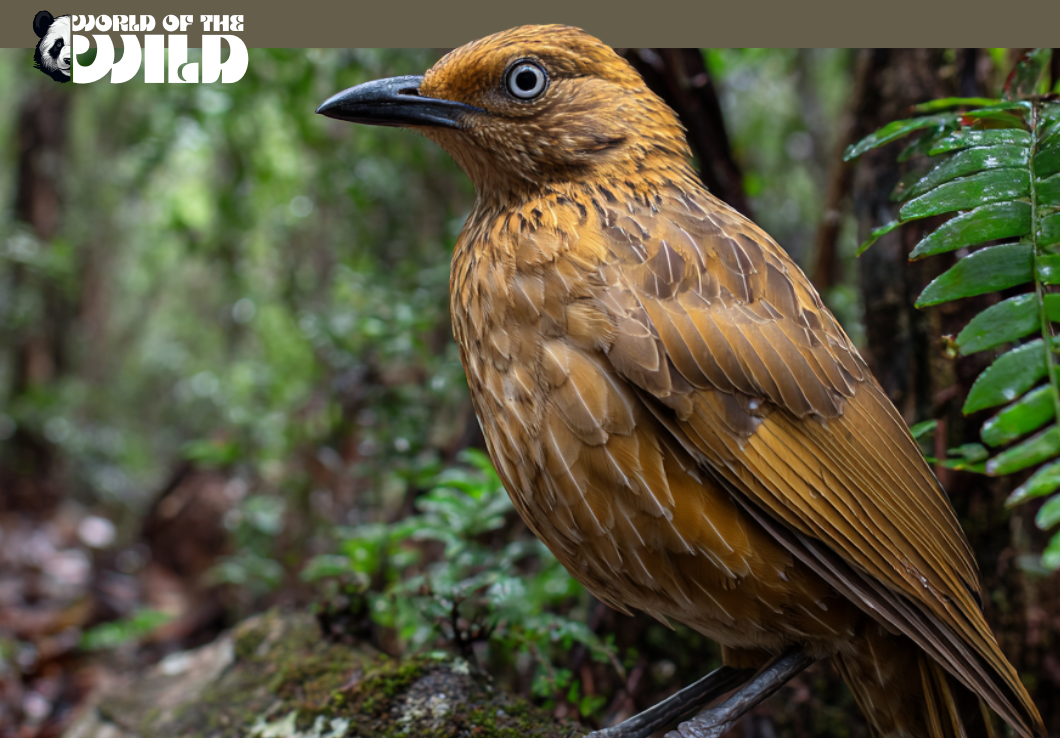
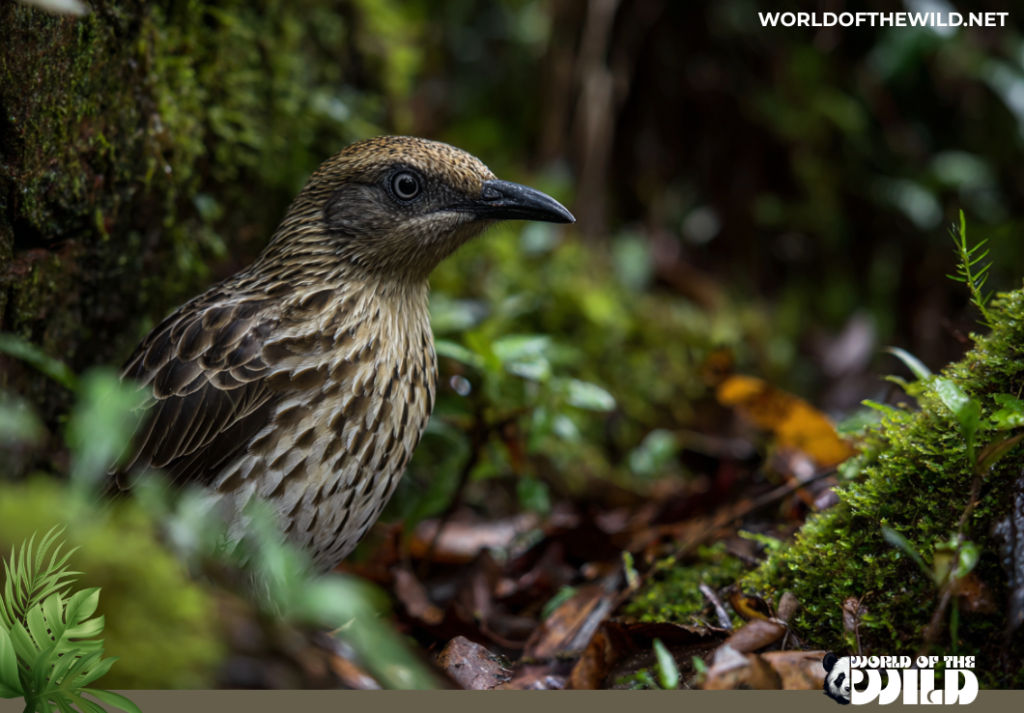
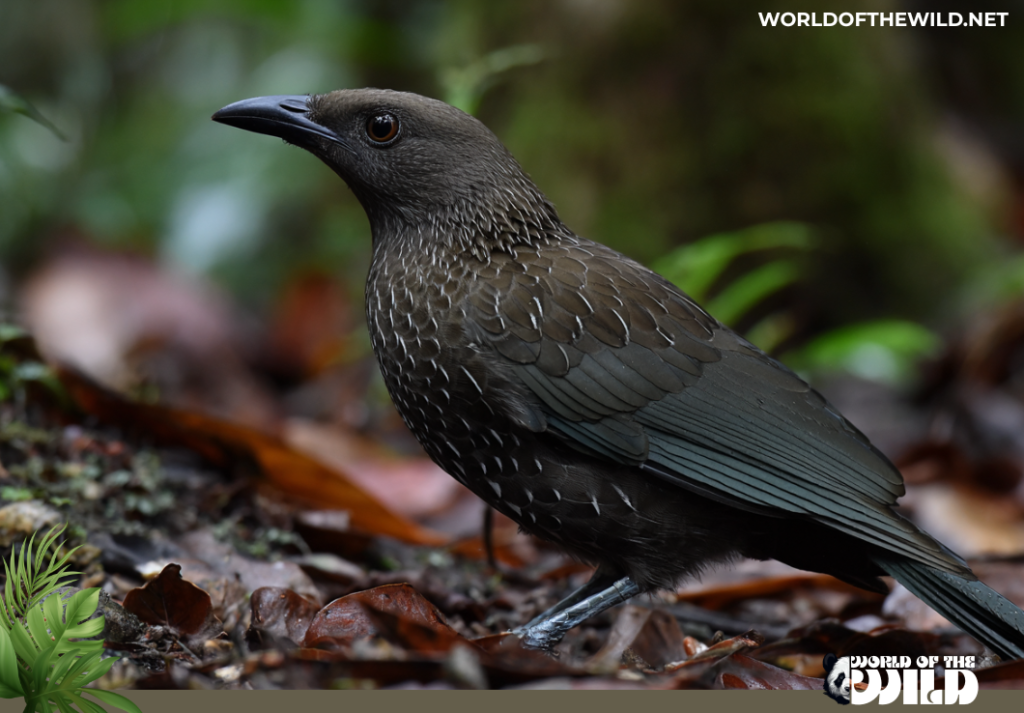
The Vogelkop Bowerbird is, by any conventional measure, a plain bird — and that plainness is itself a kind of evolutionary statement. Males measure roughly 9 to 10 inches (23–25 cm) in length and weigh between 2.5 and 3.5 ounces (70–100 grams). Their plumage is an understated olive-brown to warm brown above, with a paler, streaked underside. There is no crest, no iridescent gorget, no dramatic tail — none of the extravagant ornamentation that defines so many of their relatives in the bird-of-paradise family living in the same forests.
The bill is moderately stout and slightly hooked at the tip, well suited for handling fruit and manipulating objects. The eyes are dark and sharp, giving the bird an alert, perceptive expression that seems at odds with its otherwise anonymous appearance.
Females are virtually identical to males in plumage — a highly unusual situation for a species with such an intense, male-driven mating system. In most polygynous species, males are brilliantly colored while females are drab. Here, both sexes are drab, because the male’s attractiveness has been entirely transferred to something external to his own body. It is one of the more elegant demonstrations of evolutionary logic in the bird world: when a bower can be built bigger, brighter, and more impressive than any feather, feathers become redundant.
Behavior
The Vogelkop Bowerbird is a largely solitary species outside of mating interactions. Males spend a remarkable portion of their lives in or around their bowers, which function simultaneously as territorial claims, art installations, and performance stages. A male will spend hours each day maintaining and refining his structure — adjusting twigs, rearranging decorations, replacing wilted flowers with fresh ones, and removing debris. This level of sustained, goal-directed behavior is unusual in birds and has drawn considerable attention from researchers studying animal cognition.
Communication is relatively quiet compared to many passerines. Males produce a soft, varied repertoire of calls including mimicry of other species, hissing sounds, and churring notes, often performed during courtship displays within the bower. The bower’s entrance is oriented and sometimes even constructed to channel light in ways that maximize the visual impact of the decorative objects — a degree of spatial awareness that borders on deliberate stagecraft.
The species shows strong site fidelity, with males returning to the same bower location across multiple years. When a female visits, the male performs an animated courtship display inside or near the bower — bobbing, calling, and drawing attention to his decorations. The female evaluates the display, the bower’s structural integrity, and the quality of its decorations before making her mating decision. She may visit the same bower multiple times before committing, or leave to inspect competitors.
Perhaps most intriguingly, individual males have been documented with consistent, personal aesthetic preferences — consistently favoring certain colors of objects, placing items in specific spatial arrangements, and responding with apparent displeasure (re-rearranging objects) when researchers experimentally moved decorations around. This points toward something genuinely cognitive: an internal sense of how things should look.
Evolution
The bowerbirds as a family appear to have diverged from their closest relatives — the birds of paradise (Paradisaeidae) — somewhere between 20 and 30 million years ago, during the Oligocene or early Miocene epoch, likely originating in the ancestral landmasses that would become Australia and New Guinea as they drifted northward. The split between the two families may represent one of the most significant divergences in the history of avian sexual selection: birds of paradise doubled down on biological ornamentation, evolving spectacular plumage through runaway sexual selection, while the bowerbirds took the radical step of externalizing their display.
This “extended phenotype” strategy — where the bower functions as an external expression of genetic quality — is thought to have co-evolved with the reduction in male plumage. As bower-building ability became a reliable signal of male fitness (requiring coordination, memory, resource acquisition, and aesthetic judgment), selection pressure on elaborate feathers relaxed. Over millions of years, the ancestral bowerbird’s plumage gradually simplified while bower architecture grew increasingly elaborate.
Within the genus Amblyornis, the gardener bowerbirds represent what many researchers consider a more derived, cognitively complex form of bower construction compared to avenue-style bowers seen in species like the satin bowerbird. The Vogelkop Bowerbird, with its exceptionally large and decoratively diverse bowers, likely represents a peak in this evolutionary trajectory — the most architecturally ambitious expression of a strategy that began with ancestral birds simply stacking sticks on the forest floor.
Habitat
The Vogelkop Bowerbird is a highland forest specialist, restricted entirely to the Bird’s Head Peninsula (Vogelkop Peninsula) of western New Guinea — the westernmost extension of the island, now part of the Indonesian provinces of West Papua and Papua. Its range encompasses several isolated mountain ranges, most notably the Arfak, Tamrau, and Wandammen Mountains.
The species occupies montane forests at elevations generally ranging from about 1,000 to 2,000 meters (3,300 to 6,600 feet) above sea level — a cool, mossy, frequently cloud-covered environment dominated by dense tropical mountain forest. These forests are characterized by gnarled, moss-draped trees, rich understory vegetation, high humidity, and relatively stable temperatures compared to lowland rainforest. Epiphytic ferns, orchids, and mosses blanket nearly every surface, creating a lush, green world that provides the Vogelkop with an abundant supply of fruit and a diverse palette of decorative materials.
The geographic isolation of the Vogelkop Peninsula — separated from the main New Guinea highlands by lowland terrain — has contributed to the evolutionary distinctiveness of the species and helps explain both its unique bower style and the regional variation in bower aesthetics observed between different mountain ranges. The remoteness of this habitat has also been a double-edged sword: it has protected the bird from many human pressures while making scientific study logistically challenging.
Diet
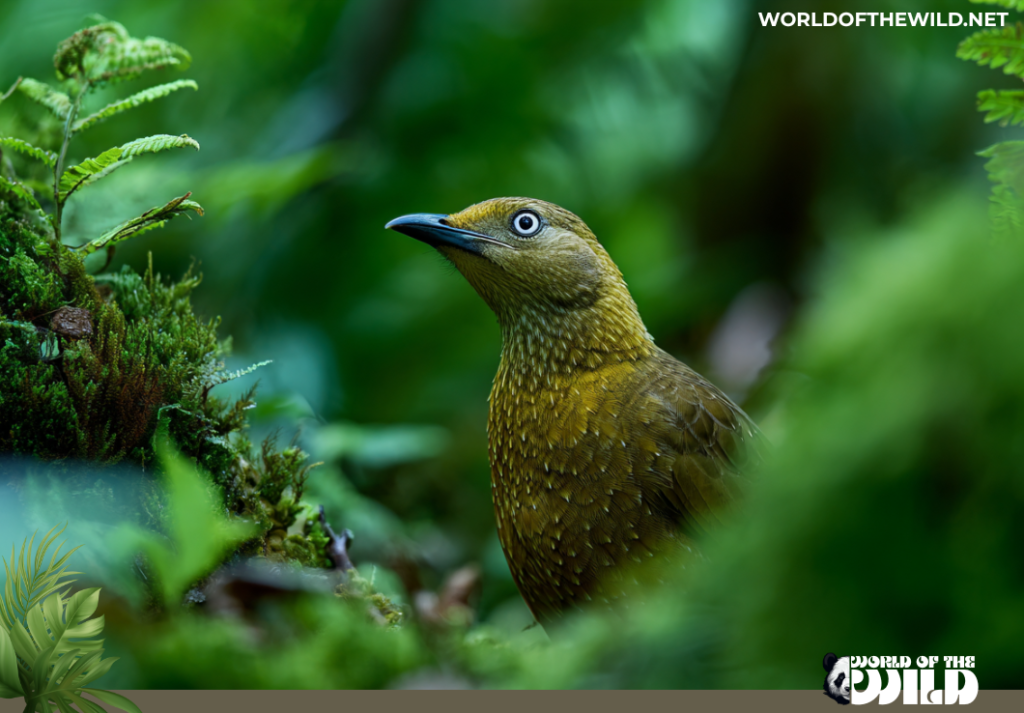
The Vogelkop Bowerbird is an omnivore, though its diet leans heavily toward frugivory. Fruit forms the foundation of its nutritional intake — the bird forages through the forest understory and mid-canopy, consuming a wide variety of seasonal fruits including figs, berries, and drupes from numerous plant species. This fruit-heavy diet is typical of its family and reflects the extraordinary fruit abundance of New Guinea’s mountain forests.
Supplementing the fruit diet, the Vogelkop also consumes arthropods — beetles, caterpillars, spiders, and other invertebrates — particularly during breeding season when protein demands are elevated. There is some evidence of flower and leaf consumption as well, rounding out a broadly opportunistic dietary strategy.
Foraging behavior involves moving through the forest at various heights, often alone. The slightly hooked bill is effective for plucking and manipulating fruit, while the bird’s generalist approach to food sources reduces dependence on any single plant species. Interestingly, males will sometimes collect inedible objects — plastic, glass, metal — during foraging excursions, suggesting that the foraging drive and the decoration-collecting drive are closely linked behavioral systems operating simultaneously.
Predators and Threats
In the wild, the Vogelkop Bowerbird faces predation pressure from several sources typical of New Guinea mountain forest. Birds of prey — particularly medium-sized raptors such as sparrowhawks and goshawks (Accipiter species) — likely represent the most significant aerial predators. Ground and arboreal predators including monitor lizards, snakes, and potentially introduced rats pose threats to nests, eggs, and chicks. The nest, built entirely by the female and located separately from the bower, is particularly vulnerable during incubation.
On the anthropogenic side, the most significant threat facing the species is deforestation and habitat degradation. While the highlands of the Vogelkop Peninsula remain relatively intact compared to lowland forests, logging concessions, agricultural expansion (particularly oil palm), and mining activities are steadily pushing into montane zones. Road construction into previously inaccessible areas accelerates forest loss and fragments habitat, isolating populations and disrupting the landscape-scale connectivity the species needs.
Climate change presents a longer-term but increasingly serious concern. As temperatures rise, the elevational band of suitable cloud forest habitat may shift upward, compressing into a shrinking zone at higher altitudes. For a species already restricted to a small geographic area, this kind of habitat squeeze could have severe consequences over coming decades. Hunting and capture for the cage-bird trade, while not a primary threat, has been documented in the region and adds additional pressure on local populations.
Reproduction and Life Cycle
The reproductive system of the Vogelkop Bowerbird is polygynous: males mate with multiple females across a breeding season, while females bear sole responsibility for nest construction, incubation, and chick-rearing. The bower plays no role in nesting — it is purely a mating arena. After copulation, the female departs entirely and the male plays no further role in offspring care.
Following a successful mating, the female constructs a cup-shaped nest of sticks, leaves, and plant fibers, typically placed in the fork of a tree at a moderate height in the forest. She lays a clutch of one to two eggs — a relatively small clutch size typical of tropical species that invest heavily in each offspring. Incubation lasts approximately 19 to 24 days, carried out entirely by the female. Chicks hatch altricial — naked and helpless — and are brooded and fed by the female alone for several weeks before fledging.
Breeding appears to be seasonal, timed to periods of peak fruit abundance in the montane forest, though the exact breeding season can vary between populations. Males begin constructing and refurbishing their bowers well in advance of peak breeding activity, sometimes starting months before females come into reproductive condition.
Lifespan data for the Vogelkop specifically are limited, but related bowerbird species are known to be long-lived for birds of their size — potentially reaching 20 or more years in the wild. Males may not reach full bower-building competence and begin attracting females until they are several years old, suggesting an extended juvenile period during which young males observe and learn from established bower owners.
Population
The Vogelkop Bowerbird is currently classified as Least Concern on the IUCN Red List of Threatened Species, reflecting the fact that its population, while restricted in range, is not considered to be declining at a rate that would qualify it for a threatened category under current assessments.
Precise global population estimates are difficult to establish given the remoteness and inaccessibility of much of the species’ range, and no robust census figures are publicly available. The species is considered locally common within suitable habitat in the Arfak, Tamrau, and Wandammen mountains, though density varies considerably with habitat quality and elevation.
The primary conservation concern is not immediate population collapse but rather the slow erosion of habitat at the margins of its range, combined with the species’ inherent vulnerability as a range-restricted endemic. Any species confined to a single peninsula — however remote — faces an elevated extinction risk from localized events: a catastrophic disease, an invasive predator, or sustained deforestation could theoretically devastate the entire population before a response could be mounted. Conservation assessments for the species should be considered against this backdrop of endemic fragility, even when current numbers appear stable.
Protected areas within the Vogelkop Peninsula, including the Arfak Mountains Nature Reserve, provide some degree of formal habitat protection, and the region’s relative inaccessibility has historically served as its best defense. Maintaining that protection while development pressures mount in Indonesian Papua will be central to the species’ long-term security.
Conclusion
The Vogelkop Bowerbird is, in many ways, a philosophical provocation wearing the feathers of a small brown bird. It forces us to confront the possibility that aesthetic judgment, creativity, and the deliberate construction of beautiful environments are not uniquely human traits — that they emerged, through the relentless pressure of sexual selection, in a creature with a brain the size of a walnut, deep in a forest most humans will never see.
Every twig placed, every berry arranged, every stolen decoration put back in its rightful position speaks to a form of intelligence and intention that we are only beginning to understand. The Vogelkop builds not from instinct alone but from something that looks, uncomfortably and wonderfully, like taste.
The continued survival of this remarkable species depends on the survival of its mountain forest home. Supporting conservation organizations working in West Papua, advocating for the protection of Indonesian montane forests, and sustaining scientific interest in the extraordinary biodiversity of New Guinea are all meaningful contributions to ensuring that this little architect keeps building — and that the forests keep standing around him, full of the raw materials of his art.
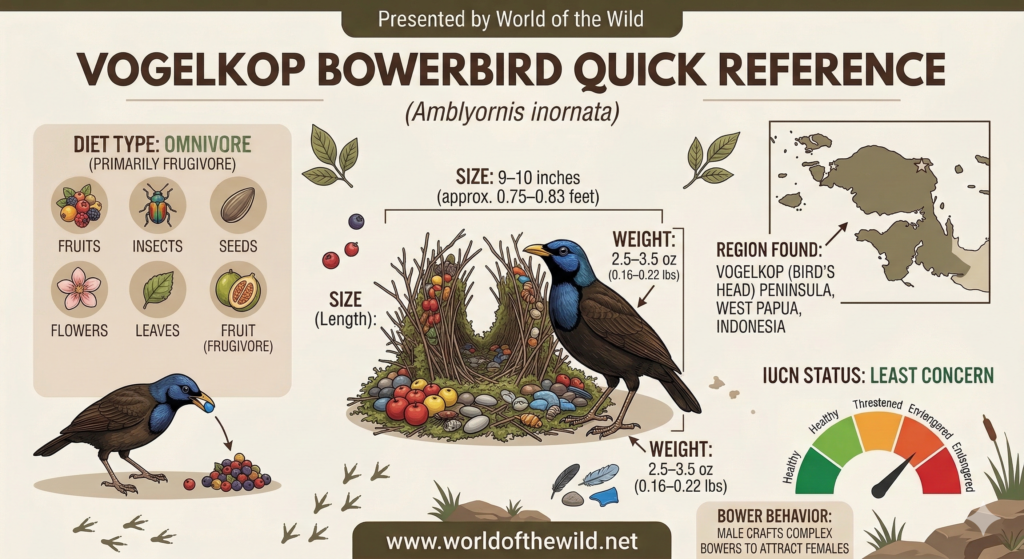
Quick Reference
| Scientific Name | Amblyornis inornata |
| Diet Type | Omnivore (primarily frugivore) |
| Size | 9–10 inches (approx. 0.75–0.83 feet) |
| Weight | 2.5–3.5 oz (0.16–0.22 lbs) |
| Region Found | Vogelkop (Bird’s Head) Peninsula, West Papua, Indonesia |