
If you were tasked with designing the most visually spectacular primate on Earth, you might struggle to top what evolution has already accomplished. Meet the mandrill — a creature so impossibly vivid, so theatrically adorned, that early European explorers refused to believe it was real. With a face painted in electric blues, vivid reds, and deep purples, and a personality to match its explosive appearance, the mandrill is one of the most arresting animals to ever walk the forest floor. But beneath those carnival colors lies a complex, intelligent, and deeply social creature whose story is as rich as its palette. Found in the dense rainforests of Central and West Africa, the mandrill is not just a visual spectacle — it is a masterpiece of evolutionary design, behavioral sophistication, and ecological importance. Yet despite its grandeur, this extraordinary primate faces very real threats to its survival. This is the story of the mandrill, told in full.
Facts
- The mandrill holds the title of the world’s largest monkey — not ape, but monkey — a distinction that surprises many people given its imposing size and powerful build.
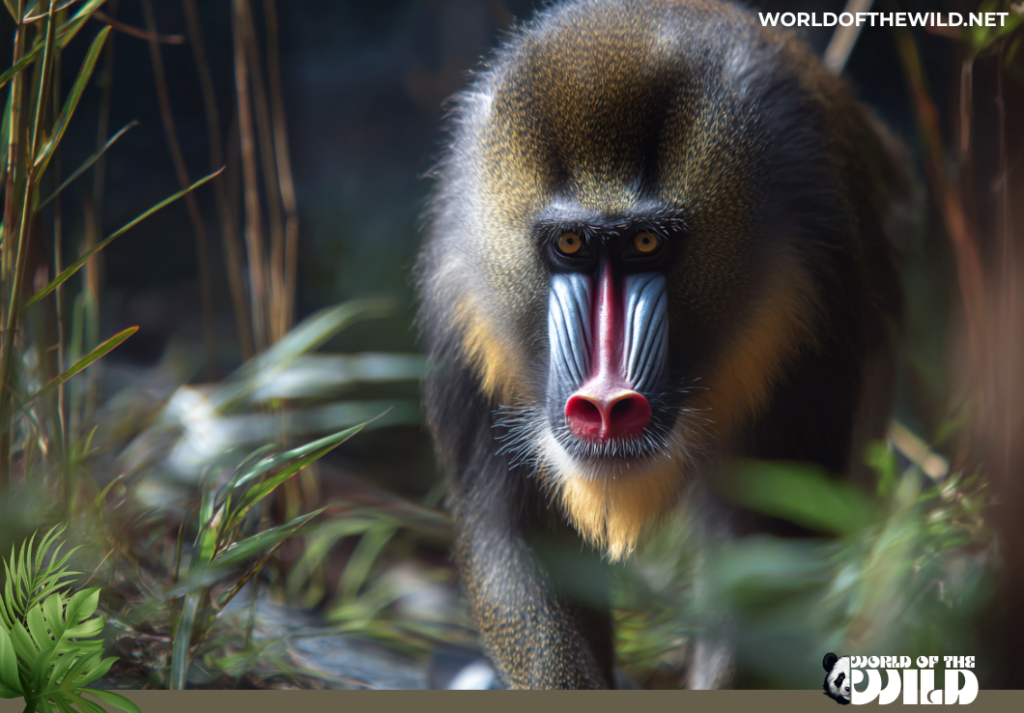
- A male mandrill’s colorful face actually intensifies with his social status. The more dominant the male, the more vivid and saturated his blue and red facial markings become — a literal badge of rank.
- Mandrills have cheek pouches inside their mouths large enough to store an entire meal’s worth of food, allowing them to forage quickly in dangerous open areas and eat safely in cover later.
- They are among the few non-human animals known to practice self-medication, deliberately seeking out and consuming specific plants with antiparasitic or antimicrobial properties when ill.
- Male mandrills are the most sexually dimorphic primates in the world — males can weigh nearly three times more than females, a difference so stark the two sexes were once mistakenly classified as different species.
- Mandrills have been documented using tools in captivity and displaying problem-solving abilities that rival many great apes, suggesting their cognitive abilities are far greater than their monkey status might imply.
- Their rumps are just as colorful as their faces — the brightly colored ischial callosities (sitting pads) range from red to purple and blue, and like their facial colors, serve as social and sexual signals.
Species
The mandrill occupies the following taxonomic classification:
- Kingdom: Animalia
- Phylum: Chordata
- Class: Mammalia
- Order: Primates
- Family: Cercopithecidae
- Genus: Mandrillus
- Species: Mandrillus sphinx
The genus Mandrillus contains only two living species: the mandrill (Mandrillus sphinx) and its close relative, the drill (Mandrillus leucophaeus). The drill, found in Nigeria, Cameroon, and Bioko Island, shares the mandrill’s large body size and complex social structure but lacks the spectacular facial coloration, sporting a predominantly black face instead. The two species diverged from a common ancestor several million years ago and occupy partially overlapping but distinct geographic ranges.
For much of the 20th century, mandrills were grouped with baboons in the genus Papio, owing to their similarly dog-like snout and terrestrial habits. However, genetic and morphological studies eventually established Mandrillus as its own distinct genus. Despite their superficial resemblance to baboons, mandrills are more closely related to mangabeys — a group of smaller, arboreal African monkeys. There are no formally recognized subspecies of Mandrillus sphinx, though some researchers have noted subtle regional variation in populations north and south of the Ogooué River in Gabon, potentially warranting future subspecific classification.
Appearance
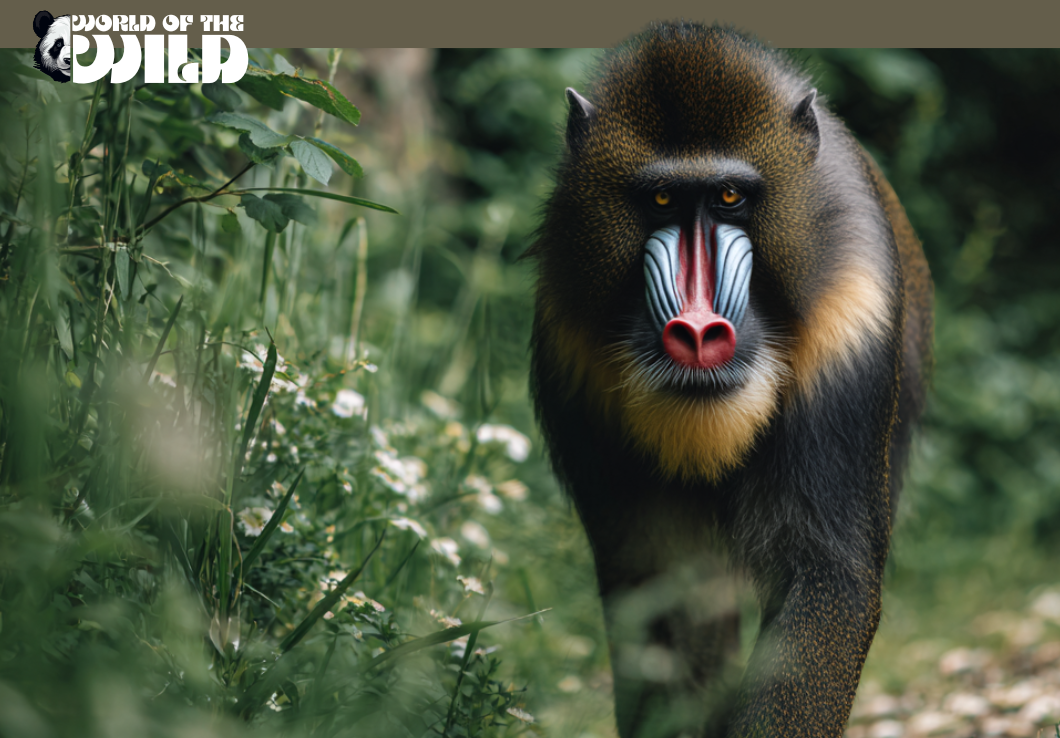
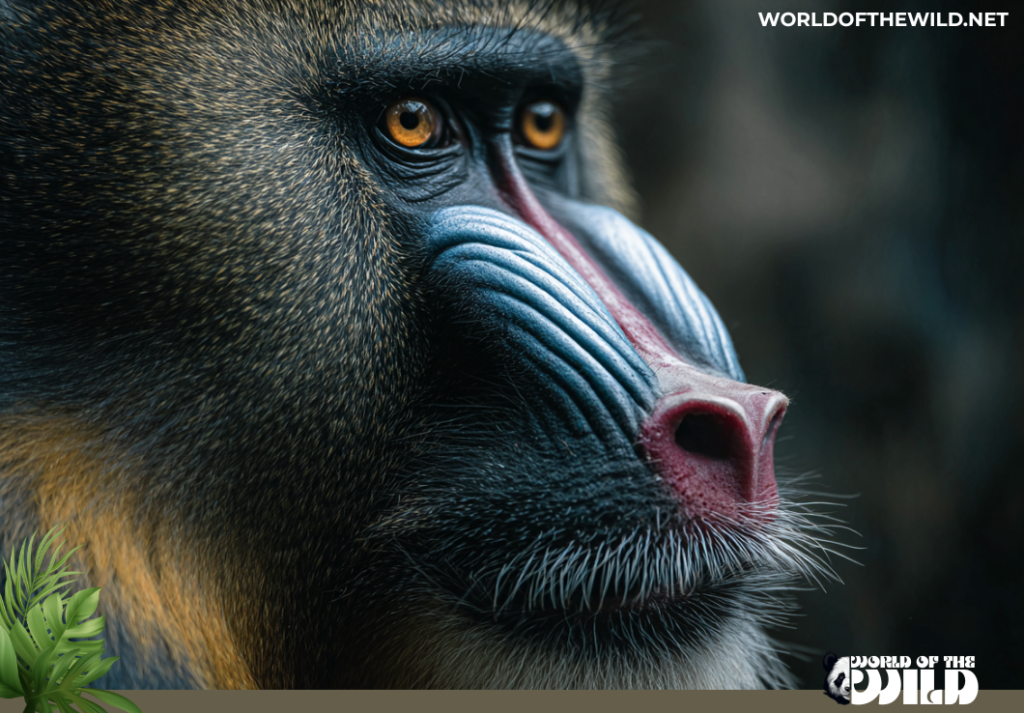
Few animals announce themselves as boldly as the mandrill. The adult male is a breathtaking spectacle, dominated by a face that looks as if it were painted by a surrealist artist on a particularly inspired afternoon. The nose and central face sport vivid scarlet and orange skin running down the ridge and tip of the snout, flanked on either side by prominent ridged blue and violet grooves that run along the cheeks. The chin is adorned with a bright yellow or orange beard. These colors are not pigment in the traditional sense — the blues are produced by the structural arrangement of collagen fibers beneath the skin, while the reds come from blood vessels close to the surface.
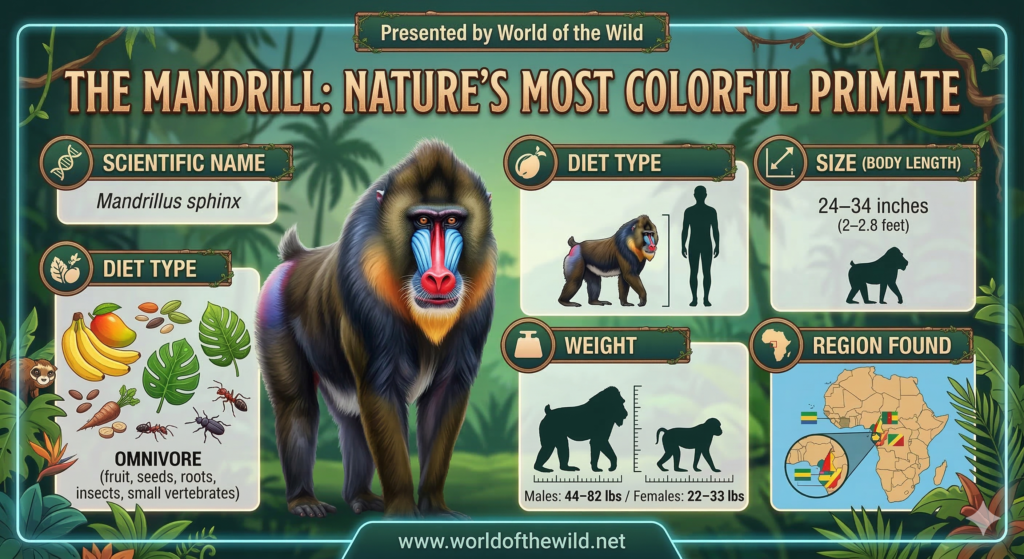
Adult males are massive by monkey standards, typically measuring 24 to 34 inches (2 to nearly 3 feet) in body length, with a short stub of a tail adding another 2 to 3 inches. They weigh between 44 and 82 pounds, with the largest wild males occasionally exceeding that upper figure. Females are dramatically smaller, typically weighing just 22 to 33 pounds and measuring considerably shorter in body length.
The mandrill’s body is powerfully built — barrel-chested, with long, muscular forelimbs and relatively short hind legs suited for quadrupedal movement on the ground. The coat is predominantly olive-green to brown-gray, providing effective camouflage in the dappled forest understory. Females and juveniles share the same general body coloration but with much more muted facial coloring — typically a dull blue-gray or pinkish face without the brilliant hues of dominant males. The rump of both sexes features colorful ischial callosities, brilliantly colored in red, pink, blue, and purple — a feature unique to the genus Mandrillus and thought to serve communicative and signaling functions.
Behavior
The mandrill is an intensely social animal, living in groups called hordes or troops that can range from a few dozen individuals to, in exceptional cases, over 800 — the largest groups of any non-human primate ever recorded. These mega-groups, sometimes called “supergroups,” represent one of the most remarkable social aggregations in the primate world. Day-to-day life, however, is typically organized around smaller subgroups of females and their offspring, with solitary or small coalitions of males joining the main group primarily during breeding season.
Social hierarchy is central to mandrill life and is communicated through those famous facial and rump colors. Dominant males maintain their status through displays — rump presentations, yawning to expose formidable canine teeth, and vigorous shaking of vegetation. Grooming plays a critical role in reinforcing social bonds and alliances, particularly among females, who form the stable social core of any mandrill group.
Communication is rich and multifaceted. Mandrills use a variety of vocalizations, including two-phase grunts, screams, and crowing calls to coordinate group movement and alert others to predators. They also rely heavily on scent marking, using sternal glands on their chest to deposit chemical signals on branches and objects throughout their territory. Visual cues — from the intensity of facial color to specific postures — complete a sophisticated three-channel communication system.
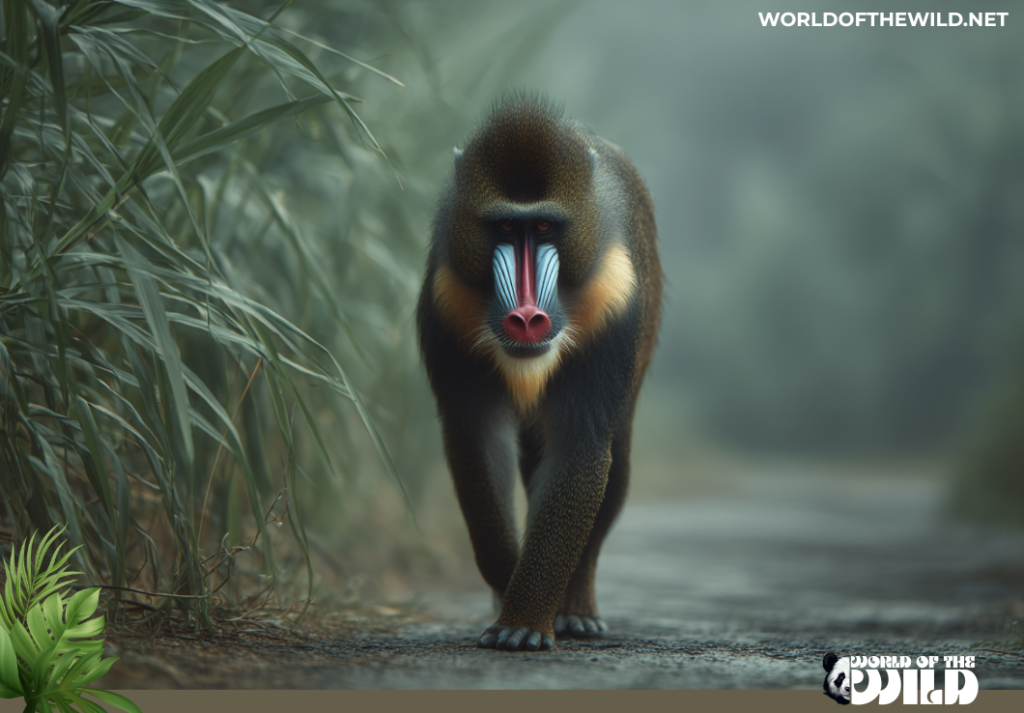
Mandrills are primarily terrestrial, spending the majority of their day foraging on the forest floor, though they are capable climbers and retreat into the trees to sleep at night, choosing high branches for safety. Their daily activity budget is split between foraging (the majority of their waking hours), social interaction, travel between feeding sites, and rest.
Their intelligence is striking. In both wild and captive settings, mandrills have demonstrated planning, tool use, and complex problem-solving. They recognize individual faces, maintain long-term social memories, and have been observed helping injured or sick group members — behaviors that suggest a depth of cognitive and emotional life well beyond what was historically attributed to Old World monkeys.
Evolution
The evolutionary story of the mandrill stretches back tens of millions of years to the great primate radiations of the Oligocene and Miocene epochs. The family Cercopithecidae — the Old World monkeys — diverged from the apes roughly 25 million years ago, eventually splitting into two subfamilies: the Cercopithecinae (which includes mandrills, baboons, and macaques) and the Colobinae (leaf monkeys and colobuses).
Within the Cercopithecinae, the lineage leading to Mandrillus likely diverged from the mangabey lineage somewhere between 3 and 6 million years ago, during a period of significant climate and forest change across Africa. The shrinking and fragmenting of African rainforests during this time is thought to have played a crucial role in driving the divergence between the mandrill and drill lineages, as populations became isolated in different forest refugia.
The mandrill’s distinctive features — its large size, sexual dimorphism, and elaborate coloration — are thought to have evolved primarily through sexual selection, where female preference for brightly colored, dominant males drove increasingly intense male ornamentation over many generations. The link between color intensity and testosterone levels, immune function, and parasite load suggests the colors function as honest signals of male genetic quality — a concept central to evolutionary theory since Darwin first proposed it in The Descent of Man (1871). Interestingly, Darwin himself studied the mandrill extensively and used it as one of his principal examples of sexual selection in action.
The shift toward large group living and terrestrial foraging also likely evolved in response to predation pressure, as forest-floor living in Central Africa exposes mandrills to a suite of large predators that arboreal species can more easily avoid.
Habitat
The mandrill’s world is the equatorial rainforest of Central and West Africa — one of the most biologically productive and species-rich environments on the planet. Their range is centered in Gabon, where the largest and most stable populations are found, and extends into Cameroon, Equatorial Guinea, and the Republic of the Congo. The Sanaga River in Cameroon marks the approximate northern boundary of their range, while the Congo River acts as a southern barrier, limiting their spread into the Democratic Republic of the Congo.
Within this region, mandrills prefer dense tropical rainforest with closed canopy cover, though they also utilize forest-savanna mosaics, gallery forests along rivers, and degraded secondary forest at the edges of human settlements. They show a preference for lowland and submontane forests rather than true montane habitats, generally staying below 6,500 feet in elevation.
The habitat is characterized by high annual rainfall (often exceeding 150 inches per year), year-round warm temperatures, and extraordinary plant biodiversity. This richness is essential to the mandrill’s survival, as its broad omnivorous diet depends on the availability of diverse fruit species, roots, insects, and small vertebrates that only such a complex ecosystem can provide. Seasonal variation in fruit availability strongly influences troop movement patterns, with mandrills traveling widely during lean months and concentrating in areas of high fruit abundance when it peaks.
Diet
Mandrills are quintessential omnivores, and their diet reflects the remarkable diversity of their rainforest home. The bulk of their nutrition comes from fruit, with figs, berries, and seasonal forest fruits forming the dietary foundation whenever available. When fruit is scarce, they shift heavily to seeds, roots, tubers, bark, and leaves — a flexibility that allows them to thrive in environments with highly seasonal resource availability.
Animal protein is also an important dietary component. Mandrills actively hunt and consume insects (particularly ants, termites, and beetles), fungi, snails, worms, small lizards, frogs, and occasionally small mammals such as rodents or young duikers. Males, by virtue of their greater size and strength, are more likely to capture and consume vertebrate prey than females or juveniles.
Foraging occupies the majority of a mandrill’s active day. They use their dexterous hands and strong fingers to excavate soil for roots and tubers, strip bark to access insects, overturn logs, and manipulate food items with a precision that reflects their considerable manual intelligence. Their cheek pouches allow rapid collection of food in exposed or dangerous areas, with processing and consumption deferred until they reach a safer location. Water is obtained both from fruit and from standing water sources in the forest.
Predators and Threats
Despite their formidable size and powerful build, mandrills face a range of natural predators in their rainforest environment. The leopard (Panthera pardus) is their most significant natural enemy, capable of taking even adult males when conditions favor ambush. Crowned eagles (Stephanoaetus coronatus) — the most powerful avian predators in Africa — pose a serious threat to juveniles and smaller females. African rock pythons and other large constrictors occasionally prey on young mandrills, and chimpanzees have been documented killing and eating mandrills in regions where the two species overlap.
However, none of these natural predators pose a fraction of the existential threat that humans represent. The two dominant human-caused threats to mandrills are:
Bushmeat hunting is perhaps the most immediate and devastating pressure. Mandrills are heavily hunted across their range for their meat, which is both consumed locally and sold commercially in urban bushmeat markets. Their large size makes them a particularly valuable target, and hunting with firearms has dramatically reduced populations in areas outside protected reserves. In some regions, entire hordes have been wiped out in a matter of years.
Habitat loss driven by logging (both commercial and artisanal), agricultural expansion, and mining is rapidly degrading and fragmenting the rainforests mandrills depend upon. As forests are carved into smaller patches, mandrills lose both food resources and the connectivity between populations needed to maintain genetic health. The construction of roads into previously inaccessible forest areas compounds this threat by opening new areas to hunting and settlement.
Reproduction and Life Cycle
Mandrill reproduction is a dramatic, highly competitive affair shaped by the species’ intense sexual dimorphism and hierarchical social structure. Breeding is not strictly seasonal in mandrills, but births do tend to peak in the dry season (January through April in Gabon), likely linked to the increased availability of food for lactating mothers several months after conception.
Males compete vigorously for mating access to females, with dominant males — identifiable by their more vivid coloration — securing the vast majority of matings. Females exercise considerable mate choice, and studies have shown they preferentially solicit brightly colored, high-status males, consistent with the honest signal hypothesis. Subordinate males employ alternative strategies, including sneaky matings when dominant males are distracted.
After a gestation period of approximately 175 days (roughly 6 months), females give birth to a single infant, rarely twins. Newborns are born with pink facial skin and dark fur, the distinctive adult coloration developing gradually over the first few years of life. Mothers are the sole caregivers, nursing their infants for approximately one year, though juvenile mandrills may remain close to their mothers for several years. Alloparental care — in which other group females assist with infant care — has been observed but is less pronounced than in some other cercopithecine species.
Males reach sexual maturity at around 4 to 6 years but rarely achieve the full facial coloration and size of socially dominant males until their mid-teens, reflecting the role of social status in physical development. Females mature earlier, typically at 3 to 4 years of age. In the wild, mandrills live approximately 20 years, while individuals in captivity have reached 35 to 40 years with proper care.
Population
The mandrill is currently classified as Vulnerable on the IUCN Red List of Threatened Species, a status that reflects genuine and ongoing population declines rather than imminent extinction, but signals serious cause for concern. Precise global population estimates are difficult to establish given the remoteness of their habitat and the challenges of surveying dense equatorial rainforest, but current estimates suggest a global wild population in the range of several hundred thousand individuals, with Gabon hosting the largest and most stable national population.
The population trend is assessed as decreasing. Bushmeat hunting pressure remains intense and is considered unsustainable across much of the range. Logging and agricultural expansion continue to erode and fragment suitable habitat. Protected areas such as Lopé National Park in Gabon — a UNESCO World Heritage Site — have proven critical as refuges, and mandrill populations within protected areas are generally more stable than those outside them. However, even within some protected areas, illegal hunting remains a serious challenge.
Captive populations in zoos worldwide contribute to research on mandrill biology, behavior, and health, and several institutions participate in coordinated breeding programs. While these efforts are valuable for scientific understanding, they cannot substitute for the protection of wild populations and the vast forest ecosystems they call home.
Conclusion
The mandrill is far more than a biological curiosity or a zoo attraction. It is a window into the power of evolution — a living demonstration of how sexual selection, social complexity, and ecological adaptation can combine to produce an animal of breathtaking sophistication. From the honest chemistry of its color signals to the extraordinary scale of its social aggregations, every aspect of the mandrill’s biology rewards deeper examination.
But the mandrill also tells a more urgent story. Like so many of the world’s most spectacular creatures, it stands at the intersection of a rapidly changing world and a biology refined over millions of years for conditions that are disappearing. The forests it needs are shrinking. The hunting pressure it faces is relentless. The window for protecting this species — and the irreplaceable ecosystems it inhabits — is not infinite.
Supporting organizations working to protect Central African rainforests, reducing demand for bushmeat, and advocating for the expansion and enforcement of protected areas are all meaningful actions in the mandrill’s defense. The most colorful monkey on Earth deserves a future as vivid as its face.
Quick Reference
| Field | Details |
|---|---|
| Scientific Name | Mandrillus sphinx |
| Diet Type | Omnivore (fruit, seeds, roots, insects, small vertebrates) |
| Size (Body Length) | 24–34 inches (2–2.8 feet) |
| Weight | Males: 44–82 lbs / Females: 22–33 lbs |
| Region Found | Central and West Africa (Gabon, Cameroon, Equatorial Guinea, Republic of the Congo) |