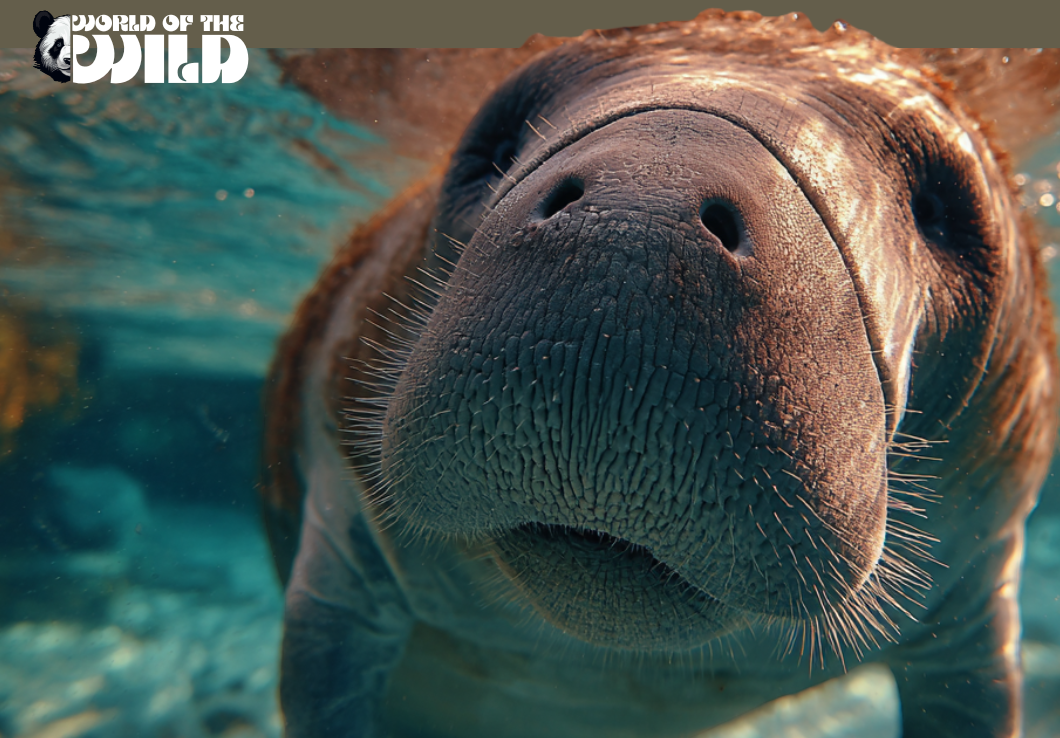

Imagine drifting through the warm, glass-clear waters of a Florida spring, and suddenly, a shadow the size of a small car glides beneath you — slow, deliberate, and utterly untroubled by your presence. You’ve just encountered one of nature’s most disarming creatures: the manatee. Often called “sea cows,” these massive, whiskered mammals have been inspiring wonder, legend, and — tragically — misidentification as mermaids for centuries. They are ancient animals in the truest sense, carrying within their quiet bodies an evolutionary story that stretches back tens of millions of years. Yet for all their grandeur, manatees remain one of the most vulnerable large mammals on Earth. To know a manatee is to fall in love with one — and perhaps to understand why fighting for their survival matters more urgently than ever.
Facts
Here are some quick, fascinating, and lesser-known facts that make manatees truly extraordinary:
- Manatees never leave the water, but they must breathe air — they surface every three to five minutes while active, though they can hold their breath for up to twenty minutes at rest.
- Their closest living relative is the elephant, not any marine mammal. Their evolutionary lineage diverged from a common ancestor approximately 55 million years ago.
- Manatees have a unique, conveyor-belt-style dental system. Unlike most mammals with fixed sets of teeth, manatees continuously grow new molars at the back of their jaw, which slowly move forward as older teeth wear down and fall out — a process called polyphyodonty, shared with kangaroos and elephants.
- They have no natural insulating blubber layer compared to most marine mammals, which is why they are highly dependent on warm water and will die if water temperatures drop below 68°F (20°C) for prolonged periods.
- Manatees are surprisingly agile swimmers and can do barrel rolls, somersaults, and even swim upside down despite their bulk.
- Their skin hosts entire ecosystems. Algae grows on manatee skin, and small fish have been observed feeding directly off that algae, effectively turning the manatee into a living reef.
- Manatees communicate through squeaks, chirps, and whistles that are inaudible to most casual observers, suggesting a richer social communication system than their slow demeanor might imply.
Species
Manatees belong to the order Sirenia, a group of aquatic herbivorous mammals that also includes the dugong. Here is the full taxonomic classification of the West Indian manatee, the most well-known species:
| Rank | Classification |
|---|---|
| Kingdom | Animalia |
| Phylum | Chordata |
| Class | Mammalia |
| Order | Sirenia |
| Family | Trichechidae |
| Genus | Trichechus |
| Species | Trichechus manatus |
The genus Trichechus contains three recognized species:
West Indian Manatee (Trichechus manatus) — The most studied and widely recognized species, found throughout the Caribbean, the Gulf of Mexico, and the southeastern United States. It is further divided into two subspecies: the Florida manatee (T. m. latirostris), which inhabits the waterways of Florida and the southeastern U.S. coast, and the Antillean manatee (T. m. manatus), distributed across Central America, the Caribbean islands, and the northern coast of South America.
West African Manatee (Trichechus senegalensis) — Found along the western coast of Africa and in freshwater river systems stretching from Senegal to Angola, this species is the least studied of the three and faces significant pressure from hunting and habitat loss.
Amazonian Manatee (Trichechus inunguis) — The smallest of the three species and the only one that lives exclusively in freshwater, inhabiting the vast Amazon River basin in Brazil, Colombia, Peru, and Ecuador. It is distinguished by its smoother skin and a characteristic white or pink patch on its chest.
The dugong (Dugong dugon), while not a manatee, is the only other surviving member of the order Sirenia and is more closely related to the extinct Steller’s sea cow (Hydrodamalis gigas), which was hunted to extinction by 1768 — just 27 years after it was first described by European scientists.
Appearance
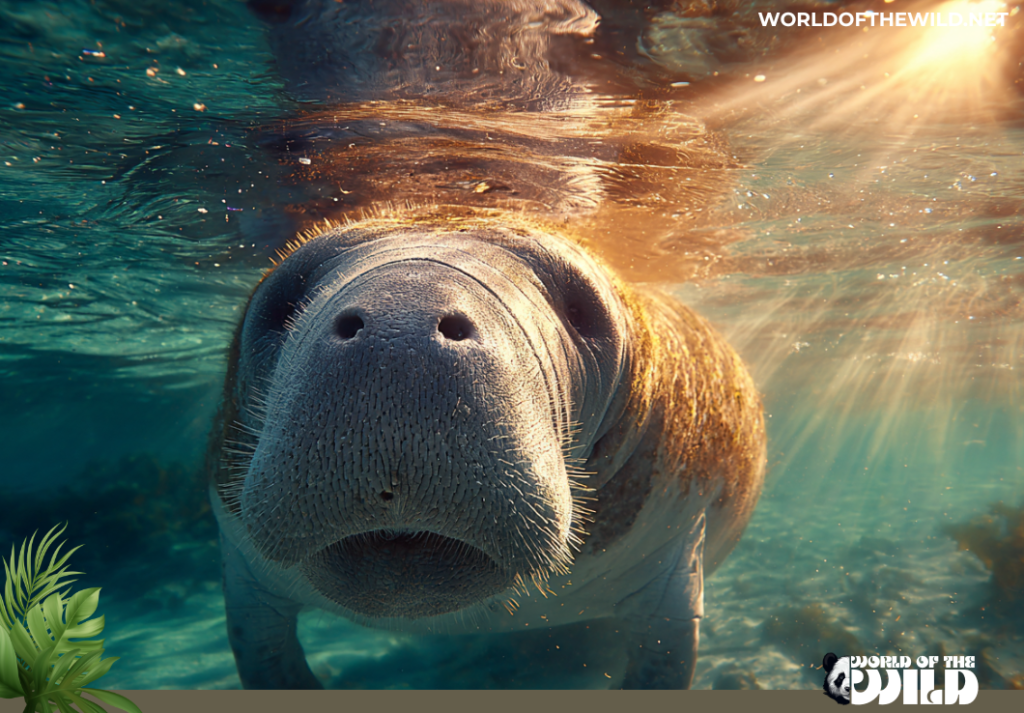
Manatees are unmistakable. Their body is torpedo-shaped and barrel-chested, tapering toward a broad, paddle-shaped tail — a horizontal fluke that distinguishes them from fish and sets them apart visually from the dugong, which has a notched, whale-like tail. Their front limbs have evolved into rounded, flexible flippers, and on closer inspection, you can spot small, fingernail-like structures on the tips of those flippers — a vestigial reminder of their terrestrial ancestors.
Adult West Indian manatees typically measure between 9 and 13 feet (108 to 156 inches) in length, with females generally being larger than males — an unusual trait among mammals. Weight ranges from approximately 800 to 1,300 pounds, though some exceptionally large individuals have exceeded 3,500 pounds.
Their skin is thick, wrinkled, and gray to brownish-gray in color, often mottled with scars — particularly from boat propeller strikes, which have become tragically common identifying markers for individual manatees in Florida. The skin is sparsely covered in fine hairs, most noticeably around the muzzle, where coarse whisker-like vibrissae (sensory bristles) help the animal detect food and navigate murky waters.
The manatee’s face is one of its most endearing features — a broad, fleshy snout with a deeply cleft, prehensile upper lip that splits into two halves, each capable of moving independently to grasp and manipulate vegetation with surprising dexterity. Their small, widely spaced eyes are capable of color vision, and they can close each eye independently using a circular sphincter muscle rather than eyelids. Their external ear openings are tiny, nearly invisible, yet their hearing is remarkably acute for low-frequency sounds.
Behavior
Manatees are gentle, mostly solitary animals — not in the sense that they avoid others of their kind, but in that they do not form permanent herds or structured social groups. They are largely nomadic, moving through warm coastal waters, estuaries, rivers, and springs on their own schedule. The one consistent social bond is between a mother and her calf, which can last for up to two years.
That said, manatees are not antisocial. They engage in what researchers describe as “casual aggregations” — loose groupings that form around warm water sources (such as natural springs or power plant discharge areas), feeding grounds, or simply when individuals happen to cross paths. During these encounters, manatees will touch, nuzzle, and roll around one another in what appears to be play behavior, particularly among younger animals.
Their daily routine is governed by two priorities: eating and thermoregulation. A manatee may spend up to eight hours a day feeding, grazing on aquatic vegetation in a slow, methodical sweep. They alternate this with long rest periods, during which they may sink to the bottom or hover just below the surface in a state of near-complete motionlessness — occasionally mistaken for debris or logs by inattentive boaters.
One of their most remarkable behavioral adaptations is their use of warm water refugia during winter months. Florida manatees, in particular, have learned over generations to congregate around the warm-water outflows of coastal power plants during cold snaps — a behavior so ingrained that certain sites, like the Tampa Electric Manatee Viewing Center, now attract hundreds of animals each winter.
Manatees are also considered cognitively capable animals. Studies have demonstrated that they can learn and retain simple tasks, distinguish between different shapes and colors, and use associative learning — performance on par with dolphins in some experimental settings, despite their very different ecological niche.
Evolution
The evolutionary story of the manatee is one of the great journeys in mammalian history — from land to sea, over the course of tens of millions of years. Manatees and their sirenian relatives descended from a common ancestor shared with proboscideans (the group that includes modern elephants and their extinct relatives like mammoths and mastodons). Fossil evidence, combined with molecular genetics, places this divergence at roughly 55 to 60 million years ago, shortly after the mass extinction event that wiped out the non-avian dinosaurs.
The earliest known sirenians, such as Prorastomus and Pezosiren from the Eocene epoch (approximately 50 million years ago), were still four-legged, semi-aquatic animals — something like a cross between a hippopotamus and a tapir. Pezosiren portelli, discovered in Jamaica, is particularly significant because it possessed fully functional hind limbs yet showed clear anatomical signs of an aquatic lifestyle, including dense bones (a trait that serves as ballast in the water) and features of the skull consistent with modern sirenians.
Over the next 20 to 30 million years, sirenians became increasingly aquatic. Their hind limbs gradually disappeared — though vestigial pelvic bones remain internally in modern manatees as a haunting anatomical echo of their land-dwelling past. Their forelimbs became flippers, their nostrils migrated to the top of their snout, and their bodies became hydrodynamically streamlined.
By the Miocene epoch (roughly 5 to 23 million years ago), sirenians had diversified into a wide range of species across tropical and subtropical coastlines worldwide. From this radiation, the family Trichechidae — the true manatees — emerged, eventually giving rise to the three species alive today. The great Steller’s sea cow, the largest sirenian in recent history at up to 30 feet long, survived in the cold waters of the North Pacific until the 18th century, when it was hunted to extinction in less than three decades of European contact.
Habitat
Manatees are creatures of warm, shallow water. They thrive in tropical and subtropical aquatic environments, which span a surprisingly broad geographic range across the Atlantic Basin and beyond.
The West Indian manatee is found along the southeastern coast of the United States (primarily Florida), throughout the Gulf of Mexico, the Caribbean Sea, and along the Atlantic coast of Central and South America as far south as Brazil. Florida serves as the critical northern stronghold of the species, where the warm-water springs of the St. Johns River, Crystal River, and Blue Spring State Park provide essential thermal refuges during winter.
The Amazonian manatee inhabits the freshwater rivers, lakes, and flooded forests of the Amazon basin — an environment that floods dramatically with seasonal rains, expanding the animal’s accessible habitat by hundreds of thousands of square miles during wet seasons.
The West African manatee occupies a sprawling range of coastal lagoons, estuaries, mangrove channels, and river systems from Senegal in the north to Angola in the south, including major river systems such as the Niger, Senegal, and Congo Rivers.
Across all three species, a few habitat requirements remain constant: water temperatures must stay above 60–68°F (15–20°C), water depth should generally range between 3 and 10 feet for easy feeding and breathing, and access to freshwater for drinking is essential. Seagrass beds are a preferred habitat feature wherever they exist, as they represent a nearly unlimited food source. Manatees are also highly dependent on mangrove ecosystems for shelter, calving, and navigational landmarks.
Diet
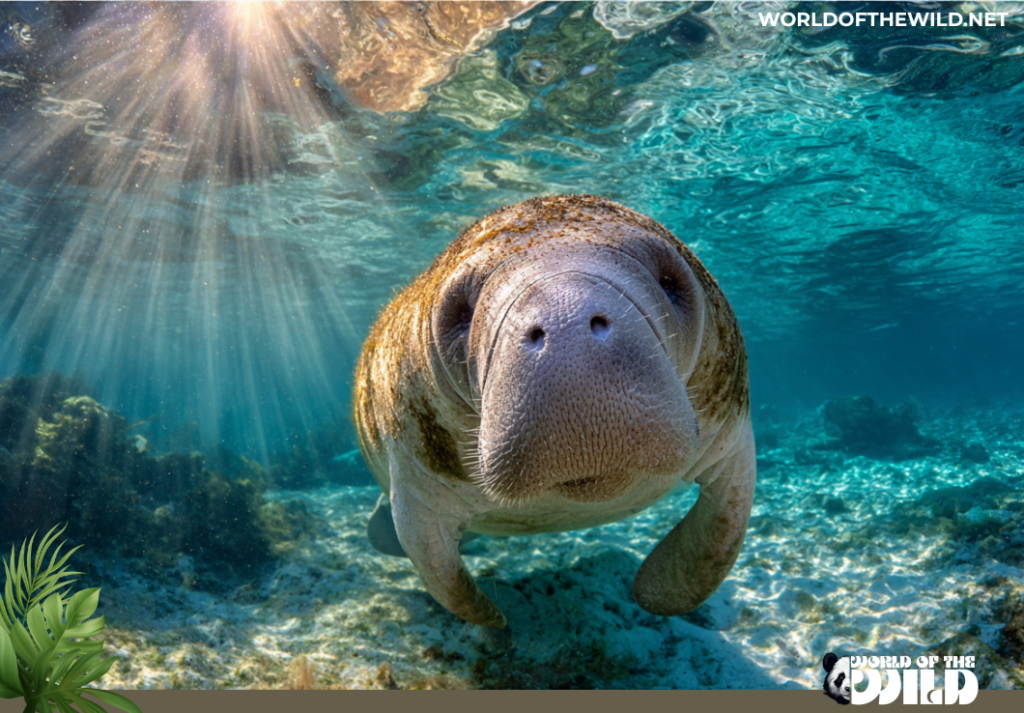
Manatees are obligate herbivores — one of the very few large marine animals to be so — and their feeding behavior is the cornerstone of their ecological role. They are sometimes called the “lawnmowers of the sea” for their ability to consume vast quantities of aquatic vegetation.
Their diet consists primarily of seagrasses, including species such as turtle grass (Thalassia testudinum), manatee grass (Syringodium filiforme), and shoal grass (Halodule wrightii). They will also consume freshwater plants, algae, water hyacinths, mangrove leaves, and even the occasional invertebrate such as small mollusks or fish — though animal matter makes up only a negligible fraction of their intake.
An adult manatee consumes roughly 10 to 15 percent of its body weight in vegetation each day — which can amount to 100 to 150 pounds of plant material for a large individual. Feeding sessions are long and methodical. Using their prehensile upper lip to grasp and tear vegetation, manatees graze slowly along the seafloor or riverbed, often leaving characteristic “prop scars” in seagrass meadows — feeding trails that are visible from the air and used by researchers to track manatee activity.
Manatees do not possess the sharp front incisors typical of many herbivores. Instead, they rely entirely on their flat, ridged molars to grind down fibrous plant material, aided by a large, complex digestive system with a hindgut fermentation process similar to horses and elephants, allowing them to extract maximum nutritional value from otherwise low-calorie vegetation.
Predators and Threats
In their natural environment, adult manatees have essentially no significant natural predators. Their sheer size, tough hide, and aquatic environment afford them effective protection from most would-be threats. Sharks and alligators have been documented in the same waters as manatees, and occasional bite marks have been found on manatee carcasses, but coordinated predatory attacks on healthy adults are virtually unheard of. Calves may be more vulnerable, but even they benefit from the constant vigilance of their mothers.
The real and existential threats to manatees come almost entirely from human activity.
Boat strikes are the single most significant direct cause of manatee mortality in Florida. Manatees are slow — they typically cruise at 3 to 5 mph and rarely exceed 15 mph in short bursts — and they spend much of their time near the water surface, making them tragically susceptible to collisions with motorized watercraft. The propeller scars carried by nearly every adult Florida manatee are a grim testament to this ongoing crisis. In record-setting years, boat strikes have accounted for dozens of deaths annually in Florida alone.
Harmful algal blooms, particularly red tide events caused by the dinoflagellate Karenia brevis, produce powerful toxins that concentrate in the seagrasses manatees eat. Mass mortality events linked to red tide have killed hundreds of manatees in single episodes along Florida’s southwest coast.
Seagrass loss driven by water pollution, agricultural runoff, and coastal development has devastated the food supply available to manatees, contributing to an unprecedented starvation crisis that emerged dramatically in 2021 along Florida’s Indian River Lagoon, where seagrass coverage collapsed due to nutrient pollution and algal overgrowth.
Cold stress syndrome becomes a growing concern as manatees that have become habituated to artificial warm-water sources (like power plant outflows) face potential exposure when those plants are decommissioned. Without the historical knowledge of natural refugia — knowledge passed from mother to calf across generations — some populations may struggle to adapt.
Entanglement in fishing gear, habitat loss from coastal development, and vessel disturbance further compound the pressures facing all three species. In West Africa and the Amazon, hunting for bushmeat remains a serious threat, compounded by weak enforcement of protective laws.
Reproduction and Life Cycle
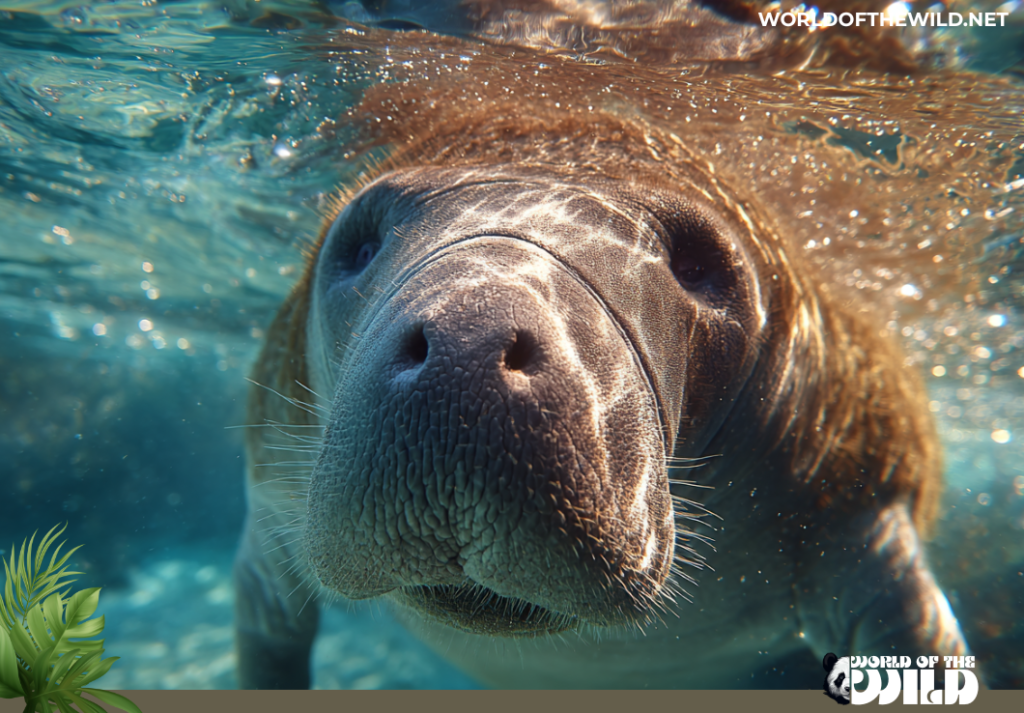
Manatees are slow reproducers — a biological reality that makes population recovery from losses painfully gradual. Females reach sexual maturity at around five years of age, while males may mature slightly earlier but typically do not reproduce successfully until somewhat older due to competition.
There is no defined breeding season. Mating can occur throughout the year, though peaks have been observed in certain populations during warmer months. When a female comes into estrus, she may attract a mating herd — a group of anywhere from 3 to 20 or more males that follow her persistently for days or weeks, jostling and competing for access in a chaotic, exhausting, and occasionally violent display. Females do not appear to actively select a mate; fertilization is largely a numbers game among persistent males.
After mating, females undergo a gestation period of approximately 12 to 14 months, typically giving birth to a single calf. Twins are extremely rare but have been documented. Calves are born underwater and must be guided to the surface for their first breath — a moment that marks the beginning of one of the most intensive mother-offspring bonds in the marine world.
Newborn calves weigh between 60 and 70 pounds and measure roughly 4 feet in length. They begin nursing almost immediately, feeding on rich milk from nipples located near the mother’s armpits, beneath her flippers. Calves remain closely bonded to their mothers for one to two years, during which they learn critical life skills: where to find food, how to navigate between seasonal habitats, and which warm-water refuges to seek in winter. This cultural transmission of knowledge is considered essential to population stability.
Because of this prolonged maternal investment, a female manatee produces a calf only once every two to five years under normal conditions, making each individual birth significant to the population’s long-term trajectory.
In the wild, manatees are believed to live approximately 40 years, with some individuals suspected of reaching 60 or more. One of the most famous Florida manatees, a female known as “Rosie,” was estimated to be over 40 years old based on long-term photo-identification records.
Population
The West Indian manatee (Trichechus manatus) is currently listed as Vulnerable on the IUCN Red List — a classification that, while an improvement from its previous “Endangered” listing (downgraded in 2017), still reflects a species that faces serious long-term risks. The Florida manatee population was estimated at approximately 7,000 to 8,000 individuals in recent aerial surveys, representing a significant recovery from the low hundreds recorded in the 1970s — a genuine conservation success story driven by federal protection, speed zone enforcement, and public awareness.
However, that trajectory was sharply interrupted in 2021, when Florida recorded over 1,100 manatee deaths in a single year — the worst mortality event in documented history — driven primarily by starvation linked to seagrass collapse in the Indian River Lagoon. The crisis prompted emergency supplemental feeding programs by wildlife managers, a controversial but necessary intervention to prevent population collapse.
The Amazonian manatee is listed as Vulnerable, though population data is sparse due to the inaccessibility of much of its range. The West African manatee is listed as Vulnerable as well, but is considered by many experts to be underassessed and potentially in worse condition than current data reflects.
Globally, sirenians are among the most conservation-dependent large mammals on Earth. Their slow reproduction, habitat specificity, and vulnerability to human activity mean that populations can decline faster than they recover. The stabilization — and in Florida’s case, the partial recovery — of manatee populations stands as proof that conservation legislation and habitat protection work. It also stands as a warning: the moment those protections lapse, populations can collapse with devastating speed.
Conclusion
The manatee is more than a gentle curiosity drifting through warm Caribbean waters. It is a living document of evolutionary time — a creature whose ancestors walked on land alongside the ancestors of elephants, whose lineage has navigated every major planetary upheaval for 50 million years, and whose survival now hangs in the balance of decisions made by humans in the span of decades. Every propeller scar on a manatee’s back is a data point in a story we are still writing, and we still have the power to change its ending.
The partial recovery of the Florida manatee is proof that species can come back from the brink when people choose to act. Seagrass restoration projects, boater education campaigns, speed zone enforcement, and dedicated rescue and rehabilitation programs have all played measurable roles in that recovery. But the 2021 mortality crisis was a reminder that recovery is never guaranteed — that the ecosystems supporting these animals are themselves fragile and require active stewardship.
If you find yourself in manatee country, slow down — literally and figuratively. Observe posted speed zones. Support organizations working to restore seagrass habitats and clean up Florida’s waterways. And if you’re ever lucky enough to share the water with one of these animals, take a moment to simply be present with it. In the unhurried drift of a manatee, there is something that feels ancient and wise — a reminder that the ocean was here long before us, and with care, will be here long after.
Quick Reference Table
| Scientific Name | Trichechus manatus (West Indian Manatee) |
| Diet Type | Herbivore |
| Size (Length) | 108 – 156 inches (9 – 13 feet) |
| Weight | 800 – 1,300 lbs (up to 3,500 lbs in exceptional cases) |
| Region Found | Southeastern United States (Florida), Gulf of Mexico, Caribbean Sea, Central & South America (Atlantic coast); West African species: Western Africa; Amazonian species: Amazon River Basin |