
Imagine standing in the dense, cathedral-like rainforests of Central Africa, where shafts of light barely pierce the layered canopy above. Somewhere in that green labyrinth lives an animal so closely related to us that sharing a handshake would feel less like fantasy and more like meeting a long-lost cousin. The Western Gorilla — the largest living primate on Earth — is a creature of contradictions: built like a fortress yet remarkably gentle, profoundly intelligent yet often misunderstood, ancient in its evolutionary roots yet dangerously close to vanishing from our world.
For centuries, these magnificent apes have captured the human imagination, inspiring both fear and reverence. Today, science has replaced myth with something even more extraordinary: a portrait of a highly social, emotionally complex, and ecologically vital animal. Understanding the Western Gorilla is not just an exercise in natural history — it is an urgent conversation about what we stand to lose if we fail to act.
Facts
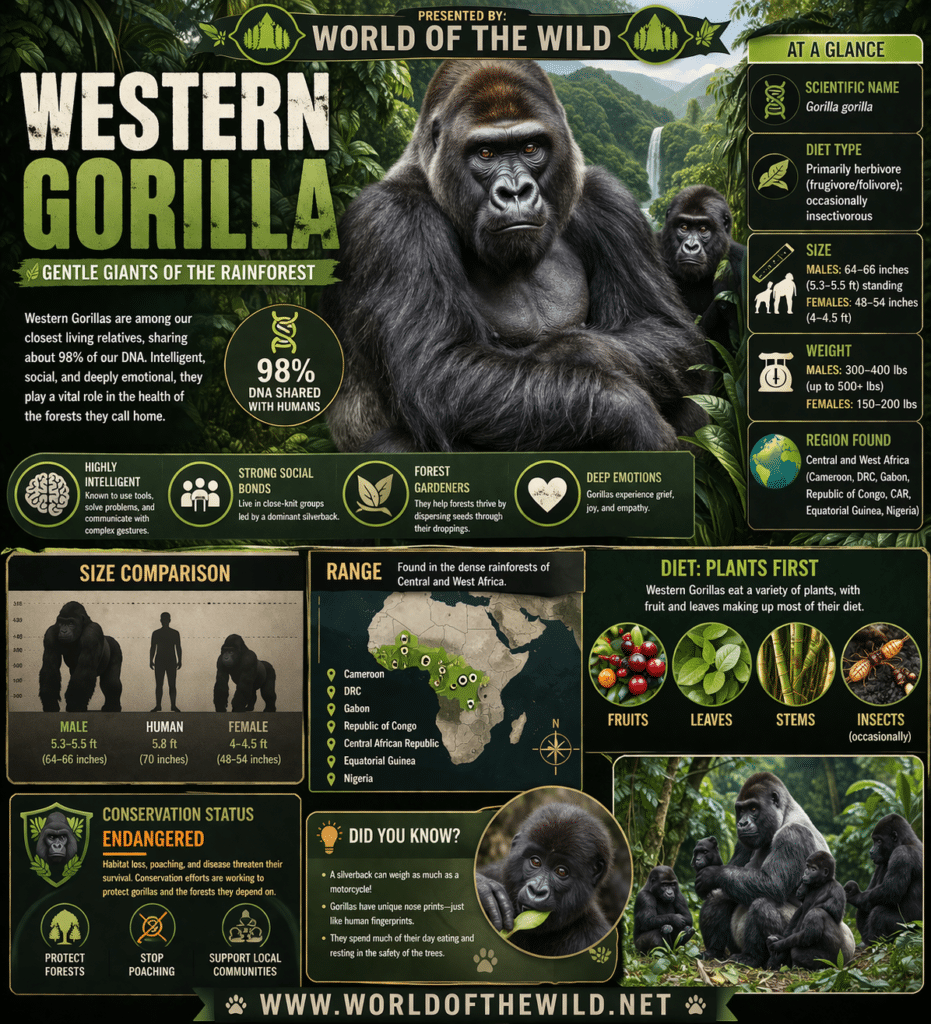
- Genetic neighbors: Western Gorillas share approximately 98.3% of their DNA with humans, making them one of our closest living relatives alongside chimpanzees and bonobos.
- Knuckle-walking engineers: Gorillas walk on their knuckles rather than the flats of their hands or feet, a locomotion style that allows them to support their massive body weight while keeping their hands partially protected.
- Gut fermenters: Western Gorillas have a remarkably large colon that ferments the tough plant matter they consume, extracting maximum nutrition from fibrous leaves and stems.
- No two noses alike: Just like human fingerprints, every gorilla has a unique nose print — researchers in the field actually use detailed nose-print catalogues to identify individual animals.
- Nest builders every night: Gorillas construct a brand-new sleeping nest each evening, either on the ground or in tree branches, using leaves and branches woven together — a fresh bed made from scratch, every single day.
- Surprisingly quiet drinkers: Western Gorillas rarely drink water directly. They obtain nearly all of their hydration from the moisture-rich plants, fruits, and morning dew on leaves that make up their diet.
- Silverbacks aren’t a separate species: The iconic silver saddle of hair that gives dominant males their famous name is simply the result of aging — it develops naturally as males mature, typically around 12–13 years of age.
Sounds of the Gorilla
Species
The Western Gorilla occupies a precise and fascinating place on the tree of life:
| Rank | Classification |
|---|---|
| Kingdom | Animalia |
| Phylum | Chordata |
| Class | Mammalia |
| Order | Primates |
| Family | Hominidae |
| Genus | Gorilla |
| Species | Gorilla gorilla |
The genus Gorilla is divided into two distinct species: the Western Gorilla (Gorilla gorilla) and the Eastern Gorilla (Gorilla beringei). These two species are separated by the vast Congo Basin and have evolved along separate trajectories for hundreds of thousands of years.
Within the Western Gorilla, there are two recognized subspecies. The Western Lowland Gorilla (Gorilla gorilla gorilla) is by far the most numerous and the subspecies most commonly seen in zoos and wildlife sanctuaries. It inhabits the lowland tropical forests and swampy areas of Central and West Africa. The second subspecies, the Cross River Gorilla (Gorilla gorilla diehli), is far rarer and is considered one of the most critically endangered primates on the planet, with a population numbering only in the hundreds. It is confined to a small cluster of forest patches along the Nigeria-Cameroon border, where its isolation has led to subtle but measurable physical and behavioral differences from its lowland cousin.
Appearance
The Western Gorilla is, simply put, an impressive physical specimen. Adult males — known as silverbacks — are the largest primates alive today, standing between 4 to 5.5 feet tall when upright and tipping the scales at a staggering 300 to 400 pounds, though exceptionally large individuals can exceed 500 pounds in captivity. Females are considerably smaller, typically weighing between 150 to 200 pounds and measuring around 4 to 4.5 feet in height.
The body is massively built, with a broad chest, powerful shoulders, and arms that are significantly longer than the legs — a design perfectly suited for climbing and knuckle-walking through dense forest undergrowth. The hands are enormous, with thick, dexterous fingers capable of both brute strength and surprisingly delicate manipulation.
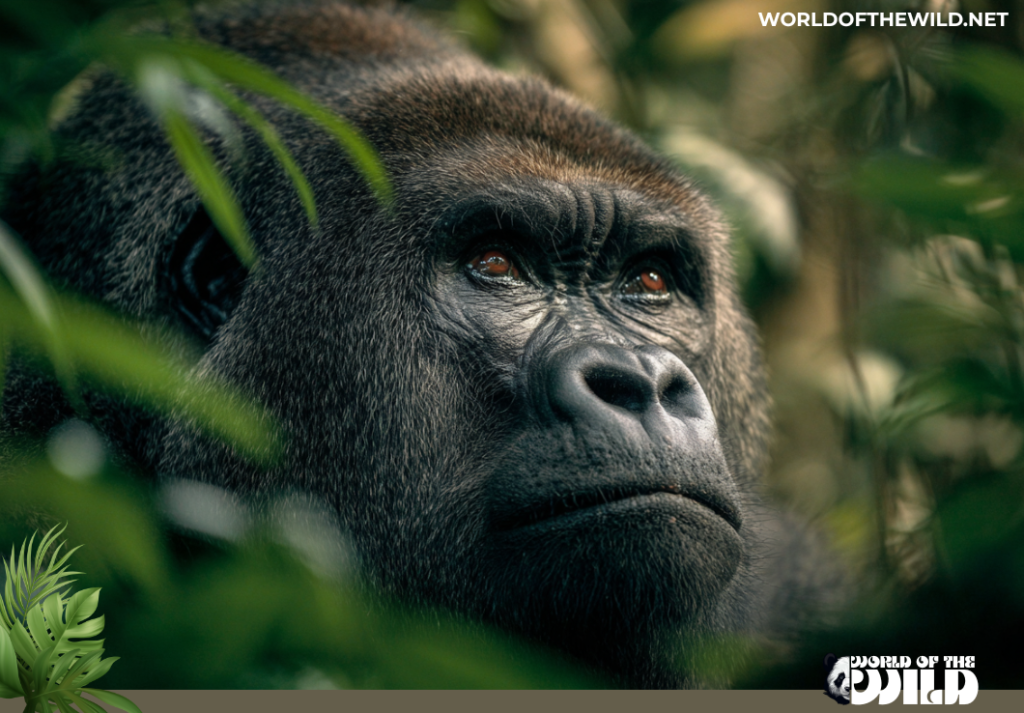
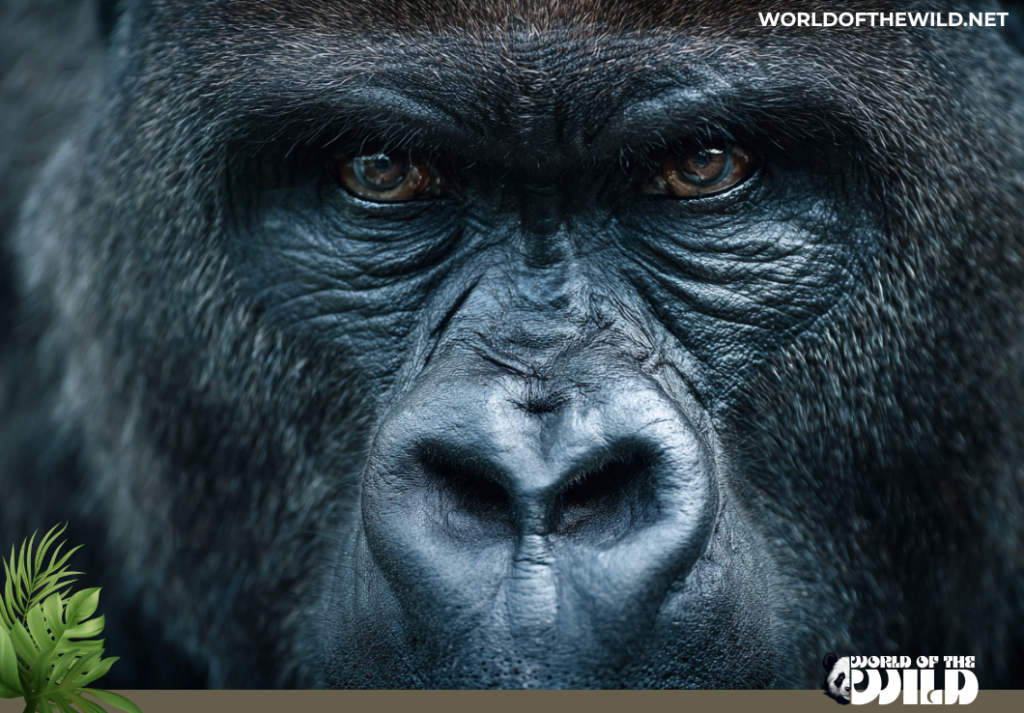
The coat of a Western Gorilla is predominantly brownish-gray to black, though Western Lowland Gorillas often exhibit a distinctive reddish-brown crown on the top of the head — a subtle feature that sets them apart visually from Eastern Gorillas. The face is bare, dark, and deeply expressive, framed by prominent brow ridges that give the animal its characteristically intense gaze. As males age, the signature silver saddle of hair spreads from the back across the rump and upper thighs, announcing their dominant status to all who see them.
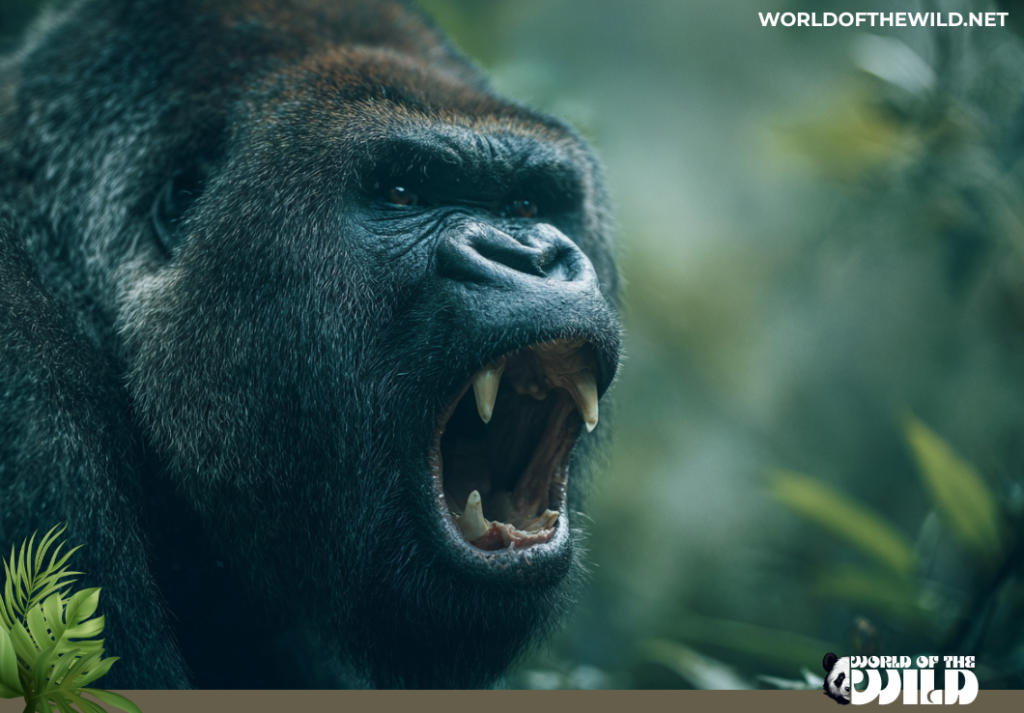
Both sexes possess large, canine teeth that may look ferocious but are used primarily for display and social signaling rather than predation. The sagittal crest — a bony ridge running along the top of the skull in adult males — serves as an anchor for the enormous jaw muscles required to process their tough plant-based diet.
Behavior
Western Gorillas are highly social animals that live in cohesive family groups, typically called troops or bands, which usually number between 5 and 30 individuals. Each group is led by a dominant silverback, who serves simultaneously as protector, decision-maker, and social anchor. His authority is rarely challenged from within the group, and his daily movements set the pace for the entire troop.
The daily routine of a gorilla group is a rhythm of feeding, resting, and moving. Mornings typically begin with foraging sessions, followed by a midday rest during which adults lounge, juveniles play, and social bonds are reinforced through grooming. Afternoons bring another round of feeding before the group settles into its freshly constructed nests as darkness falls.
Communication in Western Gorillas is rich and multi-modal. They employ a sophisticated repertoire of vocalizations — including grunts, barks, screams, and the iconic chest-beating display of silverbacks — alongside facial expressions, body postures, and tactile signals. The chest-beat, often misinterpreted as pure aggression, is more accurately a display of confidence and a warning to rivals or perceived threats. It is often accompanied by hooting calls, ground slapping, and sideways running charges, creating a theatrical performance designed to intimidate without necessarily requiring physical combat.
Gorillas demonstrate remarkable intelligence. They have been observed using tools in the wild — including using sticks to gauge water depth before wading — and individuals in captivity have learned hundreds of signs in American Sign Language. Problem-solving, play behavior, mourning of the dead, and even what appears to be laughter during play have all been documented, reinforcing the picture of an animal with a rich inner life.
Young gorillas spend years in close physical contact with their mothers and engage in extended periods of play that help develop social skills and physical coordination. The bonds within a troop are enduring and emotionally significant — the loss of a group member, particularly the dominant silverback, can send the entire troop into visible distress.
Evolution
The evolutionary story of the Western Gorilla stretches back tens of millions of years into the primate lineage. The great apes — including gorillas, chimpanzees, bonobos, orangutans, and humans — belong to the family Hominidae and share a common ancestor with Old World monkeys that diverged roughly 25 to 30 million years ago.
The lineage leading specifically to gorillas is thought to have split from the ancestor shared with humans and chimpanzees approximately 8 to 10 million years ago, during the Late Miocene epoch — a period characterized by significant climate shifts in Africa that fragmented forests and drove the diversification of primate lineages.
Early fossil evidence of gorilla-like primates includes remains found in Kenya, suggesting the ancestral gorilla lineage once ranged across a broader swath of the African continent before retreating to its current range. The split between Western and Eastern Gorilla species likely occurred somewhere between 1 and 2 million years ago, as the formation of the Congo Basin acted as a geographic barrier separating populations over geological time.
Compared to some other great apes, gorillas evolved toward a more terrestrial, herbivorous lifestyle — a departure from the more omnivorous and arboreal tendencies seen in chimpanzees. This evolutionary path shaped their massive digestive systems, powerful dentition, and the ground-dwelling social structures that define the genus today.
Habitat
The Western Gorilla is a creature of Africa’s equatorial heartland. Its range spans several countries in Central and West Africa, including Cameroon, the Central African Republic, the Democratic Republic of Congo, Equatorial Guinea, Gabon, Nigeria, and the Republic of Congo. Gabon and the Republic of Congo together harbor the majority of the remaining Western Lowland Gorilla population, largely within intact tracts of lowland tropical forest.
These gorillas thrive in a variety of forest types, including tropical moist lowland forests, montane forests, swamp forests, and forest-savanna mosaics. They show a particular affinity for areas near rivers and clearings known locally as bais — natural forest clearings where mineral-rich soils attract not only gorillas but also forest elephants and buffalo. These clearings serve as important social gathering points and are among the most reliable locations for researchers to observe Western Lowland Gorillas in the wild.
Elevation plays a role in habitat use as well, with Western Gorillas generally found at lower altitudes than their Eastern counterparts, typically below 5,000 feet above sea level. The forest they inhabit is characterized by a dense, layered canopy, a diverse understory rich in herbs and vines, and an abundance of fruit trees that define much of their seasonal movements. They are not rigidly territorial in the human sense, but groups do maintain loosely defined home ranges that may overlap with neighboring groups, occasionally leading to brief and usually non-violent encounters between silverbacks.
Diet
The Western Gorilla is primarily a herbivore, though it occasionally supplements its plant-based diet with protein from invertebrates. Its menu is impressively diverse, reflecting the extraordinary botanical richness of its forest home.
The bulk of the diet consists of fruits, leaves, stems, bark, roots, and pith — the soft inner tissue of plants. Western Lowland Gorillas are notably more frugivorous (fruit-eating) than Eastern Gorillas, and their movements through the forest are often dictated by the seasonal availability of ripe fruit. During periods when fruit is abundant, they may consume it almost exclusively; when it is scarce, they shift toward a diet heavy in leaves, stems, and terrestrial herbaceous vegetation.
Gorillas are also known to consume termites, ants, and other insects, occasionally digging into termite mounds or logs to access them — a behavior that provides a valuable boost of protein and fat. They have also been observed at mineral licks, consuming soil and clay that likely supplement their diet with essential minerals not available in sufficient quantities from plant matter alone.
Foraging is an all-day enterprise. An adult silverback may consume 40 to 60 pounds of vegetation per day to sustain his immense body mass, and the troop as a whole can have a significant impact on the plant communities within its range. This consumption, however, also positions the gorilla as an important seed disperser — fruits are eaten, seeds travel intact through the digestive system, and are deposited across the forest, actively contributing to forest regeneration and biodiversity.
Predators and Threats
In the natural world, adult Western Gorillas have few serious predators. Their sheer size, social structure, and the protective ferocity of a silverback make them formidable targets. Leopards (Panthera pardus) are the primary natural predator of gorillas, and while they may occasionally prey on juveniles or attempt attacks at night, successful predation on healthy adults is rare. Crocodiles pose a threat in riverine areas, and there is some evidence of lions occasionally testing groups near forest-savanna margins.
The far more significant and existential threats to Western Gorillas come not from other predators, but from human activity.
Habitat loss stands as the single greatest threat. Industrial logging, agricultural expansion — particularly for palm oil and rubber plantations — charcoal production, and infrastructure development are destroying and fragmenting the forests that gorillas depend upon. As forests shrink and become isolated patches, gorilla populations become genetically cut off from one another, reducing genetic diversity and long-term viability.
Bushmeat hunting remains a severe and ongoing crisis, driven by both subsistence needs and commercial trade. Gorillas are killed for food and their body parts, with infants sometimes captured alive for the illegal pet trade. The death of even a single silverback can destabilize an entire troop, leading to the disbanding or collapse of the family group.
Zoonotic disease is a uniquely devastating threat because of the genetic closeness between gorillas and humans. Ebola virus disease has caused catastrophic population crashes in certain areas of Central Africa, wiping out significant proportions of local gorilla populations in short periods of time. Respiratory illnesses carried by humans — including diseases as common as the flu — can be fatal to gorillas, making unregulated ecotourism and researcher contact a genuine biosecurity concern.
Mining and extractive industries, particularly in conflict-affected regions of the DRC, further degrade habitat and increase human presence in previously remote forest areas, creating a cascade of secondary threats including increased hunting pressure and road-building that opens previously inaccessible forest to exploitation.
Reproduction and Life Cycle
Gorillas reproduce slowly — a biological reality that makes population recovery from decline extraordinarily difficult and underscores the gravity of every individual lost.
Females reach sexual maturity at around 7 to 8 years of age, though they typically do not give birth until they are 10 or older. Males mature more slowly, with silverback status and reproductive activity generally not achieved until their mid-teens. There is no fixed breeding season; reproduction occurs year-round, with females exhibiting subtle rather than pronounced estrus signals — a relatively understated mating signal compared to other apes.
The gestation period lasts approximately 8.5 months, closely mirroring that of humans. Births almost always result in a single infant, with twins being extremely rare. A newborn gorilla is helpless and tiny relative to its mother’s size — weighing only about 4 pounds at birth — and clings to its mother’s chest during the first months of life before eventually riding on her back.
Maternal investment is enormous and prolonged. Infants are nursed for 3 to 4 years and remain in close physical and social contact with their mothers for many years beyond weaning. This extended dependence means that a female gorilla typically gives birth only once every 4 to 6 years — one of the lowest reproductive rates of any land mammal.
The interbirth interval of 4–6 years is the Achilles’ heel of gorilla population dynamics. Even under ideal conditions, a female gorilla may successfully raise only 3 to 5 offspring during her entire lifetime. Given the current rates of mortality from poaching, disease, and habitat loss, the mathematics of survival are deeply challenging.
Western Gorillas in the wild typically live 35 to 40 years, though individuals in captivity have been known to survive into their 50s. The record for longevity in captivity belongs to a female Western Lowland Gorilla named Fatou, housed at Berlin Zoo, who was reported to be over 60 years of age — an extraordinary milestone for any great ape.
Population
The Western Gorilla faces a sobering conservation reality. The species as a whole is listed as Critically Endangered on the IUCN Red List — the highest threat category before extinction in the wild. Both subspecies carry serious concern, though their situations differ significantly in scale.
The Western Lowland Gorilla (Gorilla gorilla gorilla) is estimated to number somewhere around 100,000 to 150,000 individuals in the wild, making it the most populous gorilla subspecies. While this may sound reassuring, these numbers represent a significant decline from historical levels, and the population trend is assessed as decreasing. The IUCN specifically notes that if threats continue at their current pace, the subspecies could lose more than 80% of its population over a 75-year window.
The Cross River Gorilla (Gorilla gorilla diehli) faces a far more precarious situation, with a total estimated population of only 200 to 300 individuals, fragmented across approximately 11 isolated forest patches. This small, fragmented population exists at the very edge of demographic viability, making every individual critically important to the subspecies’ survival.
Population surveys for gorillas are inherently difficult, relying on nest counts, camera traps, and DNA analysis from fecal samples across vast, often inaccessible terrain. This means population estimates carry significant uncertainty, but the broad direction of the trend — downward — is not in doubt.
Conclusion
The Western Gorilla is more than a remarkable animal. It is a mirror held up to our own nature — a reflection of intelligence, social complexity, emotional depth, and evolutionary kinship that challenges us to see ourselves in a different light. These are animals that grieve, play, problem-solve, and form lasting bonds. They are architects of the forests they inhabit, engineers of biodiversity through their role as seed dispersers, and living evidence of the extraordinary richness of life on Earth.
And they are disappearing.
The story of the Western Gorilla is, at its heart, a story about choices — the choices made by governments, corporations, conservation organizations, and individuals that collectively determine whether these great apes persist or vanish. The good news is that targeted conservation efforts do work: community-based conservation programs, anti-poaching initiatives, habitat corridors, and Ebola vaccination trials have all shown measurable positive results. Ecotourism, when properly managed, can simultaneously fund conservation and give local communities a sustainable economic stake in the gorilla’s survival.
The question is not whether we can save the Western Gorilla. The question is whether we will choose to. Future generations — both human and gorilla — are waiting for an answer.
Quick Reference
| Scientific Name | Gorilla gorilla |
| Diet Type | Primarily herbivore (frugivore/folivore); occasionally insectivorous |
| Size | Males: 64–66 inches (5.3–5.5 ft) standing; Females: 48–54 inches (4–4.5 ft) |
| Weight | Males: 300–400 lbs (up to 500+ lbs); Females: 150–200 lbs |
| Region Found | Central and West Africa (Cameroon, DRC, Gabon, Republic of Congo, CAR, Equatorial Guinea, Nigeria) |