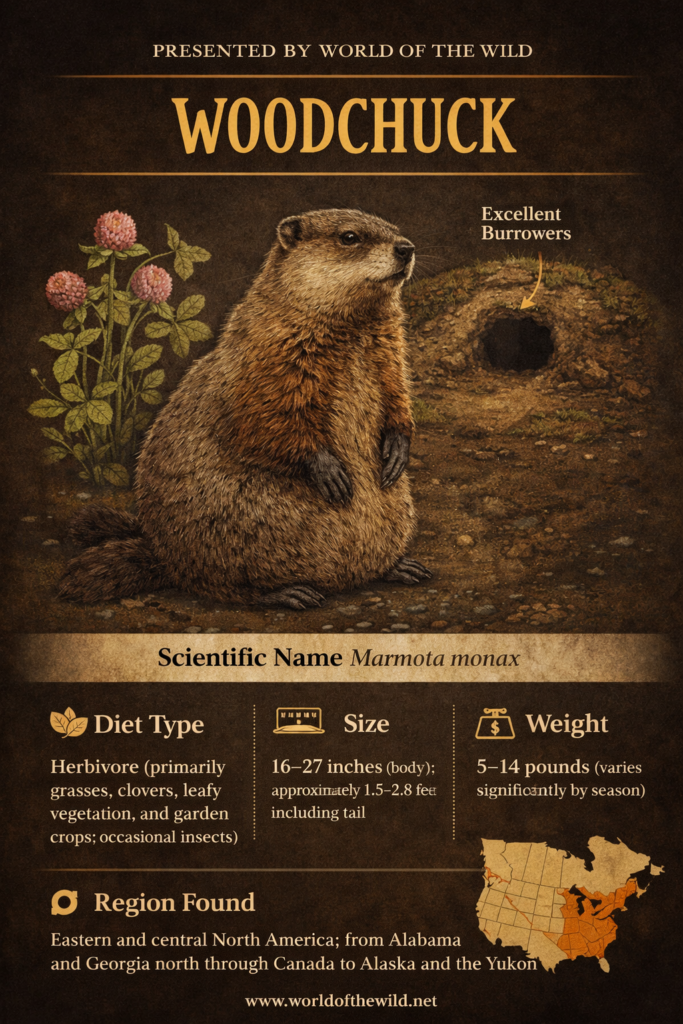

There’s a famous tongue twister that asks how much wood a woodchuck could chuck if a woodchuck could chuck wood — but the real question should be: how much do we actually know about this remarkable creature? The woodchuck, better known in many circles as the groundhog, is one of North America’s most recognizable yet thoroughly misunderstood mammals. Immortalized in folklore, celebrated on a February holiday, and dismissed by many as nothing more than a backyard nuisance, the woodchuck deserves far more credit than it typically receives. Beneath that stocky, unassuming exterior lies a physiological marvel — an animal that essentially “dies” every winter and comes back to life in spring, a burrowing architect that reshapes entire ecosystems, and a surprisingly intelligent rodent with complex social instincts. It’s time to dig a little deeper — quite literally — into the world of the woodchuck.
Facts
Here are some quick, fascinating facts that might just change the way you see this humble creature:
- The tongue twister has a real answer. Wildlife biologist Richard Thomas actually studied this question in 1988 and determined that, if a woodchuck could chuck wood, it would chuck approximately 700 pounds of dirt when digging a burrow — which translates to roughly 35 cubic feet of earth per day.
- Woodchucks are true hibernators. Unlike bears, which merely enter a light torpor, woodchucks are among the few mammals that experience genuine, deep hibernation — their body temperature drops from around 99°F to as low as 37°F, and their heart rate slows from 80 beats per minute to just 5.
- They are exceptional climbers and swimmers. Despite their rotund build, woodchucks can scale trees with surprising agility and are competent swimmers when the need arises.
- Their burrows are ecological gifts. A single woodchuck burrow can extend up to 25 feet in length, with multiple rooms used for sleeping, nursing young, and even a dedicated latrine chamber. Abandoned burrows become critical shelter for foxes, rabbits, skunks, and various birds.
- Groundhog Day is rooted in ancient European tradition. The American holiday traces its lineage to the Celtic festival of Imbolc and later the German tradition of Candlemas, in which a badger — not a groundhog — was used to predict the weather.
- Woodchucks communicate with whistles. Their sharp, high-pitched alarm calls have earned them the lesser-known nickname “whistle-pig” across parts of Appalachia and the rural South.
- They bulk up deliberately. Before hibernation, woodchucks consume enormous quantities of food to nearly double their body weight, building fat reserves that fuel their months-long underground dormancy without a single meal.
Species
The woodchuck occupies a well-defined place in the tree of life, sitting firmly within the large and diverse order of rodents.
Full Taxonomic Classification:
- Kingdom: Animalia
- Phylum: Chordata
- Class: Mammalia
- Order: Rodentia
- Family: Sciuridae (the squirrel family)
- Genus: Marmota
- Species: Marmota monax
The woodchuck belongs to the marmot genus Marmota, which contains approximately 15 species distributed across North America, Europe, and Asia. Within Marmota monax itself, scientists recognize several subspecies, each adapted to slightly different geographic and climatic conditions across its range:
- Marmota monax monax — the nominate subspecies, found across much of the eastern United States and Canada.
- Marmota monax ignava — the Canadian or Labrador woodchuck, inhabiting the northeastern reaches of the species’ range including parts of Quebec and Labrador.
- Marmota monax rufescens — found in the Great Plains and central regions, tending toward slightly more reddish-brown coloring.
- Marmota monax canadensis — broadly distributed across central Canada.
- Marmota monax ochracea — a subspecies found in Alaska and the Yukon.
Close relatives within the marmot genus include the yellow-bellied marmot (Marmota flaviventris) of the western United States, the hoary marmot (Marmota caligata) of the Pacific Northwest and Alaska, and the iconic Alpine marmot (Marmota marmota) of Europe. The woodchuck is the most widespread and commonly encountered member of its genus in North America.
Appearance
The woodchuck is built for a life spent burrowing, eating, and enduring the cold — and its physical form reflects every one of those priorities.
Adults are robust, heavyset animals with short, powerful legs and a broad, flattened head. Their body length typically ranges from 16 to 27 inches, with a shorter, bushy tail adding another 4 to 7 inches. Weight varies considerably by season and individual, but most adults fall between 5 and 14 pounds, with pre-hibernation individuals occasionally tipping the scales even higher as they pack on fat reserves.
Their fur is dense and coarse, featuring a distinctive grizzled brown coloration created by multi-banded individual hairs — typically dark brown at the base with lighter, yellowish or reddish-brown tips. The underside is a paler buff or light brown, and the face often appears somewhat darker with a blunt, broad muzzle. The feet are dark brown to black, equipped with sturdy, curved claws that are purpose-built for digging through compacted earth. A small but functional thumb-like projection on each forepaw aids in manipulating food and stabilizing the animal while it burrows.
The woodchuck’s incisors are large, white, and self-sharpening — a hallmark of the rodent family — and continue growing throughout the animal’s lifetime, worn down naturally through constant gnawing. Their small, rounded ears sit close to the skull, an adaptation that helps prevent soil from entering the ear canal during digging. Their eyes are set high on the head, providing a wide field of view — an important advantage for an animal that must constantly scan the horizon for predators while feeding.
Albino and melanistic (all-black) individuals, while rare, do occasionally appear in wild populations and have been documented across parts of their range.

Behavior
Woodchucks are largely solitary animals outside of the mating season, each adult maintaining its own burrow system and defending a personal home range. However, they are far from antisocial in the broader sense — they are surprisingly alert, communicative, and behaviorally nuanced creatures.
Their daily routine during the active season (spring through early fall) follows a fairly predictable pattern. They are most active in the early morning and late afternoon hours, emerging from their burrows to feed during cooler parts of the day and retreating from the midday heat. They spend a significant portion of their active hours foraging, but also devote considerable time to sitting upright on their haunches in a characteristic posture — scanning their surroundings with a vigilance that belies their seemingly placid demeanor.
Communication is a cornerstone of woodchuck behavior, and they employ a varied vocal repertoire. The sharp, piercing whistle for which they earned the “whistle-pig” nickname serves as an alarm call to warn neighboring animals of aerial predators. A low, chattering sound is used as a ground-level alarm, while tooth grinding signals aggression or fear. They also produce softer chirping sounds, particularly between mothers and their young.
Woodchucks are surprisingly intelligent for an animal rarely given much credit in that department. They demonstrate spatial memory, remembering the locations of burrow entrances and food sources across seasons. They also exhibit a notable awareness of human behavior over time — suburban woodchucks, for example, have been documented adjusting their activity periods and foraging routes in response to human presence, displaying a behavioral flexibility consistent with measured problem-solving.
Their burrows are among their most impressive behavioral achievements. A typical burrow system includes a primary entrance (often marked by a large dirt mound), one or more “plunge holes” (vertical emergency exits hidden under vegetation), a main tunnel, a sleeping chamber lined with dried grasses, and a separate latrine area. This degree of architectural planning reflects a level of behavioral sophistication that sets woodchucks apart from many of their rodent relatives.
As winter approaches, woodchucks enter a preparatory phase — they consume food almost obsessively, dramatically increasing caloric intake to build fat reserves. They then retreat underground and enter true hibernation, curling into a tight ball in their sleeping chamber. This state is so physiologically profound that they cannot be roused even by significant external disturbance, and they may not emerge for five to six months depending on latitude and climate conditions.
Evolution
The woodchuck’s evolutionary story stretches back tens of millions of years and is intertwined with the remarkable diversification of the rodents, which represent the most species-rich order of mammals on Earth.
The family Sciuridae — squirrels in the broadest sense — diverged from other rodent lineages approximately 36 million years ago during the Eocene epoch. Fossil evidence suggests that the earliest sciurids were arboreal creatures not unlike modern tree squirrels, and the transition to ground-dwelling lifestyles evolved multiple times independently within the family.
The genus Marmota is believed to have originated in North America during the Miocene epoch, approximately 5 to 10 million years ago. The ancestral marmots were likely already ground-dwelling and colonial, living in open grassland and steppe environments that were expanding across the continent during that period. A fascinating chapter in marmot evolutionary history involves the dispersal of the genus into Eurasia via the Bering Land Bridge, explaining why closely related marmot species exist today in both North America and across the mountains of central Asia and Europe.
The woodchuck’s particular adaptations — most notably its capacity for deep hibernation — represent one of the more extraordinary evolutionary innovations in the mammalian world. True hibernation requires a highly specialized suite of physiological controls involving altered thermoregulation, cardiac function, metabolic suppression, and immune system modulation. Scientists studying woodchuck hibernation biology have made significant contributions to our understanding of these mechanisms, and ongoing research into the molecular triggers of woodchuck hibernation has implications for fields as diverse as organ preservation and the treatment of hypothermia in humans.
Genetic studies have confirmed that Marmota monax is the most basal (ancestral) member of the Marmota genus in North America, suggesting the woodchuck most closely resembles the common ancestor of all North American marmots.

Habitat
The woodchuck is a quintessential creature of the woodland edge — thriving not in the depths of old-growth forest nor in the wide-open plains, but in that productive, transitional zone where forest gives way to meadow, field, or human-altered landscape.
Geographically, the woodchuck’s range spans a vast swath of eastern North America, extending from central Alabama and Georgia in the south northward through New England and across much of Canada, reaching as far north as Alaska and the Yukon in its western and northern limits. The species is absent from much of the southeastern coastal plain and has a patchy distribution in the arid west.
Within this range, woodchucks are most commonly found in:
- Forest edges and clearings — the classic habitat, where open ground for foraging lies within easy reach of woodland cover and burrow sites.
- Agricultural fields and pastures — farmland has proven enormously beneficial for woodchucks, providing an abundance of forage crops and soft soil well-suited for burrowing.
- Suburban and urban green spaces — parks, golf courses, highway medians, and residential backyards have all been successfully colonized, making the woodchuck one of the more adaptable suburban wildlife species in eastern North America.
- Brushy hillsides and rocky outcrops — particularly in more mountainous regions, woodchucks favor sloped terrain that naturally drains well and reduces the risk of burrow flooding.
Their burrows are almost always situated near a food source and typically feature at least one entrance beneath a rock, log, stump, or shrub for protective cover. Woodchucks generally prefer areas where the soil is relatively soft and well-drained, avoiding waterlogged lowlands and dense clay soils that make digging difficult.
Diet
The woodchuck is a strict herbivore, and a remarkably enthusiastic one at that. Its entire active-season existence is organized around the procurement of enough plant material to sustain itself through winter and fuel the recovery from hibernation in spring.
Primary food sources include:
- Grasses and clovers — the foundation of the woodchuck’s diet through most of the active season.
- Wildflowers and garden plants — dandelions, plantain, and a wide variety of garden vegetables including lettuce, beans, peas, squash, and corn are eagerly consumed, a habit that brings woodchucks into frequent conflict with gardeners.
- Agricultural crops — alfalfa and soybeans are particularly favored where available.
- Leaves, bark, and twigs — consumed more commonly in early spring before other vegetation has fully emerged, and occasionally in late fall.
- Fruits and berries — wild strawberries, raspberries, and other seasonal fruits are opportunistically eaten when available.
- Insects and small invertebrates — while primarily herbivorous, woodchucks occasionally consume beetles, grasshoppers, snails, and grubs, likely as incidental protein supplements.
Foraging woodchucks are methodical and cautious. They typically move outward from their burrow entrance in a widening arc, rarely straying more than 150 feet from the safety of their tunnel in most circumstances. Eating is frequently interrupted by upright scanning postures, and the animal retreats underground at the slightest sign of threat before returning to resume feeding. In late summer and early fall, foraging intensity reaches its peak as the woodchuck races to accumulate the fat reserves necessary for successful hibernation.
Predators and Threats
Despite its burrowing instincts and keen alertness, the woodchuck sits squarely in the middle of many predator-prey relationships across its range.
Natural Predators:
- Red foxes and gray foxes are among the woodchuck’s most persistent predators, particularly targeting juveniles and animals caught in the open.
- Coyotes have become increasingly significant predators as their range has expanded eastward and into suburban landscapes.
- Bobcats and lynx prey on woodchucks across much of their range, particularly in more rural and forested areas.
- Black bears will dig out burrows to access woodchucks, though this represents opportunistic rather than targeted predation.
- Hawks and eagles — particularly red-tailed hawks — pose a significant aerial threat, especially to juvenile woodchucks and individuals feeding in open areas.
- Dogs — both domestic and feral — are surprisingly significant predators of woodchucks in agricultural and suburban settings.
- Weasels and minks are small enough to pursue woodchucks into their burrows, making them uniquely dangerous among predators.
Human-Caused Threats:
The woodchuck does not currently face existential threats from human activity in the way that many other wildlife species do, but that doesn’t mean it exists entirely without human-related pressure:
- Vehicle collisions are among the most significant sources of woodchuck mortality in suburban and agricultural areas, as animals crossing roads between burrows and feeding sites are frequently struck.
- Habitat loss and fragmentation — while woodchucks are adaptable, the conversion of forest-edge habitat to dense urban development or intensively managed monoculture agriculture removes the structural diversity they depend on.
- Lethal pest control — because of the damage their burrows and feeding habits can cause to gardens, crops, and even building foundations, woodchucks are legally and regularly trapped and killed across much of their range.
- Hunting and trapping — woodchucks are classified as a game or nuisance species in many states and provinces, and regulated hunting is a common management tool.
Climate change poses a potentially significant long-term challenge: warming springs may disrupt the carefully timed emergence from hibernation, throwing off the synchrony between woodchuck activity and the availability of early-season vegetation.

Reproduction and Life Cycle
The woodchuck’s reproductive calendar is intimately tied to its hibernation cycle, and the timing of nearly every life event is precisely calibrated around the seasons.
Mating occurs very shortly after emergence from hibernation — typically in late February through March across most of the range — making it one of the first wildlife reproduction events of the calendar year. Males emerge from hibernation slightly ahead of females and will travel considerable distances to visit multiple female burrows. Despite their typically solitary nature, woodchucks tolerate brief proximity during this period, though courtship is not particularly elaborate. Males may fight aggressively with one another for access to females.
Gestation lasts approximately 30 to 32 days — remarkably short, even by small mammal standards. A single litter of 2 to 6 young (most commonly 4) is born in late March or April. Woodchucks are seasonally monestrous, meaning they produce only one litter per year.
Young woodchucks, called kits or pups, are born blind, hairless, and entirely helpless, weighing less than an ounce at birth. Their development is rapid, however. Eyes open at around four weeks, and young woodchucks are fully furred and active within the burrow by five to six weeks of age. Their first emergence above ground — a genuinely charming wildlife spectacle — occurs at around six to seven weeks.
Maternal care is extensive relative to many rodents. The mother nurses and protects her litter for approximately six weeks and continues to oversee the young after weaning. By late summer, juveniles disperse from the natal burrow to establish their own territories — a sometimes perilous journey that represents the period of highest mortality for young woodchucks.
Sexual maturity is reached at approximately one year of age. Wild woodchucks typically live 3 to 6 years, with occasional individuals reaching 10 years. Captive animals have been documented living up to 14 years. Mortality is highest in the first year of life, with survival rates improving significantly for animals that successfully navigate their first winter.
Population
The woodchuck is currently listed as a species of Least Concern on the IUCN Red List, reflecting its wide distribution, high adaptability, and robust population across its range.
Precise global population estimates are difficult to obtain given the species’ widespread and often overlooked presence, but the woodchuck is generally considered abundant throughout most of its range in eastern and central North America. Population density varies considerably by habitat type — estimates in prime agricultural edge habitat can reach as high as 5 to 10 individuals per acre in particularly favorable conditions, while forested and suburban areas tend to support lower densities.
Across much of its historical range, woodchuck populations have actually increased over the past century, largely as a consequence of European settlement and the clearing of eastern forests for agriculture — a transformation that created vast new expanses of the woodland-edge and open-field habitat the species thrives in. Urbanization has further extended this trend in many areas, with suburban woodchuck populations stable to growing in much of the northeastern United States.
Regional population trends are more variable. Agricultural intensification in some areas — particularly the conversion of diverse small farms to large monoculture operations with reduced habitat structure — has reduced local populations. Hunting and trapping pressure in some states also acts as a population regulator, though it has not caused range-wide declines.
Overall, the woodchuck stands as something of a conservation success story in a landscape where such stories are increasingly rare — a native North American mammal that has navigated dramatic human-driven landscape change and emerged, if not entirely unscathed, then certainly intact.
Conclusion
The woodchuck is proof that the most familiar animals are often the most underappreciated. Here is a creature that shuts down its own body chemistry to survive months of frozen darkness, excavates engineering marvels with nothing but its claws, inadvertently shelters dozens of other species, communicates through a vocabulary of whistles and chatter, and wears the physiological secrets of hibernation in every cell of its body — and yet it is most commonly remembered for a nonsensical tongue twister and a February shadow.
The next time you spot a woodchuck sitting bolt upright in a meadow, scanning the horizon with quiet intensity, consider what you are actually looking at: a creature shaped by tens of millions of years of evolution, perfectly calibrated to its environment, and resilient enough to thrive in a world that humanity has dramatically reshaped. It doesn’t need our protection in the way that more imperiled species do — but it absolutely deserves our respect, our curiosity, and perhaps a little overdue wonder.
Quick Reference
| Scientific Name | Marmota monax |
| Diet Type | Herbivore (primarily grasses, clovers, leafy vegetation, and garden crops; occasional insects) |
| Size | 16–27 inches (body); approximately 1.5–2.8 feet including tail |
| Weight | 5–14 pounds (varies significantly by season) |
| Region Found | Eastern and central North America; from Alabama and Georgia north through Canada to Alaska and the Yukon |