
Imagine descending into absolute darkness, where the pressure would crush a submarine, the temperature hovers near freezing, and no sunlight has ever reached. Now imagine doing it voluntarily, holding your breath, diving over a mile straight down — and doing it routinely as part of your daily life. This is the reality for the sperm whale, the largest toothed predator to have ever existed on Earth.
The sperm whale is not simply a big animal. It is a biological marvel, an evolutionary masterpiece, and a creature whose inner life — social, communicative, and deeply emotional — challenges everything we thought we knew about intelligence in the animal kingdom. With a brain six times the size of a human’s, a sonar system of almost incomprehensible power, and a cultural complexity that rivals some primate societies, the sperm whale stands apart even among the extraordinary citizens of the ocean. To learn about the sperm whale is to confront the humbling reality that the most sophisticated minds on this planet may not belong to us at all.
Facts
- The sperm whale possesses the largest brain of any animal ever known to have lived, weighing up to 20 pounds — roughly six times heavier than a human brain.
- The distinctive organ in their enormous forehead, called the spermaceti organ, can hold up to 500 gallons of a waxy, oily substance that was once so prized by whalers it fueled the lamps of the world.
- Sperm whales can hold their breath for up to 90 minutes and dive to depths exceeding 10,000 feet (about 3,000 meters), making them among the deepest-diving mammals on Earth.
- Their clicks — called codas — are the loudest sounds produced by any animal, reaching up to 230 decibels. For reference, a jet engine at close range produces about 140 decibels.
- Sperm whales are the only known non-human animal to have regional dialects and culturally transmitted vocal traditions passed down through family groups, much like human languages.
- Their intestines occasionally produce ambergris, a rare, waxy substance formed around indigestible squid beaks that, once expelled and aged in the ocean, becomes one of the most valuable natural substances in the world — historically used in perfumery and worth tens of thousands of dollars per pound.
- Despite their enormous size, sperm whales sleep in vertical positions near the surface, floating motionless in synchronized groups — a behavior so eerie it was once mistaken by sailors for a pod of dead whales.
Species
Full Taxonomic Classification:
| Rank | Classification |
|---|---|
| Kingdom | Animalia |
| Phylum | Chordata |
| Class | Mammalia |
| Order | Artiodactyla |
| Family | Physeteridae |
| Genus | Physeter |
| Species | Physeter macrocephalus |
The sperm whale (Physeter macrocephalus) is the sole living member of the genus Physeter and the largest member of the family Physeteridae. There are no recognized subspecies of the sperm whale, though populations across different ocean basins show some genetic and behavioral distinctions.
Two closely related, significantly smaller species share the family Physeteridae: the pygmy sperm whale (Kogia breviceps) and the dwarf sperm whale (Kogia sima), both belonging to the genus Kogia. While the sperm whale can reach lengths of 60 feet, its diminutive cousins max out at around 9–11 feet. Despite their size difference, all three species share the characteristic spermaceti organ, a narrow lower jaw lined with large conical teeth, and a fondness for deep-sea squid. The two Kogia species are shy, rarely seen animals that are poorly understood compared to their famous relative.
Appearance
The sperm whale is immediately unmistakable. Nothing in the ocean looks quite like it. The animal’s most defining feature is its enormous, block-shaped head, which can account for up to one-third of the animal’s total body length. This is not excess fat or bone — it is primarily the spermaceti organ and the junk, a complex system of fatty tissue and oil-filled chambers that play a critical role in echolocation and, possibly, buoyancy regulation.
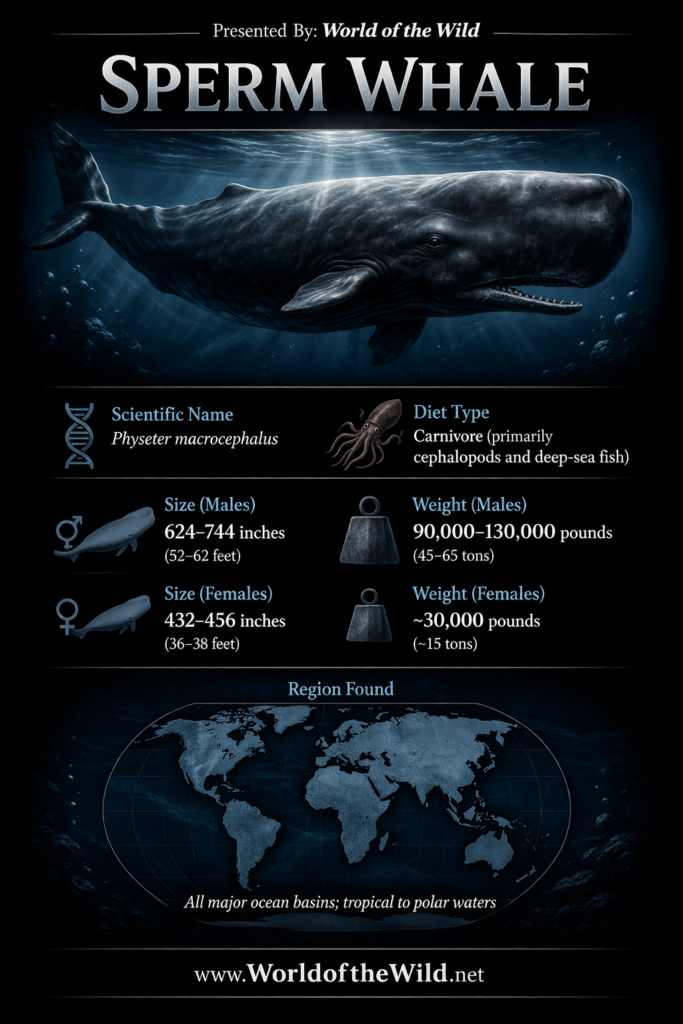
Adult males are dramatically larger than females, a pronounced sexual dimorphism rare among cetaceans. Males typically reach 52 to 62 feet (about 630–744 inches) in length and weigh between 90,000 and 130,000 pounds (roughly 45 to 65 tons), with exceptional individuals potentially exceeding those figures. Females are considerably smaller, averaging 36 to 38 feet in length and around 30,000 pounds.
The skin is dark gray to brownish-black, often described as resembling a prune due to its wrinkled, corrugated texture, particularly along the sides and back. The belly and areas around the mouth are often lighter, sometimes white or pale gray. The skin is frequently marked with circular scars left by the suckers of giant squid — battle wounds from hunts conducted in complete darkness miles below the surface.
The lower jaw is long, narrow, and lined with 18 to 26 large conical teeth on each side, each capable of weighing over two pounds. The upper jaw has few functional teeth. The single blowhole sits unusually far to the left side of the head near the front, causing the sperm whale’s distinctive bushy, angled spout to project forward and to the left at roughly a 45-degree angle — another field identification feature unique among great whales. The tail flukes are broad and triangular, extraordinarily powerful, and deeply notched at the center.

Behavior
Sperm whales are among the most socially sophisticated animals in the world, and their behavior reflects a complexity that continues to astonish researchers.
Social Structure: Female sperm whales and their young live in stable, multigenerational matrilineal units of roughly 10 to 20 individuals. These groups are remarkably cohesive and may remain together for decades. Adult males, by contrast, lead largely solitary lives after reaching sexual maturity, roaming the world’s oceans and only briefly joining female groups during the mating season. Young males often form loosely knit bachelor groups before eventually going their own way.
Communication and Culture: Perhaps the most mind-bending aspect of sperm whale behavior is their communication system. Sperm whales produce rhythmic patterns of clicks called codas — short, distinctive sequences that function like acoustic signatures. Different social units and populations have different coda repertoires, effectively constituting regional dialects. These are not innate; they are learned and culturally transmitted within family groups. Calves acquire their group’s dialect through social interaction, and entire vocal traditions can be traced across generations. This places sperm whales in a very small club of non-human animals — alongside humans, certain songbirds, and a handful of others — known to engage in cultural learning.
Cooperative Behavior: Sperm whale social bonds are not abstract. When a member of the group is injured or in distress, others will circle it, support it at the surface to breathe, and refuse to abandon it — even in the face of danger. This behavior, documented repeatedly during the whaling era, tragically made it easy for hunters to kill entire pods by first harpooning one individual.
Sleep: Sperm whales engage in a peculiar sleep pattern. They gather in groups and float vertically and motionlessly at the surface in what researchers call drift diving or synchronized logging. These bouts last only about 10 to 15 minutes at a time, suggesting sperm whales sleep in brief, fragmented intervals — possibly a necessary adaptation given their need to breathe consciously.
Diving: A sperm whale’s dive is a feat of physiology. Before descending, they take a series of breaths, flood their tissues with oxygen-rich blood, and then plunge. Their heart rate slows dramatically. Their spleens — proportionally enormous — contract and release a reservoir of oxygenated red blood cells. The spermaceti organ may cool and solidify, subtly increasing density to assist the descent. At depth, they use their extraordinary biosonar to locate and stun prey in total blackness.
Evolution
The story of sperm whale evolution is, at its heart, the story of a land mammal that returned to the sea and became something extraordinary.
All cetaceans trace their origin to terrestrial, even-toed ungulates — the same lineage that includes hippos, deer, and cattle. About 50 to 55 million years ago, during the Eocene epoch, a group of these mammals began spending increasing amounts of time in water. Over tens of millions of years, their bodies transformed: limbs became flippers, nostrils migrated to the top of the head, hind limbs disappeared, and tails evolved into horizontal flukes. The family Physeteridae — the sperm whale family — diverged from other toothed whales (odontocetes) roughly 23 to 28 million years ago during the Oligocene epoch.
Key fossil ancestors help trace this lineage. Livyatan melvillei, discovered in Peru and named in honor of Herman Melville, represents one of the most spectacular extinct relatives — a massive predatory whale from roughly 12–13 million years ago with enormous functional teeth in both jaws, suggesting it may have actively hunted large marine mammals, not squid. Unlike the modern sperm whale, Livyatan was an apex macro-predator in the truest sense.
Other early physeterids, such as Zygophyseter and Acrophyseter, similarly suggest that ancient sperm whale relatives were far more diverse and ecologically varied than the single surviving genus suggests. The modern sperm whale’s specialization for deep-sea squid hunting, its reduced upper dentition, and its extraordinary echolocation system represent a refined, highly derived adaptation honed over millions of years of oceanic evolution.
The spermaceti organ itself appears to be a highly evolved structure. Early cetaceans had melons — the rounded fat deposits in the forehead used for echolocation — and the sperm whale’s spermaceti organ is thought to be an extraordinarily hypertrophied version of this ancestral structure, adapted for the production and focusing of the most powerful biosonar on Earth.

Habitat
Sperm whales are cosmopolitan, found in every ocean basin from the tropics to the polar seas — though their distribution is far from uniform and varies significantly between sexes.
Female and juvenile groups are largely confined to tropical and subtropical waters, typically between latitudes 40°N and 40°S, where water temperatures remain relatively warm year-round. These regions include the Caribbean, the Indian Ocean, the Mediterranean, and broad swaths of the Pacific.
Adult males range far more widely. As they mature, bulls push into progressively higher latitudes, with the largest, most dominant individuals occasionally venturing into sub-polar and even polar waters — right up to the edge of Arctic and Antarctic ice. These cold, productive waters support the massive prey biomass that large males require.
The defining feature of sperm whale habitat is depth. Sperm whales are quintessential deep-ocean dwellers. They prefer oceanic waters where the seafloor lies well below their diving range, typically in areas where submarine canyons, continental slopes, or mid-ocean ridges concentrate their prey. They are rarely found in shallow coastal waters and show strong preferences for regions with steep underwater topography.
Certain areas have become famous as sperm whale hotspots: the waters around the Azores, the Galápagos, the Gulf of Mexico, the Kaikoura Canyon off New Zealand, and the Ligurian Sea in the Mediterranean. These locations share a common feature — deep, productive waters that support dense populations of cephalopods.
Diet
The sperm whale is an obligate carnivore, and its diet is dominated almost entirely by cephalopods — squids and octopuses of all sizes. The giant squid (Architeuthis dux) and the colossal squid (Mesonychoteuthis hamiltoni), two of the ocean’s most elusive creatures, are among the most celebrated prey items, evidenced by the sucker scars etched into sperm whale skin and the squid beaks found in their stomachs. However, the bulk of a sperm whale’s diet consists of medium-sized squid species that are far more numerous and reliably available.
Sperm whales also consume a variety of deep-sea fish, including species like the Patagonian toothfish and various lanternfishes. Shark remains have occasionally been found in sperm whale stomachs, though whether these represent active predation or opportunistic scavenging is debated.
Hunting takes place almost exclusively in total darkness at extreme depth. The sperm whale’s biosonar is the key to this remarkable feat. It generates clicks using a complex system involving the spermaceti organ and phonic lips, fires them outward in a focused beam, and interprets the returning echoes with extraordinary precision — detecting a squid the size of a football from hundreds of meters away in pitch blackness. There is also evidence that the clicks may be powerful enough at close range to stun or disorient prey, giving the whale a brief advantage at the moment of capture.
An adult sperm whale consumes an estimated 1,000 to 2,000 pounds of food per day, and given the global population of sperm whales, these animals collectively remove a staggering volume of biomass from the deep ocean — playing a profound and still incompletely understood role in regulating deep-sea ecosystems.
Predators and Threats
Natural Predators: For adult sperm whales, particularly large males, there are effectively no natural predators. Their sheer size, formidable teeth, and powerful flukes make them nearly invulnerable. Orca pods (Orcinus orca) are the only known natural predators capable of challenging sperm whales, and even then, attacks are typically directed at calves, juveniles, or isolated females. When threatened by orcas, adult female sperm whales form a tight defensive circle around vulnerable young — a formation sometimes called the “marguerite formation” — with their massive tails pointing outward to deter attackers. These encounters are fierce and not always successful for the orcas.
Human Threats — Historical: No discussion of sperm whale threats is complete without confronting the catastrophic legacy of commercial whaling. From the early 1700s through the mid-20th century, the global sperm whale population was decimated by industrial whaling fleets that pursued them for their spermaceti oil, used in lamps, lubricants, and cosmetics. Estimates suggest that more than one million sperm whales were killed during the height of the commercial whaling era. By the time the International Whaling Commission issued a moratorium on commercial whaling in 1986, the global population had been reduced to a fraction of its historical size.
Human Threats — Contemporary:
- Entanglement in fishing gear (particularly longlines) drowns sperm whales that cannot surface to breathe.
- Ship strikes are a documented, often fatal threat in busy shipping lanes.
- Ocean noise pollution from shipping traffic, sonar systems, and seismic surveys used in oil and gas exploration can disrupt sperm whale communication and echolocation — essentially equivalent to blinding and deafening an animal whose survival depends entirely on sound.
- Plastic pollution and marine debris are increasingly found in the stomachs of stranded sperm whales, with some individuals having ingested hundreds of pounds of plastic.
- Climate change is altering prey distributions and ocean productivity in ways that are likely to affect sperm whales, though the full extent of this impact remains an active area of research.

Reproduction and Life Cycle
Sperm whale reproduction is defined by slow pace, deep investment, and extraordinary longevity — a strategy common to highly intelligent, long-lived animals.
Maturity: Females reach sexual maturity at around 9 years of age, though they may not begin reproducing successfully until their early teens. Males reach sexual maturity somewhat earlier but do not become reproductively competitive until their late twenties, when they are large enough to rival other males.
Mating: The mating system of sperm whales remains somewhat mysterious due to the difficulty of observing behavior in deep-ocean environments. It appears to be polygynous, with large, mature “challenge” males traveling among female groups and competing for mating opportunities. Unlike some other cetaceans, sperm whales do not appear to form lasting pair bonds.
Gestation and Birth: The gestation period is exceptionally long — approximately 14 to 16 months — one of the longest of any mammal. Females give birth to a single calf, with twins being extraordinarily rare. Newborn calves are already enormous, measuring roughly 13 feet in length and weighing around 2,200 pounds at birth.
Parental Care: Calves are nursed for 2 to 5 years and remain closely bonded to their mothers throughout this period. One of the most remarkable aspects of sperm whale parenting is the communal nature of calf rearing. While a mother is diving to feed — potentially for over an hour — other females in the group take turns babysitting and protecting the calf at the surface. This alloparental care, where non-mothers actively assist in raising young, is a hallmark of deeply social species and suggests a level of cooperative social organization comparable to that of elephants or great apes.
Lifespan: Sperm whales are among the longest-lived mammals on Earth. Age is determined by examining growth layer groups in their teeth, much like counting rings in a tree. Females typically live 60 to 70 years, while males may reach 70 to 80 years, with some individuals potentially living longer. The reproductive rate is low — a female may produce a calf only once every 4 to 6 years — which means population recovery from depletion is an agonizingly slow process.
Population
The sperm whale is currently classified as Vulnerable on the IUCN Red List of Threatened Species — a status that reflects both its recovery from catastrophic historical depletion and the ongoing threats it continues to face.
Global population estimates are inherently difficult for a deep-ocean species, but current best estimates place the worldwide sperm whale population at approximately 300,000 to 450,000 individuals. This represents a significant recovery from the post-whaling lows but remains substantially below pre-whaling historical estimates, which some researchers place at over one million individuals.
Population trends are generally considered stable or slowly increasing in most ocean basins since the cessation of large-scale commercial whaling. However, recovery is painfully slow given the species’ low reproductive rate. A population of sperm whales can take decades to meaningfully rebound even in the complete absence of hunting, because a female produces so few calves over the course of her lifetime. The Mediterranean subpopulation is listed separately as Endangered, facing pressures from heavy shipping traffic, noise pollution, and reduced prey availability in that semi-enclosed sea.
The loss of culturally knowledgeable elder females — matriarchs who carry decades of accumulated knowledge about prey locations, migration routes, and social traditions — is an often-overlooked consequence of whaling that continues to affect group cohesion and foraging efficiency in depleted populations.
Conclusion
The sperm whale is not merely a creature of superlatives, though the superlatives are genuinely breathtaking. It is something rarer and more important: a window into a form of intelligence, culture, and social life that evolved entirely independently of our own, in the darkness of the deep ocean, over millions of years. These are animals that name themselves with unique clicking codas, that grieve their dead, that teach their young the traditions of their clan, and that dive to depths where the pressure would kill us instantly — all while being systematically hunted to the brink of extinction by the very species now trying to understand them.
We came dangerously close to silencing these ancient voices forever. The commercial whaling era was one of the greatest acts of biological destruction in human history, and the fact that sperm whales still swim in our oceans is partly luck, partly the result of international conservation policy, and partly a testament to the resilience of life itself.
But resilience is not invulnerability. The threats facing sperm whales today — noise pollution, plastic, climate change, entanglement — are quieter than harpoons, but no less real. Protecting the sperm whale means protecting the deep ocean itself: reducing plastic waste, supporting shipping lane modifications in sensitive areas, opposing the use of high-intensity military and seismic sonar near whale habitat, and maintaining the international moratorium on commercial whaling without exception.
We share this planet with beings whose minds we are only beginning to comprehend. The least we can do is ensure they survive long enough for us to listen.
Quick Reference
| Scientific Name | Physeter macrocephalus |
| Diet Type | Carnivore (primarily cephalopods and deep-sea fish) |
| Size (Males) | 624–744 inches (52–62 feet) |
| Size (Females) | 432–456 inches (36–38 feet) |
| Weight (Males) | 90,000–130,000 pounds (45–65 tons) |
| Weight (Females) | ~30,000 pounds (~15 tons) |
| Region Found | All major ocean basins; tropical to polar waters |