
Imagine a predator so rare that fewer individuals exist in the wild than there are people in a small apartment building. A ghost of the American Southeast, slipping silently through river cane thickets and longleaf pine forests, reclaiming a role in the ecosystem that was nearly lost forever. The red wolf (Canis rufus) is not just an endangered animal — it is a living symbol of both humanity’s capacity for destruction and its potential for redemption.
Once roaming across the entire eastern half of the United States, the red wolf was officially declared extinct in the wild in 1980, making it one of the very few large carnivores to suffer that fate in modern times. What followed was one of the most dramatic and controversial wildlife recovery programs in American history — a race against extinction that continues to this day. Neither fully wolf nor fox in the popular imagination, yet undeniably powerful in ecological importance, the red wolf occupies a singular place in North American wildlife. Its story is haunting, hopeful, and absolutely worth telling.
Facts
- The red wolf was the first carnivore in the world to be declared extinct in the wild and then successfully reintroduced through a captive breeding program.
- Despite its name, red wolves are not always red — their coats range from tawny brown to cinnamon, gray, and even black, with the reddish hue most visible behind the ears and along the legs.
- Red wolves are smaller and more slender than gray wolves, often being mistaken for coyotes, which has contributed directly to their deaths from misidentification by hunters.
- The entire wild population of red wolves is confined to a single county in North Carolina — Dare County — and its surrounding areas on the Albemarle Peninsula.
- Red wolves have a unique vocalization — their howl is distinct from both the gray wolf and the coyote, described as higher-pitched than a gray wolf and more prolonged than a coyote’s yip.
- The species plays a critical keystone role in its ecosystem, helping to regulate populations of white-tailed deer, nutria, and raccoons — animals that can cause significant agricultural and ecological damage when left unchecked.
- At their lowest point, only 14 individual red wolves were selected from the wild to form the foundation of the entire captive breeding population, making the modern red wolf one of the most genetically bottlenecked large mammals on Earth.
Sounds of the Red Wolf
Species
The red wolf’s taxonomic classification is as follows:
| Rank | Classification |
|---|---|
| Kingdom | Animalia |
| Phylum | Chordata |
| Class | Mammalia |
| Order | Carnivora |
| Family | Canidae |
| Genus | Canis |
| Species | Canis rufus |
The species question surrounding the red wolf is one of the most contentious in all of North American wildlife science. Historically, two subspecies were recognized: Canis rufus rufus, the nominate form that was once widespread across the Southeast, and Canis rufus gregoryi, the Florida black wolf, which is now considered extinct. The subspecies that survives today is generally considered to be C. r. gregoryi, the Mississippi Valley red wolf.
The deeper controversy, however, centers on whether the red wolf is a pure species at all or a stabilized hybrid between the gray wolf (Canis lupus) and the coyote (Canis latrans). Genomic research has produced deeply divided camps. Some scientists argue that red wolves represent a distinct evolutionary lineage that predates North American coyotes. Others contend that hybridization is so foundational to the red wolf’s genome that it cannot be classified as a standalone species under strict biological species concepts. The U.S. Fish & Wildlife Service and most conservation bodies continue to recognize Canis rufus as a valid, protected species — a designation with enormous legal and conservation implications.
Appearance
The red wolf is a medium-sized canid, occupying a clear size niche between the much larger gray wolf and the smaller coyote. Adults typically stand 26 to 32 inches tall at the shoulder and measure 45 to 65 inches in body length, with the tail adding another 13 to 17 inches. They have a lean, long-legged build that conveys both speed and endurance.
In terms of weight, red wolves generally range from 45 to 80 pounds, with males being noticeably larger than females — a trait known as sexual dimorphism that is common across the Canidae family. Their build is noticeably less robust than the gray wolf, with a narrower chest, longer and more slender legs, and a distinctly narrower head with a longer muzzle.
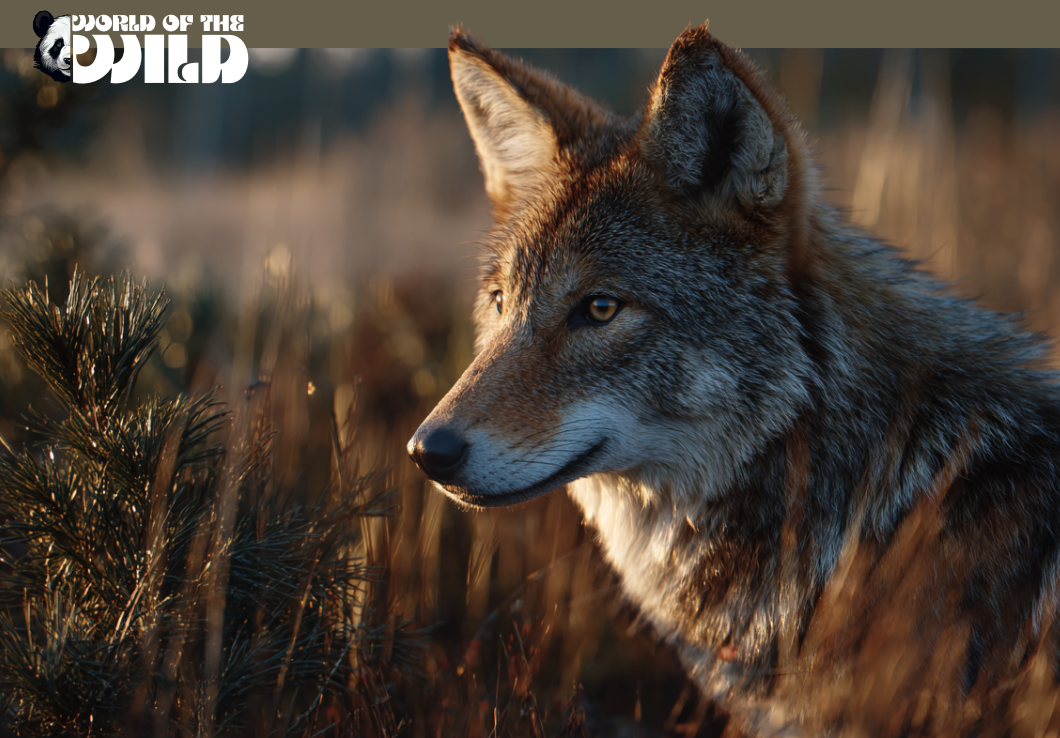
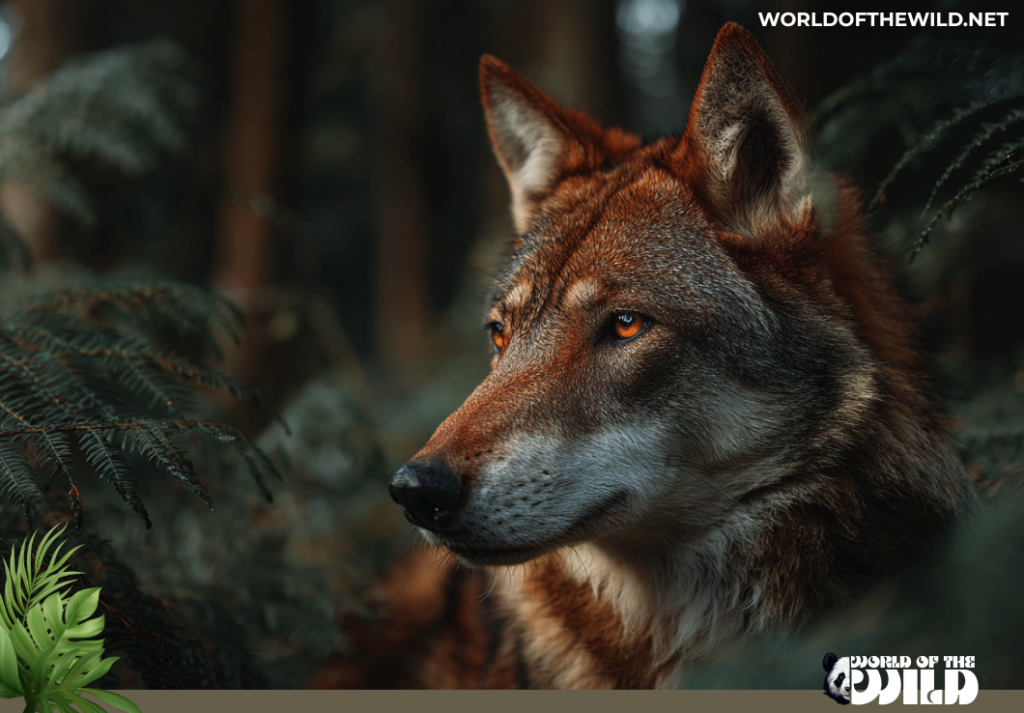
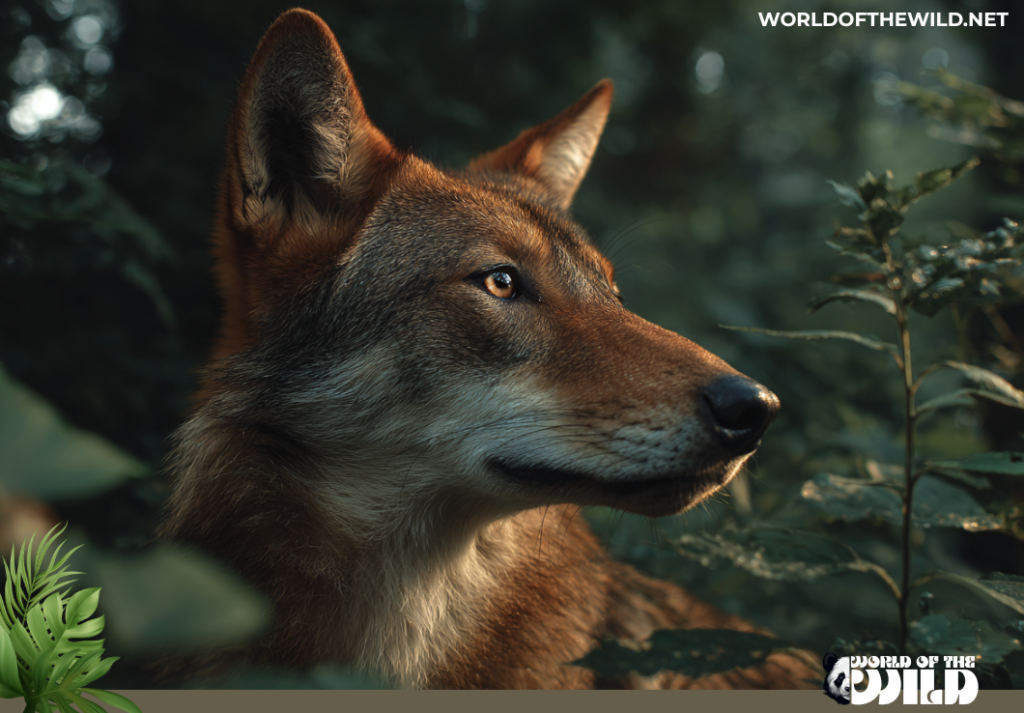
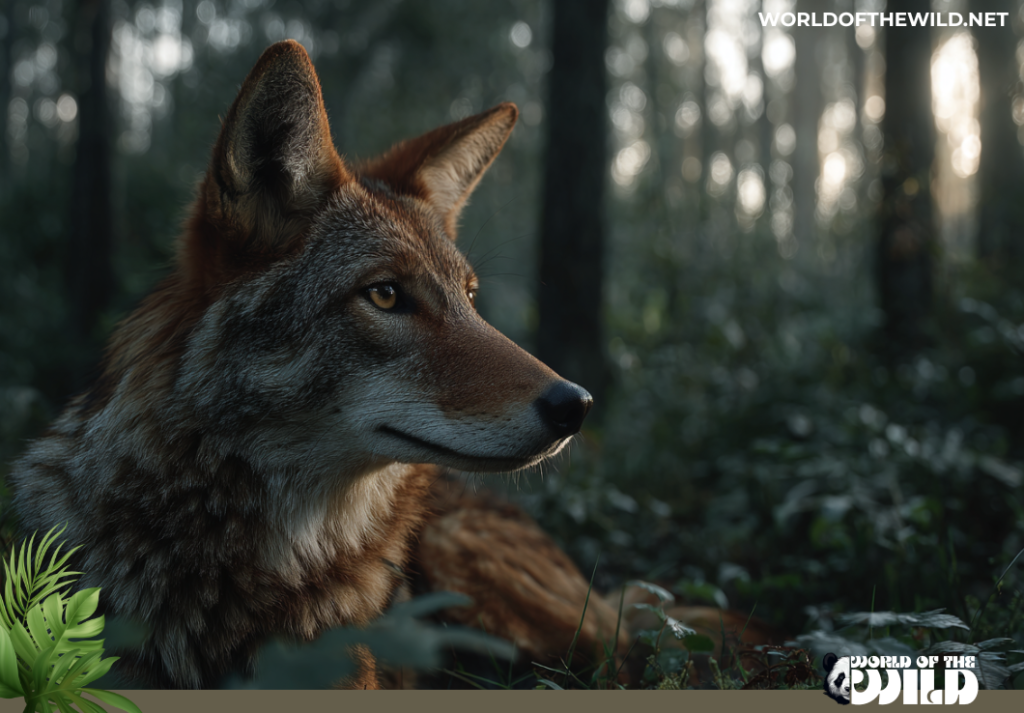
The coat is perhaps the most immediately striking feature. The base coloration is typically a mix of tawny brown, cinnamon, and buff, with richer reddish tones concentrated on the ears, muzzle, and legs — giving rise to the common name “red” wolf. The back is often darkened with black-tipped guard hairs, and the underside transitions to a paler cream or white. Melanistic (all-black) individuals have been documented, though they are rare. The ears are large and erect relative to body size, and the eyes are amber to yellow in color, giving the animal an intense, alert expression. The tail is bushy and held relatively low — a behavioral and physical contrast to the domestic dog’s characteristic upward curl.
Behavior
Red wolves are primarily crepuscular and nocturnal, meaning they are most active during the hours around dawn, dusk, and through the night. During the heat of the day, they typically rest in dense vegetation, brushy thickets, or near wetland edges.
Socially, red wolves are pack animals, though their packs tend to be smaller than those of gray wolves. A typical pack consists of a monogamous breeding pair and their offspring from one or more previous years, generally numbering between two and eight individuals. The pack structure is hierarchical, with the breeding pair — often called the alpha male and alpha female — making the bulk of territorial and movement decisions.
Communication is rich and multifaceted. Red wolves use howling not only to communicate with pack members across distances but also to advertise territory and coordinate hunts. Scent marking through urine, feces, and glandular secretions is used extensively to define and maintain territorial boundaries. Visual communication through body posture — tail position, ear orientation, facial expressions — plays an important role in social interactions within the pack.
Intelligence in red wolves is considerable. They are capable of learning, problem-solving, and adapting hunting strategies to prey availability and terrain. Pack hunting allows them to take prey significantly larger than any individual wolf could manage alone, though red wolves are also adept solo hunters of smaller prey.
One notable behavioral challenge for the species today is hybridization with coyotes, which have expanded dramatically into red wolf territory. As the red wolf population declined and pack structures were disrupted, lone red wolves began pairing with coyotes, producing fertile hybrid offspring that further complicate conservation management.
Evolution
The evolutionary history of the red wolf is both ancient and deeply debated. The genus Canis originated in North America roughly six million years ago, with early members of the lineage considerably smaller than modern wolves. Over millions of years, multiple canid species evolved, migrated, and diversified across North America and beyond.
The ancestral lineage most closely associated with the red wolf appears to trace back to forms that were present in North America well before the arrival of gray wolves from Eurasia across the Bering Land Bridge approximately 750,000 years ago. Some paleontological evidence suggests that Canis rufus or a direct ancestor was part of a distinct North American radiation of large canids, potentially including the enigmatic dire wolf (Aenocyon dirus), though the dire wolf belonged to a separate evolutionary branch and is not a direct ancestor.
The most scientifically supported hypothesis at present — bolstered by ancient DNA analysis — is that the red wolf diverged from a common ancestor shared with gray wolves and coyotes somewhere between 400,000 and one million years ago, establishing itself as a unique North American lineage before later gene flow from both gray wolves and coyotes muddied the genetic picture. The Pleistocene megafaunal extinctions roughly 12,000 years ago, which wiped out much of North America’s large prey base, almost certainly reshaped canid populations significantly, likely forcing red wolf ancestors southward and into more fragmented habitats.
Habitat
The red wolf’s historic range encompassed a vast swath of the eastern United States, stretching from Texas and Florida northward to Pennsylvania and New York, covering mixed forests, coastal prairies, swamps, agricultural land, and shrublands. This ecological flexibility made the species successful across many environments before human persecution and habitat fragmentation shattered its populations.
Today, the wild population exists exclusively within the Alligator River National Wildlife Refuge and the surrounding Albemarle-Pamlico Peninsula in northeastern North Carolina — an area of roughly 1.7 million acres. This region is characterized by low-elevation coastal terrain with a mosaic of habitats: pocosins (dense, shrubby wetlands unique to the Southeast), pine flatwoods, hardwood bottomlands, agricultural fields, and estuarine marshes.
Red wolves in this landscape are highly adaptable in terms of home range. Territories can vary enormously based on pack size and prey availability, ranging from roughly 20 square miles for smaller packs to well over 100 square miles for larger groups. The coastal nature of their current range means that sea-level rise — an accelerating consequence of climate change — poses a direct and growing threat to their already confined habitat.
Diet
The red wolf is a carnivore, and its diet is tightly linked to the prey species available within its range. White-tailed deer represent the most significant prey item by biomass, particularly for pack hunts during the winter months when deer are more vulnerable. Smaller prey, including raccoons, rabbits, nutria (an invasive South American rodent), and various small rodents, make up a substantial portion of the diet year-round — particularly for solitary individuals or during warmer months when deer are harder to take.
Red wolves are opportunistic and pragmatic hunters. They will consume carrion when available and have been documented eating insects, berries, and other plant material in small quantities, though these items are dietary supplements rather than staples.
Hunting strategy depends on prey size. For deer, packs employ cooperative pursuit, using stamina and coordination to isolate, exhaust, and bring down a target over varying terrain. For smaller prey like raccoons and rabbits, individual wolves use a stalk-and-pounce technique more reminiscent of coyote hunting behavior — another indicator of the ecological flexibility that once made this species so widespread.
Ecologically, the red wolf’s predatory pressure on white-tailed deer and especially nutria and raccoons provides measurable trophic cascade benefits, helping to limit overgrazing and agricultural damage in ways that significantly benefit human landowners in their range — a point that conservation advocates have increasingly emphasized when building public support for the recovery program.
Predators and Threats
In ecological terms, adult red wolves have no natural predators within their current range. Historically, large competitors such as mountain lions and black bears may have occasionally killed wolves, particularly pups or juveniles, but they did not constitute a meaningful check on population growth.
The real and existential threats to the red wolf are entirely human-caused, and they are severe:
Gunshot mortality is the leading cause of death for wild red wolves. Many are shot deliberately by landowners or hunters who mistake them for coyotes — a tragically common occurrence given the animals’ physical similarity and the lack of a mandatory red wolf identification training requirement for hunters in the region.
Hybridization with coyotes is the second most critical biological threat. As the red wolf population declined and became fragmented, the behavioral barriers to coyote interbreeding broke down. Hybrid animals produced from these pairings are not protected under the Endangered Species Act, complicating management enormously.
Vehicle strikes on rural roads have claimed a significant number of wolves, particularly young dispersing individuals.
Habitat loss and fragmentation — driven by agricultural expansion, residential development, and rising sea levels — continues to squeeze the available landscape.
Political and regulatory instability has plagued the recovery program for decades. A 2012 review under pressure from landowners and state legislators recommended drastically curtailing the non-essential experimental population program, leading to management actions that allowed the wild population to collapse from roughly 130 animals in 2012 to fewer than 20 by 2020 before legal and advocacy interventions partially reversed course.
Reproduction and Life Cycle
Red wolves are monogamous, forming long-term pair bonds that typically last for life. Breeding season occurs once per year, generally in January and February, with a gestation period of approximately 60 to 63 days. Pups are born in the spring, most often in April or May.
Litter sizes typically range from two to eight pups, with an average of around four to six. Dens are established in a variety of natural shelters — hollow logs, streambank burrows, dense brush piles, or even abandoned beaver lodges — chosen for concealment and proximity to water.
Pups are born blind, deaf, and entirely helpless, weighing only about a pound at birth. Both parents participate actively in rearing, with the father hunting to provision the nursing mother in the early weeks. Older pack siblings often serve as helpers at the den, babysitting pups, regurgitating food for them, and defending the den site from intruders — a behavior known as cooperative breeding that is common in pack-living canids.
Pups begin venturing from the den at roughly three weeks of age and are weaned by eight to ten weeks. By autumn, young wolves have joined the pack on hunts. Sexual maturity is reached at approximately 22 months, at which point young wolves may remain with their natal pack or disperse to establish territories of their own.
In the wild, red wolves typically live six to eight years, though captive individuals have been documented living into their mid-teens. The high mortality rate in the wild — driven largely by human-caused deaths — means that many wolves never reach their reproductive prime, a fact that makes every surviving breeding pair critically important to the species’ survival.
Population
The red wolf holds the grim distinction of carrying an IUCN Red List status of Critically Endangered — the highest threat category before extinction in the wild. The Endangered Species Act of 1973 provides additional legal protection within the United States.
The wild population exists only on the Albemarle Peninsula of North Carolina and has experienced a dramatic and deeply troubling decline over the past decade. From an estimated peak of approximately 130 wild individuals in 2012, numbers fell catastrophically to fewer than 20 animals by around 2020. Intensive intervention by the U.S. Fish & Wildlife Service and partner organizations — including increased pup fostering from captive-born litters into wild dens — has helped modestly stabilize numbers. Current estimates place the wild population at somewhere between 20 and 30 individuals, though precise counts are difficult to verify.
The captive population is considerably larger and is managed through a Species Survival Plan coordinated across more than 40 facilities in the United States. Approximately 250 to 270 red wolves currently exist in captive breeding programs, and this population represents the species’ insurance policy against complete extinction in the wild.
The long-term trajectory, however, remains deeply uncertain. At current rates of gunshot mortality and hybridization, without meaningful changes to management, land access, and public education, the wild population faces a real possibility of disappearing again within a generation.
Conclusion
The story of the red wolf is one of the most dramatic and instructive conservation narratives in American history. It tells us that extinction is not always irreversible — that with extraordinary scientific effort, political will, and public support, a species can be pulled back from the very edge of oblivion. But it also delivers a harder message: that saving a species requires more than a one-time intervention. It demands sustained commitment across generations, ongoing management, and a willingness to confront the social and political conflicts that conservation inevitably creates.
Fewer than 30 red wolves roam wild today. That number is both a testament to decades of dedicated work and a reminder of how much further there is to go. The Albemarle Peninsula is not just a tract of coastal wetland — it is the last stronghold of a creature that evolved over hundreds of thousands of years on this continent, and whose presence enriches the ecological tapestry of the American Southeast in ways that science is only beginning to fully understand.
If the red wolf disappears from the wild again, it will not be because we lacked the tools to save it. It will be because we lacked the will. That is still a choice we have the power to make differently. Support red wolf conservation organizations, advocate for stronger Endangered Species Act protections, and help spread the word — because for Canis rufus, awareness truly is a matter of survival.
🐺 Quick Reference
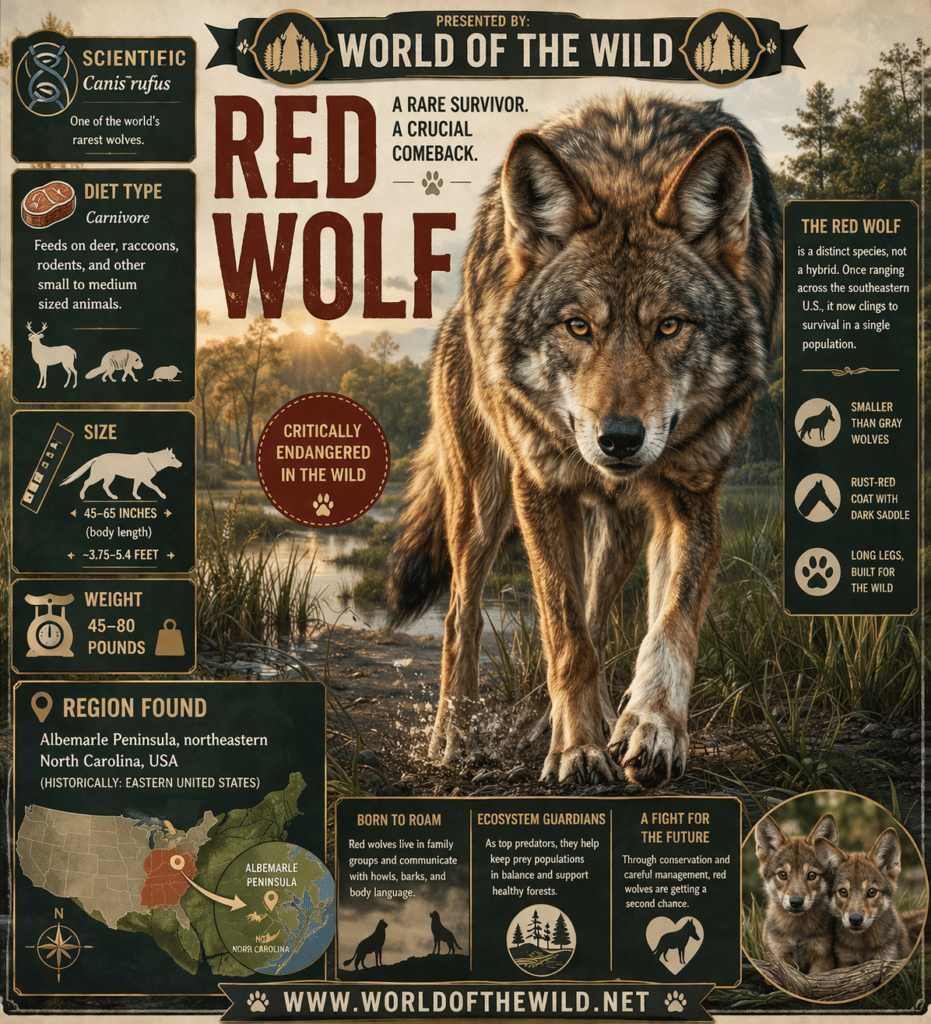
| Scientific Name | Canis rufus |
| Diet Type | Carnivore |
| Size | 45–65 inches (body length); ~3.75–5.4 feet |
| Weight | 45–80 pounds |
| Region Found | Albemarle Peninsula, northeastern North Carolina, USA (historically: eastern United States) |