
Where the World Breathes
There are places on this Earth that defy the imagination — landscapes so vast, so complex, and so alive that standing at their edge, you feel simultaneously humbled and electrified. The Brazilian Amazon is one of those places. It is not merely a forest. It is a world unto itself: a churning, breathing, roaring cathedral of biodiversity that has been growing, evolving, and sustaining life on this planet for tens of millions of years.
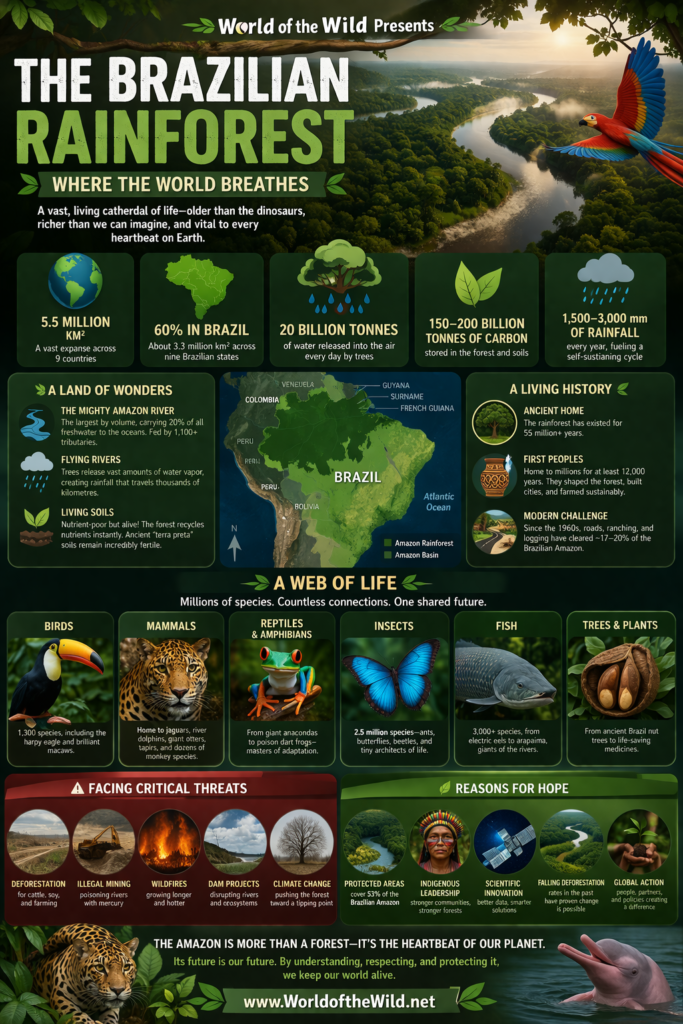
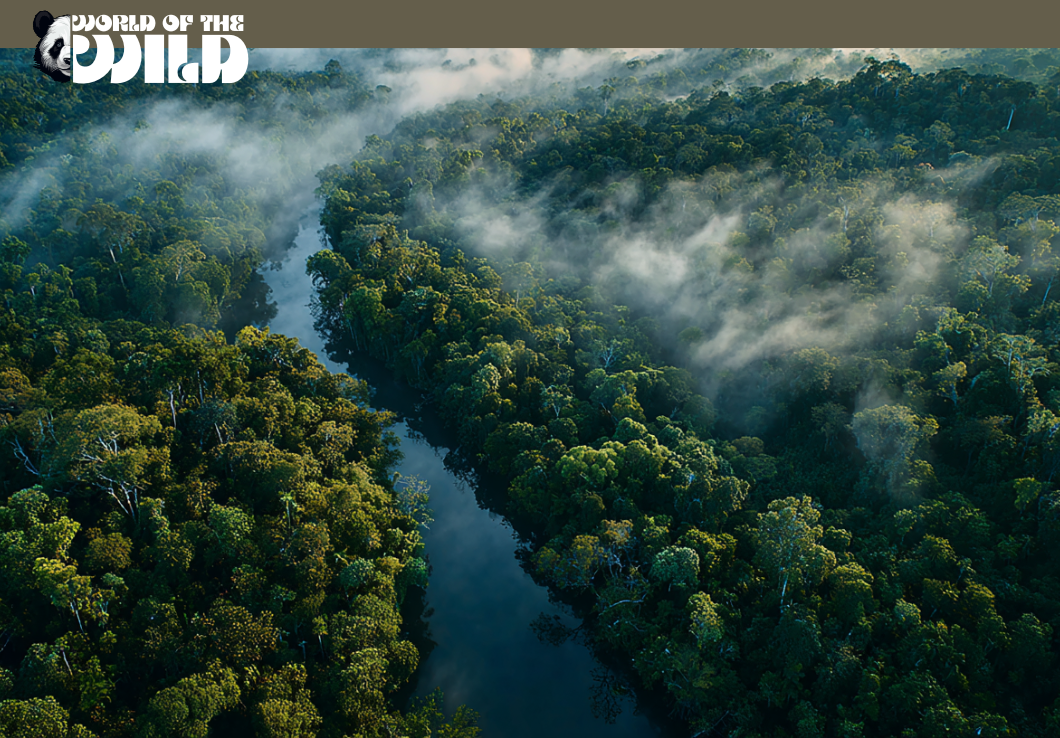
Covering an area of approximately 5.5 million square kilometres across nine countries, the Amazon rainforest is the largest tropical rainforest on Earth. Of that extraordinary expanse, Brazil claims the lion’s share — roughly 60%, or about 3.3 million square kilometres of primary and secondary rainforest sprawling across nine Brazilian states: Amazonas, Pará, Mato Grosso, Rondônia, Acre, Amapá, Roraima, Tocantins, and Maranhão. To put that in perspective, the Brazilian Amazon alone is larger than the entire country of India. It is a landmass so immense that weather systems form and dissolve within it without ever touching an ocean. Its rivers carry more freshwater to sea than any other river system on the planet. Its trees hold enough carbon to tip the balance of Earth’s climate. Its soils are home to organisms that science has not yet named.
For the team at World of the Wild, the Brazilian Amazon is not just a destination — it is a responsibility. Understanding this place, its history, its ecology, its creatures, and its precarious present is one of the most important acts of natural curiosity a person can undertake. So let’s go deep.
Part One: The Lay of the Land — Geography and Environment
A River Born from the Andes
To understand the Amazon rainforest, you must first understand the river that gives it its name. The Amazon River is the greatest river on Earth by volume, discharging approximately 20% of all freshwater that flows into the world’s oceans. It originates in the Andes Mountains of Peru — specifically near Nevado Mismi, a glacial peak in southern Peru long considered the river’s most distant source — and flows roughly 6,400 kilometres eastward before emptying into the Atlantic Ocean near the Brazilian city of Belém.
Along the way, the Amazon swells with the contributions of more than 1,100 tributaries, many of which are major rivers in their own right. The Rio Negro, the Madeira, the Tapajós, the Xingu — these are rivers that in any other context would be considered extraordinary natural wonders. Here, they are merely branches on a far greater tree. The Rio Negro alone is the largest blackwater river in the world, its dark, tannin-rich waters the result of decaying organic matter leached from the surrounding forest floor.
The Amazon basin — the enormous lowland depression into which all these rivers drain — sits primarily below 200 metres in elevation. This flat, water-logged terrain creates ideal conditions for dense, perpetually wet vegetation. During the wet season, which runs roughly from November to May, vast portions of the basin flood entirely. Known as the várzea (seasonally flooded forests) and the igapó (permanently or near-permanently flooded blackwater forests), these submerged ecosystems create habitats found nowhere else on Earth, where fish swim between the roots of trees and dolphins navigate through flooded canopies.
Climate: The Rainforest’s Engine
The Amazon’s climate is tropical and humid, characterised by high temperatures, consistently high rainfall, and minimal seasonal variation in temperature. Average temperatures in the basin hover between 24°C and 27°C year-round, and rainfall averages between 1,500 and 3,000 millimetres annually — though some areas receive considerably more.
What makes the Amazon’s climate especially remarkable is the degree to which the forest creates its own weather. Through a process known as evapotranspiration, trees release enormous quantities of water vapour into the atmosphere through their leaves. Collectively, the Amazon’s trees pump an estimated 20 billion tonnes of water into the air every day — more than the daily discharge of the Amazon River itself. This moisture condenses to form the low clouds that perpetually hang over the canopy, and eventually falls back as rain. Scientists call these self-sustaining systems “flying rivers,” and they carry water not just over the forest, but thousands of kilometres southward to water the agricultural heartlands of Brazil, Argentina, and Uruguay.
In this sense, the Amazon does not merely exist within its climate — it manufactures it. Destroy enough of the forest, and the rainfall patterns that have sustained civilisations for millennia begin to collapse. This is not a distant hypothetical. It is a process that climate scientists are watching unfold in real time.
The Soils Beneath the Canopy
One of the Amazon’s most counterintuitive secrets is that, despite its extraordinary fertility of life, its soils are remarkably poor. The deep, ancient, iron-rich soils of the basin — known as oxisols or laterite soils — are nutrient-depleted, heavily leached by millions of years of rainfall. The forest does not grow rich because of its soil. The forest IS the soil’s richness.
Nearly all the nutrients in an Amazonian ecosystem are locked up in living biomass — the trees, the plants, the animals, the fungi, and the bacteria that decompose dead matter almost instantly in the warm, humid air. When a leaf falls in the Amazon, it is broken down within weeks. When a tree dies, its nutrients are quickly recaptured by the surrounding root systems before they can be washed away by the next rain. The forest has evolved into a system of near-perfect nutrient cycling, a closed loop of life sustaining life.
There is one notable exception: the famous terra preta, or “dark earth,” soils found in scattered patches throughout the Amazon basin. These extraordinary, charcoal-rich soils were created by ancient Amazonian civilisations over thousands of years through the incorporation of charcoal, bones, and organic waste. Remarkably fertile even today, thousands of years after their creation, terra preta soils offer a compelling window into both the ingenuity of ancient Amazonian peoples and the potential for sustainable management of the basin’s soils going forward.
Part Two: A History Written in Wood and Water
Ancient Origins
The Amazon rainforest is ancient — breathtakingly, almost incomprehensibly so. The tropical forests of the Amazon basin have existed in some form for at least 55 million years, though their composition has changed dramatically over geological time. During the Cretaceous period, the region was covered by a shallow sea. As South America drifted westward and the Andes rose, the sea drained and was replaced first by a vast inland lake system and then, over millions of years, by the forest we recognise today.
The extraordinary biodiversity of the modern Amazon is, in part, the product of this immense span of time. Species that have been evolving in relative isolation for tens of millions of years develop in directions that are impossible to predict. The Amazon is not just a rich ecosystem — it is an evolutionary laboratory that has been running undisturbed (largely) for longer than almost any other place on Earth.
The First Peoples
For most of Western history, the Amazon was portrayed as a “pristine wilderness,” an untouched Eden that existed entirely apart from human civilisation. We now know this to be profoundly wrong. The Amazon has been home to human beings for at least 12,000 years — and possibly much longer — and those human inhabitants were not passive occupants of the landscape. They actively shaped it.
At the time of first European contact in the early 16th century, the Amazon basin is estimated to have been home to between 2 and 10 million people, distributed across hundreds of distinct nations and linguistic groups. These peoples built large settlements, maintained extensive agricultural systems, managed forests for the species they found useful, and traded goods across vast networks that spanned the continent. The famous accounts of early Spanish explorers — of great “cities” along the banks of the Amazon, of vast agricultural fields, of dense and prosperous populations — were long dismissed as exaggeration. Archaeology is increasingly confirming that they were not.
The catastrophe that followed European contact was one of the most devastating demographic collapses in human history. Diseases to which indigenous peoples had no immunity — smallpox, measles, influenza — swept through the basin in waves, killing an estimated 90% or more of the pre-contact population within a century. The great settlements emptied. The agricultural systems were abandoned. The forest reclaimed what had been human landscape so thoroughly that, within a few generations, European observers genuinely believed they were looking at untouched wilderness.
Colonial Exploitation
From the 16th century onward, the Amazon became a theatre of colonial extraction. The Portuguese, who claimed Brazil under the Treaty of Tordesillas in 1494, were initially more interested in the coast than the interior, but as the profitability of Amazonian resources became clear, they pushed steadily into the basin. Cacao, timber, medicinal plants, and above all, rubber became the engines of colonial exploitation.
The rubber boom of the late 19th and early 20th centuries was among the most transformative and brutal episodes in Amazonian history. As the global demand for natural rubber exploded, driven by the invention of vulcanisation and the rise of the automobile, the Amazon became the world’s primary source of latex. The rubber barons who controlled the trade built extraordinary fortunes — the Teatro Amazonas, the famous opera house in Manaus, was built at the height of the boom — while the indigenous and mestizo workers who tapped rubber trees in the forest were subjected to conditions of slavery, debt bondage, and extreme violence. The Putumayo rubber atrocities, in which an estimated 30,000 indigenous people were killed or worked to death, stand as one of the darkest chapters in the history of South America.
The boom ended abruptly when rubber seeds smuggled to Southeast Asia by British botanist Henry Wickham in 1876 gave rise to plantation industries that undercut the Amazon’s wild-harvest system. But the pattern of extractive exploitation — of treating the Amazon as an inexhaustible repository of resources to be taken — had been established, and it would persist.
The Modern Era: Roads, Ranches, and Reckoning
The modern history of the Brazilian Amazon is dominated by a series of waves of deforestation that began in earnest in the 1960s under Brazil’s military dictatorship. With the twin goals of “developing” the Amazon and relieving population pressure in the impoverished northeast, the government launched a series of major infrastructure and settlement projects. The Trans-Amazon Highway, begun in 1972, was the most ambitious — a road intended to bisect the basin from east to west. Hundreds of thousands of settlers were encouraged to relocate to the Amazon, promised land and a new beginning.
The results were, by almost any measure, disastrous. The settlers arrived to find soils that could not sustain agriculture for more than a few years. When the thin layer of nutrient-rich topsoil was exhausted, they cleared more forest. The highway became a frontline of deforestation, with destruction spreading along its length like an infection. Cattle ranching, which could sustain itself on degraded soils where crops could not, became the dominant land use, replacing ancient forest with pasture. By the 1980s, deforestation rates were reaching catastrophic levels — in 1988, an estimated 21,000 square kilometres were cleared in a single year.
The assassination of rubber tapper and environmentalist Chico Mendes in 1988 — murdered by ranchers whose interests he was threatening — brought the crisis of Amazonian deforestation to international attention and galvanised a global conservation movement. In the decades since, Brazil has oscillated between periods of relatively strong environmental enforcement (deforestation rates dropped sharply in the mid-2000s following tougher policies and satellite monitoring) and renewed destruction. As of the early 2020s, it is estimated that roughly 17–20% of the Brazilian Amazon has been deforested — and scientists warn that the forest is approaching a tipping point beyond which it may not be able to sustain itself.
Part Three: The Ecosystem — How the Forest Works
The Canopy and Its Layers
Walking into the Amazon is like entering a living cathedral with many floors. The rainforest is not a uniform mass of green — it is a layered, stratified system in which different organisms occupy different vertical zones, each adapted to the specific conditions of light, temperature, and humidity at their level.
The uppermost layer — the emergent layer — consists of the tallest trees, giants that push 40, 50, or even 60 metres above the forest floor. Species like the Brazil nut tree (Bertholletia excelsa) and the kapok (Ceiba pentandra) tower above the rest, their crowns exposed to full sunlight and subjected to wind and temperature extremes that the layers below are sheltered from. Eagles, monkeys, and a host of insects and bromeliads populate this wind-swept upper world.
Below lies the canopy proper, a dense, continuous layer of interlocking crowns at around 25 to 35 metres. This is where the majority of the forest’s photosynthesis occurs, and where the greatest density of animal life is found. Sloths, toucans, parrots, howler monkeys, and countless species of insects, frogs, and reptiles live out their entire lives here, never descending to the forest floor. The canopy receives so much light that it hosts its own micro-ecosystems of epiphytes — plants that grow on other plants, including orchids, bromeliads, and ferns — that themselves become habitats for still more creatures.
Beneath the canopy lies the understory — a dimmer, more sheltered world where light levels may be just 2-5% of what reaches the canopy above. Trees here grow slowly, their broad leaves maximising the capture of what little light filters down. Jaguars patrol this level, as do tapirs, peccaries, and a bewildering array of reptiles and amphibians. The air is still, the humidity extreme, and the sounds — the drip of condensation, the distant calls of monkeys, the sudden burst of a bird — take on an eerie resonance.
At the very bottom lies the forest floor itself: dark, damp, and covered in a thin layer of rapidly decomposing leaf litter. Little grows here for lack of light, but the floor teems with invertebrate life — ants, termites, beetles, worms, millipedes — all engaged in the ceaseless work of breaking down dead matter and returning nutrients to the soil.
The Web of Interdependence
What makes the Amazon ecosystem so extraordinary — and so fragile — is the complexity of its interdependencies. Almost nothing lives or dies in isolation. Every organism is embedded in a web of relationships with dozens, hundreds, or thousands of others, relationships that have been refined by millions of years of co-evolution.
Consider the Brazil nut tree, one of the Amazon’s most iconic species and one of its most instructive stories. Brazil nut trees cannot pollinate themselves. They depend entirely on a specific group of large-bodied bees — primarily orchid bees of the genus Eulaema — whose long tongues can reach the nectar at the base of the flower and whose size allows them to force open the flower’s complex hood. The orchid bees, in turn, depend on specific species of orchids whose fragrant compounds they collect to attract mates. The orchids depend on the bees for pollination. Remove any link in this chain, and the system begins to unravel.
The Brazil nut’s seed dispersal is equally specific. The large, woody seed pods — which can weigh up to two kilograms and fall with sufficient force to kill a person — are simply too hard for most animals to open. The primary disperser of Brazil nut seeds is the agouti, a large rodent with teeth powerful enough to gnaw through the pod’s shell. Agoutis eat some seeds immediately but bury others for later — and some of those buried seeds are never retrieved, allowing them to germinate. Without agoutis, Brazil nut trees cannot reproduce. Without Brazil nut trees, the forest loses one of its most significant structural species.
These intricate webs of dependency are repeated across millions of species in the Amazon. Figs and fig wasps. Army ants and the dozens of species of birds that follow ant swarms to catch the insects they flush. Fungi and trees, linked by vast underground mycorrhizal networks that allow trees to exchange nutrients and even chemical signals across kilometres of forest. The Amazon is not just a collection of species. It is a conversation — a continuous, multi-million-voice dialogue of mutual dependency.
Part Four: Why the Amazon Matters to the Whole World
Carbon, Climate, and the Tipping Point
The Amazon stores an estimated 150–200 billion tonnes of carbon in its vegetation and soils — equivalent to roughly four or five years of current global carbon emissions. As long as the forest stands, that carbon stays locked away. When trees are felled and burned, that carbon is released into the atmosphere, accelerating climate change. And when a changing climate reduces rainfall and increases temperature, the forest becomes more stressed, more vulnerable to fire, and less capable of sustaining itself.
Scientists have identified what they call a “tipping point” — a level of deforestation and climate stress beyond which the Amazon’s ability to generate its own rainfall breaks down, causing large areas to transition from rainforest to savanna. Most estimates place that tipping point at somewhere between 20% and 25% deforestation of the original forest. Given that deforestation already stands at around 17–20%, we may be closer to this threshold than is comfortable to contemplate.
Crossing that tipping point would not just be a regional tragedy. It would be a global one. The collapse of the Amazon’s rainfall-generating capacity would devastate agriculture across South America. The release of stored carbon would send a pulse of greenhouse gases into the atmosphere that would accelerate global warming for decades. The loss of biodiversity would impoverish the planet’s gene pool in ways whose consequences we cannot fully predict but can be sure would be profound.
The Amazon Pharmacy
Indigenous peoples of the Amazon have known for thousands of years what science is only beginning to confirm: the forest is a pharmacopoeia of incalculable value. Of the 25% of pharmaceutical drugs currently in use that are derived from tropical plants, a substantial proportion originate in Amazonian species. Quinine, used to treat malaria, comes from the bark of the cinchona tree. Curare, the legendary arrow poison of Amazonian hunters, has given us tubocurarine, a muscle relaxant used in surgery. The rosy periwinkle, originally from Madagascar but botanically related to Amazonian species, gave us vincristine and vinblastine, two of the most important drugs in the treatment of childhood leukaemia and Hodgkin’s lymphoma.
And this represents only what has so far been investigated. Scientists estimate that fewer than 1% of Amazonian plant species have been thoroughly evaluated for pharmaceutical potential. Given that the Amazon contains an estimated 40,000 plant species, the untapped medical potential of the forest is staggering — and entirely dependent on the forest’s survival.
Indigenous Peoples and Cultural Diversity
The Brazilian Amazon is home to an estimated 305 distinct indigenous peoples, speaking approximately 274 languages. Many of these communities maintain deep connections to the forest and hold knowledge of local ecology, plant medicine, and sustainable land management that has accumulated over generations. Several dozen communities remain in voluntary isolation, refusing all contact with the outside world — a choice that must be understood and respected as an act of self-determination.
The rights of indigenous peoples are, beyond any ethical argument, also among the most practical tools for forest conservation. Studies have consistently shown that indigenous territories in the Amazon have lower rates of deforestation and higher biodiversity than almost any other category of protected land. When indigenous peoples have secure land rights and the means to defend their territories, the forest tends to survive. When those rights are undermined — by illegal mining, logging, or agricultural encroachment — both human communities and the forest suffer.
Part Five: The Wildlife of the Brazilian Amazon
A Kingdom of Birds
Nowhere on Earth offers a more spectacular experience for birders than the Brazilian Amazon, which hosts an estimated 1,300 bird species — more than any other region of comparable size on the planet. From the spectacular to the bizarre, the Amazon’s avifauna is a source of perpetual wonder.
The harpy eagle (Harpia harpyja) is perhaps the forest’s most iconic bird of prey — a massive, powerful raptor with a wingspan of up to two metres, talons as large as grizzly bear claws, and the ability to snatch monkeys and sloths from the canopy. The harpy eagle is an apex predator in the emergent layer, and its presence in a forest is a reliable indicator of ecological health.
Macaws — particularly the scarlet macaw (Ara macao) and the blue-and-yellow macaw (Ara ararauna) — are among the most visually stunning birds in the world, their brilliant plumage a riot of primary colours that seems almost artificially vivid against the green of the canopy. Macaws are highly intelligent, deeply social birds that form lifelong pair bonds and are known to travel long distances to visit mineral-rich clay licks, where they consume clay to neutralise the toxins in their seed-heavy diet.
The hoatzin (Opisthocomus hoazin) is one of the Amazon’s strangest residents — a pheasant-sized bird that smells distinctly of manure (earning it the nickname “stinkbird”), digests its food through bacterial fermentation like a cow, and whose chicks are born with small claws on their wings, allowing them to scramble through riverside vegetation before they can fly. Genetic analysis has confirmed the hoatzin as an evolutionary relict — a bird so ancient and so distinct that it occupies its own taxonomic order.
Mammals: From Jaguars to Pink Dolphins
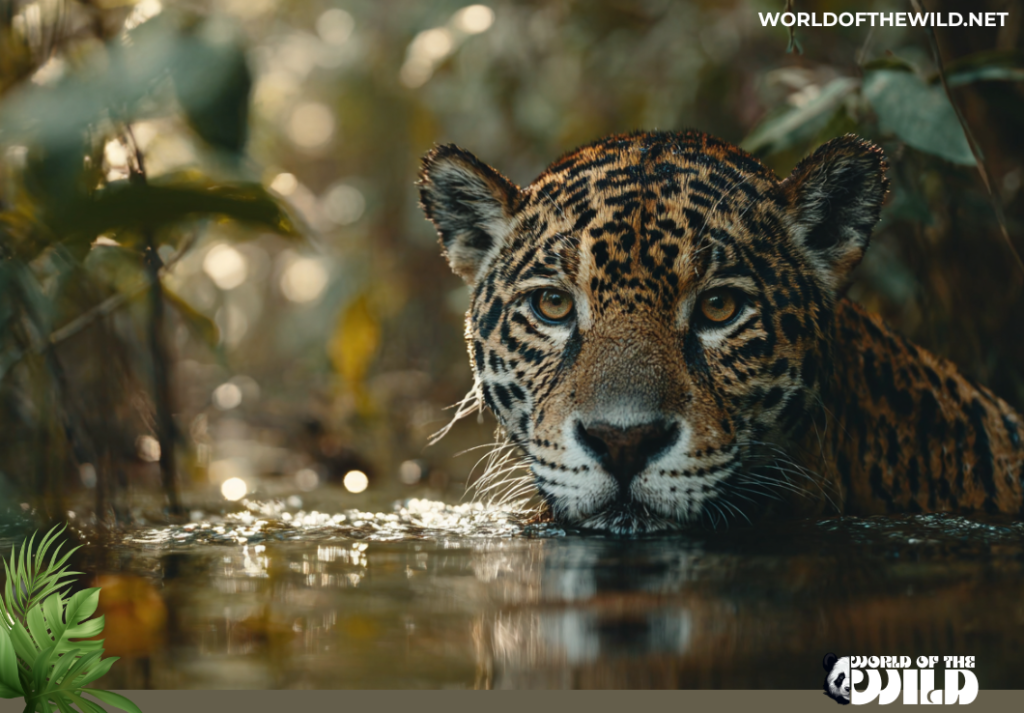
The Amazon’s mammal fauna is no less extraordinary than its birds. The jaguar (Panthera onca) is the largest cat in the Americas and the apex terrestrial predator of the Amazon basin. Unlike most large cats, jaguars are excellent swimmers and actively hunt in and around water, fishing for caiman, capybaras, and even large anacondas. Their bite force, the strongest of any big cat relative to body size, allows them to pierce the shells of turtles and the skulls of prey. The jaguar is a keystone species — its presence and behaviour cascades through the ecosystem in ways that maintain the balance of prey populations.
The Amazon River dolphin, or boto (Inia geoffrensis), is one of the world’s few freshwater dolphin species and one of the most remarkable mammals in the basin. Adult males turn pink as they age — a unique characteristic among cetaceans — and the boto is known for its extraordinary flexibility, able to turn its head 90 degrees thanks to unfused neck vertebrae, an adaptation that allows it to navigate flooded forests and hunt fish among the roots and trunks. In Amazonian mythology, the boto is a shapeshifter, able to transform into a handsome man who seduces women — a legend that has arguably contributed to the species’ survival by making many local people reluctant to harm it.
The giant river otter (Pteronura brasiliensis) is the world’s largest otter species, reaching up to 1.8 metres in length. Social, loud, and fearless, giant river otters are known to mob and drive off caimans, and their fishing efficiency is so high that they can consume up to 4 kilograms of fish per day. They are highly endangered — the species was hunted to the brink of extinction for its pelt — and their recovery in protected areas is considered one of the Amazon’s great conservation success stories.
The tapir (Tapirus terrestris), the largest native land mammal in South America, is a gentle browser whose prehensile upper lip allows it to grasp and strip vegetation. Tapirs are important seed dispersers — they swallow and pass seeds intact, depositing them across their large home ranges — and their decline in hunted areas can have measurable effects on forest composition. They are also known to be highly amphibious, spending considerable time in rivers and lakes.
The golden lion tamarin (Leontopithecus rosalia) and its close relatives are among the world’s most endangered primates — tiny, vividly coloured monkeys restricted to the Atlantic Forest fragment of southeastern Brazil. In the Amazon proper, the basin hosts an extraordinary diversity of primates, including howler monkeys (whose calls can be heard five kilometres away), spider monkeys, capuchins, uakaris (with their distinctive bald red faces), and the tiny pygmy marmoset (Cebuella pygmaea), the world’s smallest monkey, which weighs barely 100 grams.
Reptiles and Amphibians: Cold Blood, Hot Forest
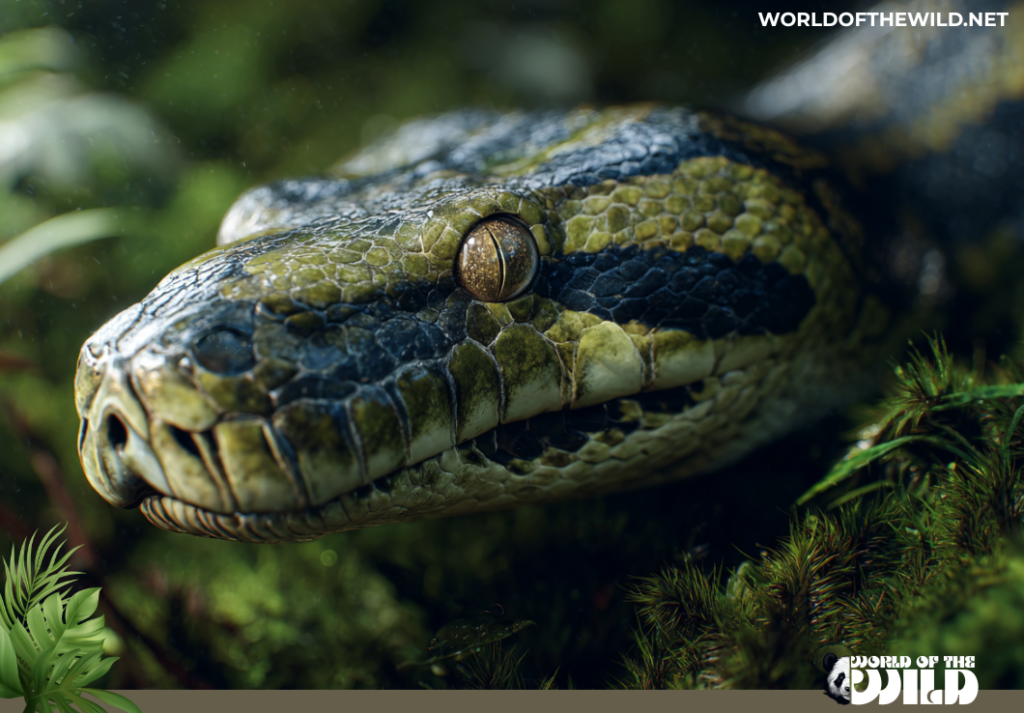
The Amazon is home to some of the world’s most spectacular and most feared reptiles. The green anaconda (Eunectes murinus) is the world’s heaviest snake — individuals have been reliably recorded at over 200 kilograms — and a consummate ambush predator of riverbanks and flooded forests. Despite their fearsome reputation, anacondas are not aggressive toward humans and primarily prey on caimans, capybaras, deer, and large birds.
The black caiman (Melanosuchus niger) is the Amazon’s largest predator — larger than any crocodilian species outside the saltwater crocodile of the Indo-Pacific — and a critical apex predator of Amazonian waterways. Heavily hunted through the mid-20th century for its skin, the black caiman has recovered substantially in protected areas and its return has been associated with improvements in the health of Amazonian river ecosystems.
Of the Amazon’s amphibians, the poison dart frogs (family Dendrobatidae) are the most celebrated. These tiny, jewel-bright frogs advertise their toxicity through spectacular colouration — brilliant reds, blues, yellows, and greens that serve as a warning to potential predators. Their toxins, derived from the insects they eat, are among the most potent naturally occurring substances on Earth, and one species, the golden poison frog of Colombia, produces enough toxin to kill ten adult humans. Despite this — or perhaps because of it — they are among the most researched organisms in the Amazon, and their toxins have yielded important insights into neuroscience and potential pharmaceutical compounds.
Insects and the Invisible Kingdom
No account of Amazonian wildlife would be complete without an attempt to convey the staggering diversity of its insect life — though any such attempt is doomed to inadequacy by the sheer scale of the subject. The Amazon basin contains an estimated 2.5 million species of insects. A single hectare of Amazonian rainforest may contain upward of 50,000 species of insects alone.
Army ants of the genus Eciton are among the forest’s most formidable organisms. Colonies of up to 700,000 individuals undertake periodic raids across the forest floor that are among the most dramatic events in nature, sweeping up and killing every invertebrate — and many small vertebrates — in their path. The ants themselves construct remarkable living structures: bridges, chains, and even temporary bivouac nests made entirely of interlocked ant bodies. Where army ants go, they are followed by a retinue of attendant species — antbirds that catch insects flushed by the ants, butterflies that feed on the droppings of those birds, parasitic flies that lay eggs on the fleeing insects.
Morpho butterflies — large, iridescent blue wings that seem to generate their own light — are iconic emblems of the Amazon. Their wings contain no blue pigment at all. Instead, microscopic structures in the wing scales scatter and reflect blue wavelengths of light with extraordinary efficiency. Morpho wings have become the subject of serious materials science research, inspiring the development of structural colour technologies for use in displays and sensors.
Fish: The Forgotten Megafauna
The Amazon River system contains the highest diversity of freshwater fish on Earth — an estimated 3,000 described species, with hundreds more awaiting formal description. Fish are not an afterthought in the Amazon ecosystem. They are central to it.
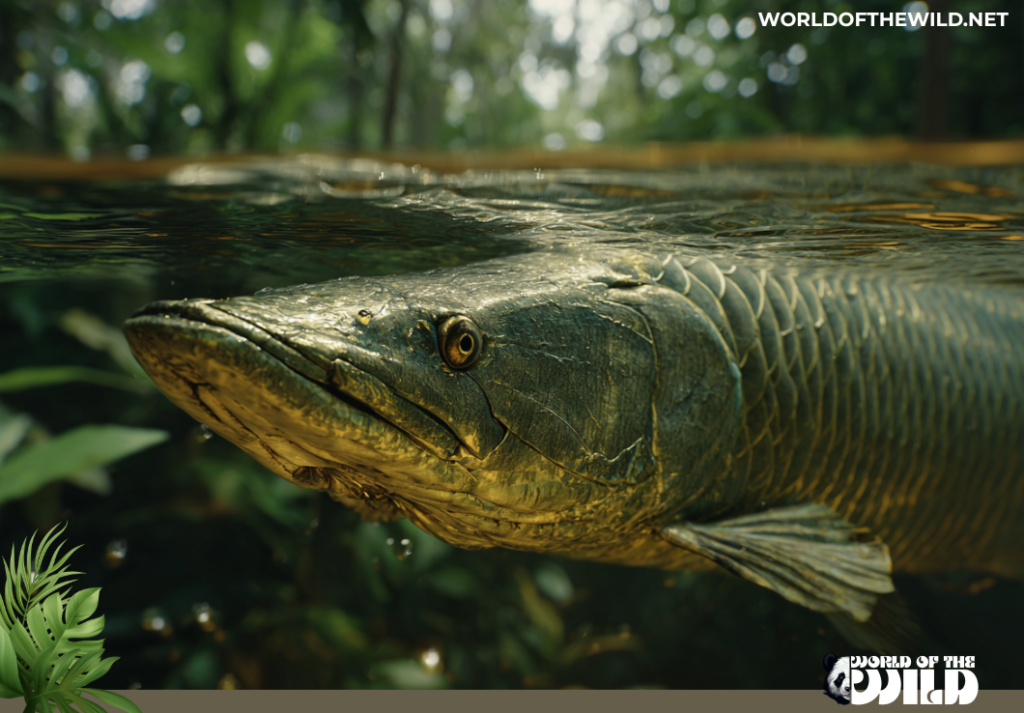
The arapaima (Arapaima gigas) is one of the world’s largest freshwater fish, reaching up to three metres in length and 200 kilograms in weight. An obligate air-breather, the arapaima surfaces every five to fifteen minutes to take a gulp of air, a behaviour that makes it uniquely vulnerable to hunters. It has been harvested to near-extinction in many parts of the Amazon but is recovering in areas where communities have imposed sustainable harvesting restrictions.
The red-bellied piranha (Pygocentrus nattereri) is, despite its fearsome reputation, rarely dangerous to healthy humans. Piranhas are primarily scavengers and opportunistic feeders, and their frenzy behaviour is largely triggered by the smell of blood and the presence of stranded, struggling animals. Their role in the ecosystem is as important decomposers, helping to rapidly process carcasses and recycle nutrients.
The electric eel (Electrophorus electricus) — which is not actually an eel but a knifefish — is capable of producing electrical discharges of up to 860 volts, used both to stun prey and to navigate in the murky blackwater environments it favours. Recent research has revealed that electric eels hunt in groups, herding schools of small fish into shallow water before collectively discharging, a level of collaborative hunting behaviour previously unknown in fish.
Part Six: The Amazon Today — Threats, Hope, and the Path Forward
The Crisis at the Canopy
The Brazilian Amazon faces a constellation of threats, but deforestation remains the central and most urgent. The primary drivers are cattle ranching (responsible for roughly 80% of deforestation), soy cultivation (often linked to cattle through feed supply chains), illegal logging, and infrastructure development. The construction of large hydroelectric dams — including the controversial Belo Monte dam on the Xingu River — has flooded vast areas of forest and disrupted the river dynamics on which downstream ecosystems depend.
Gold mining, both large-scale and artisanal (garimpo), poses a specific and severe threat to both the environment and indigenous communities. Illegal gold mining operations in indigenous territories — most notoriously in the Yanomami territory of Roraima and Amazonas states — have caused catastrophic mercury contamination of waterways, destroyed fish stocks, and brought devastating disease to indigenous communities. The Yanomami humanitarian crisis that became internationally visible in early 2023 was a stark reminder of how directly forest destruction and indigenous wellbeing are linked.
Climate change amplifies all of these threats. As temperatures rise and dry seasons lengthen, the Amazon’s susceptibility to fire increases dramatically. The record fire seasons seen in 2019 and subsequent years — driven by a combination of increased deforestation and drought — demonstrated how quickly the forest can become a net emitter of carbon rather than a sink, turning a solution to climate change into an accelerant of it.
Reasons for Hope
The situation is serious. But it is not hopeless. The Brazilian Amazon has demonstrated remarkable resilience when given the chance to recover, and there are genuine reasons for cautious optimism.
In the mid-2000s, a combination of satellite monitoring, tougher law enforcement, pressure from agricultural buyers, and the designation of new protected areas drove deforestation rates down by more than 80% from their peak. This demonstrated what is possible when there is political will and adequate resources. The Amazon’s protected areas — including indigenous territories, national parks, and extractive reserves — cover approximately 53% of the Brazilian Amazon and represent one of the largest systems of conservation areas in the world.
Community-based conservation initiatives, in which indigenous and traditional communities are recognised as the primary managers of their lands, have shown consistently positive results. Models such as the extractive reserves pioneered by Chico Mendes — areas where communities can sustainably harvest forest products such as rubber, Brazil nuts, açaí, and medicinal plants — provide an economic alternative to deforestation while maintaining forest cover.
Scientific understanding of the Amazon is advancing rapidly. New tools — from satellite remote sensing and LiDAR mapping to environmental DNA analysis and citizen science biodiversity monitoring — are giving scientists unprecedented insight into the forest’s structure, health, and change over time. This knowledge is increasingly being used to guide targeted conservation interventions and to hold governments and corporations accountable for the commitments they make.
Conclusion: A Living Legacy
The Brazilian Amazon is not simply a forest. It is a 55-million-year accumulation of evolutionary innovation. It is the home of more distinct species than any other area of comparable size on Earth. It is the engine of a hydrological cycle that sustains continental agriculture. It is a cultural homeland of hundreds of distinct human peoples, each with their own languages, knowledge systems, and ways of being in the world. It is a carbon vault whose integrity is essential to the stability of the global climate. And it is, for those who have stood at its edge and listened to the roar of its insects, the screams of its macaws, and the deep, subsonic boom of its howler monkeys at dawn, one of the most overwhelmingly alive and awe-inspiring places on this planet.
The choices made in the next decade will determine whether that extraordinary accumulation of life continues, diminishes, or enters irreversible collapse. Those choices will be made by governments, corporations, consumers, and communities — and they will be shaped, in no small part, by whether or not people understand and care about what is at stake.
That is why exploration matters. That is why telling these stories matters. That is why, at World of the Wild, we return again and again to places like the Brazilian Amazon — not merely to marvel at them, but to understand them deeply enough to fight for them.
The Amazon is not just worth saving. It is essential to save. And it starts with knowing it.
Written for World of the Wild. All facts current as of publication. The Amazon story is still being written — and its next chapter depends on all of us.