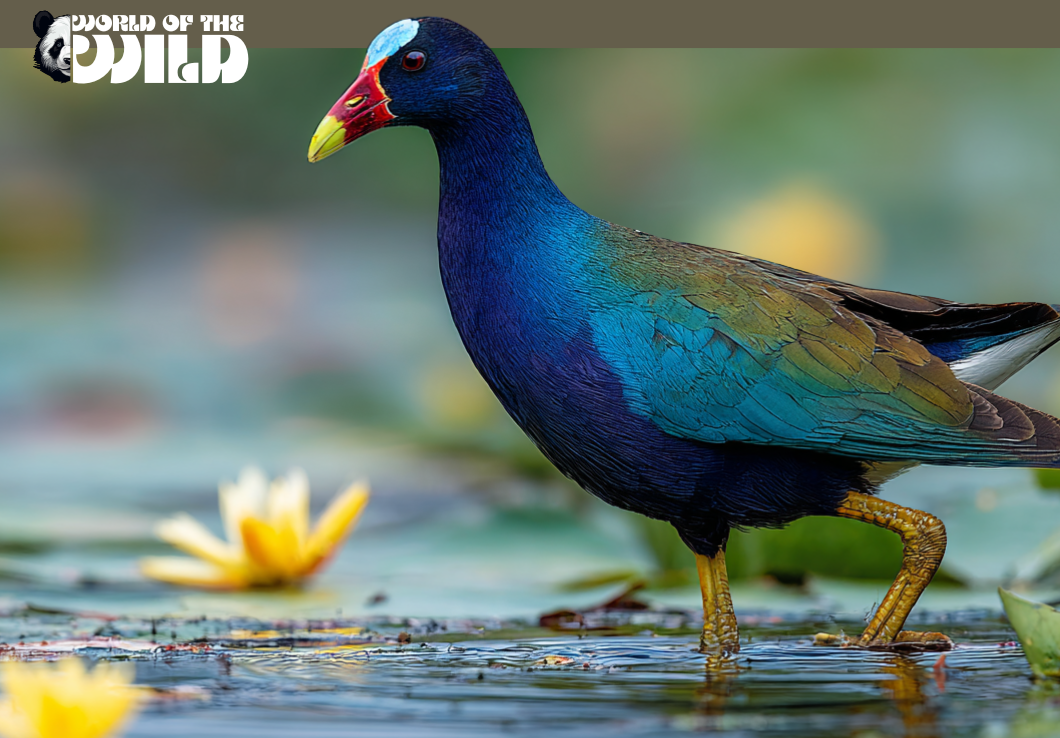

Imagine a bird so vibrantly colored it looks like it escaped from a painter’s imagination—a creature sporting an iridescent purple-blue body, bright yellow legs, and a brilliant red-and-yellow bill. This is the Purple Gallinule, one of the most stunning avian residents of North and South American wetlands. While many waterbirds dress in subdued browns and grays to blend into their marshy homes, the Purple Gallinule defies convention with its spectacular plumage that seems almost tropical in its intensity. These charismatic birds are masters of their watery domain, walking across floating vegetation with oversized feet that would make a snowshoe jealous. Despite their eye-catching appearance, Purple Gallinules remain surprisingly little-known outside birdwatching circles, making them one of nature’s best-kept secrets hiding in plain sight among the cattails and lily pads.
Facts
Here are some fascinating tidbits about the Purple Gallinule that showcase just how remarkable these birds truly are:
- Lily Pad Acrobats: Purple Gallinules possess extraordinarily long toes—proportionally some of the longest of any bird—that distribute their weight across floating vegetation, allowing them to walk on water lilies and other aquatic plants that would sink under most birds.
- Cooperative Breeders: Unlike many bird species, Purple Gallinules sometimes practice cooperative breeding, where older offspring from previous seasons help their parents raise new chicks, demonstrating sophisticated family structures.
- Omnivorous Opportunists: These birds have an incredibly varied diet and have been observed using tools—picking up floating objects to use as platforms while foraging in deeper water.
- Vocal Communicators: Purple Gallinules produce a surprising variety of calls, including chicken-like clucks, explosive cackles, and guttural croaks that echo across marshlands, particularly during breeding season.
- Vagrant Wanderers: Despite being generally sedentary, young Purple Gallinules occasionally wander far from their normal range, with individuals showing up as far north as Canada and even in Europe, stunning local birders.
- Aggressive Defenders: During breeding season, these normally secretive birds become fiercely territorial, charging at intruders with raised wings and loud vocalizations to protect their nesting areas.
- Synchronized Swimmers: Purple Gallinule chicks can swim almost immediately after hatching, following their parents through the marsh within hours of emerging from their eggs.
Species
The Purple Gallinule belongs to a well-defined taxonomic lineage within the bird world:
Classification:
- Kingdom: Animalia
- Phylum: Chordata
- Class: Aves
- Order: Gruiformes
- Family: Rallidae (rails, gallinules, and coots)
- Genus: Porphyrio
- Species: Porphyrio martinicus
The Purple Gallinule is one of several species within the genus Porphyrio, which includes the swamphens found across the Old World. Previously, scientists debated whether the Purple Gallinule should be classified separately, but genetic studies have confirmed its placement within this colorful genus.
There are no recognized subspecies of the Purple Gallinule, though there is some subtle variation in size and coloration across its geographic range. The species is most closely related to the Azure Gallinule of South America and the various swamphen species found in Africa, Asia, and Australia. All members of this genus share the characteristic of vibrant plumage and specialized adaptations for wetland living.
The Rallidae family to which Purple Gallinules belong is diverse, including over 150 species ranging from the tiny rails to the flightless takahē of New Zealand. Within this family, Purple Gallinules occupy a unique ecological niche as medium-sized, highly mobile wetland specialists.
Appearance
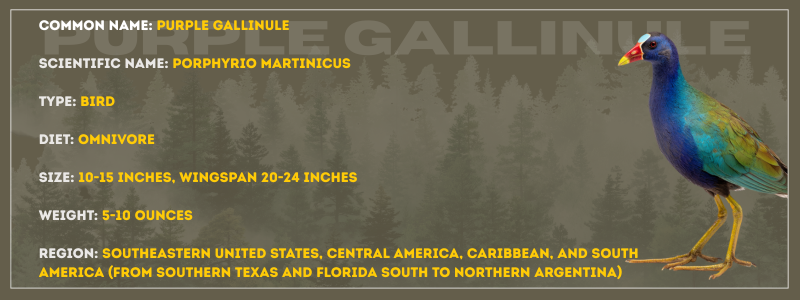
The Purple Gallinule is a medium-sized waterbird that commands attention wherever it appears. Adults typically measure 10 to 15 inches in length from bill to tail, with a wingspan of approximately 20 to 24 inches. They weigh between 5 to 10 ounces, making them lighter than they appear due to their fluffy plumage.
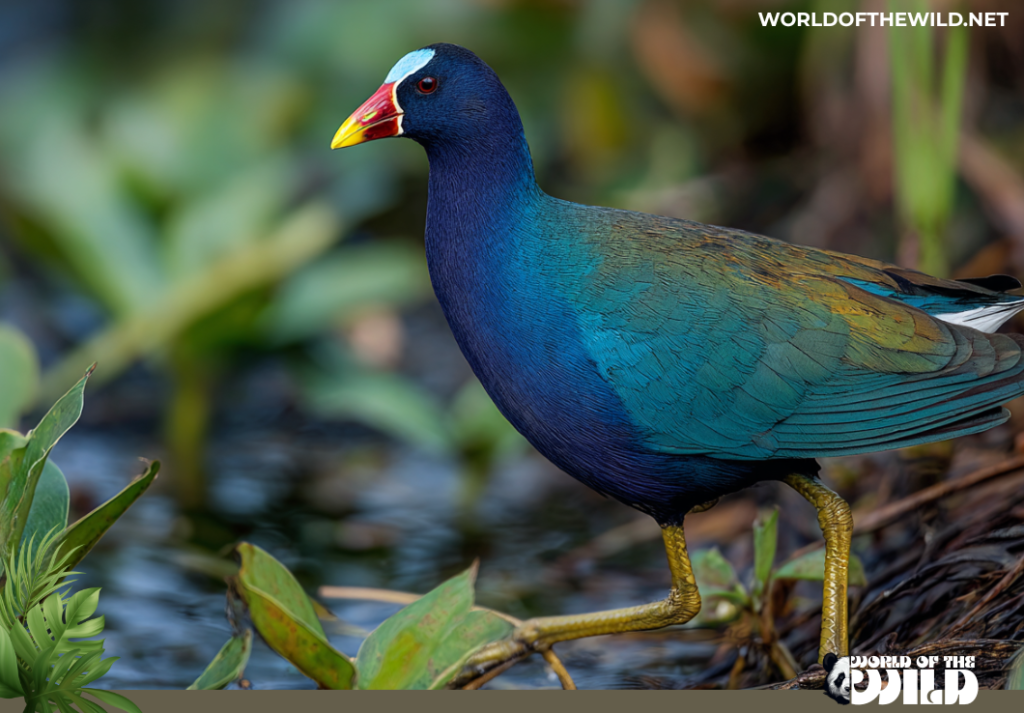
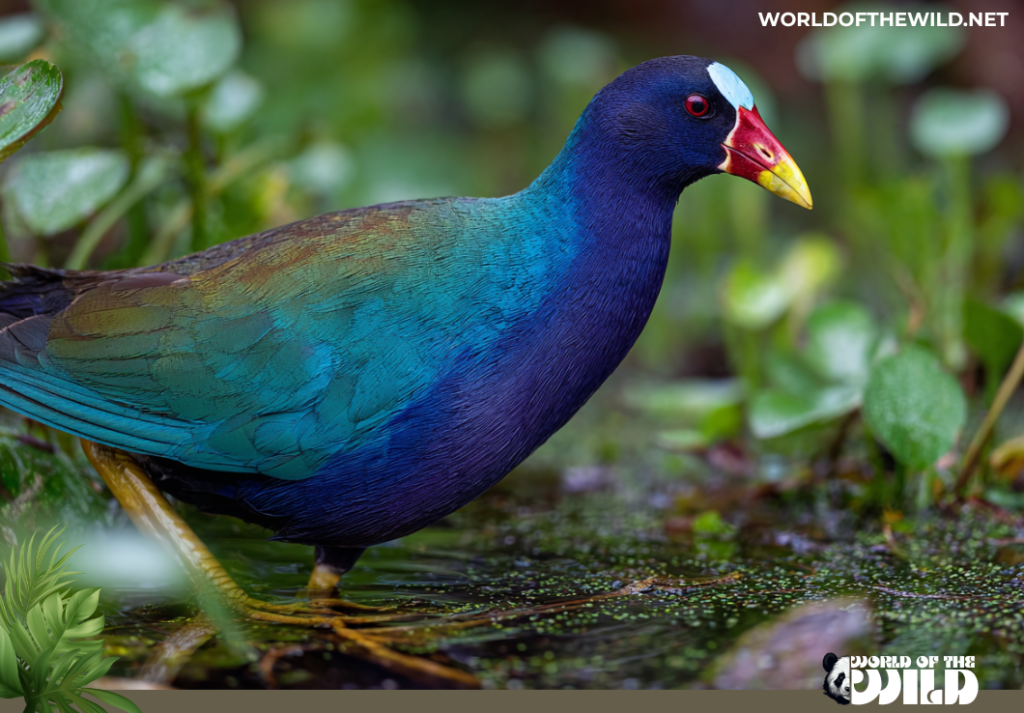
The bird’s most striking feature is its brilliant coloration. The head, neck, and underparts glow with an intense purple-blue sheen that shifts in the sunlight, appearing almost violet in certain angles. The back and wings display a bronze-green iridescence that contrasts beautifully with the purple tones. The undertail coverts are pure white, creating a bold contrast visible when the bird walks or swims.
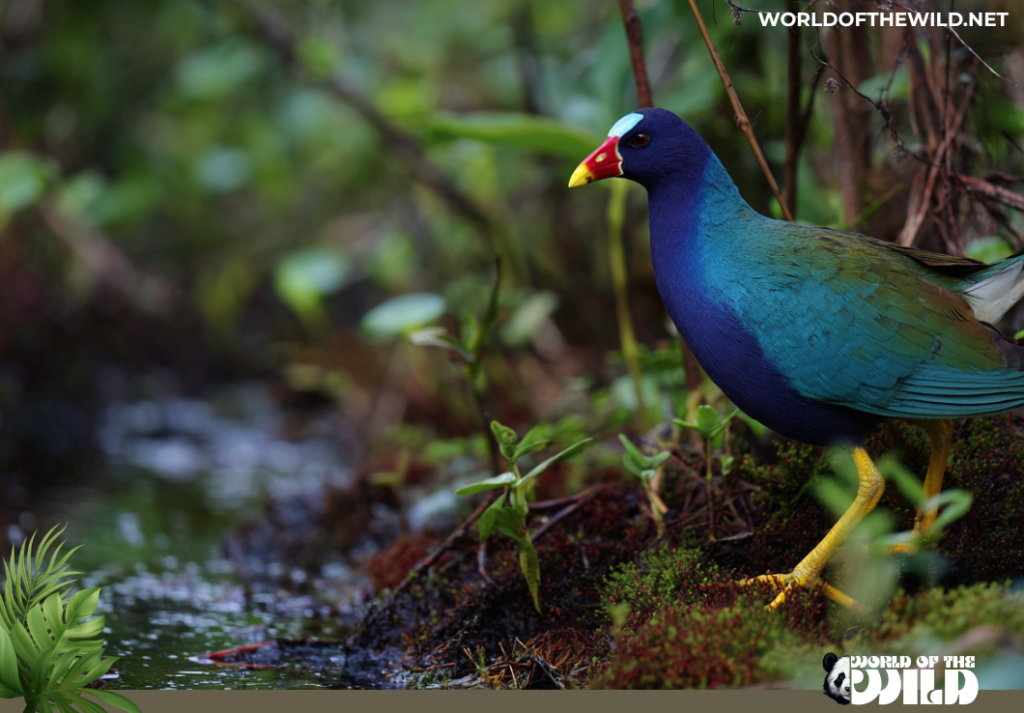
The bill is perhaps equally eye-catching: a vibrant red with a bright yellow tip and a pale blue frontal shield that extends up onto the forehead. The eyes are red, adding another splash of color to an already kaleidoscopic palette. But perhaps the most distinctive feature is the legs and feet—exceptionally long and bright yellow to golden-orange, ending in elongated toes that can span up to 5 inches across.
Juvenile Purple Gallinules look markedly different from adults, sporting buffy-brown plumage overall with greenish backs and lacking the intense purple coloration. Their bills are duller, and their frontal shields are smaller. This juvenile plumage gradually transitions to adult coloration over their first year.
Sexual dimorphism is minimal in this species, with males and females appearing nearly identical, though males average slightly larger in size. During flight, Purple Gallinules display their relatively short, rounded wings and dangling legs, creating a distinctive silhouette against the sky.
Behavior
Purple Gallinules are diurnal creatures most active during early morning and late afternoon hours, though they may forage throughout the day depending on conditions. These birds display a fascinating blend of secretive and bold behaviors, often skulking through dense vegetation one moment and walking brazenly across open lily pads the next.
Socially, Purple Gallinules are somewhat flexible. During the non-breeding season, they may be encountered alone or in small loose groups, particularly where food is abundant. However, they become highly territorial during breeding season, with pairs or family groups defending areas of marsh from intruders with remarkable aggression. Their territorial displays include raised wings, loud vocalizations, and direct charges at rivals.
Communication among Purple Gallinules is surprisingly complex and noisy. They produce a variety of calls including hen-like clucks and cackles, explosive “kek-kek-kek” sounds, and guttural croaks. These vocalizations serve multiple purposes: maintaining contact between family members, advertising territory, signaling alarm, and coordinating group activities.
One of the most remarkable behavioral adaptations is their locomotion across floating vegetation. Using their extraordinarily long toes to distribute weight, Purple Gallinules walk gracefully across lily pads, lotus leaves, and other aquatic plants that would sink under most birds. They balance with constant subtle adjustments, occasionally using their wings for stability. When moving through denser vegetation, they climb skillfully using both feet and bill to grasp stems.
Purple Gallinules are strong swimmers despite their terrestrial appearance, often swimming with a characteristic head-bobbing motion. They can also dive when threatened, sometimes grasping underwater vegetation to remain submerged until danger passes. Flight is less commonly observed but perfectly adequate—these birds can fly strongly when needed, with rapid wingbeats and dangling legs.
Intelligence is evident in their foraging behavior. Purple Gallinules have been observed using crude tools, manipulating floating debris to create feeding platforms, and learning to exploit human-modified environments like rice fields and urban ponds. They show problem-solving abilities and can remember productive foraging locations.
The species also exhibits interesting preening and maintenance behaviors, regularly oiling their feathers and engaging in sunbathing, spreading their wings to absorb warmth and possibly using sunlight for feather maintenance.
Evolution
The evolutionary history of the Purple Gallinule is intertwined with the broader story of the Rallidae family, one of the most successful groups of birds in terms of colonizing remote islands and adapting to diverse wetland habitats worldwide. The rails and their relatives have ancient origins, with fossil evidence suggesting the group emerged during the Paleocene to Eocene epochs, roughly 40 to 60 million years ago.
The genus Porphyrio, to which the Purple Gallinule belongs, likely originated in the Old World, with ancestral swamphen populations spreading across Africa, Asia, and Australasia. The Purple Gallinule represents a New World lineage that diverged from these Old World ancestors, probably during the Pliocene or early Pleistocene epochs, approximately 2 to 5 million years ago.
Genetic studies indicate that the Purple Gallinule’s closest living relative is the Azure Gallinule of South America, suggesting that the common ancestor of these species colonized the Americas and then speciated, with the Purple Gallinule expanding northward while the Azure Gallinule remained primarily in South American wetlands. This split likely occurred as populations adapted to different climatic zones and ecological conditions.
The evolution of the Purple Gallinule’s most distinctive features—its vibrant coloration, elongated toes, and wetland specializations—represents adaptations to their marsh environment. The spectacular plumage likely evolved through sexual selection, with brighter individuals having better mating success. The elongated toes are a clear adaptation for distributing weight on floating vegetation, allowing exploitation of food resources unavailable to other waterbirds.
Rails as a group are noteworthy for repeatedly evolving flightlessness on predator-free islands, though the Purple Gallinule has retained strong flight capabilities, likely because it inhabits mainland areas where flight provides important advantages for escaping predators and moving between wetland patches.
The Purple Gallinule’s evolutionary success is evident in its wide distribution across the Americas and its ability to colonize new wetland habitats, including human-created environments like rice fields and retention ponds. This adaptability suggests that the species possesses evolutionary flexibility that has served it well through changing climatic conditions over millennia.
Habitat
The Purple Gallinule inhabits freshwater and brackish wetlands across a broad geographic range stretching from the southern United States through Central America, the Caribbean, and much of South America, extending as far south as northern Argentina. In North America, their range centers on the southeastern United States, particularly Florida, Louisiana, and Texas, with populations extending along the Gulf Coast and up the Mississippi River valley during breeding season. They are year-round residents in southern Florida and tropical regions, while northern populations migrate southward for winter.
These birds are habitat specialists, requiring wetlands with specific characteristics. Their ideal habitat features shallow water—typically less than three feet deep—with abundant emergent and floating vegetation. Prime Purple Gallinule territory includes freshwater marshes dominated by cattails, bulrush, and pickerelweed, as well as the edges of lakes and ponds with extensive lily pad coverage. They particularly favor areas where water hyacinth, lotus, and other floating plants create stable platforms for walking and foraging.
The habitat must provide dense vegetation for nesting and cover, combined with more open areas where they can walk across floating vegetation. Purple Gallinules thrive in dynamic wetland environments where water levels fluctuate seasonally, creating diverse microhabitats. They readily adapt to human-modified wetlands, including rice fields, aquaculture ponds, and constructed wetlands, provided these areas maintain appropriate vegetation structure.
Elevation range is typically from sea level to about 6,500 feet, though they’re most common in lowland areas. The species requires warm climates and cannot tolerate prolonged freezing conditions, which limits their northern distribution. Their wetland habitats are often associated with warm, humid climates where vegetation grows year-round or through extended growing seasons.
Within their habitat, Purple Gallinules occupy a specific niche. They forage primarily on floating vegetation and among emergent plants in shallow zones, rarely venturing far from vegetative cover. During breeding season, territories are typically 0.5 to 2 acres, depending on habitat quality and food availability.
Diet
The Purple Gallinule is an omnivore with remarkably catholic tastes, consuming both plant and animal matter in proportions that vary seasonally and based on availability. This dietary flexibility is one key to the species’ success across diverse wetland environments.
Plant material forms a significant portion of their diet, particularly seeds, fruits, and tender shoots of aquatic and semi-aquatic vegetation. They feed heavily on the seeds of water lilies, lotus, smartweed, and various grasses. The tender shoots and leaves of cattails, water lettuce, and water hyacinth also feature prominently in their diet. During fruiting seasons, they consume berries and small fruits from wetland shrubs.
Animal prey includes a diverse array of wetland invertebrates and small vertebrates. Insects and their larvae form a major protein source, with Purple Gallinules consuming dragonfly nymphs, beetles, grasshoppers, and caterpillars. They also eat spiders, snails, worms, and small crustaceans. Occasionally, they capture small fish, tadpoles, frogs, and even the eggs and hatchlings of other birds when opportunities arise.
Foraging techniques are varied and ingenious. Purple Gallinules walk across lily pads and other floating vegetation, gleaning insects and plucking seeds from plant surfaces. They probe among submerged vegetation with their bills, flip over floating debris to uncover hidden prey, and occasionally make shallow dives to reach food items. They’ve been observed using their feet to hold down vegetation while feeding, and even manipulating floating objects as feeding platforms.
Their feeding behavior shows clear intelligence and opportunism. Purple Gallinules quickly learn to exploit new food sources, visiting the same productive feeding areas repeatedly. In agricultural areas, they feed on rice and other crops, sometimes bringing them into conflict with farmers. They’re also known to visit bird feeders in areas where their habitat borders human development.
Seasonal dietary shifts are apparent, with animal matter becoming more important during breeding season when adults need extra protein for egg production and chick-rearing. Young birds are fed primarily invertebrates in their first weeks of life, gradually transitioning to a more omnivorous diet as they mature.
Predators and Threats
Purple Gallinules face predation pressure from various sources throughout their range. Natural predators include both aerial and terrestrial hunters adapted to wetland environments. Raptors such as Red-shouldered Hawks, Red-tailed Hawks, and various owls prey on adult gallinules, while smaller hawks may take juveniles. Wading birds including Great Blue Herons and egrets occasionally capture young gallinules.
Terrestrial predators pose significant threats, particularly to nests and flightless young. Raccoons are perhaps the most important nest predators across much of the species’ range, raiding nests for eggs and chicks. Other mammalian predators include opossums, mink, river otters, and in some areas, feral cats and dogs. Snakes, particularly water snakes and rat snakes, prey on eggs, chicks, and occasionally adults. American Alligators in southern regions represent apex predators capable of taking adult gallinules.
Anthropogenic threats present increasingly serious challenges for Purple Gallinule populations. Wetland loss and degradation constitute the primary conservation concern. Drainage for agriculture, urban development, and water management projects have eliminated vast areas of suitable habitat across the species’ range. The conversion of natural wetlands to rice fields presents a mixed picture—while rice fields can provide temporary habitat, modern agricultural practices including pesticide use and irregular flooding regimes often make them unsuitable.
Water pollution affects Purple Gallinules both directly and indirectly. Agricultural runoff containing pesticides and fertilizers degrades water quality and can poison birds directly or reduce food availability. Heavy metals and other contaminants accumulate in wetland sediments, potentially affecting gallinules through bioaccumulation.
Climate change poses emerging threats through altered precipitation patterns, increased drought frequency, and sea-level rise affecting coastal wetlands. Changes in wetland hydrology can eliminate suitable habitat or alter vegetation communities that gallinules depend upon.
Invasive species present complex challenges. While Purple Gallinules sometimes benefit from invasive aquatic plants like water hyacinth that provide foraging substrate, these plants can also degrade overall wetland health. Invasive predators, particularly in island populations and isolated wetlands, can devastate local gallinule populations.
In some regions, Purple Gallinules are hunted, though they’re not typically targeted as game birds. Incidental mortality from collisions with vehicles, power lines, and buildings during migration also claims some individuals annually.
Reproduction and Life Cycle
Purple Gallinules reach sexual maturity at approximately one year of age, though some individuals may not breed until their second year. The breeding season varies geographically, generally spanning from March through September in North America, with peak activity from April through July. In tropical regions, breeding may occur year-round, often timed to coincide with wet seasons when wetland productivity peaks.
Pair formation involves elaborate courtship displays. Males advertise territories through vocalizations and visual displays, calling loudly while swimming with wings slightly raised. Courtship feeding is common, with males presenting food items to potential mates. Pairs engage in mutual preening and synchronized swimming behaviors that strengthen pair bonds.
Once paired, both sexes collaborate in nest construction, though the female typically does more of the building. Nests are substantial platforms constructed from marsh vegetation—cattails, rushes, and grasses—woven together and anchored to emergent vegetation or built on floating mats. The nest is usually positioned 4 to 12 inches above water level, with a deep cup to hold eggs and often a canopy of vegetation arched over the top for concealment. Some pairs build multiple platforms including roosting platforms and alternate nests.
The female typically lays 5 to 10 eggs, though clutch sizes of 6 to 8 are most common. Eggs are buff or pinkish-buff with brown and purple spots and blotches. Incubation lasts approximately 18 to 20 days, with both parents sharing incubation duties, though the female generally incubates more frequently, particularly at night.
Hatching is usually staggered over several days. Chicks are precocial, covered in black down with distinctive bare red patches on the crown and throat. They can swim within hours of hatching and leave the nest within a day or two, though they remain dependent on parental care. Both parents feed the young, presenting food directly to chicks’ bills. Helper birds from previous broods sometimes assist in feeding and protecting young, demonstrating the species’ cooperative breeding system.
Young gallinules grow rapidly, developing juvenile plumage within a few weeks. They become increasingly independent after 30 to 40 days but may remain with parents for several months, sometimes helping raise subsequent broods. Full adult plumage is acquired by the end of their first year.
Purple Gallinules may raise two or even three broods in a single season under favorable conditions, particularly in southern portions of their range. This high reproductive potential helps compensate for predation losses and allows populations to respond quickly to good habitat conditions.
In the wild, Purple Gallinules typically live 3 to 5 years, though some individuals survive longer. Documented maximum lifespan in the wild exceeds 10 years, though such longevity is exceptional. First-year mortality is relatively high, with many young birds succumbing to predation, weather events, or starvation during their first migration or winter.
Population
The Purple Gallinule is currently classified as “Least Concern” by the International Union for Conservation of Nature (IUCN), indicating that the species is not considered globally threatened at present. This classification reflects the bird’s wide distribution, large overall population, and ability to adapt to various wetland habitats including some human-modified environments.
Global population estimates suggest there are between 500,000 to 5 million individual Purple Gallinules worldwide, though precise figures are difficult to obtain due to the species’ secretive nature and the challenge of surveying wetland habitats comprehensively. The North American population is estimated at 100,000 to 500,000 individuals, with the largest concentrations in the southeastern United States, particularly Florida and Louisiana.
Population trends vary regionally. In parts of North America, particularly the southeastern United States, populations appear relatively stable or may be experiencing modest declines correlated with wetland loss. The North American Breeding Bird Survey indicates slight decreasing trends in some regions over recent decades, though the species’ secretive nature makes it difficult to survey accurately. In other parts of the range, particularly some Caribbean islands and Central American countries, local populations may be more vulnerable due to smaller wetland areas and greater habitat fragmentation.
Several factors complicate population assessments. Purple Gallinules are highly mobile, and individuals can disperse considerable distances, particularly young birds. This mobility means local populations may fluctuate substantially from year to year. Additionally, the species’ tendency to inhabit dense marsh vegetation makes census work challenging, and populations may be significantly underestimated in surveys.
Conservation efforts for Purple Gallinules generally focus on wetland protection and restoration rather than species-specific measures, as healthy wetland ecosystems support gallinules along with numerous other species. Protected areas including national wildlife refuges, state parks, and private conservation lands provide important habitat security. Wetland restoration projects, improved water quality management, and preservation of marsh corridors all benefit Purple Gallinule populations.
Climate change represents an emerging concern for long-term population viability, particularly regarding how shifting precipitation patterns and sea-level rise will affect wetland ecosystems. Monitoring programs continue to track population trends and habitat conditions to identify potential conservation needs before they become critical.
Conclusion
The Purple Gallinule stands as one of nature’s most spectacular yet underappreciated avian wonders—a bird that combines breathtaking beauty with remarkable adaptations for life among the lily pads. From its extraordinary toes that allow it to walk on water to its vibrant plumage that brightens even the dullest marsh, this species exemplifies the incredible diversity and ingenuity of wetland life. While currently secure across much of its range, the Purple Gallinule’s dependence on healthy wetland ecosystems makes it a living indicator of wetland health and a reminder of what we stand to lose when marshes are drained and degraded.
As we face a future where freshwater wetlands worldwide are under increasing pressure from development, pollution, and climate change, protecting species like the Purple Gallinule means protecting the vital ecosystems they represent. Every wetland preserved, every marsh restored, and every effort to improve water quality provides not just habitat for these magnificent birds, but critical services for human communities—flood control, water filtration, carbon storage, and irreplaceable biodiversity. The next time you glimpse a flash of purple among the cattails, remember that you’re witnessing not just a beautiful bird, but a symbol of wetland resilience and a call to action for conservation. The Purple Gallinule deserves a future as vibrant as its plumage, and ensuring that future is in our hands.
Scientific Name: Porphyrio martinicus
Diet Type: Omnivore
Size: 10-15 inches (25-38 cm) in length; wingspan 20-24 inches (51-61 cm)
Weight: 5-10 ounces (140-285 grams)
Region Found: Southeastern United States, Central America, Caribbean, and South America (from southern Texas and Florida south to northern Argentina)