
There are few moments in nature quite as arresting as watching a giraffe move. That long, improbable neck swaying with each stride, those legs like stilts carrying a body that seems to defy every rule of anatomy — the giraffe is, in every sense, an animal that makes you stop and stare. Standing as the tallest living terrestrial animal on Earth, the giraffe has captivated human imagination for millennia, appearing in ancient Egyptian art, Roman spectacles, and the notebooks of explorers who struggled to convince disbelieving audiences back home that such a creature truly existed.
But beyond the spectacle, the giraffe is a deeply complex, ecologically vital, and increasingly vulnerable animal. It is a creature shaped by millions of years of evolutionary pressure into something so perfectly — and so strangely — suited to its environment that studying it reveals profound truths about how life adapts, survives, and thrives. From its reinforced cardiovascular system to its surprisingly tender social bonds, the giraffe is far more than a long-necked curiosity. It is one of Africa’s great icons, and it is quietly disappearing. This is the story of the giraffe — in full.
Facts
- A giraffe’s heart weighs approximately 25 pounds and generates roughly twice the blood pressure of most other large mammals — an engineering necessity to pump blood all the way up that extraordinary neck to the brain.
- Giraffes have the same number of neck vertebrae as humans — just seven — but each one can be over 10 inches long.
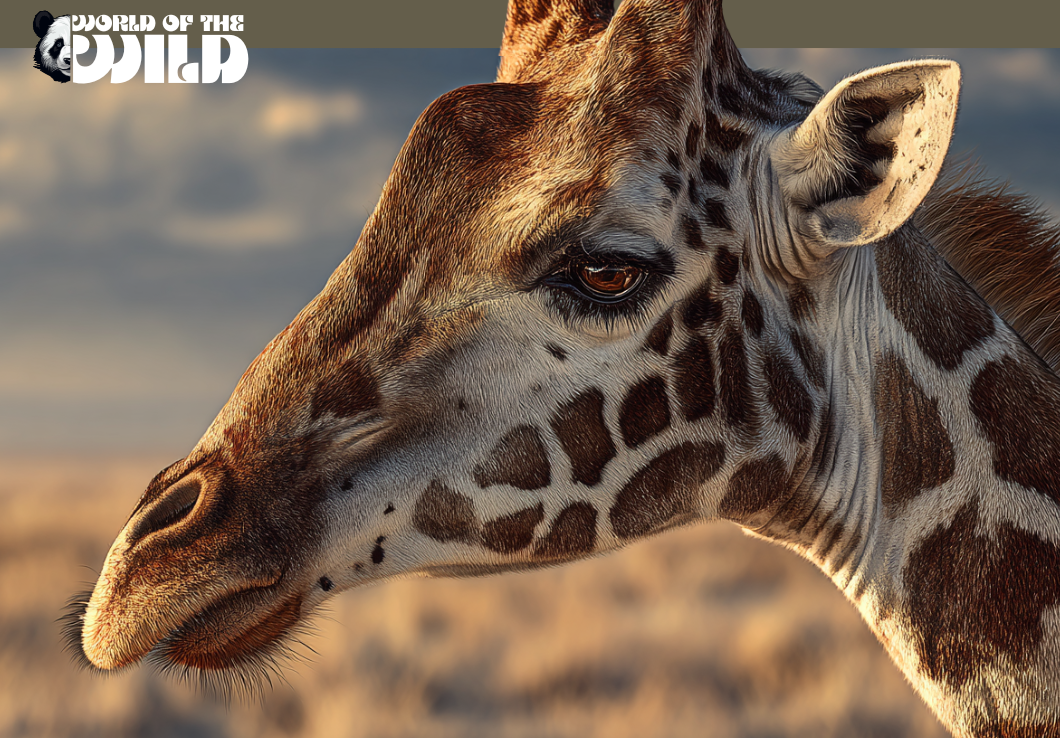
- Their tongues are 18 to 20 inches long, dark bluish-black in color, and coated in thick, UV-protective saliva, allowing them to browse thorny acacia branches without injury.
- Giraffes are largely silent animals, but they are not mute. They communicate through infrasound — low-frequency hums below the range of human hearing — as well as snorts, grunts, and flute-like calls, particularly at night.
- A giraffe can run at speeds up to 35 miles per hour over short distances and can sustain a pace of around 10 mph over longer stretches — making it far faster than most people expect from an animal of its size.
- Giraffes sleep for only 30 minutes to two hours per day, often in short bursts of just a few minutes at a time. When they do enter deep sleep, they curl their necks back along their body in one of nature’s most distinctive resting postures.
- No two giraffes have the same coat pattern. Like human fingerprints, their markings are entirely unique to the individual.
Species
Full Taxonomic Classification:
| Rank | Classification |
|---|---|
| Kingdom | Animalia |
| Phylum | Chordata |
| Class | Mammalia |
| Order | Artiodactyla |
| Family | Giraffidae |
| Genus | Giraffa |
| Species | Giraffa camelopardalis (traditional) |
For much of scientific history, the giraffe was treated as a single species with multiple subspecies. However, a landmark genetic study published in 2016 proposed that giraffes should actually be divided into four distinct species, a reclassification that remains actively debated among researchers but is increasingly accepted within the scientific community.
The four proposed species are:
- Northern Giraffe (Giraffa camelopardalis) — Encompasses the Nubian, Kordofan, and West African subspecies, found across a fragmented range in Central and West Africa, as well as parts of East Africa. This is the most critically endangered grouping.
- Southern Giraffe (Giraffa giraffa) — Includes the Angolan and South African subspecies and represents the most numerous and stable giraffe populations, concentrated in Southern Africa.
- Masai Giraffe (Giraffa tippelskirchi) — The largest of all giraffe types, found in Tanzania and Kenya. Distinguished by its jagged, irregular patch pattern and darker coloration. It is listed as Endangered.
- Reticulated Giraffe (Giraffa reticulata) — Perhaps the most visually distinctive, with large, clearly defined polygonal patches separated by bright white lines. Native to northeastern Kenya, Ethiopia, and Somalia.
The giraffe’s only living relative in the family Giraffidae is the okapi (Okapia johnstoni), a secretive, forest-dwelling animal from the Congo Basin that, despite looking more like a zebra crossed with a deer, is in fact the giraffe’s closest cousin.
Appearance
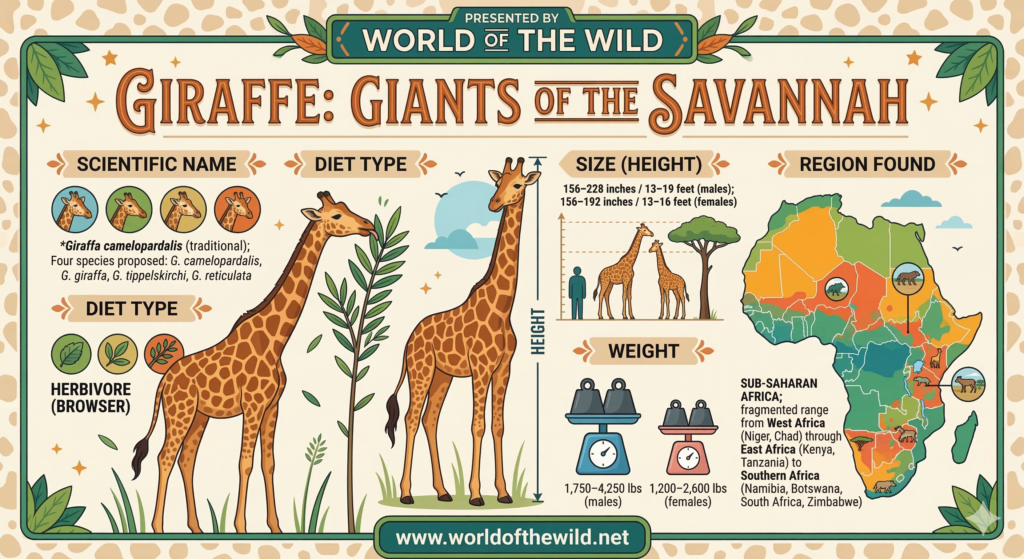
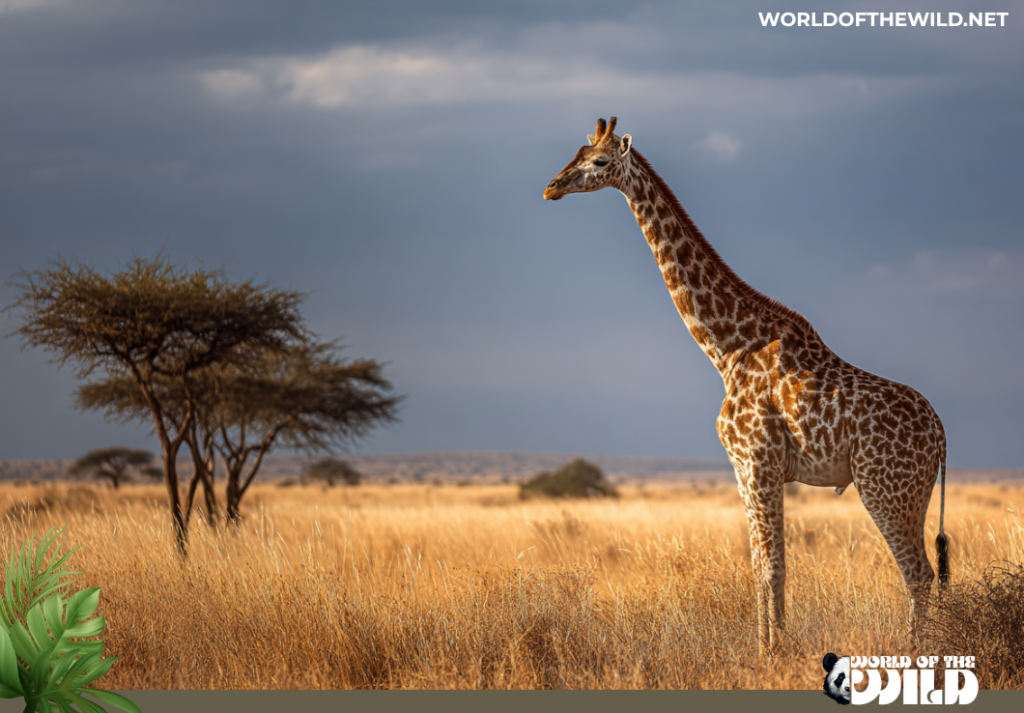
The giraffe’s appearance is nothing short of extraordinary. Adult males, known as bulls, typically stand between 14 and 19 feet tall, with their towering height almost entirely attributable to the length of their neck and legs. Females, called cows, are noticeably shorter, typically reaching 13 to 16 feet. In terms of weight, bulls can tip the scales at 1,750 to 4,250 pounds, while females are considerably lighter at around 1,200 to 2,600 pounds.
The coat is perhaps the giraffe’s most iconic feature — a mosaic of irregular brown, orange, or rust-colored patches separated by a network of lighter, cream-colored lines. This pattern serves as both camouflage in dappled woodland light and, researchers believe, as a mechanism for thermoregulation, with the darker patches acting as heat-dissipating vascular nodes.
Both male and female giraffes possess ossicones — horn-like protrusions on the skull that are not true horns but rather cartilaginous structures covered in skin and fur. Males typically have thicker, more prominent ossicones worn smooth at the top from sparring, while females retain tufted, hair-covered tips. Some individuals have additional, smaller ossicone-like bumps on the forehead.
The legs alone can reach six feet in length, and the front legs are slightly longer than the rear ones, giving the giraffe a characteristic sloping back profile. Their hooves are enormous — up to 12 inches in diameter — and function as devastating defensive weapons. A single kick from a giraffe can kill a lion.
Behavior
Giraffes are generally semi-social animals, living in loose, fluid groups called towers (or herds) that lack the rigid hierarchy of many other herd animals. These groups are dynamic and ever-changing — individuals drift in and out freely, and there is no permanent social bond enforcing group membership, though females with calves often cluster together for mutual protection.
Males engage in a remarkable behavior called “necking” — a ritualized combat in which two bulls swing their long necks and use their ossicones to deliver powerful blows to each other’s flanks and legs. These bouts establish dominance and mating rights and can occasionally be intense enough to knock an opponent unconscious, though fatalities are rare.
Drinking is one of the giraffe’s most physically awkward and vulnerable moments. Because their legs are so long, they must splay or bend their front legs dramatically to lower their head to the waterline — a posture that takes several seconds to enter and exit, during which time they are highly exposed to predators. As a result, giraffes drink as infrequently as possible, obtaining much of their water from the moisture-rich vegetation they consume.
Giraffes are also notable for their intelligence and memory. Studies have demonstrated that they can learn and retain associations between visual cues and food rewards, adjust their foraging behavior based on predator presence, and show what researchers describe as empathy-like responses toward injured or deceased group members.
Evolution
The story of the giraffe’s evolution stretches back roughly 25 million years to the early Miocene epoch in Africa and Eurasia. The earliest ancestors of modern giraffes were deer-like creatures far more modestly proportioned than their living descendants. Over millions of years, the Giraffidae family diversified into a surprisingly rich array of forms, including the Sivatherium — a massive, moose-like creature with broad, palmate ossicones that persisted into the Pleistocene and may have overlapped with early humans.
The direct lineage leading to modern giraffes passed through several key intermediate forms. Samotherium, a Miocene-era giraffid from Eurasia, is considered particularly significant as it possessed a neck of intermediate length, lending support to the idea that elongation was a gradual, continuous evolutionary process rather than a sudden development.
The classic explanation for the giraffe’s long neck — that it evolved primarily to access food at heights unavailable to shorter browsers — has been increasingly complicated by research. An alternative hypothesis, the “sexual selection” theory, proposes that longer necks were favored because they conferred advantages in necking combat between males, giving better-armed individuals greater reproductive success. Modern consensus suggests that both pressures likely operated simultaneously, making the giraffe’s neck a product of both ecological and sexual selective forces.
The split between the giraffe lineage and the okapi lineage is estimated to have occurred somewhere between 11 and 16 million years ago, with both lineages subsequently evolving in dramatically different directions — one into open savanna, the other into dense rainforest.
Habitat
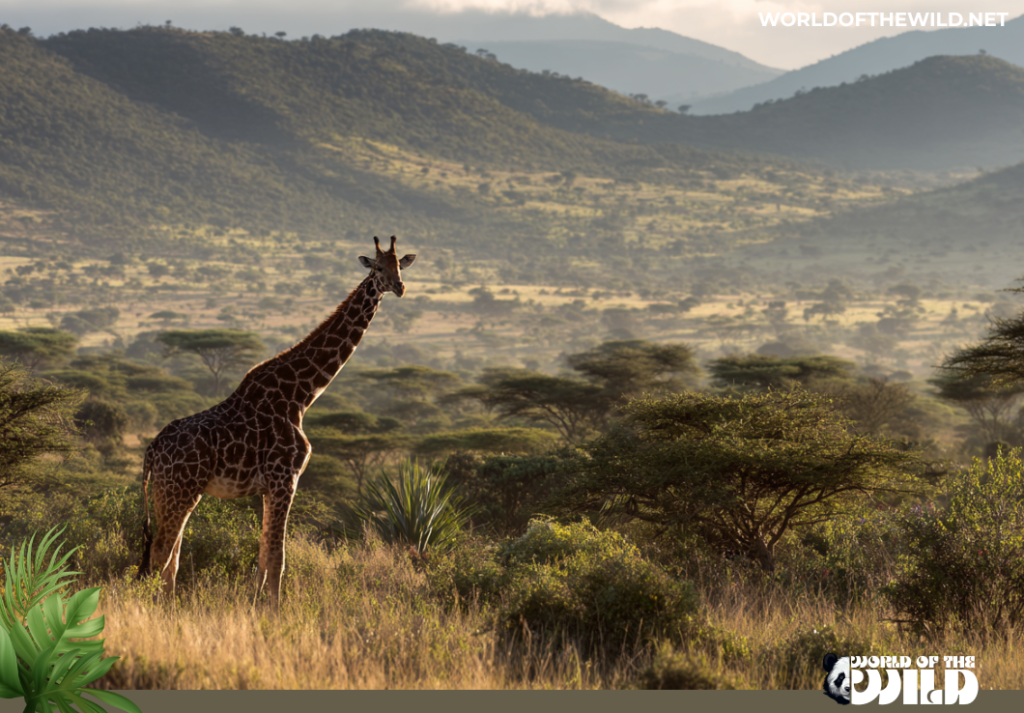
Giraffes are quintessentially African animals, with their range spanning a broad swath of sub-Saharan Africa — from Chad and Niger in the west, through the savannas of East Africa, and down into the woodlands of Namibia, Botswana, and South Africa. Historically, their range extended across much of the continent and even into North Africa, but today they are absent from vast portions of their former territory.
Their preferred habitat is open woodland and savanna, particularly areas dominated by acacia and other thorny trees that other large herbivores struggle to exploit. They thrive in environments with a mosaic of grassland and tree cover — enough open space to spot approaching predators, but enough woodland to provide their primary food source.
Key features of giraffe habitat include seasonal water sources, as giraffes are capable of surviving in semi-arid regions by extracting moisture from their food, and red oat grass and acacia woodlands that support the diverse plant communities they depend upon. They tend to avoid dense forest (where their height becomes a disadvantage) and true desert (where vegetation is insufficient).
Critically, giraffe habitat is not uniform across their range. Northern and West African populations occupy highly fragmented, isolated pockets of suitable land surrounded by degraded terrain — a reality that has severe consequences for genetic diversity and long-term viability.
Diet
The giraffe is a herbivore and one of the world’s most specialized browsers. The acacia tree is its primary food source — and a remarkably challenging one. Acacia branches are densely armed with sharp thorns, yet the giraffe has evolved a suite of adaptations to deal with this: its long, prehensile tongue grasps and strips leaves with precision, its thick, sticky saliva coats swallowed thorns to prevent injury, and its tough lips and gums provide additional protection.
An adult giraffe consumes somewhere between 75 and 165 pounds of vegetation per day, spending the majority of its waking hours — up to 12 hours — foraging. Beyond acacias, they consume a wide variety of other trees, shrubs, flowers, and fruits depending on availability and season. During the dry season, when preferred foliage is scarce, giraffes demonstrate dietary flexibility, switching to less palatable species and altering the height at which they forage.
The giraffe’s height gives it access to a feeding niche unavailable to virtually all other herbivores — the upper canopy of trees between 10 and 18 feet high. This means that while elephants and zebras compete for grass and low-level browse, the giraffe feeds largely without competition in its own vertical stratum of the landscape, a phenomenon ecologists refer to as niche partitioning.
Interestingly, giraffes have also been observed chewing on bones (osteophagy) and occasionally consuming soil, likely as a means of supplementing minerals — particularly calcium and phosphorus — that may be deficient in their purely plant-based diet.
Predators and Threats
Natural Predators
Adult giraffes, thanks to their size, speed, and devastating kick, have relatively few natural predators. Lions are the primary threat, typically targeting giraffes at their most vulnerable — when drinking, when giving birth, or when young and inexperienced. A lion attack on an adult giraffe is a high-risk undertaking; a full-grown bull can kill a lion with a single kick, and pride members must coordinate carefully to bring one down safely.
Crocodiles pose a serious danger at watering holes, particularly to younger or smaller individuals. Leopards and hyenas will take calves when the opportunity arises, and pack-hunting wild dogs have been documented successfully preying on juvenile giraffes on rare occasions.
Calves are dramatically more vulnerable than adults. It is estimated that up to 75% of giraffe calves die within their first year of life, with predation being the leading cause of mortality.
Human-Caused Threats
Despite their natural resilience, giraffes face an existential crisis driven almost entirely by human activity. The primary threats include:
- Habitat Loss and Fragmentation: Agricultural expansion, settlement, and infrastructure development have destroyed and divided giraffe habitat across much of Africa at an alarming rate. Isolated populations lose genetic diversity and become increasingly vulnerable to local extinction events.
- Illegal Hunting and Poaching: Giraffes are hunted for their meat, hide, and bone marrow across parts of their range. In some areas, their tails — considered status symbols — are taken illegally. This “silent extinction” receives far less international attention than the poaching crises affecting elephants and rhinos.
- Human-Wildlife Conflict: As human settlements encroach on wildlife areas, giraffes increasingly come into conflict with communities over water and agricultural land.
- Climate Change: Shifting rainfall patterns and prolonged droughts are altering the distribution and productivity of the vegetation giraffes depend upon, with cascading consequences for their survival.
Reproduction and Life Cycle
Giraffes do not follow a fixed breeding season — reproduction occurs year-round, though in some populations there are loose peaks corresponding to favorable ecological conditions. Males compete for mating access through necking bouts, with dominant bulls securing priority access to receptive females.
After mating, females undergo a gestation period of approximately 15 months — one of the longest of any land mammal — before giving birth to a single calf, though twins occur very rarely. Birth itself is a striking spectacle: the calf, already weighing 100 to 150 pounds and standing roughly 6 feet tall at birth, drops nearly six feet to the ground as the mother gives birth standing up. This dramatic arrival is actually functional — the impact helps stimulate the calf’s first breath.
Calves are remarkably precocious. Within hours of birth, they are able to stand and walk, an urgent necessity given the predator pressure they face from their first moments of life. Mothers are highly attentive during the early weeks, staying close to the calf and responding aggressively to approaching threats.
Calves nurse for 9 to 12 months and remain closely associated with their mothers for up to 18 months. Female calves may maintain longer-term relationships with their mothers, while male calves gradually integrate into bachelor groups as they mature.
Sexual maturity is reached at around 4 to 5 years of age for females and somewhat later for males, though males typically do not achieve dominant breeding status until they are larger and stronger — often around 7 to 10 years old. In the wild, giraffes typically live 20 to 25 years, with females generally outliving males. In captivity, some individuals have reached 30 years.
Population
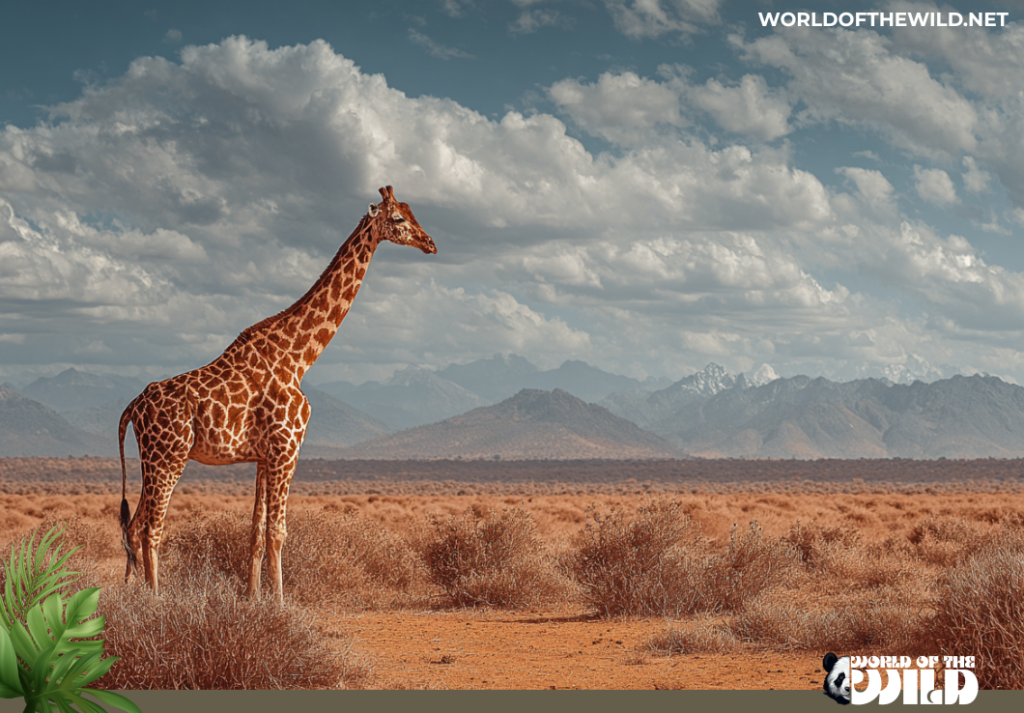
The giraffe’s conservation status is a story of quiet crisis. The International Union for Conservation of Nature (IUCN) currently lists the giraffe (Giraffa camelopardalis, under the traditional single-species classification) as Vulnerable on its Red List. However, under the four-species framework, several of the newly defined species carry far more serious designations — the Reticulated Giraffe is listed as Endangered, and the Masai Giraffe is also Endangered, reflecting the severity of their declines.
Current global population estimates suggest that approximately 117,000 giraffes remain in the wild — a figure that represents a dramatic collapse. Over the past three decades, overall giraffe numbers have declined by an estimated 30 to 40%, a trajectory that conservationists have described as a “silent extinction” occurring largely beneath the radar of global public attention.
The picture is not uniformly bleak. Southern African populations — particularly in Namibia, Botswana, South Africa, and Zimbabwe — have remained relatively stable or even grown in some protected areas, buoyed by strong conservation management and community-based wildlife programs. Northern and West African populations, by contrast, are in a far more precarious position, with some subpopulations numbering in the hundreds or even tens of individuals.
The Giraffe Conservation Foundation and other organizations are actively working to translocate giraffes to suitable but depopulated habitats, bolster anti-poaching efforts, and raise awareness of a conservation emergency that has for too long remained overshadowed by more charismatic crises.
Conclusion
The giraffe is one of nature’s most improbable and magnificent achievements — a living testament to what millions of years of evolutionary pressure can produce when given enough time and selection. From its cardiovascular engineering to its silent social sophistication, from its uniquely patterned coat to its indispensable role as a canopy browser shaping the very structure of African woodland, the giraffe is a creature of remarkable depth and ecological consequence.
And yet, it is slipping away. The numbers tell a story that is hard to ignore once you hear it: a 30 to 40 percent decline in three decades, thousands of square miles of habitat lost, populations fragmented into islands of survivors increasingly unable to reach one another. The giraffe’s “silent extinction” is a warning about what happens when the world looks away.
The good news is that trajectories can be reversed. Conservation programs are working. Awareness is growing. But awareness must translate into action — support for the organizations on the ground, pressure on governments to protect critical corridors, and a collective decision that the world is simply not prepared to lose the tallest animal that has ever walked the Earth. The giraffe has survived 25 million years of planetary change. Whether it survives us is a choice we still have time to make.
Quick Reference
| Field | Information |
|---|---|
| Scientific Name | Giraffa camelopardalis (traditional); four species proposed: G. camelopardalis, G. giraffa, G. tippelskirchi, G. reticulata |
| Diet Type | Herbivore (Browser) |
| Size (Height) | 156–228 inches / 13–19 feet (males); 156–192 inches / 13–16 feet (females) |
| Weight | 1,750–4,250 lbs (males); 1,200–2,600 lbs (females) |
| Region Found | Sub-Saharan Africa; fragmented range from West Africa (Niger, Chad) through East Africa (Kenya, Tanzania) to Southern Africa (Namibia, Botswana, South Africa, Zimbabwe) |