
Imagine standing at the edge of a vast African wetland as the morning mist rises off the water. The air is still, the papyrus reeds barely swaying, when suddenly a prehistoric shadow moves along the shallows. What steps into view is no ordinary bird — it is a creature of staggering proportions, a living testament to the grandeur of the natural world. The Goliath Heron, the largest heron on Earth, commands every inch of its name. Standing nearly as tall as a grown man, draped in rich chestnut and slate-grey plumage, this bird has haunted Africa’s waterways for millennia, hunting with the patience of a statue and the precision of a spear.
For birdwatchers, conservationists, and casual nature lovers alike, the Goliath Heron is one of those rare animals that stops you in your tracks. It is not just its size that captivates — it is the sheer authority with which it occupies its world. In an ecosystem teeming with life, the Goliath Heron stands apart, a solitary sovereign of rivers, lakes, and coastal lagoons. If you have ever wanted to understand what it feels like to encounter a truly wild and untamed creature, read on.
Facts
- Record-breaking stature: The Goliath Heron is the world’s largest living heron species, capable of reaching nearly 5 feet in height with a wingspan stretching over 7 feet — larger than many eagles.
- A uniquely bass voice: Unlike the delicate calls of smaller herons, the Goliath Heron produces a deep, booming “kowoork” call that echoes across wetlands, audible from a considerable distance.
- Slow and selective feeder: Despite its imposing size, this heron can spend hours motionless in the water, waiting for exactly the right moment to strike — a level of patience that makes it one of the most efficient ambush predators among birds.
- Kleptoparasitism victim: Goliath Herons are frequently targeted by African Fish Eagles, which harass and steal fish directly from their bills, a behavior known as kleptoparasitism.
- Surprisingly territorial but non-aggressive: While they fiercely defend fishing territories, Goliath Herons rarely engage in prolonged physical fights, relying instead on posturing, vocalizations, and sheer intimidating presence.
- Monogamous and devoted: These herons are believed to form long-term pair bonds, returning to the same nesting sites year after year with the same mate.
- Ancient survivorship: The Goliath Heron belongs to a lineage that has changed remarkably little over millions of years, making it one of the more evolutionarily “conservative” birds on the planet.
Species
The Goliath Heron occupies a well-defined place in the tree of life:
- Kingdom: Animalia
- Phylum: Chordata
- Class: Aves
- Order: Pelecaniformes
- Family: Ardeidae
- Genus: Ardea
- Species: Ardea goliath
The genus Ardea is a prestigious one, containing some of the most recognizable large herons in the world, including the Grey Heron (Ardea cinerea) of Europe and Asia, the Great Blue Heron (Ardea herodias) of North America, and the Purple Heron (Ardea purpurea) found across Africa and Eurasia. These species share the Goliath Heron’s characteristic long necks, dagger-like bills, and patient hunting styles, yet none approach its sheer size.
The Goliath Heron has no recognized subspecies — it is considered a monotypic species, meaning there is only one distinct form across its entire range. This relative uniformity across a vast geographic distribution speaks to the species’ stability and long-term success. Its closest relatives within the Ardea genus are the Grey Heron and the Great Blue Heron, with whom it shares significant physical and behavioral similarities, though the Goliath dwarfs both of them.
Appearance
There is nothing subtle about the Goliath Heron. Everything about its appearance is scaled up to match its reputation.
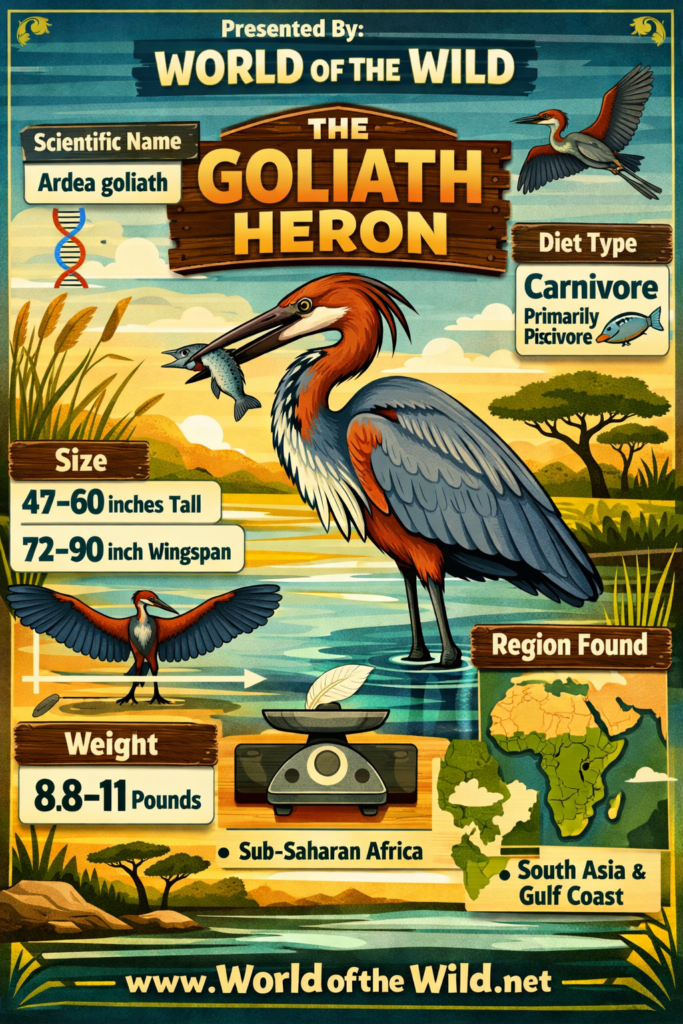
In terms of size, adults typically stand between 47 and 60 inches tall (roughly 4 to 5 feet), making it taller than many human children and comparable in height to a large dog standing on its hind legs. The wingspan is equally dramatic, stretching from 72 to 90 inches — that is up to 7.5 feet from wingtip to wingtip. Despite this formidable frame, Goliath Herons weigh between 8.8 and 11 pounds, a surprisingly moderate weight that speaks to the hollow-boned architecture shared by all birds.
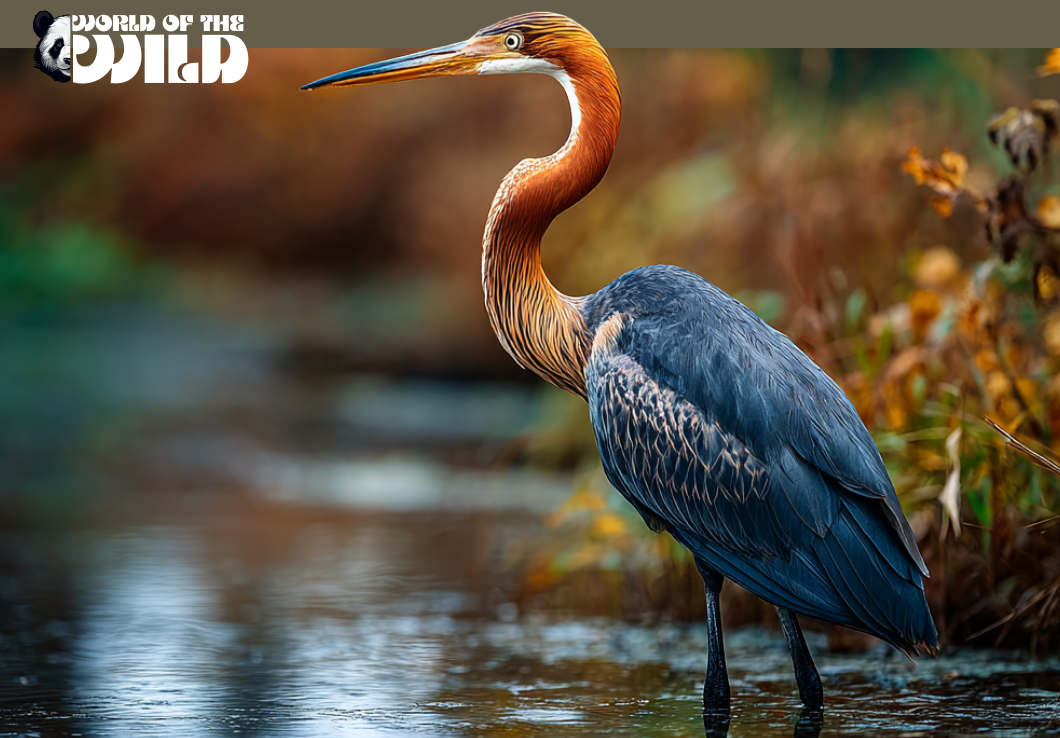
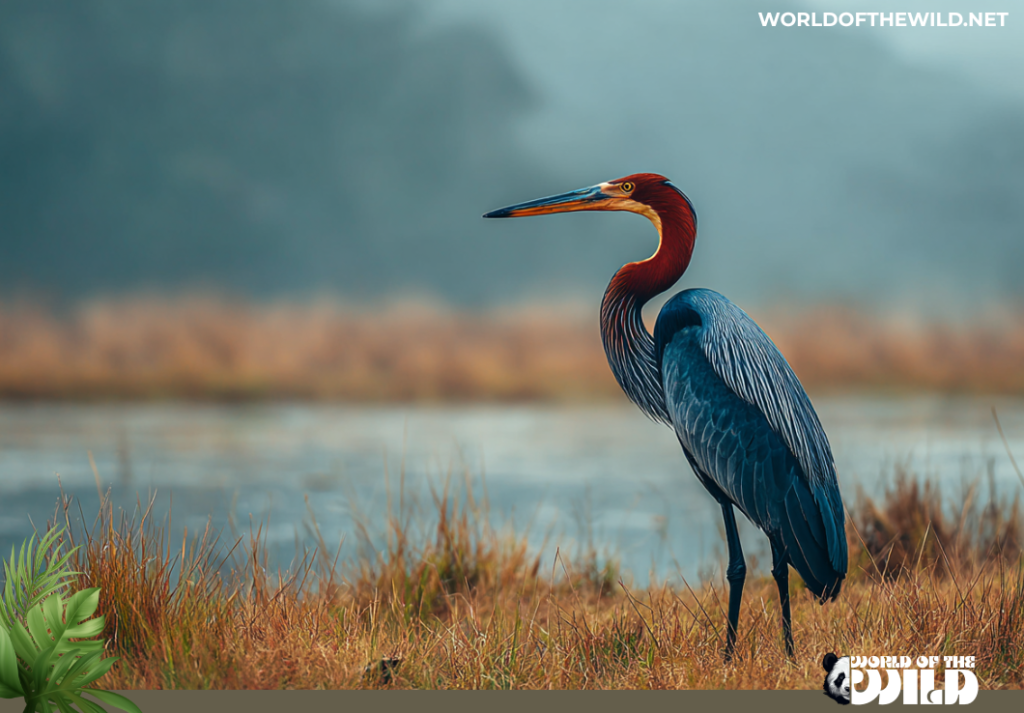
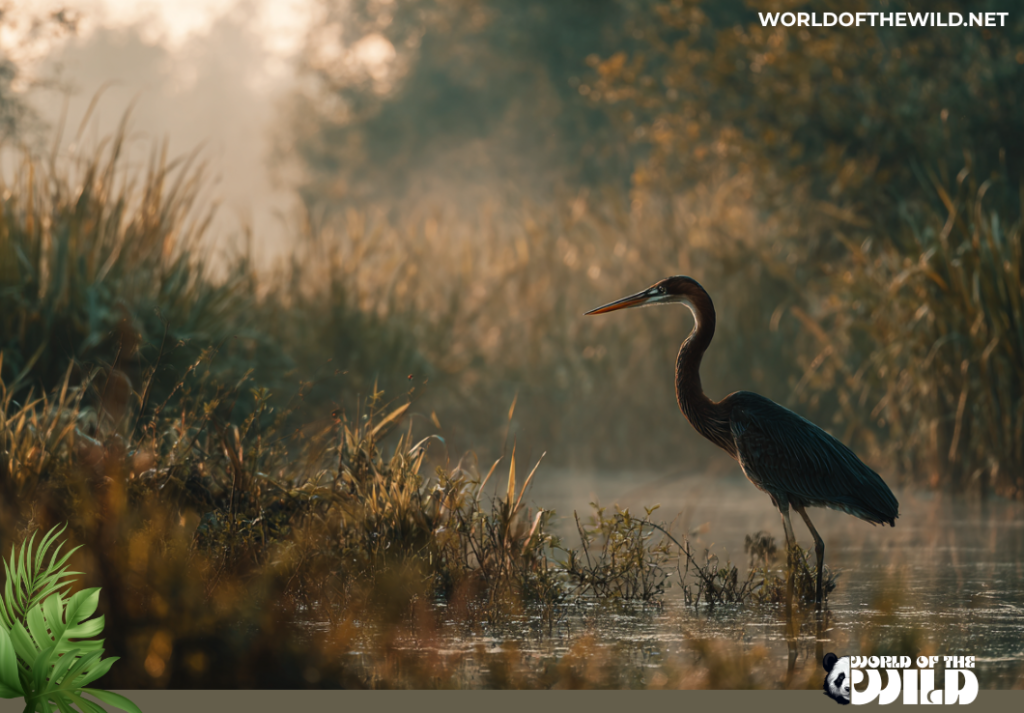
The plumage is rich and striking. The head is adorned with deep chestnut-red feathers, while the face and forehead display a white and black pattern. The neck is a warm rufous-chestnut streaked with white and black along the front, lending the bird a regal, almost mane-like appearance when viewed head-on. The back, wings, and scapular feathers are a cool slate-grey, providing excellent camouflage against the grey-green backdrop of reeds and muddy riverbanks. The underparts are streaked chestnut and white, and when the bird extends its neck during flight, the full tapestry of its coloring becomes apparent.
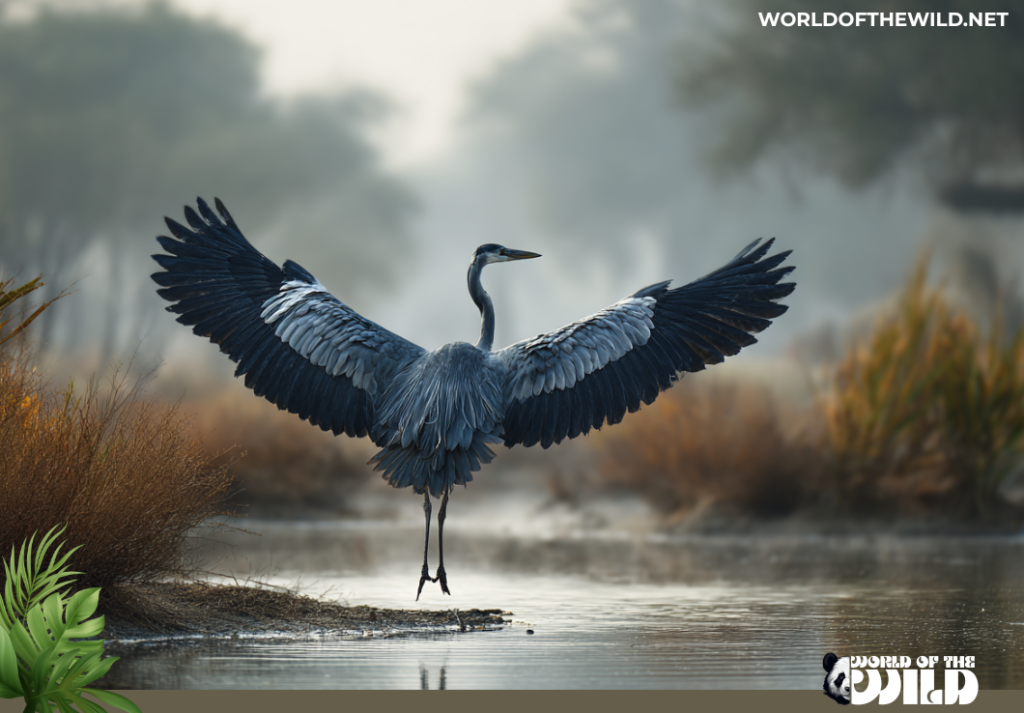
The bill is perhaps the most functionally impressive feature: massive, yellow-grey, and dagger-sharp, often exceeding 9 inches in length. This formidable weapon is perfectly engineered for spearing large, slippery fish. The legs are long and dark grey, ideally suited for wading in varying depths of water. In flight, the Goliath Heron tucks its neck into the characteristic S-curve seen in all herons, distinguishing it immediately from storks or cranes that fly with necks outstretched.
Behavior
The Goliath Heron is, at its core, a bird of extraordinary stillness and deliberation. It is almost entirely solitary outside of the breeding season, and even mated pairs spend much of their time apart, each patrolling individual stretches of waterway. This solitary nature is not born of antisocial tendencies but rather of ecological necessity — their large size demands a territory rich enough in large fish to sustain them.
Hunting behavior is the centerpiece of the Goliath Heron’s daily existence. They are classic stand-and-wait predators, often remaining motionless for extended periods in shallow water, neck coiled and bill angled toward the surface, before unleashing a lightning-fast strike. The strike itself is one of the most spectacular moments in African birdwatching — a blur of motion that ends with a large fish pinned by that massive bill. Unlike smaller herons that may swallow prey immediately, the Goliath Heron often takes time to reposition its catch before swallowing it headfirst.
Communication relies primarily on their deep, resonant calls and visual displays. When two individuals compete for territory, they engage in elaborate posturing — extending wings, raising neck feathers, and calling loudly — before one typically retreats. Goliath Herons are not known for complex tool use or problem-solving behavior in the way that corvids or parrots are, but their hunting patience and precision represent a remarkable form of behavioral intelligence refined over millennia.
One of their most notable adaptations is their ability to hunt in deeper water than almost any other heron species. Their long legs allow them to wade into chest-deep shallows where smaller herons dare not venture, giving them access to a niche that is largely their own.
Evolution
The family Ardeidae — the herons, egrets, and bitterns — is an ancient lineage with roots stretching back at least 60 million years into the Paleocene epoch. Fossil evidence suggests that heron-like birds were already diversifying in the aftermath of the mass extinction event that ended the age of the non-avian dinosaurs. Over tens of millions of years, this family radiated across the globe, adapting to a vast range of wetland and aquatic habitats.
The genus Ardea itself appears to have originated in Africa, which aligns with the Goliath Heron’s current distribution as a primarily African species. The common ancestors of today’s large herons — the Goliath, the Grey, and the Great Blue — likely diverged from a shared ancestral line during the Miocene epoch, somewhere between 5 and 20 million years ago, as continents shifted and climate changes reshaped the world’s wetland ecosystems.
The Goliath Heron represents something of an evolutionary endpoint along the axis of size within its genus. Its gigantism is thought to be a response to the richness and scale of African freshwater ecosystems, where large fish have historically been abundant enough to support a predator of this magnitude. Unlike many species that have undergone dramatic morphological changes in response to environmental pressures, the Goliath Heron appears to have remained relatively stable in form for millions of years — a sign that its ecological strategy is highly effective.
Habitat
The Goliath Heron is a bird of the tropics and subtropics, with a range that spans a broad swath of sub-Saharan Africa. It is most densely concentrated in East Africa — particularly in countries like Uganda, Kenya, Tanzania, and the Democratic Republic of Congo — where vast lake systems, river deltas, and papyrus swamps provide ideal conditions. It is also found across much of West and Central Africa, and a smaller, separate population exists in parts of South Asia, particularly in Sri Lanka, India, and coastal regions of the Persian Gulf and the Indian subcontinent.
Within these regions, the Goliath Heron shows a strong preference for large, open bodies of water. It favors the margins of lakes, slow-moving rivers, estuaries, mangrove swamps, coastal lagoons, and large reservoirs. The common thread across all these habitats is the availability of clear or semi-clear shallow water teeming with large fish. Papyrus-fringed shores are particularly favored, as they offer both productive fishing grounds and secluded nesting sites.
Unlike some waterbirds, the Goliath Heron is generally not found at high altitudes or in fast-moving mountain streams. It is a bird of the lowland water world — expansive, slow, and sun-drenched. The massive wetland systems of the African Rift Valley, including Lake Victoria, Lake Tanganyika, and the Okavango Delta, are among the finest places on Earth to observe this species in its full glory.
Diet
The Goliath Heron is an apex avian predator of the freshwater shallows, and it is unambiguously carnivorous. Fish form the overwhelming bulk of its diet, with the heron targeting species that would be entirely too large for smaller herons to manage. Catfish, lungfish, tilapia, and other substantial freshwater species are all fair game, with individual fish weighing up to a pound or more being consumed whole.
Beyond fish, the Goliath Heron is an opportunistic feeder that will take whatever the wetland offers. Frogs, water snakes, small turtles, large insects, and even small mammals that venture too close to the water’s edge have all been recorded as prey. Occasionally, it will consume carrion if the opportunity arises, though fresh prey is strongly preferred.
The hunting method is one of two primary strategies: stand-and-wait ambush, in which the bird freezes motionless and waits for prey to come within striking range, or slow-stalk, in which it moves with glacial deliberation through the shallows, placing each enormous foot with care to avoid alerting fish below. The bill strike is driven by the powerful muscles of the neck, which act like a coiled spring released in a fraction of a second. The force of this strike is sufficient to impale even large, thick-bodied fish cleanly.
Predators and Threats
Despite its size, the Goliath Heron is not without its vulnerabilities, particularly during the early stages of life. Eggs and chicks in the nest are susceptible to a range of predators, including large monitor lizards, African fish eagles, marabou storks, and various species of crows and ravens that raid nesting colonies. Adult Goliath Herons, on account of their formidable bill and size, face very few natural predators, though large crocodiles represent a genuine danger for birds that wade in crocodile-inhabited waters.
The more pressing threats are human in origin. Habitat destruction is the most significant long-term concern, as wetlands across Africa and South Asia continue to be drained, converted to agricultural land, or degraded by pollution. The damming of major rivers has dramatically altered the hydrology of many of the Goliath Heron’s key habitats, reducing fish populations and disrupting the shallow-water ecosystems on which the species depends.
Water pollution — from agricultural runoff, industrial discharge, and the widespread use of pesticides — directly impacts fish populations and thus the heron’s food supply. In some regions, the birds are also disturbed by human activity near nesting sites, which can cause nest abandonment. While the Goliath Heron is not currently a primary target of hunting or poaching, incidental disturbance and collision with fishing nets or lines pose local threats in heavily fished areas.
Climate change presents an emerging and complex set of challenges, as shifting rainfall patterns alter the seasonal flooding cycles that many of Africa’s wetlands depend on, potentially reducing habitat quality and fish availability.
Reproduction and Life Cycle
Breeding in the Goliath Heron is a measured, careful affair that mirrors the bird’s generally deliberate temperament. The species is monogamous, and pairs are thought to maintain long-term bonds, reuniting at the same nesting site in successive breeding seasons. Courtship involves elaborate displays in which both birds engage in neck stretching, feather erection, bill clapping, and mutual preening — behaviors that reinforce the pair bond and signal readiness to breed.
Breeding seasons vary by geography. In East Africa, nesting tends to peak between October and April, aligning with the post-rainy season when fish populations are at their most abundant. In southern Africa, nesting can occur somewhat later in the year.
Nests are substantial platforms of sticks, built in trees, reed beds, or on rocky outcrops above or near water, sometimes in loose association with other waterbirds. Both parents participate in nest construction, which can result in impressive structures that are reused and added to year after year, eventually reaching considerable size. Females typically lay between two and four pale blue-green eggs, with incubation shared between both parents lasting approximately 24 to 30 days.
Chicks hatch covered in pale grey down and are entirely dependent on their parents for food and protection. Both adults take turns brooding and feeding the young, delivering regurgitated fish directly into the nest. The young herons grow rapidly, and fledging occurs at approximately 40 to 50 days of age, though juveniles remain dependent on parental feeding for some weeks after leaving the nest. Full adult plumage develops gradually over the first few years of life.
In the wild, Goliath Herons are estimated to live for approximately 15 years, though with reduced threats in captivity, lifespans can potentially exceed this. Mortality is highest during the first year of life, before juveniles have fully developed the fishing skills necessary for survival.
Population
The Goliath Heron is currently classified as a species of Least Concern on the IUCN Red List, indicating that it does not face an immediate threat of extinction at the global level. This status reflects the species’ relatively wide geographic range and the absence of steep, rapid population declines.
Global population estimates are difficult to pin down precisely due to the species’ solitary nature and vast range, but ornithologists estimate that the total population likely numbers in the tens of thousands of individuals — a figure that, while not cause for immediate alarm, is not large enough to be complacent about. The population is considered to be stable in the core of its African range, though localized declines have been observed in areas where wetland degradation has been most severe.
In South Asia, populations are generally smaller and more fragmented, with Sri Lanka and coastal India supporting modest numbers of birds. The Persian Gulf population, while present, is considered quite small.
Monitoring efforts remain somewhat inconsistent across the heron’s range, which means population changes can go undetected for extended periods. Conservation organizations and birdwatching groups play an important role in documenting sightings and contributing to the broader understanding of population trends. The species benefits from the protection of large wetland areas and national parks across Africa, though increasing pressure on these ecosystems means that “Least Concern” should not be read as “no concern.”
Conclusion
The Goliath Heron is, in every sense of the word, extraordinary. It is the largest heron alive, a master hunter of Africa’s waterways, and a living link to an ancient lineage that has endured for tens of millions of years. From its booming call echoing across a papyrus swamp to the breathtaking precision of its strike, every aspect of this bird’s existence commands respect and wonder.
That it currently sits in a stable conservation position is encouraging, but it is not a guarantee of future security. The wetlands this bird calls home are among the most threatened ecosystems on the planet — drained for agriculture, polluted by industry, and increasingly disrupted by a changing climate. Protecting the Goliath Heron means protecting vast, interconnected water systems that also sustain millions of people, countless other species, and the ecological balance of entire regions.
The next time you see an image of this magnificent bird — or, if you are lucky, encounter one standing motionless at the edge of a shimmering African lake — take a moment to consider what it represents: billions of years of evolution, an irreplaceable piece of our planet’s biodiversity, and a creature whose continued existence depends, in no small part, on the choices we make today. Some giants, it turns out, still need our protection.
Quick Reference
| Scientific Name | Ardea goliath |
| Diet Type | Carnivore (primarily piscivore) |
| Size | 47–60 inches (approximately 4–5 feet) tall; wingspan 72–90 inches (6–7.5 feet) |
| Weight | 8.8–11 pounds |
| Region Found | Sub-Saharan Africa (primary range); South Asia including Sri Lanka, India, and Persian Gulf coast (secondary range) |