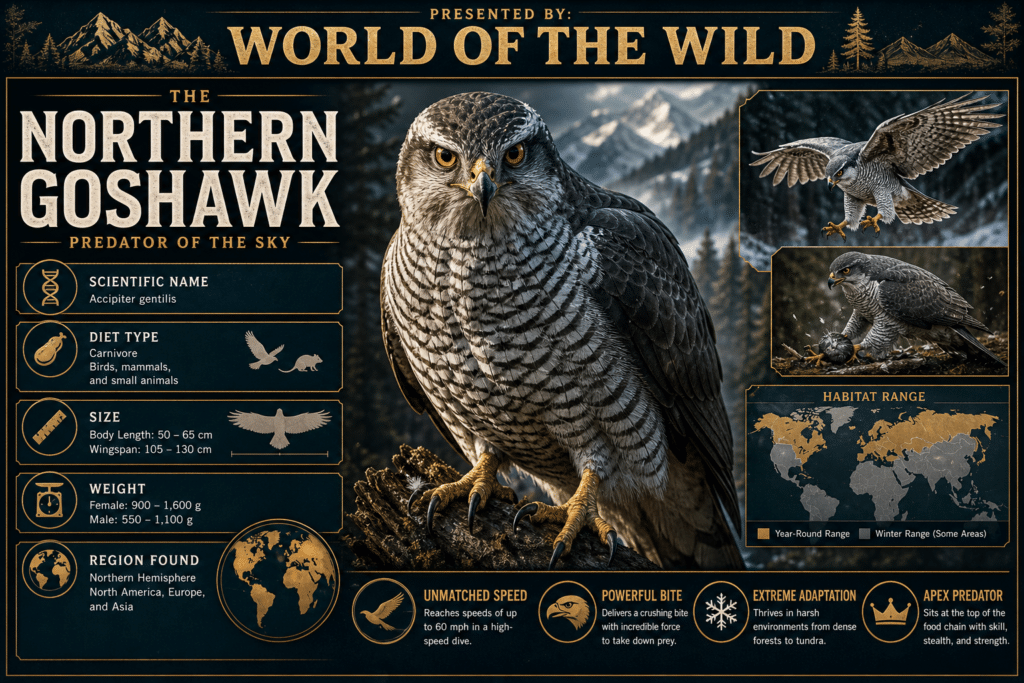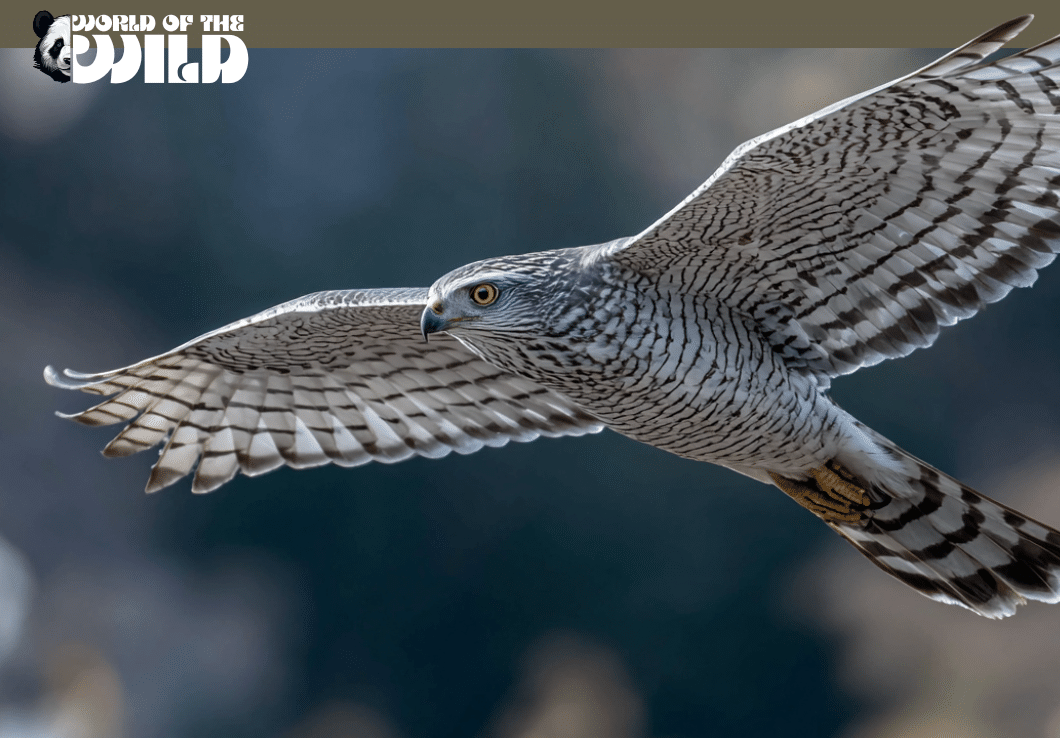

Deep within the ancient cathedral forests of the Northern Hemisphere, a predator moves like a ghost between the trees — swift, silent, and utterly ruthless. The Northern Goshawk (Accipiter gentilis) is not a bird that announces itself gently. It arrives in an explosion of wingbeats, threading impossibly tight gaps between branches at speeds that defy belief, talons outstretched and locked onto its prey before the forest has time to react. Falconers in the Middle Ages called it the “cook’s bird” because it could reliably fill a pot with game. Indigenous cultures across continents revered it as a symbol of power and ferocity. Even today, seasoned birders consider spotting one a moment of genuine privilege.
Yet for all its legend, the Northern Goshawk remains one of the most elusive, misunderstood, and fiercely private raptors in the world. It doesn’t perch on roadsides or soar obligingly overhead. It lives on its own terms, in the shadowed heart of deep woodland, and it tolerates no intrusions lightly. To understand the goshawk is to understand something essential about wildness itself — raw, uncompromising, and magnificent.
Facts
- Warriors of the nest: Northern Goshawks are famously aggressive nest defenders and will attack virtually any intruder — including wolves, bears, and unsuspecting hikers — that ventures too close to their young. Ornithologists often wear hard hats when approaching active nests.
- A raptor with a heraldic legacy: The goshawk appears on the coat of arms of the Faroe Islands and has been used in falconry for over 2,000 years. It was prized above almost all other birds by medieval falconers due to its power and versatility.
- Speed in the dark: Unlike open-country hawks that rely on soaring, goshawks are adapted for explosive, high-speed pursuit through dense forest — a habitat most raptors simply cannot navigate at full speed.
- Eyes built for the forest: Their eyes contain more rods than most raptors, giving them superior low-light vision — an essential advantage when hunting in the dim understory of boreal and temperate forests.
- Irruptive migrants: In years when prey populations crash — particularly snowshoe hares and ruffed grouse — goshawks undergo dramatic southward irruptions, appearing far outside their usual range in numbers that can surprise even experienced birders.
- They reuse and renovate: A mated pair will often maintain multiple nest sites in their territory, reusing and expanding the same nests over many years. Some goshawk nests, built up over decades, can weigh hundreds of pounds.
- Ancient name, enduring bird: The word “goshawk” derives from the Old English gōshafoc, meaning “goose hawk” — a nod to the bird’s formidable size and hunting capability, even if geese aren’t typically on the menu.
Species
The Northern Goshawk sits within one of the most precisely organized lineages in the avian world:
- Kingdom: Animalia
- Phylum: Chordata
- Class: Aves
- Order: Accipitriformes
- Family: Accipitridae
- Genus: Accipiter
- Species: Accipiter gentilis
The species name gentilis comes from the Latin for “noble” or “of good birth” — a reflection of the bird’s prestige in medieval falconry culture, where only nobility were permitted to fly a goshawk.
Currently, taxonomists recognize ten to eleven subspecies of Accipiter gentilis, distributed across its enormous Holarctic range. The nominate subspecies, A. g. gentilis, inhabits most of Europe. The North American subspecies, A. g. atricapillus, is the largest and arguably the most studied, with a particularly dark cap and bold white supercilium. A. g. laingi, found in coastal British Columbia and parts of the Pacific Northwest, is notably smaller and darker — possibly an adaptation to the dense temperate rainforest it inhabits. In Asia, A. g. fujiyamae of Japan and several other regional forms show meaningful variation in size and plumage.
The Northern Goshawk’s closest relatives within the Accipiter genus are the Eurasian Sparrowhawk (A. nisus) and the Cooper’s Hawk (A. cooperii) of North America — a smaller, structurally similar cousin that occupies many of the same ecological niches in mixed woodlands. Some taxonomists have proposed splitting the Eurasian and North American populations into separate species given their genetic and morphological divergence, a debate that remains active in the ornithological community.
Appearance
The Northern Goshawk is built for one thing above all else: lethal efficiency in tight spaces. It is a large, powerful accipiter, and its body reflects a design refined over millions of years for forest pursuit.
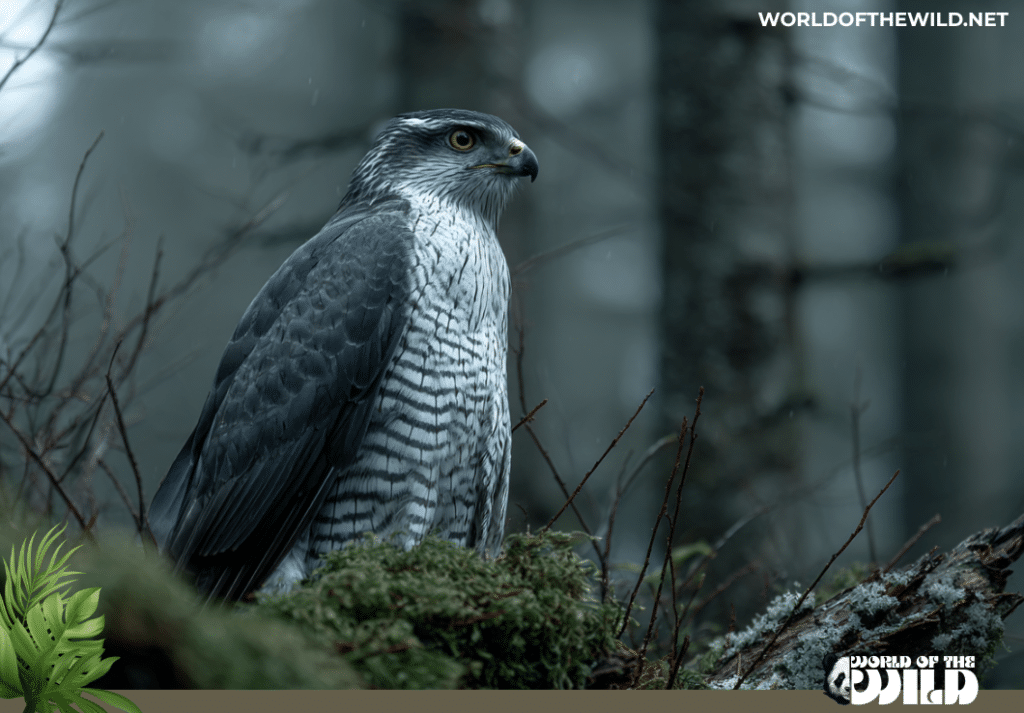
Adults are immediately recognizable by their slate-gray to blue-gray upperparts, which shift in tone from the pale silver-gray of European birds to the deeper, more charcoal hues of North American and Pacific populations. The underparts are white to pale gray, densely barred with fine, wavy gray lines that create a striking scalloped effect when viewed up close. The most arresting feature of the adult bird’s face is the bold white supercilium — a thick, cream-white eyebrow stripe that stands in sharp contrast against a jet-black crown and nape, framing a pair of fierce, burning orange to deep red eyes. Those eyes are not merely dramatic; they signal age and experience, brightening from yellow in juveniles to fiery orange-red in fully mature adults.
Juveniles look strikingly different: their upperparts are brown and streaked, their underparts cream with bold dark brown streaking, and their eyes are pale yellow. This plumage is maintained through the first two years of life, creating the impression of an almost entirely different bird.
Physically, the goshawk is imposing. Adult females, as is typical in raptors, are substantially larger than males — a phenomenon known as reverse sexual dimorphism. Females can reach a body length of 20 to 26 inches (roughly 1.7 to 2.2 feet) with a wingspan stretching between 40 and 46 inches (approximately 3.3 to 3.8 feet). Males are notably smaller, typically measuring 18 to 21 inches in length with wingspans of 35 to 41 inches. Weight ranges from approximately 1.4 to 2.2 pounds in males and 1.8 to 3.0 pounds in females.
The wings are broad for an accipiter — shorter and more rounded than a falcon’s — allowing rapid maneuverability through cluttered woodland. The tail is long and rounded, acting as a rudder in tight turns. The legs are long and heavily muscled, terminating in enormous, needle-sharp talons designed to grip and pierce with extraordinary force.
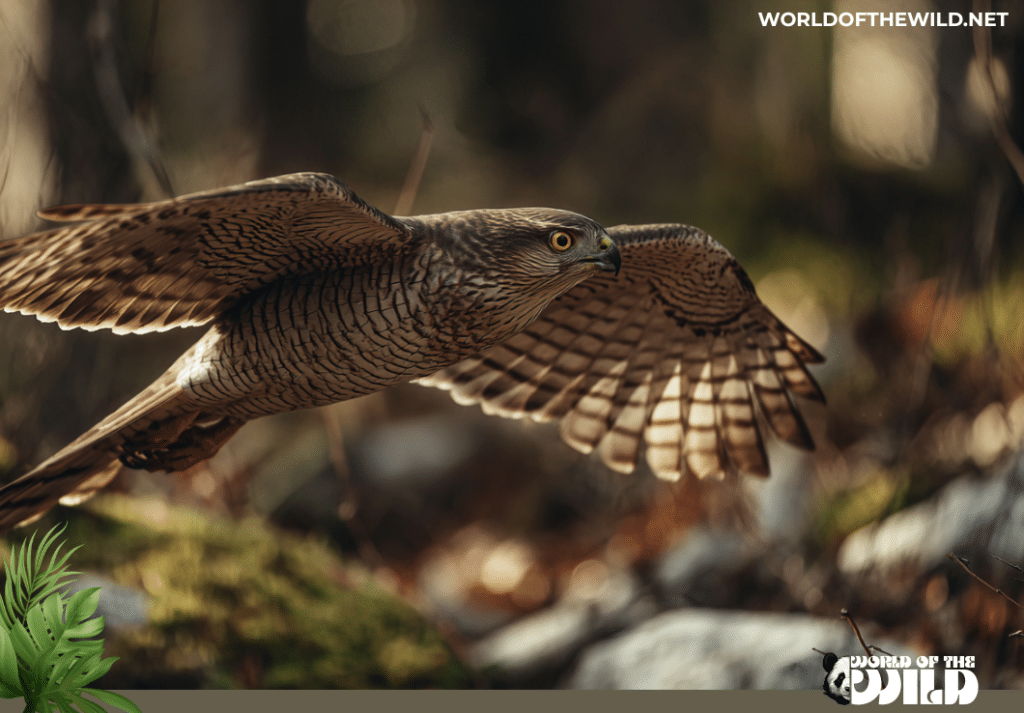
Behavior
If one word could define the goshawk’s behavioral character, it would be intensity. These are not casual, patient hunters. They are explosive, decisive, and almost reckless in their pursuit of prey — a behavioral profile perfectly matched to their forest environment where opportunities are brief and hesitation is fatal.
Goshawks are predominantly solitary outside of the breeding season. They maintain large, well-defined territories that they patrol actively and defend with extraordinary aggression. An established pair will hold a territory year after year, but even mated birds spend most of the non-breeding season alone within that range.
Communication is largely vocal, particularly during the breeding season. The goshawk has a loud, rapid, staccato call — often described as a sharp, repetitive kek-kek-kek — that carries well through dense forest. This call is used to defend territory, coordinate with mates, and raise alarm. During courtship, pairs engage in aerial displays above the canopy, with slow, undulating flights that are strikingly different from the bird’s typical explosive dashes.
Perhaps the goshawk’s most celebrated behavioral trait is its hunting technique. Unlike buteonine hawks that scan from high perches or circle over open ground, goshawks are coursing hunters that commit fully to pursuit. They will launch from a perch into a chase that takes them directly through undergrowth, ducking under branches and cutting between tree trunks at full speed. Prey has been observed diving into thickets to escape — only to find the goshawk following them in. The bird uses its long tail as a dynamic rudder and its broad wings to decelerate and re-accelerate through turns with a precision that borders on the impossible.
Goshawks are also notably intelligent and adaptable. Studies in falconry contexts have demonstrated strong problem-solving ability, and wild birds have been observed learning and exploiting the predictable movement patterns of prey species. They are known to stake out locations where grouse reliably flush, returning repeatedly to exploit the same productive hunting areas.
Their aggression around the nest deserves special mention. Both males and females will dive-bomb intruders without hesitation, often striking the back of the head with their talons. Rangers, researchers, and hikers have all been drawn blood by protective goshawks. This behavior is not merely performative — it is a genuine, unrestrained physical assault, and it has earned the species a fearsome reputation among those who work in goshawk country.
Evolution
The accipiter lineage has deep roots in the Eocene epoch, roughly 34 to 56 million years ago, when the world’s forests were expanding after the mass extinction event that ended the Mesozoic Era. The earliest fossil evidence for hawk-like birds of prey places them in this period, as newly dominant mammalian and avian prey species created rich new ecological niches for aerial predators.
The genus Accipiter itself is thought to have diversified during the Miocene and Pliocene, as cooling global temperatures transformed tropical forest into the temperate and boreal woodland biomes that accipiters now dominate. The Northern Goshawk’s evolutionary success is closely tied to the expansion of these forested ecosystems across the Holarctic — the combined landmass of the Northern Hemisphere temperate zone.
Fossil material attributed to Accipiter has been recovered from Miocene deposits in Europe and North America, suggesting the genus had already achieved a wide distribution by at least 10 to 15 million years ago. The specific evolutionary divergence of the Northern Goshawk from its closest relatives is estimated to have occurred several million years ago, during a period of dramatic climatic fluctuation that repeatedly fragmented and reconnected forest habitats across the Northern Hemisphere.
The reverse sexual dimorphism so characteristic of Accipiter species — where females are significantly larger than males — is an evolutionary feature that remains debated among biologists. Leading hypotheses suggest it reduces competition between mates (since males and females effectively specialize on differently sized prey), improves female ability to defend the nest, or reflects selection pressures related to the different roles each sex plays in reproduction. Whatever its origin, it is ancient, consistent, and deeply embedded in the accipiter lineage.
The isolation of island and coastal populations — such as the laingi subspecies of the Pacific Northwest — illustrates evolution in progress, as geographically separated groups adapt to local conditions over thousands of generations, moving gradually toward what may eventually become distinct species.
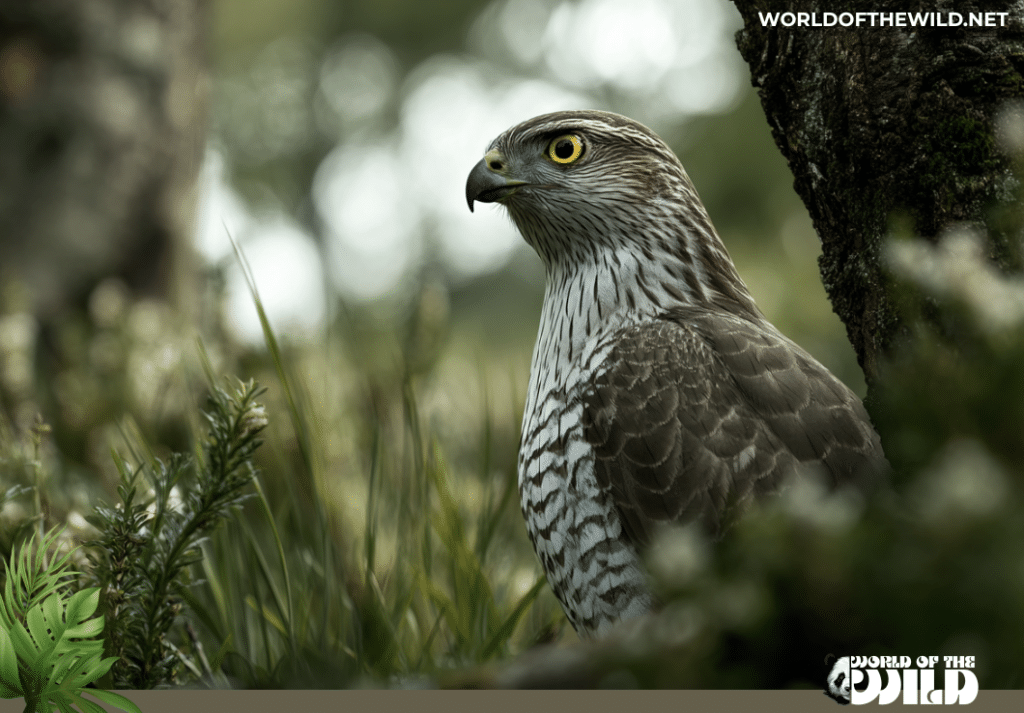
Habitat
The Northern Goshawk is a creature of the forest — specifically, the mature, structurally complex forest of the temperate and boreal zones. It is not a bird of forest edges, clearings, or fragmented woodlands. It demands depth, density, and the kind of ancient, multi-layered canopy that takes centuries to develop.
Across its vast Holarctic range — which spans from western Europe eastward through Russia and central Asia to Japan, and from Alaska and Canada south through the western United States — the goshawk occupies several distinct forest types. In North America, it is most closely associated with mature coniferous and mixed forests: spruce-fir forests in the boreal zone, ponderosa pine forests in the Rocky Mountains, Douglas fir stands in the Pacific Northwest, and northern hardwood forests across the Great Lakes region and New England.
Key habitat features include a closed or semi-closed canopy, a relatively open understory (which allows the goshawk to maneuver at speed beneath the canopy without obstruction), large-diameter trees for nesting, and proximity to water sources. These birds are strongly associated with old-growth and late-successional forest — ecosystems characterized by enormous trees, complex vertical structure, abundant deadwood, and decades or centuries of ecological maturity.
In Europe, goshawks are somewhat more adaptable, having recolonized managed forests and even some large urban green spaces in cities like London and Berlin. However, their core habitat requirements remain the same: large, contiguous blocks of mature woodland with minimal human disturbance.
Goshawks are generally year-round residents in their territories, but in the northern parts of their range — particularly in Scandinavia, Russia, and northern Canada — prey crashes periodically force southward movements. During these irruption years, birds can appear at hawk watch sites and in suburban areas far outside their usual haunts.
Diet
The Northern Goshawk is a carnivore and a supremely capable one. It is among the most ecologically flexible raptors in its range, capable of taking prey ranging from small songbirds to rabbits nearly as large as itself.
The core of the diet across most of its range consists of medium-sized birds and mammals. In North America, ruffed grouse, blue grouse, and American crows are among the most important avian prey. Snowshoe hares, red squirrels, and chipmunks form the mammalian backbone of the diet. In Europe, wood pigeons, corvids, and various thrushes are commonly taken, alongside rabbits and voles. In Asia, pheasants and similar ground birds feature prominently.
The goshawk hunts using two primary strategies. The perch-and-launch method involves waiting motionless on a concealed branch until prey moves into range, then striking with a sudden burst of acceleration. The coursing pursuit method — perhaps the more famous — involves active, high-speed chases through woodland, often initiated when prey is flushed unexpectedly. Both strategies end the same way: with those powerful talons driven into the prey, the grip immediately tightened to compress the prey’s vital organs.
Unlike many other raptors, goshawks are not aerial soarers waiting for thermal assistance. They are active, energetic hunters that may make multiple pursuit attempts per day. They are also not above piracy — stealing prey from smaller raptors when the opportunity arises.
The relationship between goshawk populations and prey population cycles — particularly the 10-year snowshoe hare cycle in North America and the vole cycles of Eurasia — is one of the most compelling examples of predator-prey dynamics in ecology. When prey populations crash, goshawk reproduction drops sharply and dispersal increases dramatically.
Predators and Threats
As an apex forest predator, the adult Northern Goshawk has few natural enemies. Large owls — particularly the Great Horned Owl in North America and the Eurasian Eagle-Owl in Europe — are capable of taking goshawks, particularly at night when the hawk’s visual advantage is reduced. Golden Eagles have also been documented occasionally predating goshawks, typically in open terrain where the accipiter’s woodland agility offers no advantage. Young birds and eggs are vulnerable to raccoons, martens, and other climbing predators that discover nests.
The more significant and pressing threats to the Northern Goshawk are almost entirely human-caused:
Habitat loss and forest degradation represent the most severe long-term threat. Industrial logging that targets old-growth and mature second-growth forest directly removes the structural complexity that goshawks require. Clear-cutting is particularly devastating, stripping territory of both nesting sites and the prey base simultaneously. Even selective logging, if it removes large-diameter trees and simplifies the understory, can render apparently intact forest uninhabitable for goshawks.
Persecution remains an issue in some parts of the range. In areas with intensive game bird management — particularly driven grouse moors in Scotland and pheasant shooting estates across Europe — goshawks are still illegally killed by gamekeepers who view them as threats to stock.
Rodenticides and pesticides present a secondary poisoning risk. Goshawks that prey heavily on rodents in agricultural areas or forest environments treated with rodenticides accumulate toxins, which can cause reproductive failure and death.
Collisions with infrastructure — particularly wind turbines and power lines in areas where goshawk habitat and energy development overlap — are an emerging and growing concern.
Climate change poses a longer-term threat by shifting the distribution and abundance of prey species, altering forest composition, and potentially pushing the boreal forest zone northward faster than goshawks can adapt.
Reproduction and Life Cycle
The Northern Goshawk breeds once per year, typically from March through July depending on latitude. As winter loosens its grip and prey availability begins to improve, established pairs return to their territory and begin the courtship process — often the only time these solitary birds reliably seek each other out.
Courtship displays are striking and uncharacteristically conspicuous for such a secretive bird. Pairs soar together in slow, undulating flight above the forest canopy, calling repeatedly. The male performs food passes to the female, delivering prey as a demonstration of his hunting ability — a behavior directly tied to her assessment of his fitness as a mate and provider.
Nests — called eyries — are large, bulky platforms of sticks, typically placed in the main fork of a large-diameter tree, usually 30 to 75 feet above the ground. Fresh green sprigs are added to the nest throughout the breeding season, a behavior observed in many raptor species and thought to have antimicrobial properties. Pairs often maintain two to five alternate nest sites within their territory, sometimes rotating between them in consecutive years.
The female lays two to four eggs, with three being the most common clutch size. The eggs are pale blue-white, often stained with brown over time. Incubation lasts approximately 28 to 38 days, performed almost entirely by the female while the male hunts and delivers food to the nest. After hatching, the nestlings are brooded closely by the female for the first two weeks while the male continues sole provisioning duties.
Young goshawks fledge at approximately 35 to 42 days of age but remain dependent on their parents for prey delivery for an additional four to six weeks after leaving the nest. This extended post-fledging period is critical — juvenile goshawks have much to learn about hunting, and starvation during the first independent winter is the leading cause of mortality in young birds.
Sexual maturity is reached at one to three years of age, though many birds do not successfully breed until their third year. In the wild, Northern Goshawks typically live 7 to 11 years, with some individuals exceeding 15 years in captivity.
Population
The Northern Goshawk is currently classified as Least Concern on the IUCN Red List — a status that reflects its wide global distribution and large overall population, but which should not be interpreted as an absence of concern. Regional populations tell a more complicated story.
The global population is estimated at roughly 700,000 to 1,000,000 individuals across all subspecies and geographic regions, making it one of the more numerous large raptors in the Northern Hemisphere. European populations have shown recovery in recent decades following severe persecution in the 19th and early 20th centuries, when goshawks were nearly extirpated from Britain and heavily reduced across much of western Europe. Strict legal protection and the maturation of commercial conifer plantations provided enough cover for a slow but meaningful comeback.
In North America, however, the picture is less encouraging. Western populations, particularly in the Pacific Northwest and the Rocky Mountains, have experienced significant declines linked directly to old-growth logging. The laingi subspecies of coastal British Columbia is considered particularly vulnerable. The U.S. Fish & Wildlife Service has repeatedly reviewed the goshawk for listing under the Endangered Species Act, reflecting ongoing scientific concern about population trends in the American West.
In parts of Russia and central Asia, populations remain relatively stable due to the sheer scale of intact boreal forest, though monitoring data from these remote regions is limited.
The overarching population trend for the species, per current assessments, is stable to slightly declining in most regions, with localized declines where old-growth forest loss and persecution remain unaddressed.
Conclusion
The Northern Goshawk is not merely a spectacular predator — it is an ecological indicator of extraordinary precision. Where goshawks thrive, so does the forest. The presence of a breeding pair signals mature, structurally complex woodland with a healthy prey base, intact canopy, and a measure of human restraint. Their absence, conversely, is a warning sign written in feathers and silence.
We live in an era when forests are under relentless pressure from industry, development, and a rapidly shifting climate. The goshawk, in its fierce, uncompromising way, asks us to reckon honestly with what we are willing to preserve. Not managed woodlots. Not plantation monocultures. Real forest — old, deep, wild, and entire.
The next time you walk into a mature woodland and feel that inexplicable sense of being watched, of entering a space that belongs to something other than you — pay attention to that feeling. You may be closer to a goshawk than you know. And in that moment, you are being measured just as surely as any prey that has ever made the mistake of crossing its path.
Support organizations that advocate for old-growth forest protection. Push back against policies that prioritize short-term timber yield over long-term ecological integrity. The goshawk has survived millions of years of change. Whether it survives us is still an open question — and the answer belongs entirely to us.
Quick Reference
| Scientific Name | Accipiter gentilis |
| Diet Type | Carnivore |
| Size (Length) | 18–26 inches (1.5–2.2 feet) |
| Wingspan | 35–46 inches (2.9–3.8 feet) |
| Weight | 1.4–3.0 pounds |
| Region Found | Holarctic — North America, Europe, Russia, Central Asia, Japan |