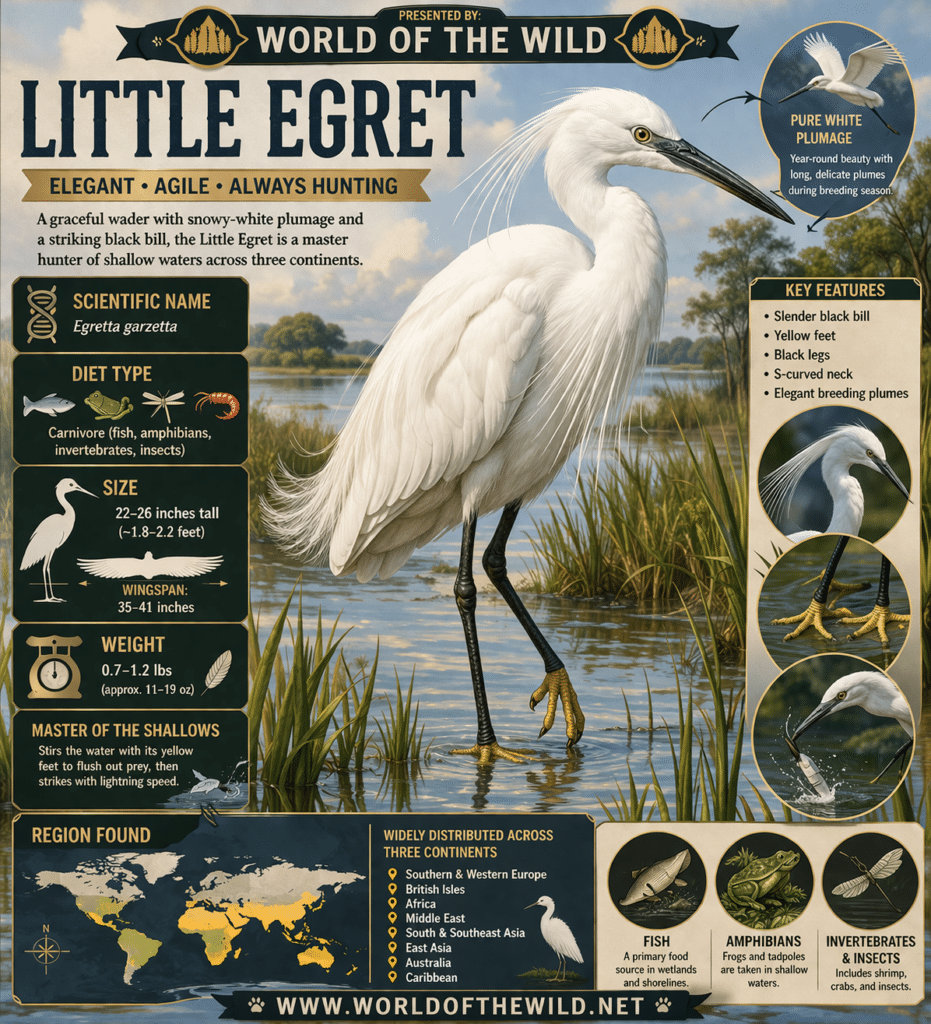

There is a moment, familiar to anyone who has wandered near a slow-moving river, tidal estuary, or sun-drenched wetland, when the world seems to hold its breath. A flash of pure white cuts through the reeds. A slender neck coils back like a drawn bow. Then — in a strike almost too fast for the human eye to follow — a small, jewel-bright fish is lifted from the water and swallowed whole. The perpetrator of this breathtaking act stands barely knee-high, yet carries itself with the bearing of something ancient and aristocratic. This is the Little Egret (Egretta garzetta), and it is one of the most quietly spectacular birds on the planet.
For centuries, this small heron was hunted almost to extinction for the very thing that makes it so enchanting: its feathers. Today, it has not only survived that dark chapter but has staged one of the most remarkable wildlife comebacks in modern ornithological history, expanding its range across continents and reclaiming wetlands from Europe to Australia. Delicate in appearance but formidable in resilience, the Little Egret is a story of beauty, adaptability, and the enduring power of nature to bounce back — if only we let it.
Facts
- The Little Egret was once a luxury item. During the late 19th century, its elegant breeding plumes — known as “aigrettes” — sold for more than their weight in gold on the Parisian and London fashion markets, destined to adorn ladies’ hats.
- It uses its feet as a lure. When hunting, the Little Egret will shuffle and stir the sediment with its bright yellow feet to flush out hidden prey — a behavior known as “foot stirring” or “foot raking” that is surprisingly rare among birds.
- It has colonized Britain within living memory. The Little Egret was virtually unknown as a breeding bird in the United Kingdom before the 1990s. Today, thousands of pairs nest there, representing one of the fastest natural range expansions of any bird species in British history.
- Its breeding plumes are structurally unique. The long, lacy feathers that appear during breeding season — called nuptial plumes — have a loose, disconnected barb structure that gives them their distinctive, cloud-like softness. No other bird family produces quite the same effect.
- It can see in color far better than most animals. Like many wading birds, the Little Egret has a high density of cone cells in its retina, giving it exceptional color vision that helps it track the iridescent flash of fish beneath the water’s surface.
- It sometimes hunts cooperatively. While largely a solitary forager, individuals have been observed herding small fish toward one another in shallow water — a rudimentary form of cooperative behavior rarely documented in herons.
- It roosts in enormous communal flocks. Though it hunts alone by day, at dusk the Little Egret joins hundreds or even thousands of other individuals at traditional roost sites — sometimes mixing with other heron and egret species in a dazzling white congregation.
Sounds of the Little Egret
Species
The Little Egret occupies a well-defined position in the bird family tree, sitting within a group that has fascinated naturalists for centuries.
Full Taxonomic Classification:
- Kingdom: Animalia
- Phylum: Chordata
- Class: Aves
- Order: Pelecaniformes
- Family: Ardeidae
- Genus: Egretta
- Species: Egretta garzetta
The species was formally described by Carl Linnaeus in 1766. Two subspecies are generally recognized: E. g. garzetta, the nominate form found across Europe, Africa, and Asia, and E. g. nigripes, a slightly larger, darker-footed subspecies found in Indonesia, the Pacific Islands, and parts of Australasia. Some authorities also propose a third form, E. g. immaculata, native to Australia, though this classification remains debated.
Within the genus Egretta, the Little Egret’s closest relatives include the Western Reef Egret (Egretta gularis), which occurs in two color morphs — white and dark grey — along African and Middle Eastern coasts, and the Dimorphic Egret (Egretta dimorpha) of the eastern African coast and Madagascar. The Little Egret is also closely related to the Snowy Egret (Egretta thula) of the Americas, which is so similar in appearance and behavior that early taxonomists frequently confused the two. The primary distinguishing feature is the Snowy Egret’s bright yellow lores (the patch between the eye and bill) versus the Little Egret’s yellow-green lores and consistently yellow feet.
Appearance
The Little Egret is the definition of understated elegance. In its non-breeding plumage, it is entirely white — a pure, unbroken snow-white that seems almost luminous against the green of a riverbank or the grey-brown of a tidal mudflat. Its bill is long, dagger-straight, and black, perfectly engineered for the spearing of prey. Its legs are also black, creating a striking visual contrast, while its feet are unmistakably bright yellow — a feature so distinctive that experienced birdwatchers often identify the species by its feet alone as it wades through the shallows.
In size, it is a medium-small heron. Adults typically stand between 22 and 26 inches (roughly 56 to 65 cm) tall, with a wingspan ranging from approximately 35 to 41 inches (88 to 106 cm). They weigh between 11 and 19 ounces (around 0.7 to 1.2 pounds, or 300 to 540 grams), making them surprisingly lightweight for a bird of their apparent stature.
When breeding season arrives, the transformation is remarkable. Both males and females develop two long, sweeping nuptial plumes that extend from the lower back, fanning out past the tail. A further two pendant plumes drop from the chest, and additional fine filamentous plumes appear on the head and neck. The bare skin around the eye flushes from its usual yellow-green to a vivid reddish-pink during courtship — a brief but intense signal of reproductive readiness. The eyes themselves are a clear, penetrating yellow. Juveniles resemble adults in non-breeding plumage but may show greenish tinges on the bill and legs as they mature through their first year.

Behavior
The Little Egret is an active, energetic, and visually theatrical hunter. Unlike the patient, statue-still hunting style of the larger Grey Heron, it is a bird in near-constant motion, striding purposefully through shallow water, darting sideways, freezing, and lunging with explosive speed. It employs a repertoire of hunting techniques that speaks to a surprisingly high degree of behavioral flexibility.
Its most famous technique is foot stirring: the bird wades slowly while dragging one yellow foot along the substrate, disturbing sediment and flushing invertebrates and small fish into open water where they can be seized. It also employs open-wing feeding, spreading its wings slightly to create shade on the water’s surface — reducing glare and making it easier to spot prey, while simultaneously confusing fish that may mistake the shadow for cover.
Socially, the Little Egret occupies an interesting middle ground. It forages alone, defending feeding territories from other egrets with surprisingly assertive displays — raising its crest, fanning its plumes, and uttering harsh, croaking calls. Yet at night it abandons this solitary stance entirely, joining communal roosts in dense reedbeds, willows, and bamboo thickets alongside other waterbirds.
Communication involves a range of guttural croaks, barking alarm calls, and, during the breeding season, a series of bubbling, rhythmic vocalizations used during courtship. The species is not known for complex song, but its calls are highly functional — conveying alarm, territorial aggression, and courtship readiness with economy and clarity.
Intelligence in the Little Egret is demonstrated not just in its diverse hunting strategies but in its rapid behavioral adaptation to new environments. As it has colonized northern Europe, it has learned to exploit entirely new prey bases — including marine invertebrates on British rocky shores — demonstrating a learning capacity that has been central to its successful range expansion.
Evolution
The family Ardeidae — herons, egrets, and bitterns — has a deep evolutionary history stretching back at least 60 million years, with fossil evidence suggesting that the group diverged from other waterbirds during the Eocene epoch, in the wake of the mass extinction event that ended the age of the dinosaurs. The earliest definitive ardeids appear in the fossil record in the Eocene of Europe and North America, though the family likely originated in the warm, shallow inland seas and wetlands that covered much of the Northern Hemisphere at that time.
The genus Egretta itself represents a relatively derived branch of the ardeids, evolving alongside the spread and diversification of shallow freshwater and coastal wetland habitats. The ancestral egrets were likely similar to modern species — long-legged, long-necked, and piscivorous — adapting to an ecological niche that has remained fundamentally stable for tens of millions of years.
The Little Egret’s bright yellow feet are thought to be an evolutionary specialization linked directly to its foot-stirring hunting technique, serving as visual lures to attract curious prey. The nuptial plumes that proved so commercially attractive to human hunters evolved millions of years before any human ever saw them, shaped by sexual selection as honest signals of fitness during mate choice. The lacy, disconnected barb structure of these plumes — which made them so prized by milliners — is itself an evolutionary novelty, departing from the tightly interlocked barb architecture found in most flight feathers.
Molecular phylogenetic studies have confirmed that the Little Egret is most closely related to the Reef Egrets and the Snowy Egret, suggesting that this cluster of small, active-hunting egrets evolved from a common ancestor and subsequently spread across the Old and New Worlds via a combination of overwater dispersal and continental drift-driven habitat fragmentation.
Habitat
The Little Egret is a creature of the water’s edge in almost every sense. It occupies an exceptionally broad range of wetland habitats, from tropical mangrove forests and coral reef flats to temperate freshwater marshes, river deltas, flooded rice paddies, ornamental park lakes, and rocky North Atlantic coastlines. This habitat breadth is one of the fundamental reasons for the species’ ongoing success and range expansion.
Geographically, Egretta garzetta has one of the widest distributions of any heron. Its range spans from southern and western Europe — including the British Isles, the Iberian Peninsula, and France — east across the Mediterranean, sub-Saharan Africa, the Middle East, the Indian subcontinent, Southeast Asia, China, Japan, and south to Australia. In much of Africa and South Asia, it is a year-round resident. In Europe and parts of East Asia, populations are partially migratory, moving south and west in autumn to escape freezing conditions that would render feeding impossible.
The key habitat requirement is shallow water — typically less than 12 inches (30 cm) deep — with sufficient prey density and access to vegetation for roosting and nesting. The species is notably tolerant of human presence and has adapted readily to man-made water bodies: irrigation channels, aquaculture ponds, sewage treatment wetlands, and urban rivers all attract Little Egrets, sometimes in impressive numbers. This adaptability to modified landscapes has been crucial to its survival and expansion in an increasingly human-dominated world.

Diet
The Little Egret is a carnivore and an opportunistic one at that. While fish form the backbone of its diet in most habitats, it is by no means a strict piscivore. Its menu shifts with the season, location, and availability of prey, encompassing a remarkable breadth of small aquatic and semi-aquatic animals.
Primary prey items include:
- Small fish (sticklebacks, minnows, gobies, and juvenile flatfish)
- Amphibians (frogs, tadpoles, and salamanders)
- Aquatic invertebrates (water beetles, dragonfly larvae, freshwater shrimps, and crabs)
- Earthworms and insects (particularly in grassland habitats adjacent to water)
- Small reptiles and mammals on occasion
Hunting is primarily visual, conducted during daylight hours, though individuals have been recorded feeding at dusk and even by moonlight. The bird employs its various active hunting techniques — foot stirring, wing shading, running through shallows — as well as prolonged motionless “stand-and-wait” ambush postures, depending on the nature of the prey and habitat. In marine and estuarine environments, it specializes in catching gobies and small crustaceans from exposed mudflats during low tide.
Prey is almost always swallowed whole and headfirst, ensuring that spines and scales pass smoothly down the gullet. The long, muscular neck acts as a biological spring — coiled in the characteristic S-shape of all herons and egrets, it is capable of unleashing a strike in a fraction of a second, making escape almost impossible for any fish within range.
Predators and Threats
In the wild, the Little Egret faces a relatively modest array of natural predators, largely owing to its alertness, its preference for open habitats where approaching danger is easily spotted, and the communal vigilance of its roost flocks. Eggs and chicks in the nest are vulnerable to corvids (crows and ravens), mustelids (minks and martens), and large raptors. Adults may occasionally be taken by Peregrine Falcons, Marsh Harriers, or large owls, but such predation events are uncommon.
The far greater and more historically significant threats have come from human activity.
Historical persecution through the plume trade was catastrophic. By the early 20th century, egret populations across southern Europe, Africa, and Asia had crashed precipitously, with hunting during the breeding season — when the birds were most visible and least wary — being especially devastating. The campaign to end the plume trade, led by early conservationists on both sides of the Atlantic, helped spark the modern bird protection movement and led directly to the founding of organizations like the Royal Society for the Protection of Birds (RSPB) in the UK.
Contemporary threats are more diffuse but in many ways more insidious:
- Wetland drainage and habitat loss remain the primary long-term threat across much of the range, as agricultural intensification, urban development, and river engineering destroy and fragment the shallow water habitats the species depends on.
- Pollution — particularly agricultural runoff carrying pesticides and herbicides — reduces prey availability and can cause direct mortality through bioaccumulation of toxins in the food chain.
- Climate change brings complex and sometimes contradictory pressures: warming winters have facilitated the northward range expansion in Europe but threaten the stability of tropical wetlands and alter the timing of prey availability in ways that may disrupt breeding success.
- Disturbance at nesting colonies, particularly from human recreation near waterways, can cause adults to abandon nests, leaving eggs and chicks exposed to predation and weather.
Reproduction and Life Cycle
The Little Egret is a colonial nester, and its breeding colonies — called heronries — are among the most vivid spectacles in the ornithological calendar. Colonies range from a handful of pairs to several hundred, often shared with Grey Herons, Night Herons, and other egret species, with nests packed into a compact stand of trees or dense reedbeds.
Courtship begins in spring in temperate regions, typically from March onward, and earlier in tropical populations. The displays are elaborate and visually arresting: males select a display perch and perform a series of ritualized postures — raising their ornamental plumes into a shimmering fan, stretching the neck skyward, bowing, and producing soft bubbling calls. When a female approaches and is accepted, the pair reinforces the bond through mutual preening and simultaneous plume displays, the brief flush of red on the lore skin signaling peak arousal.
Both parents construct the nest — a loose, shallow platform of sticks typically placed in trees or dense shrubs near water, ranging from a few feet above the ground to high in the forest canopy. The female lays a clutch of 3 to 5 pale, blue-green eggs, which are incubated by both parents for approximately 21 to 25 days. Hatching is asynchronous, meaning chicks emerge over several days, creating a size hierarchy within the nest.
Chicks are semi-altricial — helpless at hatching, covered in white down, but developing rapidly. Both parents feed them by regurgitation, thrusting their bills crosswise into the parent’s open throat — a somewhat alarming spectacle to the uninitiated. Chicks fledge at around 40 to 45 days and become fully independent shortly thereafter.
Sexual maturity is typically reached at 2 years of age. In the wild, the Little Egret lives an average of around 5 years, though individuals have been recorded reaching 22 years in exceptional cases. Mortality is highest in the first year of life.

Population
The Little Egret carries a Least Concern designation on the IUCN Red List — the most reassuring classification available — and for good reason. Global population estimates are difficult to pin down with precision given the species’ vast range, but current assessments suggest a worldwide population of somewhere between 660,000 and several million individuals, with the global trend considered stable to increasing across most of its range.
The story of the Little Egret’s population is, unusually, one of genuine recovery and expansion. Following the collapse caused by the plume trade in the 19th and early 20th centuries, legal protections introduced across Europe from the 1920s onward allowed populations to recover dramatically. By the mid-20th century, the species had re-established itself across much of southern Europe. From the 1980s onward, a northwestward expansion began in earnest, with the bird crossing the English Channel and colonizing the British Isles, Ireland, and eventually Iceland.
In parts of Africa and South Asia, where wetland habitats remain relatively intact, populations are large and robust. The species has also naturally colonized the eastern Caribbean, with birds recorded in Barbados and other islands, likely originating from the African population. In Australia, the subspecies nigripes maintains stable numbers across its tropical wetland range.
The principal areas of concern are localized: certain breeding populations in the Mediterranean are under pressure from habitat loss, and some East Asian populations have declined due to wetland drainage. Overall, however, the Little Egret stands as a rare conservation success story — proof that when persecution ends and habitats are protected, nature’s resilience can be extraordinary.
Conclusion
The Little Egret is many things at once: an aesthetic marvel, a behavioral innovator, a survivor of human greed, and a living emblem of what conservation can achieve when it is given the chance to work. From the fashion salons of Paris that nearly destroyed it to the river-mouths of Britain it now calls home, this small white heron has traveled a long and improbable road.
Its story reminds us that the natural world is not static, not inevitably declining, and not beyond redemption. Populations can recover. Ranges can expand. Species written off by one generation can become the familiar, cherished wildlife of the next. But that recovery is never automatic — it required campaigners who fought to end the plume trade, lawmakers who enacted protections, and generations of landowners and wetland managers who maintained the habitats that made survival possible.
As climate change, agricultural intensification, and urban sprawl continue to reshape the landscapes on which the Little Egret and countless other wetland species depend, the work of conservation is far from finished. The next time you see that flash of white at the water’s edge — that yellow-footed, black-billed ghost wading through the shallows with quiet, purposeful grace — take a moment to consider what it took for that bird to be there. And consider what it would take to keep it there for the generations that follow.
Quick Reference
| Scientific Name | Egretta garzetta |
| Diet Type | Carnivore (fish, amphibians, invertebrates, insects) |
| Size (inches / feet) | 22–26 inches tall / ~1.8–2.2 feet; Wingspan: 35–41 inches |
| Weight (pounds) | 0.7–1.2 lbs (approx. 11–19 oz) |
| Region Found | Southern & Western Europe, British Isles, Africa, Middle East, South & Southeast Asia, East Asia, Australia, Caribbean |