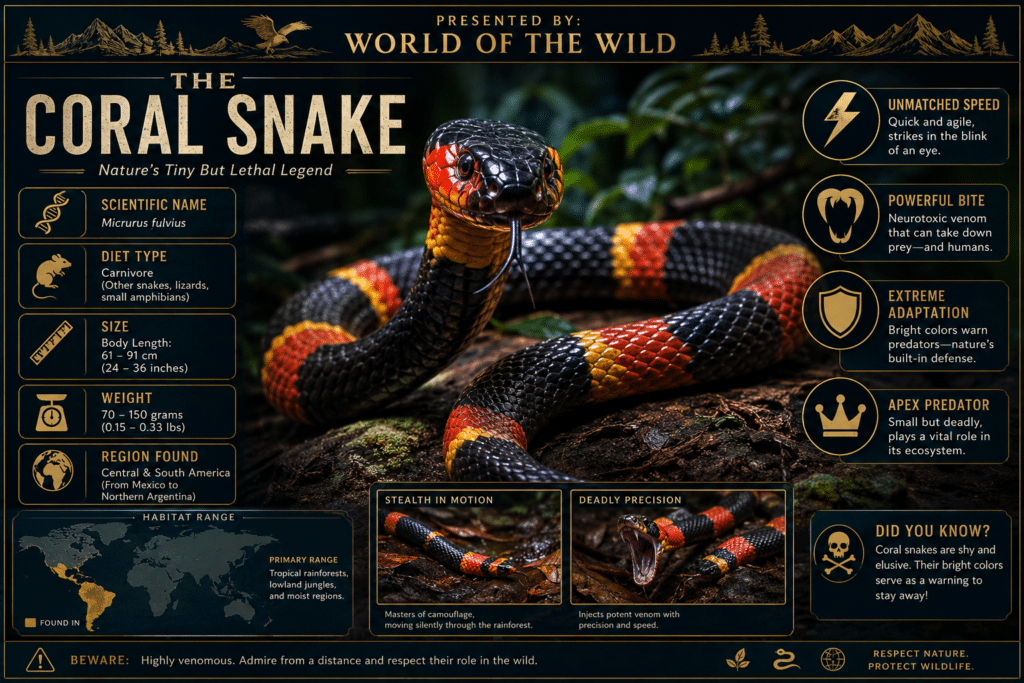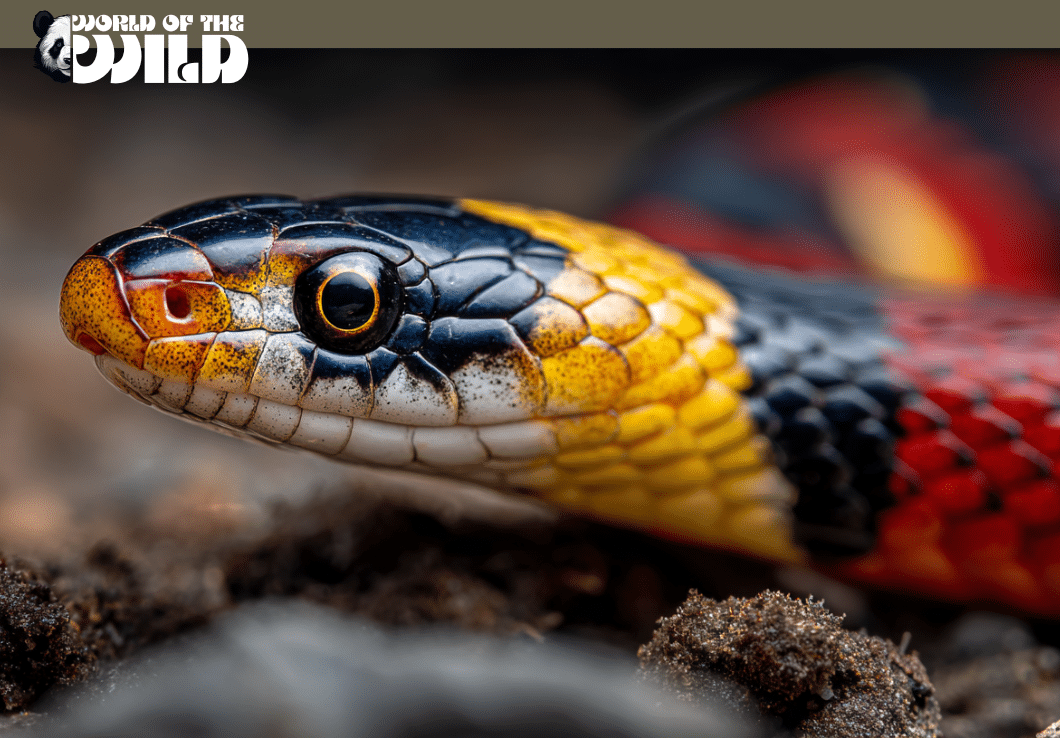

There is something almost paradoxical about the coral snake. It is one of the most visually stunning creatures in the natural world — draped in bold bands of red, yellow, and black like a living piece of abstract art — and yet, hidden beneath that breathtaking exterior lies one of the most potent venoms on the North American continent. For centuries, this small, elusive serpent has captured the imagination of naturalists, herpetologists, and curious hikers alike. It inspired one of the most memorized rhymes in outdoor survival culture: “Red touches yellow, kill a fellow; red touches black, friend of Jack.” But the coral snake is far more than a mnemonic device. It is a masterpiece of evolution, a critical player in its ecosystem, and a reminder that nature’s most dangerous gifts often come wrapped in extraordinary beauty.
Facts
- The coral snake belongs to the family Elapidae, making it a close relative of cobras, mambas, and sea snakes — not the pit vipers most people associate with venomous snakes in the Americas.
- Unlike rattlesnakes or copperheads, coral snakes have fixed, small fangs at the front of their mouths rather than retractable ones, and they must chew rather than strike to fully inject their venom.
- Their venom is neurotoxic, meaning it attacks the nervous system rather than destroying tissue, and symptoms of envenomation can be delayed for several hours — creating a dangerously false sense of safety after a bite.
- Despite their fearsome reputation, coral snakes are responsible for fewer than 1% of all venomous snakebites in the United States each year, largely because of their secretive, non-aggressive nature.
- The vivid color pattern of coral snakes is a textbook example of aposematism — the biological strategy of using bright colors to warn predators of danger.
- There are over 65 recognized species of coral snakes distributed across the Americas and Asia, making them far more diverse than most people realize.
- The antivenom for North American coral snakes was discontinued by its manufacturer in 2010, and while existing stockpiles have been extended, the situation has raised serious concerns among medical professionals about future treatment options.
Species
Taxonomic Classification:
| Rank | Classification |
|---|---|
| Kingdom | Animalia |
| Phylum | Chordata |
| Class | Reptilia |
| Order | Squamata |
| Family | Elapidae |
| Genus | Micrurus (New World) / Micruroides (Arizona) / Calliophis (Old World) |
| Species | Micrurus fulvius (Eastern Coral Snake) |
The coral snake is not a single species but rather a broad grouping of elapid snakes spread across multiple genera. In North America, the most well-known species include:
- Micrurus fulvius — the Eastern Coral Snake, found throughout the southeastern United States and considered the “classic” coral snake of North American lore.
- Micrurus tener — the Texas Coral Snake, ranging from Texas into northeastern Mexico, slightly smaller and sometimes treated as a subspecies of M. fulvius.
- Micruroides euryxanthus — the Arizona Coral Snake (or Sonoran Coral Snake), a smaller, more reclusive species inhabiting the desert Southwest. It belongs to its own separate genus.
- In Central and South America, the genus Micrurus explodes into extraordinary diversity, with species like the Amazonian Coral Snake (M. spixii) and the Many-banded Coral Snake (M. multifasciatus) showcasing remarkable variation in banding patterns and behavior.
- In the Old World, the genus Calliophis represents Asian coral snakes — a fascinating parallel lineage that convergently evolved similar features.
Appearance
The coral snake’s appearance is, in a word, unforgettable. The North American species typically measure between 20 to 30 inches in length, though some larger individuals have been recorded approaching 48 inches. They are slender and cylindrical, with a body built more for burrowing than confrontation. Their heads are small, rounded, and barely distinguishable from their necks — a stark contrast to the triangular, wedge-shaped heads of pit vipers.
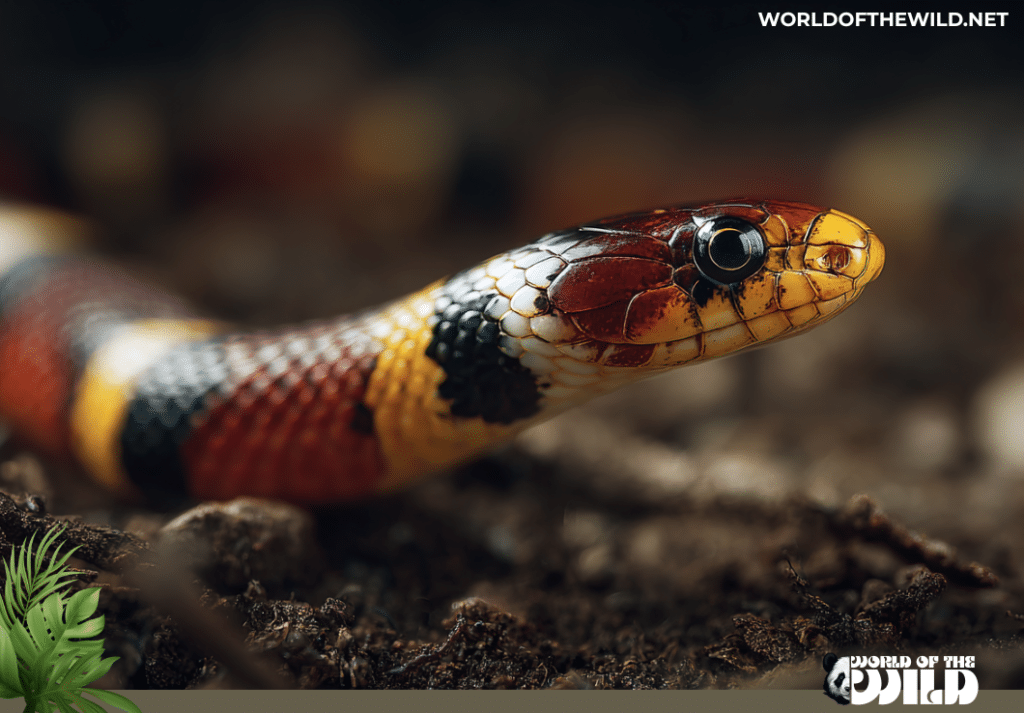
The defining feature, of course, is the tricolor banding pattern: brilliant rings of red, yellow (or white in some species), and black that encircle the entire body. In North American species, the red and yellow bands always touch — the key identifier that distinguishes them from harmless mimics like the scarlet kingsnake and scarlet snake, where red and black bands are adjacent instead.
The tail is short and bluntly rounded, and unlike many snakes, coral snakes show very little difference between their dorsal and ventral surfaces — the vivid bands wrap completely around. Their eyes are small with round pupils, consistent with other elapids and reflective of their primarily diurnal and crepuscular habits. The scales are smooth and glossy, giving them a polished, almost ceramic appearance in direct sunlight.
Weight is modest — most adults range from 2 to 5 ounces, occasionally reaching up to half a pound in the largest individuals. Despite their relatively small stature, every visual cue about the coral snake communicates a single, unmistakable message: stay away.
Behavior
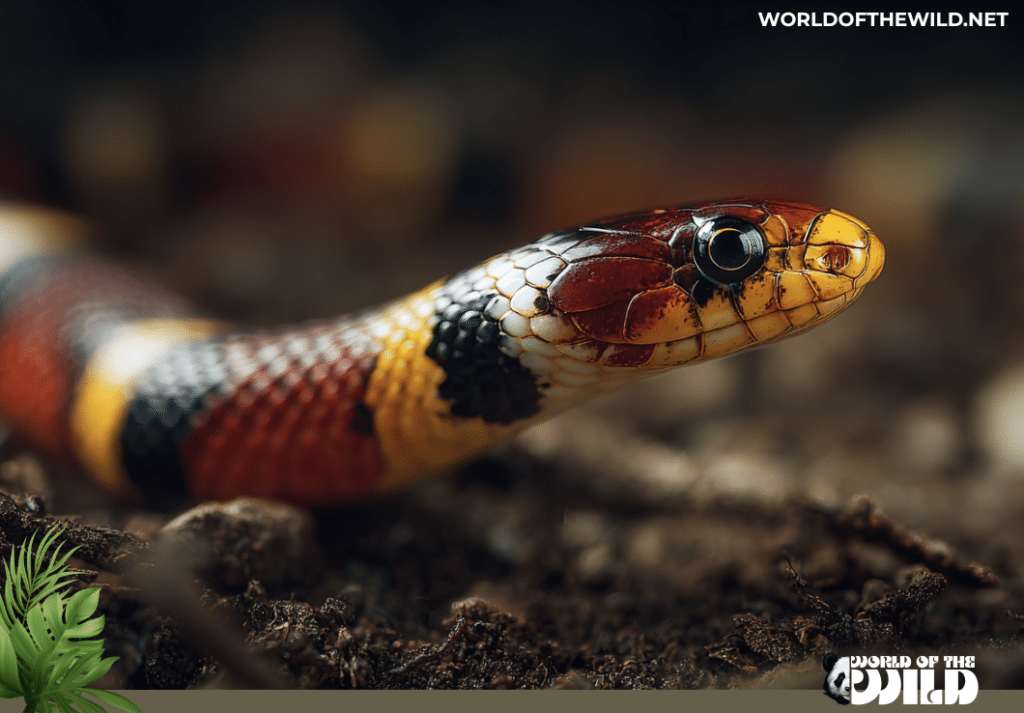
The coral snake is, by nature, a creature of secrets. It spends the vast majority of its life underground or hidden beneath leaf litter, rotting logs, and dense ground cover. This fossorial lifestyle makes it rarely seen, even in areas where populations are relatively healthy. Most encounters with humans occur when the snakes emerge during or after heavy rains, or during the spring and fall when temperatures are moderate enough to draw them to the surface.
Coral snakes are solitary animals with no known complex social structures. They are not territorial in an aggressive sense — they simply prefer to avoid contact with anything larger than their prey. When threatened, a coral snake will often hide its head beneath its coiled body, curl and wave its tail as a decoy, and produce a distinctive popping sound by expelling air from the cloaca — a behavior unique among North American snakes. Only as an absolute last resort will it attempt to bite.
Despite their small fixed fangs, coral snakes compensate with a chewing biting motion, working their fangs deeper into tissue to deliver venom more effectively. This is a marked behavioral difference from the quick strike-and-release technique of vipers.
Activity patterns vary by season and region. In Florida, coral snakes may be active year-round during mild winters, while populations farther north become largely inactive during cold months. They are most active in the early morning and late afternoon, avoiding the harsh midday heat — a behavioral adaptation that also reduces encounters with many of their predators.
Their sensory world is dominated by chemoreception — they use their flickering tongues to detect chemical traces left by prey, predators, and potential mates in the environment, feeding information to the Jacobson’s organ on the roof of the mouth for processing.
Evolution
The coral snake’s lineage stretches deep into the evolutionary history of snakes. The family Elapidae, to which all coral snakes belong, is believed to have originated in Asia or Africa during the Eocene epoch, roughly 40 to 50 million years ago. The ancestors of New World coral snakes are thought to have crossed into the Americas during the Great American Biotic Interchange — the dramatic ecological event that occurred approximately 3 million years ago when the Isthmus of Panama formed, creating a land bridge between North and South America.
This event was transformative for the genus Micrurus, which subsequently underwent explosive speciation throughout Central and South America, giving rise to the more than 80 species and subspecies recognized today. The relative poverty of coral snake species in North America (only three main species) compared to the dozens found in South America reflects the fact that North America was essentially the frontier of their range expansion.
The evolution of the neurotoxic venom system in elapids is considered a derived trait that distinguished this lineage from earlier venomous snakes, offering a highly effective means of subduing prey. Interestingly, research has suggested that the vivid warning coloration of coral snakes likely coevolved alongside the development of color vision in their primary predators, particularly birds, creating one of nature’s most elegant arms races between signal and perception.
The existence of Batesian mimics — harmless species like the scarlet kingsnake that evolved to resemble coral snakes — provides compelling evolutionary evidence that the coral snake’s warning coloration is genuinely effective at deterring predators, as mimicry of this type only proliferates when the model species poses a real and recognized threat.
Habitat
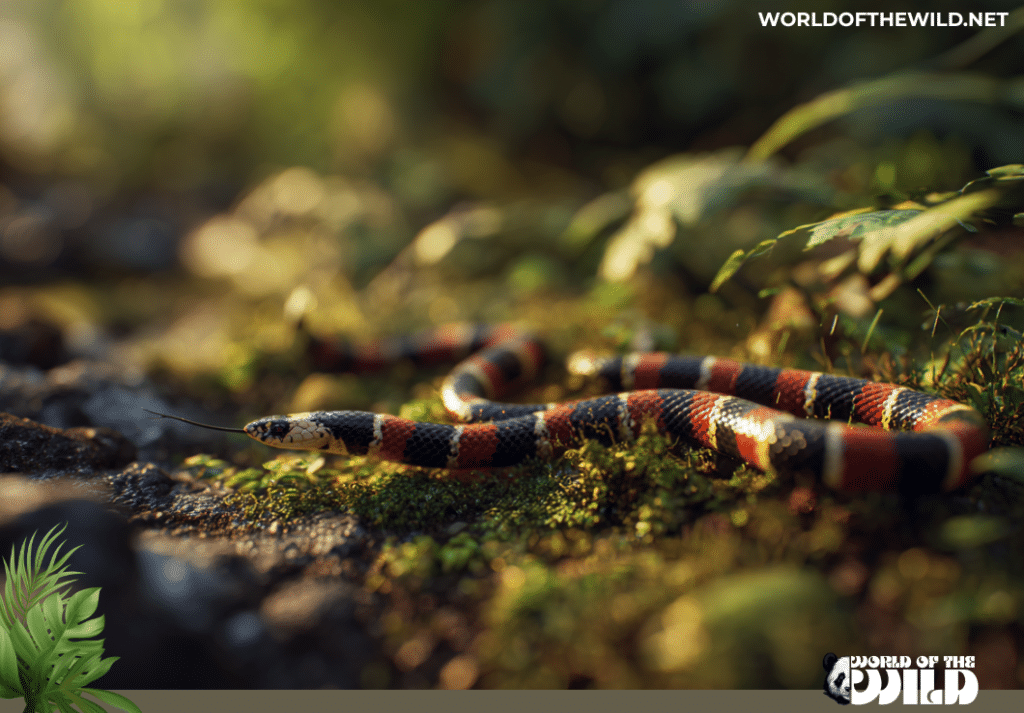
In North America, coral snakes occupy a broad but largely southeastern range. The Eastern Coral Snake (M. fulvius) is found throughout Florida, Georgia, South Carolina, North Carolina, Mississippi, Alabama, Louisiana, and into parts of Tennessee and Arkansas. The Texas Coral Snake extends westward through Texas and into northeastern Mexico, while the Arizona Coral Snake inhabits the Sonoran Desert of Arizona, New Mexico, and adjacent Mexico.
These snakes thrive in a variety of habitats, but they share a common preference for areas with abundant ground cover and loose, friable soil that facilitates their burrowing lifestyle. Key habitats include:
- Longleaf pine and wiregrass flatwoods in the Southeast — open, fire-maintained ecosystems with deep leaf litter
- Scrub and sandhill communities, particularly in Florida, where sandy soils are ideal for burrowing
- Hardwood hammocks and mixed woodland edges
- Rocky hillsides and desert scrub for the Arizona Coral Snake
- Tropical and subtropical forests across Central and South America for the broader genus
Coral snakes are rarely found far from moisture, and populations in Florida are often associated with areas near wetlands, marshes, or seasonally flooded flatwoods. They are not urban adapters and show declining presence in heavily developed or fragmented landscapes. Elevation range varies by species, but most North American populations are found at relatively low elevations below 3,000 feet.
Diet
The coral snake is a specialized carnivore, with a diet that sets it apart from many other North American snakes. Rather than focusing on mammals or frogs, coral snakes are ophiophagous — meaning they primarily eat other snakes. This dietary preference makes them important natural regulators of other reptile populations, including some species that might otherwise reach harmful densities.
Primary prey items include:
- Smaller snake species, including smooth earth snakes, ring-necked snakes, and other slender-bodied species that can be swallowed whole
- Lizards, particularly skinks and glass lizards, which are consumed readily when available
- Small amphisbaenians (worm lizards) in Florida
- Occasionally, small frogs and other reptile eggs
Hunting is conducted primarily through chemical detection — the coral snake uses its tongue and Jacobson’s organ to track the scent trails of prey through leaf litter and underground burrows. Once prey is located, the coral snake seizes it and employs its chewing bite to deliver venom, after which the prey is swallowed headfirst. Digestion is relatively slow given the snake’s low metabolic rate, and individuals may go weeks or even months between meals in the wild.
The neurotoxic venom that makes coral snakes so dangerous to humans is, from an ecological standpoint, a highly efficient predatory tool — rapidly paralyzing the prey’s nervous system and preventing any struggle that might injure the small, slender snake during feeding.
Predators and Threats
Natural Predators:
Despite their potent venom, coral snakes are not without enemies in the wild. A number of animals have evolved resistance to or behavioral avoidance of coral snake venom, including:
- Ophiophagous kingsnakes (Lampropeltis species), which possess partial physiological resistance to elapid venom and will readily consume coral snakes
- Birds of prey, including certain hawks and the secretary bird-like raptors that use aerial approaches to avoid being bitten
- Larger mammals such as raccoons, opossums, and wild pigs, which may occasionally prey on coral snakes opportunistically
- Other coral snakes — cannibalism has been documented within the species
Human-Caused Threats:
The most significant threats to coral snake populations today are almost entirely anthropogenic:
- Habitat destruction and fragmentation is the single greatest threat, as urban sprawl, agricultural expansion, and pine flatwood conversion have eliminated vast swaths of suitable habitat, particularly in Florida and the Southeast.
- Road mortality claims a significant number of individuals, especially during seasonal movements triggered by rainfall.
- Misidentification and persecution — many coral snakes are killed by humans who mistake them for harmless mimics, or conversely, kill them out of fear upon correct identification.
- Suppression of natural fire regimes has degraded longleaf pine and wiregrass ecosystems that many southeastern populations depend on, allowing woody encroachment that eliminates the open ground structure coral snakes require.
- Climate change threatens to alter the thermal and moisture regimes of key habitats, potentially pushing suitable conditions northward while degrading southern strongholds.
- Collection for the pet trade, while less significant than habitat loss, remains a localized pressure in some areas.
Reproduction and Life Cycle
Coral snakes are oviparous — they lay eggs rather than giving birth to live young, which is the strategy of many vipers. Mating typically occurs in spring and early summer, though the secretive nature of these snakes means that courtship behavior has rarely been directly observed in the wild.
Females lay a relatively small clutch of 3 to 12 elongated eggs, usually in late spring or early summer, depositing them in decaying logs, leaf litter, or underground in moist soil where temperatures are stable. Unlike some reptiles, female coral snakes do not provide extended parental care beyond the act of laying — the eggs are left to develop independently.
Incubation lasts approximately 60 to 90 days, depending on temperature and environmental conditions. Hatchlings emerge in late summer or early fall and are fully venomous and functionally independent from birth — one of nature’s more sobering realities. Juvenile coral snakes are miniature replicas of adults, typically measuring 7 to 9 inches at hatching, and immediately begin the solitary, fossorial lifestyle they will maintain throughout their lives.
Sexual maturity is reached at approximately 18 to 24 months of age. Lifespan in the wild is difficult to determine with precision given their secretive habits, but captive individuals have lived for 7 years or more, and wild populations are believed to have similar potential longevity under favorable conditions.
Population
The conservation status of coral snakes varies by species, but the North American species have not been formally assessed with robust population estimates due to the extraordinary difficulty of studying these secretive, underground-dwelling animals. On the IUCN Red List, the Eastern Coral Snake (Micrurus fulvius) is currently listed as Least Concern, a designation that reflects the absence of documented dramatic range-wide declines rather than confirmed population health.
However, this designation masks considerable regional concern. Florida herpetologists and wildlife biologists have noted anecdotal but persistent declines in many parts of the state, corresponding to decades of habitat development and wetland alteration. Local populations in some areas are believed to have been severely reduced or eliminated entirely.
In Central and South America, the picture is more fragmented. Some Micrurus species with narrow endemic ranges in South America face significant pressure from deforestation in the Amazon Basin and Atlantic Forest and are considered regionally threatened even in the absence of formal IUCN listing updates.
The lack of reliable population census data for most coral snake species represents a significant gap in herpetological knowledge. Their fossorial lifestyle renders standard survey techniques largely ineffective, meaning true population trends remain poorly understood — a scientific blind spot that has real conservation implications.
Conclusion
The coral snake is, in every sense, an animal that rewards closer attention. Beneath its vivid banding lies an ecological specialist of remarkable refinement — a snake that has spent millions of years perfecting its venom, its camouflage, its hunting strategies, and its survival in some of the most dynamic ecosystems in the Americas. It is not a monster, nor a mindless killing machine. It is a shy, burrowing predator that asks only to be left undisturbed in the leaf litter and sandy soils it calls home.
Yet that home is disappearing. With every pine flatwood converted to a strip mall, every wetland drained for development, and every prescribed fire suppressed out of suburban discomfort, the quiet world of the coral snake shrinks a little further. These snakes rarely make headlines — they don’t charge, they don’t rattle, and they don’t appear on warning signs at trailheads. Their decline, if it is happening, will be nearly invisible until it is far too late to reverse.
Understanding and appreciating the coral snake is itself an act of conservation. The next time you encounter one of nature’s most perfectly designed creatures — in the wild, in a photograph, or even in a childhood rhyme — take a moment to recognize it for what it truly is: not a threat, but a treasure.
Quick Reference
| Scientific Name | Micrurus fulvius (Eastern Coral Snake) |
| Diet Type | Carnivore (ophiophagous — primarily other snakes and lizards) |
| Size | 20–30 inches (1.6–2.5 feet); up to 48 inches (4 feet) in large individuals |
| Weight | 2–5 ounces (0.125–0.31 lbs); occasionally up to ~0.5 lbs |
| Region Found | Southeastern United States (FL, GA, SC, NC, MS, AL, LA); Texas into Mexico; Arizona/New Mexico (Arizona Coral Snake); Central and South America (related species) |